Why Insurance for Non Owners Is More Important Than You Think
{.header-image}
Many people believe that if you don’t own a car, you don’t need car insurance. This common misconception can leave you financially exposed every time you slide behind the wheel of a borrowed vehicle, rental car, or car-sharing service. The reality is simple: every time you drive, you assume potential financial responsibility for accidents.
Insurance for non owners is a specialized liability policy that follows you as a driver, not a specific vehicle. It provides secondary protection that can step in when the car owner’s policy isn’t enough to cover damages you cause. Typically costing a fraction of a standard auto policy, it’s an affordable safety net and, in some cases, a legal necessity—especially if you need an SR-22 or FR-44 filing in Florida and don’t own a vehicle.
Whether you’re borrowing a friend’s car for a grocery run in St. Petersburg or renting a vehicle for a weekend trip, non-owner car insurance provides liability coverage that protects your assets and gives you peace of mind.
I’m Jason Miller, and I’ve been helping Florida drivers steer complex insurance needs for over 20 years, including finding the right insurance for non owners solutions. As a second-generation insurance professional, I’ve seen how this often-overlooked coverage can protect people from financial hardship.
{.infographic}
A clear understanding of what non-owner coverage does—and does not—do will help you decide if it belongs in your financial plan. Below, we break down how it works, who needs it, what it covers, and the practical details like cost and filings, with Florida-specific insights throughout.
What is Non-Owner Car Insurance?
Imagine you regularly borrow your neighbor’s car for errands or use a car-sharing service in downtown St. Petersburg. In these situations, insurance for non owners becomes your financial lifeline. Unlike standard auto insurance that protects a specific vehicle, this coverage protects you as a driver, no matter whose eligible car you’re operating. It’s often called a named non-owner policy because your name is on the policy, but no specific vehicle is listed.
This driver-based coverage follows you wherever you go, providing crucial liability protection. It’s designed for people who drive but don’t own a car, offering a focused and affordable way to protect your personal assets if you cause an accident. You can learn more about how this fits into the bigger picture of auto protection by reviewing Auto Insurance Coverage Options at https://floridaallrisk.com/auto-insurance-coverage-options/.
How It Works as Secondary Coverage
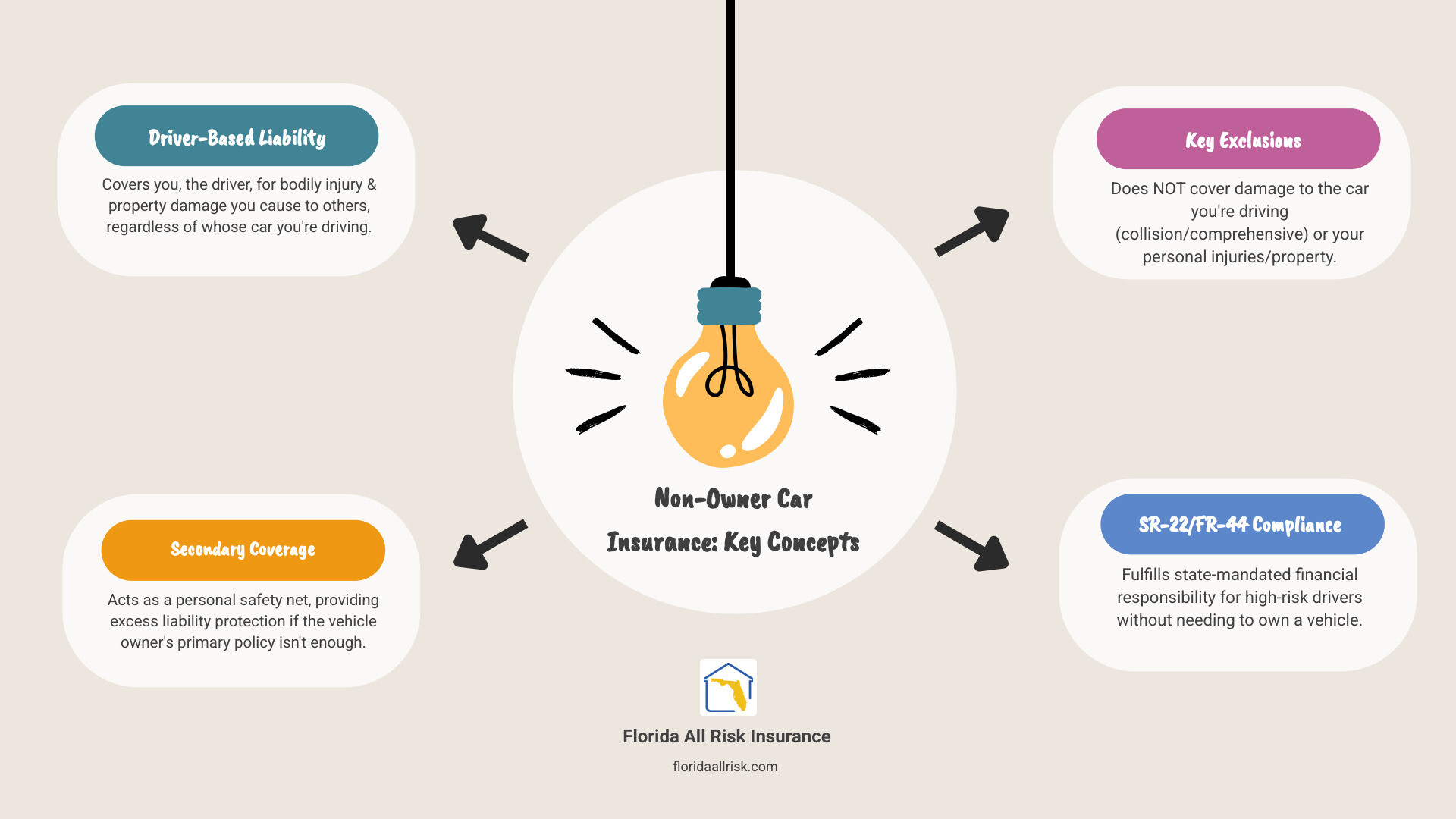
When you borrow a car with permission, the owner’s insurance is typically primary, meaning it pays first in an accident. But what if the damages exceed their policy limits? That’s where your non-owner policy steps in as secondary coverage.
For example, if you cause an accident with $50,000 in damages but the car owner’s policy only covers $25,000, you could be responsible for the remaining $25,000. Without a non-owner policy, that shortfall could come from your savings or future earnings. With it, your policy may cover that excess amount up to your limits, shielding you from severe out-of-pocket costs.
Non-owner policies generally do not include physical damage coverage for the car you’re driving, and they won’t cover vehicles you own or have regular access to in your household. They are purpose-built for liability protection when you drive cars that aren’t yours.
Key Differences from a Standard Auto Policy
Understanding the distinctions explains why non-owner policies are more affordable.
- Focus: Standard insurance is vehicle-specific, covering a particular car. Non-owner insurance is driver-specific, covering you in eligible cars you borrow or rent.
- Coverage Type: Standard policies often bundle liability with physical damage coverage (collision and comprehensive). Non-owner policies are typically liability-only, since you don’t own the vehicle and thus don’t need to insure it against damage or theft.
- Primary vs. Secondary: A standard policy is primary for the insured vehicle. A non-owner policy is secondary, only paying after the primary policy’s limits are exhausted.
Choosing Sensible Liability Limits
A common question is, “How much liability coverage should I buy?” The answer depends on your assets, income, and risk tolerance. In practice, many drivers select higher limits—such as 100/300/100 or a combined single limit—in order to better protect against the rising costs of medical care and vehicle repairs. Florida’s minimums are relatively low compared to real-world costs, so consider limits that reflect your financial exposure rather than just meeting the minimum legal standard.
If you’re unsure, talk with an independent agent who can help you map your coverage to your financial situation and driving patterns. If you’re comparing options, our overview of Liability Car Insurance Florida at https://floridaallrisk.com/liability-car-insurance-florida/ is a helpful starting point.
Who Needs Insurance for Non Owners and Who Doesn’t?
Deciding if you need insurance for non owners comes down to a simple question: How often do you drive a car you don’t own? Your driving habits and life circumstances determine if this coverage is a smart addition to your protection plan.
You Should Consider a Non-Owner Policy If…
If any of these scenarios sound familiar, this coverage is likely essential for you:
- You frequently borrow cars: If you often drive cars belonging to friends or family you don’t live with, you’re relying on their insurance. A non-owner policy helps protect you if damages exceed their policy limits.
- You use car-sharing services: Popular car-sharing services may include only state-minimum liability. Your own policy can provide higher limits and more consistent protection.
- You frequently rent vehicles: A non-owner policy can be more cost-effective than purchasing the rental company’s liability insurance every time you travel.
- You need an SR-22 or FR-44: In Florida, if you're required to file proof of financial responsibility after a serious violation (like a DUI) but don't own a car, a non-owner policy is often the only way to meet this legal requirement and reinstate your license. See our DUI Auto Insurance Florida guide at https://floridaallrisk.com/dui-auto-insurance-florida/.
- You want to maintain continuous coverage: A gap in your insurance history can label you high-risk, leading to higher premiums when you eventually buy a car. A non-owner policy prevents this lapse.
Real-world examples:
- The Weekend Traveler: You rent a car for a few days each month to visit family. Over a year, rental counter liability fees can add up. A non-owner policy can provide consistent liability protection at a lower annual cost.
- The City Commuter: You rely on car-sharing services when public transit schedules don’t fit. Your own liability limits follow you from car to car, rather than relying on minimums that vary by provider.
You Likely Don’t Need a Non-Owner Policy If…
This coverage isn’t for everyone. You probably don’t need it if:
- You own a vehicle: Your standard auto policy already provides liability coverage when you occasionally drive other cars with permission.
- You rarely drive: If you only borrow or rent a car once or twice a year, the annual cost may not be justified. Buying the rental company’s liability coverage for those rare trips might be fine.
- You borrow from a household member: Insurance companies require you to be listed as a driver on the policy of any car in your household that you drive regularly. Explore Auto Insurance for Families at https://floridaallrisk.com/auto-insurance-for-families/ to ensure you're properly covered.
- You only drive a company car for business: Your employer’s commercial auto policy usually covers you for business use. However, if you use it for personal errands, verify coverage. You may need a non-owner policy to fill any personal-use gaps.
A Quick Decision Checklist
- Do you drive at least monthly but don’t own a car?
- Do you rent or car-share several times a year?
- Would paying out of pocket for someone else’s injuries or property damage strain your finances?
- Do you need to avoid a lapse in prior insurance to keep future rates lower?
If you answered yes to any of these, a non-owner policy is likely worth evaluating.
Understanding Your Coverage: What’s Included and What’s Not
When considering insurance for non owners, it's crucial to know exactly what you're buying. This policy is a specialized tool designed primarily for liability protection—meaning it covers damage you cause to others—but it has clear boundaries. For a deeper dive into liability basics, see Liability Car Insurance Florida at https://floridaallrisk.com/liability-car-insurance-florida/.
What Non-Owner Insurance Typically Covers
Your policy is built on a foundation of liability coverage, which acts as your financial shield when driving a car you don’t own.
- Bodily Injury Liability (BI): Covers medical bills, lost wages, and certain other costs if you injure someone in an at-fault accident.
- Property Damage Liability (PD): Pays to repair or replace property you damage, such as another person’s car, a fence, or a building.
These coverages work as secondary protection, kicking in after the car owner’s primary insurance limits are reached. You can also add optional coverages for more robust protection:
- Medical Payments (MedPay) or Personal Injury Protection (PIP): Helps cover medical expenses for you and your passengers, regardless of fault. In Florida, a no-fault state, PIP can be especially important for prompt medical payments.
- Uninsured/Underinsured Motorist (UM/UIM): Protects you if you're in an accident caused by a driver with little or no insurance. Given the number of uninsured drivers, our guide on Uninsured Motorist Coverage Florida at https://floridaallrisk.com/uninsured-motorist-coverage-florida/ explains why this is a vital addition.
For a consumer-friendly explanation of auto insurance terms and protections, the National Association of Insurance Commissioners provides a helpful overview. This resource can clarify how liability, UM/UIM, and other coverages interact.
What Non-Owner Insurance Does NOT Cover
Understanding the exclusions is just as important to avoid surprises.
- Damage to the vehicle you are driving: Your policy does not include collision or comprehensive coverage. It will not pay to repair the borrowed or rented car if it’s damaged, stolen, or vandalized.
- Your own medical bills: Unless you add optional MedPay or PIP, your base policy will not cover your injuries. In Florida, your PIP on a non-owner policy (if available) can help with eligible medical expenses up to your selected limit.
- Your personal belongings: If items inside the car (like a laptop or luggage) are damaged or stolen, this would be a claim for your homeowner’s or renter’s insurance, not your non-owner policy.
- Towing and rental reimbursement: These convenience coverages are not typically included.
- Vehicles in your household: The policy explicitly excludes coverage for cars owned by anyone you live with. You should be listed on their standard auto policy instead.
- Business-specific exposures: If you’re using a borrowed or rented vehicle for commercial or gig work, coverage may be limited or excluded. Clarify with your agent if rideshare or delivery work is part of your driving.
How Your Non-Owner Policy Coordinates With Other Coverages
- With the Car Owner’s Policy: The owner’s liability coverage responds first. If damages exceed their limits, your non-owner policy can step in up to your limits.
- With Rental Counter Products: Your non-owner policy can provide liability coverage, while a rental company’s Collision Damage Waiver (CDW) or a credit card’s rental benefit may address damage to the rental vehicle itself. Always confirm what the card benefit covers and any exclusions that apply.
- With Your Personal Policies: Your homeowner’s or renter’s insurance may cover personal items stolen from a car, subject to your deductible and policy terms.
If you’d like broader context on how insurers operate and market-wide trends such as claims costs and inflation, the Insurance Information Institute maintains up-to-date research. Their resources can help you understand why adequate liability limits matter today.
The Practical Details: Cost, SR-22s, and Special Cases
Let’s explore the practicalities of insurance for non owners. Understanding the cost, legal applications, and specific use cases helps clarify why this unique product is such a valuable tool for many drivers.
How Much Does Insurance for Non Owners Cost?
One of the most appealing aspects of non-owner insurance is its affordability. Since you are buying targeted liability protection, the cost is significantly lower than a standard auto policy. Many drivers can expect to pay between $300 and $700 annually, with a national average around the mid-$500s.
Your final premium depends on several factors:
- Driving Record: A clean record earns the best rates; recent violations can increase costs.
- Age and Location: Younger drivers or those in high-traffic urban areas like St. Petersburg may pay more.
- Coverage Limits: Higher limits provide more protection but increase the premium.
- Credit-Based Insurance Score (where permitted): In many states, a better score can lower your rate.
- Discounts: Ask about potential savings for continuous coverage, multi-policy, defensive driving courses, or safe-driver programs. See Safe Driver Insurance Discounts at https://floridaallrisk.com/safe-driver-insurance-discounts/.
Example: A driver in their mid-30s with a clean record who rents cars monthly might pay closer to the lower end of the range for solid liability limits. A younger driver with a recent at-fault accident may see higher premiums even for the same limits.
While market surveys offer a baseline, a personalized quote is the only way to know your exact cost. If you’re curious about broader insurer performance and pricing trends, the Insurance Information Institute’s research page is a useful reference.
SR-22/FR-44 and Insurance for Non Owners
For some, non-owner insurance is a legal necessity. If you’re required by the state to file an SR-22 or FR-44 certificate but don’t own a car, this policy is your solution. These forms are not insurance but proof of financial responsibility, often required after violations like a DUI, reckless driving, or driving without insurance. The FR-44 is specific to Florida for certain offenses (such as DUI) and requires higher liability limits.
A non-owner policy allows you to meet the state’s requirements and reinstate your license without owning a vehicle. Your insurance company files the certificate directly with the state for a small fee. For official information on Florida licensing and compliance, visit the Florida Department of Highway Safety and Motor Vehicles.
Special Scenarios: Rental Cars, Company Cars, and Subscriptions
-
Rental Cars: Your non-owner policy provides liability coverage when you rent a vehicle, which is often a more economical alternative to the rental counter’s daily liability add-on. However, it does not cover damage to the rental car itself. For that, consider the rental company’s Collision Damage Waiver (CDW) or confirm whether a credit card you carry offers primary or secondary rental car damage coverage. Be mindful of exclusions (e.g., certain countries or vehicle types).
-
Company Cars: If you drive a company car strictly for business, your employer’s commercial policy typically covers you. But if you use the car for personal errands, that coverage may not apply. Verify your employer’s rules and coverage, and consider a non-owner policy to fill any personal-use gaps.
-
Car Subscriptions and Car-Sharing: Subscription services and peer-to-peer car-sharing platforms may provide some base liability protection. However, limits and deductibles vary widely. Your non-owner policy can supply consistent liability limits across different vehicles and providers.
Claims and What to Expect
If you’re involved in an accident while driving a borrowed or rented car:
- Ensure everyone’s safety and call emergency services if needed.
- Collect information: names, contact details, insurance information, vehicle information, and photos.
- Notify the vehicle owner and their insurer promptly.
- Contact your non-owner insurer. Your policy is secondary; the owner’s policy will generally handle the claim first, and your policy may respond if limits are exceeded.
Understanding this process ahead of time can reduce stress and help the claim go more smoothly.
Frequently Asked Questions about Non-Owner Car Insurance
It’s natural to have questions about a specialized product like insurance for non owners. Here are answers to common concerns we hear from drivers across Florida.
Can I get a non-owner policy if someone in my household owns a car?
Generally, no. Insurers operate on the principle that anyone with regular access to a vehicle in their household should be listed as a driver on that vehicle’s standard policy. Using a non-owner policy in this scenario would leave coverage gaps and is typically prohibited by insurers.
Does non-owner insurance help me avoid a lapse in coverage?
Yes. This is one of the smartest reasons to have a non-owner policy. Letting your auto insurance lapse, even briefly, can label you a higher-risk driver and increase future premiums. A non-owner policy acts as an affordable bridge between cars, maintaining your continuous insurance history.
Does a non-owner policy include SR-22 or FR-44 filings automatically?
Not automatically, but many insurers can add the filing to your policy for a small fee. If you need a filing, let your agent know at the time of purchase so the certificate can be submitted to the state promptly.
Can I add my spouse or another driver to a non-owner policy?
Some insurers allow multiple named insureds on a non-owner policy, while others require separate policies. Because household access rules are strict, discuss who borrows which vehicles and how often so your agent can structure coverage appropriately.
Does non-owner coverage apply to motorcycles, scooters, or mopeds?
Non-owner auto policies are designed for private passenger vehicles and typically exclude motorcycles and certain other vehicle types. If you borrow or rent a motorcycle, you likely need a separate motorcycle policy tailored to that risk.
What if I cause damage to the borrowed or rented car?
A non-owner policy does not include collision or comprehensive coverage on the vehicle you’re driving. For rental cars, the rental company’s Collision Damage Waiver (CDW) or a credit card benefit may address the vehicle’s damage. For borrowed personal vehicles, the owner’s collision coverage (if purchased) would respond, subject to their deductible and policy terms.
Will a non-owner policy cover me for rideshare or delivery driving?
Most non-owner policies exclude business or livery use. Rideshare and delivery work typically require a separate endorsement or commercial coverage. Confirm with your agent before using a borrowed or rented car for these activities.
How do I buy a non-owner insurance policy?
Because non-owner insurance is specialized, it’s not always available through a simple online form. The most reliable path is to contact an independent agent who can confirm eligibility, discuss your driving habits, and quote multiple carriers. You’ll need a valid driver’s license and must confirm that you do not own a vehicle and do not have regular access to one in your household.
How do I file a claim under a non-owner policy?
Report the accident to the vehicle owner and their insurer first. Then notify your non-owner insurer. Provide all documentation (police report, photos, contact details, and the primary insurer’s claim number). Your non-owner insurer will coordinate as secondary coverage if the damages exceed the primary limits.
Are there limits to how often I can use non-owner insurance?
Policies don’t usually cap how often you can drive, but they are intended for occasional use, not daily commuting in the same vehicle you have regular access to. If your usage pattern changes (e.g., you start borrowing a household member’s car regularly), update your coverage to avoid gaps.
For individualized guidance and Florida-specific answers, see Auto Insurance Quotes Florida at https://floridaallrisk.com/auto-insurance-quotes-florida/ or speak with an independent agent who can walk you through options and eligibility.
Conclusion: Secure Your Peace of Mind on the Road
Insurance for non owners is a practical, often underestimated, tool for anyone who drives but doesn’t own a car. It provides essential liability coverage that acts as a secondary safety net when you’re behind the wheel of a borrowed, rented, or shared vehicle. This protection can safeguard your financial future from the potentially devastating costs of an at-fault accident, help you maintain continuous coverage, and even satisfy SR-22/FR-44 requirements without owning a car.
If you drive occasionally, prefer car-sharing, rent frequently, or need to keep your insurance history active between vehicles, a non-owner policy can be a cost-effective way to stay protected and prepared.
Ready to take the next step?
- Get your fast, personalized Non-Owner Car Insurance Florida quote now at https://floridaallrisk.com/non-owner-car-insurance-florida/.
- Have questions or need guidance? Call us at (727) 522-6686 to speak with a friendly, licensed agent who can help you choose the right limits and options for your situation.
Drive with confidence knowing you’ve put the right protection in place—no car ownership required.
Contact Us
We’re here to help you navigate insurance for non owners and find coverage that fits how you drive.
Florida All Risk Insurance
Address: 7751 66th St N, Pinellas Park, FL 33781
Phone: (727) 522-6686
Email: [email protected]
Our office proudly serves drivers in St. Petersburg and across Florida. Reach out by phone or email, and a licensed agent will follow up promptly to answer questions and provide tailored options.