

You open the front door before sunrise, step into the back room, and hear the sound every grocery owner hates: silence from a freezer that should be humming. By the time staff starts rolling in, you're not dealing with one problem. You're dealing with spoiled inventory, possible equipment repair, cleanup, vendor calls, and a hard question about whether you can keep normal operations going that day.
That’s how grocery risk works in real life. Problems rarely stay in one lane.
A failed refrigeration unit can become a spoilage loss. A storm can become roof damage, water intrusion, a power outage, and a shutdown. A small produce spill can turn into a customer injury claim, then legal costs, then a review of your safety procedures. Insurance for grocery stores has to be built around that chain reaction, especially in Florida, where weather, humidity, and supply disruptions put extra pressure on a business that already runs on thin margins and fast-moving inventory.
A lot of owners buy coverage the same way they buy office supplies. They check boxes, compare premiums, and assume the basics are enough. For a grocery store, that approach usually fails when a claim happens. The right policy setup works more like a layered safety net. One layer catches customer injuries. Another protects the building and equipment. Another keeps payroll and overhead from crushing the business when operations stop.
The Unseen Risks in Every Aisle
The daily risks inside a grocery store are easy to normalize because they happen around routine work. Staff mops a floor. A customer drops a carton. A freezer runs hard during a hot week. A stocker lifts a heavy case wrong. None of that feels dramatic until it creates a claim.
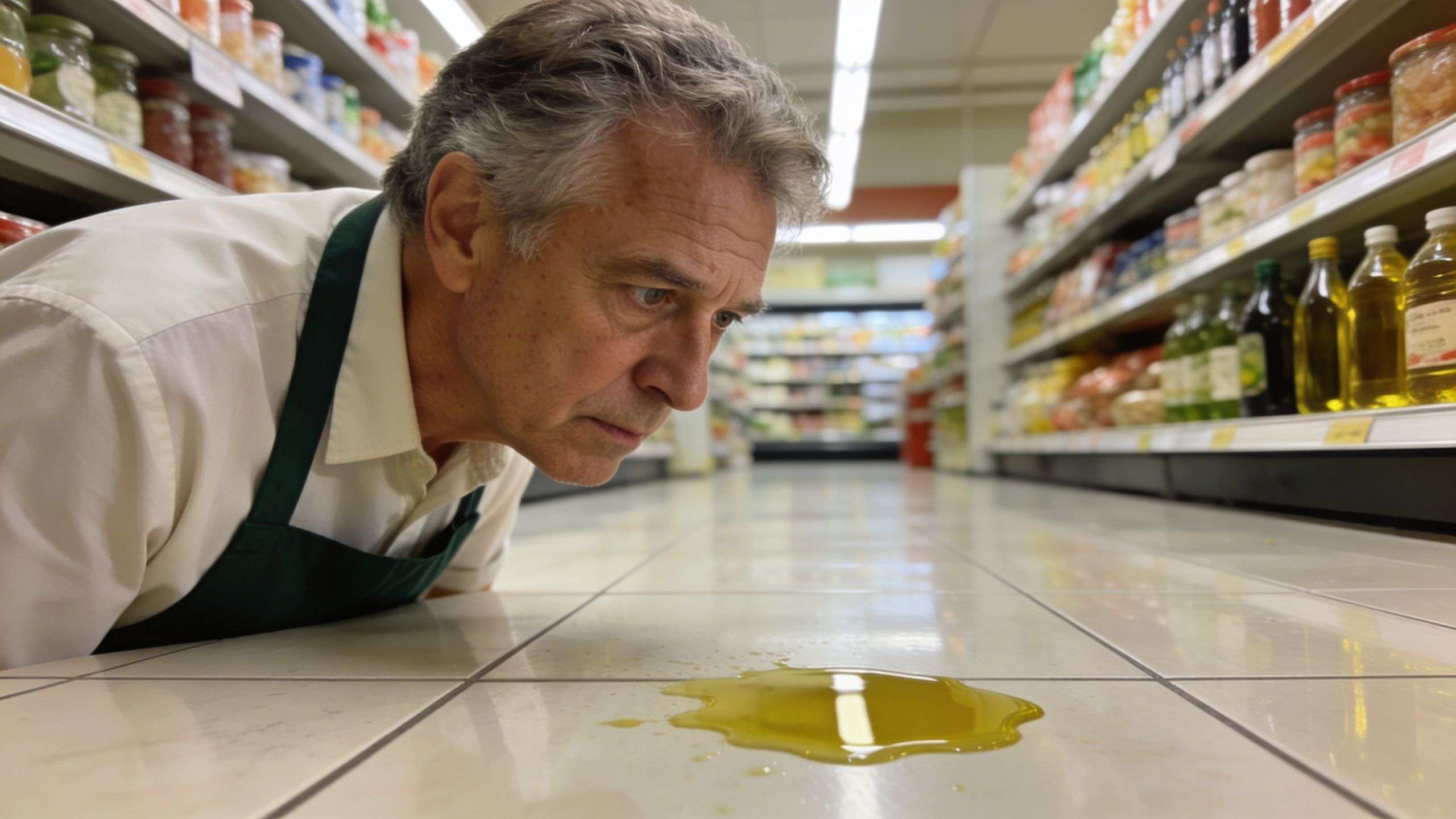
Slip-and-fall accidents are one of the most prevalent claims in grocery stores, and medical and legal fees can exceed tens of thousands per incident, according to Normandy Insurance’s overview of common grocery store claims. The same source notes that employee injuries from work like stocking shelves are also common, with workers’ compensation premiums averaging around $175 per month.
Routine hazards that become expensive fast
A grocery store invites foot traffic all day. That’s the business model. It also means people constantly move through produce mist, freezer condensation, leaky containers, narrow aisles, and parking lot transitions during rain. One missed cleanup or one missing caution sign can create a claim that costs much more than the spill that caused it.
The risks aren't limited to customers. Employees lift, cut, climb, stock, unload, and work around carts, coolers, and sometimes delivery areas. Injury exposure is built into the job.
Practical rule: If a hazard can happen during a normal shift, treat it as a recurring insurance issue, not a one-time accident.
Small operational issues connect to larger losses
Some owners think in separate buckets. Premises liability is one bucket. Equipment is another. Spoilage is another. In practice, they connect.
Take sanitation and pest control. A rodent issue may start as a maintenance concern, but it can also affect inventory, inspections, cleanup costs, and brand reputation. That’s why operational risk matters just as much as policy language. For a useful outside perspective on facility hygiene pressure points, this article on wiping out rodents at local businesses is worth reading.
A grocery store owner doesn’t need the cheapest policy. They need a setup that responds when one bad morning turns into four separate claims.
The Foundation of Protection Core Insurance Policies
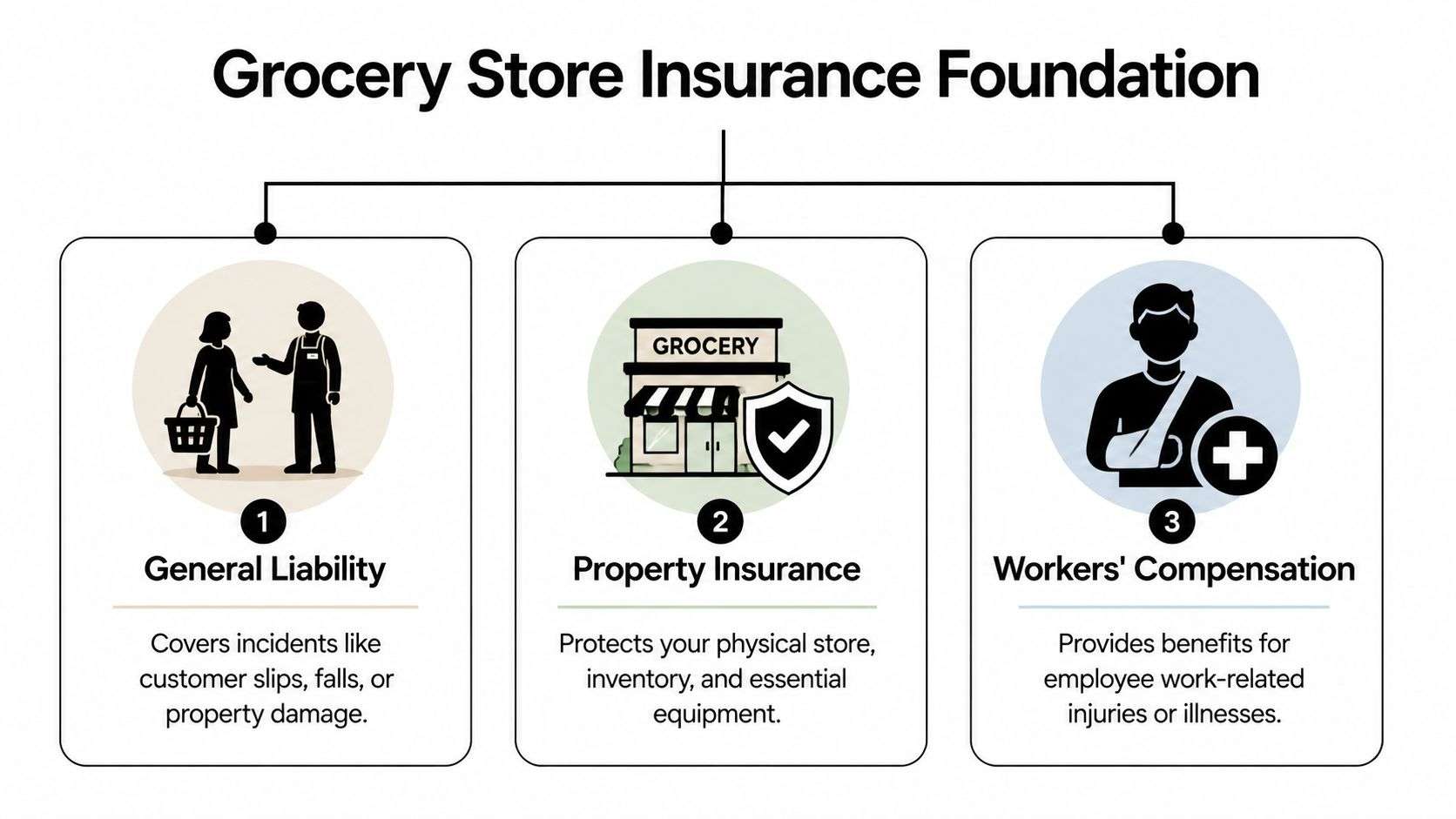
If you strip grocery insurance down to the essentials, three policies hold the whole structure up. Think of them as a three-legged stool. Remove one leg, and the store may still look stable until weight shifts. Then the whole thing drops.
General liability is the customer-facing safety net
General liability is what responds when a customer says your store caused bodily injury or property damage. In a grocery setting, that usually means slips, falls, and product-related incidents. It’s the first layer many owners think about, and for good reason.
According to Zensurance’s grocery store insurance guide, general liability insurance averages around $43 per month for a grocery store, and slip-and-fall claims can settle for $30,000 to $100,000. That’s why this policy isn’t optional. It’s the base shield between a routine customer accident and a direct hit to the business.
If you want a plain-English overview of this coverage type, review general liability insurance for businesses.
Property insurance protects what you physically rely on
Grocery stores are more equipment-heavy than many owners realize until an incident like a fire or mechanical failure occurs. While shelves are important, the primary exposure sits in the systems that keep the store functioning: refrigeration, electrical infrastructure, POS hardware, storage areas, signs, and the building itself if you own it.
Property insurance is the leg that protects those physical assets when a covered event damages them. Without it, owners often discover too late that replacing fixtures, repairing interior damage, and rebuilding after a major event isn't just expensive. It can interrupt operations long enough to create a second financial problem.
Workers’ compensation protects the people doing the work
Workers’ comp is the third leg. It handles work-related employee injuries and illnesses. Grocery stores generate steady exposure here because the job is physical. Cases of drinks, frozen goods, produce bins, ladders, pallet jacks, and repetitive movement all create injury opportunities.
Owners sometimes focus heavily on customer claims and underweight employee claims. That’s a mistake. A store can have excellent customer safety habits and still produce workers’ comp losses if training, lifting practices, and back-room housekeeping are weak.
The strongest insurance program in a grocery store usually starts with everyday discipline, clean floors, safe stocking practices, equipment maintenance, and reporting procedures that people actually follow.
Why one policy can’t replace the others
Some buyers get tripped up, assuming liability covers “anything bad that happens.” It doesn’t. Liability won’t replace a damaged compressor. Property coverage won’t handle an employee strain claim. Workers’ comp won’t defend a customer injury suit.
Here’s the practical split:
- General liability handles claims from customers and other third parties.
- Property insurance handles covered damage to the store’s physical assets.
- Workers’ compensation handles employee injuries tied to the job.
Miss one, and you create a gap big enough for a serious claim to fall through.
A simple way to pressure-test your foundation
Ask these three questions:
- If a customer falls today, who pays?
- If the store suffers physical damage tonight, what gets repaired or replaced?
- If an employee gets hurt unloading product tomorrow morning, what coverage responds?
If any answer is vague, your insurance foundation needs work. Insurance for grocery stores only works when the basics are complete before you start adding specialized coverage.
Beyond the Basics Specialized Coverage Your Store Needs
The foundational policies keep the business upright. Specialized coverage keeps one disruption from turning into a cash-flow crisis. For grocery owners, these are not luxury add-ons. They’re more like the right tires on a delivery vehicle. Technically optional until the road conditions prove otherwise.
Spoilage and equipment breakdown
Refrigeration is the heartbeat of many grocery operations. When it fails, the loss isn't limited to the machine.
According to The Hartford’s grocery store insurance overview, equipment breakdown is a top claim for grocers, and a sudden freezer failure can spoil over $10,000 in inventory. The right policy can cover both the repair and the value of the spoiled goods.
That distinction matters. Owners sometimes assume property insurance automatically handles spoiled inventory after a mechanical failure. Sometimes it doesn’t, at least not the way they expect. Equipment breakdown and spoilage coverage should be reviewed closely so there’s no confusion about what triggers coverage and how inventory loss is valued.
Business interruption and extra expense
When a store can’t operate normally after a covered event, the damage isn't just physical. Revenue stops or slows while fixed expenses keep moving. Rent, payroll, loan obligations, and vendor commitments don’t care that the doors are partly closed.
Business interruption coverage is designed to address that income gap after a covered loss. Extra expense coverage can also help with the added costs of keeping operations going in a limited way, such as temporary workarounds, emergency service arrangements, or moving certain functions.
Chain-reaction thinking matters. If a storm damages part of the building, then knocks out power, then ruins refrigerated stock, the question isn't only, “What broke?” It’s also, “How long will this store earn below normal while repairs and restocking happen?”
Commercial auto and delivery exposure
Some grocers still treat delivery as an informal service. That’s risky. If the store uses owned vehicles, leased vehicles, or employees making deliveries for business purposes, the auto exposure needs to be addressed clearly.
Personal auto policies and business operations don't mix well. If the delivery side of the operation isn’t disclosed correctly, that gap can become obvious only after a serious accident. Grocery owners should review whether they need commercial auto, hired and non-owned auto, or both.
Cyber liability and payment systems
Modern grocery stores collect more digital information than many owners realize. Point-of-sale systems, card payments, loyalty data, online orders, vendor portals, and email systems all create exposure. Cyber claims don't have to start with a dramatic ransomware event. A smaller breach can still trigger investigation costs, notification obligations, and downtime.
This coverage often gets pushed aside because it doesn’t feel as tangible as a roof or a freezer. That’s a mistake. If your store takes digital payments, you have cyber exposure.
Product liability and recall gaps
Food creates a different kind of liability because customers consume what you sell. A contamination issue, storage problem, or supplier-related problem can reach far beyond a single refund request. Grocery owners should look hard at product liability and, where appropriate, recall-related protection.
For a practical backgrounder on this issue, see this guide to product liability insurance and related exposures.
Here’s a side-by-side view of the specialized layers many stores need:
Specialized grocery store coverages at a glance
| Coverage Type | What It Protects | Common Scenario |
|---|---|---|
| Equipment breakdown | Critical systems such as refrigeration and HVAC | A freezer fails overnight and stock has to be discarded |
| Spoilage coverage | Perishable inventory after a covered failure or outage | Dairy, meat, or produce becomes unsellable |
| Business interruption | Lost income after a covered shutdown | Repairs force partial closure after a storm or fire |
| Extra expense | Costs to keep operating during disruption | Temporary cold storage or emergency service work |
| Commercial auto | Business vehicles used for deliveries or transport | A company van is involved in an accident |
| Hired and non-owned auto | Delivery done with rented vehicles or employee cars | Staff uses personal vehicles for store deliveries |
| Cyber liability | Digital and payment-related incidents | A breach affects customer payment data |
| Product liability or recall-related coverage | Food-related claims and potential recall expenses | Imported produce raises contamination concerns |
Don’t buy specialized coverage by name alone. Buy it by scenario. Ask what happens if the freezer dies, the lights go out, a vendor shipment is questionable, or your delivery driver causes an accident.
Navigating Florida’s Unique Risk Landscape
Florida changes the insurance conversation because it stress-tests every weak point in a grocery operation. A policy that looks adequate on paper in a lower-risk market can leave obvious gaps here once wind, flood, power instability, and supply disruption enter the picture.

One storm can trigger multiple policies
A hurricane doesn’t arrive as a single clean claim. It can damage the roof, let water in, cut power, shut the store, spoil inventory, and delay incoming product. That’s why grocery insurance in Florida has to be reviewed as a system, not a stack of unrelated forms.
Property coverage may handle direct physical damage from a covered event. Spoilage-related protection may address perishable stock. Business interruption may come into play if the shutdown results from covered damage. The hard part is making sure those pieces align before the storm hits.
A lot of frustration after a claim comes from owners discovering they had some of the needed parts, but not all of them.
Wind and flood aren’t interchangeable
Many owners understand hurricane risk in a general sense, but fewer look carefully at the split between wind-driven damage and flood-related damage. Those are not always handled the same way, and assumptions get expensive.
Even stores outside areas with obvious flood concerns should think beyond map labels. Water can enter from rising conditions, drainage failure, heavy rain, and surrounding property impacts. If your location is vulnerable operationally, not just technically, the flood conversation deserves attention.
For owners reviewing storm exposure, this overview of hurricane insurance costs and considerations in Florida is a useful starting point.
Supply chain pressure is a Florida problem too
Florida grocery owners also deal with supply chain fragility after storms, especially when imports and produce are involved. According to Insuranceopedia’s discussion of grocery store insurance risks, storms and port delays in Florida have increased the risk of contaminated shipments by 15%. The same source notes that many general liability policies do not cover product recall expenses, even though a single outbreak can lead to losses in the millions.
That’s the part many guides miss. The risk isn’t only damage to your building. It’s questionable product arriving after delays, interrupted cold chain handling, and the possibility that a claim starts with your supplier but lands on your desk.
A Florida grocery store doesn’t just insure a building. It insures continuity through weather, outages, and disrupted inventory flow.
Local risk planning works better than generic shopping
Insurance for grocery stores in Florida should be built around location-specific realities. Distance from the coast matters. So does the building’s age, drainage, roof condition, refrigeration setup, and how dependent the operation is on steady delivery timing.
A policy package copied from another state may look affordable at binding. It often looks very different after a storm claim.
Understanding Your Grocery Store Insurance Costs
Insurance pricing for a grocery store isn’t a random number. It’s closer to a risk score built from your operation, your building, and how likely the carrier thinks a claim is. Owners who understand that usually make better buying decisions.
What grocery owners are actually paying
According to Insureon’s grocery store insurance cost analysis, the average annual cost for a full grocery store insurance package in Florida is around $2,195. The same source says a Business Owner’s Policy averages about $87 per month nationwide, and that bundled approach is often the most affordable starting point.
That doesn’t mean every store should buy the lowest-priced bundle and stop there. It means the BOP often makes sense as the base package because it combines general liability and commercial property in a more efficient way than buying those pieces separately.
What pushes the premium up or down
The premium usually moves based on practical underwriting factors such as:
- Store size and layout. Larger spaces, more foot traffic, and complex floor plans can increase exposure.
- Location. Florida weather risk, local crime conditions, and building surroundings all matter.
- Revenue and operations. A busier store with more transactions and more inventory creates more opportunity for claims.
- Employee count and job duties. More workers and more physical tasks usually increase workers’ comp exposure.
- Equipment reliance. Stores heavy on refrigeration have more spoilage and breakdown exposure.
- Claims history. Prior incidents affect how underwriters view your operation.
- Product mix. Higher-risk offerings can change pricing and coverage needs.
A store with disciplined maintenance, documented cleanup procedures, and clear training often presents better than a similar store that handles safety informally.
The cheapest quote can be the most expensive choice
Owners naturally compare premiums first. That’s fine. But grocery insurance should be compared on structure, not price alone.
A cheaper quote might have tighter property terms, no meaningful spoilage protection, limited business interruption language, or exclusions that don’t fit your actual operations. If a storm or refrigeration loss exposes one of those gaps, the savings disappears quickly.
Here’s a better way to evaluate quotes:
| What to Compare | Why It Matters |
|---|---|
| Coverage structure | Two quotes can cost similar amounts and protect very different losses |
| Deductibles | Lower premiums may shift more cost back to you at claim time |
| Endorsements | Add-ons often determine whether grocery-specific losses are covered |
| Operational fit | Delivery, perishables, imported goods, and cold storage all need correct treatment |
| Claim scenarios | Ask how the policy would respond to the specific losses your store is most likely to face |
Cost check: Premium is only one number. The more important question is what financial hit you’d have to absorb yourself after a bad loss.
Good operations can improve insurance results
Insurance and operations aren’t separate. Clean loss runs usually start with clean procedures. Floor checks, incident reporting, refrigeration maintenance logs, and employee training don’t just reduce losses. They make your account easier to place and easier to defend.
That’s one area where grocery owners have more control than they think.
Your Smart Buyer’s Checklist for Getting Quotes
Getting quotes goes faster and more accurately when you prepare like a pilot before takeoff. If key details are missing, the process drags, the quote comes back incomplete, or the policy gets issued with assumptions that don’t match the business.
Gather the business basics first
Start with the core information every agent and underwriter will ask for:
- Legal business details. Business name, entity type, mailing address, and operating locations.
- Tax and ownership information. FEIN, owner names, and who signs insurance documents.
- Current insurance documents. Existing policies, declaration pages, and loss runs if available.
- Description of operations. What you sell, whether you import goods, and whether you offer services like delivery.
If your operation has changed since the last renewal, say so clearly. That includes expanded square footage, added food categories, new equipment, or a delivery program that started informally.
Be ready with property and equipment details
Underwriters look closely at the building because grocery stores depend on systems working together. Have these details ready:
- Building age and updates. Roof age, electrical updates, plumbing, and HVAC information.
- Occupancy and tenancy. Whether you own or lease, and who is responsible for what.
- Protection features. Fire alarms, sprinklers, monitored security, and backup power arrangements.
- Refrigeration inventory. Walk-ins, display coolers, freezer units, and any specialized equipment.
A vague answer like “normal grocery equipment” slows everything down. Specific equipment lists help the quote match the actual exposure.
Organize your payroll and staffing picture
Workers’ comp pricing depends heavily on payroll and duties. The cleaner this part is, the fewer surprises later.
Break out payroll by job type if you can. Cashiers, stockers, managers, warehouse staff, drivers, and maintenance roles don’t present the same exposure. If family members work in the business, note that too.
Flag vehicles and delivery clearly
A lot of grocery businesses stumble here. If the store owns vans, uses rented vehicles, or has employees making runs in personal cars, say it up front. Don’t wait for the agent to discover delivery exposure halfway through the quote.
That issue affects more than auto coverage. It can change how the whole operation is viewed.
Bring your safety procedures, not just your policy paperwork
Good underwriters want to know how you run the store, not just what you want insured. Bring practical information such as:
- Floor inspection and cleanup procedures
- Incident reporting process
- Employee lifting or safety training
- Equipment maintenance schedules
- Food handling and spoilage response procedures
A grocery owner who can show how the store manages hazards usually gets a better conversation than one who just asks for “full coverage.”
Questions worth asking before you bind
Before you accept a quote, ask:
- What claim scenarios are covered that matter most to my store?
- What scenarios are excluded unless I add something?
- How is spoiled inventory handled after equipment failure or outage?
- Does my delivery activity create any gap?
- If a storm shuts me down, what would trigger income-related coverage?
A quote meeting should feel like a risk review, not a fast checkout line.
Common Policy Exclusions to Watch For
Most claim disputes don’t start with fraud or bad faith. They start with assumption. The owner assumes the loss fits the policy. The carrier points to an exclusion, a condition, or an undisclosed operation. That’s why the fine print matters.
Wear and tear is not the same as sudden breakdown
This catches grocery owners all the time. Insurance is usually built for sudden, accidental events. It is not a maintenance contract.
If a refrigeration unit fails because of internal breakdown under the right coverage structure, there may be a path to coverage. If it gradually deteriorates from age, poor maintenance, or neglected repair needs, that’s a very different conversation. Owners need to know where their policy draws that line.
Water claims often split into separate buckets
Many people say “water damage” like it’s one thing. It isn’t. Water from a burst internal pipe is different from rising floodwater. Rain entering through storm-created damage may be treated differently from long-term seepage or poor maintenance.
That’s why owners shouldn’t ask only, “Do I have property coverage?” They should ask, “Which kinds of water loss am I specifically insured for?”
Undeclared operations can create ugly surprises
A store that adds delivery, catering, online ordering, hot food service, alcohol sales, or another side operation without updating the policy creates unnecessary risk. Insurers underwrite the business described to them. If the actual operation is broader, the claim review can get uncomfortable.
This is especially true with personal vehicles used for business, third-party delivery arrangements, and outside vendors working on-site.
Crime and internal dishonesty need separate attention
Owners often assume losses caused by theft are automatically covered. Sometimes they aren’t, especially when the issue involves employee theft, fraud, or certain inventory disappearances. Those exposures may require separate crime-related coverage or closer review of policy terms.
Product recall assumptions can be costly
Food businesses also need to watch for recall expense gaps. Many owners believe that because they have general liability, recall-related costs are automatically covered. That assumption often fails.
Here’s a quick exclusion checklist to review with an agent:
| Area to Review | Why It Causes Problems |
|---|---|
| Wear and tear | Gradual deterioration is commonly excluded |
| Flood-related damage | Standard property coverage may not address it |
| Undisclosed delivery activity | Business use can fall outside the expected exposure |
| Employee theft | Crime-related losses may need separate treatment |
| Recall expense | Liability protection may not reimburse recall costs |
Read exclusions like you’d read a lease. The expensive part is usually buried in what sounded routine at the start.
Conclusion Partnering for Complete Peace of Mind
Insurance for grocery stores works when it matches how the business runs. A grocery store isn’t just a retail box with shelves. It’s a fast-moving operation built on foot traffic, perishables, refrigeration, employees doing physical work, and in Florida, constant exposure to weather-related disruption. When one event hits, it often triggers several losses at once.
That’s why the right approach isn’t to buy the minimum and hope the rest sorts itself out. It’s to build layered protection that covers customer injuries, property damage, employee injuries, equipment breakdown, spoilage, shutdowns, delivery exposure, and the Florida-specific risks that turn small weaknesses into major claims.
If you own a grocery store and aren’t sure whether your current policy would hold up after a storm, freezer failure, or customer injury claim, review your coverage now before the next loss tests it for you.
If you’re shopping for insurance or renewing soon, get a quote review that focuses on your actual operations, not just a premium number. That’s the fastest way to find dangerous gaps before they become expensive lessons.
Contact Florida All Risk Insurance Today
Florida All Risk Insurance serves businesses across Florida with personalized guidance on commercial coverage, including liability, property, workers’ compensation, and storm-related exposures. For broader risk planning guidance, the U.S. Small Business Administration business guide is also a useful resource.
Florida All Risk Insurance
Address: Saint Petersburg, FL
Phone: (727) 345-0242
Email: [email protected]
Need help reviewing your grocery store coverage before the next renewal or storm season? Contact Florida All Risk Insurance for a practical policy review and specific quote guidance built around how your store operates.

