

Insurance Collector Car: Protecting Your Automotive Investment
Why Insurance Collector Car Matters: Protecting Your Automotive Investment
Insurance collector car coverage is specialized protection for classic, antique, and collectible vehicles. Unlike a standard auto policy that values your car based on depreciation, collector car insurance protects its true market value. This is crucial for any enthusiast who has invested significant time, money, and passion into their vehicle. It’s not just a car; it’s a rolling piece of art, a family heirloom, or the realization of a lifelong dream. Standard insurance simply doesn’t recognize this unique blend of financial and sentimental value.
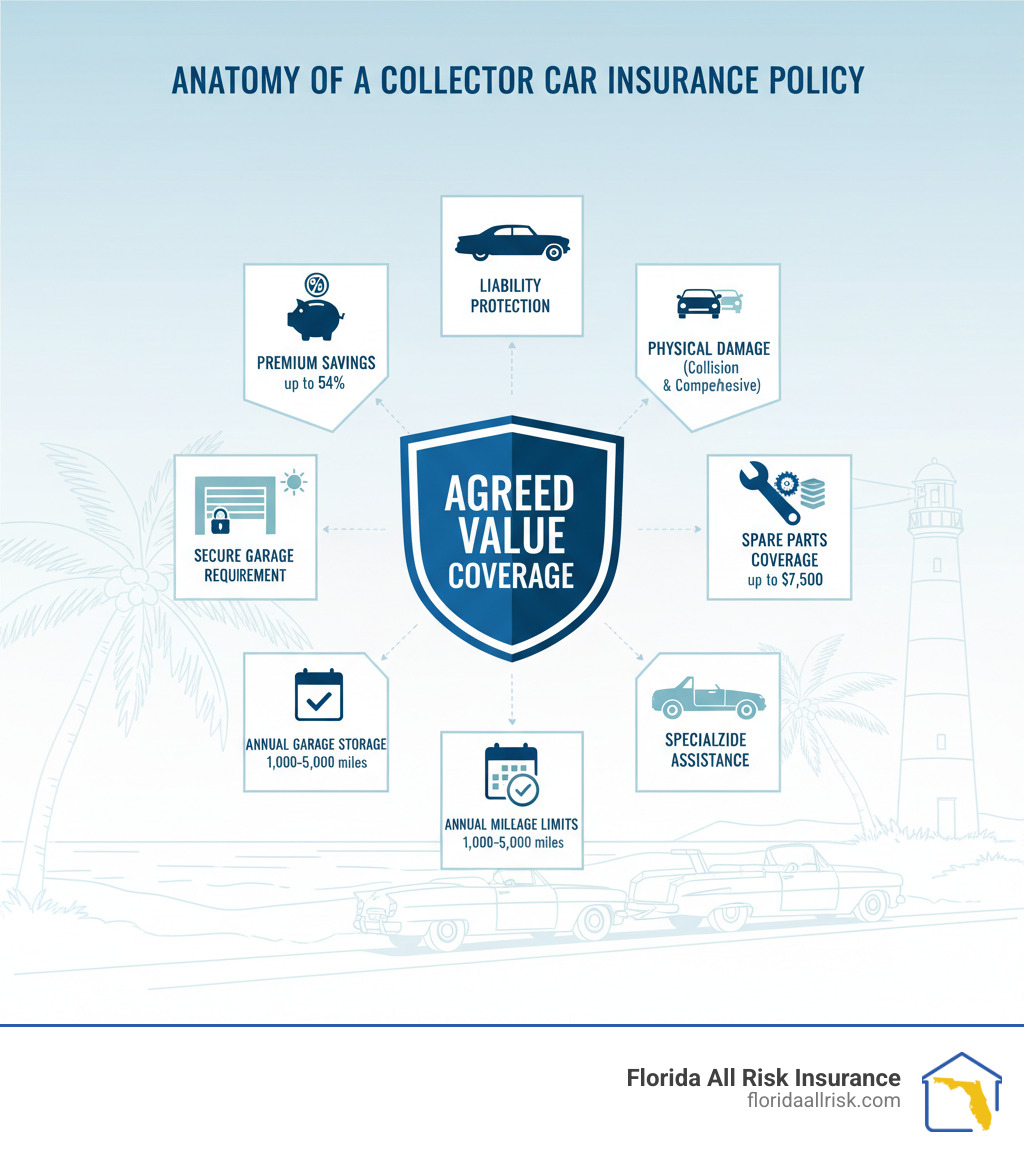
A regular policy uses “Actual Cash Value,” which can leave you with a fraction of your car’s worth after a total loss. Collector car insurance uses Agreed Value coverage. You and the insurer agree on the car’s value upfront, and that’s the amount you receive in a covered total loss—no depreciation, no last-minute haggling. This peace of mind is the fundamental promise of collector car insurance. This approach, combined with rules reflecting how enthusiasts use their cars (limited mileage, secure storage), results in significantly lower premiums.
Key differences between collector car insurance and standard auto insurance:
| Feature | Standard Auto Insurance | Collector Car Insurance |
|---|---|---|
| Value Basis | Actual Cash Value (depreciates) | Agreed Value (guaranteed, no depreciation) |
| Premiums | Higher, based on daily use | Up to 54% lower |
| Mileage | Unlimited | Annual limit (typically 1,000-5,000 miles) |
| Usage | Daily commuting, errands | Pleasure drives, shows, club events only |
| Storage | Street or driveway acceptable | Secure enclosed garage required |
| Driver Requirements | Primary vehicle for household | Must have separate daily-use vehicle |
Whether you own a restored 1965 Mustang, a numbers-matching Corvette, or a modern exotic, the right insurance is essential. This guide will walk you through what qualifies, how coverage differs, and how to protect your automotive investment with confidence.
I’m Jason Miller, and with over 20 years providing insurance collector car solutions to Florida enthusiasts, I’ve seen firsthand the devastation that inadequate coverage can cause. From the sun-drenched shows in Sarasota to the vibrant cruise nights in Miami, I’ve helped countless owners protect their passion. My goal is to translate the complex world of insurance into clear, actionable advice, so you can get back to what matters most: enjoying your classic with complete peace of mind.
What Qualifies as a Collector Car for Insurance?
Not every older vehicle qualifies for insurance collector car policies. Insurers look for vehicles that hold special value due to age, rarity, or historical significance and are treated as hobby cars, not daily transportation. Key qualifications include having a separate daily-use vehicle, secure storage, and using the car only for pleasure.
Classic and Antique Designations
While often used interchangeably, “classic” and “antique” have specific meanings for insurance purposes.
- Classic Car: Typically a vehicle that is at least 20-25 years old. It should be maintained in good condition and remain largely true to its original design, though tasteful restorations and period-correct modifications are welcome. The key is that the vehicle is largely preserved and not used as a daily commuter.
- Antique Car: A vehicle that is generally 25 years or older, representing a piece of automotive history. Like classics, they are expected to maintain their original character.
In Florida, for instance, a vehicle must be at least 30 years old to qualify for an ‘Antique’ license plate, which exempts it from annual registration renewals. While insurance company definitions may differ slightly (often using a 25-year threshold), having this official state designation can certainly support your application for collector coverage. For more details on state-specific requirements, our Classic Car Insurance Florida page offers further insight. Both classic and antique cars are expected to have limited annual mileage and be used for pleasure drives, shows, and club events, not daily commuting.
Modern Collectibles and Modified Cars
The collector world extends beyond vintage models. Specialized insurance collector car coverage is also available for newer and custom vehicles.
- Modern Classics & Exotics: These are newer vehicles, often 10-15 years old, that are already appreciating or holding significant value due to limited production or iconic status. Think of special edition performance models, supercars like a Ferrari or Lamborghini, or “instant classics” like a 2005 Ford GT, a limited-run Porsche 911, or even a low-mileage Acura NSX.
- Modified Vehicles & Restomods: The industry has evolved to accept classic cars updated with modern technology (engines, brakes, suspension). These “restomods,” along with custom-built cars, kit cars, and replicas, can qualify for coverage. The key is to thoroughly document all modifications and investments. This means keeping a detailed build book with receipts for parts, invoices for labor, and extensive photographs of the process. This documentation is not just for your records; it’s crucial evidence for an appraiser and the insurance underwriter to establish an accurate Agreed Value that reflects the thousands of dollars and hours you’ve invested.
Whether your passion is a numbers-matching antique, a modern exotic, or a custom-built masterpiece, a collector car policy can be custom to fit. The world of collectible vehicles is broad, and so are the options for protecting them.
Standard vs. Collector Car Insurance: The Key Distinctions
The insurance that protects your daily driver is fundamentally different from what your classic car needs. Standard auto insurance is built for vehicles that face daily traffic, high mileage, and steady depreciation. Insurance collector car policies, however, are designed for cherished vehicles that are driven carefully, stored securely, and often appreciate in value.
| Feature | Standard Auto Insurance | Collector Car Insurance |
|---|---|---|
| Value Basis | Actual Cash Value (ACV) – depreciates | Agreed Value – guaranteed, no depreciation |
| Premiums | Standard rates, often higher | Up to 54% lower than standard policies |
| Mileage | Unlimited for most policies | Annual limit (e.g., 1,000, 2,500, 5,000 miles) |
| Usage | Daily commuting, errands, business | Pleasure drives, shows, club events only |
| Storage | Driveway, street, unsecured garage | Secure, enclosed, locked garage required |
The Crucial Difference: Agreed Value vs. Actual Cash Value
The most important distinction is how your vehicle’s value is determined in a claim.
- Agreed Value: This is the cornerstone of collector car insurance. You and the insurer agree on your car’s value when the policy begins. If the car is declared a total loss, you receive that full agreed-upon amount, minus your deductible. There is no depreciation. This guarantees your investment is protected.
- Actual Cash Value (ACV): Standard policies use ACV, which is the vehicle’s market value at the moment of the loss. This calculation includes depreciation due to age and mileage. For a classic car, an ACV payout could be devastatingly less than its true worth. Imagine you own a beautifully restored 1969 Camaro, valued by experts at $70,000. After a garage fire, your standard auto insurer’s adjuster consults a generic valuation guide, factors in the car’s age and ‘book value,’ and offers you $25,000. That’s ACV. With an Agreed Value policy, you would have locked in the $70,000 value upfront, and that’s the check you’d receive, no questions asked. This is the single most important reason enthusiasts must choose specialized coverage.
Cost, Usage, and Storage Requirements
You might expect better coverage to cost more, but insurance collector car premiums are often up to 54% lower than standard policies. This is because insurers recognize that collector car owners are a fundamentally lower-risk group. They aren’t battling rush-hour traffic or parking in crowded lots. They are enthusiasts who baby their vehicles, perform meticulous maintenance, and drive cautiously on sunny weekends. The strict usage and storage requirements aren’t just arbitrary rules; they are the foundation of a risk model that allows insurers to offer superior coverage at a fraction of the cost.
This is made possible by a few key requirements:
- Annual Mileage Limits: Policies include mileage plans (e.g., 1,000, 2,500, or 5,000 miles per year) that align with typical hobbyist use.
- Pleasure Use Only: The vehicle is for pleasure drives, car shows, and club events. It cannot be used for daily commuting, running errands, or any business purpose.
- Secure Storage: Your collector car must be stored in a secure, enclosed, and locked location, such as a private garage or dedicated storage facility.
Understanding Your Collector Car Insurance Coverage
A quality insurance collector car policy includes the fundamental protections you’d expect, such as liability, comprehensive, and collision coverage. However, it’s the specialized endorsements and perks built for enthusiasts that truly set these policies apart. They acknowledge that a collector’s investment extends beyond the car itself to include parts, tools, and ongoing projects.

Specialized Coverage Options for Enthusiasts
Look for policies that offer these valuable add-ons custom to the collector lifestyle:
- Spare Parts and Tools Coverage: Protects your inventory of valuable parts, tools, and automobilia stored with your vehicle, often up to a set limit like $7,500. This can cover everything from a numbers-matching carburetor you’ve been hunting for to your collection of vintage license plates, shop manuals, and other related automobilia.
- Vehicle Under Construction Coverage: Essential for restoration projects, this covers your car throughout the build process. The Agreed Value can be increased as you invest more time and money. Most policies allow you to periodically update the value, ensuring that if a disaster strikes mid-build, you’re compensated for the current value of the project, not just the pile of parts you started with.
- Newly Acquired Vehicle Coverage: Provides automatic temporary coverage for a new addition to your collection, giving you time to formally add it to your policy.
- Trip Interruption Coverage: Reimburses expenses for lodging, meals, and transportation if your classic has a mechanical failure during a planned trip more than a certain distance from home (e.g., 50 miles). It turns a potential vacation-ruining disaster into a manageable inconvenience.
Unique Policy Perks
Specialized providers often include benefits that show they understand the enthusiast mindset:
- Cherished Salvage Rights: In the event of a total loss, this allows you to keep the vehicle’s salvage (the “cherished” remains) while still receiving the full Agreed Value payout.
- Specialized Roadside Assistance: Guarantees flatbed towing with soft straps to ensure your vehicle is transported without damage.
- Expert Claims Handling: You’ll work with adjusters who are classic car experts and have the freedom to choose your own trusted repair or restoration shop.
- Evacuation Expense Coverage: Particularly useful in Florida, this helps cover the cost of moving your vehicle to safety during a declared emergency like a hurricane.
- Pet Coverage: Some policies even extend coverage to your furry co-pilot, helping with veterinary expenses if your pet is injured in a covered accident.
Choosing the right insurer also means partnering with a company that supports the car culture, often through contributions to organizations like the RPM Foundation, which is dedicated to preserving the hobby for future generations.
The Nuts and Bolts of Your Insurance Collector Car Policy
Securing the right insurance collector car policy involves a few key steps, from ensuring you and your vehicle qualify to accurately determining its value. Understanding these practical details will help you get the best possible coverage.
Eligibility and Requirements
Insurers look for responsible owners who treat their vehicles as hobby cars. Common requirements include:
- Driver Age and Record: The primary driver is typically required to be at least 25 years old with a clean driving record, meaning no major violations (like a DUI or reckless driving) in the past three to five years.
- Daily-Use Vehicle: Every licensed driver in the household must have their own separate vehicle for daily transportation.
- Secure Storage: The collector vehicle must be stored in a locked, fully enclosed garage or a dedicated storage facility.
- Vehicle Condition: The car should be in good to excellent condition or actively undergoing restoration.
- Mileage Agreement: You must agree to an annual mileage limit that reflects pleasure use.
Determining Your Car’s Value
Establishing the correct Agreed Value is the most critical part of the process. This is a collaborative effort based on research and documentation. For high-value or unique cars, a professional appraisal is often required and is always the best approach. A qualified appraiser will conduct a thorough inspection, research comparable sales, and produce a detailed report that serves as undeniable proof of your car’s value. For more common classics, insurers use professional valuation tools, like those from Hagerty or Grundy, combined with your own documentation and photos.
Your documentation is key. A binder with restoration receipts, maintenance records, photos, and evidence of provenance (ownership history, celebrity ownership, race history, original window sticker, build sheets, and show awards) can significantly impact the agreed value. A well-documented history can add thousands to a car’s worth. It’s also vital to be honest about your car’s condition, typically graded on a scale from concours-quality to a parts car. As you restore or improve your vehicle, remember to update your policy’s Agreed Value to protect your ongoing investment.
Factors Influencing Premiums and Discounts
While collector car premiums are low, several factors determine your final rate:
- Vehicle’s Agreed Value: Higher-value cars cost more to insure.
- Vehicle Type: Rare or high-performance models may have higher premiums due to repair costs and theft risk.
- Location: Your ZIP code, including local crime rates and disaster risk, affects the cost.
- Mileage Plan: A lower annual mileage limit results in a lower premium.
- Deductible: Choosing a higher deductible will lower your premium.
You can also find significant savings through discounts. Insurers often offer a variety of discounts. Common savings include reductions for being a member of a recognized car club (like the AACA or a local Mustang club), installing safety equipment (fire extinguisher, anti-theft system), insuring multiple collector cars on the same policy, having a long history with the insurer, or even for being a mature driver. Bundling your policy with other insurance, such as your homeowners policy, can also lead to significant savings.
Navigating Claims and Specialized Services
The true test of any policy is the claims process. With insurance collector car coverage, the experience is designed to preserve your vehicle’s integrity and value, not just get it back on the road.
The Collector Car Claims Process
When you file a claim, you’ll immediately notice the difference. The process is built around the unique needs of classic vehicles and their owners.
- Specialized Adjusters: Your claim will be handled by an adjuster who is an expert in collector vehicles. They understand the nuances of originality, restoration quality, and parts sourcing.
- Freedom of Choice: You have the freedom to choose your own repair or restoration shop. You’re not limited to a network of standard body shops; you can take your car to the craftsman you trust.
- Expert Parts Sourcing: Specialized insurers often have dedicated parts specialists who can help locate rare, original, or correct reproduction parts to ensure a proper repair.
- Agreed Value Payout: In the event of a total loss, the process is refreshingly simple. You receive the full Agreed Value that was determined at the start of your policy, minus any deductible. There are no last-minute negotiations or depreciation games. For example, if your car is stolen and not recovered, the claim is straightforward: you get a check for the full agreed-upon amount, allowing you to begin the search for your next dream car.
Why a Specialized Insurer Matters
Choosing an insurer that lives and breathes the collector car world is essential. They bring deep industry knowledge, stay on top of market value fluctuations, and offer policies with features that enthusiasts need, like Cherished Salvage rights. This is a crucial feature for true enthusiasts. If your car is declared a total loss, most standard policies take the vehicle. With Cherished Salvage, you get to keep the car (the ‘salvage’) and still receive the full Agreed Value payment. This allows you to rebuild it, use its parts for another project, or keep it as a memento. It acknowledges that even a wrecked classic holds immense value to its owner.
This commitment to the community often extends to promoting initiatives that benefit all drivers. Supporting road safety is a shared goal, and organizations like the National Highway Traffic Safety Administration (NHTSA) provide valuable resources to create a safer driving environment for everyone. At Florida All Risk Insurance, we partner with top specialized insurers to bring this level of expertise to our clients.
Frequently Asked Questions about Collector Car Insurance
Here are answers to some of the most common questions enthusiasts have about insurance collector car policies.
Can I use my collector car for occasional errands?
Generally, no. These policies are designed and priced for “pleasure use,” which includes car shows, club events, and scenic drives. Using your classic for regular errands, commuting to work, or any commercial purpose is typically prohibited. While a quick, infrequent trip for coffee might be acceptable, the vehicle cannot serve as a regular mode of transportation.
What happens to my premium if my car’s value increases?
As your car appreciates or you invest in restoration, you should contact your agent to increase its Agreed Value. This ensures your coverage keeps pace with your car’s current worth. Your premium will increase slightly to reflect the higher value, but this is a small price to pay for ensuring your full investment is protected in the event of a total loss. We recommend reviewing your Agreed Value annually.
Is insurance for a car under restoration different?
Yes, and it’s a critical distinction. You need “Vehicle Under Construction” coverage. This specialized endorsement protects your project car through every stage of its restoration. The Agreed Value can be increased periodically to reflect the parts and labor you’ve invested. This ensures that if a fire or theft occurs mid-project, you’re covered for the work you’ve already put in, not just the car’s pre-restoration value.
What if I own multiple collector cars? Do I need a separate policy for each?
No, and this is a major advantage of specialized insurance. You can typically place all of your qualified collector vehicles on a single policy. This not only simplifies paperwork and payments but also often results in a significant multi-car discount. You can customize coverage, mileage limits, and Agreed Values for each vehicle, creating one comprehensive and cost-effective solution for your entire collection.
What happens if I approach my annual mileage limit but want to attend one more show?
Collector car insurers understand that opportunities pop up. While the mileage plans are a key part of keeping premiums low, they are not always rigid. Many insurers offer flexible options. You can often call your agent to purchase additional miles for a nominal fee or even upgrade to the next mileage tier mid-term. The key is to be proactive and communicate with your insurer before you exceed the limit to ensure you remain fully covered.
Conclusion: Protecting Your Passion with the Right Policy
Your collector car is more than just a vehicle; it’s an investment of time, passion, and money. Protecting it with a standard auto policy is a risk that enthusiasts can’t afford to take. Insurance collector car policies are the only way to ensure your automotive treasure is properly protected.
The foundation of this protection is Agreed Value coverage, which guarantees you’ll receive your car’s full, pre-determined worth in a total loss—with no depreciation. Combined with lower premiums, specialized claims handling, and unique endorsements for things like spare parts and restorations, it’s clear why this coverage is essential. The requirements—secure storage, limited mileage, and a separate daily driver—are simply best practices that responsible owners already follow.
As an independent agency in St. Petersburg, Florida All Risk Insurance has over 20 years of experience helping Florida enthusiasts find the right protection. We understand the local car culture and partner with the nation’s top collector car insurers to find a policy that fits your vehicle and your budget. Don’t leave your passion underinsured.
Ready to protect your investment with coverage designed for classics? Get your comprehensive Florida classic car insurance quote now!
For a personalized consultation to discuss your unique vehicle and coverage needs, contact our specialists today. We’ll help you craft a policy that provides complete peace of mind.
Contact Us
Florida All Risk Insurance
Address: 700 94th Ave N STE 300, Saint Petersburg, FL 33702
Phone: (727) 900-5888
Email: [email protected]

