

HVAC General Liability Insurance: 3 Essential Shields
Why HVAC General Liability Insurance is Essential for Your Business
HVAC general liability insurance is a foundational coverage that protects heating, ventilation, and air conditioning contractors from financial loss. Also known as Commercial General Liability (CGL), it shields your business when a third party—like a client or bystander—claims bodily injury or property damage resulting from your work.
This essential protection covers medical expenses, repair costs for damaged property, and legal fees for covered claims. It also includes coverage for issues that arise after a job is complete (products-completed operations) and personal or advertising injury, such as slander or copyright infringement.
The HVAC industry is inherently risky. Whether you’re installing a new system or repairing commercial equipment, accidents can lead to costly lawsuits. A homeowner could trip over your tools, or an improper installation could cause water damage to walls and ceilings. With many clients, contracts, and state licensing boards requiring proof of coverage, general liability insurance is a necessity for any professional HVAC business.

What is HVAC General Liability Insurance and What Does It Cover?
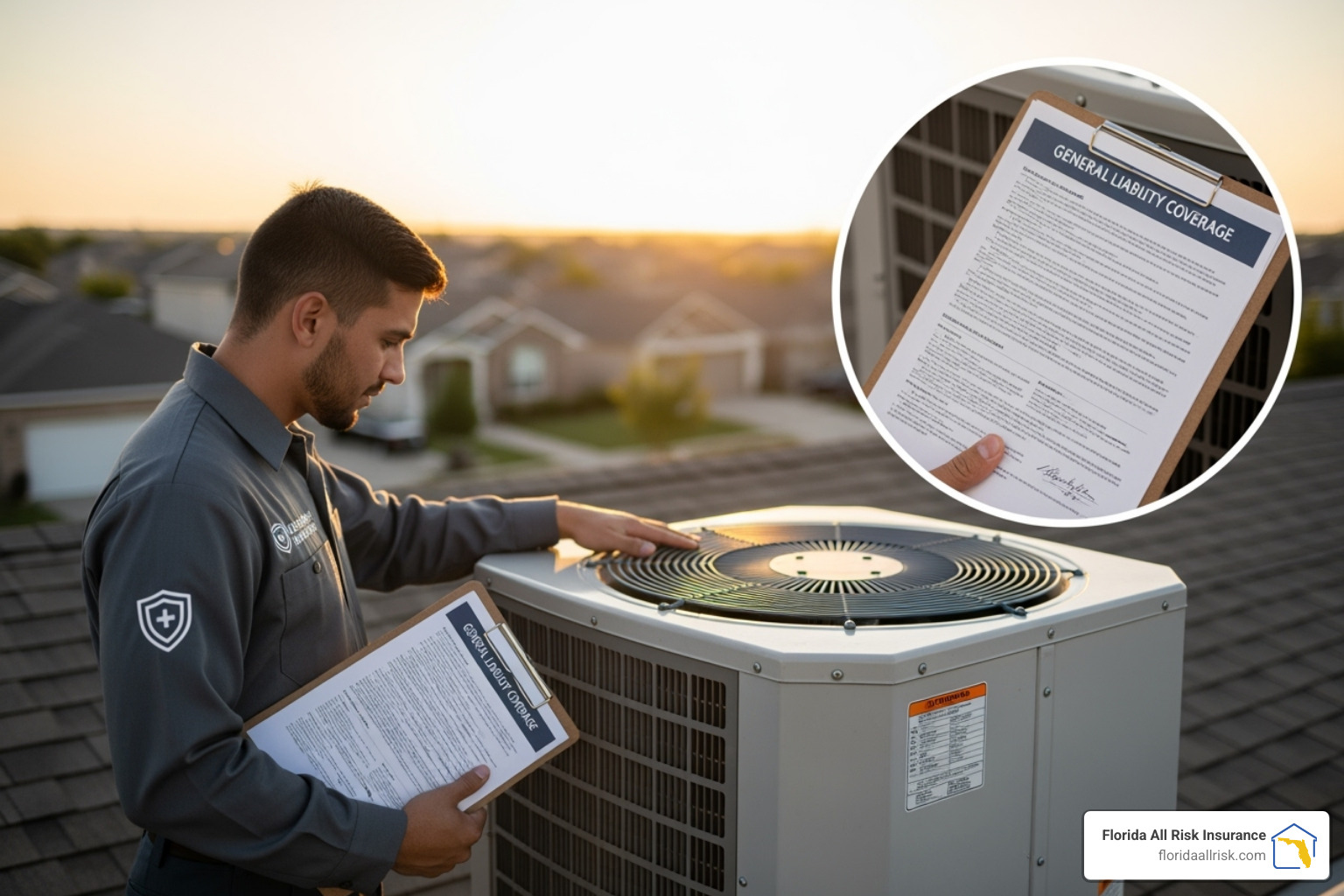
HVAC general liability insurance, or Commercial General Liability (CGL), is your business’s financial shield against third-party claims of bodily injury or property damage. Beyond covering damages, it also handles legal defense costs, settlements, and judgments from covered claims—even if a lawsuit is baseless. For a deeper look at this coverage, you can explore What Does General Liability Insurance Cover?.
Bodily Injury Coverage
If a client, visitor, or bystander is injured due to your work—for instance, tripping over a toolbox—bodily injury coverage handles their medical expenses, lost wages, and your legal fees. This protection applies to any non-employee physically harmed by your business operations.
Property Damage Coverage
When your work accidentally harms a client’s property, this coverage pays for repairs or replacement. Examples include scratching a floor with a ladder, causing a water leak that damages a wall, or creating an electrical short that fries an appliance. Property damage coverage protects you from these costly mistakes.
Personal and Advertising Injury
This coverage protects against non-physical harm claims. It applies if you are accused of slander, libel, or copyright infringement in your business operations or advertising. While less common, these claims can result in expensive legal battles.
Products-Completed Operations Coverage
Your responsibility doesn’t end when you leave the job site. Products-completed operations coverage is critical for HVAC contractors, as it protects you from claims arising after your work is finished. If a furnace you installed leaks carbon monoxide weeks later, or a faulty AC installation causes mold, this coverage handles the resulting claims. It’s essential long-term protection.
Why This Insurance is a Must-Have for HVAC Professionals

Investing in HVAC general liability insurance is about protecting the business you’ve built. It’s the foundation of responsible Business Liability Insurance and provides the confidence to focus on your work.
The High-Stakes World of HVAC Work
HVAC work is physically demanding and risky, involving heavy equipment, electrical systems, and challenging environments. The potential for an accident is always present. The U.S. Bureau of Labor Statistics recorded 34,700 nonfatal injuries and illnesses in the industry in 2020, highlighting the dangers. You can find more on these nonfatal injury statistics from the BLS. General liability insurance acts as a crucial safety net.
Protecting Your Business from Crippling Lawsuits
A single lawsuit can be financially devastating. Medical bills, property repairs, and legal fees can quickly overwhelm a small business. Common liability scenarios include water damage from a leaky AC unit, a client tripping over equipment, or an electrical surge damaging electronics. HVAC general liability insurance absorbs these financial shocks, allowing your business to continue operating.
Meeting Contractual and Licensing Requirements
This insurance is often a prerequisite for securing work. Many commercial clients and property managers require proof of coverage, and state licensing boards frequently mandate it for legal operation. For example, Texas has specific insurance requirements for licensed contractors, which you can review at the example of state requirements in Texas. A Certificate of Insurance (COI) demonstrates professionalism and gives you a competitive edge. For more on contractor-specific needs, explore General Liability Insurance for Contractors.
Your Guide to HVAC General Liability Insurance Policies

Understanding your HVAC general liability insurance policy is key to ensuring you have the right protection. Let’s break down how policies are priced and whether they are legally required.
How is the Cost of HVAC General Liability Insurance Determined?
Insurance companies assess several factors to determine your premium. Your rate is a direct reflection of your business’s unique risk profile. Key factors include:
- Business Size & Revenue: Larger operations with higher revenue generally have greater exposure and higher premiums.
- Number of Employees: More employees can increase the chances of a third-party incident occurring.
- Claims History: A clean record with no past claims typically results in lower rates.
- Location: Premiums can vary based on regional risks and local legal environments.
- Type of Work: The risks associated with commercial projects can differ from those in residential settings.
- Coverage Limits & Deductibles: Higher limits and lower deductibles provide more protection but also increase your premium.
For a more detailed breakdown, see our guide on General Liability Insurance Cost.
Is General Liability Insurance Mandatory for HVAC Contractors?
While there may not be a single federal law mandating it, HVAC general liability insurance is a practical necessity.
State and local laws often require it for contractor licensing. For instance, Texas has specific requirements for licensed contractors. Additionally, client contracts, especially for commercial jobs, almost always stipulate minimum coverage levels. Even residential homeowners are increasingly asking for proof of insurance. Finally, if you rent a workshop or office, your landlord will likely require it.
Operating without this insurance severely limits the jobs you can take and exposes your business to immense financial risk. To determine your needs, review our insights on How Much General Liability Insurance Do I Need?.
Building a Complete Shield: Other Essential Insurance for Your HVAC Business
HVAC general liability insurance is the cornerstone of your protection, but it doesn’t cover every risk. To create a complete shield, you should consider other policies that address specific exposures related to your employees, vehicles, and equipment. A comprehensive insurance portfolio protects your business from all angles. For a broader overview, explore Insurance for Small Businesses.
Workers’ Compensation Insurance
If you have employees, workers’ compensation is almost certainly required by state law. It covers medical bills, lost wages, and rehabilitation costs for employees injured on the job. Given the physical risks of HVAC work—lifting heavy units, working with electrical systems, and exposure to extreme temperatures—this coverage is vital for protecting both your team and your business from injury-related lawsuits.
Commercial Auto Insurance
Your personal auto policy won’t cover accidents that happen while using your van or truck for business. Commercial Auto insurance is essential to cover liability and physical damage for your work vehicles. It protects you if you’re at fault in an accident and can also cover damage to the expensive equipment you’re transporting.
Tools & Equipment Insurance (Inland Marine)
Your specialized tools and equipment are a major investment. Standard property insurance only covers them at your business location, leaving them unprotected at job sites. Tools & Equipment insurance, also known as Inland Marine insurance, covers your gear while in transit, at a client’s property, or in your vehicle. It protects against theft, damage, and other losses. Learn more by understanding inland marine insurance.
Professional Liability (Errors & Omissions)
General liability covers property damage and injury, but not financial loss due to professional mistakes. Professional Liability insurance, or E&O, protects you if a client claims your advice or design caused them financial harm. For example, if you recommend an incorrectly sized system that leads to high energy bills, E&O covers the resulting legal claims.
Business Owner’s Policy (BOP)
A Business Owner’s Policy (BOP) is a convenient package for many HVAC businesses. It bundles Commercial General Liability Insurance with commercial property insurance, and often business interruption coverage. A BOP simplifies your insurance management and is typically more cost-effective than buying each policy separately.
How to Secure Your HVAC General Liability Insurance Policy

Getting the right HVAC general liability insurance is a straightforward process with the right preparation. Following these steps will help you secure the protection your business needs efficiently.
Step 1: Gather Your Business Information
To get accurate quotes, you’ll need to provide a clear picture of your business. Organize the following details:
- Business name, legal structure (LLC, sole prop, etc.), and address
- Years in business
- Annual revenue and total payroll information
- A detailed list of services you offer (e.g., residential repair, commercial installation)
- Your claims history for the past 3-5 years
Step 2: Assess Your Risks and Coverage Needs
Your coverage should match your unique risk profile. Consider these factors to determine how much protection you need:
- Project types: Do you handle large commercial installations or small residential repairs?
- Contractual requirements: Check contracts for any specified insurance limits.
- Work hazards: Do you work at heights, in confined spaces, or with hazardous materials?
The standard $1 million per occurrence / $2 million aggregate limit is common, but your business may need more.
Step 3: Get a Quote and Compare Your Options
With your information ready, it’s time to get quotes. Working with an independent insurance agency allows you to compare options from multiple carriers to find the best combination of coverage and price. An agent can help you understand policy terms, deductibles, and exclusions to ensure you’re making an informed choice. The goal is to find a policy that provides robust protection without unnecessary costs. Ready to start? You can easily Get a General Liability Insurance Quote today.
Conclusion: Secure Your Business and Your Future
In the demanding Florida HVAC industry, HVAC general liability insurance is not just an expense—it’s the foundation that allows you to operate with confidence. This essential coverage protects you from the financial fallout of third-party claims, improves your professional credibility, and provides invaluable peace of mind. With the right insurance, you can focus on what you do best: keeping your clients comfortable.
At Florida All Risk Insurance, we understand the unique challenges HVAC contractors face in the Sunshine State. As an independent agency in St. Petersburg, we know the local risk landscape. We take the time to understand your business and leverage our relationships with top-rated carriers to find coverage that fits perfectly—no gaps, no waste, just solid protection.
The risks of the HVAC industry are unavoidable, but they don’t have to threaten your financial security. Don’t let an unexpected liability put your hard work at risk.
Explore our comprehensive general liability coverage options today and see how the right insurance partnership can help your business thrive.
Contact Us
Florida All Risk Insurance
Address: Saint Petersburg, FL
Phone: (727) 800-2121
Email: [email protected]

