

How Much Does Insurance Cost for a 28-Foot RV in Florida?
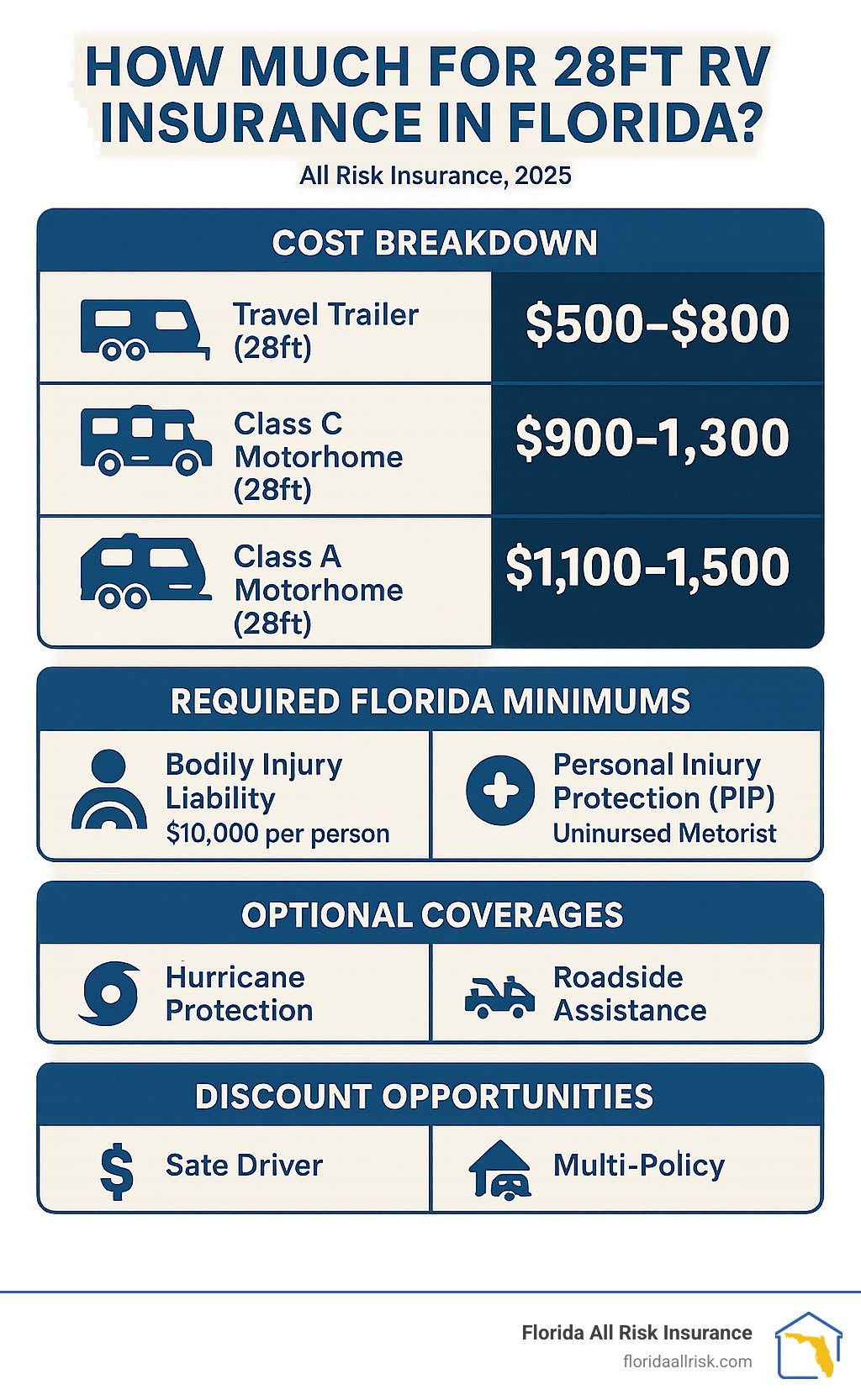
Understanding how much insurance costs for a 28-foot RV in Florida starts with recognizing that “RV insurance” is really a bundle of protections custom to both a vehicle and a home-on-wheels. In Florida, typical annual premiums for a 28-foot RV range from about $500 to $1,500 for recreational users, depending on the RV type, your driving record, where you store the RV, and the coverages you choose. If you live in your RV full-time, plan on higher costs for specialized protections, often from $1,500 to $4,000 per year.
Quick reference ranges for 28-foot RVs in Florida:
- Travel trailers: $500-$800 per year (often comprehensive-only or comprehensive with optional add-ons)
- Class C motorhomes: $900-$1,300 per year (full auto-style policy with RV-specific options)
- Class A motorhomes: $1,100-$1,500 per year (higher value and more complex systems)
- Liability-only (motorhomes): typically the cheapest option but rarely recommended on its own
- Full coverage (comprehensive and collision): common for financed or newer rigs; cost depends heavily on your deductible, claims history, and garaging location
Why the spread? Florida’s unique environment (coastal weather, hurricane exposure, and higher traffic density in certain regions) amplifies risk, especially on comprehensive coverage. According to the National Hurricane Center, Florida experiences more hurricane landfalls than any other U.S. state, which directly impacts insurance pricing for RVs stored in coastal areas. On top of that, your usage patterns—weekend trips versus extended stays—play a major role. A part-time traveler who securely stores a 28-foot trailer inland may pay far less than a motorhome owner who parks year-round near the coast.
Whether you’re new to RVing or upgrading to a 28-footer, this guide breaks down what affects your price, how to choose coverages, and practical ways to save without cutting crucial protection. You’ll find real-world scenarios, Florida-specific insights, and straightforward steps for getting quotes that reflect your exact usage.
At a Glance: What Drives Your Premium in Florida
- RV type and value: Travel trailer versus motorhome, and the RV’s purchase price, equipment, and age
- Where you keep it: ZIP code risk, proximity to the coast, storage security features
- How you use it: Recreational versus full-time, annual mileage, and trip frequency
- Your profile: Driving and claims history, credit-based insurance score (where allowed), prior continuous insurance
- Coverage design: Liability limits, comprehensive and collision, personal effects, deductibles, and special add-ons
The bottom line: Insurers price RVs like a hybrid of auto and property exposure. The more precisely you describe your RV and lifestyle, the more accurate—and potentially lower—your quote will be.
The Core: What Influences Your 28-Foot RV Insurance Cost in Florida?
Determining how much insurance costs for a 28-foot RV in Florida is a function of your RV’s profile, your usage pattern, your personal risk signals, and your coverage choices. Below are the key elements that reliably move the needle on premium.
Your RV’s Profile: Type, Value, and Age
The single biggest price driver is the kind of RV you own and its replacement value.
- Travel trailers (28 ft): Since your tow vehicle’s auto policy generally supplies liability while the trailer is attached, the trailer’s policy primarily covers the trailer itself against theft, vandalism, storms, and other perils (comprehensive), plus collision if desired. This structure usually keeps premiums in the $500–$800 range for recreational use.
- Class C motorhomes (28 ft): Combining vehicle and living quarters, Class C policies price like auto policies but include RV-specific protections. In Florida, $900–$1,300 annually is common for part-time users.
- Class A motorhomes (28 ft): Often built on a heavy-duty commercial bus or truck chassis, these motorhomes represent the peak of luxury and complexity. Even at 28 feet, a Class A will have more expensive systems (like hydraulic leveling jacks), higher-end interior finishes, and a more powerful engine than a comparable Class C. This higher replacement cost and potential for more expensive repairs directly translate to higher premiums, generally in the $1,100–$1,500 range for recreational use.
Value and age matter. A newer, higher-dollar 28-footer costs more to insure than an older, modestly priced unit. Some very old rigs can be more expensive to fix if parts are scarce, which can offset depreciation.
How Insurers Value Your RV
- Actual Cash Value (ACV): This is the default for most policies. It pays the market value of your RV at the time of the loss, accounting for depreciation. While it results in a lower premium, it can leave you with a financial gap if you owe more on your loan than the RV is worth.
- Agreed Value: This option is ideal for well-maintained older RVs, custom rigs, or full-timers. You and the insurer agree on a fixed payout amount when you buy the policy. This value remains locked in for the policy term, eliminating surprises after a total loss. It costs more than ACV but provides certainty.
- Total Loss Replacement (TLR): Typically available for the first few model years of a new RV, this is the highest level of protection. If your RV is totaled, the insurer will replace it with a brand new, comparable model, not just give you what you paid for it. This coverage is the most expensive but offers complete peace of mind for new owners.
If you’ve financed the RV, lenders typically require comprehensive and collision. Consider whether ACV, Agreed Value, or TLR best fits your RV’s age and your budget.
Your Personal Profile and On-Road Behavior
- Driving history: Clean records usually get better pricing. Multiple violations or at-fault accidents increase premiums.
- Claims history: Recent claims—auto or RV—can raise prices. A long claims-free period helps.
- Experience: Insurers may view seasoned RV drivers as lower risk, especially for larger motorhomes.
How You Use the RV
- Recreational use: Fewer annual nights and miles generally mean lower risk and cost.
- Seasonal or snowbird use: Be accurate about where and when you use the RV; coastal hurricane exposure can affect pricing.
- Full-time use: Policies designed for full-timers operate more like homeowners coverage, with personal liability, increased personal property limits, and loss-of-use coverage. Expect roughly $1,500–$4,000 annually, depending on configuration and limits.
Where and How You Store It
- Storage location: Coastal ZIP codes, high-theft areas, and exposure to hurricanes typically raise comprehensive premiums.
- Storage type: Indoor or climate-controlled storage, locked facilities, cameras, and alarms may reduce risk and cost.
- Security features: Wheel locks, hitch locks, GPS trackers, and alarm systems can result in discounts.
Coverage Choices and Florida-Specific Requirements
Florida’s insurance rules apply to self-propelled RVs just as they do to other motor vehicles. Travel trailers are not self-propelled and therefore have different requirements.
- Liability insurance: Mandatory for motorhomes. Choose limits high enough to protect your assets; Florida’s minimums are often inadequate in serious crashes.
- Personal Injury Protection (PIP): Florida’s no-fault structure requires PIP on motor vehicles subject to registration, which includes motorhomes. You can review state requirements via the Florida Highway Safety and Motor Vehicles website: Florida Highway Safety and Motor Vehicles (FLHSMV) insurance requirements (https://www.flhsmv.gov/).
- Uninsured/Underinsured Motorist (UM/UIM): Strongly recommended to protect you from drivers with little or no insurance.
- Comprehensive and collision: Comprehensive protects against theft, fire, vandalism, animal damage, and severe weather; collision covers crash-related damage regardless of fault. For a clear primer on how these coverages work in personal vehicle policies, see the Insurance Information Institute’s overview of comprehensive and collision coverage (https://www.iii.org/article/what-auto-insurance-covers).
Deductibles and Premium Tradeoffs
- Increasing deductibles (e.g., from $500 to $1,000) typically reduces premium.
- Consider separate deductibles for hurricane/wind if your carrier offers them; confirm how they apply and what triggers them.
- Choose deductibles you could comfortably pay out-of-pocket after a claim.
Helpful Optional Coverages for Florida RVers
- Personal effects coverage: This protects your belongings that aren’t part of the RV itself—things like clothing, laptops, camping gear, and kitchen supplies. While your homeowners policy might offer some ‘off-premises’ coverage, it often comes with a high deductible and may not cover items adequately. RV-specific personal effects coverage typically has a lower deductible and can be purchased with limits that reflect what you actually carry with you, from $2,000 to over $10,000 for full-timers.
- Vacation liability: This is a crucial and often misunderstood coverage. When your RV is parked at a campsite and you’re using it as a temporary home, your motorhome’s auto liability may not apply to incidents that happen in and around your site (like a guest tripping over your awning tie-down). Vacation liability provides premises liability protection, similar to a homeowners policy, for a specified limit (e.g., $10,000) and is very inexpensive to add.
- Full-timer’s liability: For those who live primarily in their RV; functions like personal liability on a homeowners policy.
- Emergency expense and trip interruption: Helps with hotel and travel costs if a covered claim strands you far from home.
- Roadside assistance and towing: Standard auto club plans are rarely equipped to handle an RV. A disabled 28-foot motorhome requires a heavy-duty tow truck, which can cost thousands of dollars for a long-distance tow. RV-specific roadside assistance ensures the right equipment is dispatched and often covers towing to the nearest qualified repair facility without a mileage cap, as well as services like tire changes, fuel delivery, and lockout assistance.
- Coverage for awnings, satellite equipment, attached accessories: These items are frequently damaged and may have sub-limits if not scheduled.
Designing your coverage is the most direct lever you have on price. The goal is to match your coverage to your actual risks so you’re not paying for what you don’t need—or underinsuring what truly matters.
Smart Savings: Discounts and How to Find the Best Value
Getting a fair price on RV insurance is about more than chasing the lowest premium. It’s about aligning protection with your risks and capturing every discount you legitimately qualify for.
Common Discounts for Florida RV Owners
- Multi-policy bundling: Packaging your RV with your auto and/or home can shave 15–25% with many carriers.
- Safe driver and claims-free: Clean records yield better pricing across the board.
- Original owner: Some insurers reward original owners who maintain their rigs carefully.
- Safety equipment: Anti-lock brakes (motorhomes), alarm systems, GPS trackers, tire pressure monitoring, and approved anti-theft devices may help.
- Storage and lay-up options: If you store the RV for part of the year, some carriers allow you to suspend or reduce certain coverages when it’s not in use.
- Paid-in-full and auto-pay: Paying the policy term upfront or enrolling in auto-pay can trim billing fees and sometimes unlock a small discount.
- Affinity and education: Membership in recognized RV clubs, completion of RV safety or defensive driving courses, or certain professional associations may qualify. RV club membership details vary; as one example, national RV associations often publish safety resources and maintenance tips that align with insurer discount criteria.
How to Shop the Market Effectively
- Compare multiple quotes at once: Independent agencies can source quotes from several carriers with a single set of data. If you prefer to explore on your own, ensure you’re comparing identical limits and deductibles across carriers.
- Be specific about storage and use: Insurers price risk based on real-world exposure. Accurate detail about how, where, and how often you use the RV produces prices that reflect your true risk—and can sometimes lower your quote.
- Adjust deductibles methodically: Price out at least two or three deductible options for comprehensive and collision (e.g., $500, $1,000, $1,500) to see where the cost/benefit feels right.
- Revisit annually: As your RV depreciates, usage changes, or storage improves, your policy may be ripe for updates.
- Ask about hurricane/wind specifics: In coastal areas, verify whether special wind or named-storm deductibles apply and whether inland storage could reduce your rate during peak season.
Choosing Value Over the Bare Minimum
Florida’s minimum liability requirements are low relative to the potential costs of a serious accident. Low limits may save a few dollars up front but can be costly if you’re involved in a significant claim. Many owners find a sweet spot by pairing robust liability limits with moderate deductibles and carefully chosen add-ons.
If you’d like to see how different configurations affect price for your exact RV, you can review options or request a comparison through our RV product page: RV Insurance Florida (https://floridaallrisk.com/insurance_products/rec-vehicle/.
Real-World Costs and Scenarios for 28-Foot RVs in Florida
Numbers are most helpful when they reflect situations similar to your own. While every quote is unique, the following examples illustrate common patterns we see across Florida.
What Owners Commonly Pay
- Travel trailers (28 ft), recreational use: $500–$800 annually for comprehensive and often collision; liability comes from the tow vehicle while towing. Storage inland and security features can help keep costs toward the lower end.
- Class C motorhomes (28 ft), recreational use: $900–$1,300 annually, with comprehensive and collision and solid liability limits. Expect add-ons like roadside assistance and personal effects coverage to influence the final number.
- Class A motorhomes (28 ft), recreational use: $1,100–$1,500 annually; higher value and more complex components tend to drive claims costs up, affecting premiums.
- Full-time use (motorhomes or fifth wheels): $1,500–$4,000 annually, reflecting additional liability, personal property, and living-expense protection.
These ranges assume clean driving histories and typical deductibles. Coastal garaging, higher claim frequency, or recent violations can push quotes higher.
Scenario 1: The Weekend Trailer Owner
A family in Ocala owns a late-model 28-foot travel trailer worth $38,000. They take five to six weekend trips per year, with two longer trips in spring and fall. The trailer is stored in a fenced facility 15 miles inland with keypad access and cameras.
- Coverage: Comprehensive and collision with $1,000 deductibles, $2,500 personal effects coverage, roadside assistance, and emergency expense
- Annual premium: About $610
- Why it works: Inland storage and a modest claim history keep comprehensive costs down. The tow vehicle carries liability while towing, reducing the trailer’s policy cost.
Scenario 2: The Active Class C Owner
A couple based in St. Petersburg uses a 28-foot Class C for monthly state-park trips and two multi-week road trips each year. They park in a secure RV storage lot inland during hurricane season.
- Coverage: Liability limits of 250/500/100, comprehensive and collision with $1,000 deductibles, UM/UIM, vacation liability, and personal effects coverage of $5,000
- Annual premium: Around $1,050
- Why it works: Good driving records, inland storage during peak storm months, and reasonable deductibles keep the policy affordable while providing robust protection.
Scenario 3: Full-Timers in a 28-Foot Motorhome
A remote-working couple lives full-time in a 28-foot motorhome and travels year-round. They carry higher personal property limits and full-timer’s liability, plus emergency expense for lodging if the RV is sidelined.
- Coverage: Full-timer’s package with enhanced personal liability, $10,000 personal effects, replacement cost for personal property, comprehensive and collision with $1,000 deductibles
- Annual premium: Roughly $2,600–$3,000
- Why it works: The policy mirrors many aspects of homeowners insurance and is calibrated to their lifestyle. The cost is higher, but exposure is, too.
Scenario 4: The Seasonal Snowbird
A retired couple from Ohio brings their 28-foot travel trailer, valued at $32,000, to a long-term RV park in Fort Myers for five months (November to March). For the rest of the year, the trailer is stored at their home in a covered structure. Their primary residence and tow vehicle are insured in Ohio.
- Coverage: They maintain comprehensive and collision coverage year-round with $1,000 deductibles. They also add vacation liability for their time in Florida. Their Ohio auto policy provides liability while towing.
- Annual premium: Approximately $550
- Why it works: The premium reflects a mixed risk profile. While the RV is in a high-risk coastal Florida zone for part of the year, it spends the majority of the year in a lower-risk, secure location in Ohio. Insurers can rate for this split usage. By informing their carrier of the storage and usage schedule, they get an accurate rate that is lower than if the RV were garaged in Florida year-round.
Claims Lessons and Florida-Specific Risks
- Hurricanes and tropical storms: Comprehensive coverage is essential. Confirm how your policy treats named-storm events and whether a special deductible applies. For broader preparedness guidance, see Ready.gov’s hurricane planning checklist (https://www.ready.gov/hurricanes).
- Storm debris and hail: Roof, awning, and vent damages are common. Ask how accessories are covered and whether they need to be scheduled for full value.
- Theft and vandalism: Secure storage and visible deterrents (wheel locks, hitch locks) can reduce both risk and cost.
- Wildlife and road hazards: Comprehensive typically addresses animal-related damage; collision addresses impacts with other vehicles or objects.
- Flood Damage from Storm Surge: A significant risk in coastal Florida, flood damage is typically covered under the comprehensive portion of your policy. However, it’s critical to understand that policies may have specific terms or exclusions related to flooding, especially if a named storm is involved. Proactively moving your RV to higher ground before a storm is not just a good safety practice; it’s a key part of mitigating risk that insurers expect.
- Liability When Parked: As mentioned in the optional coverages, a standard motorhome policy’s liability is designed for when the vehicle is in motion. A claim where someone is injured at your campsite (e.g., a slip and fall, or a fire from your grill spreading to a neighbor’s rig) may not be covered without specific Vacation Liability or Full-Timer’s Liability. This is one of the most common and dangerous coverage gaps for recreational RVers.
Coverage Coordination Tips
- Homeowners vs. RV personal property: Some home policies offer limited off-premises coverage for belongings. Know which policy responds first, deductibles for each, and whether replacement cost applies.
- Medical and PIP: For motorhomes, Florida PIP provisions apply. Confirm medical payments or PIP options with your agent, especially if multiple policies could respond.
- Towing and roadside: RV towing can be costly due to size and distance limitations. Verify coverage specifics (miles included, dispatch process, and whether off-road or soft-surface recovery is included).
The most reliable way to price your situation is to build a side-by-side quote with your exact RV, usage pattern, and storage setup. You can start that process here: RV Insurance Florida (https://floridaallrisk.com/insurance_products/rec-vehicle/.
Why Work With a Florida-Based Independent Agency
Choosing an independent agency in Florida gives you options and context. Instead of one company’s pricing and underwriting, you see how multiple carriers view your 28-foot RV and your unique risk profile. That helps you compare coverage, not just cost.
What that looks like in practice:
- Local insight: We pay close attention to Florida-specific rating factors—storm exposure, storage distances from the coast, and how seasonal usage affects pricing.
- Multiple carriers in one conversation: You can review comparable quotes without starting from scratch each time.
- Coverage translations: We explain how liability, comprehensive, collision, PIP, and UM/UIM work together on a motorhome—and how that differs for a travel trailer hitched to your truck.
- Claims advocacy: If something happens, you have a team to help document damage, coordinate with adjusters, and clarify coverage triggers.
- Annual tune-ups: Life changes and so should your policy. We help you adjust deductibles, limits, and endorsements as your RV ages or your usage shifts.
We keep the tone straightforward: your budget, your risks, your priorities. Our role is to present clear options and help you choose with confidence. If you want to see sample configurations or request a personalized comparison, you can use our RV product page or start a quote here: RV Insurance Florida (https://floridaallrisk.com/insurance_products/rec-vehicle/ and Get a Quote (https://floridaallrisk.com/get-a-quote/.
Conclusion: Build the Right Protection for Your 28-Foot RV—At a Fair Price
For a 28-foot RV in Florida, most recreational owners land between $500 and $1,500 per year depending on RV type, where it’s stored, and the coverages selected. Full-timers need extra protection and should budget more. The levers you control—deductibles, storage decisions, accessory scheduling, and liability limits—can fine-tune your price without sacrificing the coverage that matters during a claim.
If you’re unsure where to start, think about these steps:
- Identify your usage: Recreational, seasonal, or full-time?
- List your must-have protections: Liability limits, comprehensive and collision, personal effects, roadside assistance, vacation or full-timer’s liability.
- Decide on deductibles you can comfortably handle.
- Note storage details and any security upgrades.
- Gather prior insurance and driving history information to help streamline quoting.
With those pieces in hand, comparing carriers becomes straightforward and productive. If you’d like additional context on state requirements, Florida’s official site offers helpful references: Florida Highway Safety and Motor Vehicles (https://www.flhsmv.gov/). For a refresher on how comprehensive and collision respond to common perils, the Insurance Information Institute’s coverage overview is a concise resource (https://www.iii.org/article/what-auto-insurance-covers). For broader hurricane preparedness tips, Ready.gov’s hurricane guide adds useful checklists specific to Florida’s seasonal risks (https://www.ready.gov/hurricanes).
Strong CTAs:
- Get your personalized Florida RV insurance quote in minutes: Get a Quote (https://floridaallrisk.com/get-a-quote/.
- Prefer to discuss options with an advisor? Review coverages and request help here: RV Insurance Florida (https://floridaallrisk.com/insurance_products/rec-vehicle/.
Choose coverage that reflects how you actually use your 28-footer. With a clear plan and the right guidance, you can enjoy Florida’s roads and campsites knowing your RV—and the memories you’re making—are well protected.
Contact Us
Florida All Risk Insurance
123 Sunshine Ave
Saint Petersburg, FL 33701
Phone: (727) 555-1234
Email: [email protected]
Product and service pages:
- RV Insurance Florida: https://floridaallrisk.com/insurance_products/rec-vehicle/
- Get a Quote: https://floridaallrisk.com/get-a-quote/
We’re here to answer questions, explain coverage options, and help you compare quotes at your pace.

