

Homeowners insurance homestead fl: Best 2025 Guide
Your Guide to Homeowners Insurance in Homestead, FL
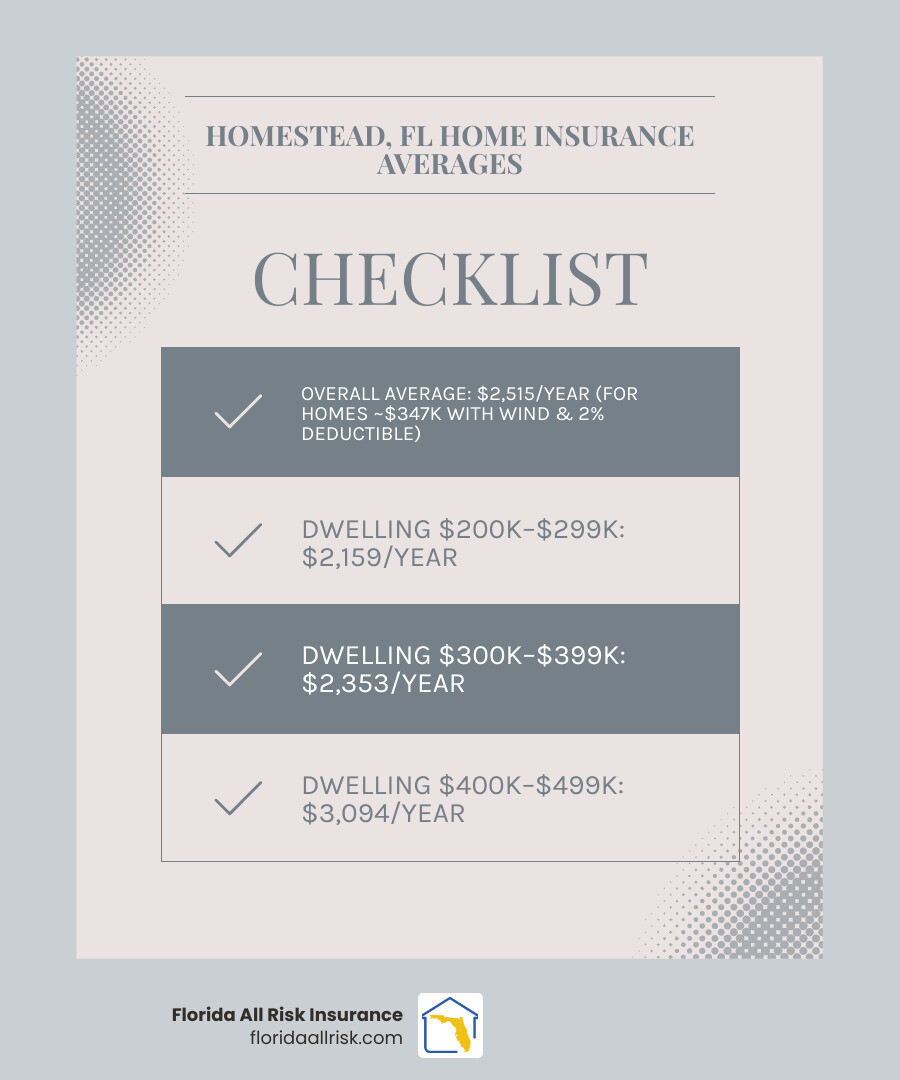
Searching for homeowners insurance Homestead FL? Here’s a quick look at average annual costs:
- Overall Average: Around $2,515 annually for policies covering homes valued at about $347,881, including windstorm and hail protection with a 2% deductible.
- For dwelling coverage limits of $200,000 – $299,999: The average annual premium is $2,159.
- For dwelling coverage limits of $300,000 – $399,999: The average annual premium is $2,353.
- For dwelling coverage limits of $400,000 – $499,999: The average annual premium is $3,094.
Your home is your “home sweet Florida home,” and securing the right homeowners insurance Homestead FL is essential to protect this valuable investment. In a place like Homestead, understanding your insurance options is key. This guide will walk you through everything you need to know, from coverage types to finding affordable solutions.
Jason Miller, a second-generation insurance professional with a B.S. in Construction Engineering, has over 20 years of experience providing homeowners insurance in Homestead, FL. He leads Florida All Risk Insurance, focusing on superior customer service and competitive rates in Florida’s dynamic insurance marketplace.
Must-know homeowners insurance homestead fl terms:
- homeowners insurance Florida
- another home insurance company leaving florida
- homeowners insurance englewood fl
Homeowners insurance is property insurance that provides financial protection against damage or loss to your private residence and its contents. It safeguards your financial stability, allowing you to rebuild if the unexpected happens. For residents in Homestead, FL (population 81,659, average home value $454,577), protecting this significant asset is paramount. It also typically includes liability coverage for accidents on your property.
What is Homeowners Insurance and Why is it Essential for Residents in Homestead, FL?
In Homestead (median household income $61,975, median age 32), homeowners insurance is a financial safety net. It protects your property against damage from perils like fires, theft, and certain natural disasters.
Without it, you’d be responsible for all repair and rebuilding costs. Since a home is most people’s largest investment, protecting it is smart financial planning. Mortgage lenders require homeowners insurance to protect their investment. Even if your home is paid off, coverage is highly recommended to protect your assets and provide peace of mind.
The Anatomy of a Standard Florida Homeowners Policy
Understanding your homeowners insurance policy is simpler than you think. While policies can be customized, most standard Florida Homeowners Insurance Products have several key parts that work together to create a safety net for your home and finances.
Dwelling Coverage (Coverage A)
Dwelling Coverage (Coverage A) protects the structure of your house, including the roof, walls, foundation, and built-in systems like electrical and plumbing. It also covers attached structures like garages. This coverage helps pay for rebuilding or repairs after a covered event. Ensure your coverage amount is enough to rebuild your home, not just its market value. For more details, see Understanding Florida homeowners insurance coverage.
Other Structures (Coverage B)
Other Structures (Coverage B) covers structures on your property not attached to your main house, such as a shed, detached garage, fence, or driveway. This coverage is typically set at 10% of your dwelling coverage but can often be adjusted for more valuable structures.
Personal Property (Coverage C)
Personal Property coverage (Coverage C) protects your belongings, such as furniture, electronics, clothing, and appliances. You can choose between:
- Actual Cash Value (ACV): Pays the current, depreciated value of an item.
- Replacement Cost Value (RCV): Pays to replace an item with a new one.
It’s highly recommended to keep a home inventory list with photos or videos to simplify claims. Learn more about personal belongings coverage.
Loss of Use / Additional Living Expenses (Coverage D)
If a covered event makes your Homestead home unlivable, Loss of Use (Coverage D), or Additional Living Expenses, helps cover costs. This includes temporary housing like a hotel or rental, and extra restaurant meals. It’s designed to help you maintain your normal standard of living while your home is repaired.
Personal Liability (Coverage E)
Personal Liability (Coverage E) protects you financially if you’re legally responsible for someone’s injury or property damage, whether it happens on or off your property. It can cover medical bills, lost wages, and legal fees. This coverage is crucial for pet owners, as it often includes incidents like dog bites. Learn more about insurance with pets here: Paws Policies: Navigating Homeowners Insurance With Dogs.
Medical Payments to Others (Coverage F)
Medical Payments to Others (Coverage F) covers minor medical expenses for guests injured on your property, regardless of who is at fault. This “no-fault” coverage helps pay for immediate medical care for small incidents, with limits typically ranging from $1,000 to $5,000. It’s a good way to handle minor issues and prevent them from becoming larger liability claims.
Decoding the Cost of Homeowners Insurance in Homestead, FL
A common question for homeowners is, “How much will it cost?” In Homestead, insurance prices are not one-size-fits-all. They are influenced by your home’s characteristics, its location, and your coverage choices. Understanding these factors helps you anticipate costs and find ways to save.
Image: A calculator and a house model on a desk, symbolizing the calculation of insurance premiums. Photo by Tierra Mallorca on Unsplash.

What is the Average Cost of Homeowners Insurance in Homestead, FL?
The average annual premium for homeowners insurance Homestead FL is around $2,515. This is for policies on homes valued at approximately $347,881 and includes windstorm and hail protection with a 2% deductible. Your specific premium will vary based on your unique circumstances.
Here’s a breakdown of how dwelling coverage limits can affect your annual premium in Homestead:
| Dwelling Coverage Limit | Average Annual Premium |
|---|---|
| $200k–$299k | $2,159 |
| $300k–$399k | $2,353 |
| $400k–$499k | $3,094 |
| $500k–$599k | $3,240 |
| $600k–$699k | $3,923 |
Key Factors That Influence Your Insurance Rates
Several key elements help determine your homeowners insurance Homestead FL premium:
- Location & ZIP Code: Proximity to the coast, neighborhood crime rates, and the local fire department’s rating all influence your premium. Homestead’s location in South Florida makes this a key factor. Insurers use a system called the Public Protection Classification (PPC) program, which grades fire departments from 1 (best) to 10. A lower PPC rating for your area, indicating better fire protection, can lead to lower insurance costs.
- Home Characteristics: The construction material, age, and overall condition of your home are carefully considered. In Florida, homes made of Concrete Block Structure (CBS) are generally cheaper to insure than wood-frame homes because they are more resistant to wind and fire damage. The quality of your electrical, plumbing, and HVAC systems also plays a significant role.
- Roof Age & Condition: A newer roof built to modern hurricane codes can lower your premium, while an older roof signals higher risk.
- Credit History: Many insurers use a credit-based insurance score to help determine risk. This score is different from your standard credit score (like FICO) but is derived from information in your credit report. It predicts the likelihood of you filing a claim. A higher score can lead to lower premiums, as it suggests lower risk to the insurer.
- Claims History: A history of multiple claims can increase your rates, while a claims-free record is often rewarded.
- Deductible Amount: This is your out-of-pocket cost for a claim. A higher deductible lowers your premium but increases what you pay if you file a claim.
- Attractive Nuisances: Features like swimming pools or trampolines can increase your liability risk and your premiums.
How Home Age and Size Impact Your Homestead, FL Insurance Premiums
Older Homes often have higher premiums due to aging electrical, plumbing, and heating systems that pose increased risks of fire or water damage.
Newer Homes typically have lower insurance rates because they are built with modern materials and adhere to current safety codes, reducing the risk of damage. As Forbes notes, Newer homes are less risky in the eyes of insurers.
Square Footage also affects premiums, as larger homes cost more to repair or replace. In Homestead, homes over 2,500 square feet average an annual premium of $5,879, while those under 2,500 square feet average around $3,798.
Discounts and Savings Opportunities
There are many ways to lower your homeowners insurance Homestead FL costs without sacrificing protection:
- Bundling Policies: Combine your home and auto insurance with the same carrier for a multi-policy discount.
- Wind Mitigation Features: Installing hurricane shutters, impact-resistant windows, and reinforced roofing can earn you substantial discounts.
- Home Security Systems: Burglar alarms, fire alarms, and smoke detectors can reduce your risk and lead to discounts.
- Claims-Free Discount: You may qualify for a discount if you have not filed claims for a certain period.
- Loyalty Discount: Staying with the same insurer for several years can lead to savings.
- New Home Discount: If you’ve recently purchased or built a new home, you may qualify for a discount.
Navigating Homestead’s Unique Insurance Risks: Hurricanes & Floods
Living in South Florida means preparing for hurricanes and floods. Your standard homeowners insurance Homestead FL policy has specific limitations for these events, so it’s crucial for residents to understand what is and isn’t covered.
Image: A home with hurricane shutters installed, prepared for a storm. Photo by Matthew T Rader on Unsplash.

Understanding Hurricane Deductibles and Windstorm Coverage
Hurricane season in Florida runs from June 1st to November 30th, and for a city like Homestead, this period demands serious preparation. The city’s history is deeply intertwined with Hurricane Andrew, the devastating 1992 storm that reshaped South Florida’s building codes and insurance landscape. Because of this history, most standard Florida policies include Windstorm Coverage, which protects your home’s structure from damage caused by wind from named storms.
The Hurricane Deductible is a direct result of the high cost of hurricane claims. It is different from your standard deductible (which covers perils like fire or theft). It’s a percentage (e.g., 1%, 2%, 5%, or 10%) of your dwelling coverage limit and applies only to damage from a named hurricane. For a home insured for $350,000 with a 2% hurricane deductible, you would pay the first $7,000 of damage out-of-pocket. Understanding this figure is crucial when selecting your policy, as it represents your immediate financial exposure during a storm. Learn more about Severe weather in Florida.
The Critical Need for Separate Flood Insurance
A critical point for homeowners: standard homeowners insurance policies do NOT cover flood damage. This exclusion applies to water damage from storm surge, overflowing rivers, or even torrential rainfall that pools and enters your home.
To protect your home from floods, you must buy a separate flood insurance policy. You have two main options:
- National Flood Insurance Program (NFIP): This is a federal program managed by FEMA. NFIP policies have set coverage limits (currently up to $250,000 for the structure and $100,000 for contents) and typically have a 30-day waiting period before coverage takes effect.
- Private Flood Insurance: Offered by private insurance companies, these policies often provide more flexibility. They may offer higher coverage limits, cover additional living expenses (which the NFIP does not), and sometimes have shorter waiting periods. An independent agent can help you compare private options alongside the NFIP.
Explore your options at Flood Insurance Florida.
FEMA Flood Maps identify high-risk flood zones (like Zones A or V). If your home is in a high-risk area and you have a federally-backed mortgage, you are legally required to have flood insurance. However, it’s strongly recommended for all homeowners, as FEMA reports that over 25% of flood claims come from outside high-risk areas. The cost factors for flood insurance include your home’s flood zone, elevation, foundation type, and chosen coverage amount. While an added expense, it provides vital protection against what is often the most costly natural disaster. Learn more about How Much Does Flood Insurance Cost in Florida.
How to Find the Right Policy and Agent in Homestead
Now that you understand the basics, the next step is finding the right homeowners insurance Homestead FL policy. This involves getting personalized quotes and comparing your options to secure your peace of mind.
How to Get a Personalized Homeowners Insurance Quote
To get an accurate, personalized quote for homeowners insurance Homestead FL, be prepared with key details about your property. You will need your property address, year built, square footage, construction type, and roof age. You should also determine your desired coverage limits for both your dwelling and personal property, and have your personal information, including claims history, ready. While online tools are available, speaking with an experienced agent can help uncover specific discounts and tailor coverage to your needs.
Choosing the Right Insurance Agent in Homestead, FL
Your choice of agent can significantly impact your policy and experience. There are two main types:
- Captive Agents work for a single insurance company and can only offer that company’s products.
- Independent Agents, like us at Florida All Risk Insurance, represent multiple insurance companies. This allows us to shop the market for you, comparing policies from various insurers to find the best coverage at the most competitive rate. We work for you, not an insurance company, providing personalized advice custom to your needs in Florida’s dynamic market. Learn more about finding the best options in our guide to the Best Homeowners Insurance in Florida 2025.
Steps to Take Before Finalizing Your Policy
Before finalizing your homeowners insurance Homestead FL policy, take these crucial steps:
- Read your policy thoroughly: Understand all terms, conditions, exclusions, and limitations.
- Verify coverage limits and deductibles: Ensure your dwelling coverage is sufficient for a full rebuild and that you are comfortable with your deductible amounts, including the hurricane deductible.
- Ask questions: Clarify any confusing terms or conditions with your agent.
- Review the insurer’s financial strength: Check ratings from agencies like A.M. Best to ensure the company can pay claims.
- Ensure continuous coverage: Avoid any gaps between your old and new policies.
Frequently Asked Questions about Homestead Homeowners Insurance
Here are answers to some common questions about homeowners insurance in Homestead, FL.
Is homeowners insurance required by law in Homestead, FL?
No, Florida state law does not mandate homeowners insurance. However, if you have a mortgage, your lender will almost certainly require it to protect their investment. Even if your home is paid off, coverage is highly recommended to protect your largest asset and provide financial security.
What is a wind mitigation inspection and can it save me money?
Yes, it can save you money. A wind mitigation inspection assesses how well your home is built to withstand high winds. A certified inspector checks features like your roof’s shape, how the roof is attached, the presence of hurricane-rated windows or shutters, and a secondary water resistance barrier. A favorable report showing these protective features can lead to significant discounts on your Homeowners Insurance Florida premium, as a more resilient home is less risky to insure.
Does my policy cover sinkholes?
Standard Florida homeowners policies typically do not cover sinkhole damage. They may cover “catastrophic ground cover collapse,” but this has a very strict legal definition that is rarely met. For full protection, you must purchase separate sinkhole coverage as an endorsement to your policy. It’s important to discuss this option with your agent to understand your risks and coverage needs.
Your Partner in Protecting Your Homestead Home
Navigating homeowners insurance Homestead FL involves understanding everything from hurricane deductibles to cost factors. The goal is to secure a policy that fits your home, your family, and the unique risks of living in South Florida. By understanding your coverage choices, cost drivers, and the need for specialized protection like flood insurance, you can make an informed decision that brings peace of mind.
This is where an independent agency like Florida All Risk Insurance provides a key advantage. Unlike captive agents tied to one carrier, we offer access to a wide network of top-rated insurance providers. This allows us to find the best possible coverage at the most competitive price for your Homestead home.
Your home is where your life unfolds. Don’t leave its protection to chance. Let a trusted expert guide you in building a policy that feels right. To explore your options and tailor the perfect protection for your home, get a comprehensive review of your Florida Homeowners Insurance with us today. We are here to help you protect your “home sweet Florida home.”
Contact Us
When you’re ready to connect, we’re here for you. Whether you have more questions about homeowners insurance Homestead FL or are ready to get your personalized quote, reaching out is easy. We’re always happy to help you protect what matters most.
Florida All Risk Insurance
Saint Petersburg, FL
Phone: (727) 498-7230
Email: [email protected]
Authoritative Outbound Links
We believe that being well-informed is your best defense when it comes to protecting your home. That’s why we always encourage you to explore reputable sources and dig a little deeper. Here are some fantastic, trustworthy resources that can help you understand even more about homeowners insurance in Florida:
-
If you’re looking for a comprehensive overview of what Florida homeowners insurance typically covers, the Florida Department of Financial Services offers an excellent guide. You can gain a deeper understanding of your policy’s components by checking out their page on Understanding Florida homeowners insurance coverage. It’s a clear and official resource straight from the state!
-
Ever wondered why your home’s age might affect your insurance rates? Forbes Advisor sheds some light on this, explaining how Newer homes are less risky in the eyes of insurers. This article helps clarify why modern construction and updated features can work in your favor when it comes to premiums.

