

High Risk Small Business Insurance: Secure Your 2025
Understanding the High-Risk Small Business Insurance Landscape in Florida
Metadata: Business owner reviewing insurance policy, high risk small business insurance, Florida market, risk assessment.
High risk small business insurance is specialized coverage for businesses facing elevated risks due to their industry, operations, location, or claims history. These ventures require protection beyond standard policies to address their unique exposures. Whether you’re a contractor using heavy machinery, a restaurant owner managing fire hazards, or a transportation company with a fleet of vehicles, understanding your risk profile is the first step toward securing the right protection.
In a dynamic state like Florida, the need for this coverage is particularly acute. The state’s booming construction industry, thriving hospitality sector, and status as a logistics hub mean that many businesses inherently operate with higher-than-average risk. Compounded by exposure to natural disasters like hurricanes, the standard insurance market often shies away, leaving many entrepreneurs feeling vulnerable. This is where specialized high-risk insurance becomes not just an option, but a fundamental necessity for survival and growth.
While this specialized insurance comes with higher premiums, it’s often the only barrier between your business and financial catastrophe. A single lawsuit or disaster can lead to devastating damages and legal fees. Key coverages include:
- General Liability: Protects against third-party injury and property damage claims.
- Commercial Property: Covers buildings and equipment in high-risk locations.
- Commercial Auto: Insures vehicles for businesses with poor driving records or high-risk operations.
- Workers’ Compensation: Covers employee injuries, which is critical for dangerous industries.
As a second-generation insurance professional with over 20 years of experience in Florida’s volatile market, I’ve helped thousands of businesses steer the complexities of high risk small business insurance. At Florida All Risk Insurance, my team specializes in finding coverage for hard-to-place businesses that standard carriers often reject.
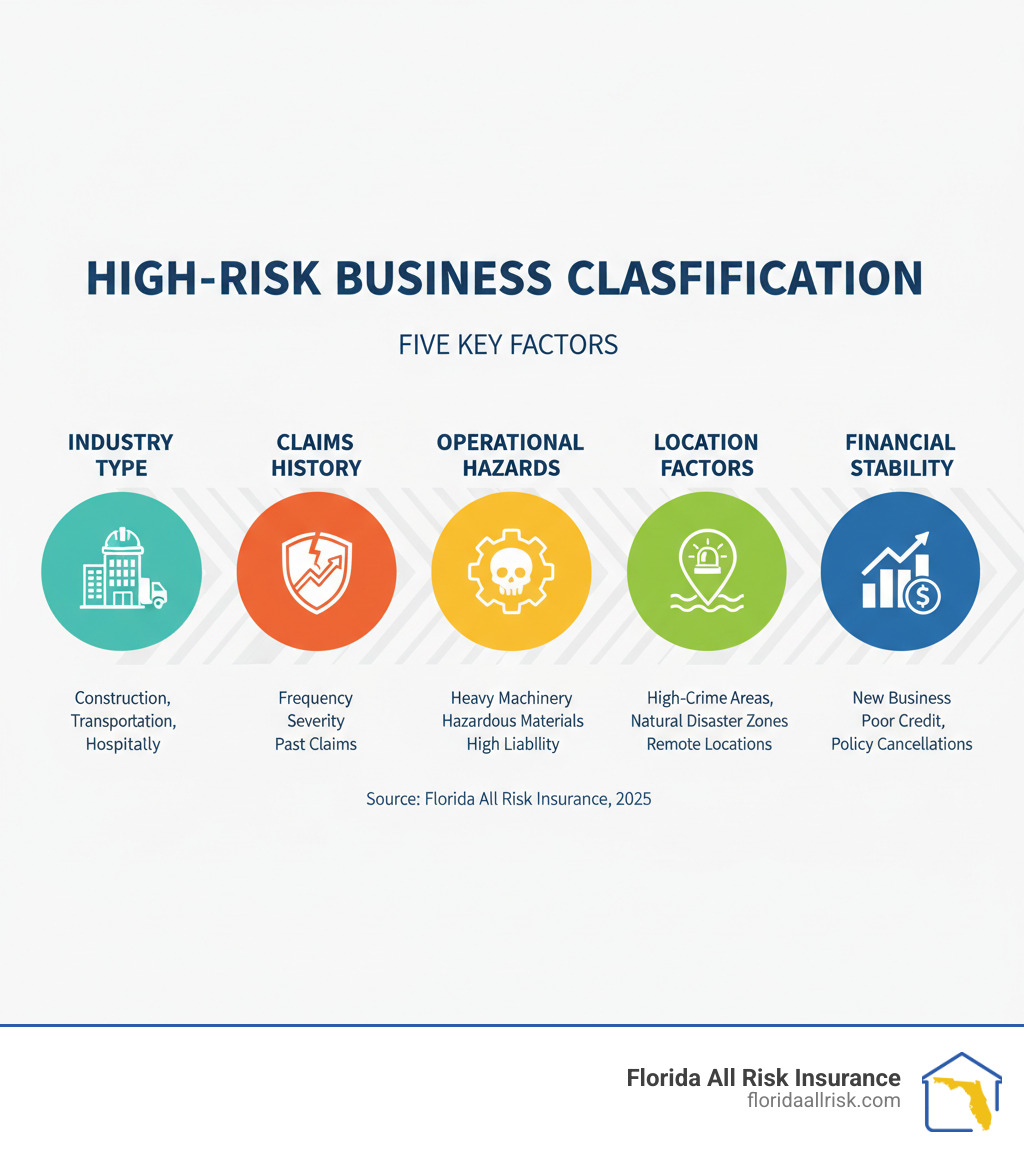
Metadata: Infographic, high-risk business factors, industry type, claims history, operational hazards, location, financial stability.
What It Means to Be a “High-Risk” Small Business
In the insurance world, “risk” refers to the likelihood that a business will file a claim. Being labeled “high-risk” isn’t a judgment on your business’s quality; it’s a calculated assessment by underwriters based on data and specific operational factors. Understanding these factors is crucial to securing the right protection. While nearly 44% of business owners may operate without insurance, this is a gamble that can jeopardize everything for those in high-risk categories.
Defining a High-Risk Business from an Insurer’s Perspective
From an insurer’s viewpoint, a “high-risk” business is one with a greater potential for claims or lawsuits compared to an average small business. Underwriters analyze your operations to assess the increased probability of claims and lawsuit potential. A roofing company working at heights faces different risks than a home-based consulting firm, and insurance pricing reflects that.
When standard carriers decline coverage, specialized carriers in the “Excess & Surplus” (E&S) or non-standard market step in. These companies are designed to handle businesses that don’t fit the standard mold. Unlike standard (or “admitted”) carriers that are rigidly regulated by state insurance departments, E&S carriers have the flexibility to set rates and create policy forms tailored to unique, complex risks. This freedom allows them to insure businesses that would otherwise be left unprotected. The underwriting process is more thorough, but being hard-to-place doesn’t mean you’re impossible to insure.
Key Factors That Increase Your Risk Profile
Several factors can place your business in the high-risk category. Understanding them can help you prepare for the insurance marketplace.
-
Industry Type: This is often the biggest factor. Industries like construction, transportation, and hospitality (restaurants, bars) are inherently more prone to accidents, injuries, and liability claims due to the nature of their work.
-
Claims History: A track record of frequent or severe insurance claims signals higher risk to insurers, as past behavior can predict future events. Even a single large, unresolved claim can make it difficult to find standard coverage.
-
Operational Hazards: Daily operations involving heavy machinery, hazardous materials, or complex processes increase scrutiny from insurers. Think of manufacturing, chemical handling, tree removal services, or businesses that perform work at significant heights.
-
Business Location: Operating in high-crime areas or natural disaster zones—a common concern in Florida with its hurricane exposure—automatically increases risk. Remote locations with limited fire protection or properties adjacent to hazardous businesses also pose challenges.
-
Financial History and Experience: New businesses with unproven track records, poor credit history, or inexperienced ownership may be viewed as higher risk. Insurers see a lack of a proven safety and management history as an unknown variable.
-
Policy History: Previous policy cancellations or non-renewals are major red flags for new carriers, who will want to understand why your prior coverage was terminated, whether for non-payment of premium or an unacceptable number of claims.
While these factors increase your risk profile, they don’t make you uninsurable. With the right approach and insurance partner, every business can find the protection it needs.
Core Categories of High-Risk Commercial Insurance
When your business is labeled “high-risk,” you enter a specialized world of insurance. This coverage is crafted to handle the unique exposures that standard insurers avoid. While you may face higher premiums and stricter terms, this specialized coverage can mean the difference between staying in business after a major incident or closing your doors forever. High-risk coverage is generally broken down into three main categories.
High-Risk Commercial General Liability Insurance
Commercial General Liability is your business’s frontline defense against claims from third parties. For high-risk businesses, this coverage is critical. It protects against:
- Bodily Injury Claims: Incidents like a customer slipping on a wet floor in a restaurant, a passerby being injured by debris from a construction site, or a client tripping over equipment left in a walkway.
- Property Damage Liability: Scenarios such as a delivery driver backing into a client’s storefront, a painting crew spilling paint on a customer’s expensive rug, or your crew accidentally damaging underground utility lines.
- Personal and Advertising Injury: Claims related to libel, slander, or copyright infringement. For example, a marketing campaign that unintentionally uses a competitor’s trademarked slogan could trigger a lawsuit.
High-liability industries like construction and hospitality face these exposures daily. Robust lawsuit protection is essential, as this coverage can handle both defense costs and potential settlements, which can otherwise be financially devastating.
To dive deeper into how this essential protection works, learn more about High Risk General Liability Insurance or explore our guide on Commercial General Liability Insurance for Small Business.
High-Risk Commercial Property Insurance
Your building, equipment, and inventory are valuable assets. High-risk commercial property insurance is designed for properties that standard insurers find too risky to cover. This includes:
- Vacant properties that attract vandalism, theft of copper wiring, squatters, and are more susceptible to undetected fire or water damage.
- Older buildings with outdated electrical or plumbing systems, which have a higher probability of causing fires or major water leaks.
- Properties with poor construction materials or structural issues, such as an un-reinforced masonry building in an earthquake-prone area.
- Buildings with high-risk tenants, such as student housing, nightclubs, or short-term rentals, where the likelihood of property damage is higher.
- Locations in flood or hurricane zones, a significant factor for any property in Florida, where wind and water damage can be catastrophic.
Specialized property insurance exists for these challenging situations, providing coverage for perils that standard carriers won’t touch. For more details, visit our page on High Risk Commercial Property Insurance and learn about assessing your Commercial Property Insurance Risk.
High-Risk Commercial Auto Insurance
Business vehicles can be a major source of risk. High-risk commercial auto coverage is necessary when standard insurers are wary of your driving records, vehicle types, or operations. Common triggers include:
- Poor driving records with multiple tickets, at-fault accidents, or DUIs among your drivers.
- Inexperienced drivers, especially those under 25, who statistically have higher accident rates.
- High-risk vehicles like heavy trucks, tow trucks, or delivery vans that can cause significant damage in an accident. This also includes vehicles with specialized or expensive equipment attached.
- No prior insurance history, which makes it difficult for insurers to assess a new business’s risk and predict future performance.
- High mileage operations, as more time on the road directly increases exposure to accidents. This is common for logistics, delivery, and taxi services.
The key to managing this risk is working with professionals who understand this specialized market and can find coverage that protects your business without breaking your budget.
The Financial Realities of High-Risk Small Business Insurance
It’s no secret: high risk small business insurance costs more than standard coverage. Insurers charge higher premiums because they are taking on greater financial risk. However, viewing this cost as just another expense is a mistake. I’ve seen too many business owners cut corners on coverage, only to face financial devastation when a disaster strikes. A policy with a multi-million dollar coverage limit might seem expensive, but it could be the only thing standing between your business’s survival and bankruptcy.

Metadata: Business owner, safety measure, security camera, safety training, risk management, insurance premium reduction.
Comparing the Costs: Standard vs. High-Risk Premiums
To be transparent, the price difference can be stark. A low-risk tech consulting firm might pay a few hundred dollars annually for general liability, while a high-risk roofing contractor could face premiums in the thousands. This difference isn’t arbitrary; it’s calculated based on your specific risk factors, including industry, location, claims history, and coverage needs. High-risk policies may also come with higher deductibles.
| Insurance Type | Low-Risk Business (e.g., Consulting Firm) | High-Risk Business (e.g., Roofing Contractor) |
|---|---|---|
| General Liability | $300 – $1,500 annually | $2,000 – $10,000+ annually |
| Commercial Property | $500 – $2,500 annually | $1,500 – $15,000+ annually |
Note: These figures are estimates and can vary widely based on numerous specific factors.
The Consequences of Inadequate Coverage
Operating without adequate coverage can be devastating. The consequences extend beyond just financial loss. A single major lawsuit can lead to financial ruin, draining business accounts and even forcing you into personal bankruptcy. Legal fees alone can cripple a small business, even if you win the case. Without proper coverage, you may face asset liquidation, lose out on valuable contracts that require proof of insurance, and suffer irreparable reputational damage.
Actionable Strategies to Lower Your Insurance Premiums
Being classified as high-risk doesn’t have to be a permanent sentence. You can take proactive steps to lower your premiums over time.
- Implement a formal safety program: Documented safety protocols show insurers you are serious about preventing incidents.
- Conduct regular employee training: As research from PwC highlights, well-trained teams have fewer accidents, which can lower premiums.
- Improve your property: Installing security systems, fire suppression equipment, and modern alarms can make a substantial difference.
- Prioritize property maintenance: Keeping electrical, plumbing, and roofing systems in good repair reduces the chance of claims.
- Maintain a clean claims history: Every year without a claim strengthens your case for lower premiums.
- Increase your deductible: If you have good cash reserves, accepting a higher out-of-pocket cost can provide immediate premium relief.
- Develop a risk management strategy: A comprehensive plan shows insurers you are actively minimizing your exposures. The U.S. Chamber of Commerce offers excellent guidance on this topic.
These strategies build a compelling case for lower premiums over time, with some businesses reducing their costs by 30% or more after several years of consistent effort.
How to Secure the Right High-Risk Small Business Insurance
Navigating the high-risk insurance market can feel overwhelming, but “hard-to-place” does not mean “impossible-to-insure.” The key is to partner with professionals who specialize in this area. An independent insurance broker is your most valuable ally, providing access to specialized carriers and expert guidance to find a policy that fits your unique risk profile and budget.
Determining if Your Business Needs High-Risk Coverage
The first step is an honest assessment. You may need specialized coverage if:
- Your business is in a high-risk industry like construction, transportation, or hospitality.
- Your daily operations involve heavy machinery, hazardous materials, or work in dangerous environments.
- You have a history of multiple claims or a single severe incident.
- You have experienced policy non-renewals or cancellations.
- Clients or landlords require high-limit coverage that standard policies don’t offer.
Recognizing your high-risk status early allows you to proactively seek the right coverage. For a broader look at business insurance, explore our general guide on Insurance for Small Businesses.
The Crucial Role of an Independent Insurance Broker
For high risk small business insurance, an independent broker is essential. Unlike standard agents tied to a few carriers, an independent agency like Florida All Risk Insurance offers:
- Access to Specialty Markets: We have relationships with “Excess & Surplus” (E&S) carriers who focus on challenging risks that standard insurers reject.
- Policy Customization: We take the time to understand your unique operations to help craft coverage that truly protects your exposures.
- Risk Assessment Guidance: We provide practical advice on how to reduce your risks over time, which can lead to lower premiums.
- Claims Advocacy: If a claim occurs, we guide you through the process, ensuring you have an expert on your side.
- Market Competition: We shop the market for you, comparing options from multiple specialized insurers to find competitive rates and better terms.
The Process: What to Expect When Working with a Broker
Partnering with a specialized broker involves a clear, collaborative process designed to find the best possible solution for your business.
- Initial Consultation and Discovery: The process begins with a detailed conversation about your business. Your broker will ask about your operations, revenue, payroll, number of employees, equipment, vehicles, and past claims history. Be prepared to be transparent; the more accurate the information, the better the outcome.
- Application and Submission: Your broker will help you complete the necessary insurance applications. For high-risk businesses, this often requires supplemental applications specific to your industry (e.g., a roofing questionnaire or a restaurant liability form). They will then create a professional submission package and present it to multiple E&S carriers that are a good fit for your risk profile.
- Negotiation and Quoting: The broker receives quotes from various carriers. This is where their expertise shines. They will analyze the terms, conditions, exclusions, and pricing of each option. They may negotiate with underwriters to refine coverage or improve pricing based on your business’s strengths and risk management efforts.
- Proposal and Review: Your broker will present you with the best options, explaining the differences in coverage, limits, deductibles, and premiums. They will translate the complex insurance jargon into plain English, empowering you to make an informed decision.
- Binding Coverage and Servicing: Once you select a policy, the broker will “bind” coverage, meaning your policy is officially active. They will provide you with proof of insurance (like a Certificate of Insurance) and remain your point of contact for any policy questions, changes, or claims throughout the year.
Understanding Legal and Regulatory Implications
Securing the right insurance is also about meeting legal and contractual obligations. In Florida, Workers’ Compensation insurance is typically mandatory for businesses with employees. Additionally, many industries face specific regulations, such as federal mandates for trucking companies. Failing to comply can lead to fines or license suspension.
Many business opportunities depend on meeting contractual obligations for insurance. Landlords and corporate clients often require a Certificate of Insurance (COI) as proof of coverage before they will work with you. Without it, you could be locked out of valuable contracts. The SBA provides valuable guidance on business insurance to help you understand your obligations.
Frequently Asked Questions about High-Risk Insurance
When business owners find they need high risk small business insurance, they often have similar questions. Here are answers to the most common concerns we hear.
What are the most common industries that need high-risk small business insurance?
While risk is unique to each business, certain industries consistently require specialized coverage due to their operations. These include:
- Construction and Contractors
- Restaurants and Bars
- Transportation and Trucking
- Cannabis-related Businesses
- Security Services
- Manufacturing with hazardous materials
- Entertainment and Event Venues
- Auto Repair and Dealerships
The common thread is that their daily activities statistically lead to more insurance claims than a typical office-based business.
How long will my business be considered high-risk?
This classification is not necessarily permanent. Many businesses transition back to standard insurance markets by demonstrating a commitment to safety and maintaining a clean claims record. With consistent effort, some businesses can improve their risk profile enough to qualify for standard coverage in as little as one to two years.
The key is implementing strong risk management, conducting regular employee training, and avoiding claims for several years (typically three to five). An annual review with your insurance broker is essential to track your progress and explore better options as your profile improves.
What is the difference between an admitted carrier and a non-admitted (E&S) carrier?
This distinction is crucial for high-risk businesses. Admitted carriers are licensed by the state and must follow strict state regulations on rates and policy forms. They also contribute to the state’s guaranty fund, a safety net that pays claims if the insurer fails.
Non-admitted carriers, also known as Excess & Surplus (E&S) lines carriers, are approved to insure risks that admitted carriers won’t cover. They have more flexibility in pricing and coverage terms, which is why they are the solution for most high-risk businesses. However, E&S carriers do not contribute to state guaranty funds. This makes it critical to work with an experienced broker who only partners with financially stable and reputable E&S carriers.
What should I look for in a high-risk insurance policy?
Because E&S policies are not standardized, it’s vital to review the details carefully with your broker. Pay close attention to:
- Exclusions: High-risk policies often contain specific exclusions. For example, a roofer’s policy might exclude work on buildings over a certain height or any work involving torches. Make sure the policy doesn’t exclude a core part of your operations.
- Sub-limits: A policy might have a $1 million general liability limit, but a much lower sub-limit (e.g., $100,000) for a specific risk like assault and battery coverage for a bar. Understand these limitations.
- Claims-Made vs. Occurrence Form: Most general liability policies are “occurrence” based, meaning they cover incidents that happen during the policy period, regardless of when the claim is filed. Some high-risk policies are “claims-made,” which only cover claims filed while the policy is active. This is a critical distinction that affects your long-term protection.
- Deductibles: High-risk policies may have higher deductibles or multiple deductibles for different types of claims. Ensure you can comfortably cover these out-of-pocket costs.
Your Partner in Protecting Your Business
Running a high risk small business takes courage and resilience. While the insurance landscape might seem complex, securing the right high risk small business insurance is one of the smartest investments you can make in your future. It’s not just about buying a policy; it’s about buying peace of mind so you can focus on what you do best: growing your business.
High-risk businesses are often essential to our communities. Construction companies build our cities, restaurants create gathering places, and transportation companies keep our economy moving. At Florida All Risk Insurance, we believe every business deserves protection, no matter how complex its risks.
Finding the Right Insurance Partner
Our team has built a reputation on helping Florida business owners who were told “no” by other agencies. What sets us apart is our understanding that behind every policy is a person with a dream. We have the expertise and relationships with specialized Excess & Surplus carriers to steer even the most challenging insurance situations. We don’t just find you a policy; we partner with you for the long term, from the initial quote to claims support.
Your Next Steps Forward
Don’t let insurance uncertainty hold your business back. Every day without proper coverage is a gamble with everything you’ve built. Getting started is easier than you think.
Ready to protect your hard work? Request a custom business insurance quote today and find how affordable comprehensive coverage can be.
Have specific questions about your unique situation? Contact our experienced team for personalized guidance that fits your exact needs.
Contact Us
Florida All Risk Insurance
Address: 7000 4th St N, St. Petersburg, FL 33702
Phone: (727) 522-6641
Email: [email protected]

