

Why Health Insurance for Businesses is Critical to Your Success
Health insurance for businesses is more than just a benefit – it’s a strategic investment that can make or break your company’s ability to attract talent, retain employees, and build a thriving workplace culture.
Quick Overview: Health Insurance for Businesses
- What it is: Group health coverage that pools risk across multiple employees for better rates
- Who needs it: Any business wanting to attract top talent (not mandatory for companies under 50 employees)
- Average cost: $286 per person per month, with employers typically covering 50% or more
- Key benefits: 79% of employees prefer benefits over pay raises, 70% more likely to stay loyal
- Tax advantages: Premiums are tax-deductible business expenses, potential 50% tax credit for qualifying small businesses
- Plan types: HMO, PPO, POS, High-Deductible Health Plans (HDHP), pooled plans, and supplemental coverage
The numbers tell a compelling story. Nearly half (49%) of small business employees would choose health benefits over a pay raise. Even more striking – 76% of employees without health benefits would leave their current job for one offering better coverage. For small businesses competing for talent, this isn’t just about being nice to employees. It’s about survival.
The bottom line: Offering health insurance isn’t just the right thing to do – it’s smart business. Companies that invest in employee health see reduced turnover, higher productivity, and a stronger employer brand that attracts better candidates.
As Jason Miller, a second-generation insurance professional with over 20 years of experience helping Florida businesses steer complex insurance needs, I’ve seen how health insurance for businesses transforms companies from struggling to retain staff to becoming employers of choice. My team at Florida All Risk Insurance has helped thousands of businesses find the right coverage that balances employee needs with budget realities.

Simple Health insurance for businesses word guide:
- what is a self funded group health insurance plan
- Small business employee benefits
- how to choose a group health insurance plan
What Is Business Health Insurance & How Does It Work?
Think of health insurance for businesses as a safety net that works better when more people are holding it together. Business health insurance, also called group health insurance, provides healthcare coverage for your employees and their families through risk pooling – where your entire workforce is viewed as one group rather than individual health histories.
Here’s how it works: Your business signs a contract with an insurance carrier to cover your employees. You and your team split the cost – most employers pay at least 50% of the employee-only premium, while employees contribute through payroll deductions. The guaranteed issue feature means employees can’t be turned away because of pre-existing conditions, and underwriting looks at your group’s overall health rather than individual medical histories.
Health insurance for businesses – basics & terminology
Understanding key terms helps you make informed decisions. The deductible is what employees pay out-of-pocket before insurance kicks in. Copays are flat fees for specific services like doctor visits. Coinsurance is the percentage employees pay after meeting their deductible. The out-of-pocket maximum caps annual expenses, while premiums are monthly membership fees typically shared between employer and employee.
For more detailed information about how these concepts apply to your specific business situation, check out our business health insurance services page.
Why Small Businesses Should Offer Health Insurance
Health insurance for businesses isn’t just about being generous – it’s about making smart business decisions. Nearly 79% of employees prefer better benefits over pay raises, and employees with good benefits are 70% more likely to stay with their employer.
The recruitment advantage is significant. When competing for talent, you’re not just competing on salary but on the complete package. For most people, health insurance represents $5,000 to $15,000 in annual value that doesn’t come from your salary budget but makes your total compensation much more attractive.
The ROI of employee well-being
The return on investment is measurable. Employees with health insurance access preventive care, catching problems early and avoiding expensive emergency situations. They’re more productive, take fewer sick days, and show up less stressed about medical bills. Scientific research on employee wellness consistently shows healthier employees are more engaged and creative at work.
Types of Health Insurance Plans for Businesses
When exploring health insurance for businesses, you’ll find several plan types designed for different needs and budgets.
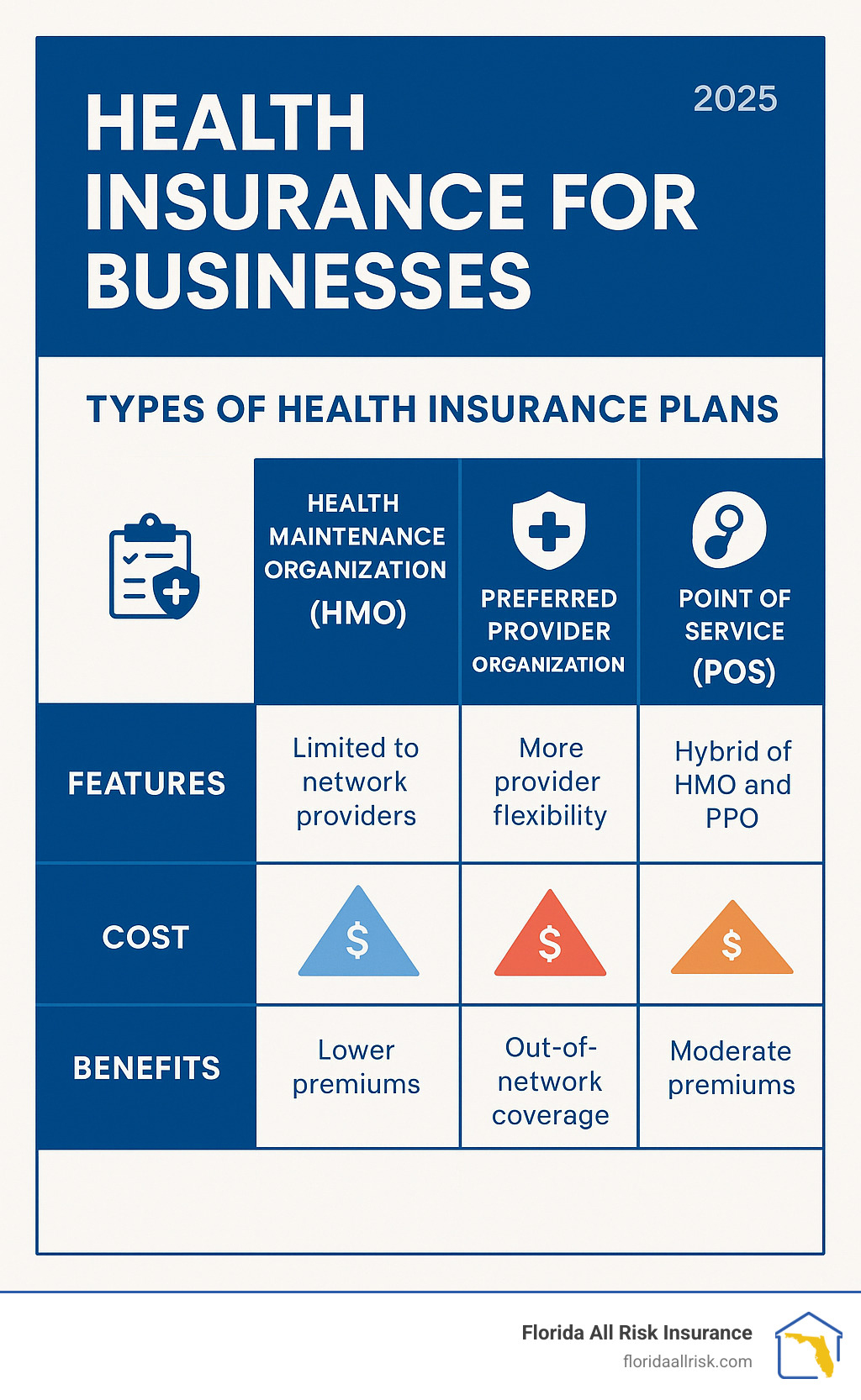
Health Maintenance Organizations (HMOs) keep costs down by requiring employees to stay within a specific network and choose a primary care physician who coordinates all care. Preferred Provider Organizations (PPOs) offer flexibility to see any doctor without referrals but cost more. Point of Service (POS) plans combine HMO coordination with PPO flexibility.
High-Deductible Health Plans (HDHPs) feature lower premiums but higher deductibles, often paired with Health Savings Accounts (HSAs) for tax advantages.
| Plan Type | Monthly Premium | Deductible | Provider Flexibility | Best For |
|---|---|---|---|---|
| HMO | Lower | Lower | Limited to network | Cost-conscious employees |
| PPO | Higher | Moderate | High flexibility | Employees wanting choice |
| POS | Moderate | Moderate | Moderate flexibility | Balance of cost and choice |
| HDHP | Lowest | Highest | Varies | Healthy employees with HSA |
Plan structures and pooled options
Fully-insured plans offer predictable monthly costs where you pay fixed premiums and the insurance company handles all claims. Self-insured plans let larger businesses pay claims directly, potentially saving money with healthy workforces.
Pooled insurance plans combine multiple small businesses into larger risk pools, providing better rates and stability. For detailed information about pooled plans, visit our Business Health Insurance for Small Businesses resource page.
Optional benefits
Dental and vision insurance are highly valued, affordable add-ons. Disability insurance protects income if employees can’t work due to illness or injury. Life insurance and critical illness coverage provide additional financial security for employees and their families.
Cost, Tax Advantages & Compliance Essentials
Understanding the real costs and benefits of health insurance for businesses is crucial for smart decision-making. The average small business plan costs about $286 per person monthly, with employers typically covering 50% or more. However, significant tax advantages reduce your actual costs.
Budgeting and tax benefits
The Small Business Health Care Tax Credit can cover up to 50% of premiums for qualifying businesses with 25 or fewer employees and average wages under $50,000. Premium deductibility means group health insurance premiums are tax-deductible business expenses, reducing your taxable income.
Section 125 plans allow employees to pay their portion with pre-tax dollars, providing additional savings. For Florida-specific strategies, check out our Florida Group Health Insurance page.
The Small Business Health Options Program (SHOP) provides additional resources and potential tax benefits for qualifying small businesses.
Compliance requirements
While health insurance for businesses isn’t mandatory for companies under 50 employees, understanding regulations helps avoid issues. The Employer Mandate requires businesses with 50+ full-time employees to provide coverage or face penalties.
HIPAA compliance applies to all group plans, requiring protection of employee health information. COBRA continuation coverage requirements apply to businesses with 20+ employees, offering continued coverage after qualifying events like job loss.
Choosing and Managing Your Plan
Selecting the right health insurance for businesses starts with a needs assessment. Talk to your employees about their priorities – some prefer low monthly costs with higher deductibles, while others need comprehensive coverage for ongoing health conditions.

Setup process
Start by gathering employee census data, then request quotes from multiple carriers for comparison. Complete applications thoroughly to avoid delays, and be responsive during the underwriting review. Once approved, pay initial premiums promptly and distribute welcome materials to employees.
For detailed guidance, check out our How to Choose a Group Health Insurance Plan resource.
Ongoing management
Modern benefits administration relies on technology. HRIS integration connects your systems with insurance carriers, reducing manual work. Self-service portals give employees 24/7 access to benefits information. Claims dashboards help you understand usage patterns for better renewal decisions.
Regular plan reviews ensure your coverage stays competitive and effective as your workforce evolves.
Frequently Asked Questions about Health Insurance for Businesses
When it comes to health insurance for businesses, I hear the same questions from business owners week after week. Let me address the most common concerns that keep entrepreneurs up at night – because honestly, navigating healthcare benefits shouldn’t be more complicated than running your actual business.
Is it mandatory for my small business to offer coverage?
Here’s the straightforward answer: health insurance for businesses isn’t mandatory if you have fewer than 50 full-time equivalent employees. You’re off the hook legally, but that doesn’t mean you should dismiss it entirely.
The Affordable Care Act only requires businesses with 50 or more full-time equivalent employees to provide affordable health insurance that meets minimum essential coverage requirements. If you don’t comply and you’re over that threshold, you’ll face penalties that can really hurt your bottom line.
But here’s what I tell my clients – just because you’re not legally required to offer coverage doesn’t mean you shouldn’t consider it. Remember those statistics I mentioned earlier? 76% of employees without health benefits would leave their current job for one offering better coverage. That’s not just a number – that’s your talent walking out the door to your competitors.
Think of it this way: if you’re trying to attract quality employees and your competitor down the street offers health insurance while you don’t, who do you think is going to land the better candidates? It’s not really about what’s required – it’s about what’s smart for your business.
How many employees do I need to qualify for group health insurance?
Most insurance carriers require at least two employees to qualify for group health insurance, and here’s the catch – the second employee needs to be a legitimate W-2 employee who isn’t the spouse of a business owner. So you can’t just put your spouse on payroll and call it a day (nice try though!).
The participation requirement is where it gets interesting. Most carriers want to see at least 75% of your eligible employees enrolled in the plan. This makes sense from their perspective – they need enough people in the risk pool to make the numbers work.
But don’t let these requirements discourage you if you’re a smaller business. There are options like pooled plans and association coverage that can help smaller companies access group benefits. The key is working with an experienced broker who understands the different pathways available.
Larger groups generally get better rates and more plan options because insurance companies love that improved risk pooling. If you have 10 employees versus 3, you’re going to have more leverage in negotiations and more carriers willing to compete for your business.
What are Health Spending Accounts (HSAs) and how do they work?
Health Spending Accounts (HSAs) are one of the best-kept secrets in health insurance for businesses, and I’m genuinely excited to explain them because they offer incredible value when used correctly.
An HSA is essentially a tax-advantaged savings account specifically for medical expenses. But here’s what makes them special – they offer what we call “triple tax advantages.” Your contributions are tax-deductible, the money grows tax-free while it sits in the account, and when you withdraw it for qualified medical expenses, you don’t pay taxes on that either. It’s like the IRS actually wants to help you save money on healthcare (shocking, I know).
There’s one important catch: HSAs can only be paired with High-Deductible Health Plans (HDHPs). This means your health insurance plan needs to meet specific deductible minimums set by the IRS each year.
For 2024, individuals can contribute up to $4,150 to an HSA, while families can contribute up to $8,300. If you’re over 55, you get an additional $1,000 catch-up contribution because apparently, the government recognizes that healthcare gets more expensive as we age.
Unlike Flexible Spending Accounts (FSAs) that follow the “use it or lose it” rule, HSA funds roll over year after year. You can even invest the money for long-term growth, essentially creating a healthcare retirement account. I’ve seen employees build substantial HSA balances over time that provide real financial security.
HSAs work particularly well for healthy employees who want to minimize premium costs while building savings for future medical expenses. They give employees more control over their healthcare spending decisions, which many people really appreciate in today’s healthcare environment.
The beauty of offering HSAs as part of your benefits package is that it provides value to employees while often reducing your premium costs compared to traditional low-deductible plans. It’s one of those rare win-win situations in business.
Conclusion
Making the decision to offer health insurance for businesses creates a foundation for long-term success. The investment pays dividends through better retention, stronger recruitment, and improved workplace culture.
Start by assessing your needs through employee input, compare options carefully beyond just price, and leverage available tax advantages. The small business health care tax credit and premium deductibility can significantly reduce actual costs.
At Florida All Risk Insurance, we’ve helped thousands of Florida businesses find the right balance between employee needs and budget realities. We understand every company is unique and don’t believe in one-size-fits-all solutions.
Our team takes time to understand your specific situation, explains options clearly, and helps you make informed decisions. We’re here to find the right plan that works for your business, not sell you the most expensive option.
Ready to explore your options? Visit our Affordable Employee Health Insurance page to learn more about how we can help your business thrive through better employee benefits.
Contact Us
Florida All Risk Insurance
Saint Petersburg, FL
Email: [email protected]
When it comes to health insurance for businesses, you don’t have to steer this complex landscape alone. Our experienced team at Florida All Risk Insurance understands that every business is unique, and we’re committed to finding the perfect insurance solution that fits both your budget and your employees’ needs.
As an independent insurance agency based in Saint Petersburg, Florida, we’ve built our reputation on providing personalized service that goes beyond just selling policies. We take the time to understand your business, your workforce, and your goals. Whether you’re a small startup looking to offer benefits for the first time or an established company seeking to optimize your current coverage, we’re here to guide you through every step of the process.
Our team brings decades of combined experience in the Florida insurance market, giving us deep insights into what works best for businesses across different industries and sizes. We work with multiple carriers, which means we can present you with options rather than trying to fit you into a one-size-fits-all solution.
Ready to explore your options? Contact us today for a personalized consultation where we’ll discuss your specific needs, answer all your questions, and show you how the right health insurance plan can become a powerful tool for your business success.

