

Hazard Insurance for Commercial Property: A Complete Guide to Safeguarding Your Business
When you own a business, your commercial property is more than just a building; it is the foundation of your operations, housing valuable assets, equipment, and inventory. Protecting this investment from unforeseen events is not just a good idea—it’s a critical component of a sound business continuity strategy. Hazard insurance for commercial property, more commonly known as commercial property insurance, is the financial shield that helps your business recover from unexpected events that can damage or destroy your physical assets.
The stakes are incredibly high. According to the U.S. Small Business Administration (SBA), a staggering 40% of businesses never reopen their doors following a major disaster, and another 25% fail within the subsequent year. These statistics underscore a harsh reality: without adequate financial protection, a single event like a fire, hurricane, or significant theft can permanently shutter an otherwise thriving enterprise. This insurance provides the capital needed for repairs, replacement of essential equipment, and restocking of inventory, allowing you to focus on getting back to business instead of facing financial ruin.
Here is a quick overview of what hazard insurance for commercial property entails:
- What it is: The standard industry term for this coverage is commercial property insurance.
- What it covers: Your physical business assets, including the building itself (if you own it) and its contents, such as equipment, furniture, computers, and inventory.
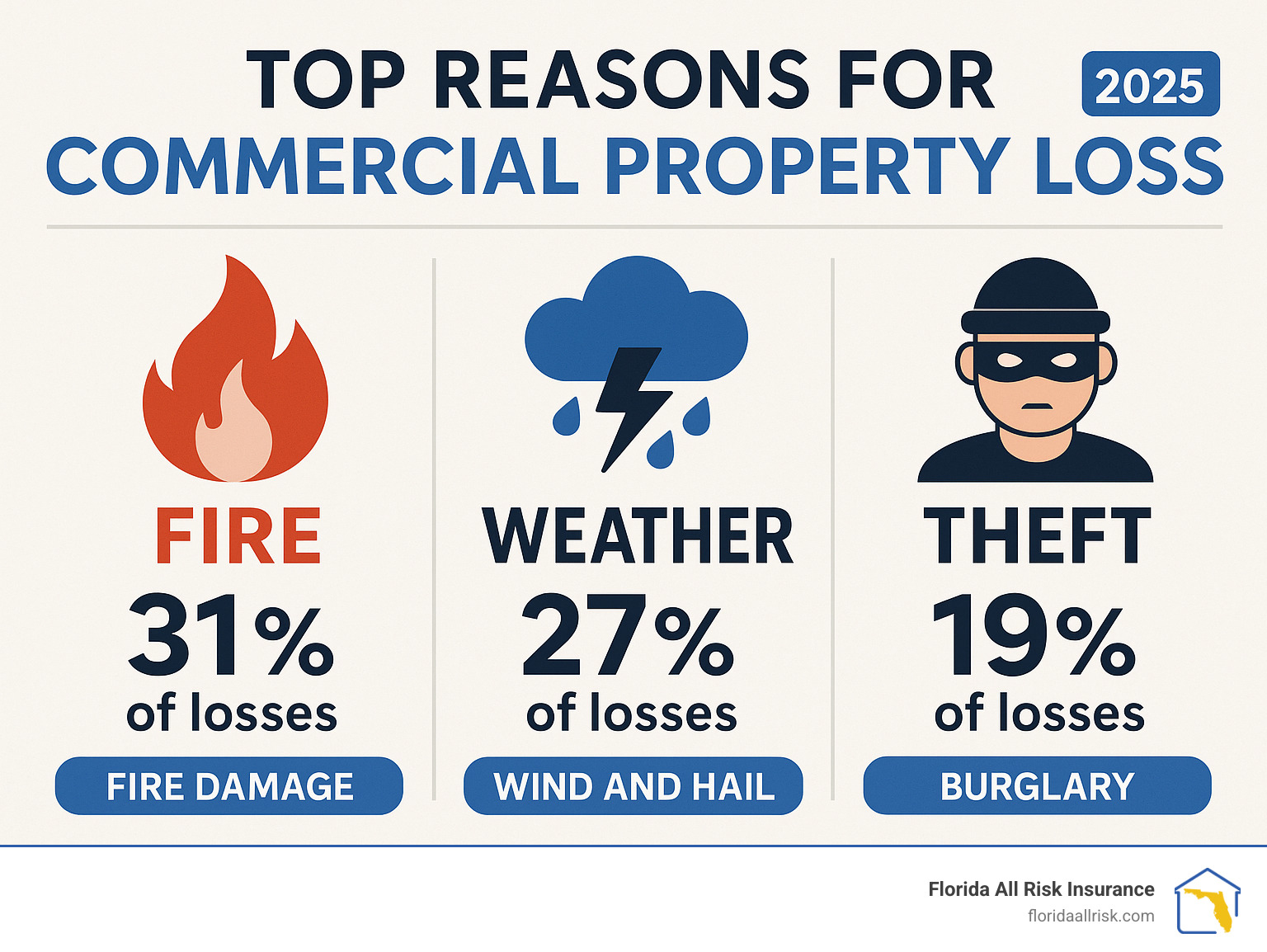
- Common covered events: Policies generally cover damage from a wide range of perils, including fire, theft, vandalism, and many weather-related events like windstorms and hail.
- Why it matters: It provides the vital financial support necessary for repairs or replacement, helping your business get back on its feet after a disaster. Furthermore, this coverage is often a mandatory requirement for commercial mortgages and lease agreements.
This comprehensive guide will break down everything you need to know about protecting your business investment with commercial hazard insurance, from understanding policy details to managing costs effectively.
What Is Commercial Hazard Insurance?
When people refer to “hazard insurance” in a business context, they are almost always talking about commercial property insurance. This is the foundational policy that pays to repair or replace your building and its contents after a covered event, or “peril.” Think of it as a financial safety net that enables you to rebuild and reopen your doors quickly, rather than attempting to fund a massive reconstruction project out-of-pocket.
Understanding the Terminology
In the insurance world, you will encounter several labels for this type of coverage: commercial property insurance, business property insurance, or business hazard insurance. While the names may vary slightly, they all describe the same fundamental protection for the physical components of your operation. If the terminology feels confusing, the core purpose is always the same: to safeguard your physical location, equipment, and inventory from financial loss due to damage or destruction.
What Property and Assets Are Covered?
A standard commercial property policy is designed to be broad, covering the tangible assets that are essential to your business operations. While every policy has specific limits and conditions, coverage generally applies to:
- The Building: This includes the structure you own, its foundation, walls, roof, and any permanently installed fixtures like plumbing, wiring, HVAC systems, and built-in cabinetry.
- Business Personal Property (BPP): This is a wide-ranging category that covers the contents within your building. It includes items like desks, chairs, shelving, computers, servers, phone systems, and point-of-sale (POS) systems.
- Equipment and Machinery: This covers tools and machinery used for production, service, or daily operations, from manufacturing equipment on a factory floor to the ovens and refrigerators in a restaurant kitchen.
- Inventory: This includes your raw materials, work-in-progress, and finished goods held for sale.
- Tenants’ Improvements and Betterments: If you are a tenant, this covers the fixtures or alterations you have paid for and installed in a leased space, such as custom lighting, flooring, or partitions.
- Exterior Fixtures: This can include outdoor signs, fences, and landscaping that are attached to the property.
- Property of Others: If your business model involves holding customer property for service (e.g., a computer repair shop or dry cleaner), this coverage can protect those items while they are in your care, custody, or control.
Where a Business Owner’s Policy (BOP) Fits In
For many small and mid-sized businesses, the most efficient and cost-effective way to purchase hazard insurance is through a Business Owner’s Policy (BOP). A BOP is a package policy that bundles three essential coverages into one:
- Commercial Property (Hazard) Insurance: Protects your building and its contents.
- General Liability Insurance: Protects your business from claims of bodily injury or property damage caused to third parties (e.g., a customer slipping and falling in your store).
- Business Interruption Insurance: Replaces lost income and covers ongoing expenses (like rent and payroll) if your business has to temporarily shut down due to a covered property loss.
Bundling these coverages into a BOP is often less expensive than purchasing each policy separately. It also simplifies administration, as you are dealing with a single policy and a single renewal date. To be eligible for a BOP, a business typically must meet certain criteria related to its size, revenue, and risk profile, as BOPs are designed for lower-risk industries.
Decoding Your Coverage: What’s In and What’s Out
An insurance policy is a legal contract, and its value lies in the details. Understanding what is covered (and what is not) is essential to ensuring your business is truly protected. Policies are generally written in one of two forms: “named peril” or “open peril.” The form, along with your policy’s limits and deductibles, will determine the financial assistance you receive after a loss.
Open Peril vs. Named Peril Policies
- Open Peril (or “All-Risk”) Policies: This is the most common and comprehensive form of commercial property insurance. An open peril policy covers losses from any cause except for those specifically listed as exclusions in the policy. The burden of proof is on the insurance company to demonstrate that the cause of loss is excluded.
- Named Peril Policies: This type of policy is more restrictive. It only covers losses from the specific perils that are explicitly listed in the policy document (e.g., “Fire, Theft, and Windstorm”). If your property is damaged by a peril that is not on the list, the policy will not pay. Here, the burden of proof is on you, the policyholder, to show that the loss was caused by a listed peril.
For most businesses, an open peril policy is preferable due to its broader scope of protection.
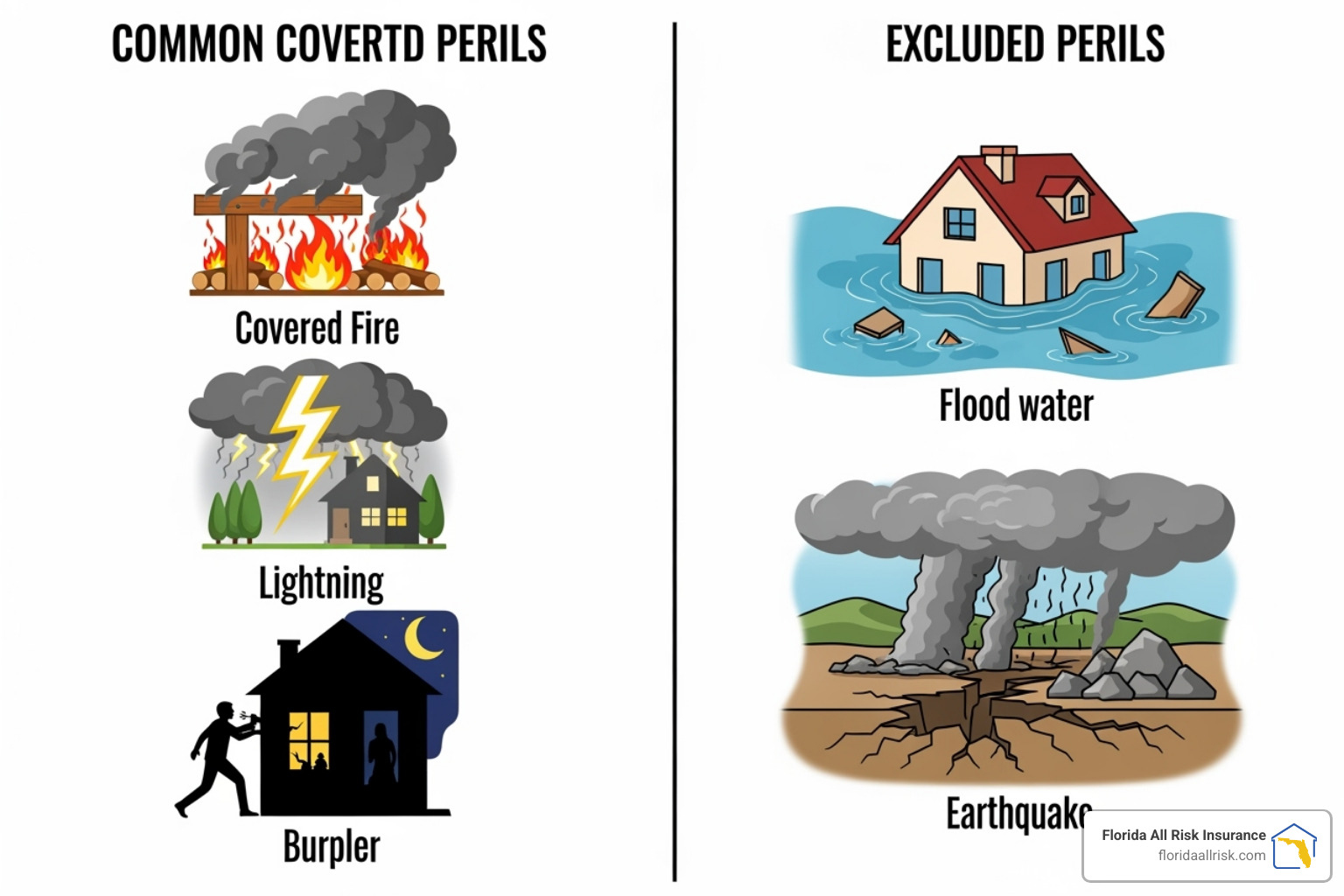
Perils Most Policies Cover
Whether your policy is open or named peril, it will typically cover damage from common events such as:
- Fire and smoke
- Theft and vandalism
- Windstorm, hail, or lightning
- Explosion
- Damage from vehicles or aircraft
- Riot or civil commotion
- Accidental sprinkler leakage
- Certain types of water damage (e.g., from a burst pipe)
- Certain types of structural collapse
Events Often Excluded (and How to Cover Them)
No policy covers everything. Standard commercial property policies almost always exclude damage from catastrophic or specialized events. Key exclusions include:
- Flood or Storm Surge: This is the most common major exclusion. Protection must be purchased through a separate policy, often from the National Flood Insurance Program (NFIP) or a specialized private flood insurer.
- Earth Movement: This includes earthquakes, sinkholes, and landslides. Coverage can typically be added as an endorsement or purchased as a separate policy.
- War, Terrorism, and Nuclear Events: Damage from these events is excluded, though terrorism coverage may be available for purchase as a result of the Terrorism Risk Insurance Act (TRIA).
- Wear and Tear: Gradual deterioration, rust, corrosion, or damage from pests (like termites) is considered a maintenance issue, not an insurable loss.
- Equipment Breakdown: A standard policy covers a fire caused by an electrical surge, but it won’t cover the cost to repair the piece of equipment that simply broke down. This requires a separate Equipment Breakdown (or Boiler and Machinery) endorsement.
- Sewer and Drain Backup: Water damage from a backed-up sewer line is often excluded but can usually be added back with a specific endorsement.
Considering that billion-dollar weather and climate disasters are becoming more frequent, reviewing these exclusions and strategically closing the most critical gaps with endorsements is an increasingly important part of risk management.
Who Needs Hazard Insurance (and When It’s Mandatory)
While every business with physical assets can benefit from hazard insurance, for many, it is not optional. If you own, lease, or finance commercial real estate, or if you keep valuable equipment and inventory inside a building, carrying this insurance is often a contractual or legal requirement.
When Coverage is Required
- Commercial Mortgages: No bank or mortgage lender will finance the purchase of a commercial property without proof of insurance. They will require you to maintain a policy that covers the building for at least the value of the loan to protect their financial interest.
- Commercial Leases: Landlords almost universally require their tenants to carry insurance. The specifics depend on the lease type (e.g., Triple Net, Modified Gross), but tenants are typically responsible for insuring their own business personal property and often for any damage they cause to the building’s interior. The lease agreement will spell out the exact insurance requirements.
- SBA Loans: The U.S. Small Business Administration has strict insurance requirements for its loan programs. According to the official SBA loan guidelines, businesses must obtain hazard insurance on all physical collateral, often for the full replacement cost, before the loan can be disbursed.
Insurance Needs for Different Business Types
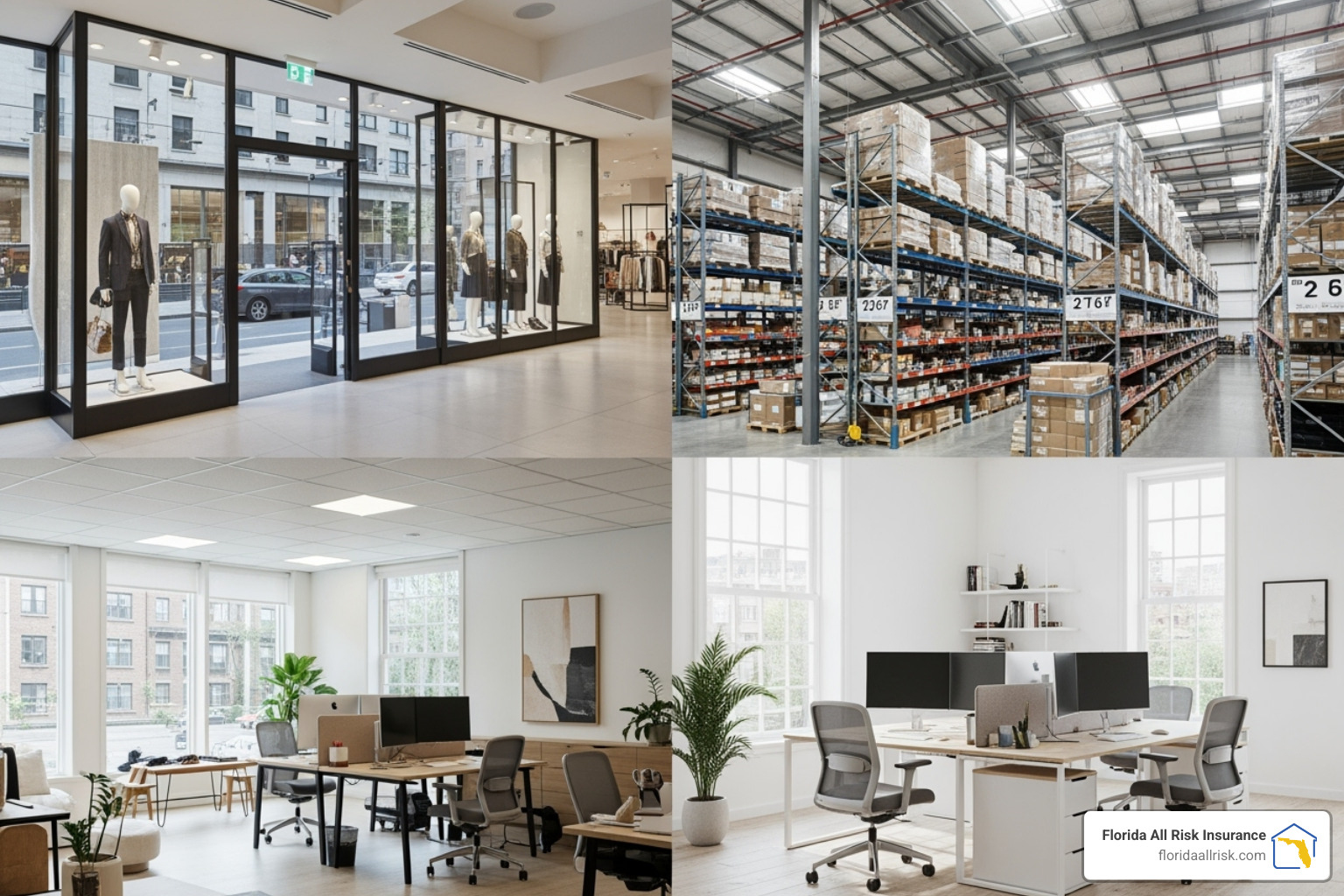
- Retail Stores and Restaurants: These businesses have significant exposure related to their inventory, specialized equipment (POS systems, kitchen appliances), and customer foot traffic. A fire or major theft could be devastating without coverage for both the property and the resulting business interruption.
- Manufacturing and Warehousing: These operations are centered around heavy machinery, raw materials, and finished goods. The value of these assets can be immense, making robust property insurance, including equipment breakdown coverage, absolutely essential.
- Office-Based Businesses (e.g., Law Firms, Tech Companies): While they may not have extensive inventory, these businesses rely on expensive electronics, servers, and custom office build-outs. A fire or water damage event could destroy critical infrastructure.
What About Home-Based Businesses?
This is a common and dangerous blind spot for entrepreneurs. A standard homeowners insurance policy provides very limited coverage for business property—typically only up to $2,500—and explicitly excludes business-related liability. If you store more than a minimal amount of inventory or equipment at home, or if clients ever visit your home office, your homeowners policy is inadequate. To properly protect your assets, you will need to add a commercial property endorsement to your homeowners policy or, more appropriately, purchase a separate Business Owner’s Policy (BOP). As explained by Investopedia’s overview of a standard homeowners’ insurance policy, relying on it for business purposes can lead to a denied claim.
How Much Does Hazard Insurance Cost?
Commercial property insurance premiums are not one-size-fits-all; they are carefully calculated based on a detailed risk assessment of your specific business and property. While national median costs for small businesses can be around $800 to $1,200 per year for a basic policy, rates can vary dramatically based on factors like location, construction type, and industry. For businesses in high-risk areas, such as hurricane-exposed regions of Florida, premiums can be significantly higher.
Digging Deeper into Rating Factors
Insurance underwriters use a methodology known as “COPE” to determine your risk profile and premium:
- Construction: What is the building made of? A modern, fire-resistive structure made of reinforced concrete will be cheaper to insure than an older, wood-frame building. The age and condition of the roof, electrical, and plumbing systems are also critical factors.
- Occupancy: What is your business? The risk profile of a quiet accounting office is vastly different from that of a restaurant with deep-fat fryers or a woodworking shop with combustible dust. The insurer will assess the specific risks associated with your industry.
- Protection: What fire and theft protection systems are in place? The presence of features like a monitored fire and burglar alarm system, automatic sprinklers, and fire extinguishers can lead to substantial premium credits, often ranging from 5% to 20% per protective device.
- Exposure: What are the risks surrounding your property? This includes your geographic location (e.g., proximity to the coast, flood zones, or areas with high crime rates) as well as the risk profile of your neighbors. Being located next to a fireworks factory will result in a higher premium than being next to a library.
Replacement Cost vs. Actual Cash Value (ACV)
When you buy a policy, you must choose a valuation method. This choice has a major impact on how much you will be paid after a claim.
| Feature | Replacement Cost Value (RCV) | Actual Cash Value (ACV) |
|---|---|---|
| Depreciation | Depreciation is not deducted. | Depreciation (for age and wear) is deducted. |
| Claim Payout | Pays the cost to replace the damaged item with a new, similar item. | Pays the replacement cost minus depreciation. |
| Premium Impact | Higher premium. | Lower premium. |
| Best For | Ensuring you can fully rebuild and replace assets without significant out-of-pocket costs. | Businesses on a very tight budget, but it carries significant financial risk. |
Although an ACV policy is cheaper, it can lead to major financial shortfalls after a loss. For example, if a 5-year-old server system that cost $20,000 new is destroyed, RCV would pay the full $20,000 to buy a new one. ACV might determine the system had depreciated by 60%, paying you only $8,000 and leaving you to cover the $12,000 difference.
Coinsurance: The Hidden Risk of Being Underinsured
Most commercial property policies contain a coinsurance clause, typically requiring you to insure your property for at least 80% or 90% of its full replacement value. If you fail to meet this requirement, the insurer can impose a penalty on your claim payout.
For a broader overview of how this mechanism works in insurance, see the Wikipedia entry on Coinsurance.
Example: You own a building with a replacement value of $1,000,000. Your policy has an 80% coinsurance clause, meaning you must insure it for at least $800,000. However, to save money, you only insure it for $600,000. A fire causes $200,000 in damage. The insurance company will calculate your payout as follows:
(Amount of Insurance Carried / Amount Required) x Amount of Loss = Payout
($600,000 / $800,000) x $200,000 = $150,000
Because you were underinsured, you would face a $50,000 coinsurance penalty and have to pay that amount out-of-pocket, in addition to your deductible.
Strategies for Keeping Premiums Affordable
- Bundle Coverages: Purchase a Business Owner’s Policy (BOP) if you are eligible to get property, liability, and business interruption insurance at a lower bundled rate.
- Install Protective Systems: Proactively install and maintain monitored fire and security alarms, sprinkler systems, and hurricane shutters to earn premium discounts.
- Increase Your Deductible: A higher deductible will lower your premium, but make sure you choose a level that your business can comfortably afford to pay out-of-pocket.
- Maintain Your Property: Keeping your building in good repair, especially the roof and electrical systems, can prevent claims and may lead to better rates.
- Conduct Annual Reviews: Review your policy and property valuations annually with an insurance professional to ensure you are meeting coinsurance requirements and not paying for coverage you no longer need.
Securing the Right Coverage in Three Steps
Navigating commercial insurance can be complex, but a systematic approach can simplify the process and ensure you end up with the right protection. Following these three key steps will help you build a robust insurance program custom to your business’s specific needs.

1. Conduct a Thorough Property Valuation
Before you can insure your property, you must know what it’s worth. Underinsuring can lead to devastating coinsurance penalties, while over-insuring means wasting money on unnecessary premiums. Create a detailed inventory of all your business assets. For the building, this means calculating the current cost to rebuild it from the ground up, not its market value. For your contents (Business Personal Property), create a spreadsheet listing all equipment, machinery, furniture, and inventory with their current replacement costs. It is wise to hire a professional appraiser for the building valuation to ensure accuracy. Store copies of this inventory digitally in the cloud and physically off-site so it is accessible after a disaster.
2. Identify Your Unique Risks and Coverage Gaps
Every business has a unique risk profile. Go beyond the standard perils of fire and theft and consider what specific threats your business faces. Are you located in a flood zone? Do you rely on refrigeration that could fail and lead to spoilage? Do you handle sensitive customer data that could be lost in a server crash? Make a list of these unique risks and discuss them with an insurance professional. This is where specialized coverages, known as endorsements or floaters, come into play. You may need to add endorsements for flood, earthquake, equipment breakdown, data loss, or spoilage to fill the gaps left by a standard policy.
3. Work with an Insurance Professional
While it is possible to purchase insurance directly from a carrier, many businesses find value in working with an insurance professional. An independent agent, for example, represents multiple insurance companies and can shop the market to find a suitable combination of coverage and price. A knowledgeable agent can also act as a risk management advisor, helping you accurately value your property, identify hidden risks, understand complex policy language, and steer the claims process if a loss occurs. Their expertise can be invaluable in crafting a comprehensive protection plan.
Frequently Asked Questions
How is hazard insurance different from general liability insurance?
Hazard (commercial property) insurance is first-party coverage, meaning it pays for damage to your own property (your building, equipment, inventory). General liability insurance is third-party coverage; it pays for bodily injuries or property damage you cause to others (e.g., a client who slips and falls). Both are essential for a comprehensive business protection plan and are often bundled together in a Business Owner’s Policy (BOP).
Are all natural disasters covered?
No. While damage from wind, hail, and lightning is typically included in a standard policy, damage from floods and earthquakes is almost always excluded. This coverage must be purchased separately through a dedicated flood policy (like one from the NFIP) or an earthquake endorsement. Given the increasing frequency of severe weather events, as tracked by the NOAA National Centers for Environmental Information, it is critical for business owners to review these exclusions and secure appropriate separate coverage.
What is business interruption insurance and is it included?
Business interruption insurance (also called business income insurance) replaces lost profits and covers continuing operating expenses (like rent, utilities, and payroll) if your business has to temporarily shut down due to a covered property loss. It is one of the most critical coverages for ensuring long-term survival after a disaster. It is often included as part of a Business Owner’s Policy (BOP) but may need to be added to a standalone commercial property policy.
Does hazard insurance cover equipment breakdown?
Generally, no. A standard property policy covers damage to your equipment from an external peril like a fire. It does not cover the equipment’s internal mechanical or electrical breakdown. For that, you need a separate Equipment Breakdown endorsement, which covers costs to repair or replace equipment that suddenly breaks down due to issues like power surges, motor burnout, or boiler malfunction.
Can I insure a commercial condo?
Yes. If you own a commercial condo unit, you need your own policy. The condo association’s master policy typically only covers the building’s main structure and common areas (the “bare walls”). Your individual policy, often called a commercial condo unit-owners policy, is needed to cover everything from the studs inward, including your interior build-out, business contents, and any lost income if you are forced to close for repairs.
Conclusion: Protect Your Investment with the Right Partner
Your commercial property is the heartbeat of your enterprise—the physical space where your products are made, your services are delivered, and your vision comes to life. It represents countless hours of hard work and a significant capital investment. Yet, a single fire, severe storm, or major break-in could jeopardize everything you have built. A comprehensive hazard insurance for commercial property policy acts as a critical financial safety net, providing the resources needed to recover, rebuild, and continue operating with minimal disruption.
Understanding the nuances of your coverage—from choosing between replacement cost and actual cash value, to addressing coinsurance clauses and filling coverage gaps with endorsements—is paramount to true financial security. By conducting a thorough valuation of your assets, identifying your unique operational risks, and working with a knowledgeable insurance partner, you can build a resilient business prepared to weather any storm.
Florida companies, in particular, face a unique set of challenges, from powerful coastal storms to the day-to-day risks inherent in a dynamic economy. Navigating this landscape requires specialized expertise.
Ready to secure the peace of mind that comes with knowing your business is protected? Reach out to a qualified insurance professional today to start building a protection plan customized to your unique operations.
Contact Us
Florida All Risk Insurance
360 Central Avenue, Suite 800
Saint Petersburg, FL 33701
Email: [email protected]
Have questions about protecting your commercial property? Visit our contact page at joea233.sg-host.com/contact to connect with one of our licensed Florida agents.

