

Haulage Business Insurance: 2026 Affordable Expert
Why Your Haulage Business Needs Specialized Insurance Protection
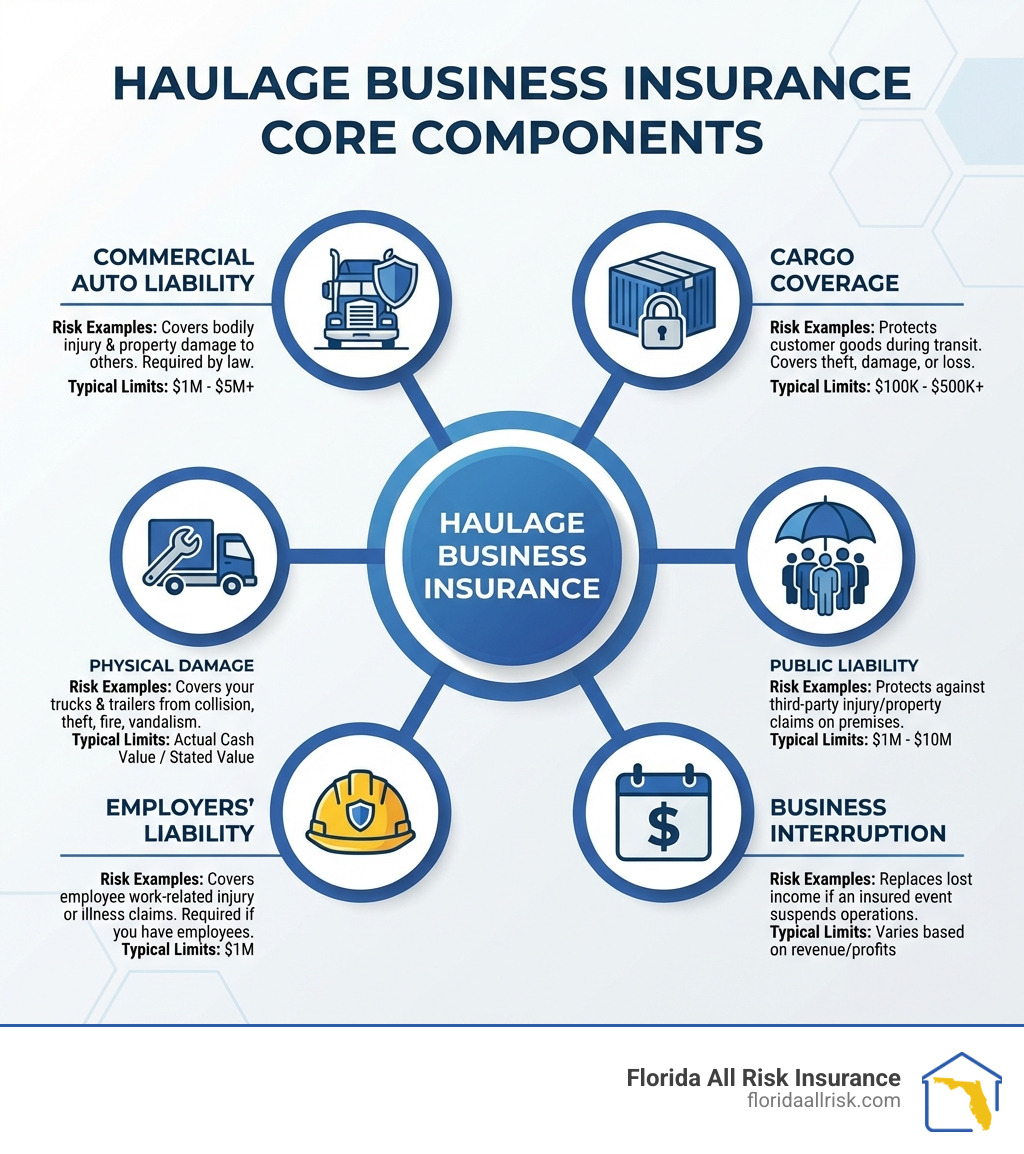
Haulage business insurance is specialized coverage designed to protect commercial transportation companies from the unique risks they face daily. Unlike standard business insurance, haulage policies address the specific exposures of transporting goods, including liability for customer cargo, commercial vehicle damage, and regulatory compliance. A comprehensive policy typically bundles essential protections like Commercial Auto Liability, Cargo/Goods in Transit, Physical Damage for your fleet, Public and Employers’ Liability, and Business Interruption coverage.
The haulage industry is the backbone of commerce, but it faces constant risks. Your vehicles travel millions of miles on Florida’s highways, exposing your business to accidents, cargo theft, and costly liability claims. Since 2009, specialized insurance investigation units have recovered over $37 million in stolen items for haulage clients, highlighting the persistent threat of theft. Without proper coverage, a single serious accident or cargo claim can threaten your company’s financial stability.
I’m Jason Miller, and at Florida All Risk Insurance, my family brings over 60 years of combined experience to the table, specializing in haulage business insurance for Florida transportation companies. Our team understands the risks unique to Florida’s climate and roadways. We work to match haulage operators with affordable, comprehensive coverage that keeps them moving forward.
Explore more about haulage business insurance:
Understanding the Essentials: What is Haulage Insurance and Why is it Crucial?
In commercial transportation, your fleet is the lifeblood of your business. Haulage business insurance acts as a critical financial safety net, custom-built for the unique exposures of the trucking industry. It’s not just a legal requirement but a fundamental part of sound business management, designed to protect your assets, reputation, and ensure operational continuity.
Imagine a major accident on I-75 or a theft at a loading dock. Without specialized insurance, the financial fallout could be devastating, covering everything from vehicle repairs and cargo loss to third-party liability claims. This coverage provides peace of mind, knowing that an unexpected event won’t derail your entire operation. At Florida All Risk Insurance, we understand the challenges haulers face in our state, from hurricane season and flash floods to busy port traffic and congested tourist areas. We help you mitigate those risks effectively.
Protecting Your Business from Catastrophic Loss
The potential for financial loss in the haulage industry is substantial. A single incident can trigger a cascade of problems. Consider a scenario where one of your trucks jackknifes on a wet highway, causing a multi-vehicle pile-up. The immediate costs include towing and recovery for your vehicle, but the liability exposure is far greater. You could face multiple bodily injury claims from other drivers, lawsuits for property damage to several vehicles, and even environmental cleanup costs if your cargo spills. Legal defense fees alone can run into the tens of thousands. Without robust haulage business insurance, the total cost of such an event could easily exceed your company’s assets, leading to bankruptcy. This insurance is designed to absorb these financial shocks, preventing a single bad day from becoming a catastrophic, business-ending event.
The Core Risks in the Haulage Industry
The haulage industry is exposed to a variety of significant threats that demand specialized insurance. These core risks include:
- Cargo Damage and Theft: Whether from an accident, improper loading, or criminal activity, you are liable for the goods you transport. Cargo theft is a sophisticated enterprise, with organized crime rings targeting high-value loads. Research shows that specialized units have recovered over $37 million in stolen items since 2009, underscoring the severity of this threat. Coverage is essential to protect both your finances and your client relationships.
- Vehicle Accidents: Collisions can lead to extensive vehicle damage, costly repairs, and potential injury to your drivers and third parties. The high mileage and constant road presence inherent in haulage make accidents a statistical probability, not just a possibility.
- Public Liability: Incidents such as a pedestrian being injured during loading/unloading or third-party property being damaged at a delivery site can lead to expensive legal claims. This risk exists anytime your operations interact with the public, even when your truck is parked.
- Regulatory Fines: Non-compliance with standards from bodies like the DOT and FMCSA can result in heavy fines and even out-of-service orders. Violations related to Hours of Service (HOS), Electronic Logging Device (ELD) mandates, or equipment maintenance are common and costly.
- Business Interruption: If an insured event, like a fire at your terminal or a major accident that sidelines a significant portion of your fleet, halts your operations, this risk covers the loss of income and ongoing expenses (like salaries and loan payments) while you recover.
Our policies are designed to address these core risks, providing a robust shield for your operations. For more information, see our Business Insurance Florida Complete Guide and our guide on Fleet Insurance Risk Management.
Deconstructing Your Policy: Key Coverages in Haulage Business Insurance
Understanding the components of your haulage business insurance policy is crucial for ensuring you have no gaps in your protection. It’s not a one-size-fits-all product but a suite of coverages custom to your specific risks. At Florida All Risk Insurance, we help you build a policy that acts as a comprehensive shield for your business.
Primary Liability and Physical Damage
These two coverages form the foundation of any haulage insurance policy.
- Commercial Auto Liability: This is the most critical component, covering bodily injury and property damage your vehicles cause to others. It’s a legal requirement with specific minimums in Florida and for federal interstate carriers. While minimums may be $750,000, a serious accident can easily result in claims exceeding $1 million, making higher limits a wise investment. Policies can be structured with a Combined Single Limit (CSL) or split limits. For more details, explore our Commercial Truck Liability Insurance page.
- Physical Damage Coverage: This protects your own trucks and trailers. It includes Collision Coverage for damage from accidents and Comprehensive Coverage for non-collision events like theft, fire, vandalism, and natural disasters—a key concern in Florida. It’s important to decide between Actual Cash Value (ACV), which pays the depreciated value, and a Stated Amount/Agreed Value, which guarantees a pre-agreed payout, especially for custom or high-value rigs.
Cargo and Goods in Transit Coverage
As a hauler, you are responsible for your clients’ goods. Cargo and Goods in Transit Coverage protects against the loss or damage of customer property in your care, custody, or control. It can cover incidents like theft, damage during transit, spoilage for refrigerated goods (Reefer Breakdown coverage), and accidents during loading or unloading. Policies can be written on a broad form (all-risk) or specified perils basis. Your policy must also align with your contract conditions (e.g., RHA, CMR) to ensure your liability is properly covered. Look for important extensions like debris removal and earned freight coverage. Learn more in our Cargo Insurance for Trucks guide.
Essential Liability Protections
Beyond auto liability, other protections are vital for comprehensive coverage.
- Public Liability Insurance: Also known as General Liability, this protects your business against third-party claims for injury or property damage arising from your operations, separate from vehicle use (e.g., a slip and fall at your depot or a driver damaging a customer’s loading dock with a pallet jack). Limits typically range from $1 million to $10 million. See our General Liability Insurance page for more.
- Employers’ Liability Insurance: If you have employees, this coverage is a legal necessity in many cases. It works alongside Workers’ Compensation to protect you from claims if an employee suffers a work-related injury or illness not covered by the standard workers’ comp system, such as a lawsuit from a family member for consequential damages.
Additional and Specialized Coverages
A robust haulage business insurance policy can be improved with specialized coverages to address every vulnerability.
- Business Interruption Insurance: Replaces lost income and covers ongoing expenses if an insured event forces you to suspend operations. Policies have a defined “waiting period” before benefits kick in.
- Trailer Interchange Insurance: Covers physical damage to non-owned trailers when you’re operating under a written interchange agreement, common in intermodal and drayage operations.
- Workers’ Compensation: A mandatory coverage for businesses with employees, it provides medical benefits and wage replacement to employees injured on the job, regardless of fault. See our Workers Compensation Insurance Complete Guide.
- Uninsured/Underinsured Motorist Coverage: Protects you, your drivers, and your vehicles if you’re in an accident with a motorist who has insufficient or no insurance to cover the damages they caused.
The Price Tag: Factors That Influence Your Haulage Insurance Costs
Every haulage business is unique, and so is its insurance premium. The cost of haulage business insurance is determined by a detailed risk assessment conducted by underwriters. At Florida All Risk Insurance, our goal is to help you understand these factors, manage costs effectively, and find the best value—comprehensive coverage at a competitive price. We leverage our relationships with multiple carriers to tailor policies that fit your budget. For more insights, visit our guide on Best Truck Insurance Rates.
Vehicle and Fleet Characteristics
The nature of your fleet is a primary factor in determining your premium. Insurers evaluate:
- Fleet Size and Vehicle Type: The number of vehicles and their type (e.g., an 18 Wheeler Truck Insurance policy differs from a Box Truck Insurance Cost Guide) impact exposure and cost.
- Vehicle Age and Value: Newer, more valuable vehicles cost more to insure for physical damage, while older vehicles may pose maintenance risks if not meticulously maintained.
- Maintenance and Safety: A strong, documented maintenance record demonstrates a commitment to risk management. Furthermore, the use of safety technology like telematics, dashcams, automatic emergency braking (AEB), and lane departure warnings can significantly lower your premiums as they provide data to prove safe operations and can prevent accidents.
Operational and Driver History
Your operational practices and driver quality are critically important to insurers. Your FMCSA Compliance, Safety, Accountability (CSA) score is a key metric underwriters review.
- Driving Records (MVRs): Clean MVRs for all drivers are essential for lower premiums. A history of violations, at-fault accidents, or DUIs will increase costs dramatically. Insurers will also review the federal Pre-employment Screening Program (PSP) database.
- Experience and Training: A team of experienced drivers (typically with 2+ years of commercial driving experience) and a commitment to ongoing safety training are viewed favorably by underwriters. A formal driver hiring and screening process is a must.
- Claims History: A history of frequent or severe claims will lead to higher premiums. Your loss run report is one of the most important documents at renewal. A clean record can earn you significant savings.
- Radius of Operation: Local (under 100 miles), regional, or long-haul operations present different levels of risk, with longer distances and overnight trips typically translating to higher risk and premiums.
Cargo and Business Specifics
What you haul and how you operate also influence your insurance costs.
- Type of Cargo: Transporting hazardous materials (hazmat), high-value goods like electronics or pharmaceuticals, or refrigerated items is riskier and requires more expensive, specialized coverage than general dry freight like lumber or building materials.
- Contractual Requirements: Clients and brokers often require specific minimum coverage limits (e.g., $1,000,000 in auto liability and $100,000 in cargo) which will influence your policy structure and cost.
- Coverage Limits and Deductibles: Higher liability limits offer more protection but increase premiums. Opting for a higher deductible can lower your premium but increases your out-of-pocket cost in the event of a claim. It’s a balance between upfront cost and potential claim exposure.
Staying Compliant: Legal and Regulatory Insurance Requirements
Operating a haulage business in Florida means navigating a complex web of legal and regulatory insurance requirements. Compliance is not optional—failure to meet these standards can result in severe penalties, fines, or even the suspension of your operating authority. At Florida All Risk Insurance, we specialize in guiding you through these mandates to ensure your haulage business insurance meets all federal and state standards.
Federal Motor Carrier Safety Administration (FMCSA) Rules
If your business engages in interstate commerce (crossing state lines), you must comply with rules set by the Federal Motor Carrier Safety Administration (FMCSA). Key requirements include:
- Minimum Liability Limits: The FMCSA mandates proof of financial responsibility. The required minimums vary based on your cargo:
- $750,000: For trucks over 10,001 lbs. transporting non-hazardous freight.
- $1,000,000: For trucks transporting oil or certain hazardous materials.
- $5,000,000: For trucks transporting other specific hazardous substances, such as explosives or compressed gas.
- Insurance Filings (MCS-90/BMC-91X): You must have an insurance filing on record with the FMCSA. The BMC-91 or BMC-91X filing is sent by your insurer to the FMCSA as proof of liability coverage. The MCS-90 endorsement is part of your policy and guarantees payment for public liability claims up to the federal minimum, even if your policy would otherwise not cover it.
- Operating Authority (MC Number): You must obtain the proper operating authority from the FMCSA, which requires proof of insurance before it becomes active.
- Unified Carrier Registration (UCR): Interstate carriers must also register and pay annual fees through the UCR program, which verifies active insurance coverage.
For authoritative guidance, visit the official website of the DOT FMCSA. If your operations involve cross-border transport, understanding regulations from CBP is also essential.
State-Specific Regulations in Florida
Haulage businesses operating exclusively within Florida (intrastate) must adhere to state-specific requirements set by the Florida Department of Highway Safety and Motor Vehicles (FLHSMV).
- Florida Liability Requirements: Intrastate carriers must meet liability minimums that generally align with federal standards but can have unique nuances. For example, commercial vehicles with a GVW of 26,001 lbs. to 34,999 lbs. require $50,000 in liability, while those from 35,000 lbs. to 43,999 lbs. require $100,000, and those 44,000 lbs. or more require $300,000.
- Commercial Vehicle Registration: All commercial vehicles in Florida must be properly registered with the FLHSMV, and proof of adequate insurance is a prerequisite for obtaining and maintaining that registration.
- Florida No-Fault Law: While Florida is a no-fault state for personal vehicles, commercial trucks are generally exempt from the Personal Injury Protection (PIP) requirement, but this can be complex. Understanding how liability is determined in an accident is crucial.
We specialize in helping Florida trucking companies steer these state-specific rules, ensuring your policy provides robust protection custom to our local environment. For more information, explore our Trucking Company Insurance Florida resources.
Making the Right Choice: How to Select Your Policy and Insurance Partner
Choosing the right haulage business insurance is a pivotal decision for your company’s security. It is about building a robust shield that protects your assets, employees, and reputation. At Florida All Risk Insurance, we believe in fostering long-term partnerships to help you make an informed choice.
How to Choose the Right Haulage Business Insurance Policy
Selecting the right policy requires a clear understanding of your business needs. Follow these steps:
- Assess Your Risks: Evaluate your cargo types, routes, driver mix, and claims history to understand your unique vulnerabilities.
- Review Contract Requirements: Ensure your policy meets or exceeds the insurance stipulations in your client and broker contracts.
- Compare Quotes Wisely: Do not just look at the price. Compare coverage limits, deductibles, and exclusions to ensure you are getting the best value. You can start the process and Buy Business Insurance Online through our platform.
- Understand Limits and Deductibles: Choose liability limits that can cover a catastrophic event and a deductible you can comfortably afford.
- Read the Fine Print: Pay close attention to policy exclusions and conditions. We are here to help you decipher the complexities.
The Role of an Independent Insurance Broker
An independent insurance broker like Florida All Risk Insurance is an invaluable asset. We work for you, not a single insurance company.
- Expertise and Access: We offer in-depth industry knowledge and access to a wide network of specialized carriers, allowing us to find competitive rates and comprehensive coverage options.
- Customization and Advocacy: We provide personalized service to tailor a policy to your unique needs. In the event of a claim, we act as your advocate to support a fair and prompt settlement.
Working with an independent agency ensures you receive unbiased advice and customized solutions. Learn more about Why You Should Work With An Independent Insurance Agency and how we help with Finding The Right Insurance Agency.
Understanding Common Exclusions and Limitations
Even the most comprehensive haulage business insurance policies have exclusions. It is crucial to understand what is not covered to avoid surprises.
Common exclusions include damage from normal wear and tear, intentional criminal acts, certain highly hazardous or illicit cargo, and losses occurring outside your policy’s specified geographic territory.
Haulage vs. Other Logistics Insurance
It is important to have the right insurance for your specific role in the supply chain. Haulage business insurance is distinct from other logistics coverages.
| Feature | Haulage Insurance | Freight Forwarder Insurance | Logistics Insurance |
|---|---|---|---|
| Primary Focus | Physical transportation of goods (asset-based). | Arranging shipments (often non-asset-based). | Broader supply chain operations. |
| Key Coverages | Commercial Auto Liability, Physical Damage, Cargo, Workers’ Compensation. | Errors & Omissions (E&O), Contingent Cargo, Broker’s Liability. | Warehouse Liability, Supply Chain Interruption, Technology-related coverage. |
| Main Exposure | Accidents, cargo damage or theft in transit. | Documentation errors, misdirection of cargo. | Storage risks, multi-modal risks, data and operational risks. |
| Typical Client | Trucking companies and fleet owners. | Freight brokers and logistics coordinators. | 3PL/4PL providers and distribution centers. |
After an Incident: Navigating the Haulage Insurance Claims Process
Even with the best safety protocols, incidents happen. Knowing how to steer the claims process efficiently is key to minimizing disruption and getting back on the road quickly. At Florida All Risk Insurance, we stand by you every step of the way, providing support and advocacy when you need it most.
Steps to Take Immediately After an Accident or Loss
The actions you take in the moments after an incident are crucial for a smooth claims process. Equip your drivers with an accident kit and train them to follow these steps:
- Ensure Safety First: Prioritize the safety of your driver and anyone else involved. Secure the scene, turn on hazard lights, and administer first aid if trained.
- Contact Authorities: Immediately report any accident involving injury, significant damage, or theft to law enforcement (e.g., Florida Highway Patrol) and get an official report number. This is non-negotiable.
- Document Everything: Use a phone to take extensive photos and videos. Capture all four corners of every vehicle involved, license plates, VINs, property damage, the wider accident scene, road conditions, traffic signals, and any relevant landmarks. Note the time, date, and weather.
- Gather Information: Collect names, phone numbers, addresses, and insurance details from all other parties involved. Get contact information from any witnesses. Do not rely on the police report to contain all this information.
- Do Not Admit Fault: Instruct your drivers to never admit fault, apologize, or speculate on the cause of the accident at the scene. They should state only the objective facts to law enforcement.
- Report the Claim Promptly: Contact us at Florida All Risk Insurance as soon as possible to file the First Notification of Loss (FNOL). Prompt reporting is a policy condition and is critical for initiating the process, controlling costs, and protecting your interests.
How to Expedite Your Haulage Business Insurance Claim
To speed up your claim, be proactive and organized.
- Provide Complete Information: The more detailed information you provide upfront—police reports, photos, witness statements, driver logs—the faster the adjuster can process your claim.
- Respond Quickly: Promptly respond to any requests for additional information from the insurance adjuster. Delays on your end will delay the entire process.
- Keep Detailed Records: Maintain a dedicated file for all communications, documents, and expenses related to the claim, such as towing bills, temporary repair costs, or cargo storage fees.
- Lean on Your Broker: As your insurance broker, we act as your advocate. We help you communicate with the insurer, understand what’s needed, and work to resolve any issues that arise during the claims process.
Working with the Insurance Adjuster
After you file a claim, an insurance adjuster will be assigned to your case. Their job is to investigate the facts of the loss, determine the cause, and evaluate the damages based on the coverages in your policy. To work effectively with them, provide all documentation they request and be honest and factual in your communications. A good working relationship can help streamline the process. The adjuster is also key in the subrogation process, where your insurer will attempt to recover the money they paid out from the at-fault party’s insurance company, which can potentially help you recover your deductible.
For immediate assistance with reporting a claim, please visit our Claims Numbers page. We are here to help you steer challenging times.
Conclusion
Navigating the complexities of haulage business insurance is a critical investment in the security and longevity of your commercial fleet. From understanding the core risks and key coverages to meeting legal requirements and managing costs, the right policy is one of your best defenses against the unexpected.
A well-structured plan should address:
- Primary liability for injuries and property damage you may cause to others
- Physical damage coverage to protect your own trucks and trailers
- Cargo and goods in transit coverage for your customers’ freight
- Essential liability protections such as public liability and employers’ liability
- Additional tools like business interruption, workers’ compensation, and uninsured/underinsured motorist coverage
By combining these protections with strong driver training, safety technology, and sound maintenance practices, you create a resilient foundation for your operation. Florida All Risk Insurance draws on extensive experience with Florida trucking and haulage risks, from severe weather to busy ports and highways, to help you align your coverage with real-world exposures.
If you would like to deepen your understanding of broader commercial coverage, resources such as the Business Insurance Florida Complete Guide and information from the Federal Motor Carrier Safety Administration can provide additional perspective on risk and regulatory expectations.
At the end of the day, haulage business insurance is not just about meeting minimum requirements. It is about protecting the enterprise you have built, the people who work for you, and the clients who rely on you to keep their supply chains moving.
Ready to secure your haulage business with coverage custom to your fleet and routes? Get a personalized quote for your trucking insurance needs today!
Prefer to talk through your options with a commercial insurance specialist? Contact our team to discuss your haulage business and review your current coverage.
Contact Us
Florida All Risk Insurance
Address: 3400 34th St N, Saint Petersburg, FL 33713
Phone: (727) 571-0400
Email: [email protected]

