

Group health insurance vs individual plan 2025: Smart Guide
Why Understanding Health Insurance Options Matters for Florida Residents
Deciding between group health insurance vs individual plan options is a critical choice for most Americans, as it significantly impacts healthcare costs, access to providers, and financial security. With roughly 159 million people covered by employer-based plans, understanding the differences is essential.
Quick Comparison: Group vs Individual Health Insurance
| Factor | Group Health Insurance | Individual Health Insurance |
|---|---|---|
| Who Purchases | Employer | Individual/Family |
| Average Monthly Premium (Individual) | $703 | $456 |
| Average Monthly Premium (Family) | $1,997 | $1,152 |
| Employer Contribution | Yes (typically 70-80%) | No |
| Portability | Tied to employment | Follows you anywhere |
| Plan Choice | Limited to employer options | Wide selection available |
| Tax Benefits | Pre-tax premiums | Potential subsidies |
| Enrollment Period | At hire or annual open enrollment | Annual open enrollment or qualifying events |
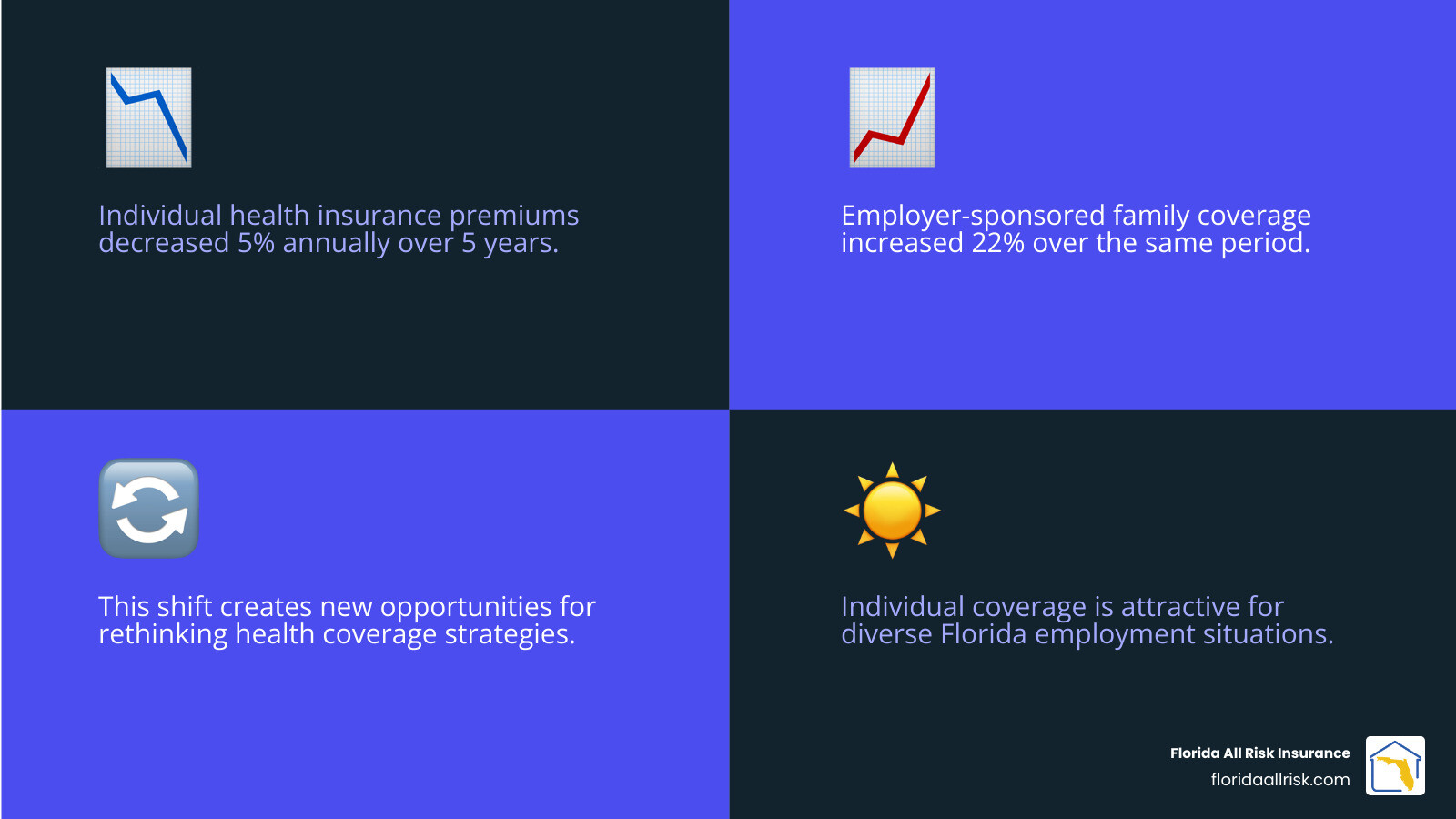
The health insurance landscape is changing. While employer-sponsored family coverage costs have risen 22% in the last five years, individual plan premiums have decreased. This shift presents new opportunities for both employers and employees to rethink their health coverage.
For Florida residents, this decision is especially important. The state’s diverse economy means many people work as contractors, seasonal employees, or for small businesses, making individual coverage a vital option. As experienced insurance professionals serving Florida, we’ve helped thousands of families and businesses steer these complex choices to find coverage that fits their unique needs and budget.

Similar topics to group health insurance vs individual plan:
- how to choose a group health insurance plan
- Small business employee benefits
- Florida health insurance brokers
Understanding the Basics: What Are Group and Individual Health Plans?
When considering group health insurance vs individual plan options, you are looking at two fundamentally different ways to get healthcare coverage. The core concept of insurance is to spread risk among a group of people to make healthcare more affordable. Understanding how group and individual plans achieve this will help you choose the best path for your budget and needs.
Let’s break down how each type works. For more comprehensive information, you can learn more info about our Florida Medical Insurance Plans.
What is Group Health Insurance and How Does It Work?
Group health insurance is a single policy purchased by an employer to cover a group of people, typically employees and their families. The key advantage is risk pooling. By spreading the financial risk across a large group, the insurance company can offer lower premiums per person than if they were buying coverage alone.
Employers usually pay a significant portion of the premium, often 70-80%, making the coverage much more affordable for employees. The employee’s share is typically deducted from their paycheck before taxes, providing an additional tax saving.
Under the Affordable Care Act (ACA), employers with 50 or more full-time employees, known as Applicable Large Employers (ALEs), are required to offer affordable health coverage to at least 95% of their full-time workers and their dependents or face penalties. To ensure the risk pool is stable, insurers often require at least 70% of eligible employees to enroll in the plan.
Enrollment is straightforward, usually occurring upon hiring or during an annual open enrollment period, with premiums automatically deducted from paychecks.
To learn more about how employers can benefit, see our guide on the Benefits Of Health Benefits. For alternative funding methods, our article on What Is A Self-Funded Group Health Insurance Plan offers more insight.
What is Individual Health Insurance and How Does It Work?
Individual health insurance is a policy you purchase directly for yourself or your family, not through an employer. You can buy plans from an insurance company, through a licensed broker, or via the Health Insurance Marketplace established by the ACA.
The ACA transformed the individual market by prohibiting insurers from denying coverage or charging more based on health history. All individual plans must also cover ten essential health benefits, ensuring comprehensive coverage. These benefits are:
- Ambulatory patient services: Outpatient care you receive without being admitted to a hospital.
- Emergency services: Care for life-threatening conditions, which cannot be billed at higher out-of-network rates.
- Hospitalization: Inpatient care, including surgery and overnight stays.
- Pregnancy, maternity, and newborn care: Care before and after your baby is born.
- Mental health and substance use disorder services: Including behavioral health treatment, counseling, and psychotherapy.
- Prescription drugs: Medications prescribed by a doctor.
- Rehabilitative and habilitative services and devices: Services to help people with injuries, disabilities, or chronic conditions gain or recover mental and physical skills.
- Laboratory services: Diagnostic tests and screenings.
- Preventive and wellness services and chronic disease management: Including vaccinations, cancer screenings, and counseling.
- Pediatric services: Including dental and vision care for children.
Eligibility is simple: if you are not eligible for Medicare or Medicaid, you can purchase a plan. Enrollment is restricted to the annual Open Enrollment Period (typically Nov. 1 to Dec. 15) unless you experience a Qualifying Life Event. Major life changes, known as Qualifying Life Events (QLEs), can trigger a Special Enrollment Period, allowing you to sign up outside the standard window. Common QLEs include:
- Losing other health coverage (due to job loss, divorce, aging off a parent’s plan, etc.)
- Getting married or divorced
- Having a baby, adopting a child, or placing a child for foster care
- Moving to a new ZIP code or county
- Changes in your income that affect the coverage you qualify for
- Becoming a U.S. citizen
A major feature of individual plans is the availability of government subsidies. Premium tax credits can significantly lower monthly premiums for those with household incomes between 100% and 400% of the federal poverty level. Some may also qualify for cost-sharing reductions that lower out-of-pocket costs like deductibles.
These subsidies can make individual plans surprisingly affordable, sometimes even cheaper than an employer’s group plan, especially if the employer coverage is unavailable or doesn’t meet affordability standards.
The Core Differences: A Detailed Group Health Insurance vs Individual Plan Comparison
Understanding the key distinctions between group health insurance vs individual plan options is crucial for making an informed choice. These differences affect everything from enrollment and cost to your choice of doctors and what happens when you change jobs. Let’s compare how these two approaches stack up in the areas that matter most.

Eligibility and Enrollment Criteria
Group Health Insurance: Eligibility is tied to your employment. You generally must be a full-time employee, and there may be a waiting period of up to 90 days. Enrollment happens when you’re hired or during an annual open enrollment period. Employers often need high participation rates (e.g., 70%) to maintain the plan. For more details on Florida options, see our information on Florida Group Health Insurance.
Individual Health Insurance: Your employment status doesn’t matter. Enrollment is limited to the annual Open Enrollment Period (typically Nov. 1 – Dec. 15) or a Special Enrollment Period triggered by a Qualifying Life Event, such as losing other coverage, getting married, or moving.
Cost Structures: Premiums, Deductibles, and Subsidies
The cost structures of group and individual plans are fundamentally different. The employer’s contribution is the biggest factor in group plan affordability.
| Cost Factor | Group Health Insurance (2023 Averages) | Individual Health Insurance (2023 Averages) |
|---|---|---|
| Self-Only Premium (Annual) | $8,435 | $5,616 ($468/month) |
| Family Premium (Annual) | $23,968 | $16,344 ($1,362/month, unsubsidized family of three, 2022) |
| Employer Contribution (Typical) | Substantial (often 70-80% of premium) | None |
| Employee Cost (Self-Only, Annual) | ~$1,687 – $2,530 (20-30% of premium) | $5,616 (before subsidies) |
| Employee Cost (Family, Annual) | ~$4,794 – $7,190 (20-30% of premium) | $16,344 (before subsidies) |
| Average Deductible (Single Coverage) | $1,763 (2022) | Varies greatly by plan, can be higher or lower |
| Subsidies Available | No | Yes (Premium Tax Credits, Cost-Sharing Reductions) |
Note: The “Employee Cost” for group plans represents the portion typically paid by the employee after the employer’s contribution. Individual plan costs are unsubsidized; many qualify for significant subsidies.
For group plans, the employer’s contribution dramatically lowers your out-of-pocket cost. Your share is also paid with pre-tax dollars, reducing your taxable income.
For individual plans, you are responsible for the full premium unless you qualify for government subsidies. Premium Tax Credits and Cost-Sharing Reductions can make these plans very affordable, sometimes more so than group coverage, depending on your income and the employer’s offer.
Coverage Flexibility and Provider Networks
Group Health Insurance: Flexibility is limited to the plans selected by your employer, which usually include options like HMOs or PPOs. While these plans often have broad provider networks and good benefits, your choice is restricted to what the employer offers.
Individual Health Insurance: You have a wide selection of plans from various carriers. This allows you to choose a plan that includes your preferred doctors and hospitals. However, you must carefully research each plan’s network, as they can vary significantly. Understanding the different types of health plans is key:
- HMO (Health Maintenance Organization): These plans typically require you to use doctors, hospitals, and specialists within their network (except in an emergency). You often need a referral from a Primary Care Physician (PCP) to see a specialist. In exchange for these restrictions, HMOs usually have lower monthly premiums.
- PPO (Preferred Provider Organization): PPOs offer greater flexibility. You can see both in-network and out-of-network providers, though your out-of-pocket costs will be significantly lower if you stay in-network. You generally don’t need a PCP referral to see a specialist, giving you more direct access to care.
- EPO (Exclusive Provider Organization): An EPO is a hybrid model. Like an HMO, it requires you to use providers within the plan’s network for services to be covered (except in emergencies). However, like a PPO, you typically don’t need a referral to see a specialist.
- POS (Point of Service): This plan blends features of HMOs and PPOs. You may be required to choose a PCP and get referrals for specialists, but you also have the option to go out-of-network for care, albeit at a higher cost.
Portability: What Happens When You Change Jobs?
Group Health Insurance: Coverage is tied to your job. When you leave, your coverage typically ends. You may be able to continue it temporarily through COBRA, but you’ll have to pay the full premium plus an administrative fee, which can be very expensive. You can find More info about job loss and coverage from the Department of Labor.
Individual Health Insurance: Your plan is completely independent of your job. It follows you through career changes, self-employment, or time off, providing continuous coverage without gaps. This portability is a major advantage in today’s flexible job market.
Weighing the Pros and Cons for Employers and Employees
The best choice in the group health insurance vs individual plan debate depends on your perspective. Both employers and employees have different priorities, and understanding the pros and cons for each side is key to making a smart decision.
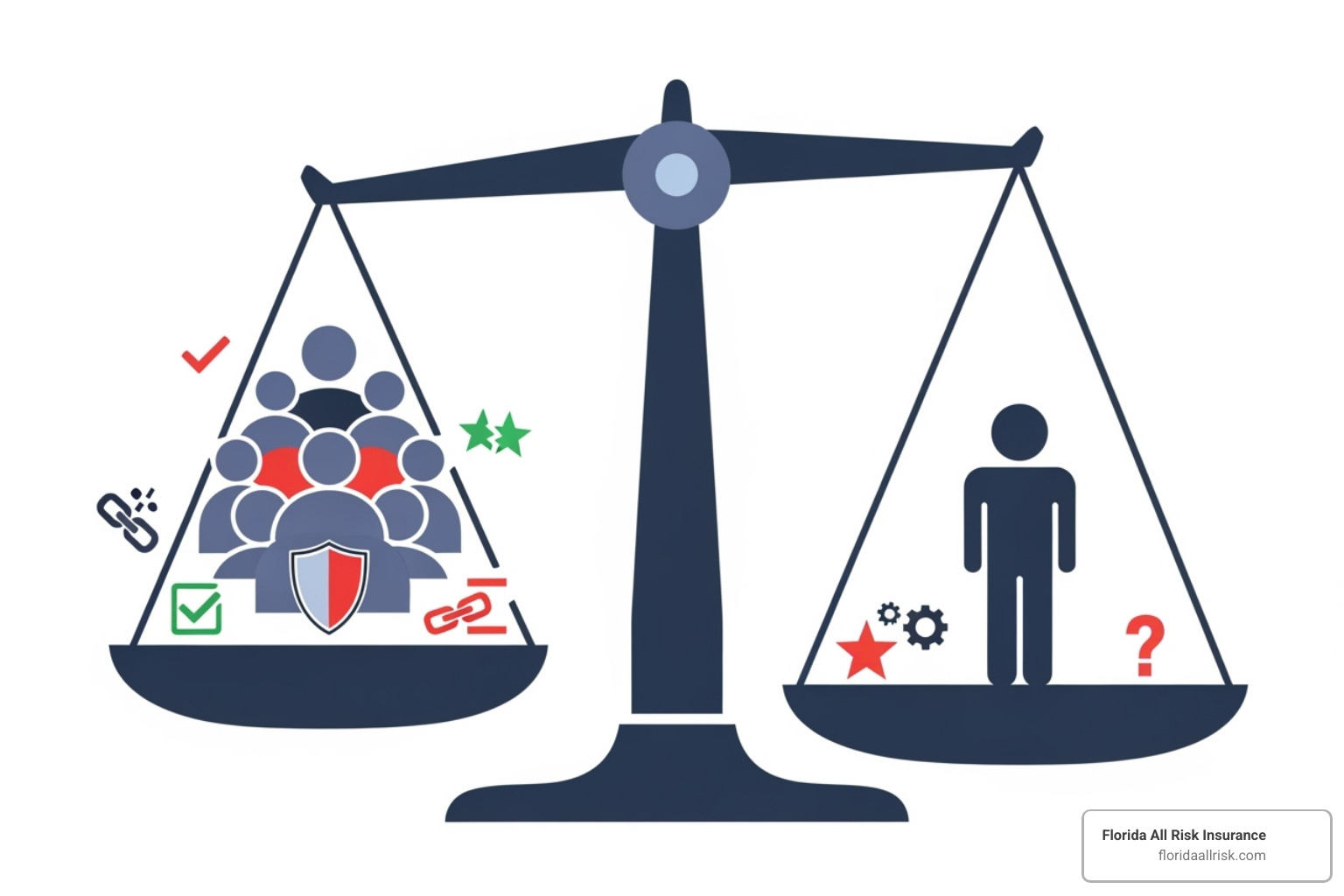
Advantages and Disadvantages of Group Health Insurance
For Employers:
- Pros: Group plans are a powerful tool for attracting and retaining talent. Contributions are tax-deductible, and a healthy workforce is a productive one. Risk pooling often allows access to better plans at lower rates.
- Cons: The administrative burden of managing plans, enrollment, and compliance can be significant. Rising premium costs are a major challenge, with family coverage costs increasing 22% in the last five years. Insurers also often require high employee participation rates.
For guidance, see our articles on Small Business Employee Benefits and Health Insurance For Businesses.
For Employees:
- Pros: The employer’s contribution leads to lower premiums. Pre-tax payroll deductions provide additional tax savings. The enrollment process is simple, with HR handling most of the details.
- Cons: There is a lack of plan choice, as you are limited to what your employer selects. Most critically, coverage is tied to your job, meaning you lose it if you leave. COBRA is an expensive temporary solution.
Advantages and Disadvantages of Individual Health Insurance
For Employers:
- Pros: Shifting to an individual coverage model (like an HRA) eliminates administrative overhead and creates predictable benefit costs. Employers set a fixed contribution amount and are done.
- Cons: There is less direct control over employee benefits, which can be a concern for recruitment and ensuring employees are well-covered.
Our page on Group Health Insurance Plans For Small Businesses explores innovative alternatives.
For Employees:
- Pros: You have complete control over plan choice, allowing you to find a perfect fit for your needs and doctor network. The plan is portable and follows you regardless of your employment status. Access to subsidies can make coverage surprisingly affordable.
- Cons: You are responsible for the full premium cost if you don’t qualify for subsidies, which can be high. The research and enrollment process can be complex and time-consuming.
Financial Deep Dive: Cost Trends and Tax Implications
When comparing group health insurance vs individual plan options, the financial details are critical. Cost trends and tax implications can significantly influence which choice is better for your budget.
A Closer Look at the Cost of Group Health Insurance vs Individual Plan
Cost trends for group and individual plans have been moving in opposite directions. Group health insurance costs have been rising steadily. According to the Kaiser Family Foundation (KFF), the average annual premium for employer-sponsored family coverage reached $23,968 in 2023, a 22% increase over the last five years. This puts financial pressure on both businesses and employees.
Conversely, individual health insurance premiums have decreased in recent years due to the stabilization of the ACA marketplaces. In 2023, the average monthly premium for an unsubsidized ACA silver plan was $468. While this may seem high, the impact of income-based subsidies is a game-changer. For many, an individual plan with subsidies can cost less than their share of a group plan.
Understanding the Tax Implications
Both plan types offer tax advantages, but they work differently.
With group health insurance, employers can deduct their premium contributions as a business expense. For employees, contributions are made with pre-tax dollars, which lowers their taxable income and saves them money on taxes.
With individual health insurance, self-employed individuals can often deduct their health insurance premiums, reducing their adjusted gross income. Additionally, choosing a High Deductible Health Plan (HDHP) allows you to contribute to a Health Savings Account (HSA). An HSA is one of the most powerful tools for managing healthcare costs due to its triple tax advantage: contributions are tax-deductible, the funds grow tax-free, and withdrawals for qualified medical expenses are also tax-free.
To be eligible for an HSA, you must be enrolled in a qualified HDHP. For 2024, the IRS defines an HDHP as a plan with a minimum deductible of $1,600 for an individual or $3,200 for a family. The annual contribution limits for HSAs in 2024 are $4,150 for self-only coverage and $8,300 for family coverage. Individuals aged 55 and older can make an additional $1,000 catch-up contribution.
The funds in an HSA can be used for a wide range of qualified medical expenses that aren’t covered by your plan, such as:
- Deductibles, copayments, and coinsurance
- Dental and vision care (including exams, glasses, and braces)
- Prescription medications
- Chiropractic services
- Acupuncture
- Over-the-counter medicines (with a prescription)
Unlike a Flexible Spending Account (FSA), HSA funds roll over year after year and are owned by you, not your employer, making them a portable, long-term savings vehicle for healthcare.
For more on this topic, our guide on Group Health Insurance Plans For Self-Employed explores these strategies in detail.
Making the Right Decision: When to Choose Each Plan
Choosing between a group health insurance vs individual plan is a personal decision based on your budget, healthcare needs, and circumstances. There is no single right answer, but understanding the scenarios where each plan typically excels can guide you to the best choice for you and your family.

When to Choose an Employer-Sponsored Group Health Plan
A group plan is often the best choice if:
- Your employer makes a generous contribution. If your company covers 70% or more of the premium, it’s likely the most cost-effective option.
- The available plans meet your needs. If the employer’s plan includes your preferred doctors and hospitals and covers your specific health needs, it’s a convenient choice.
- You value simplicity. Automatic, pre-tax payroll deductions simplify payments and provide tax savings without extra effort.
- It’s more affordable than a Marketplace plan. Even with subsidies, a strong employer contribution might make the group plan cheaper. It’s always wise to compare your net costs.
Employers can learn more by reading our guide on How To Choose A Group Health Insurance Plan.
When to Consider an Individual Health Insurance Plan
An individual plan may be the right fit if:
- You are self-employed or your employer doesn’t offer insurance. For freelancers, contractors, and employees of many small businesses, the individual market is the primary source of coverage.
- The employer’s plan is unaffordable. If the plan offered costs more than a certain percentage of your household income (9.12% in 2023 for self-only coverage), you may be eligible for subsidies on the Marketplace, making an individual plan a better deal.
- You qualify for significant subsidies. If your income makes you eligible for premium tax credits, an individual plan can become remarkably affordable.
- You need specific coverage or doctors. The individual market allows you to choose a plan that is custom to your unique health needs or includes a specific provider network not offered by your employer.
- You prioritize portability. If you change jobs frequently or value having coverage that isn’t tied to your employer, an individual plan provides stability and peace of mind.
Exploring Modern Alternatives: HRAs and Personalized Benefits
The traditional group health insurance vs individual plan debate is being reshaped by modern, flexible solutions. Health Reimbursement Arrangements (HRAs) are a game-changing alternative that blends the best features of both worlds, offering personalized benefits with predictable costs for employers.
How HRAs Bridge the Gap
An HRA is an employer-funded, tax-advantaged benefit that allows employees to get reimbursed for qualified medical expenses, including individual health insurance premiums. Instead of offering a one-size-fits-all group plan (a “defined benefit”), the employer provides a fixed monetary allowance (a “defined contribution”). This gives employers budget control while empowering employees with the freedom to choose a plan that fits their life. Reimbursements are generally tax-free for both parties.
ICHRA: The Individual Coverage HRA
The Individual Coverage HRA (ICHRA) is a powerful option for businesses of any size. The employer provides a tax-free allowance that employees use to purchase their own individual health insurance plan. This gives employees complete freedom of choice over their coverage.
For employers, ICHRA offers predictable budget control and can satisfy the ACA’s employer mandate for Applicable Large Employers (ALEs). Benefits can also be customized for different employee classes (e.g., full-time vs. part-time). The federal government provides official guidance on the individual coverage health reimbursement arrangement (ICHRA).
QSEHRA: The Qualified Small Employer HRA
The Qualified Small Employer HRA (QSEHRA) is designed for businesses with fewer than 50 full-time employees that do not offer a group plan. It allows small employers to provide tax-free reimbursements for their employees’ individual health insurance premiums and other medical expenses.
QSEHRA eliminates the administrative complexity of traditional group plans. There are no participation requirements or surprise premium hikes. The IRS sets annual contribution limits to ensure fairness. For 2025, these limits are $6,350 for self-only coverage and $12,800 for family coverage. This makes QSEHRA an accessible way for small businesses to offer valuable health benefits.
Conclusion: Partnering with an Expert for Your Health Insurance Needs
Choosing between group health insurance vs individual plan is a major decision for your health and finances. Group plans offer simplicity and affordability through employer contributions, while individual plans provide best flexibility, portability, and access to subsidies. Modern solutions like Health Reimbursement Arrangements (HRAs) are further revolutionizing benefits by offering a personalized, defined-contribution approach.
Navigating these options in Florida’s dynamic market can be complex. Working with a knowledgeable expert is the best way to ensure you make the right choice. An independent agency like Florida All Risk Insurance acts as your guide, helping you compare all available Group Health Insurance Plans and individual policies to find the perfect match.
We understand the nuances of the Florida market and are committed to helping you find a plan that fits your life, budget, and healthcare needs. Whether you’re a business owner, a freelancer, or in between jobs, we provide the personalized service you need to make an informed decision.
Ready to find the right health coverage?
Explore our comprehensive group health solutions or contact a Florida Health Insurance Broker today.
Contact Us
Florida All Risk Insurance
Address: 700 94th Ave N STE 300, Saint Petersburg, FL 33702
Phone: (727) 577-4700
Email: [email protected]

