

Why Group Health Insurance Plans for Small Businesses Are Essential
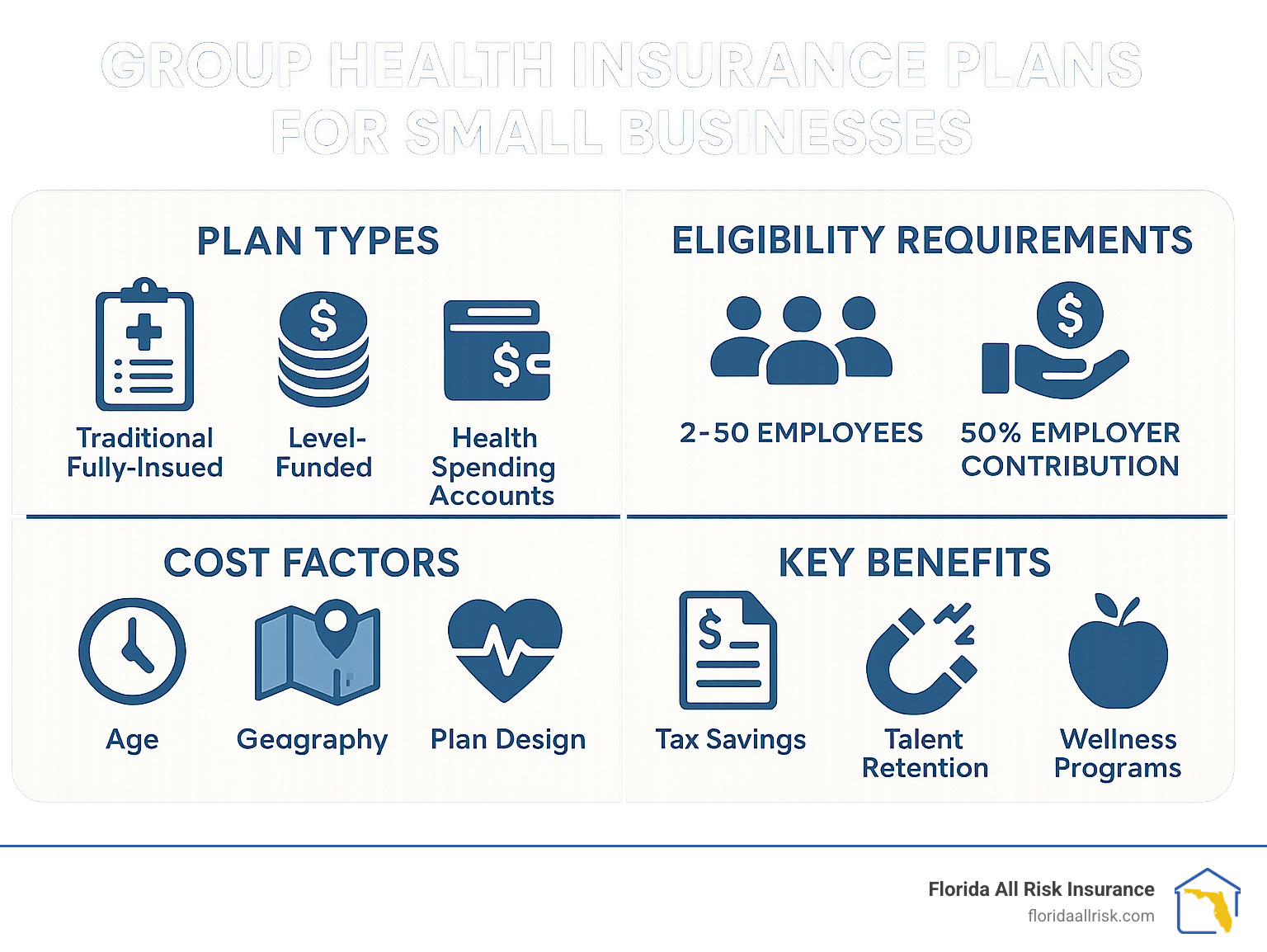
Group health insurance plans for small businesses are shared health coverage policies that spread risk across multiple employees, typically for companies with 2-50 workers. Here’s what you need to know:
Key Benefits:
– Lower premiums than individual plans through risk pooling
– Tax advantages – premiums are deductible for employers, tax-free for employees
– Talent attraction – helps recruit and retain quality staff
– Employee wellness – reduces sick days and boosts productivity
Basic Requirements:
– Minimum 2 employees in most states
– Employer must contribute at least 50% of employee-only premiums
– 12-month rate guarantee periods standard
– Available year-round (not just during open enrollment)
As a small business owner in Florida, you’re juggling countless responsibilities. The last thing you want is the headache of figuring out employee benefits while worrying about costs spiraling out of control. Yet offering health insurance has become essential for attracting good employees and staying competitive.
The good news? Group health insurance doesn’t have to be complicated or break your budget. With the right approach, you can provide valuable benefits that protect your team while actually saving money through tax advantages and reduced turnover costs.
I’m Jason Miller, and I’ve been helping Florida businesses steer insurance challenges for over 20 years. My experience has shown me that the companies who get this right see happier employees, lower recruitment costs, and stronger bottom lines.
Group health insurance plans for small businesses terms to know:
– Florida health insurance brokers
– how to choose a group health insurance plan
– benefits of health benefits
What Are Group Health Insurance Plans for Small Businesses?

Group health insurance plans for small businesses offer a team approach to healthcare coverage where employees join forces under one umbrella plan. Instead of each employee navigating individual health insurance alone, the entire group shares financial risk through something called risk pooling.
The Affordable Care Act created the Small Business Health Options Program (SHOP) to make these plans more accessible, though you’re not limited to SHOP options. Private carriers and association plans offer plenty of alternatives.
Getting qualified is straightforward. You need at least 2 employees (you as the owner usually count as one). Most states require at least one non-owner employee, and team members typically need to work 20-30 hours per week to be eligible.
The stability factor is huge for small businesses. Unlike individual plans where one person’s health scare can send rates through the roof, group plans spread that risk across everyone. The 12-month rate guarantee that comes with most group plans means you’ll know exactly what you’re paying for the entire year.
Benefits of Group Health Insurance Plans for Small Businesses
You become a talent magnet practically overnight. Candidates aren’t just looking at salary – they’re calculating the total value of working for you. Health benefits signal that you’re serious about your business and your people.
The premium savings are real. While individual plans can easily cost $500-800 per month for decent coverage, group plans typically run 15-30% less. Tax advantages work for everyone involved. Every dollar you spend on employee health premiums is 100% deductible as a business expense, while employees receive this valuable benefit tax-free.
Your workplace becomes more productive. When people aren’t stressed about medical bills, they show up more focused and energized. We consistently see businesses report fewer sick days and higher employee satisfaction after implementing group health plans.
Turnover costs plummet. Replacing an employee typically costs 50-200% of their annual salary. Health benefits create natural retention because leaving becomes a much bigger decision when someone has good coverage through work.
Costs, Contributions & Tax Advantages
The Foundation: The 50% Employer Contribution Rule
Most insurance carriers require you to contribute at least half of your employees’ monthly premiums. So if an employee has a $400 monthly premium, you’d pay $200 and they’d pay $200.
Family coverage gives you more flexibility. Many Florida businesses pay 50-80% of the employee’s portion but contribute less toward covering spouses and kids, keeping costs predictable while still offering valuable family benefits.
Predictable Budgeting Through Rate Guarantees
Group health insurance plans for small businesses typically lock in rates for 12 full months. You’ll know in January exactly what you’ll pay in December, making cash flow planning much easier than individual insurance with unpredictable rate jumps.
The Tax Benefits Are Real Money
Every dollar you spend on employee health insurance premiums is 100% tax-deductible as a business expense. Meanwhile, your employees don’t pay income tax on the value of their health coverage.
Real example: A 10-employee marketing firm spends $48,000 annually on group health premiums. After tax deductions, their actual cost drops to about $36,000. If those same employees bought individual coverage with after-tax dollars, they’d need roughly $64,000 in pre-tax income to afford equivalent coverage. The group plan saved everyone nearly $28,000 per year combined.

For detailed information on keeping costs manageable, our Affordable Employee Health Insurance guide walks through specific strategies. The latest research on premium trends also helps you understand market direction.
Key Factors That Drive Cost
Your Team’s Age Mix plays the biggest role in pricing. A group where most employees are in their 40s and 50s will pay significantly more than a younger workforce based on actuarial data.
Location matters significantly. Healthcare costs vary dramatically across Florida. Miami typically costs more than Gainesville due to local hospital costs and market competition.
Plan Design gives you the most control. Higher deductibles mean lower monthly premiums. A $5,000 deductible plan costs much less than a $1,000 deductible plan.
Claims History becomes important after your first year, while Wellness Programs can actually reduce premiums through insurer discounts.
Smart Strategies to Control Spending
Health Spending Accounts are game-changers for cost control. You give each employee a set annual amount to spend on health expenses, often retaining 20-30% of unused balances.
High-Deductible Plans paired with Health Savings Accounts reduce costs while giving employees control. Virtual Care costs a fraction of traditional office visits. Pooled Plans spread risk across thousands of businesses, providing stable rates.
Coverage Options & Plan Structures
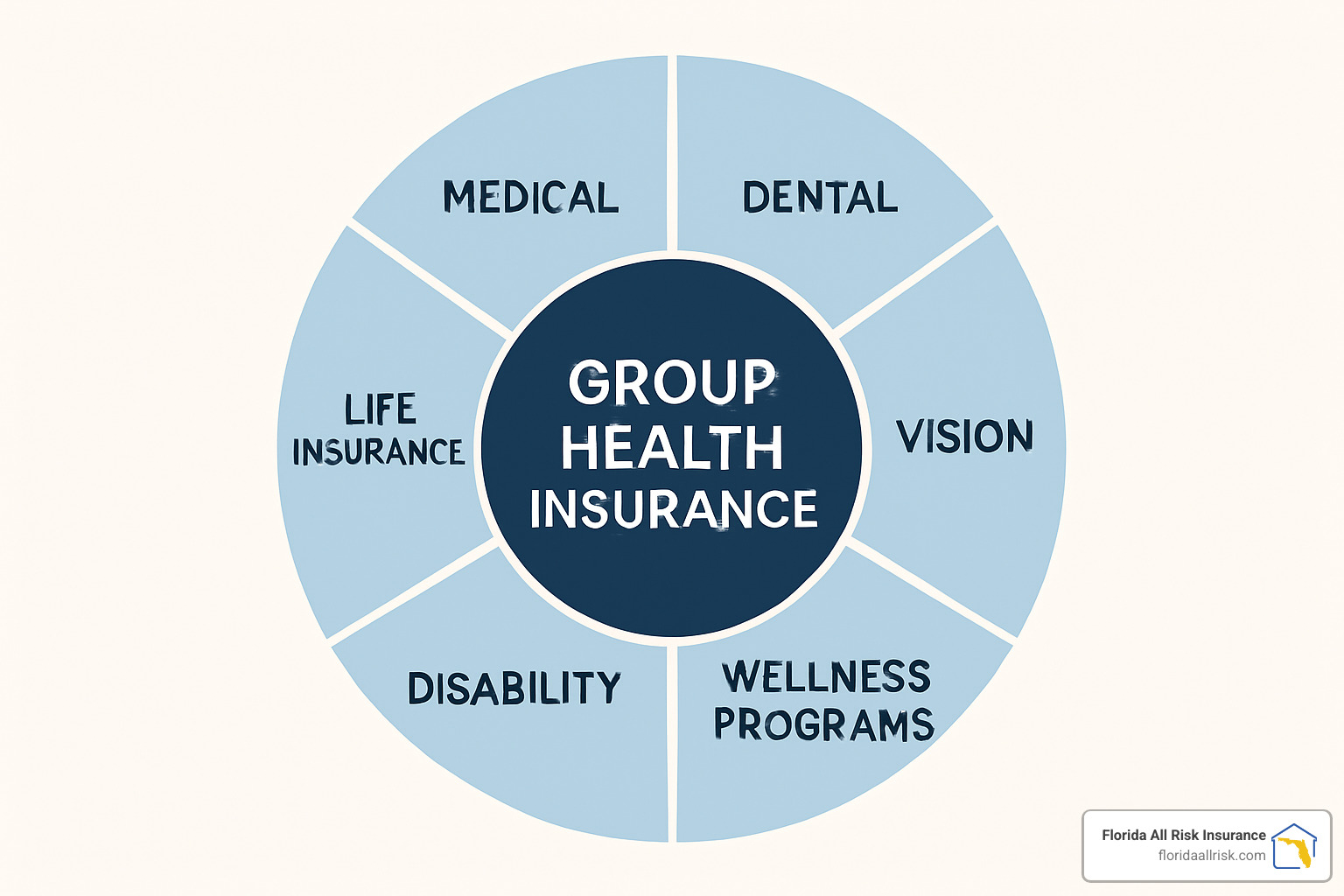
Modern group health insurance plans for small businesses offer much more than basic medical coverage. Think of it like building your perfect benefits package – you start with the essential medical foundation, then add the coverage your team actually wants.
Your medical foundation covers preventive care, emergency room visits, hospital stays, prescription medications, specialist visits, and mental health coverage. But the add-ons can make your benefits package shine.
Dental coverage is often the first thing employees ask about after medical. Vision benefits are popular with computer-heavy workforces. Basic life insurance often comes included, usually one to two times annual salary. Disability insurance replaces income if someone can’t work due to illness or injury.
Employee Assistance Programs provide confidential counseling and support services. Health Care Spending Accounts let employees pay for medical expenses with pre-tax dollars, covering everything from deductibles to prescriptions.
For businesses wanting more control over healthcare costs, our detailed guide on self-funded plans explains how some businesses save significantly.
Traditional vs Level-Funded vs Spending Accounts
Traditional fully-insured plans are the “set it and forget it” option. You pay a fixed premium monthly, and the insurance company handles everything else. This predictability makes budgeting simple with minimal administration. The trade-off is higher premiums with no money back in healthy years.
Level-funded plans offer an interesting middle ground. You pay a predictable monthly amount, but if your team has a healthy year with low claims, you get money back. We’ve seen Florida businesses receive refunds of 10-30% of annual premiums.
Health Spending Accounts and self-funded arrangements give you maximum control. Instead of paying insurance premiums, you fund actual employee medical expenses as they happen, potentially saving 20-30% of traditional premium costs.
Customization & Add-Ons Employees Love
Wellness allowances of $200-500 annually for gym memberships or fitness equipment show you care about overall health. Virtual doctor visits cost $40-60 compared to $150-300 for traditional office visits.
Robust mental health resources are essential in today’s work environment. Lifestyle benefits like pet insurance, legal services, and financial wellness programs are relatively inexpensive add-ons that create real value.
The key is understanding what your specific team values most and finding combinations that work for both your budget and their needs.
Selecting & Enrolling: Step-by-Step Guide
Getting group health insurance plans for small businesses up and running is more straightforward than most owners expect.
Start with your budget reality check. Figure out what you can afford monthly and annually. You’ll need to contribute at least 50% of employee-only premiums, but many successful businesses find that paying 70-80% helps with recruitment and retention.
Choose your path wisely. Working with an independent broker gives you access to multiple carriers and expert guidance. Trade associations might offer group plans with decent rates. The SHOP marketplace can provide tax credits for qualifying small businesses.
The comparison phase is crucial. Don’t just look at monthly premiums – compare deductibles, copays, prescription coverage, and provider networks. Make sure your employees’ current doctors are covered. Consider your team’s demographics when choosing between high-deductible plans and traditional copay plans.
Get employees involved early. Survey them about current coverage and preferences. This input helps you choose plans that actually get used and appreciated.
The underwriting process requires completing carrier applications and providing employee information. Most small groups sail through underwriting without issues.
Enrollment is your victory lap. Distribute materials clearly, hold group meetings to explain options, and give employees plenty of time to make decisions.
For detailed guidance, visit our comprehensive guide on how to choose a group health insurance plan.
Timeline from Quote to First Claim
Weeks 1-2: Quoting phase. Initial quotes come back within 48-72 hours, with detailed proposals taking 1-2 weeks.
Weeks 3-6: Enrollment and underwriting. Submit applications, employees complete enrollment forms, and carriers review everything. This phase takes 2-4 weeks depending on group size.
Week 7+: Implementation. ID cards arrive 7-10 days before your effective date, first premium payments are due, and you’ll hold employee orientation sessions. Coverage typically starts on the first of the month following enrollment completion.
First claims happen immediately once coverage is effective. Pharmacy benefits often work instantly, while medical claims process within 1-2 weeks.
Digital Tools & Support to Simplify Administration
Technology around group health insurance plans for small businesses has become remarkably user-friendly.
Self-enrollment portals let employees complete enrollment online, upload documents, and make changes during qualifying events. Most systems are mobile-friendly for field or remote workers.
Mobile apps let employees view digital ID cards, find network providers, check claim status, and access virtual care options. Direct billing handles nearly 98% of claims directly between providers and insurance companies.
Payroll integration connects with popular platforms, automatically handling premium deductions and generating reports. Online administration portals give you real-time access to add or remove employees and manage renewals.
Ready to explore your options? Get a Free Quote to see how group health insurance plans for small businesses can work for your team and budget.
Frequently Asked Questions about Small Business Group Health Insurance
What is the minimum number of employees needed to qualify?
Most states, including Florida, require just 2 employees for group coverage, with typically at least one non-owner W-2 employee. Some carriers are surprisingly flexible – I’ve successfully placed coverage for husband-and-wife businesses and single-owner companies with one part-time employee.
Each insurance company has slightly different rules. Some are stricter about the non-owner employee requirement, while others focus more on total hours worked or payroll amounts. Working with an experienced broker helps identify which carriers will approve your specific situation.
How much must an employer contribute toward premiums?
The standard requirement is 50% of the employee-only premium. If your employee’s monthly premium runs $400, you’d contribute at least $200.
Family coverage rules are much more flexible. Successful approaches include: paying 100% of employee-only coverage but only 50% of family premiums, covering 75% of employee portion and 25% of dependent coverage, or using a fixed dollar amount per employee regardless of coverage level.
Even paying the minimum 50% provides tremendous value. Your contributions are fully deductible business expenses, and employees don’t pay income tax on their health coverage value.
Can I start a plan at any time of year or only during open enrollment?
You can start group coverage virtually any time of year – no waiting for special enrollment periods. Most carriers allow coverage to begin on the first of any month, with some offering mid-month effective dates.
The typical timeline requires completing enrollment about 15-30 days before your desired start date. This year-round availability means you can add health benefits when it’s right for your business, not when the insurance calendar dictates.
Conclusion & Next Steps
Offering group health insurance plans for small businesses isn’t just about being a good employer – it’s about building a business that can compete for talent, retain great employees, and save money through tax advantages.
The numbers are compelling. When you factor in tax deductions for your business and tax-free benefits for employees, group plans often cost 25-40% less than individual coverage. Add reduced turnover costs and improved productivity from healthier, less-stressed employees, and the return on investment becomes clear.
Your employees will sleep better knowing they’re covered, and you’ll sleep better knowing you have competitive benefits that help attract and keep the people who make your business successful.
At Florida All Risk Insurance, we’ve been helping St. Petersburg area businesses with these decisions since 2003. Plans are more flexible now, administration is easier with digital tools, and there are more options than ever to fit different budgets and needs.
Ready to move forward? We make this process painless with no high-pressure sales tactics or confusing jargon – just straight talk about what works best for your situation. We’ll get you quotes from multiple carriers, explain differences in plain English, and handle all paperwork once you decide.
The consultation is completely free with no strings attached. We only succeed when you’re happy with your coverage and your employees value their benefits.
Visit our Florida Group Health Insurance page to get started. We’ll set up a time that works for your schedule and walk through everything at your pace.
Your business has come this far because you make smart decisions. Adding group health insurance plans for small businesses to your benefits package is another smart decision that pays dividends for years to come. Every day you wait is another day a great potential employee might choose your competitor because they offer health benefits.

