Let's get right to the number everyone wants to know: most Florida residents can expect to pay somewhere between $250 and $600 annually for standard golf cart insurance. But honestly, that's just a starting point. The final price on your policy is a unique mix of factors, all tied to you, your cart, and where you cruise around the Sunshine State.
Breaking Down the Average Florida Golf Cart Insurance Cost
Think of insuring your golf cart less like buying a product off the shelf and more like getting a custom-fit suit. The price can swing pretty widely. A beefed-up, street-legal cart zipping through a busy St. Petersburg community has entirely different insurance needs than a basic model that never leaves the grounds of a private resort.
The simple fact is, golf carts are everywhere now, and that's a huge reason why getting the right insurance is so critical. The American market for golf carts is on track to hit a staggering $1,627.6 million by 2026. This boom, especially in places like Florida, means more carts are sharing the road in retirement communities, resorts, and local neighborhoods, which directly shapes insurance needs. If you're curious, you can explore the full market research on this trend from Allied Market Research to see just how fast this is growing.
Estimated Annual Golf Cart Insurance Costs in Florida (2026)
To give you a clearer picture of what you might pay, it helps to see how costs can shift based on how you use your cart and the level of protection you choose. This table gives a quick look at some typical annual premium ranges.
| Usage Type | Coverage Level | Estimated Annual Premium Range |
|---|---|---|
| Private Community Use | Basic Liability & Comprehensive | $250 – $400 |
| Street-Legal (LSV) | Higher Liability & Collision | $400 – $600+ |
| Golf Course Only | Standard Liability | $200 – $350 |
| Commercial/Resort Use | Commercial Liability & High Limits | $700 – $1,200+ |
This is just a quick reference, but it shows the spectrum of potential costs. The main thing to remember is that your policy is built around your specific situation.
Why Your Homeowners Policy Is Not Enough
It’s a common mistake to think your homeowners insurance has you covered. While it might offer a tiny bit of protection for an incident on your own property, that coverage almost always vanishes the second your wheels hit a public road, a neighbor's property, or even a community path.
A dedicated golf cart policy is essential for covering liability risks, physical damage, and theft once you leave your own driveway. It closes a significant and often overlooked coverage gap.
This is especially true for Low-Speed Vehicles (LSVs). Florida law requires these street-legal carts to carry specific insurance, just like a regular car. If you're curious how vehicle insurance is calculated in general, our guide on the Florida car insurance cost estimator can provide some helpful background.
Ultimately, your final golf cart insurance cost is a direct reflection of the specific risks you face. In the sections ahead, we’ll dig into the details that insurance companies use to figure out your exact premium.
What Goes Into Your Golf Cart Insurance Quote?
Ever wondered how insurance companies come up with that final number for your golf cart policy? It’s not just a number pulled from a hat. Think of it more like a custom-built price tag, where every detail about your cart, who drives it, and where you use it gets factored in.
The process has some familiar echoes of auto insurance, but with its own unique twists for the golf cart world. By understanding these key pieces, you can start to see your policy through an insurer's eyes and get a much clearer picture of what you're actually paying for.
The Cart Itself: Value and Customizations
First things first, the insurance company wants to know all about the vehicle you're insuring. It makes sense—a brand new, tricked-out cart will cost more to protect than a ten-year-old workhorse you just use on the back nine.
Here’s what they’re looking at:
- Actual Cash Value (ACV): This is just the industry term for your cart's current market value, factoring in its age and condition. A shiny new cart worth $15,000 has a higher potential replacement cost than a used one valued at $5,000, so its insurance will naturally be higher.
- Age and Model: Newer, high-end models often have more expensive parts and can cost more to repair, which directly impacts the price of your collision and comprehensive coverage.
- Gas vs. Electric: The difference here is usually pretty small, but some insurers see gas-powered carts as having a slightly higher fire risk. It’s a minor detail that can subtly nudge your rate.
- Customizations and Accessories: This is a big one. Did you add a premium sound system, a lift kit, custom wheels, or plush new seats? Those upgrades add real value, and your standard policy probably won't cover them. You'll need a specific accessory coverage endorsement to make sure they're protected.
The Driver: Your Record Matters
Just like with your regular car insurance, who’s holding the keys is a huge part of the equation. Your driving history is one of the clearest signals of how much risk you represent.
An operator's driving history is a powerful predictor of future behavior. A clean record with no accidents or violations signals responsibility and directly translates to a lower insurance premium.
Insurers will want to know the following for every person who will be driving the cart:
- Driving Record: A history of speeding tickets, at-fault accidents, or especially DUIs will send your premium climbing.
- Age of Drivers: Statistically, very young or inexperienced drivers are more likely to be in an accident. That’s why you’ll see higher rates for them. Most policies require operators to be at least 16 with a valid driver’s license.
- Insurance History: Insurers like to see a track record of continuous coverage. If you’ve maintained insurance without any gaps, it shows you’re a responsible customer and can lead to better rates.
Location and Use: The Biggest Factor of All
Where and how you use your golf cart is arguably the single most important factor in what you’ll pay. The risks on a quiet, private golf course are worlds away from those on a busy street in a coastal town.
Street-Legal vs. Private Use: A golf cart that’s been modified and registered as a Low-Speed Vehicle (LSV) for use on public roads with speed limits of 35 mph or less is a whole different ballgame. It’s interacting with cars, cyclists, and pedestrians, which skyrockets the liability risk. Because of this, LSV insurance is more expensive and demands higher liability limits, much like a standard auto policy.
Florida-Specific Risks: Hurricanes and Floods: Living in the Sunshine State means your comprehensive coverage has to account for some serious environmental threats.
- Hurricane Exposure: If you live in a coastal county like Pinellas, Miami-Dade, or Sarasota, your cart faces a much higher risk of damage from high winds and storm surge. Insurers price this risk into your premium.
- Flood Zones: We’ve seen it happen time and again—a storm stalls, and the water starts rising. If your home is in a designated flood zone, your premium will reflect the increased risk of water damage, which can easily total a golf cart.
Getting a handle on these elements is the first step toward finding the right policy. Your cart, your driving habits, and especially your location all come together to create your unique risk profile—and that’s what your premium is designed to cover.
Understanding Your Golf Cart Policy Coverage Options
Think of your golf cart insurance policy less like a single, rigid product and more like a menu of specific financial protections. Each coverage option is a different tool designed to handle a particular kind of risk. Knowing what each tool does is the key to building a policy that truly protects you from unexpected—and often significant—out-of-pocket costs.
The right mix of coverages makes sure there are no gaps in your financial safety net. Let's break down the essential pieces you’ll find in a typical Florida golf cart policy.
The Foundation: Liability Coverage
Liability coverage is the absolute cornerstone of your policy. It’s not about protecting your cart; it’s about protecting your personal assets if you’re found legally responsible for an accident that injures someone or damages their property.
There are two parts to this crucial coverage:
- Bodily Injury Liability: This helps pay for medical bills, lost wages, and other costs if you injure another person in an accident.
- Property Damage Liability: This covers the cost to repair or replace someone else’s property you damage, whether it’s their car, a fence, or even another golf cart.
A serious accident can easily lead to lawsuits costing tens or even hundreds of thousands of dollars. Carrying liability limits that adequately protect your net worth isn't just smart—it's essential.
Protecting Your Cart: Collision and Comprehensive
While liability covers others, collision and comprehensive coverages are all about protecting your own investment in your golf cart. These two work together to shield you from the most common causes of damage or total loss.
Collision Coverage pays to repair or replace your golf cart if it's damaged in a crash with another vehicle or an object, like a tree or a light pole. It applies no matter who is at fault.
Comprehensive Coverage, sometimes called "other than collision," is your defense against a wide range of non-crash incidents. This includes:
- Theft and vandalism
- Fire and explosions
- Falling objects
- Damage from weather like hail, wind, and—critically for us in Florida—hurricanes and floods.
For Florida golf cart owners, comprehensive coverage is not a luxury; it's a necessity. With our state's constant exposure to severe weather, this coverage is often the only thing standing between you and the total loss of your vehicle after a storm.
Valuable Add-Ons for Complete Protection
Beyond the core coverages, several optional endorsements, or add-ons, can fill crucial gaps and customize your policy to your lifestyle. These can significantly boost your peace of mind for a relatively small increase in your premium.
Accessory Coverage: If you’ve invested in custom wheels, a high-end sound system, a lift kit, or other upgrades, this is a must-have. A standard policy typically only covers the factory version of your cart, leaving your expensive additions unprotected. Accessory coverage makes sure your customizations are covered if you need to file a claim.
The following visual shows how the value of your cart, your driving profile, and your location come together to determine your overall cost.
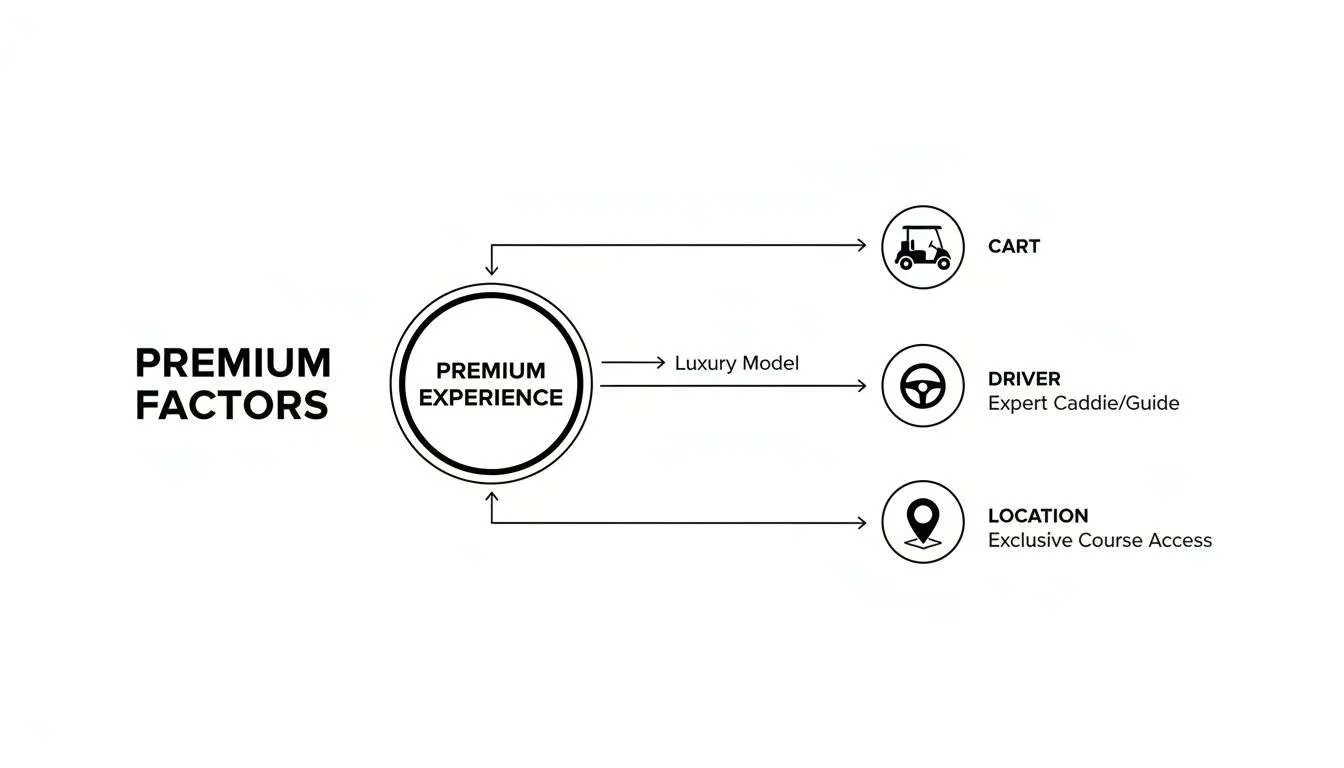
As you can see, the cart's value, the driver's history, and where you use it all play a role in the final premium. For a deeper dive into the various types of coverage available, you can check out this detailed guide on Golf Cart Insurance Coverage.
Medical Payments Coverage: This coverage helps pay for medical or funeral expenses for you and your passengers if you're injured in an accident, regardless of who is at fault. It gives you quick access to funds for immediate medical needs.
Roadside Assistance: This convenient add-on provides help if your cart breaks down, runs out of battery, or gets a flat tire. It typically covers services like towing to the nearest repair shop.
The global golf cart market is booming, projected to climb from $2.41 billion in 2024 to an expected $3.86 billion by 2036. This growth is driven by trends in golf tourism and community living that are especially strong here in Florida. More carts on paths and roads means a higher risk of accidents and theft. While the national average premium is $300-$600, this heightened activity can push costs 20-30% higher in high-traffic states like ours.
Real-World Cost Scenarios for Florida Drivers
All the talk about coverage factors and variables is great, but what do these numbers actually look like in the real world? The best way to understand golf cart insurance cost is to see it in action.
Let's walk through three common Florida driver profiles. Each one has a different cart, different needs, and a different approach to insurance, showing you just how much the final premium can change based on your personal story.
Scenario 1: The Village Retiree
First up, let's meet a retired couple living in a large Central Florida community like The Villages. They own a standard, two-year-old electric golf cart. Their daily routine involves short trips to the community center, visiting friends, and grabbing a few things from the local grocery store, all on private roads.
Their biggest priority is protecting their retirement savings from a lawsuit. If they accidentally injure someone or damage property, they want to be sure their nest egg is safe.
- Golf Cart Type: Standard 4-seater electric cart (Value: $8,000)
- Usage: Neighborhood travel on private roads, less than 20 miles per week.
- Driver Profile: Two drivers over 65 with perfect driving records.
- Key Coverages: They go for solid Bodily Injury and Property Damage liability ($100,000/$300,000/$50,000), $5,000 in Medical Payments, and Comprehensive coverage for theft or storm damage. To keep costs down, they skip Collision coverage, feeling comfortable paying for a minor fender-bender themselves.
- Estimated Annual Premium: $325
For this couple, the combination of low-risk usage and a clean driving history makes their insurance incredibly affordable. The cost is almost entirely driven by their need for strong liability protection.
Scenario 2: The Coastal Family
Now, let’s picture a family in a coastal St. Petersburg neighborhood. They own a souped-up, street-legal Low-Speed Vehicle (LSV) that serves as their go-to ride for beach trips, zipping to local restaurants, and running errands on public roads with speed limits of 35 mph or less.
Their cart is their pride and joy, decked out with a lift kit, custom wheels, and a great stereo system. Because they share the road with cars, their main concern is high liability limits. They also want to protect their investment from accidents and the very real threat of hurricane damage.
For owners of street-legal LSVs in Florida, insurance isn't just a good idea—it's the law. These vehicles must carry Personal Injury Protection (PIP) and Property Damage Liability coverage, just like a regular car.
Here’s how their policy shakes out:
- Golf Cart Type: Customized, street-legal LSV (Value: $18,000 + $4,000 in accessories)
- Usage: Frequent use on public roads.
- Driver Profile: Two adults in their 40s with clean records, plus a 17-year-old licensed driver.
- Key Coverages: They wisely choose high liability limits ($250,000/$500,000/$100,000), state-required PIP, Collision, Comprehensive, and a $4,000 Accessory Coverage add-on to protect their upgrades.
- Estimated Annual Premium: $580
The family’s higher premium is a direct reflection of their situation. The increased risk of driving an LSV on public roads, having a teen driver on the policy, the high value of their customized cart, and their coastal storm exposure all add up. The higher golf cart insurance cost buys them maximum peace of mind.
Scenario 3: The Resort Operator
Finally, let’s look at a small boutique resort on the Gulf Coast that relies on a fleet of four utility golf carts. Staff members use these workhorses to haul luggage, deliver room service, and handle maintenance tasks across the property.
For the resort, the number one concern is commercial liability. They need to shield the business from potential lawsuits if an employee has an accident involving a guest or if one of their expensive carts gets damaged or stolen.
- Golf Cart Type: Four commercial utility carts (Value: $9,000 each)
- Usage: Daily commercial operations on private property.
- Driver Profile: Multiple employees of various ages.
- Key Coverages: A Commercial General Liability policy that includes owned auto coverage for the carts, with a hefty $1,000,000 liability limit. The policy also includes full comprehensive and collision coverage for the vehicles.
- Estimated Annual Premium: $1,150
The resort’s premium is the highest because it’s a commercial policy built to handle business risks, multiple vehicles, and a rotating cast of employee drivers. This is the kind of broad protection a business operation needs.
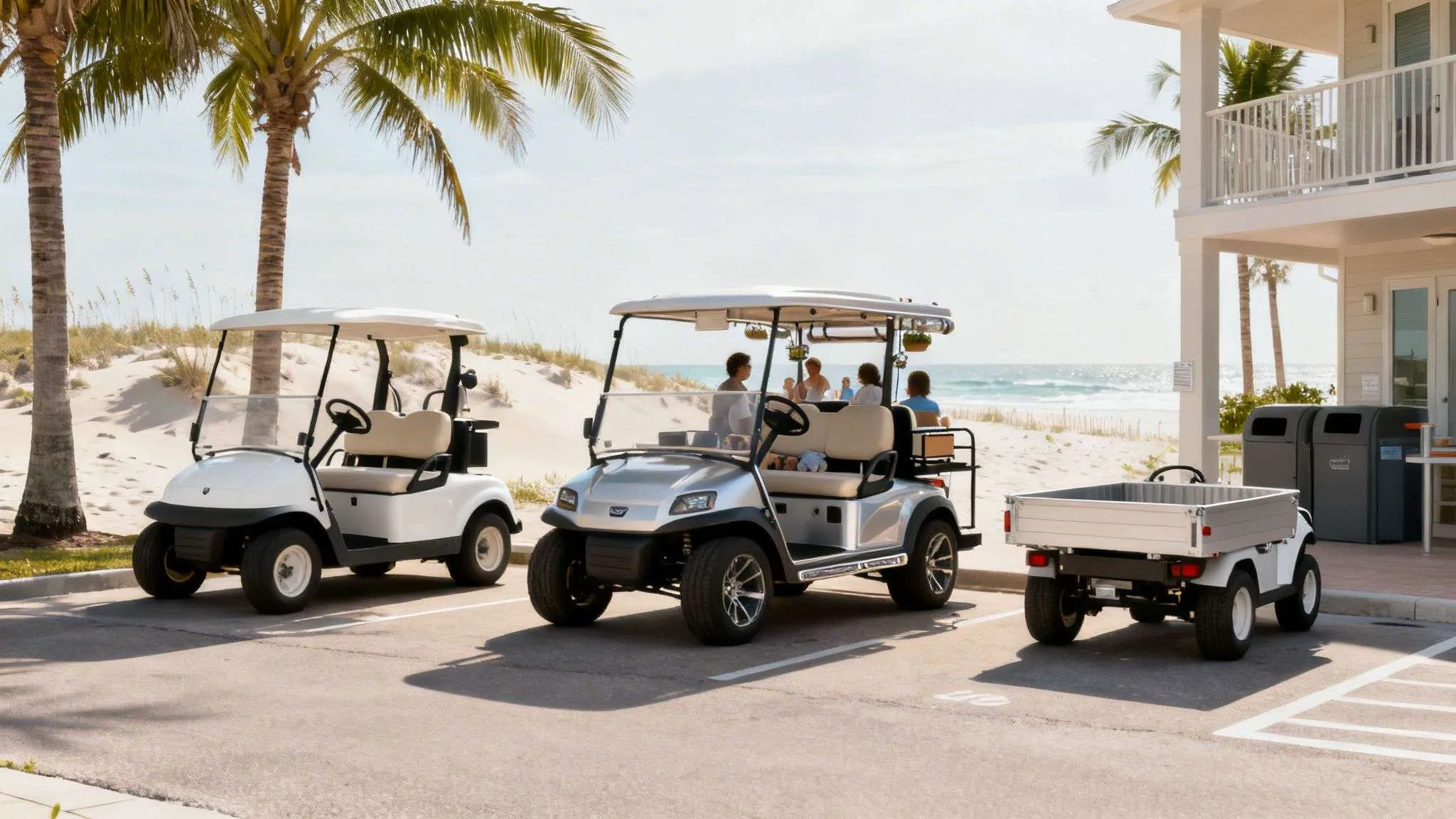
To make it even clearer how different your needs can be, let's put these three scenarios side-by-side.
Cost Comparison Across Different Florida Driver Profiles
| Driver Profile | Golf Cart Type | Key Coverages | Estimated Annual Premium |
|---|---|---|---|
| The Village Retiree | Standard Electric Cart | Strong Liability, Comprehensive | $325 |
| The Coastal Family | Street-Legal LSV (Custom) | High Liability, PIP, Comp/Collision, Accessory | $580 |
| The Resort Operator | Fleet of 4 Utility Carts | $1M Commercial Liability, Comp/Collision | $1,150 |
As you can see, there’s no such thing as a one-size-fits-all answer for golf cart insurance cost. Your premium is a unique reflection of your lifestyle, your vehicle, and the protection you need.
Actionable Strategies to Lower Your Insurance Cost
Knowing how your premium is calculated is one thing, but learning how to actively lower your golf cart insurance cost is where you really take control. With a few smart moves, you can trim what you pay without giving up the essential protection you and your family need. These are the strategies that put you back in the driver's seat.
The most powerful tool for savings is almost always bundling. Think of it as a loyalty reward—when you combine your golf cart policy with your existing home or auto insurance, carriers often give you a substantial price break. This is especially true here in Florida. North America commands over 58.5% of the global golf cart market, and for families here, bundling can lead to savings of up to 20% compared to buying a standalone policy. You can read the full research on the global golf cart market to see just how big this industry has become.
Proactive Steps for Immediate Savings
Beyond just bundling, several other proven methods can help trim your premium. Many of these are simple habits and decisions that show insurers you're a low-risk, responsible owner.
- Maintain a Clean Driving Record: This is your easiest win. Avoiding accidents and traffic tickets is the number one way to keep rates low for any vehicle you insure.
- Increase Your Deductible: Your deductible is what you agree to pay out-of-pocket before insurance kicks in. Choosing a higher deductible, say $1,000 instead of $500, will lower your annual premium. Just be sure you can comfortably cover that amount if you ever need to file a claim.
- Complete a Safety Course: Many insurers offer a discount to drivers who complete an approved golf cart or vehicle safety course. It’s a small investment of your time that can pay off for years to come.
Smart Upgrades and Policy Management
You can also make strategic choices about your cart and how you manage your policy that lead to long-term savings. While our focus is on golf carts, many of these principles apply across other recreational vehicles. For a different perspective, you can explore insights into electric bike insurance cost.
Installing certain safety features can also make a real difference. Adding an anti-theft alarm or a GPS tracker makes your cart a less attractive target for thieves, which can earn you a nice discount on your comprehensive coverage.
One of the most overlooked strategies is the annual policy review. Life changes—you might sell a custom cart for a standard one, a teen driver may head off to college, or you could move to a lower-risk neighborhood. Reviewing your policy each year with your agent ensures your coverage and your price match your current reality.
Finally, don't forget to ask about all the available discounts. Many of the same principles for saving on car insurance apply here. Our guide on Florida car insurance discounts offers more ideas you can bring up with your agent. The goal is to make sure you're not leaving any money on the table.
Why an Independent Agent Is Your Best Resource
When it's time to shop for golf cart insurance, you've got a few choices. You can go straight to a big insurance brand, talk to a "captive" agent who only sells for one company, or team up with an independent agent. Let's talk about why that third option is your secret weapon for finding the best possible value.
Think of an independent agent as your personal insurance shopper. We don’t work for a single company; our loyalty is to you, the client. That might sound like a small distinction, but it makes all the difference for your wallet and your peace of mind.
Getting More Options and Honest Advice
A captive agent is stuck with the products their one company offers. If their rates are high for your situation or their coverage just doesn't quite fit, their hands are tied. It’s like going to a shoe store that only sells one brand in one width—if it doesn’t fit perfectly, you’re out of luck.
An independent agency, on the other hand, builds relationships with a whole network of top-rated insurance carriers. This lets us do the heavy lifting for you, gathering and comparing multiple quotes to find the perfect blend of coverage and cost. We dig into the fine print, explain the differences, and give you unbiased advice on which policy actually serves you best.
An independent agent's primary role is to be your advocate in the insurance marketplace. By having access to multiple carriers, they can tailor a solution that fits your specific risk profile, rather than trying to fit you into a pre-packaged product.
This strategy is especially powerful when it comes to the golf cart insurance cost. We make the insurance companies compete for your business, which almost always results in a better premium for you.
Local Expertise in Florida’s Unique Market
An online quoting tool or a national call center just can't compete with the on-the-ground knowledge of a local, independent agent. Florida’s insurance market is notoriously complex, with its own specific laws for Low-Speed Vehicles (LSVs) and the ever-present risks from hurricanes and flooding.
We live and work here, so we get the nuances that can swing your premium, like:
- Local rules in communities like St. Petersburg or The Villages.
- The specific storm surge or flood risk tied to your zip code.
- How to correctly insure a street-legal LSV versus a standard golf cart used only on the course.
This local insight lets us give you personalized advice a website simply can't match. We know which carriers offer the best rates for coastal homes or who has the most generous accessory coverage for your custom sound system and lift kit. To see more on this, you can learn about the real-world advantages when you work with an independent insurance agency that truly understands your home turf.
Ultimately, our job is to find every discount you're entitled to and make sure you aren't paying for coverage you don’t need—or worse, missing protection you absolutely do. By acting as your dedicated insurance advisor, we take the confusion out of the process and deliver real confidence along with a great rate.
Your Top Florida Golf Cart Insurance Questions, Answered
Navigating the world of golf cart insurance can feel a little confusing, especially here in Florida where the rules and risks are so unique. To help clear things up, we’ve put together straightforward answers to the most common questions we hear from golf cart owners all across the state.
Is My Golf Cart Covered by My Homeowners Insurance?
This is the number one question we get, and the short answer is almost always no, not in any meaningful way. A standard homeowners policy might offer a tiny sliver of liability protection if an accident happens on your own property, but that coverage disappears the second your tires hit a public sidewalk, a neighbor's driveway, or a community road.
For any off-property use, for damage to the cart itself, or to make it street-legal, you absolutely need a dedicated golf cart policy. Trying to rely on homeowners insurance leaves a massive and very risky gap in your protection.
Do I Need Insurance If I Only Drive on Private Property?
Even if you never leave your own property or gated community, insurance is still a critical investment. Accidents don't just happen on public roads. A collision with another cart, a pedestrian, or private property can easily lead to a major liability claim against you.
Plus, your cart is a valuable asset. A dedicated policy with comprehensive coverage is what protects it from theft, vandalism, fire, and storm damage—risks that exist no matter where you drive or park it.
In states like Florida, having proof of liability insurance is a legal requirement to even register a golf cart for use on public roads. According to South Carolina law, which shares similarities, drivers must carry their registration and proof of insurance at all times.
What Is the Difference Between a Golf Cart and an LSV?
It's a common point of confusion, but the distinction is pretty simple. A standard golf cart is designed for speeds under 20 mph and is generally restricted to golf courses or designated private roads.
A Low-Speed Vehicle (LSV), on the other hand, is a golf cart that has been modified to be street-legal. To qualify as an LSV, the vehicle must have safety features like headlights, taillights, turn signals, and a windshield. It can then be driven on roads with speed limits of 35 mph or less.
Because they operate in regular traffic, Florida law requires LSVs to be insured just like a car, and that includes carrying Personal Injury Protection (PIP) coverage.
How Do I File a Claim After a Hurricane?
After a hurricane, the first step is always to make sure you and your family are safe. Once the storm has passed and it's safe to go outside, your next move is to document the damage to your golf cart. Take clear photos and videos from every angle you can.
Then, contact your insurance agent immediately. This is where having an independent agent really pays off. We can guide you through your specific carrier's claims process, help you with the paperwork, and act as your advocate to make sure your claim is handled quickly and fairly. Having comprehensive coverage is what makes this entire process possible.
Don’t wait for an accident to find out you're not properly covered. Get the right protection for your golf cart today.
Ready to find the best rate? Call us at [Company Phone] now for a personalized quote!
Visit our website to get a fast, free online quote and see how much you can save on your Florida golf cart insurance.
Contact Us
For personalized advice or a detailed quote for your golf cart insurance needs, please reach out to our team.
Address: [Company Address, Saint Petersburg, FL]
Phone: [Company Phone]
Email: [Company Email]