

Protecting Your Business with General Liability Insurance
If you’re searching for a gl insurance quote, you need quick access to comprehensive protection for your business at competitive rates. Here’s what you need to know:
Quick Guide to GL Insurance Quotes
- Average Cost: $30-$80 per month for most small businesses
- Coverage Includes: Third-party bodily injury, property damage, and advertising injuries
- Get a Quote By: Providing business information, industry type, revenue, and claims history
- Typical Limits: $1 million per occurrence, $2 million aggregate
- Timeframe: Coverage can be bound same-day with instant certificates available
General liability insurance serves as the foundation of business protection, shielding your company from potentially devastating third-party claims. Whether you’re a contractor, retailer, consultant, or service provider, this essential coverage helps pay for medical expenses, legal defense costs, and settlements when someone claims your business caused them harm.
While not always legally required, general liability insurance is often demanded by clients, landlords, and lenders as a condition of doing business. Without it, your business assets (and potentially your personal assets) remain exposed to costly litigation.
I’m Jason Miller, a second-generation insurance professional with over 20 years of experience helping Florida businesses find affordable gl insurance quotes that provide comprehensive protection. At Florida All Risk Insurance, we understand that every business has unique needs and risk exposures.

Easy gl insurance quote glossary:
– excess public liability
– general risk insurance
– public liability risk
Why This Guide Matters
When it comes to protecting your business, the stakes couldn’t be higher. According to industry data, four out of ten small business owners are likely to experience a property or general liability claim in the next 10 years. Without proper coverage, these claims can be financially devastating.
Consider this: the average cost of a slip-and-fall claim can exceed $30,000, while more serious incidents can result in six or seven-figure settlements. Legal defense costs alone can drain your business resources, even if you’re ultimately found not liable.
Beyond risk mitigation, having general liability insurance opens doors. Many contracts explicitly require proof of GL coverage before you can begin work. From government contracts to commercial leases, a certificate of insurance is often your ticket to new business opportunities.
Understanding General Liability Insurance 101
General liability insurance (sometimes called commercial general liability or CGL) is the foundation of business insurance protection. It’s like having a safety net that catches you when the unexpected happens in your business day.
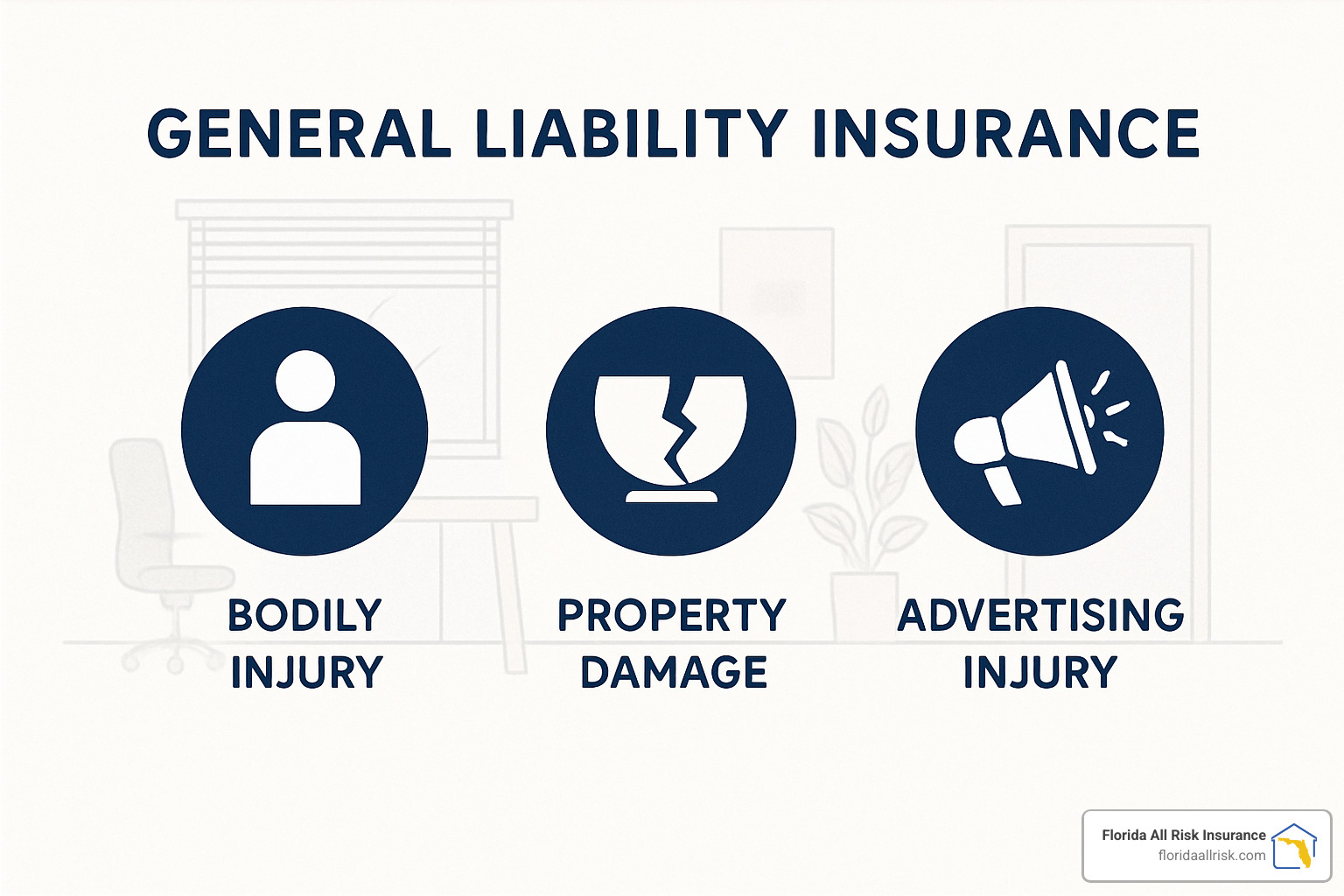
When you’re looking for a gl insurance quote, you’re essentially shopping for protection against three main types of risk:
Bodily Injury coverage steps in when someone who doesn’t work for you gets hurt at your business or because of your operations. Imagine a customer slipping on your freshly mopped floor – your GL policy would help cover their medical bills, your legal defense, and any settlements.
Property Damage protection is there when accidents happen to other people’s belongings. If your employee accidentally damages a client’s expensive equipment while on a job, your GL policy can help pay for repairs or replacement.
Personal and Advertising Injury coverage might sound complicated, but it’s simply protection against non-physical injuries like if someone claims you’ve damaged their reputation through libel or slander, or if you accidentally used copyrighted material in your marketing.
Most GL policies also include medical payments coverage (regardless of who’s at fault), products-completed operations protection (for problems that pop up after your work is finished), and coverage for damage to premises you’re renting.
For businesses that need extra peace of mind, umbrella policies work like an extension of your GL coverage – pushing your protection limits higher when you need it most.
More info about What Does General Liability Insurance Cover?
What GL Does—and Doesn’t—Cover
Your gl insurance policy is comprehensive, but it’s not a catch-all. Understanding its boundaries helps you avoid surprise gaps in protection.
On the “covered” side, your policy typically handles medical payments when someone gets hurt on your property, even before determining who’s at fault. It also covers defense costs – paying for attorneys, court fees, and expert witnesses if you’re sued. And if you’re found liable or choose to settle, your policy can cover these costs up to your policy limits.
One of our restaurant clients shared, “When a customer claimed they found glass in their meal, I panicked. But our GL policy covered the legal defense and settlement completely. Without it, that single incident could have closed our doors for good.”
However, GL insurance has clear boundaries. It won’t cover employee injuries (that’s what workers’ comp is for) or professional errors in your services. It also doesn’t extend to auto accidents, damage to your own property, intentional harmful acts, or data breaches. Each of these risks requires its own specific type of insurance protection.
General Liability vs. Professional Liability
Many business owners come to us confused about the difference between general and professional liability coverage. While both protect against third-party claims, they address fundamentally different risks:
| Coverage Aspect | General Liability | Professional Liability |
|---|---|---|
| Primary Focus | Physical harm and damage | Economic/financial harm |
| Covers | Bodily injury, property damage, advertising injury | Errors, omissions, negligence, bad advice |
| Claim Example | Customer slips and falls | Client loses money due to your advice |
| Typical Industries | All businesses with physical locations or client interaction | Professionals: consultants, architects, accountants, etc. |
| Claim Trigger | Physical damage or injury | Service error or failure to perform |
Think of general liability as protection against physical world problems, while professional liability guards against mistakes in your expertise or service. A web designer, for example, would need general liability if a client tripped over a cord during a meeting, but professional liability if their website design caused the client to lose business.
Many businesses need both types of coverage for complete protection. When you request a gl insurance quote, we can help you determine if professional liability makes sense for your business too.
Why Every Business Should Consider a GL Policy
Let’s be honest – nobody gets excited about buying insurance. But here’s the reality I’ve seen after helping hundreds of Florida businesses: the question isn’t whether you can afford gl insurance, it’s whether your business can survive without it.
Think about this: About 75% of the commercial contracts we review at Florida All Risk Insurance require vendors to carry at least $1 million in general liability coverage. That means without proper insurance, three-quarters of those potential clients might simply walk away.
Your commercial landlord likely feels the same way. Most commercial leases make gl insurance mandatory, often requiring you to list the property owner as an additional insured. It’s not just about protecting you – it’s about protecting everyone involved in your business ecosystem.
The lawsuit landscape gets more treacherous every year. I recently helped a small retailer who faced a $45,000 claim when a customer tripped on an extension cord. Without insurance, that single incident would have devastated their finances. Instead, they only paid their $500 deductible.
Some industries naturally face higher risks. If you’re in construction, food service, retail, or healthcare, your liability exposure is significantly higher than, say, a remote software developer. Your coverage needs to match your real-world risk level.
Here’s a silver lining: general liability premiums are typically tax-deductible as legitimate business expenses. The IRS considers reasonable insurance costs as ordinary and necessary business expenses in most cases. This tax benefit helps offset the cost of protection. Learn more about deducting business expenses.
As one of our clients, a Tampa contractor, told me: “I initially got gl insurance because my clients required it, but when a subcontractor accidentally damaged an expensive chandelier, the coverage paid for itself ten times over. Without it, that mistake would have wiped out my profit for the entire quarter.”
How GL Insurance Helps Win Contracts
Your gl insurance policy does double duty – it protects you from claims while opening doors to new business opportunities.
Many government contracts and corporate RFPs make insurance a non-negotiable requirement. Without proper coverage, your business simply can’t compete for these opportunities. I’ve seen talented business owners miss out on lucrative contracts simply because they couldn’t provide proof of adequate insurance.
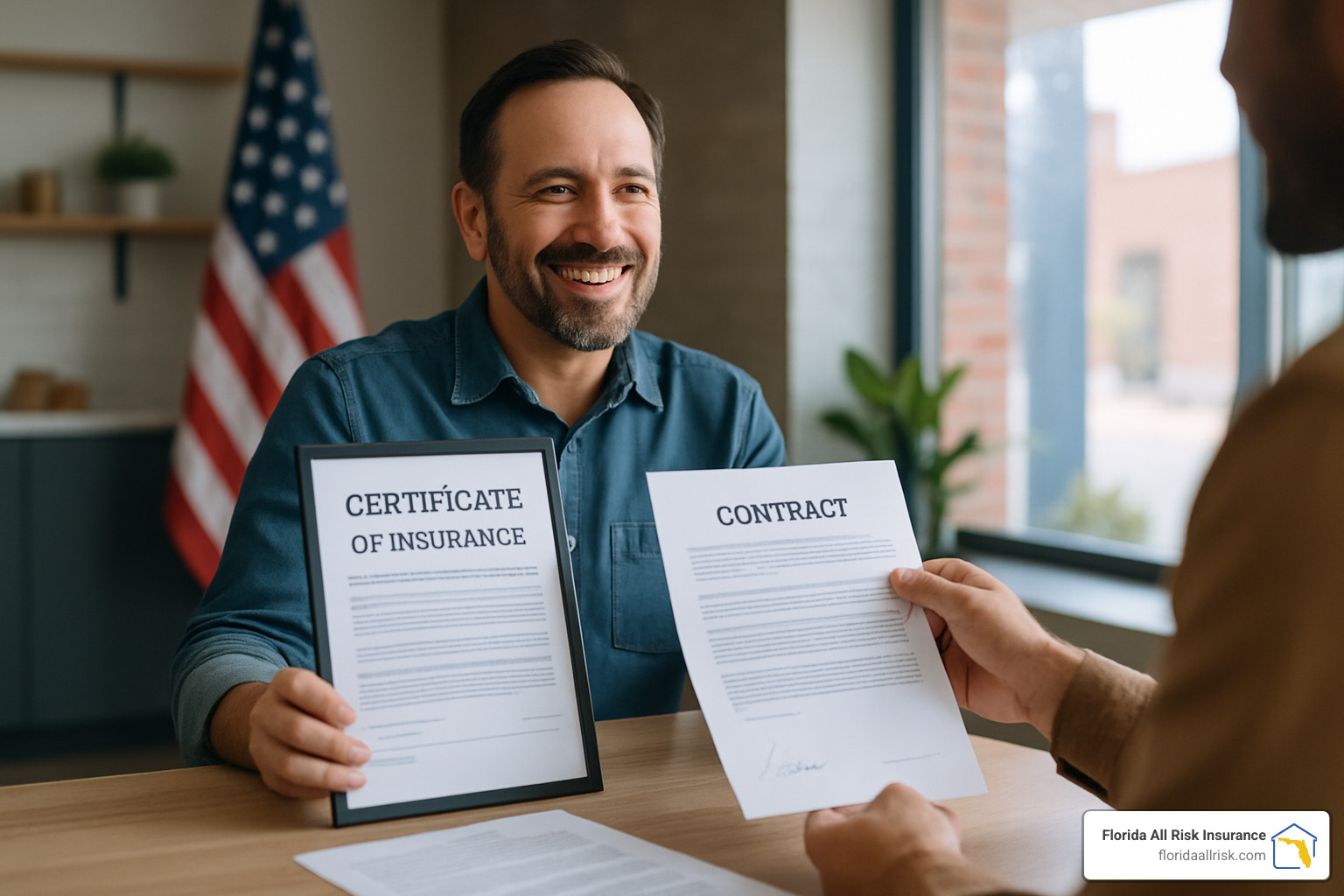
Clients feel more confident working with properly insured businesses. When you can provide a certificate of insurance, you’re signaling that you’re professional, responsible, and financially prepared for unexpected problems.
The ability to add clients as “additional insureds” on your policy gives them peace of mind that they won’t be dragged into litigation if something goes wrong with your work. At Florida All Risk Insurance, we can typically add these endorsements quickly, often with minimal or no additional cost.
One of our St. Petersburg retail clients shared something that stuck with me: “When we bid on a contract to supply merchandise to the school district, our insurance program gave us an edge over competitors who couldn’t meet the requirements. That single contract increased our annual revenue by 22%.”
Is GL Insurance Required by Law?
Unlike auto insurance, general liability coverage isn’t typically mandated by state law for most businesses. However, the practical requirements often make it effectively mandatory.
Some states do require specific businesses – particularly contractors – to carry gl insurance to obtain and maintain their licenses. Professional licensing boards may also require coverage as a condition of your professional credentials.
If you have a business loan, check your agreement carefully. Many lenders require borrowers to maintain liability coverage to protect their investment in your business. They know an uninsured claim could destroy your ability to repay.
While not legally mandated in most cases, general liability insurance becomes practically required when you need to:
– Sign commercial leases
– Enter client contracts
– Protect personal assets (especially critical for sole proprietors)
– Maintain professional credibility in your industry
I remember a promising Jacksonville landscaping company that lost a major commercial contract because they couldn’t produce the required certificate of insurance within the client’s timeframe. By the time they got coverage in place, the opportunity had gone to a competitor.
Don’t let insurance gaps close doors for your business. At Florida All Risk Insurance, we’ll help you understand exactly what coverage you need – no more, no less – to protect your business and keep opportunities flowing.
Getting Your GL Insurance Quote Step-by-Step

I remember when I first started helping small business owners with their insurance needs. Many walked in looking overwhelmed at the thought of getting a gl insurance quote. The good news? It’s much simpler than most people think!
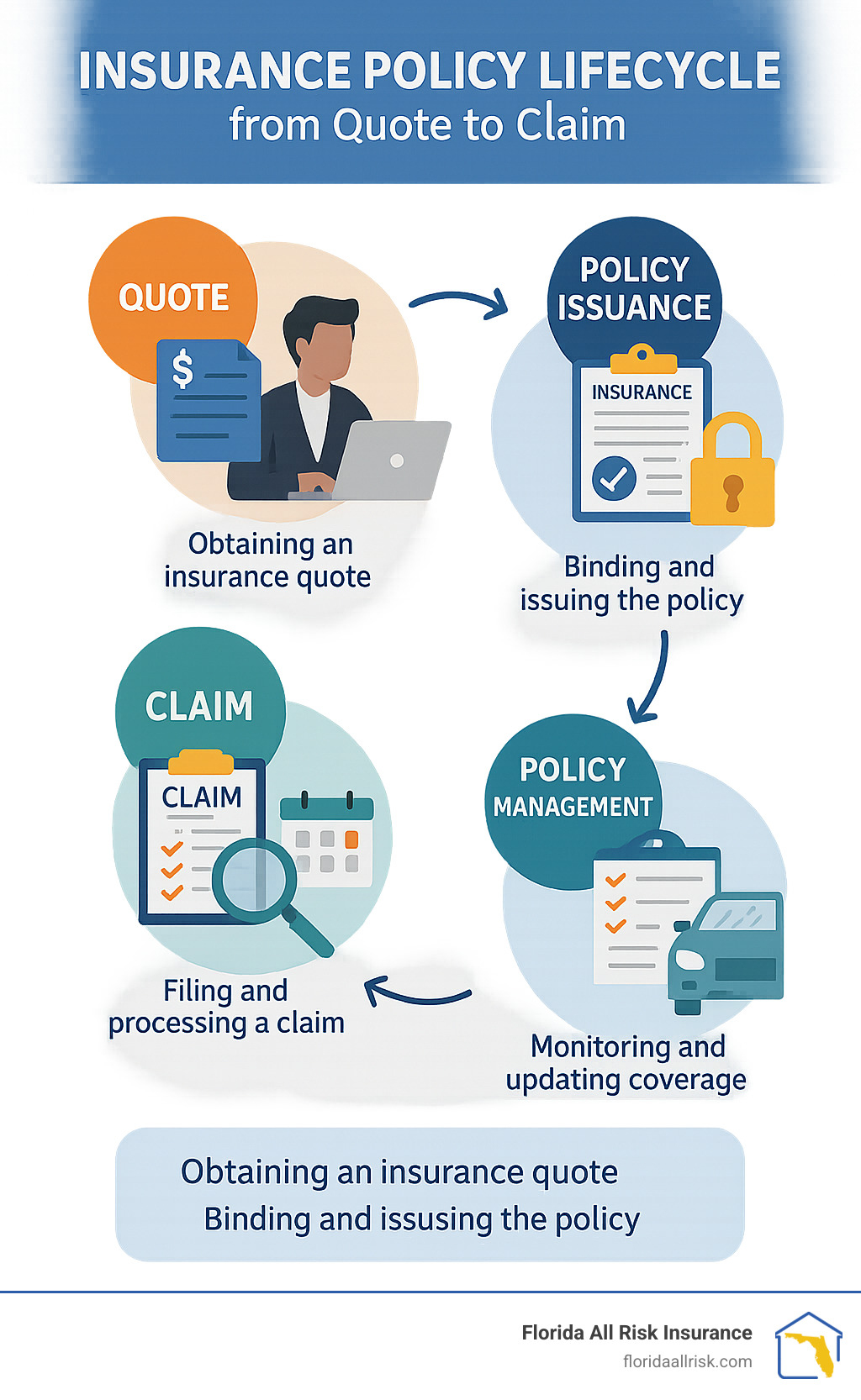
Getting your general liability quote is a straightforward process that we’ve streamlined over the years. First, you’ll gather some basic information about your business operations – things like what your company does, your annual revenue, and any previous claims history. Don’t worry if you don’t have every detail at your fingertips; we can guide you through what’s essential.
Next, you’ll choose how you’d like to receive your quote. At Florida All Risk Insurance, we believe in giving you options that fit your schedule and preference. Whether you prefer applying online while sipping your morning coffee, chatting over the phone during your lunch break, or sitting down face-to-face with one of our friendly agents, we’ve got you covered.
When you complete your application, being thorough and accurate is key. I’ve seen how providing complete information upfront saves headaches later on. Once we have your details, we’ll present you with coverage options custom to your business’s specific needs and risks.
The final step is the most satisfying – binding your coverage and receiving your proof of insurance. For most businesses, this can happen the same day you accept your quote, giving you immediate peace of mind.
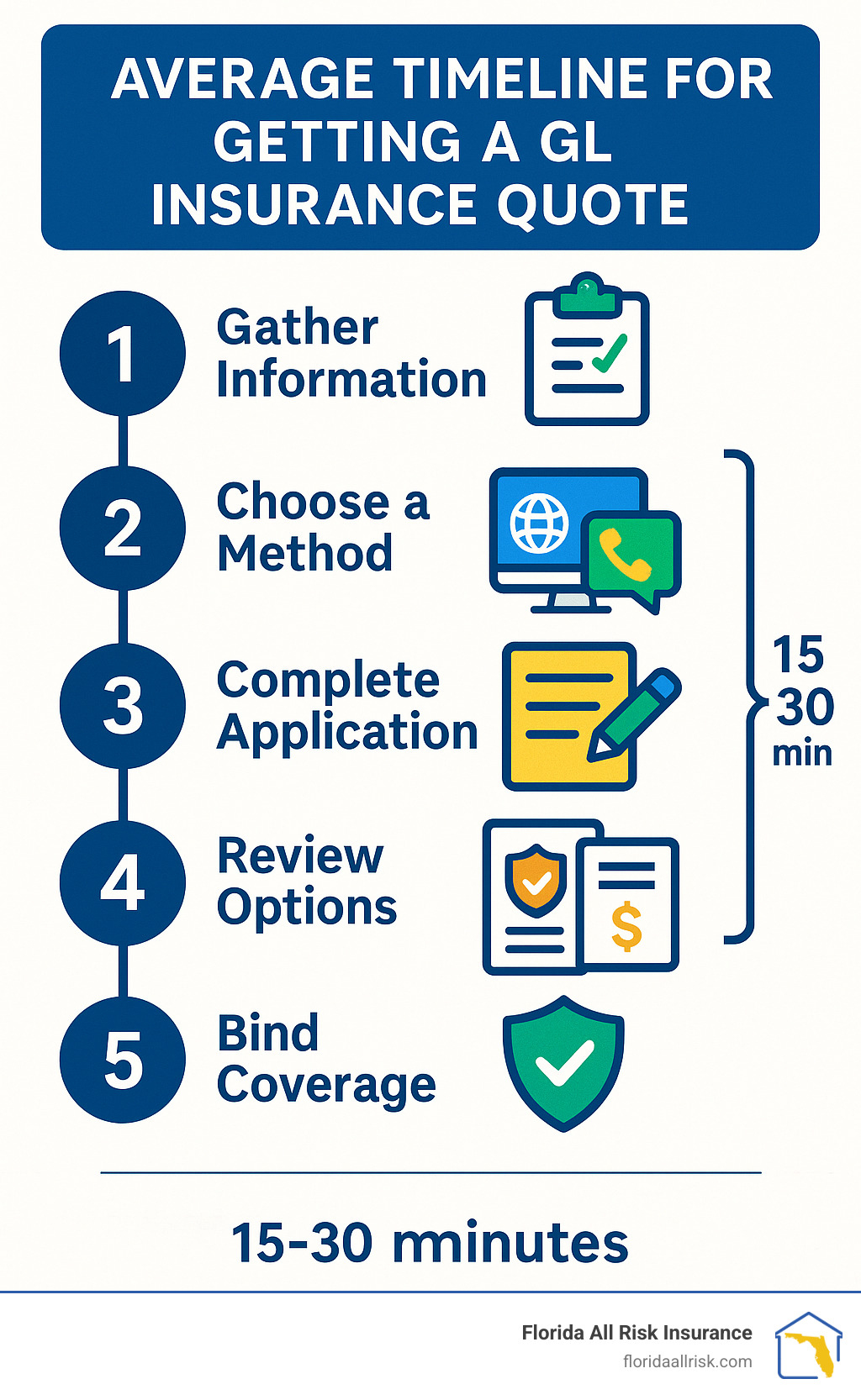
The entire process typically takes 15-30 minutes for straightforward businesses. More complex operations might require additional underwriting time, but we’ll keep you informed every step of the way.
What Information You’ll Need for a GL Insurance Quote
When you’re ready to get your gl insurance quote, having the right information at hand makes everything smoother. Think of it as preparing ingredients before cooking a meal – a little prep work makes the whole process more enjoyable!
You’ll need to share some business details including your legal business name (and any DBAs you might use), your physical address, how long you’ve been in business, and your business structure. We’ll also need a clear description of what your business actually does – the more specific, the better.
On the financial side, we’ll ask about your annual revenue (estimates are fine for new businesses), payroll information, and your employee count. These figures help us determine your exposure level and calculate appropriate premiums.
Your risk factors play an important role too. We’ll need to know about any claims you’ve had in the past 3-5 years, safety programs you have in place, and whether you use subcontractors (and if they carry their own insurance).
Finally, we’ll discuss your coverage preferences – including your desired liability limits, deductible options, and any additional insureds you might need to add to your policy.
I’ll never forget when Maria, a Tampa bakery owner, came in flustered because she needed insurance for a new contract. “I thought this would take days!” she told me later. “I had my quote in 45 minutes and my certificate before the end of the day. I couldn’t believe how painless it was!”
How Quickly Can You Bind Coverage After a GL Insurance Quote?
In today’s business world, waiting days for insurance coverage simply isn’t an option. That’s why we’ve designed our process to match your timeline, not the other way around.
For most standard businesses, we can bind your gl insurance coverage the very same day you accept your quote. This means you can walk away with active protection almost immediately after making your decision.
Your Certificate of Insurance (COI) can be in your email inbox within minutes of binding coverage. This digital proof of insurance lets you immediately meet contract requirements, sign that lease, or finalize that business deal you’ve been working on.
Facing a tight deadline? Let us know! We understand that business opportunities don’t always give you weeks of notice. At Florida All Risk Insurance, we can prioritize urgent applications to ensure you meet your obligations on time.
Some situations do require a bit more patience. If your business operates in a high-risk industry or has complex operations, underwriters may need 1-3 business days to review your application thoroughly. Even then, we’ll keep you updated every step of the way.
Just last month, Carlos, a St. Petersburg contractor, called us in a panic. “I need proof of insurance for a major project by 5 PM today,” he explained. Our team sprang into action, and by 3 PM, Carlos had his certificate in hand and was able to secure his contract. As he told me later, “You folks saved my biggest deal of the year!”
Whether you need coverage today or are planning ahead, we’re here to make getting your gl insurance quote as quick and painless as possible. After all, you have a business to run – and we’re here to help you protect it.
Cost Factors, Ranges & Smart Savings
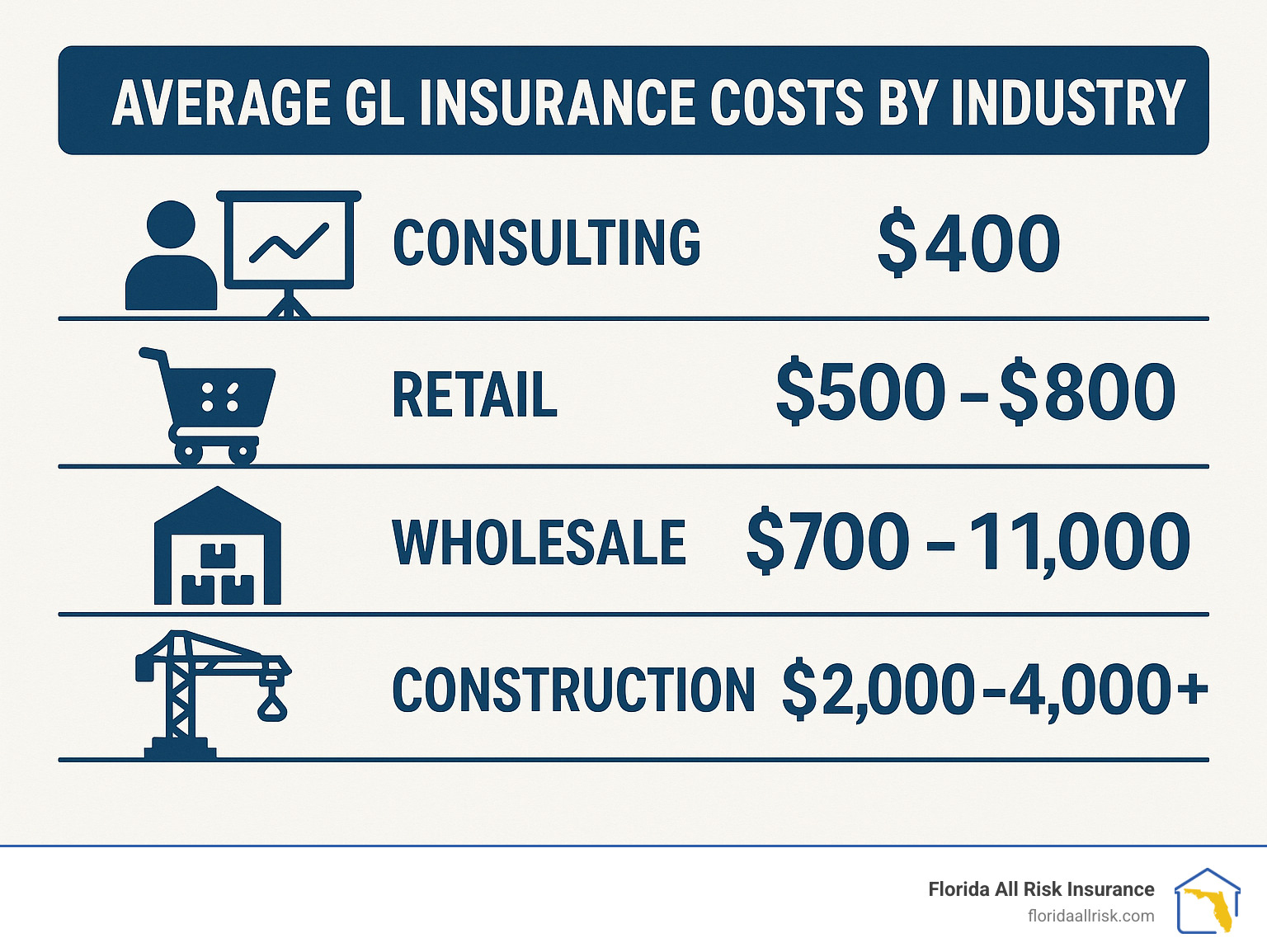
When it comes to gl insurance quotes, prices can vary dramatically. Think of it like buying a car – the cost depends on what you need, where you live, and your driving history.
Your industry class is one of the biggest factors affecting your premium. A quiet consulting firm might pay just $400 a year, while a busy construction company could pay several thousand dollars for identical coverage limits. It’s all about risk exposure – the more likely someone could get hurt around your business, the more you’ll pay.
Your location matters too. Here in Florida, we face different risks than businesses in, say, Colorado or Maine. Even your specific zip code within Florida can impact your rates based on local claim patterns and risk factors.
The size of your operation plays a role too. More employees, higher revenue, and multiple locations all translate to greater exposure – and typically higher premiums. It’s simple math: more activity means more opportunities for something to go wrong.
Your claims history is like your business credit score. Previous liability claims suggest you might have more in the future, which usually means higher premiums. This is why implementing safety programs can actually save you money in the long run.
Higher coverage limits naturally cost more, but they provide crucial extra protection. Most small businesses start with $1 million per occurrence and $2 million aggregate limits – a solid foundation for many operations.
According to recent industry data, most businesses pay around $59 per month (median) for general liability insurance, with the average being slightly higher at $80 monthly due to those high-risk outliers pulling up the average. Here at Florida All Risk Insurance, we’ve helped low-risk small businesses secure coverage for as little as $30 monthly, while higher-risk operations might pay $150-$300+ each month.
More info about General Liability Insurance Cost
How Much Coverage Do You Really Need?
Finding your sweet spot for coverage is about balancing protection with cost. It’s like buying a home security system – you want enough protection to sleep soundly without spending on features you don’t need.
First, check your contract requirements. Many clients and landlords specify minimum coverage amounts, typically $1 million per occurrence and $2 million aggregate. There’s no point in buying less than what your contracts require.
Consider your asset protection needs. The more your business is worth, the more you have to lose in a lawsuit. A business with substantial assets should consider higher limits than one just starting out.
Your risk exposure matters tremendously. If you have customers visiting your location daily or you work in people’s homes, you’re naturally facing more opportunities for something to go wrong compared to someone working remotely behind a computer.
Industry standards can provide helpful guidance. What’s considered adequate coverage varies widely by field – what works for a graphic designer might leave a contractor dangerously exposed.
Most businesses choose from these common liability limit tiers:
– $500,000/$1 million (bare minimum for very small, low-risk operations)
– $1 million/$2 million (the most common choice)
– $2 million/$4 million (for growing businesses with more exposure)
– $5 million+ (larger businesses or those with significant risks)
I remember one Tampa restaurateur who told me: “I thought saving $40 a month on lower limits made sense until you showed me that one slip-and-fall could exceed those limits tenfold. That extra coverage is the best money I spend each month.”
Bundling GL with Other Coverages
Smart business owners know that bundling insurance policies is like buying in bulk – you get better protection and often save money too.
A Business Owner’s Policy (BOP) combines general liability with commercial property coverage, usually at a better price than buying them separately. This is perfect if you have a physical location, expensive equipment, or inventory to protect.
Workers’ compensation isn’t optional for most Florida businesses with four or more employees – it’s required by law. Bundling this with your GL policy keeps everything under one roof and often qualifies you for multi-policy discounts.
If your business uses vehicles in any capacity, commercial auto insurance is essential protection that pairs naturally with your GL policy. Even occasional business driving needs proper coverage.
Service providers should consider adding professional liability coverage (also called E&O) to protect against claims that your work or advice caused financial harm to clients. This covers a major gap that GL insurance doesn’t address.
With cyber threats everywhere today, cyber liability protection has become increasingly important. This covers costs related to data breaches, ransomware, and other digital threats that standard GL policies don’t touch.
When our clients at Florida All Risk Insurance bundle multiple policies, they typically save between 5-15% across their coverages. Beyond the financial savings, bundling simplifies your insurance management – one agency, one renewal date, and no coverage gaps to worry about.
Managing Your Policy & Filing Claims

Congratulations! You’ve secured your gl insurance policy. But our relationship doesn’t end once you’ve bound coverage – in many ways, it’s just beginning. Let’s talk about what happens next and how to handle the unexpected if it occurs.
Think of your policy as a living document that needs occasional attention. Keep your policy information somewhere accessible (both digital and physical copies are smart). Each year as renewal approaches, or whenever your business undergoes significant changes, it’s worth reviewing your coverage with us. New locations, expanded operations, or substantial revenue increases can affect your protection needs.
One small business owner in Tampa told me, “I completely forgot to update my policy after expanding to a second location. Thankfully, my Florida All Risk agent called to check in, or I might have had a serious coverage gap!”
When it comes to potential claims, time matters. If something happens that might lead to a claim – even if you’re not sure it will – document everything immediately. Take photos, collect witness statements, and report the incident to us promptly. We’ll guide you through the process, but remember: don’t admit fault or make settlement offers without talking to your insurer first.
The claims timeline typically flows like this: you make an initial report (ideally within 24-48 hours), an adjuster gets assigned (usually within 1-3 business days), they investigate (timeframe varies with complexity), determine coverage, handle settlement negotiations or defense, and finally, resolve the claim.
More info about How Much General Liability Insurance Do I Need?
Common General Liability Claim Scenarios
Understanding what typical claims look like helps you spot potential issues before they escalate. The classic slip-and-fall happens more often than you might think – a customer slips on a wet floor, breaks their wrist, and suddenly you’re facing medical expenses, lost wages, and pain and suffering claims.
Product liability claims arise when something you sell causes injury. Property damage claims occur when your employee accidentally damages a client’s equipment while working at their location. Even your marketing isn’t immune – advertising injury claims can stem from using another company’s slogan without permission.
I’ll never forget when Maria, who owns a boutique in St. Petersburg, called me in a panic. “A display fell and a customer is saying they got hurt. What do I do?” We walked her through documenting the scene, collecting witness information, and promptly reporting to her insurer. “The claim settled quickly,” she told me later, “and having someone guide me through it made all the difference.”
Reputational harm claims might seem less common, but in today’s digital world, a hasty social media post about a competitor could land you in hot water. These claims remind us that gl insurance protects more than just physical injuries.
Filing a Claim the Right Way
When something happens, taking the right steps can dramatically improve the outcome. Most insurers offer multiple ways to report claims – phone, online portals, or mobile apps – available 24/7. Don’t wait; report incidents as soon as possible.
Documentation is your best friend. Gather evidence immediately – photos of the scene, witness statements, incident reports, and any relevant communications. If medical attention was needed, keep those reports too. This information becomes invaluable as the claim progresses.
While staying in communication with your adjuster is important, remember to direct any third-party claimants to your insurance company rather than handling discussions yourself. If a lawsuit gets filed, your insurer will typically appoint defense counsel, and cooperate fully with your assigned attorney.
Don’t be shy about requesting regular updates on your claim status. At Florida All Risk Insurance, we see ourselves as your advocate throughout the entire claims process. We understand Florida’s unique insurance landscape and work to ensure you receive fair treatment and prompt resolution.
As one contractor client put it, “Having someone who knows the system fighting for me made all the difference when we faced our first liability claim. They spoke the insurance language I didn’t understand and made sure we weren’t taken advantage of.”
The claims process is precisely why you invested in a gl insurance policy in the first place. When handled properly, it works exactly as designed – protecting your business when you need it most.
Frequently Asked Questions about gl insurance quote
Is General Liability Insurance Tax Deductible?
Good news for your bottom line! gl insurance premiums typically qualify as legitimate business expenses you can deduct on your taxes. The IRS classifies insurance that’s directly related to your business operations as an “ordinary and necessary” expense.
Think of it this way: not only does your policy protect your business, but Uncle Sam essentially gives you a discount through tax savings. Just be sure to keep detailed records of all your premium payments throughout the year. I always recommend chatting with your tax professional to make sure you’re handling the deduction correctly on your specific business returns.
One of our clients in Tampa recently shared: “I was pleasantly surprised when my accountant pointed out how much my insurance deductions reduced my overall tax burden. It made the decision to carry comprehensive coverage even more worthwhile.”
What Isn’t Covered Under a Standard GL Policy?
While general liability provides crucial protection, it’s important to understand its boundaries. Your gl insurance quote covers a lot, but not everything.
Standard policies typically don’t cover professional mistakes or bad advice – that’s where professional liability comes in. Employee injuries fall under workers’ compensation, not GL insurance. If your delivery van gets in an accident, you’ll need commercial auto coverage for that.
Other common exclusions include intentional acts (you can’t deliberately cause harm and expect coverage), damage to your own property, pollution incidents, cyber attacks, and employment-related claims like discrimination or wrongful termination.
One St. Petersburg restaurant owner told us: “I assumed my general liability policy would cover everything, but my agent at Florida All Risk Insurance explained the gaps and helped me build a complete protection plan. When our computer system was hacked months later, I was grateful we’d added cyber coverage.”
Understanding these limitations helps you identify additional policies you might need. We’re happy to review your specific risks and recommend a comprehensive protection plan custom to your business.
Can an LLC Skip Buying GL Insurance?
I hear this question often, and while forming an LLC does provide some personal asset protection, it’s not a substitute for proper insurance.
Here’s the reality: even with an LLC structure, your business assets remain fully exposed to liability claims without insurance. If someone sues your company, your equipment, inventory, savings, and future earnings are all at risk.
Beyond protection, there’s practicality. Many clients and landlords simply won’t do business with you without seeing a certificate of insurance, regardless of your business structure. Your LLC status doesn’t matter to them – they want to know you’re properly insured.
It’s also worth noting that the “corporate veil” of an LLC can be pierced in certain circumstances, potentially putting your personal assets at risk after all. Plus, even if you ultimately win a lawsuit, defending your business still costs money – money that insurance would cover.
A landscaping business owner in Clearwater recently told me: “My LLC gave me a false sense of security. When a client claimed we damaged an underground sprinkler system, I quickly realized that without insurance, I’d be paying thousands in legal fees just to defend myself, win or lose. My gl insurance policy covered everything, including the attorney, and I didn’t pay a dime out of pocket.”
At Florida All Risk Insurance, we’re always happy to discuss how different business structures and insurance policies work together to create the right protection plan for your specific situation.
Conclusion & Next Steps

You’ve made it through the guide, and by now, you should feel much more confident about getting that gl insurance quote for your business. The world of insurance can seem complicated at first glance, but with the right information—which you now have—it becomes a straightforward way to protect everything you’ve worked so hard to build.
Think of general liability insurance as your business’s safety net. It catches you when unexpected claims threaten to knock you off balance. From the customer who slips on your freshly mopped floor to the competitor claiming your advertisement damaged their reputation, GL insurance stands between these claims and your business assets.
Remember these essential takeaways:
General liability insurance forms the foundation of your business protection plan. It’s not just about meeting contractual requirements—though it certainly helps with that—it’s about ensuring one unfortunate incident doesn’t derail years of hard work.
While not always required by law, the practical reality is that operating without GL coverage leaves your business unnecessarily vulnerable. When clients, landlords, or lenders ask for proof of insurance, you’ll be ready with your certificate in hand.
Most small businesses can secure solid protection for about $30-$80 monthly—a small price for the significant peace of mind it brings. And don’t forget, these premiums are typically tax-deductible as a legitimate business expense.
The quoting process itself is refreshingly simple when you have your business information organized. At Florida All Risk Insurance, we’ve streamlined the process so that most businesses can get covered the same day they reach out to us.
As a St. Petersburg-based independent agency, Florida All Risk Insurance understands the unique challenges Florida businesses face. We’ve helped countless local businesses—from contractors working in the intense Florida heat to retailers navigating our busy tourist seasons—find the right coverage at competitive rates.
Being independent means we work for you, not the insurance companies. We can shop multiple carriers to find the best combination of coverage and value for your specific situation. Our personalized approach means we take the time to understand your business before recommending solutions.
Don’t leave your business vulnerable to claims that could drain your resources and disrupt your operations. A single lawsuit—even one without merit—can cost thousands in defense costs alone. With proper GL coverage, you can focus on growing your business instead of worrying about what might go wrong.
More info about coverage/general-liability
Florida All Risk Insurance is ready to provide your customized GL solution today. Visit our website to get started. We’re not just selling policies—we’re building partnerships with Florida businesses like yours.

