

Why Understanding General Liability vs Errors and Omissions Matters for Your Business
General liability vs errors and omissions insurance are two of the most commonly confused business policies—and getting them wrong can leave your company dangerously exposed. If you’re trying to figure out which one you need (or whether you need both), you’re in the right place.
Quick Answer: General Liability vs Errors and Omissions
| General Liability Insurance | Errors & Omissions Insurance |
|---|---|
| Covers physical injuries and property damage | Covers financial losses from professional mistakes |
| Protects against slip-and-fall accidents, damaged client property | Protects against negligence claims, missed deadlines, bad advice |
| Needed by businesses with physical locations or customer interactions | Needed by businesses providing professional services or advice |
| Example: A customer trips in your office and breaks their arm | Example: A client loses money because you gave incorrect financial guidance |
| Also covers: Advertising injury (libel, slander, copyright issues) | Also covers: Failure to deliver services, contract breaches, omissions |
The Bottom Line: General Liability protects against tangible harm (physical injuries and property damage), while Errors & Omissions protects against intangible harm (financial losses from your professional work). Many businesses need both.
Here’s the reality: both policies protect you from lawsuits, both cover your legal defense costs, and both are often required by client contracts. But they cover completely different types of claims. General Liability is your safety net for the physical risks of doing business—someone gets hurt on your property, you accidentally damage a client’s building, or you’re accused of copyright infringement in your marketing. Errors & Omissions, on the other hand, kicks in when a client claims your professional services caused them financial harm, whether through a mistake, negligence, or failure to deliver what you promised.
The confusion between these two policies has cost countless business owners thousands of dollars in out-of-pocket legal fees and settlements. A web designer with only General Liability coverage who gets sued for a coding error that crashes a client’s e-commerce site during Black Friday? Not covered. A plumber with only Errors & Omissions who accidentally floods a client’s home? Not covered either.
I’m Jason Miller, and I’ve spent over 20 years helping Florida businesses steer exactly these kinds of insurance questions, including determining when general liability vs errors and omissions coverage is needed. At Florida All Risk Insurance, we’ve seen how the right combination of policies protects our clients from financial devastation—and how the wrong coverage leaves dangerous gaps.
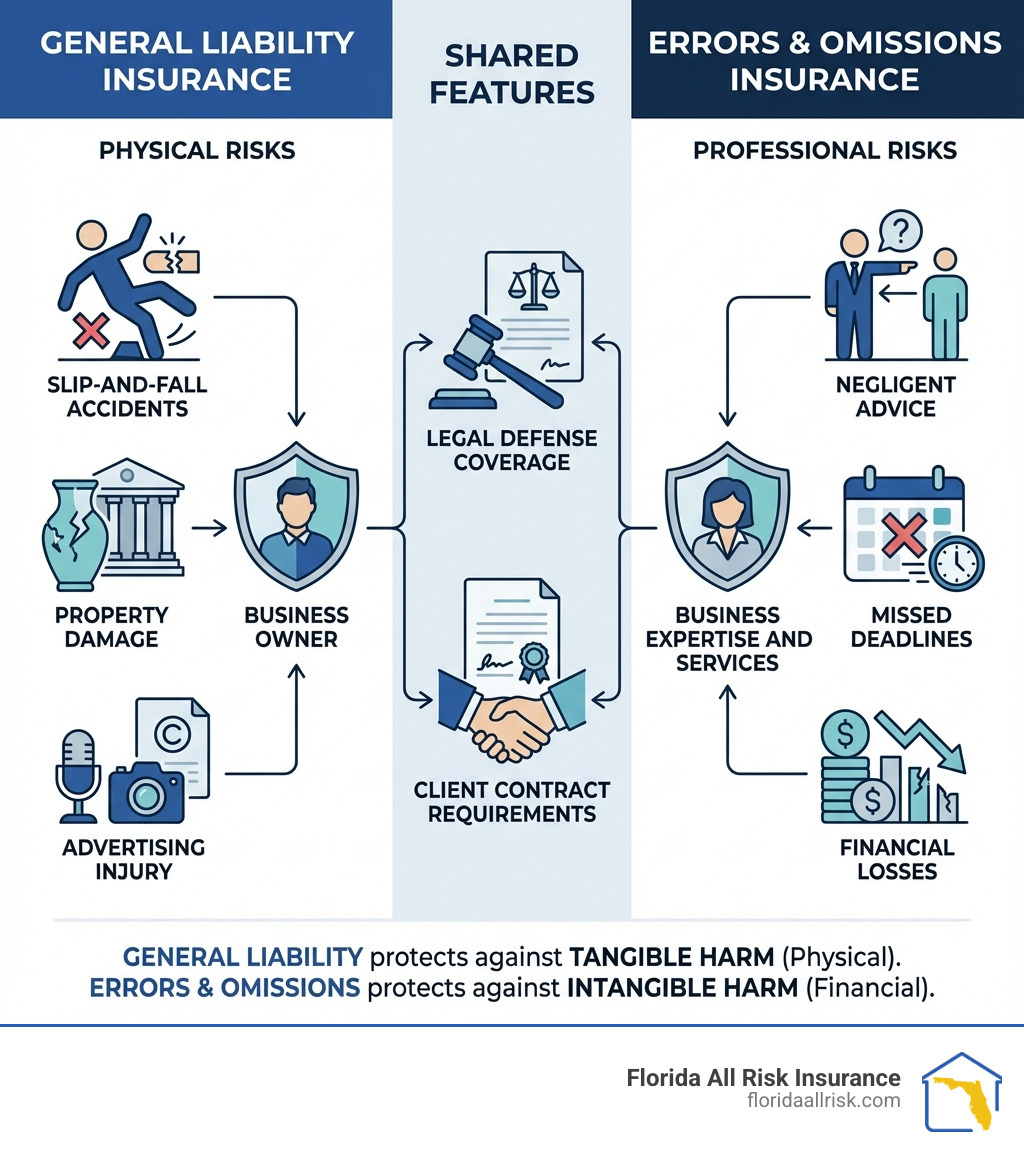
At a Glance: General Liability vs. Errors and Omissions
When we talk about business insurance, it’s easy to get lost in the jargon. But understanding the core differences between General Liability (GL) and Errors and Omissions (E&O) insurance is fundamental for protecting your Florida business. Think of it this way: General Liability is your shield against the everyday, physical mishaps that can happen in any business, while E&O is custom for the unique risks faced by professionals who provide advice or services.
The fundamental difference between general liability insurance and errors and omissions (E&O) insurance boils down to the type of harm they cover. General Liability primarily addresses claims of bodily injury, property damage, and personal injury (like slander) to third parties. It’s about tangible harm. E&O, however, focuses on claims of financial loss experienced by a client due to alleged mistakes, negligence, or failures in your professional services. It’s about intangible harm stemming from your expertise or lack thereof.
Key Similarities Between GL and E&O
Despite their distinct purposes, general liability vs errors and omissions insurance share some important common ground. Understanding these similarities can help clarify why businesses often need both:
- Liability Protection: Both policies are designed to protect your business from the financial fallout of liability claims. This means they step in when a third party alleges your business is responsible for their losses or injuries.
- Lawsuit Coverage: Whether it’s a client slipping on a wet floor or a client suing over a bad piece of advice, both GL and E&O primarily respond to lawsuits. They cover the costs associated with defending your business in court.
- Legal Defense Costs: This is a huge one! Lawsuits, even frivolous ones, are expensive. Both policies typically cover attorney’s fees, court costs, and other legal expenses incurred during a defense, regardless of whether you win or lose the case. This can save your business hundreds of thousands of dollars out of pocket.
- Settlements and Judgments: If a claim against your business results in a settlement or a court-ordered judgment, both GL and E&O policies are designed to cover these financial payouts up to your policy limits.
- Client Contract Requirements: Many clients, especially larger ones, will contractually require you to carry specific amounts of both GL and E&O insurance before they’ll work with you. This is their way of ensuring you’re a responsible, protected business partner.
- Claims-Made Policies: While not universal, many E&O policies, and some GL policies, are “claims-made” coverage. This means that for the policy to pay out, the alleged incident and the claim itself must occur while the policy is active.
The Fundamental Difference in General Liability vs. Errors and Omissions
The core distinction lies in what they aim to protect. General Liability (GL), often called Commercial General Liability (CGL), is about protecting your business from the physical risks of daily operations. It covers things like a customer getting injured at your St. Petersburg office or your team accidentally damaging a client’s property during a project.
Errors & Omissions (E&O) insurance, on the other hand, is also known as Professional Liability Insurance. This policy steps in when a client claims that your professional service or advice led to their financial loss due to negligence, a mistake, or an omission. For instance, if you’re an IT consultant and a coding error you made causes a client’s system to crash, leading to lost revenue, E&O would be your go-to. General liability insurance cannot cover professional mistakes. It’s specifically designed for professionals who provide services or advice for a fee, and whose mistakes could cause significant financial harm to their clients.
What is General Liability Insurance? (Protecting Your Physical Operations)
General Liability (GL) insurance, often called Commercial General Liability (CGL), is the foundational policy for most businesses. It protects your business from financial loss should you be held liable for bodily injury, property damage, or personal and advertising injury to a third party. Think of it as coverage for the day-to-day, tangible risks of running a business. For virtually any business operating in Florida, from a small retail shop in St. Petersburg to a large construction company, GL insurance is considered essential.
What Claims Does General Liability Cover?
General Liability insurance is a broad safety net that catches many common, everyday risks. Here are the specific types of claims it typically covers:
- Bodily Injury: This is probably the most common type of claim. It covers medical expenses and legal fees if a non-employee gets hurt on your business premises or due to your business operations.
- Examples: A customer slips and falls on a wet floor in your retail store; a visitor trips over a loose rug in your waiting room and breaks an arm; a delivery person is injured while unloading at your warehouse.
- Property Damage: This covers the cost to repair or replace property belonging to someone else that your business accidentally damages.
- Examples: Your team is working at a client’s home in Gulfport and accidentally spills paint on their expensive carpet; a contractor drops a tool and damages a client’s skylight during a roof repair; a plumbing company accidentally floods a client’s home.
- Personal & Advertising Injury: This less-understood aspect of GL covers claims related to non-physical damages that can harm someone’s reputation or rights.
- Examples: Someone accuses your business of libel (written defamation) or slander (spoken defamation) in your advertising or communications; you’re sued for copyright infringement because you used an image without permission; allegations of misappropriation of advertising ideas.
For a deeper dive into how general liability stands apart from other forms of professional coverage, you can read more about it on reputable financial sites like NerdWallet: General Liability vs. Professional Liability Insurance: Do You Need Both?.
Common Exclusions for General Liability
While GL is comprehensive, it doesn’t cover everything. Knowing its limitations is crucial:
- Professional Mistakes: This is the big one! General Liability does not cover financial losses arising from errors, omissions, or negligence in the professional services or advice you provide. That’s where E&O comes in. For example, if an accountant makes a mistake that costs a client money, GL won’t help.
- Employee Injuries: If your employees get hurt on the job, that falls under Workers’ Compensation insurance, not General Liability.
- Auto-Related Accidents: Accidents involving company vehicles are typically covered by a Commercial Auto insurance policy.
- Intentional Damage: GL policies are for accidental occurrences, not deliberate acts of harm or damage.
- Your Own Property Damage: Damage to your own business property (your office building, equipment, inventory) is covered by Commercial Property insurance, not General Liability.
- Contractual Disputes: While E&O might cover some breaches of contract related to service delivery, GL typically doesn’t cover general contractual disputes.
What is Errors & Omissions Insurance? (Protecting Your Professional Expertise)
Errors & Omissions (E&O) insurance is a specialized form of liability protection also known as Professional Liability insurance. For some fields, like medicine, it’s called malpractice insurance. This policy is designed to cover your business if a client claims a financial loss resulted from your professional services, whether due to a mistake (error), a failure to do something (omission), or negligence. If your Florida business provides professional advice, designs, consulting, or any service where your expertise is the product, E&O is indispensable. It’s the policy that protects you when your brainpower, or lack thereof in a specific instance, is called into question.
What Claims Does Errors & Omissions Cover?
E&O insurance specifically targets the unique risks associated with providing professional services. It covers a wide range of claims where a client alleges financial harm due to your professional actions or inactions:
- Professional Negligence: This is at the heart of E&O. It covers claims that you failed to exercise the standard of care expected of a professional in your field, leading to client losses.
- Example: A financial advisor provides incorrect investment advice that causes a client significant financial losses.
- Work Mistakes/Errors: Even unintentional slip-ups can have big consequences. E&O covers claims stemming from these errors.
- Example: A software developer makes a coding error that causes a client’s e-commerce site to malfunction, leading to lost sales.
- Omissions: Sometimes, it’s not what you did, but what you didn’t do. E&O covers claims of failing to perform a necessary service or duty.
- Example: An architect overlooks a critical building code requirement in a design, causing costly delays and rework for the client.
- Undelivered Services/Missed Deadlines: If you fail to deliver a promised service or miss a crucial deadline, and that results in financial harm to your client, E&O can provide coverage.
- Example: A marketing consultant fails to launch a campaign by the agreed-upon date, causing the client to miss a key sales period.
- Breach of Contract (related to service): While not all contractual disputes are covered, E&O can often respond to claims where a breach of contract is alleged due to your professional services.
- Example: A consultant is accused of not delivering the scope of work outlined in a contract, leading to client dissatisfaction and financial claims.
- Inaccurate Advice: If your professional advice is found to be incorrect or misleading, causing a client financial detriment, E&O is there.
- Example: A real estate agent provides an inaccurate valuation, leading a client to sell a property for less than its market value.
To learn more about how E&O insurance functions and who specifically benefits from it, Investopedia offers excellent insights: [Errors and Omissions Insurance: What It Is, How It Works, and Who Needs It](https://www.investopedia.com/terms/e/errors-omissions-insurance.asp#:~:text=Errors%20and%20omissions%20(E%26O).
Common Exclusions for Errors & Omissions
Just like General Liability, E&O insurance has its boundaries. It’s crucial to understand what it doesn’t cover:
- Bodily Injury & Property Damage: These are explicitly excluded from E&O policies, as they fall under the domain of General Liability. If your professional error leads to a physical injury or property damage, you’d need GL for that aspect.
- Intentional Wrongdoing/Criminal Acts: E&O policies do not cover deliberate acts of fraud, illegal activities, or intentional harm. Insurance is for unforeseen accidents, not purposeful malice.
- Employment Practices Claims: Issues like wrongful termination, discrimination, or harassment claims by employees are covered by Employment Practices Liability Insurance (EPLI), not E&O.
- False Advertising, Patent Infringement, Trade Secret Theft: While General Liability might touch on some advertising injury, more specific intellectual property infringements are typically excluded from E&O.
- Guarantees & Warranties: E&O usually doesn’t cover claims that simply allege your services didn’t meet a general guarantee or warranty unless it’s tied to a specific professional error.
- Your Own Work or Products: E&O covers claims from clients regarding your services, not damages to your own products or services themselves.
Do You Need Both Policies? Assessing Your Complete Risk Profile
For many businesses operating in Florida, the question isn’t “which one do I need?” but rather “do I need both?” If your business provides a professional service and interacts with the public, visits client properties, or has a physical location, the answer is almost always yes. Relying on a single policy leaves a significant gap in your protection, like trying to catch fish with only half a net.
Consider the example of an architect in St. Petersburg. They need E&O insurance to cover potential claims if a design flaw in their blueprints leads to structural issues or financial losses for their client. But they also need General Liability in case a client trips over a roll of blueprints in their office and gets injured, or if an employee accidentally damages a valuable piece of art at a client’s home during a site visit. These are entirely different scenarios, covered by entirely different policies.
The potential financial consequences for a business that lacks adequate general liability vs errors and omissions coverage can be devastating. Without GL, a simple slip-and-fall could lead to medical bills, legal fees, and settlement costs that wipe out your savings or even force you to close your doors. Without E&O, a single professional mistake could result in a client suing you for lost profits, and you’d be on the hook for all legal defense and damages. In today’s litigious environment, being uninsured or underinsured is a gamble most businesses can’t afford to take.
Contractual Requirements and Client Expectations
It’s not just about what you think your business needs; often, it’s about what others demand. Contractual requirements from clients frequently influence the need for both General Liability and E&O insurance. Many corporate service contracts, particularly with larger clients, stipulate that you must carry specific coverage limits for both policies. This is a standard practice to mitigate their own risks when engaging with third-party service providers.
- Client Contracts: Before starting on a project, especially in industries like construction, IT, or consulting, clients will often ask for a Certificate of Insurance (COI) proving you have adequate GL and E&O coverage. Without it, you might lose out on valuable contracts.
- Landlord Requirements/Lease Agreements: If your business operates out of a physical location in Florida, your commercial landlord will almost certainly require you to carry General Liability insurance as part of your lease agreement. This protects them if someone is injured on your rented premises.
- Professional Licensing Boards: Certain professions in Florida may have regulatory bodies or licensing boards that mandate E&O (or professional liability) coverage as a condition of maintaining your license. This ensures accountability within the profession.
- Subcontractor Requirements: General contractors often require their subcontractors to carry their own GL and E&O policies, passing down the need for comprehensive protection throughout the project chain.
Meeting these requirements isn’t just about compliance; it offers a competitive advantage. Having the right coverage demonstrates professionalism and reliability, giving clients an extra level of security when choosing to work with your business.
The Case for Bundling: General Liability vs. Errors and Omissions
When you realize your Florida business likely needs both General Liability and E&O insurance, the next logical step is to consider how to acquire them. While you can purchase them separately, there’s a strong case for bundling them, ideally with the same insurance carrier.
- Single Carrier Benefits: Having both policies handled by one company can significantly streamline the claims process. If an incident occurs and there’s ambiguity about whether it falls under GL or E&O, having a single insurer means they’re incentivized to quickly determine coverage rather than pointing fingers between different companies.
- Streamlined Claims: Imagine a scenario where a client is injured on your property, and they also claim that your professional advice contributed to their financial losses. With separate carriers, you might have two different claims adjusters, two sets of paperwork, and potentially disputes over which policy should pay what. A single carrier simplifies this, making the process faster and less stressful for you.
- Avoiding Coverage Disputes: One of the biggest headaches for business owners is when two different insurers deny a claim, each arguing it falls under the other’s policy. Bundling helps avoid these “gray area” disputes, ensuring your claim is handled efficiently.
- Comprehensive Protection: Bundling allows us at Florida All Risk Insurance to craft a truly comprehensive risk management strategy, ensuring there are no unintended gaps between your policies. We can tailor coverage limits and endorsements across both policies to provide seamless protection for your unique business operations in Florida.
Understanding the Costs and Coverage Limits
The cost of insurance is always a significant consideration for business owners. When comparing general liability vs errors and omissions insurance, you’ll find that their pricing structures and typical coverage limits reflect the different types of risks they cover. While General Liability is often less expensive on average, E&O premiums reflect the potential for high-dollar financial loss claims that can arise from professional services.
Factors Influencing Your Insurance Premiums
Several factors come into play when calculating the premium for both GL and E&O insurance:
- For General Liability:
- Industry: A high-risk industry like construction will typically pay more than a low-risk one like a consulting firm.
- Business Location: Your physical address in Florida, whether it’s a busy downtown St. Petersburg office or a quieter suburban storefront, can affect rates based on local risk factors.
- Number of Employees: More employees often means more potential for accidents or claims.
- Foot Traffic: Businesses with high customer foot traffic (e.g., retail, restaurants) typically face higher premiums due to increased risk of slip-and-fall incidents.
- Claims History: A history of previous GL claims will likely lead to higher premiums.
- Coverage Limits & Deductibles: Higher limits and lower deductibles mean higher premiums.
- For Errors & Omissions:
- Profession: The inherent risk of your specific profession is a major factor. An architect or a financial advisor typically faces higher E&O premiums than a graphic designer, due to the potential magnitude of financial loss from an error.
- Years of Experience: More experienced professionals with a proven track record may receive lower rates.
- Types of Client Contracts: High-value contracts or those with complex deliverables can increase perceived risk.
- Industry Risk Level: Some industries are simply more prone to E&O claims.
- Coverage Limits Selected: Similar to GL, higher coverage limits mean higher premiums.
- Claims History: Past E&O claims will impact future rates.
Typical Coverage Limits and Costs
Both E&O and General Liability policies typically offer substantial coverage limits, reflecting the potentially high costs of lawsuits and settlements.
- Coverage Limits: It’s common to see coverage limits ranging from $1 million to $5 million per occurrence, with aggregate limits often being double the per-occurrence amount (e.g., $1 million per occurrence / $2 million aggregate). The “per occurrence” limit is the maximum your policy will pay for a single incident, while the “aggregate” limit is the total maximum it will pay over the policy period (usually one year).
- General Liability Cost: For many small businesses, general liability insurance can cost as little as $11 per month. However, this can vary significantly based on the factors mentioned above.
- Errors & Omissions Cost: The cost of E&O insurance can be as low as $18.34 a month. The average premium for E&O coverage for a small business is about $735 a year. Again, this is an average, and specific costs for your Florida business will depend on your profession, size, and risk profile.
Choosing appropriate coverage limits is a critical decision. We recommend considering your industry’s typical lawsuit values, your business’s assets, and any contractual requirements from clients. It’s always better to be adequately covered than to face a massive financial shortfall after a claim.
Conclusion: Securing Comprehensive Protection for Your Florida Business
Navigating business insurance doesn’t have to be confusing. The key is to remember the distinct roles of each policy: General Liability protects against physical risks and accidents, while Errors & Omissions shields you from claims of professional mistakes and financial harm. For many Florida businesses, having both isn’t a luxury—it’s a necessity for comprehensive protection against the diverse risks you face every day. Failing to secure the right coverage can lead to devastating out-of-pocket costs for legal fees, settlements, and judgments that could threaten your company’s future.
An independent insurance agent can be your most valuable asset in this process. At Florida All Risk Insurance, our experts can assess your unique operations to identify your specific exposures and craft a custom insurance package that leaves no gaps. We help you understand exactly what you’re paying for and ensure your business is prepared for the unexpected.
Don’t wait for a claim to find out you’re underinsured. Protect your business with the right liability coverage today.
Ready to get started? Request your free, no-obligation insurance quote now and gain the peace of mind that comes with complete protection.
Contact Us
Florida All Risk Insurance

