Why Getting the Right General Liability Insurance Quote Matters
A general liability insurance quote can save your business from financial disaster. Here’s what you need to know to get started:
Quick Answer: To get a general liability insurance quote, you’ll need:
• Your business name, address, and industry type
• Annual revenue and number of employees
• Three years of loss history (if any)
• Desired coverage limits (typically $1M per occurrence/$2M aggregate)
• Federal tax ID number
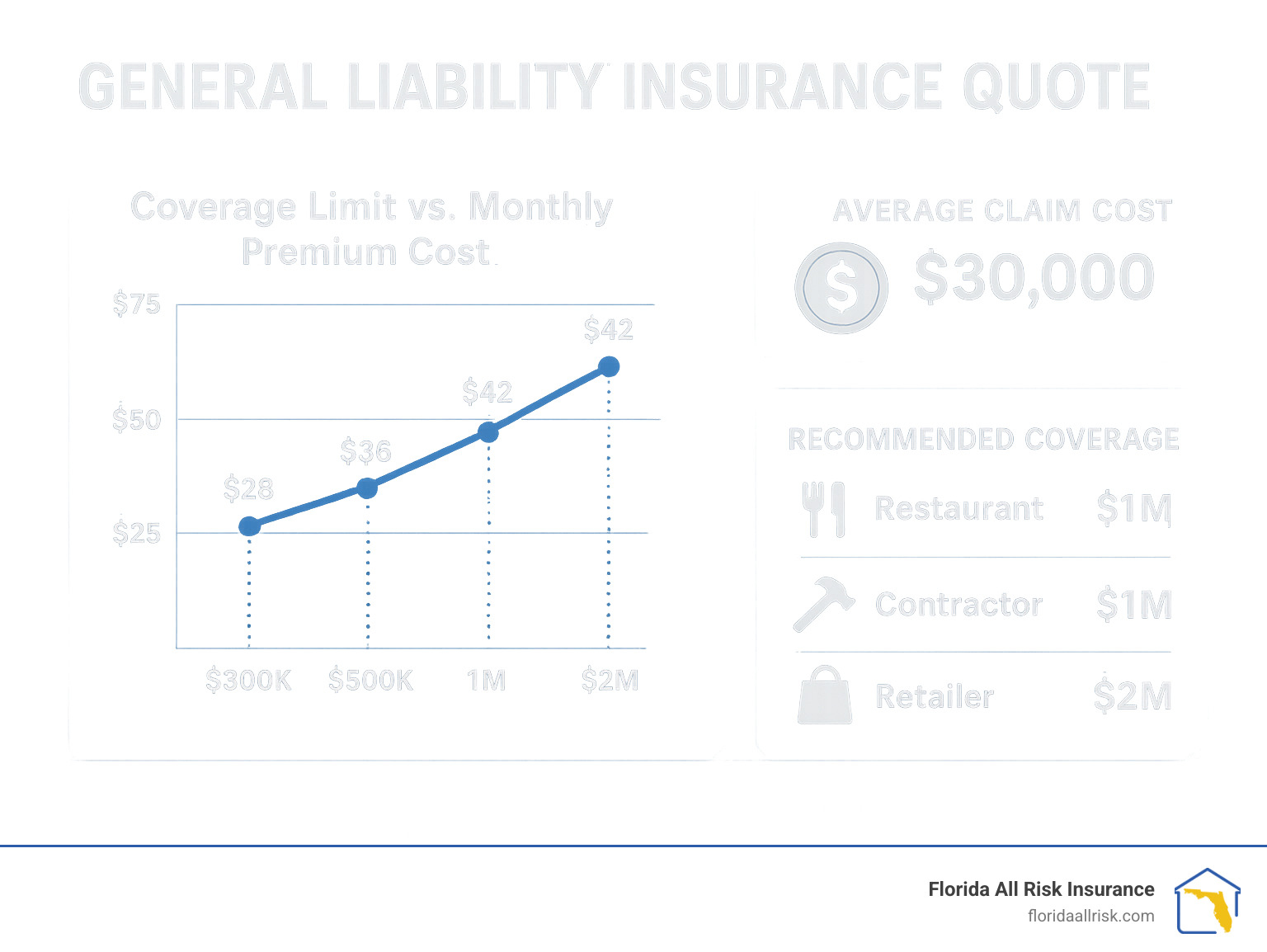
Most small businesses pay between $30-$80 per month for general liability coverage, with many paying around $42 monthly according to recent industry data. The exact cost depends on your industry risk level, business size, and location.
Why this matters: Four out of ten small business owners will face a property or general liability claim in the next ten years. Without proper coverage, a single lawsuit could wipe out years of hard work.
Think about it this way – if a customer slips and falls at your business, or you accidentally damage someone’s property while working, you could face medical bills, legal fees, and settlement costs that easily reach six figures. General liability insurance acts as your financial safety net.
The good news? Getting quotes has never been easier. You can compare rates online in minutes, often receiving instant certificates of insurance for immediate proof of coverage.
I’m Jason Miller, a second-generation insurance professional with over 20 years of experience helping Florida businesses secure affordable general liability insurance quotes. My team at Florida All Risk Insurance has guided thousands of clients through the quote process, ensuring they get comprehensive protection at competitive rates.
General liability insurance quote terms simplified:
- business general liability insurance
- commercial general liability insurance
- what does general liability insurance cover
Understanding General Liability Insurance
Think of general liability insurance as your business’s financial bodyguard. Also called commercial general liability (CGL), this coverage protects you when things go wrong with customers, vendors, or anyone else who isn’t your employee.
Picture this: A customer trips over a loose cable in your office and breaks their wrist. Or maybe you’re working at a client’s location and accidentally knock over their expensive computer monitor. These everyday accidents can quickly turn into expensive lawsuits – that’s exactly where general liability insurance saves the day.
Your general liability insurance quote will cover three main problem areas. Bodily injury happens when someone gets hurt because of your business operations. Property damage covers when you accidentally break or damage someone else’s stuff. Personal and advertising injury protects you if someone claims your marketing materials hurt their reputation or violated their privacy.
Most businesses choose policy limits between $300,000 and $2,000,000 per incident. The “per occurrence” limit is what the insurance company will pay for a single claim, while the “aggregate limit” caps how much they’ll pay total for the entire year.
Here’s some good news – deductibles are usually pretty low, often between $0 and $1,000. This means you won’t face a huge out-of-pocket expense when you need to file a claim.
But here’s the catch: general liability doesn’t cover everything. Professional mistakes, car accidents, employee injuries, and cyber attacks all need separate insurance policies. Think of general liability as one important piece of your business protection puzzle, not the whole solution.
More info about What Does General Liability Insurance Cover?
What General Liability Insurance Covers
Medical payments coverage is like having a first-aid fund for your business. When someone gets a minor injury on your property – maybe they bump their head on a low-hanging sign – this coverage pays their immediate medical bills up to $5,000 per person. The best part? It doesn’t matter who was actually at fault.
This quick payment approach often prevents small incidents from turning into big lawsuits. Instead of an injured customer getting frustrated and calling a lawyer, you can get their medical bills handled right away.
Legal defense costs might be the most valuable part of your coverage. Even if someone files a completely bogus lawsuit against your business, you still need a lawyer to defend yourself. Those attorney fees can easily hit $100,000 or more – even when you win the case.
Your general liability policy covers all those legal expenses: attorney fees, court costs, expert witnesses, and depositions. The insurance company handles everything, so you can focus on running your business instead of managing a lawsuit.
Product liability protection covers you if something you sell, make, or distribute hurts someone or damages their property. This applies even after the customer takes the product home. Whether you’re selling handmade crafts at a farmers market or importing goods from overseas, this coverage has your back.
Personal and advertising injury protection has become incredibly important in our social media world. If someone claims your Facebook ad used their photo without permission, or that your marketing materials copied their slogan, this coverage handles the legal mess. It also covers claims of libel, slander, and invasion of privacy.
Property damage coverage pays when your business operations accidentally damage someone else’s belongings. This includes damage to buildings you’re renting for your business. If you’re a contractor and accidentally put a hole in your client’s wall, or if you’re a caterer and spill wine on an expensive tablecloth, you’re covered.
What General Liability Insurance Does NOT Cover
Professional errors and mistakes need their own insurance policy called professional liability or errors and omissions coverage. If you’re an accountant who makes a tax mistake, a consultant who gives bad advice, or a designer whose plans have flaws, general liability won’t help. You need professional liability insurance for those situations.
Auto accidents require commercial auto insurance, period. Whether it’s your company truck, an employee driving their personal car for work, or a rental vehicle on a business trip, general liability doesn’t cover vehicle-related incidents.
Employee injuries fall under workers’ compensation insurance, not general liability. If your employee gets hurt on the job, workers’ comp handles their medical bills and lost wages. In Florida, most businesses with employees are required by law to carry workers’ compensation coverage.
Cyber risks and data breaches need specialized cyber liability insurance. If hackers steal your customer data, or if ransomware shuts down your computer systems, general liability won’t cover those digital disasters. With cyber attacks becoming more common, this separate coverage is increasingly important.
Intentional harmful acts are never covered. If you or your employees deliberately hurt someone or damage their property, you’re on your own. Insurance only covers accidents and mistakes, not intentional wrongdoing.

How to Get a General Liability Insurance Quote
Getting a general liability insurance quote has become remarkably straightforward. You have several options: online quote forms, working with licensed agents, or using hybrid approaches that combine digital convenience with human expertise.
Online quote systems can provide instant estimates based on basic business information. Many insurers now offer real-time pricing and can issue certificates of insurance within minutes of binding coverage. However, for complex businesses or those with unique risks, working with an experienced agent often yields better results.
At Florida All Risk Insurance, we’ve streamlined the quote process to give you the best of both worlds – quick online estimates backed by expert guidance when you need it. Our licensed agents understand Florida’s unique business landscape and can identify coverage gaps that automated systems might miss.
The key to getting accurate quotes is providing complete, honest information about your business operations. Underestimating revenues or omitting certain business activities can lead to coverage denials when you need to file a claim.
Steps to Secure a General Liability Insurance Quote Online
Step 1: Enter Your ZIP Code and Industry Classification
Start by providing your business location and selecting the industry code that best describes your operations. This helps insurers assess regional risks and apply appropriate rating factors. In Florida, factors like hurricane exposure and litigation trends can impact pricing.
Step 2: Provide Business Details
You’ll need your business name, legal structure (LLC, corporation, etc.), years in operation, and primary business activities. Be specific about what you do – a “contractor” could be anything from a handyman to a high-rise construction company, and pricing varies dramatically.
Step 3: Share Financial Information
Annual revenue and payroll figures help insurers gauge your business size and exposure. Don’t worry about exact numbers – estimates are fine for initial quotes, but you’ll need precise figures for final pricing.
Step 4: Disclose Loss History
List any claims or lawsuits from the past three to five years, even if they weren’t covered by insurance. This information significantly impacts pricing and coverage availability.
Step 5: Select Coverage Limits
Choose your per-occurrence and aggregate limits. Most businesses start with $1 million per occurrence and $2 million aggregate, but higher limits may be necessary depending on your contracts and risk tolerance.
Documents Needed for a General Liability Insurance Quote
Federal Employer Identification Number (FEIN): This tax ID number helps insurers verify your business legitimacy and access relevant databases for underwriting purposes.
Payroll Information: Provide total annual payroll broken down by job classification. Different types of work carry different risk levels, so accurate payroll allocation ensures proper pricing.
Lease Agreements or Property Information: If you rent business space, insurers need to understand your lease terms and any insurance requirements your landlord has imposed. Property owners often require specific coverage limits and additional insured status.
Prior Insurance Policies and Claims Reports: Bring your current policy declarations page and any loss runs from previous insurers. This documentation helps agents identify coverage gaps and negotiate better terms with new carriers.
Business Licenses and Certifications: Professional licenses, trade certifications, and industry credentials can sometimes qualify you for discounts or preferred pricing with certain insurers.
Comparing Quotes & Coverage
When evaluating general liability insurance quotes, don’t focus solely on price. Coverage differences can be substantial between carriers, and the cheapest option might leave you exposed when you need protection most.
Policy Limits Comparison:
| Coverage Level | Per Occurrence | Aggregate | Typical Monthly Cost | Best For |
|---|---|---|---|---|
| Basic | $300,000 | $600,000 | $25-40 | Very low-risk businesses |
| Standard | $1,000,000 | $2,000,000 | $35-65 | Most small businesses |
| Improved | $2,000,000 | $4,000,000 | $60-120 | Higher-risk operations |
Key Comparison Factors:
- Defense cost coverage (inside or outside policy limits)
- Medical payments limits
- Damage to rented premises coverage
- Personal and advertising injury definitions
- Available endorsements and add-on coverages
Look for carriers with strong financial ratings (A.M. Best A- or better) and good claims handling reputations. A slightly higher premium is worthwhile if it means faster claim payments and better customer service when you need it most.
Cost Factors and Money-Saving Tips
When you’re shopping for a general liability insurance quote, understanding what drives pricing can save you hundreds of dollars annually. Think of it like buying a car – the sticker price is just the starting point.
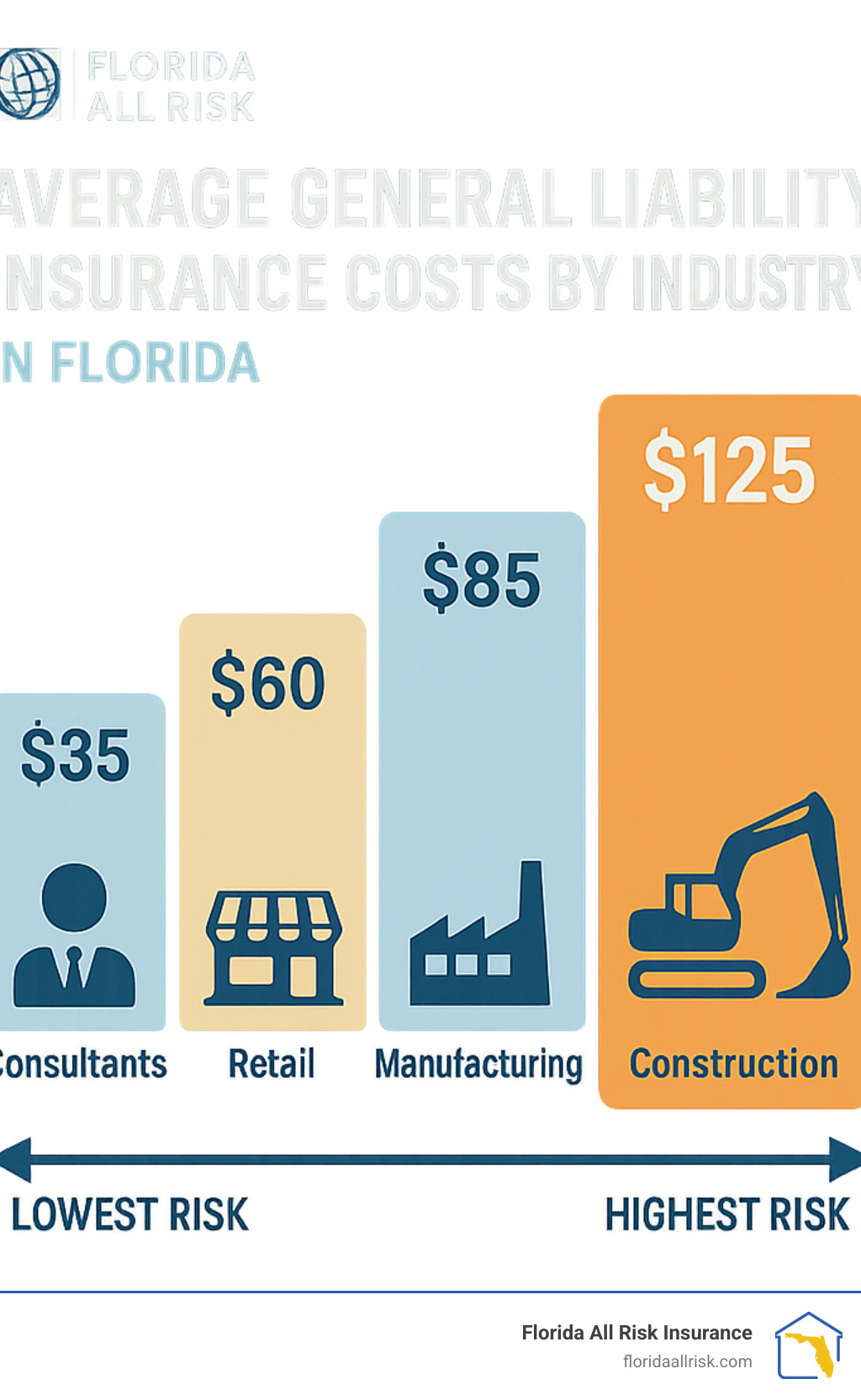
Your industry plays the biggest role in determining costs. A software consultant working from home faces very different risks than a roofing contractor, and insurance companies price accordingly. Industry risk level is the foundation of every quote you’ll receive.
Business location matters more than you might expect. If you’re operating in Miami’s busy downtown versus a quiet suburb in Gainesville, you’ll see different rates. Urban areas with higher lawsuit frequency typically mean higher premiums, even for identical businesses.
The size of your operation directly impacts your quote. Payroll and revenue figures help insurers estimate your exposure – more employees and higher sales generally mean more opportunities for something to go wrong. It’s simple math from the insurance company’s perspective.
Your claims history follows you like a credit score. Previous losses can bump up rates for three to five years, while a clean record often qualifies you for preferred pricing. Even claims that weren’t your fault can impact future quotes.
Coverage limits affect pricing, but not always in the way you’d expect. Doubling your limits doesn’t double your premium – the increase is usually much smaller. This makes higher limits an excellent value for most businesses.
Here in Florida, we often see rates slightly above national averages. Our state’s active litigation environment and natural disaster exposure contribute to this, but competition among insurers keeps costs reasonable for most businesses.
General Liability Insurance Cost
Good news for your bottom line: the IRS typically allows you to deduct general liability insurance premiums as a business expense. This tax benefit effectively reduces your net insurance cost, making comprehensive coverage even more affordable.
IRS guidance on deductible premiums
Typical Price Ranges for Small Businesses
After helping thousands of Florida businesses secure coverage, I can share what real companies actually pay for general liability insurance. These numbers come from our daily experience writing policies across the state.
Low-risk businesses like consultants, accountants, and software developers typically see the friendliest rates. If you’re working primarily from an office or home without much public interaction, expect monthly premiums between $30-50. Annual costs usually fall in the $350-600 range.
Moderate-risk operations including retail stores, restaurants, and light manufacturing face middle-ground pricing. These businesses see more foot traffic and handle physical products, which increases exposure. Monthly costs typically run $50-80, with annual premiums between $600-960.
Higher-risk businesses such as contractors, landscapers, and event planners deal with more complex exposures. Working on client properties, using heavy equipment, or managing large gatherings naturally increases risk. Monthly premiums often fall between $80-150, with annual costs ranging from $960-1,800.
National data shows that 29% of small businesses pay less than $30 monthly, while the median hovers around $42. However, these broad statistics don’t tell the whole story – your specific situation matters much more than national averages.
These are starting points for businesses with clean records and standard operations. Unique risks, high revenues, or previous claims can push costs higher. On the flip side, exceptionally safe operations with excellent track records often qualify for rates below these ranges.
Ways to Lower Your Rate Without Cutting Coverage
Smart business owners know that cutting corners on insurance rarely pays off. Instead, focus on strategies that reduce premiums while maintaining solid protection.
Risk management programs represent your best opportunity for meaningful savings. Insurance companies love businesses that actively prevent claims. Safety training for employees, regular equipment maintenance schedules, and documented safety procedures can earn you discounts up to 15%. It’s a win-win – you reduce both accidents and premiums.
Higher deductibles offer immediate premium relief. Bumping your deductible from $500 to $2,500 typically reduces costs by 10-20%. Just make sure you can comfortably handle the higher out-of-pocket expense if you need to file a claim.
Bundling policies often delivers the biggest savings with the least effort. Combining general liability with commercial property, workers’ compensation, or commercial auto usually qualifies you for package discounts. Business Owner’s Policies (BOPs) can be particularly cost-effective for smaller operations that need multiple coverage types.
Annual policy reviews catch changes that affect your rates. Maybe you’ve moved to a safer location, changed your business model, or qualified for new discounts. Regular reviews ensure you’re not overpaying for coverage you don’t need or missing savings opportunities.
Your business credit score influences insurance pricing more than most owners realize. Many insurers factor credit into their rating algorithms. Maintaining strong business credit can result in better rates across all your insurance lines.
Industry associations sometimes offer group insurance programs with member discounts. These programs often include additional perks like risk management resources and claims advocacy services. If you’re already a member of a trade organization, ask about insurance benefits.
The key is working with an agent who understands these strategies and actively looks for savings opportunities. At Florida All Risk Insurance, we regularly review our clients’ policies to ensure they’re getting the best value for their coverage investment.
After the Quote: Binding Coverage, Certificates & Claims
You’ve found the perfect general liability insurance quote – now what? The good news is that getting from quote to active coverage is faster and easier than ever before. Most standard businesses can have their policy bound and certificates in hand within minutes.
When you’re ready to move forward, you’ll review the final policy terms with your agent. This is your chance to ask questions and make sure everything looks right. Once you approve the terms and make your initial payment, your coverage becomes active immediately. You’ll receive your policy documents electronically, and many insurers provide mobile apps so you can manage your policy from anywhere.
Policy customization happens through endorsements – think of them as add-ons that tailor your coverage to your specific needs. Popular endorsements include hired and non-owned auto liability for employees using personal vehicles for work, employment practices liability for wrongful termination claims, and cyber liability for data breaches. These endorsements help fill coverage gaps without buying separate policies.
At Florida All Risk Insurance, we make sure you understand exactly what you’re buying. Our online portal gives you 24/7 access to your policy documents, and you can request certificates of insurance anytime you need them. This convenience becomes invaluable when a client needs proof of insurance by 5 PM and it’s already 4:30.
Commercial General Liability Insurance
Getting Proof of Insurance in Minutes
Digital certificates of insurance have revolutionized how businesses handle proof of coverage. Gone are the days of calling your agent and waiting hours or days for a certificate. Most insurers now provide instant ACORD 25 forms through online portals or mobile apps, complete with your coverage limits, policy numbers, and effective dates.
Your landlord wants to see proof of insurance before you can move into that new office space. Your biggest client requires a certificate before they’ll sign the contract. These situations used to cause major headaches, but now you can generate and email certificates within minutes.
Understanding certificate requirements saves time and prevents frustration. Commercial leases typically require minimum coverage limits of $1 million per occurrence, with the property owner listed as an additional insured. Service contracts often demand similar protections, plus waiver of subrogation clauses and primary and non-contributory language.
Don’t worry if this sounds like insurance gibberish – we help our clients understand these requirements and ensure their certificates meet all contractual obligations. Getting the language right the first time prevents project delays and keeps your professional relationships smooth.
Keep digital copies of all certificates and update them promptly when your policy renews. Many business opportunities slip away because of expired or inadequate insurance documentation. It’s a simple thing to track, but it can make or break important deals.
Filing a Claim Under Your Policy
Nobody wants to file a claim, but knowing the process ahead of time reduces stress when incidents happen. Your first priority is always safety – make sure everyone is okay and call emergency services if needed. Once the immediate situation is under control, start documenting everything.
Take photos of the scene, get witness contact information, and write down exactly what happened while it’s fresh in your memory. These details become crucial later when insurance adjusters investigate the claim.
Contact your insurance carrier within 24 to 48 hours of any incident that might result in a claim. Many policies require prompt notification, and delays can complicate the process. When you call, have your policy number ready and be prepared to describe what happened in detail.
Here’s something important: avoid admitting fault or making settlement offers to the injured party. It’s natural to want to help, but leave the legal and financial discussions to the professionals. Your insurance company has experienced adjusters and attorneys who handle these situations every day.
The claims timeline varies depending on complexity. Simple incidents like minor slip-and-falls with no significant injury often resolve within 30 to 60 days. More serious claims involving major injuries or property damage can take months or even years to reach final resolution. Your adjuster will keep you updated throughout the process.
Most general liability claims receive initial contact from an adjuster within 48 hours of reporting. They’ll want to review your incident documentation, interview witnesses, and assess the damages. The more complete information you provide upfront, the smoother everything proceeds.
Documentation is your friend throughout the claims process. Maintain detailed incident reports, collect medical records if someone was injured, gather repair estimates for property damage, and keep copies of all correspondence. Good documentation helps your claim move faster and often leads to better outcomes.
Smart business owners use claims as learning opportunities. Many insurers offer risk management consultations after claims to help identify and address potential hazards. These free consultations can prevent future incidents and sometimes qualify you for premium discounts.
This is exactly why you bought insurance in the first place. Your general liability insurance quote led to coverage that’s now protecting your business when you need it most. Trust the process and let your insurance company do what they do best.
Frequently Asked Questions about General Liability Insurance Quotes
Is general liability insurance required by law?
Here’s something that surprises many business owners: general liability insurance isn’t required by law in Florida. But here’s the catch – you’ll quickly find that running a business without it is nearly impossible.
Think of it this way: while the state won’t fine you for lacking coverage, the business world has its own requirements. Your commercial landlord will likely demand proof of insurance before you can sign a lease. Most clients won’t work with uninsured contractors. Even something as simple as setting up a booth at a local festival often requires a certificate of insurance.
Government contracts almost always mandate specific coverage limits, typically starting at $1 million per occurrence. Many private sector agreements follow the same pattern. Some professional licenses require proof of insurance to maintain good standing with regulatory boards.
The reality is that while general liability insurance isn’t legally mandated like workers’ compensation, it’s become a business necessity. Going without coverage doesn’t just expose you to financial risk – it can cost you customers and opportunities.
At Florida All Risk Insurance, we’ve seen businesses lose valuable contracts simply because they couldn’t provide proof of coverage when requested. The cost of insurance is minimal compared to the cost of missed opportunities.
How much general liability coverage do I need?
This question doesn’t have a one-size-fits-all answer, but I can share some practical guidelines that work for most Florida businesses.
Start with $1 million per occurrence and $2 million aggregate – this is our baseline recommendation for most small businesses. These limits satisfy the majority of lease agreements and client contracts while providing meaningful protection for your assets.
But some businesses need to think bigger. If you’re in construction, food service, or event planning, consider jumping to $2 million per occurrence and $4 million aggregate. These industries face higher lawsuit risks and often have contractual requirements for increased coverage.
Here’s a simple rule I share with clients: your coverage should at least match your net worth. If a lawsuit results in a judgment that exceeds your policy limits, your personal and business assets could be on the line. That beautiful home in St. Petersburg? Your business equipment? All potentially at risk.
For businesses needing very high limits, commercial umbrella policies offer an affordable solution. These policies sit above your primary general liability coverage and can provide millions in additional protection for a relatively small premium increase.
Don’t forget to review your coverage annually. As your business grows and your assets increase, your insurance needs grow too. What seemed adequate when you started might leave you exposed five years down the road.
Is the premium tax-deductible?
Yes, and this is one of my favorite benefits to share with clients! General liability insurance premiums are typically 100% tax-deductible as ordinary and necessary business expenses.
This applies whether you’re a sole proprietor working from your garage, a partnership, an LLC, or a full corporation. The key requirement is that the coverage must be for legitimate business purposes, not personal activities.
The math works in your favor: Let’s say you’re paying $1,200 annually for coverage and you’re in a 25% tax bracket. Your actual after-tax cost is only $900. That’s like getting a 25% discount on your insurance premium.
The deduction typically applies to premiums paid during the tax year, making budgeting straightforward. You pay your annual premium in January, you can generally deduct the full amount on that year’s tax return.
Of course, tax situations can be complex, and I always recommend consulting with your tax professional for guidance specific to your business structure and circumstances. But for most businesses, this tax benefit makes adequate general liability insurance coverage even more affordable and reinforces why maintaining continuous protection makes both financial and business sense.
Conclusion

You’ve now got everything you need to secure a smart general liability insurance quote for your business. The process really doesn’t have to stress you out or eat up your entire day.
Think of it this way – you’re building a financial safety net that protects years of hard work from one unfortunate accident. Whether it’s a customer slipping in your lobby or accidentally damaging someone’s property during a job, the right coverage means you can focus on running your business instead of worrying about lawsuits.
The smart approach starts with understanding exactly what you’re buying. General liability insurance covers the big three: bodily injury to others, property damage you cause, and those pesky advertising injury claims. But remember, it won’t cover your professional mistakes, employee injuries, or cyber attacks – those need separate policies.
Getting quotes is easier than ever. Most businesses can get accurate estimates online in just a few minutes. Have your basic business info ready, be honest about your operations and revenue, and don’t forget to mention any past claims. The small extra effort upfront saves you headaches later.
Here in Florida, we understand the unique challenges facing local businesses. From hurricane season to our state’s litigation climate, Florida businesses need agents who get it. That’s where Florida All Risk Insurance comes in as your one-stop source for comprehensive protection.
We’re not just another insurance agency throwing quotes at you. Our team takes time to understand your specific risks and finds coverage that actually makes sense for your business and budget. As an independent agency, we work with multiple carriers to get you the best combination of coverage and price.
Your next steps are simple. Review your current coverage (or get your first policy if you’re starting out), gather the documents we’ve outlined, and reach out for a personalized quote. Don’t wait until something happens – by then, it’s too late.
The peace of mind that comes with proper general liability coverage is worth every penny. You’ve worked too hard building your business to let one accident destroy everything you’ve accomplished.
Ready to protect your business the right way? Let’s get started on your general liability insurance quote today.