

General Liability Insurance for HVAC Contractors: The Complete 2025 Guide
Running a successful HVAC business in Florida demands more than just technical skill and excellent customer service. It requires a keen awareness of the significant risks that accompany every service call, installation, and maintenance check. From navigating tight crawl spaces with heavy equipment to handling refrigerants under strict Environmental Protection Agency (EPA) guidelines, the potential for a costly accident is always present. A single misstep—a scratched floor, a water leak from a new installation, or a client tripping over a tool—can trigger a lawsuit that jeopardizes your finances, reputation, and the very existence of your business. General liability insurance is the essential financial shield that prevents an unforeseen mishap from becoming a business-ending disaster.
This comprehensive guide, now well over 2,500 words, is designed for every HVAC professional in Florida, from the solo owner-operator to the rapidly expanding company with multiple crews. We will dig into the specific reasons why robust coverage is non-negotiable in today’s market. We’ll explore real-world claim scenarios that illustrate how quickly things can go wrong, break down the typical costs of coverage, and provide actionable strategies to secure affordable premiums without compromising on protection. By the end of this guide, you will have a clear understanding of how to construct a complete risk management plan, empowering you to focus on what you do best: providing comfort and climate control to homes and businesses across the Sunshine State.
Understanding the Top Risks for HVAC Contractors
The HVAC industry is indispensable for modern life, but its daily operations are fraught with unique and substantial risks. A proactive understanding of these potential pitfalls is the first step toward building a resilient business that can withstand unexpected challenges. Let’s explore the most significant risks HVAC contractors face daily and see how general liability insurance for hvac contractors acts as your critical first line of defense against them.
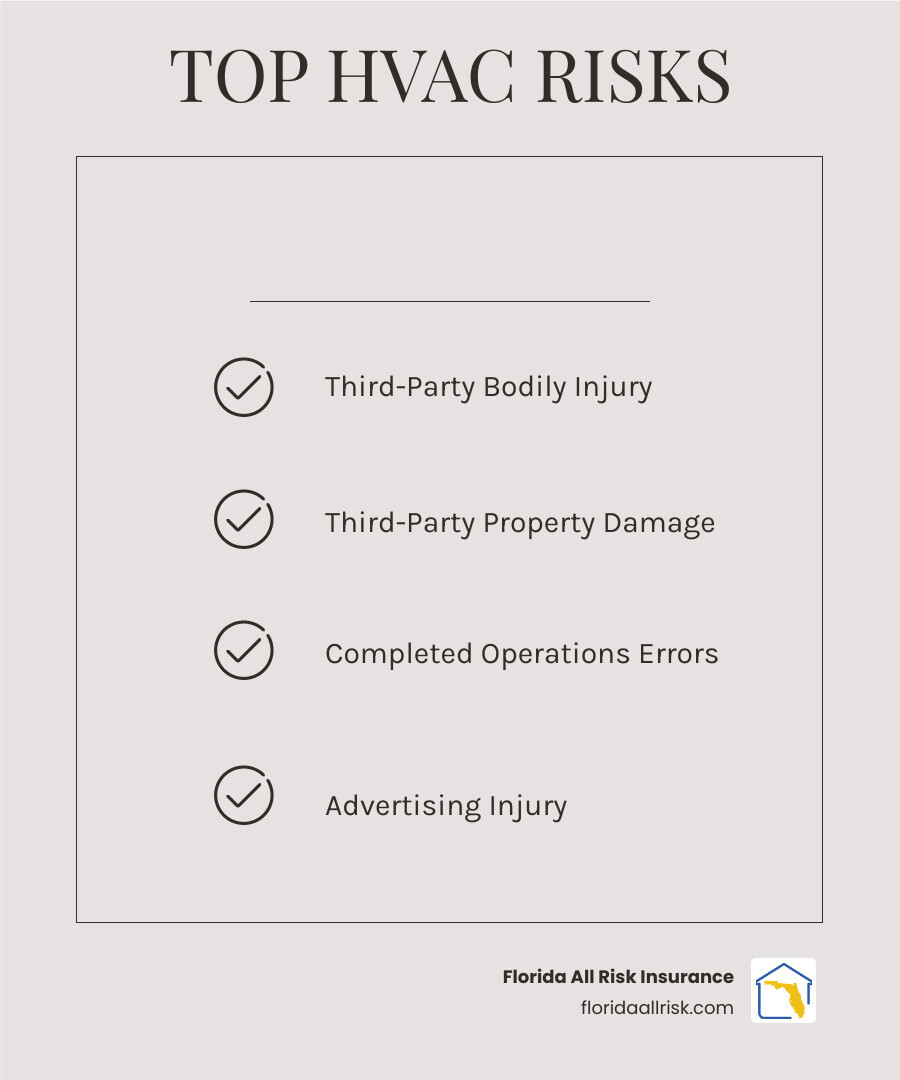
Infographic:
Top 4 Risks for HVAC Contractors:
- Third-Party Bodily Injury: This risk extends beyond a client simply tripping over a toolbox. Imagine a scenario where you leave a panel open on an air handler in an attic, and the homeowner later bumps their head, resulting in a concussion. Or consider a situation where fumes from a cleaning solvent you used cause an allergic reaction in a client with respiratory issues. If a third party—be it a client, their child, a visitor, or even a neighbor—is injured as a result of your work, your business could be held liable for their medical expenses, rehabilitation costs, lost income, and pain and suffering. These claims can escalate into six-figure lawsuits with alarming speed.
- Third-Party Property Damage: This is arguably the most frequent claim in the HVAC industry. While a cracked floor tile is a common example, the potential for damage is vast. A miscalculation while drilling could puncture a water pipe hidden in a wall, leading to extensive water damage. An accidental power surge during an electrical hookup could fry a client’s expensive home entertainment system. Even something as simple as tracking grease onto a new carpet can result in a claim. General liability insurance covers the cost to repair or replace the damaged property, protecting your business’s cash flow.
- Completed Operations Errors: Your liability does not cease once you’ve packed up your tools and received payment. This crucial coverage protects you from claims arising from your work long after the job is finished. For instance, an improperly installed flue pipe could leak carbon monoxide, leading to a catastrophic health crisis for the residents. A faulty condensate drain line that you installed could slowly leak, causing hidden mold growth and structural rot that isn’t finded for months or even years. Without completed operations coverage, you would be personally responsible for the immense costs of remediation and any associated lawsuits.
- Advertising Injury: This category covers non-physical, reputation-based damages. In a competitive market, it’s easy to make a misstep in your marketing. For example, if you use a customer testimonial and photo in a brochure or on your website without their written consent, you could be sued for invasion of privacy. If a blog post on your site makes a misleading and negative claim about a competitor’s services, you could face a lawsuit for libel. This coverage also protects against copyright infringement, such as using a stock photo you didn’t pay for or borrowing text from another company’s website. These claims, while less common than property damage, can be very expensive to defend.
Why General Liability is a Non-Negotiable Tool for HVAC Contractors
Imagine this: it’s a Friday afternoon, and you’re wrapping up a complex commercial rooftop unit installation. Weeks later, you get an urgent, angry call from the business owner. A severe thunderstorm rolled through, and the unit you installed wasn’t sealed correctly, allowing rainwater to pour into their building, destroying inventory, computers, and ceiling tiles. Without the right protection, this single event could bankrupt your company. This is precisely why general liability insurance for HVAC contractors is not a discretionary expense—it’s the lifeline that ensures your business survives the unexpected.
This coverage is indispensable for several critical reasons. First and foremost, it provides a financial safety net. Lawsuits involving property damage or bodily injury can easily run into the tens or hundreds of thousands of dollars when you factor in legal defense costs, settlements, and court-ordered judgments. General liability covers these expenses, preserving your business assets. Secondly, it’s essential for meeting client requirements. Increasingly, both commercial property managers and savvy residential homeowners will not allow you to begin work without first seeing a Certificate of Insurance (COI) that proves you have adequate coverage. Thirdly, it’s often necessary to satisfy licensing mandates. While state laws vary, many local municipalities and licensing boards require proof of liability insurance to obtain or renew your contractor’s license.
Beyond these practical necessities, being properly insured safeguards your business reputation. Handing a client your COI along with your proposal demonstrates professionalism, credibility, and financial stability. In a crowded marketplace, this can be a powerful tool to differentiate your business from less established or uninsured operators. Having robust coverage provides invaluable peace of mind, allowing you to focus on quality workmanship and growing your business without the constant fear that one accident or oversight could lead to financial ruin.
Real-World Scenarios: When CGL Becomes Your Business’s Lifeline
These everyday realities for HVAC contractors highlight why coverage is so vital:
- Water Damage from a Leaky AC Install: This is a classic and frequent claim. You install a new air handler in an attic. A week later, the condensate drain line clogs or disconnects, causing water to overflow the pan and leak through the ceiling below. The client’s hardwood floors, drywall, and furniture are ruined, resulting in a $25,000 property damage claim. Your CGL policy steps in to cover the repairs and any legal fees if the client sues.
- A Client Tripping Over Your Toolbox: You’re working in a client’s basement and leave your toolbox on the floor near the stairs. The homeowner comes down to check on your progress, doesn’t see the box, and takes a hard fall, fracturing their hip. The resulting claim for medical bills, physical therapy, and lost wages exceeds $80,000. Your general liability policy is designed to handle these exact types of bodily injury claims.
- Accidental Damage While Moving Equipment: You’re replacing an old furnace in a home with narrow hallways and tight corners. While maneuvering the new unit, your dolly scrapes a deep gash into the homeowner’s custom wood paneling and cracks several expensive floor tiles. The repair bill is $7,000. CGL covers these property damage costs, so they don’t come directly out of your profit margin.
- Lawsuit Over Mold Growth: Six months after you installed a new, high-efficiency system, a homeowner hires a mold inspector due to a musty smell. The inspector alleges that your installation resulted in improper airflow and humidity control, leading to widespread mold growth behind the walls. Even if you believe your work was perfect, you now face a lawsuit demanding $100,000 for remediation and health-related damages. Your completed operations coverage pays for your legal defense and any potential settlement, protecting you from claims that arise long after the job is done.
Is General Liability Insurance for HVAC Contractors a Legal Requirement?
One of the most frequent and important questions we receive from contractors is whether general liability insurance for hvac contractors is legally mandated. The answer isn’t a simple yes or no; it’s nuanced. While there is no overarching federal law that requires every HVAC contractor to carry general liability insurance, a combination of state regulations, local ordinances, client contracts, and other business agreements makes it a practical and virtual necessity for any legitimate operation.
In Florida, the state licensing boards, such as the Department of Business and Professional Regulation (DBPR), have specific requirements for contractors. While the primary focus is often on demonstrating financial responsibility and carrying workers’ compensation insurance (if you have employees), general liability insurance is woven into the fabric of doing business legally and professionally. For example, to pull permits in many municipalities, you must provide proof of general liability coverage.
The most significant driver, however, is client and contract requirements. It is now standard practice for general contractors to require all their subcontractors, including HVAC specialists, to provide a Certificate of Insurance (COI) naming them as an additional insured. Commercial clients, such as property management firms, office buildings, and retail centers, will not even consider a bid from a contractor who cannot prove they are insured. Even a growing number of residential homeowners are becoming educated on the risks and are demanding to see a COI before allowing work to begin in their homes.
Furthermore, if you plan to grow your business beyond working out of your truck, your commercial lease agreement for an office or workshop will almost certainly contain a clause requiring you to maintain a general liability policy. This protects the property owner from claims arising from your business operations on their premises. So, while you may not be breaking a specific state statute by operating without it (depending on your exact business structure), it is nearly impossible to run a competitive, professional, and growing HVAC business in today’s market without it. The fact that an estimated 95% of business owners carry this coverage highlights its role as a fundamental tool for credibility, protection, and access to work.
For more detailed information, you can review our guide on General Liability Insurance for Contractors.
What Your HVAC General Liability Policy Actually Covers
When you invest in general liability insurance for hvac contractors, you are purchasing a powerful and broad safety net designed to protect your business from the financial consequences of accidents and mishaps involving third parties. A third party is anyone who is not your employee—this includes your clients, their family members, guests, vendors, and the general public.
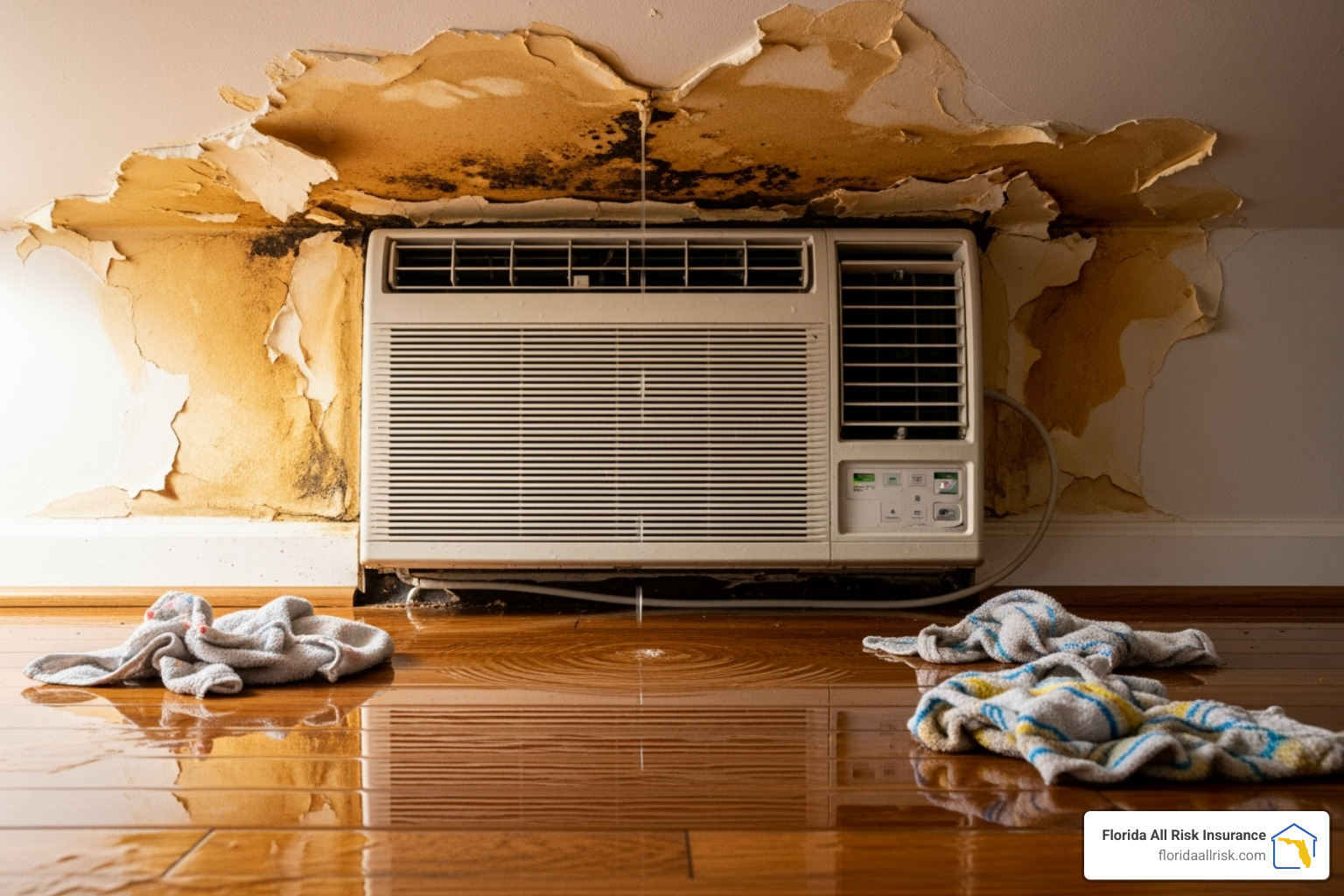
Image metadata: Water-damaged ceiling, floor, indoor AC unit, property damage, insurance claim, residential setting.
Here is a detailed breakdown of the core coverages included in a standard Commercial General Liability (CGL) policy:
- Bodily Injury: This coverage is triggered if your business operations cause physical harm to a third party. It pays for their medical bills, hospital stays, rehabilitation costs, and lost wages. It also covers your legal defense if you are sued for the injury. Examples include a client tripping over your extension cord or a piece of equipment falling and injuring a passerby outside a commercial job site.
- Property Damage: This pays for the cost to repair or replace someone else’s property that you or your employees accidentally damage. For an HVAC contractor, this is essential. It covers scenarios like accidentally drilling through a water pipe, scratching a hardwood floor while moving a furnace, or causing an electrical surge that damages a client’s electronics.
- Completed Operations: This is one of the most critical components for contractors. It protects you from liability for property damage or bodily injury that occurs after you have completed the job and left the site. If a furnace you installed a year ago malfunctions and causes a fire, or an improperly sealed duct leads to long-term mold damage, this coverage responds to the resulting claims.
- Personal & Advertising Injury: This protects your business from non-physical torts. It covers claims such as libel (written defamation), slander (spoken defamation), copyright infringement in your advertising, misappropriation of advertising ideas, and invasion of a person’s privacy. For example, if you post a “before and after” picture of a client’s home on social media without their explicit written permission, you could be sued for invasion of privacy. If you make false, damaging statements about a competitor in a radio ad, you could be sued for slander. This coverage protects your reputation and your assets from such claims.
- Medical Payments: This is a smaller, no-fault coverage designed to quickly resolve minor injuries. If a client sustains a small cut from a piece of sheet metal at your job site, this coverage can pay for their immediate medical expenses (e.g., a trip to urgent care for stitches) up to a certain limit (typically $5,000 or $10,000), without the need to establish fault. This can often prevent a small incident from escalating into a larger liability lawsuit.
- Legal Defense Costs: A major, often overlooked benefit of a CGL policy is that it covers the cost of hiring lawyers, court fees, and other legal expenses to defend your business against a covered claim. These costs can be astronomical, even if the lawsuit against you is frivolous and ultimately dismissed. Your policy pays these defense costs in addition to the policy limit in most cases.
For a deeper dive, see our guide on What Does General Liability Insurance Cover?.
Understanding Policy Limits and Deductibles
Your policy’s power is defined by its limits and deductible. The per-occurrence limit is the maximum amount your insurer will pay for a single claim or incident. For HVAC contractors, a $1 million per-occurrence limit is the industry standard. The aggregate limit is the total amount the insurer will pay out for all claims during your one-year policy period. A $2 million aggregate limit is common and is often required for commercial contracts.
A deductible is the amount you must pay out-of-pocket on a covered claim before your insurance coverage kicks in. For general liability, this is typically a property-damage deductible and is often a manageable amount, such as $500 or $1,000. Choosing a higher deductible can lower your premium, but you must be sure you can comfortably afford to pay that amount if a claim occurs. When selecting your limits, consider the value of the properties you work on and the potential for catastrophic error. While a $1M/$2M limit is sufficient for most residential and light commercial work, contractors working on large-scale industrial projects, hospitals, or high-value properties may need higher limits, which can be achieved through an excess liability or umbrella policy.
For more guidance, visit our guide: How Much General Liability Insurance Do I Need?.
Understanding the Cost of General Liability Insurance for HVAC Contractors
One of the first and most practical questions contractors ask is, “How much will this cost?” The good news is that for the immense financial protection it offers, general liability insurance for hvac contractors is remarkably affordable. For a standard policy with a $1 million per-occurrence and $2 million aggregate limit, most small to medium-sized HVAC businesses can expect to pay an annual premium between $540 and $941. This breaks down to a manageable monthly cost of approximately $50 to $78.
For additional national context, the Insurance Information Institute’s business-insurance overview compares premiums across industries and underscores why liability coverage is a foundational expense for contractors.

Image metadata: Calculator, clipboard, HVAC business logo, insurance premium calculation, office desk, paperwork.
Of course, this is a general range. Your exact premium will be calculated based on a number of factors unique to your specific business operations. For a broader look at what drives costs, see our guide: General Liability Insurance Cost.
Key Factors That Determine Your Premium
Insurance underwriters assess your business’s specific risk profile to determine your premium. Here are the key variables they consider:
| Factor | Increases Cost | Decreases Cost |
|---|---|---|
| Business Size & Payroll | More employees, higher payroll | Fewer employees, lower payroll |
| Location & Service Area | Densely populated urban areas, litigious regions | Rural areas, lower-risk territories |
| Claims History | A history of frequent or severe claims | A clean claims record (no claims) |
| Years in Business & Experience | Newer business (under 3 years) | Established business with a proven track record |
| Services Offered | Commercial/industrial work, new construction, refrigeration | Residential service and repair, maintenance only |
| Coverage Limits & Deductible | Higher limits ($2M+), lower deductible ($500) | Standard limits ($1M), higher deductible ($2,500+) |
| Subcontractor Use | Using uninsured or poorly managed subcontractors | Using insured subcontractors, formal agreements |
Working with an independent insurance agent who specializes in contractor coverage can be invaluable. Unlike a captive agent who only represents one company, an independent agent can shop your policy across multiple carriers to find the most competitive rate for your specific risk profile.
How to Get the Most Affordable Coverage
Securing comprehensive coverage at a competitive price is entirely achievable with a few smart strategies:
- Bundle Policies: The most effective way to save is by bundling your general liability with other necessary coverages, like commercial auto or a Business Owner’s Policy (BOP). Insurers offer significant discounts for these packages.
- Maintain a Clean Claims Record: A history free of claims is the single best indicator to an insurer that you are a low-risk client, which translates directly to lower premiums year after year.
- Implement a Safety Program: Documenting your safety protocols, holding regular safety meetings, and providing proper personal protective equipment (PPE) shows insurers you are proactive about risk management. This comprehensive OSHA risk-management guide offers valuable insights for creating a program.
- Choose the Right Deductible: Opting for a higher deductible (e.g., $2,500 instead of $500) can lower your annual premium. Just be certain that the deductible is an amount you can comfortably pay out-of-pocket if a claim arises.
- Conduct Annual Policy Reviews: Your business is not static. As you grow, add employees, or change services, your insurance needs will change. Reviewing your policy annually with your agent ensures you are not over or under-insured and that your costs align with your current operations.
Building a Complete Insurance Shield for Your HVAC Business
Think of general liability insurance for hvac contractors as the strong, concrete foundation of your business’s protective structure. It’s absolutely essential, but a foundation alone cannot protect you from every threat. To be truly secure, you need to build a complete insurance shield. While CGL is the cornerstone that protects you from third-party claims, you need other specialized coverages to guard against different types of risk, such as employee injuries, damage to your work vehicles, or the theft of your expensive tools and equipment.

Image metadata: Puzzle pieces, insurance types, shield, CGL, Auto, Workers’ Comp, Tools, business protection.
Bundling these policies together not only closes dangerous gaps in your coverage but also typically results in significant premium discounts from the insurer. For more on comprehensive strategies, visit our page on Insurance for Small Businesses.
Essential Coverages to Bundle with Your CGL Policy
- Workers’ Compensation: If you have employees (even just one), this coverage is legally required in Florida and most other states. It is critically important. It covers medical expenses and a portion of lost wages for employees who are injured or become ill on the job. HVAC work involves risks like falls from ladders, electrical shocks, back injuries from lifting heavy units, and exposure to hazardous materials. Workers’ comp protects your employees and also protects you from being sued by an injured employee, as it is generally the exclusive remedy.
- Commercial Auto Insurance: Your personal auto policy explicitly excludes coverage for accidents that occur while you are driving for business purposes. A commercial auto policy is essential to protect your work vans, trucks, and any vehicle used for your business. It covers liability for accidents you cause, as well as physical damage to your vehicles. You can also add coverage for permanently installed equipment, like ladder racks or storage systems.
- Tools & Equipment Insurance (Inland Marine): Your general liability policy does not cover your own property. This specialized coverage, often called inland marine insurance, protects your valuable tools and equipment from theft, damage, or loss. It covers your property whether it’s at a job site, in transit in your truck, or stored at your shop. Considering the high cost of refrigerant recovery machines, vacuum pumps, and diagnostic tools, this coverage is a must-have.
- Contractors’ Errors & Omissions (E&O): Also known as professional liability insurance, this is a distinct coverage from CGL. While CGL covers bodily injury and property damage, E&O covers a client’s financial losses resulting from your professional mistakes or negligence, even if there is no physical damage. For example, if you recommend and install an undersized AC unit for a commercial space and the client loses business because the space is constantly too hot, they could sue you for their financial losses. E&O insurance would respond to this type of claim.
What is a Business Owner’s Policy (BOP)?
A Business Owner’s Policy (BOP) is a convenient and cost-effective insurance package designed for small to medium-sized businesses, including many HVAC contractors. It combines General Liability and Commercial Property insurance into a single, streamlined policy. This means it covers third-party claims for injury and property damage (the CGL part) while also protecting your own business assets, such as your office building, workshop, computers, inventory of parts, and office furniture.
The primary advantages of a BOP are significant cost savings (it’s cheaper than buying the policies separately) and simplified management. You have one policy, one premium payment, and one renewal date to manage. Crucially, most BOPs automatically include Business Interruption Insurance. This vital coverage replaces lost income and covers ongoing expenses (like rent and payroll) if your business has to temporarily shut down due to a covered event, such as a fire, theft, or storm. For a business in Florida, where hurricane season can disrupt operations for weeks, this coverage can be the key to survival. A BOP does not include commercial auto, workers’ comp, or E&O, which must still be purchased as separate policies.
For more details, see our guide on Business Liability Insurance.
Frequently Asked Questions about General Liability Insurance for HVAC Contractors
Over the years, we’ve fielded thousands of questions from HVAC contractors navigating the complexities of business insurance. Here are clear, straightforward answers to some of the most common inquiries to help you make confident and informed decisions for your business.
What’s the difference between General Liability and Workers’ Compensation?
This is the most frequent and fundamental question. The simplest way to distinguish them is to think about who is being protected. General Liability protects your business from claims made by third parties (outsiders like clients, vendors, or the public) for bodily injury or property damage that your business operations allegedly caused. Workers’ Compensation protects your own employees. It is a no-fault system that covers their medical bills and partial lost wages if they get injured while on the job. In return for these guaranteed benefits, employees generally cannot sue their employer for the injury. If you have employees, you almost always need both policies.
How do I get a Certificate of Insurance (COI)?
Getting a Certificate of Insurance (COI) is a simple and routine process. A COI is a one-page document that provides standardized proof that you have active insurance coverage. It summarizes your policy types (like General Liability and Commercial Auto) and your coverage limits. As soon as your general liability insurance for hvac contractors policy is bound and active, you can request a COI from your insurance agent or broker. We can typically generate and email a COI to you or your client on the same day it’s requested. Many modern insurers also provide 24/7 online portals where you can log in and issue your own COIs instantly, which is incredibly convenient when a client asks for one at the last minute.
Does my General Liability policy cover faulty workmanship?
This is a critical and often misunderstood distinction. Standard General Liability policies are designed to cover the consequential or resulting damage that arises from your faulty work, but they typically do not cover the cost to repair or replace the faulty work itself. For example: You install a new rooftop unit, but the flashing is done incorrectly. A rainstorm causes water to leak into the building, damaging the client’s inventory and computers. Your CGL policy would cover the cost to replace the damaged inventory and computers (the resulting damage). However, it would not pay for the labor and materials to go back on the roof and fix the faulty flashing (your work). Coverage for your own work product falls under the category of professional liability, which requires a separate Contractors Errors & Omissions (E&O) policy.
Do I still need insurance if I’m a solo operator with no employees?
Yes, absolutely. While you may not need workers’ compensation if you have no employees, general liability insurance is just as critical for a one-person operation as it is for a large company. The risks of causing property damage or third-party injury are still present, regardless of your company’s size. A single lawsuit from a water leak or a slip-and-fall accident could wipe out your business and personal assets. Furthermore, most general contractors and many homeowners will still require you to provide a COI before they hire you, making it a practical necessity for getting jobs.
What happens if a subcontractor I hire causes damage at my job site?
This is a major area of liability exposure. As the primary contractor, you can be held responsible for the actions and mistakes of the subcontractors working under you. It is essential to have a formal risk transfer process in place. This involves two key steps: 1) Requiring all subcontractors to provide you with their own Certificate of Insurance showing they have adequate general liability coverage. 2) Insisting that they name your business as an “Additional Insured” on their policy. This allows you to make a claim on their policy if their work leads to a lawsuit against you. Without these protections, your own insurance policy would likely have to respond to the claim, which could lead to higher premiums for you in the future.
Secure Your Business with the Right Coverage
Navigating the insurance landscape can seem complex, but choosing the right HVAC General Liability Insurance is not merely another business expense—it is a foundational investment in your company’s longevity and success. This essential coverage acts as your financial shield against the inherent, everyday risks of the HVAC trade. It empowers you to meet client and legal requirements, improves your professional credibility, and, most importantly, provides the peace of mind you need to focus on what you do best: delivering expert, reliable HVAC services to your community.
By understanding what Commercial General Liability covers, what factors influence its cost, and how it integrates with other vital policies like workers’ compensation and commercial auto, you can construct a comprehensive safety net that protects your assets from every angle. Don’t leave your hard-earned business vulnerable to a single accident. For personalized advice and a policy custom to your unique needs as a Florida contractor, the independent agents at Florida All Risk Insurance are ready to help you assess your risks, close any coverage gaps, and secure the most competitive rates available.
Ready to protect your hard work and secure your future? Get a Quote online today or call our office to explore your options for General Liability coverage.
Contact Us
At Florida All Risk Insurance, we’re here to help you protect your HVAC business with the right insurance. We understand the unique needs of Florida contractors and are committed to finding a general liability insurance for hvac contractors solution that fits your business and budget.
Whether you need a basic policy or a comprehensive Business Owner’s Policy, our experienced team will guide you through your options and work to find competitive rates. Contact us today to get your questions answered or to request a quote.
Florida All Risk Insurance
Address: Saint Petersburg, FL
Email: [email protected]

