

General Liability Insurance for Healthcare Providers: Secure 2025
Why Healthcare Providers Need General Liability Protection
As a healthcare provider, your primary focus is delivering exceptional patient care. However, running a medical practice also means operating a business, and businesses face a wide array of risks that extend far beyond clinical treatment. General liability insurance for healthcare providers is a fundamental business policy designed to shield your practice from the financial fallout of third-party claims alleging bodily injury, property damage, and personal or advertising injury. This coverage is critically distinct from medical malpractice insurance, as it addresses the everyday operational risks inherent in any facility open to the public.
Imagine a scenario: a patient’s elderly spouse, accompanying them to an appointment, slips on a recently mopped floor in your waiting room, resulting in a fractured hip. The subsequent medical bills, potential for a prolonged legal battle, and settlement could easily reach six figures. This incident has nothing to do with the quality of your medical care, so your malpractice insurance would not respond. Without general liability coverage, the entire financial burden of legal defense and settlement would fall directly on your practice, potentially threatening its viability.
Quick Answer: What General liability Insurance Covers for Healthcare Providers
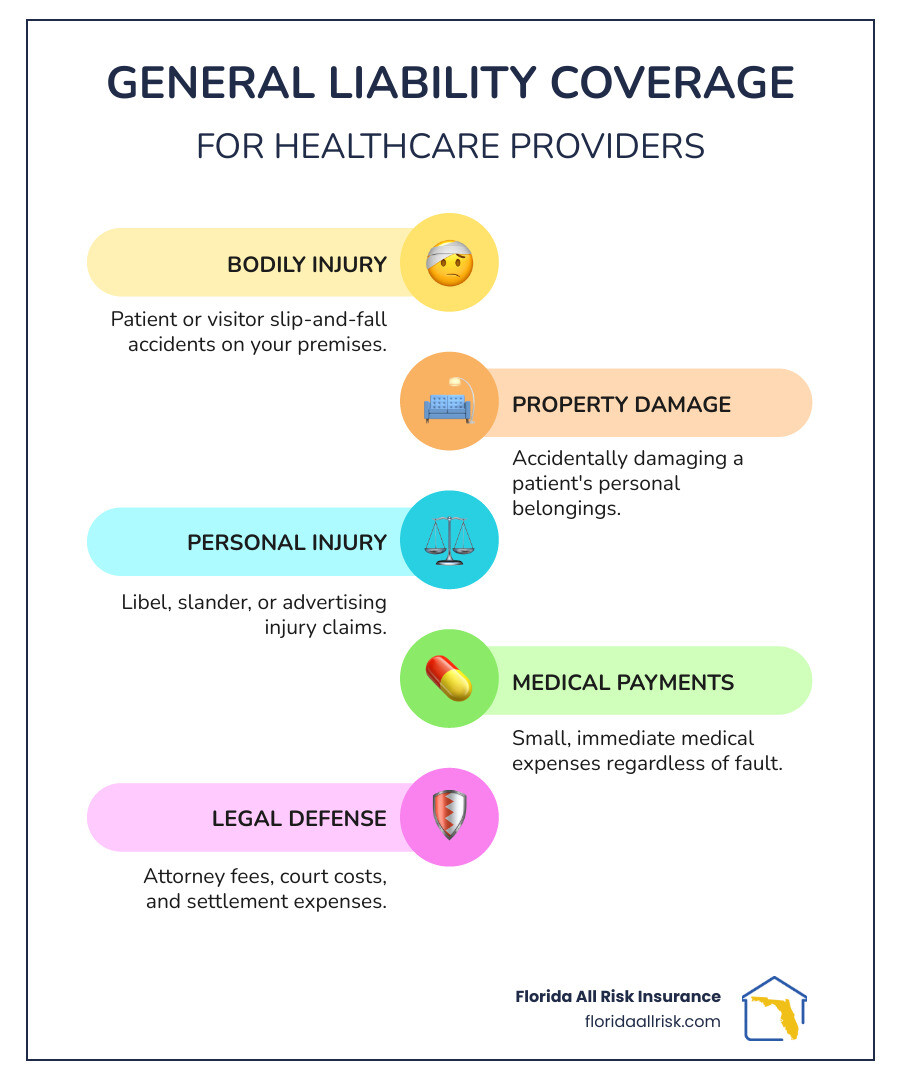
- Bodily Injury: Protects your practice if a non-employee (like a patient, visitor, or vendor) is injured on your premises.
- Property Damage: Covers costs if your business operations cause damage to someone else’s property.
- Personal & Advertising Injury: Defends against claims of libel, slander, copyright infringement, or invasion of privacy.
- Medical Payments: Provides for small, immediate medical expenses for an injured third party, helping to prevent larger lawsuits regardless of fault.
- Legal Defense Costs: Pays for attorney fees, court costs, and settlements or judgments for covered claims, often up to the policy limit.
While professional liability (malpractice) insurance is non-negotiable for protecting against claims of medical negligence, general liability is the bedrock that protects the business itself. It addresses the fundamental risks of your physical space—from the parking lot to the reception desk. A failure to secure this protection can leave your practice dangerously exposed to common, yet financially devastating, accidents.
The Foundation of Practice Protection: What is General Liability Insurance?
Think of general liability insurance for healthcare providers as your practice’s essential financial shield against the unpredictable nature of public interaction. While your expertise is focused on patient well-being, this policy diligently protects your business from common, non-medical risks. It is specifically designed to cover third-party claims—legal actions brought by individuals who are not your employees. This includes patients (in a non-medical context), their family members, visiting colleagues, delivery personnel, or any other person who enters your property and alleges that your business operations caused them bodily harm or damaged their property.
Unlike medical malpractice insurance, which scrutinizes your professional conduct and treatment decisions, general liability is concerned with the physical environment and day-to-day activities of your facility. It establishes a crucial layer of financial protection for incidents that are mundane yet potentially catastrophic. A visitor slipping on an icy patch in your parking lot, a staff member accidentally knocking over and breaking a patient’s expensive smartphone, or a delivery driver tripping over a loose cord are all classic general liability scenarios. This coverage ensures both patient safety and visitor safety from an operational, non-clinical perspective.
Why is this coverage a necessity?
Every individual who walks through your doors represents a potential liability risk. Accidents are an unfortunate reality of operating a business, and their financial and reputational consequences can be severe.
- Bodily Injury: The classic slip-and-fall is a primary example, but this also includes injuries from faulty waiting room chairs, automatic doors, or even items falling from shelves. A single serious injury can result in staggering medical bills, lost income claims, and substantial legal defense costs.
- Property Damage: Beyond minor accidents, this could involve a leaking pipe from your office damaging equipment in a neighboring suite or a home health aide accidentally causing significant damage to a patient’s home. These claims can quickly escalate into expensive repairs or replacements.
- Advertising Injury: In today’s competitive healthcare market, your marketing efforts can inadvertently create liability. Using a patient’s photo in a brochure without proper consent could lead to an invasion of privacy claim. A poorly worded social media post could be construed as libel against a competing practice. General liability helps cover the legal fallout from such missteps.
- Contractual Requirements: This is a non-negotiable aspect for most practices. Landlords will not sign a lease agreement without proof of general liability insurance. Similarly, healthcare networks, hospital credentialing bodies, and government contracts often mandate this coverage as a prerequisite for partnership. Without it, your practice’s ability to operate and grow is severely hampered.
By transferring these everyday operational risks to an insurer, you secure the operational stability and financial health of your practice. This risk transfer mechanism protects your business assets from being liquidated to cover a claim and provides profound peace of mind, allowing you to focus on what you do best: caring for your patients.
General Liability vs. Medical Malpractice: A Critical Distinction

Many healthcare professionals mistakenly assume their medical malpractice policy is a catch-all shield. This is a dangerous misconception. General liability and medical malpractice insurance are two distinct pillars of a comprehensive risk management strategy, each designed to protect against entirely different categories of risk. One guards your professional judgment and clinical skills, while the other protects your business operations and physical premises.
Medical Malpractice Insurance (Professional Liability)
This policy is the safeguard for your professional services. It activates when a patient alleges that an error, omission, or deviation from the accepted standard of care in your field resulted in their injury or harm. It is exclusively focused on the clinical aspects of your work.
Common malpractice claims involve allegations of misdiagnosis, surgical mistakes, medication errors, birth injuries, and other forms of negligence in treatment. These claims challenge your professional competence. As highlighted by extensive data from the American Medical Association (AMA), the frequency and severity of these claims make malpractice coverage an absolute necessity for practicing clinicians, including those seeking specialized professional liability insurance for independent contractors.
General Liability Insurance
This coverage is entirely separate from your medical expertise. It centers on your premises and general operations—the risks associated with running a facility that is open to the public. It handles non-medical incidents that can happen at any business. This includes a patient tripping over a misplaced medical bag, a visitor’s car being damaged by a falling sign in your parking lot, or a staff member damaging a patient’s personal property. It also extends to non-physical harm through its personal and advertising injury coverage, defending against claims of libel, slander, and copyright infringement. It protects the business entity from everyday accidents.
Comparing General Liability and Medical Malpractice Insurance
| Feature | General Liability Insurance | Medical Malpractice Insurance (Professional Liability) |
|---|---|---|
| Primary Focus | The business premises and its general, non-professional operations. | The professional services and clinical actions of the healthcare provider. |
| Scope of Coverage | Non-medical claims: bodily injury, property damage, personal/advertising injury to third parties. | Medical claims: errors, omissions, negligence, or malpractice in professional services. |
| Who is Covered | The business entity, its owners, and employees in the context of general operations. | The individual healthcare professional(s) and/or the facility for their clinical actions. |
| Trigger for a Claim | An accident or incident on the premises or related to business operations causing harm. | An adverse patient outcome allegedly caused by a breach in the standard of care. |
| Typical Claims | Slip-and-falls, accidental property damage (e.g., breaking a patient’s glasses), libel/slander, advertising injury. | Misdiagnosis, surgical errors, medication errors, improper treatment, failure to refer. |
| Is it Required? | Often required by landlords, contracts, and for prudent business management. Not always state-mandated. | Almost always mandatory by state laws, professional boards, hospitals, or managed care networks. |
For truly comprehensive protection, you need both policies. They work in tandem, not in place of one another. Malpractice insurance defends your professional reputation and clinical decisions, while general liability shields your business assets from the common accidents that can occur on any given day.
What Does General Liability Insurance for Healthcare Providers Cover?

A general liability policy is a multi-faceted shield designed to absorb the financial impact of everyday operational risks. Understanding its core components is key to appreciating its value for your practice.
Bodily Injury and Property Damage
This is the cornerstone of any general liability policy, covering physical harm to third parties (non-employees) or damage to their tangible property.
- Bodily Injury: This coverage is triggered when a person is physically injured on your business premises or as a result of your business operations. Slip-and-fall incidents are the most frequent claim, but the exposure is much broader. Examples include a patient tripping over a loose carpet edge, a visitor being struck by a closing automatic door, a child injuring themselves on waiting room furniture, or an injury occurring in your parking lot due to poor maintenance. The policy covers the injured party’s medical expenses, lost wages, and your legal defense costs if a lawsuit is filed.
- Property Damage: This applies when your business, including your employees, accidentally damages, destroys, or causes the loss of use of someone else’s property. For instance, if a home healthcare aide accidentally spills a cleaning solution that ruins a patient’s antique rug, or if your maintenance staff inadvertently damages a neighboring business’s property while performing repairs, this coverage would pay for the repair or replacement costs.
For a comprehensive overview of this core coverage, see our guide on what does general liability insurance cover?.
Personal and Advertising Injury
This coverage protects against claims of non-physical injuries that can arise from your practice’s communications, marketing, and interactions.
- Libel and Slander: Protects against claims that you damaged another person’s or business’s reputation through written (libel) or spoken (slander) words.
- Copyright Infringement: Covers the legal risks of using images, music, text, or slogans in your marketing materials (website, brochures, social media) without proper permission or licensing.
- Invasion of Privacy: Defends against claims that you violated a person’s right to privacy, for example, by using a patient’s image or story in an advertisement without their explicit consent.
- Malicious Prosecution: Can cover damages if you are sued for wrongfully initiating legal action against another party.
Medical Payments Coverage
Often called “MedPay,” this is a valuable “goodwill” coverage. It pays for minor, necessary medical expenses if someone is injured on your property, regardless of who is at fault. Coverage limits are typically modest (e.g., $5,000 to $10,000), but its power lies in its ability to prevent larger lawsuits. By immediately offering to pay for an urgent care visit or an X-ray for a minor fall, you demonstrate care and responsibility, which can often de-escalate a situation and satisfy the injured party before they consider hiring an attorney.
Common Exclusions: What’s NOT Covered?
Understanding what your policy excludes is as important as knowing what it covers. These risks require separate, specialized insurance policies.
- Professional Negligence: Any claim related to your medical services or treatment decisions is explicitly excluded and must be covered by Medical Malpractice Insurance.
- Employee Injuries: If one of your employees is injured on the job, their medical bills and lost wages are covered by Workers’ Compensation Insurance, not general liability.
- Your Own Property Damage: Damage to your building, medical equipment, furniture, or computers is covered by Commercial Property Insurance (often bundled with GL in a BOP).
- Auto-Related Incidents: Accidents involving vehicles used for business purposes (whether owned by the practice or not) require a Commercial Auto Insurance policy.
- Cyber Liability: Data breaches, electronic theft of patient information, and HIPAA violation fines are complex risks excluded from general liability and require a dedicated Cyber Liability policy.
- Intentional Acts: Insurance policies do not cover harm that is caused intentionally or as a result of criminal behavior.
Who Needs Coverage and What Does It Cost?

If your healthcare business interacts with the public—whether in a dedicated facility, a patient’s home, or a community setting—you have a clear and present need for general liability insurance. The requirement is not defined by specialty but by the simple act of operating a business that involves third-party presence.
Healthcare Professionals and Facilities That Need a Policy
Any practice where patients, clients, vendors, or other visitors are present is exposed to general liability risks. The list is extensive and spans the entire healthcare industry:
- Physicians and Private Practices: From solo practitioners to large multi-specialty groups.
- Dental and Orthodontic Offices: Risks include slips in the waiting area or damage to patient belongings.
- Chiropractors and Physical Therapists: Higher risk due to active patient movement and specialized equipment.
- Mental Health Professionals: Counselors, therapists, and social workers with private offices.
- Home Healthcare Agencies: Coverage is crucial for operations that take place on client property.
- Medical Spas and Aesthetic Practices: High foot traffic and interaction with client property create significant exposure.
- Optometrists and Audiologists: Risks associated with patients navigating the retail and clinical spaces.
- Clinics and Urgent Care Centers: High patient volume increases the probability of an incident.
- Medical Labs and Diagnostic Imaging Centers: Patients and visitors are constantly moving through these facilities.
- Nursing Homes and Assisted Living Facilities: Constant interaction between residents, staff, and visitors creates a high-risk environment.
Factors Influencing the Cost of General Liability Insurance
The good news is that general liability insurance for healthcare providers is typically one of the more affordable business policies. Many small practices can secure robust coverage for as little as $30 per month or around $350 annually. However, your specific premium is calculated based on a detailed risk assessment. Key factors include:
- Practice Size and Location: A large urban practice with high foot traffic will have greater exposure than a small, rural counseling office. Insurers also consider the legal climate (tort environment) of your state and county, as some areas are more litigious than others.
- Specific Services Offered: The nature of your practice matters. A physical therapy clinic with extensive exercise equipment presents a different (and likely higher) bodily injury risk than a psychiatrist’s office.
- Number of Employees & Annual Revenue: These metrics are used by insurers to gauge the scale of your operations. More activity generally correlates with more exposure to potential claims.
- Claims History: A practice with a clean claims history demonstrates effective risk management and will be rewarded with lower premiums. Conversely, a history of frequent claims will lead to higher costs.
- Policy Limits and Deductibles: The amount of coverage you choose directly impacts the price. Higher coverage limits (e.g., $2 million per occurrence instead of $1 million) will increase the premium. A higher deductible (the amount you pay out-of-pocket per claim) will lower your premium, but requires you to assume more initial risk.
Understanding these variables is the first step toward securing a policy that provides adequate protection without straining your budget. For a more detailed analysis, explore our guide on general liability insurance cost.
Building a Comprehensive Safety Net for Your Practice
While general liability insurance is the foundation of your practice’s protection, it is just one piece of a larger puzzle. A truly resilient practice is shielded by a comprehensive safety net of interconnected policies that address its unique risk profile. Combining policies not only eliminates dangerous coverage gaps but can also lead to significant cost savings through bundling.
Combining Policies for Complete Protection
To create a robust insurance portfolio, consider these essential coverages alongside your general liability policy:
- Business Owner’s Policy (BOP): This is an ideal and cost-effective solution for many small to medium-sized practices. A BOP conveniently bundles general liability with commercial property insurance into a single policy. This means you are protected from third-party liability claims (like slip-and-falls) while also covering your own business assets—your building, expensive medical equipment, computers, and office furniture—from perils like fire, theft, or vandalism.
- Workers’ Compensation: This is legally required in Florida for most businesses with four or more employees (including owners). It is a critical policy that covers medical expenses and lost wages for employees who are injured or become ill as a direct result of their job. It protects your employees’ well-being and shields your practice from lawsuits by injured staff.
- Cyber Liability Insurance: This is non-negotiable for any practice handling protected health information (PHI). A standard general liability policy explicitly excludes data-related losses. Cyber liability insurance covers the immense costs associated with data breaches, ransomware attacks, and HIPAA violations, including notification costs, credit monitoring for affected patients, data recovery, and regulatory fines.
- Employment Practices Liability Insurance (EPLI): This policy protects the practice from claims made by its own employees. It covers lawsuits alleging wrongful termination, discrimination, harassment, retaliation, and other employment-related issues. In a complex employment landscape, EPLI is a vital shield for practice owners.
- Commercial Auto Insurance: If your practice owns vehicles, or if employees use their personal cars for business errands (like making bank deposits or visiting patients), you need commercial auto coverage. Personal auto policies typically exclude business use, leaving a major gap in liability protection.
How to Obtain a Policy and Choose the Right Limits
Securing the right coverage is a straightforward process when approached methodically:
- Assess Your Unique Risks: Begin by evaluating your practice’s specific exposures. Consider your patient volume, the physical layout of your premises, any off-site services you provide (like home visits), and the value of your equipment.
- Work with an Independent Insurance Agent: An independent agent is a crucial partner. Unlike a captive agent who represents only one company, an independent agent works for you. They can shop the market on your behalf, comparing quotes and policy language from multiple A-rated carriers to find the optimal balance of coverage and cost.
- Choose Your Coverage Limits: A standard policy includes a per-occurrence limit (the maximum payout for a single claim) and an aggregate limit (the total maximum payout for the entire policy year). A $1 million per-occurrence / $2 million aggregate limit is a common and recommended starting point for most healthcare practices.
- Select an Appropriate Deductible: The deductible is the amount you pay out-of-pocket on a covered claim before the insurance company begins to pay. A higher deductible will lower your premium, while a lower deductible means less out-of-pocket cost when a claim occurs. Choose a level you can comfortably afford.
- Review and Adjust Annually: Your practice is not static. As you grow, add staff, or offer new services, your risks change. Conduct an annual review of your policies with your agent to ensure your coverage continues to meet your evolving needs.
For more detailed guidance on selecting coverage amounts, our article on how much general liability insurance do I need? offers valuable insights.
Frequently Asked Questions about General Liability Insurance for Healthcare Providers
Here are answers to some of the most common questions we receive from healthcare professionals about this essential coverage.
Is general liability insurance required by law in Florida for healthcare providers?
While Florida may not have a specific state statute mandating general liability insurance for every type of healthcare provider, it is a practical and contractual necessity. Virtually all commercial landlords will require you to carry a policy with specific minimum limits as a condition of your lease. Furthermore, hospitals, managed care organizations, and other healthcare networks will almost certainly ask for a certificate of insurance (COI) before granting credentialing or allowing participation. From a risk management perspective, operating without it exposes your business to unacceptable financial peril. It is considered a fundamental best practice for responsible business management, aligning with the patient safety principles promoted by organizations like the Agency for Healthcare Research and-Quality (AHRQ).
Can a single incident involve both a general liability and a malpractice claim?
Yes, this is a real possibility and perfectly illustrates the need for both distinct policies. Consider this scenario: a patient is being helped onto an adjustable exam table. The table mechanism fails, causing the table to collapse and the patient to fall and sustain an injury. This could trigger a general liability claim based on premises liability and faulty equipment. However, if it’s determined that the medical assistant failed to properly secure the patient or left them unattended in a vulnerable position, it could also trigger a medical malpractice claim for breaching the professional standard of care. In such complex cases, both insurance policies would need to respond to their respective aspects of the claim, working in concert to provide comprehensive protection.
Does general liability insurance cover incidents that happen outside my clinic, like during a home visit?
Yes, absolutely. A standard general liability policy provides coverage for your business operations wherever they may occur, which is often referred to as “off-premises” coverage. This is vital for the growing number of mobile healthcare professionals. If a home health aide accidentally knocks over and breaks an expensive television in a patient’s home, or if a physical therapist’s portable equipment causes someone in the home to trip and get injured, the general liability policy would respond to the resulting claim. This ensures your practice is protected whether you are working in your own facility, a patient’s private residence, or at a community health fair.
What is a Certificate of Insurance (COI) and why do I keep getting asked for one?
A Certificate of Insurance is a one-page document that serves as proof that you have an active insurance policy. It summarizes the key details of your coverage, including the policy type (e.g., General Liability), the name of the insurance company, your policy number, the effective dates, and your coverage limits. Landlords, hospitals, and business partners request a COI to verify that you meet their insurance requirements before they will sign a contract or lease with you. It is a standard and essential document for any operating business.
My landlord has insurance on the building. Isn’t that enough?
No, this is a common and dangerous misunderstanding. Your landlord’s insurance policy covers the landlord’s liability and their property (the building structure itself). It does absolutely nothing to protect your business. If a visitor slips and falls inside your leased suite, they will sue your practice, not the landlord. If your operations cause a fire that damages your medical equipment and a neighboring tenant’s suite, your landlord’s policy will not cover your liability or your lost property. You must have your own general liability and property insurance to protect your specific business operations and assets.
Secure Your Practice’s Future
Your unwavering commitment to patient care is the cornerstone of your practice, but protecting the business that facilitates that care is equally vital. General liability insurance for healthcare providers is not an optional luxury; it is the essential safety net that shields your business from the significant financial consequences of everyday accidents. From slip-and-falls and property damage to advertising-related claims, this coverage addresses the operational risks that are entirely separate from your clinical practice.
It is the fundamental difference between medical malpractice insurance, which protects your professional skills, and a policy that protects your physical place of business. Proper general liability coverage provides invaluable peace of mind, allowing you to dedicate your full attention to your patients without the looming fear that one unforeseen incident could jeopardize the practice you have worked so hard to build.
At Florida All Risk Insurance, we specialize in navigating the unique risk landscape faced by healthcare providers across Florida. As a dedicated independent agency, we leverage our industry expertise and relationships with multiple top-rated carriers to find a policy that is precisely custom to your practice’s needs and budget.
Don’t leave your practice’s future to chance. The protection afforded by a robust general liability policy is immeasurable, and its cost is a small, predictable investment in securing the long-term health of your business.
Take the Next Step
Ready to ensure your practice is fully protected? Contact our team of healthcare insurance specialists today. We will provide a no-obligation quote and a comprehensive review of your current coverage to identify any potential gaps and opportunities for improvement.

