Why Every Florida Resident Faces Civil Liability Risk
General civil liability affects every person and business in Florida – whether you realize it or not. Simply put, it’s your legal responsibility to pay for damages when you accidentally harm someone or damage their property.
Quick Answer: What is General Civil Liability?
– Legal obligation to compensate others for harm you cause
– Lower burden of proof than criminal cases (preponderance of evidence vs. beyond reasonable doubt)
– Covers bodily injury, property damage, and sometimes emotional distress
– Can result from accidents, negligence, or breach of contract
– Protected by general liability insurance policies
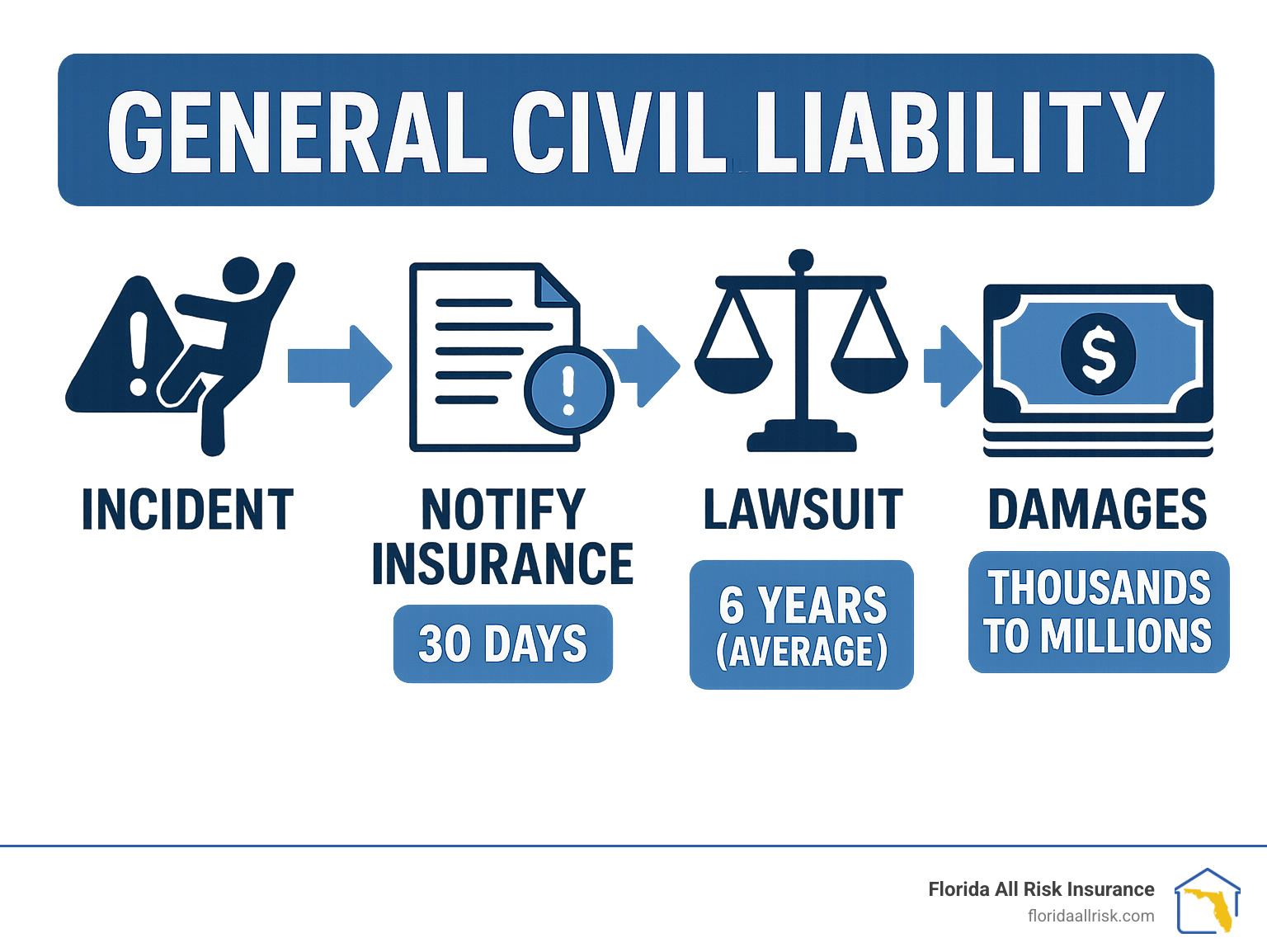
Here’s the reality: It’s a busy lunch hour at a local diner. In her haste, a waitress spills scalding tea on a customer’s lap, which could cost the owners a fortune—unless they have civil liability insurance! This scenario from our research shows how quickly everyday activities can turn into expensive lawsuits.
The average lawsuit lasts six years and can devastate your finances. With many insurers recommending liability limits of at least $1,000,000, the stakes are higher than most people think.
Whether you’re a homeowner worried about a slip-and-fall on your property, a business owner concerned about customer injuries, or someone who owns a dog that might bite a neighbor, civil liability is everywhere. In Florida’s litigious environment, understanding these risks isn’t optional – it’s essential for protecting your assets and your future.
I’m Jason Miller, a second-generation insurance professional with over 20 years of experience helping Florida residents steer general civil liability risks and insurance solutions. My background in construction engineering and decades in Florida’s volatile insurance marketplace have given me unique insights into how civil liability affects both individuals and businesses across our state.
Common general civil liability vocab:
– contractor liability coverage
– general liability errors and omissions insurance
– public liability risk
Understanding General Civil Liability
Picture this: You’re hosting a backyard barbecue when a guest trips over your garden hose and breaks their wrist. Suddenly, you’re facing a potential lawsuit for medical bills, lost wages, and pain and suffering. Welcome to general civil liability – where everyday activities can lead to serious financial consequences.
General civil liability is fundamentally different from the criminal law you see on TV. While criminal law punishes wrongdoing with jail time or fines, civil law focuses on one thing: making the injured person whole again through compensation. It’s about fixing the problem, not punishment.
Think of it as society’s way of saying, “If you break it, you buy it” – except what you “broke” might be someone’s ability to work, their sense of security, or their property.
The legal foundation of civil liability rests on several key concepts. Negligence is the big one – this happens when you fail to act with reasonable care and someone gets hurt as a result. Maybe you forgot to put up a “Wet Floor” sign at your business, or you didn’t maintain your property properly.
Tort liability covers legal wrongs that happen outside of contracts – like when your dog bites the mailman or your teenager accidentally damages a neighbor’s fence with a baseball. Contract breach is exactly what it sounds like: failing to keep your promises in a business agreement. Then there’s strict liability, which can hold you responsible even when you did nothing wrong – this often applies to defective products or inherently dangerous activities.
Here’s what makes civil cases easier to win than criminal ones: the preponderance of evidence standard. Instead of proving guilt “beyond a reasonable doubt,” the injured party only needs to show it’s more likely than not that you caused their harm. It’s like tipping the scales just slightly in their favor.
What Does “General Civil Liability” Mean?
When insurance professionals talk about general civil liability, we’re referring to your everyday legal responsibility for accidents and mishaps that affect other people. It’s the “general” part of life – not your professional services or specialized business activities, but the regular stuff that can go wrong.
Bodily injury is the most common concern. This covers physical harm to another person, from minor cuts to serious injuries requiring surgery. The costs can be staggering – a simple slip-and-fall can result in tens of thousands in medical bills, especially here in Florida where healthcare costs continue to climb.
Property damage is equally important. Whether it’s your contractor accidentally damaging a client’s expensive flooring or your delivery truck backing into someone’s garage door, property damage claims add up quickly. In Florida’s hurricane-prone environment, these situations become even more complex.
Personal injury goes beyond physical harm to include non-physical damages like defamation, false imprisonment, or invasion of privacy. Think of a business owner who wrongly accuses a customer of shoplifting – that’s a personal injury claim waiting to happen.
Finally, advertising injury covers harm caused by your marketing efforts. This might include copyright infringement in your ads, false statements about competitors, or misuse of someone’s likeness in your promotional materials.
The beauty – and challenge – of general civil liability is that it covers the unexpected moments when life goes sideways. It’s protection for the “what if” scenarios that keep business owners awake at night.
Civil vs. Criminal Liability: Key Differences
Understanding the difference between civil and criminal liability isn’t just academic – it’s crucial for protecting yourself and your assets in Florida’s legal environment.
| Aspect | Civil Liability | Criminal Liability |
|---|---|---|
| Purpose | Compensate victims | Punish wrongdoers |
| Who brings the case | Private parties | Government/State |
| Burden of proof | Preponderance of evidence | Beyond reasonable doubt |
| Consequences | Monetary damages, injunctions | Fines, imprisonment, probation |
| Standard | More likely than not | Near certainty |
| Focus | Making victim whole | Deterring future crimes |
Here’s what this means in real life: Let’s say you’re involved in a car accident. The police might investigate and decide not to file criminal charges because they can’t prove you were definitely at fault. But the other driver can still sue you in civil court for their injuries and damages. They only need to convince a jury that you were probably at fault – a much lower bar to clear.
This distinction matters enormously for Florida residents and business owners. You can find yourself paying substantial damages in civil court even when you’ve done nothing criminally wrong. The focus shifts from “Did you break the law?” to “Should you pay for the harm that occurred?”
Civil liability also means the remedies are different. Instead of facing jail time, you’re looking at monetary damages and possibly court orders to stop certain behaviors. For businesses, this might mean paying for medical bills, lost wages, property repairs, and sometimes punitive damages designed to send a message.
The bottom line? Civil liability casts a much wider net than criminal law, and the consequences – while different – can be just as life-changing for your financial future.
Types of Civil Liability & Real-World Scenarios
General civil liability takes many forms in Florida, and recognizing these different types can help protect you from financial disaster. Let me walk you through the main categories and show you how they play out in real life.

Contractual vs. Extra-Contractual (Tort) Liability
Think of liability in two main buckets: problems that arise from broken promises and problems that come from everyday accidents.
Contractual liability happens when you don’t live up to your end of a deal. Maybe you’re a contractor who misses a deadline, causing your client to lose money. Or perhaps you’re a business owner who can’t deliver the services you promised, forcing your customer to find expensive alternatives elsewhere.
Extra-contractual liability – also called tort liability – is when you accidentally harm someone you don’t even have a contract with. Picture this: a customer walks into your store, slips on your freshly mopped floor, and breaks their wrist. You never had any agreement with this person, but your duty of care to keep your premises safe means you could be liable for their medical bills.
Here’s something important to know: contractual civil liability isn’t always covered by insurance, while tort liability typically is. This is why understanding the difference matters for your wallet.
Common Claims & Who Can Be Liable
The truth is, anyone can face civil liability. It doesn’t matter if you’re running a Fortune 500 company or just trying to enjoy retirement in sunny Florida.
Individuals get hit with liability claims more often than you’d think. Dog bites alone result in 4.7 million incidents annually across the US, with the average claim costing $30,000. Then there are slip-and-fall accidents around your home, swimming pool incidents, or that fender-bender on I-275 during rush hour.
Businesses face even more exposure. Your customers can get hurt on your property, and suddenly you’re dealing with bodily injury claims. If you sell products, product defects can come back to haunt you years later. Even your employees’ actions can create liability – what they do on company time becomes your responsibility.
Here’s something that surprises many business owners: hiring subcontractors doesn’t get you off the hook. Our research shows a perfect example – a homeowner hired a subcontractor to install a fireplace, but the shoddy work led to a house fire. Since the customer didn’t know about the subcontractor arrangement, the homeowner remained liable for all the damages.

Organizations including nonprofits aren’t immune either. Vicarious liability means you can be responsible for volunteer activities, event-related injuries, or even decisions made by your directors and officers.
Damages You Might Owe
When you’re found liable, the financial hit can be devastating. The courts focus on making the injured person whole again, which can get expensive fast.
Compensatory damages cover the victim’s actual losses. This includes their medical bills – both current and future treatments. If they can’t work, you might owe lost wages and reduced earning capacity for years to come. Property damage costs pile up quickly too, especially here in Florida where a single hurricane can turn a small liability issue into a massive claim.
Don’t forget about pain and suffering damages. These cover the emotional distress and reduced quality of life that comes with serious injuries. While harder to calculate, they often represent the largest portion of a settlement.
Punitive damages are less common but can be crushing when they’re awarded. These are designed to punish particularly reckless behavior and send a message to others.
Here’s the kicker: even if you win your case, you’re still looking at substantial legal costs. The good news? General civil liability insurance typically covers these defense costs regardless of fault, which is why having proper coverage is so valuable.
With nationwide dog bite claims alone totaling $489 million annually, and serious accidents reaching hundreds of thousands or millions in damages, these scenarios aren’t as rare as you might hope. The key is being prepared before something happens.
General Civil Liability Insurance: Coverage, Limits & Risk Management
Think of general civil liability insurance as your financial bodyguard. After two decades helping Florida families and businesses steer insurance claims, I’ve witnessed how the right coverage transforms a potential disaster into a manageable situation.
At Florida All Risk Insurance, we’ve seen clients sleep peacefully knowing they’re protected, while others faced sleepless nights wondering if a lawsuit would wipe out their life savings. The difference? Understanding how this critical coverage works.
How General Civil Liability Insurance Works
General civil liability insurance functions like a protective umbrella over your daily activities. Most policies operate on an occurrence basis, which means if something happens while your policy is active, you’re covered – even if the lawsuit comes years later.
This differs from claims-made policies that only cover lawsuits filed during your policy period. For general liability, occurrence coverage is typically your best bet since accidents can take time to surface as legal claims.
Here’s what makes this coverage so valuable: your insurer handles two crucial responsibilities. First, they defend you by hiring experienced attorneys and covering all legal costs. Second, they pay damages up to your policy limits if you’re found liable.
The beauty of this arrangement? Your insurance company must defend you even when you’re not at fault. I’ve seen clients vindicated in court, but their defense costs alone would have been financially devastating without coverage.
What’s Covered – and What’s Not

Your general civil liability policy acts like a safety net for life’s unexpected moments. When a customer slips on your freshly mopped floor, or your tree branch damages a neighbor’s roof during a storm, you’re protected.
Standard coverage includes bodily injury to others, property damage you accidentally cause, and even personal injury claims like defamation. Many policies also cover advertising injury if your marketing accidentally infringes on someone’s copyright, plus medical payments for immediate treatment regardless of who’s at fault.
However, insurance can’t cover everything. Intentional acts are excluded because you can’t insure against deliberate harm – that would defeat the purpose of deterring bad behavior. Your professional services need separate coverage, employee injuries fall under workers’ compensation, and auto accidents require their own liability coverage.
Understanding these boundaries prevents unpleasant surprises. As one client learned when his contracting business faced a claim, general liability covered the customer’s slip-and-fall injury but not the design error that caused structural problems – that required professional liability coverage.
Determining the Right Limit & When to Add Umbrella Coverage
Choosing coverage limits isn’t just about premiums – it’s about protecting everything you’ve worked to build. The research consistently points to $1 million minimum coverage, though many Florida residents benefit from $2 million limits given our state’s active litigation environment.
Your net worth provides a starting point for determining adequate limits. If you own assets worth $500,000, but only carry $300,000 in coverage, you’re essentially self-insuring the difference. That’s a risky gamble when lawsuits can drag on for years.
Risk exposure varies dramatically by situation. A retiree living in a quiet neighborhood faces different liability risks than a contractor working on busy construction sites. Business owners typically need higher limits due to increased exposure from customers, vendors, and daily operations.
Umbrella coverage becomes your best friend when you need protection beyond standard policy limits. These policies typically provide $1 million to $5 million in additional coverage at surprisingly affordable rates. Think of it as buying peace of mind in bulk.
Consider umbrella protection if you have significant assets, own rental properties, have teenage drivers, or operate a business. Given that lawsuits average six years to resolve and can impact your credit and borrowing capacity throughout that period, the extra protection often pays for itself.
For business owners, our General Liability Insurance for Small Business options provide custom protection that grows with your company.
Claim Time: Your Legal Obligations & Process
When an incident happens, your first few hours can make or break your insurance claim. After handling countless claims over the years, I’ve learned that preparation and quick action protect both your coverage and your legal position.
Immediate safety comes first – get medical help if anyone’s injured, then secure the scene to prevent additional harm. Document everything with photos, witness statements, and detailed notes about what happened. Resist the urge to apologize or admit fault; sympathy is fine, but leave liability determinations to the professionals.
Notify your insurer immediately – most policies require prompt reporting, and delays can jeopardize your coverage. I’ve seen claims denied because clients waited weeks to report incidents, thinking they could handle things privately.
Your ongoing responsibilities include full cooperation with your insurer’s investigation, preserving all evidence, and avoiding any settlements or payments without prior approval. You also have a duty to mitigate damages where possible – if your burst pipe floods a neighbor’s basement, help with immediate cleanup to prevent mold damage.
Your insurance company handles the legal heavy lifting, but you remain personally responsible for amounts exceeding your policy limits. This reality underscores why adequate limits matter so much.
For comprehensive information about civil liability standards, the Civil Liability Definition resource provides valuable legal context that complements your insurance protection.
Understanding these coverage fundamentals helps you make informed decisions about protecting your assets and your future in Florida’s dynamic legal environment.
Frequently Asked Questions about General Civil Liability
Let’s tackle the most common questions we hear from Florida residents about general civil liability. These answers come from real situations we’ve helped clients steer over the years.
What is the standard of proof in civil liability cases?
Here’s something that surprises many people: civil liability cases are much easier to prove than criminal ones. In civil court, the standard is called “preponderance of evidence” or “balance of probabilities.”
This simply means the person suing you only needs to show it’s more likely than not that you caused their damages – basically, greater than a 50% chance. Think of it like a seesaw that just needs to tip slightly in their favor.
Compare this to criminal cases, where prosecutors must prove guilt “beyond a reasonable doubt” – requiring near certainty. That’s why you might avoid criminal charges for an accident but still face a civil lawsuit. The bar is simply much lower in civil court.
This lower standard is exactly why general civil liability insurance is so crucial. Even when you think you’ve done nothing wrong, a civil court might disagree based on this easier-to-meet standard.
How does general civil liability differ from professional liability insurance?
Think of these two types of coverage as protecting different aspects of your life or business. General civil liability covers your everyday operations and physical activities – the “slip, trip, and grip” exposures we all face.
Your general liability policy kicks in when a customer slips on your wet floor, when your business activities damage someone’s property, or when your product causes an injury. It’s about the physical world around you.
Professional liability, also called Errors & Omissions (E&O), protects you when your advice goes wrong or you fail to deliver promised services. This covers the mental work you do – consulting, designing, advising, or providing professional services.
Here’s a real example: An accountant needs general liability in case a client trips in their office, but they need professional liability if their tax advice costs a client money. Two different risks, two different coverages.
Many Florida businesses need both types of protection. If you provide any kind of professional service, consider our General Liability Errors and Omissions Insurance to ensure complete coverage.
What happens if I’m sued but don’t carry liability insurance?
This is where things get scary – and expensive – fast. Without liability insurance, you’re flying solo against what could be a devastating financial storm.
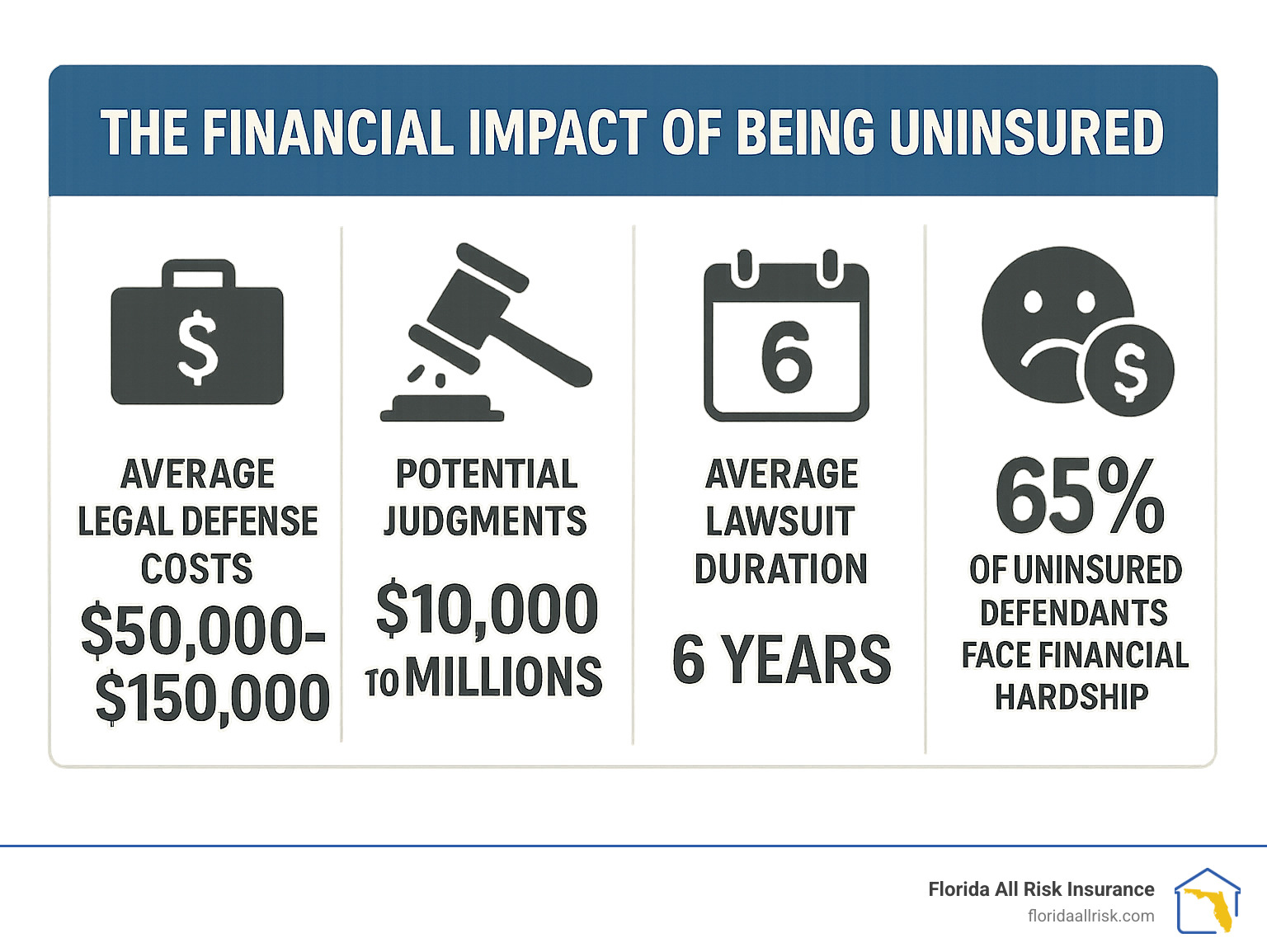
You’ll be personally responsible for every dollar of legal defense costs, which can easily reach $50,000 to $150,000 even if you win the case. If you lose, you’re on the hook for whatever damages the court awards – potentially hundreds of thousands or even millions of dollars.
The consequences can be life-changing. Courts can seize your assets including your home, vehicles, and bank accounts. They can garnish your wages, taking a percentage of every paycheck for years. Your credit score takes a hit, making it harder to get loans, mortgages, or even rent an apartment.
The average lawsuit drags on for six years. That’s six years of stress, uncertainty, and financial vulnerability. Even if you ultimately win, the legal bills alone can force you into bankruptcy.
We’ve seen Florida residents lose everything they’ve worked for because they thought they didn’t need liability coverage. Don’t let that be your story. For more detailed information about civil liability legal concepts, check out this Civil liability overview.
The bottom line? General civil liability insurance isn’t just about protecting your assets – it’s about protecting your future. The peace of mind alone is worth the relatively small cost of proper coverage.
Protecting Your Future: Why General Civil Liability Insurance Matters
Here’s something that might surprise you: general civil liability situations happen to ordinary people every single day. The friendly neighbor whose tree crashes through your fence during a storm. The small café owner whose floor gets mopped right before the lunch rush. The dog owner whose usually gentle pet gets startled and nips someone.
These aren’t dramatic Hollywood scenarios – they’re real situations that can turn your financial world upside down faster than you’d imagine.
Let’s talk numbers for a moment. With 4.7 million dog bites happening across the country each year and $489 million in related insurance claims, pet liability alone represents a massive exposure most people never consider. Add in slip-and-fall accidents, property damage, and other everyday incidents, and the picture becomes crystal clear.
The really sobering part? The average lawsuit drags on for six years. That’s six years of stress, uncertainty, and potential financial strain hanging over your head. During that time, your assets remain at risk, your credit can be affected, and your peace of mind disappears.
This is exactly why many insurance professionals recommend minimum coverage of $1,000,000 for general liability protection. It’s not because they’re trying to sell you more insurance – it’s because they’ve seen what happens when people don’t have adequate coverage.
Here in Florida, we face some unique challenges that make general civil liability protection even more critical. Our state’s active legal environment means lawsuits are filed frequently. Our tourism-heavy economy brings millions of visitors who might get injured on your property or in your business. Our unpredictable weather creates situations where accidents happen more often.
Whether you’re running a small business in downtown St. Petersburg or you’re a homeowner anywhere across our beautiful state, these risks are real and they’re everywhere.
At Florida All Risk Insurance, we’ve built our reputation on understanding exactly what Florida residents face. We know that cookie-cutter insurance solutions don’t work when every person’s situation is different. That’s why our approach to General Civil Liability Insurance starts with really listening to your specific needs and concerns.
As an independent agency, we’re not tied to just one insurance company. This means we can shop around with multiple carriers to find you the best coverage at the most competitive rates. We’re not trying to force you into a one-size-fits-all solution – we’re here to build protection that actually makes sense for your life.
The research we’ve seen consistently shows that proper general civil liability insurance does two important things: it protects your finances when accidents happen, and it gives you genuine peace of mind knowing you’re covered. That peace of mind is priceless.
Don’t wait until something happens to think about protection. The statistics tell us it’s not really a question of if you’ll face some kind of liability situation – it’s more a question of when. The good news is that with the right coverage in place, you can handle whatever comes your way.
Contact Florida All Risk Insurance today, and let’s have a conversation about your specific situation. We’ll help you understand your exposures and make sure you have the coverage to protect everything you’ve worked so hard to build.