

Understanding the Protection Your Business Needs
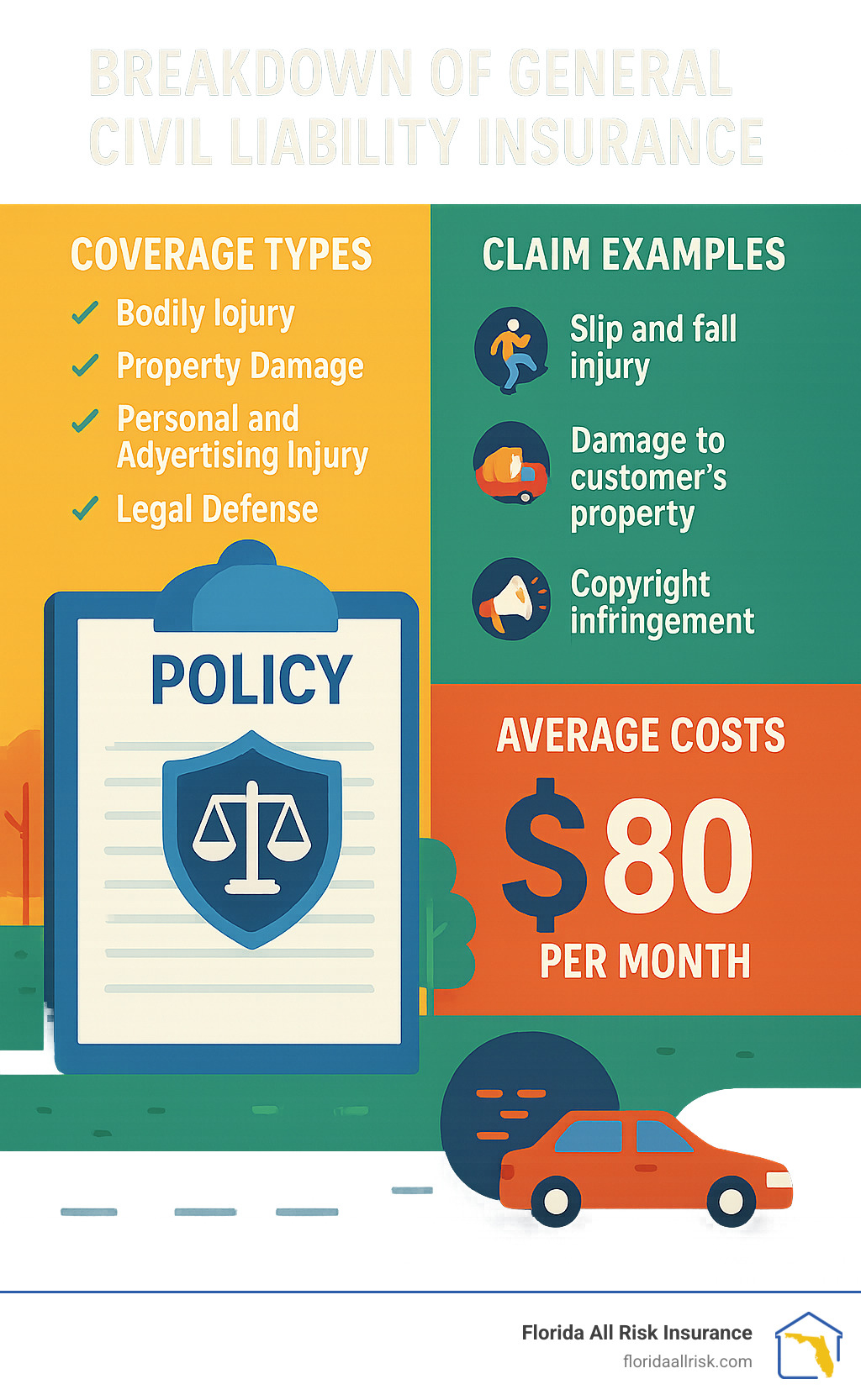
General civil liability insurance is a fundamental type of business insurance that protects your company against third-party claims for bodily injury, property damage, and advertising injury.
If you’re looking for quick answers about general civil liability insurance:
| What It Is | What It Covers | Who Needs It | Average Cost |
|---|---|---|---|
| Insurance that protects businesses from third-party claims | – Bodily injury to customers/visitors – Property damage to others’ belongings – Personal/advertising injury – Legal defense costs |
– All businesses with physical locations – Contractors – Service providers – Retailers – Manufacturers |
$59/month median $80/month average |
When running a business, you face numerous risks every day. A customer could slip and fall on your premises, your product could damage someone’s property, or your marketing materials might accidentally infringe on someone’s copyright. Without proper protection, these incidents could lead to devastating financial consequences.
Consider this: 4 out of 10 small businesses will likely experience a liability claim in the next 10 years. The average slip-and-fall claim costs approximately $35,000, but if it leads to a lawsuit, that figure can balloon to more than $75,000 in defense and settlement costs.
General civil liability insurance serves as your financial safety net, covering legal fees, medical costs, and settlements or judgments up to your policy limits. It’s often called the “first line of defense” for businesses because it addresses the most common third-party risks you’ll encounter.
I’m Jason Miller, a second-generation insurance professional with over 20 years of experience helping Florida businesses find the right general civil liability insurance to protect their operations and assets. My team and I at Florida All Risk Insurance understand the unique challenges Florida businesses face and can help you steer this essential coverage.
Understanding General Civil Liability Insurance
Think of general civil liability insurance as your business’s safety net. It has deep roots in the age-old legal principle that businesses should avoid harming others. While this concept has existed for centuries, it only evolved into the standardized policies we know today in the early 1900s. For a broader historical overview, see the liability insurance entry on Wikipedia.
At its heart, this insurance works on a third-party basis—it protects you when outsiders (like customers, visitors, or vendors) claim your business operations caused them harm. This differs from first-party insurance such as property coverage, which protects things you own.
One of the most valuable features of general civil liability insurance is the “duty to defend” provision. This means your insurance company must provide legal representation if someone sues you for a covered claim—even if the lawsuit turns out to be groundless.
Most policies follow a standard structure with four main coverage areas:
- Warranty A: Covers bodily injury and property damage liability
- Warranty B: Handles personal and advertising injury
- Warranty C: Takes care of medical payments
- Warranty D: Protects against tenant’s liability (damage to places you rent)
Your policy will define two critical limit types:
* Your per-occurrence limit caps how much the insurer will pay for any single incident
* Your general aggregate limit sets the maximum amount paid during your entire policy period
What Is General Civil Liability Insurance?
General civil liability insurance serves as a comprehensive shield that protects your business from financial losses when you’re legally responsible for harming a third party—whether through bodily injury, property damage, or personal and advertising injury.
This coverage blankets several key areas:
When a customer slips on your wet floor and breaks their wrist, bodily injury coverage steps in. This covers physical harm to non-employees, including their medical bills, lost wages, and pain and suffering.
If your delivery driver accidentally backs into a client’s ornamental fence, property damage coverage comes to the rescue. This covers physical damage to someone else’s tangible property, including their inability to use that property while it’s being repaired.
When your marketing team unintentionally uses a competitor’s slogan in your new ad campaign, personal and advertising injury coverage provides protection. This covers non-physical injuries like libel, slander, defamation, copyright infringement in your advertisements, and invasion of privacy.
Perhaps most importantly, general civil liability insurance typically covers legal defense costs, which can quickly spiral into tens of thousands of dollars—even if you’re ultimately found not liable.
Who Needs General Civil Liability Insurance?
Almost every business needs this protection, but some face higher risks than others:
Start-ups and new businesses need protection from day one. Don’t make the mistake of thinking your small size protects you from lawsuits.
Contractors and construction professionals face significant liability exposures due to the physical nature of their work and frequent presence on clients’ properties.
Retailers and storefront businesses with physical locations where customers visit face slip-and-fall risks and other premises liability exposures.
Professional landlords and property managers need protection from tenant and visitor claims.
Event organizers and venue operators face unique challenges from large crowds and temporary installations.
Manufacturers and product sellers need protection against claims that their products caused injury or property damage.
Service providers who work at client locations need protection against claims of damage or injury.
Even home-based businesses should consider general civil liability insurance, as homeowners policies typically exclude business activities.
General Civil Liability Insurance Coverage & Exclusions
When does general civil liability insurance actually kick in? Understanding the triggers helps you know when you’re protected:
Most policies are “occurrence-based,” meaning they cover incidents that happen during your policy period—even if someone files a claim years later. Less common are “claims-made” policies, which only cover claims reported while your policy is active.
Your general civil liability insurance typically protects you in four main areas:
Premises liability—the classic “someone gets hurt at your business” scenario. Whether a customer trips over a loose carpet in your shop or your employee accidentally damages a client’s antique vase while working at their home.
Products-completed operations coverage—protection that follows your products or services after they leave your hands. Sold a toaster that starts a kitchen fire? Installed flooring that buckles and causes someone to trip? This coverage steps in.
For minor injuries, medical payments coverage pays reasonable medical expenses for someone hurt on your property—regardless of who’s at fault. This often resolves small incidents before they escalate to lawsuits.
Contractual liability covers you when you’ve signed certain agreements to take on someone else’s liability. This happens more often than you might think, especially in leases and vendor contracts.
Want a deeper understanding of what’s covered? Visit our detailed guide on What Does General Liability Insurance Cover?
But it’s equally important to know what’s not covered. Your general civil liability insurance won’t help with:
- Intentional harm caused by you or your employees
- Employee injuries belong to workers’ compensation territory
- Pollution issues typically require specialized environmental coverage
- Professional mistakes like giving bad advice need professional liability/E&O insurance
- Cyber attacks affecting your business or customers’ data
- Auto accidents fall under commercial auto insurance
- Your own property damage is covered by commercial property insurance
| Covered Events | Excluded Events |
|---|---|
| Customer slip-and-fall | Employee workplace injury |
| Fire damage to client property | Damage to your own building |
| Copyright infringement in ads | Professional negligence |
| Product causing injury | Intentional harm |
| Medical expenses for visitor | Auto accident during deliveries |
Common Real-World Claims
The infamous slip-and-fall tops the list of common claims. Picture this: a customer walks into your Florida boutique during a summer downpour, slips on the wet tile, and fractures their wrist. Your policy covers their medical bills, lost income while they recover, and your legal defense if they sue.
Recent research from the National Floor Safety Institute shows these accidents aren’t rare—they lead to over 1 million emergency room visits yearly and cost businesses billions in claims.
Then there’s the product nightmare scenario. A customer buys a lamp from your store, and it causes an electrical fire in their home. Your general civil liability insurance helps cover the property damage and any injuries resulting from the incident.
Even your marketing can create liability. Say your social media manager posts something that disparages a competitor. They sue for libel or slander, and your policy’s personal and advertising injury coverage comes to your rescue.

Difference Between General Civil Liability Insurance and Professional Liability
Many Florida business owners ask us about the difference between general civil liability insurance and professional liability (also called errors and omissions or E&O). Though both protect against third-party claims, they cover very different risks:
General civil liability insurance protects against physical mishaps—bodily injuries when someone falls at your store, property damage when your equipment breaks a client’s window, or advertising injuries when your marketing accidentally infringes on someone’s copyright.
Professional liability insurance protects against mental mistakes—the advice you gave that cost someone money, the service you performed incorrectly, or the professional duty you failed to fulfill.
Here’s a real-world example: If you’re a financial advisor, general liability covers a client who trips over your briefcase during a meeting. But professional liability covers you when that client loses money following your investment advice and decides to sue.
How Much Coverage Do You Need & What Does It Cost?
Figuring out how much general civil liability insurance your business needs isn’t a one-size-fits-all equation. It’s more like tailoring a suit – it needs to fit your specific business perfectly.
When I sit down with clients to discuss coverage needs, we look at several key factors together:
Your industry plays a huge role in determining risk exposure. Insurance companies assign different class codes to businesses based on risk levels – and yes, a roofing contractor faces substantially higher liability risks than someone designing websites from their home office.
The size of your operation matters too. As your business grows – with more employees, higher revenue, and expanded operations – your liability exposure naturally increases.
Most small businesses begin with what I call the “standard starting package”:
* $1 million per-occurrence limit (covering any single incident)
* $2 million aggregate limit (your total coverage for the policy year)

As for cost, the national median for general civil liability insurance in 2023 ran about $59 monthly, with the average at $80 per month. However, Florida businesses – especially those in coastal areas like Tampa, Miami, or St. Petersburg – often face higher premiums due to increased weather-related risks and Florida’s unique litigation environment.
Your premium will be influenced by:
* Where your business operates
* Your claims history
* Your chosen coverage limits and deductibles
* How long you’ve been in business
* Safety measures and risk management practices
You can potentially lower your premium by choosing a higher deductible – the amount you pay out-of-pocket before insurance kicks in.
For more detailed pricing information specific to your industry and situation, check out our comprehensive guide on General Liability Insurance Cost.
Recommended Limits for Small & Mid-Sized Businesses
For small business clients (those under $1 million in annual revenue), I typically recommend:
General civil liability insurance with $1 million per-occurrence and $2 million aggregate limits provides solid foundation-level protection. This should include $1 million for products-completed operations, $1 million for personal and advertising injury, $5,000-$10,000 for medical expenses, and $100,000-$300,000 for damage to rented premises.
Mid-sized businesses with revenue between $1-10 million should consider bumping up to $1-2 million per-occurrence with $2-4 million aggregate limits, plus adding an umbrella policy of $1-5 million for additional protection.
In certain situations, you’ll need to consider even higher limits:
* When contracts specifically require it
* If you work in higher-risk industries like construction or manufacturing
* When you have substantial personal or business assets that need protection
Is General Civil Liability Insurance Required by Law?
Unlike auto insurance, general civil liability insurance isn’t universally mandated by Florida state law. However, in practice, many businesses find it effectively required through other channels:
State licensing requirements often mandate coverage. For example, many Florida contractors must show proof of insurance to obtain and maintain their professional licenses.
Commercial landlords almost universally require tenants to maintain liability insurance – and typically at specified minimum limits. Most leases also require naming the property owner as an additional insured on your policy.
Client and vendor contracts frequently contain insurance requirements. This is especially true with government contracts, which almost always specify minimum coverage levels.
Even when not technically required, operating without general civil liability insurance is like driving without a seatbelt – technically possible, but unnecessarily risky. One substantial claim could threaten your business’s financial survival.
Claims Process, Financial Protection & Risk Management
When an incident occurs that might lead to a claim, the general civil liability insurance claims process typically follows these steps:
-
Notice of loss: You notify your insurer as soon as possible after an incident occurs.
-
Insurer investigation: The insurance company assigns an adjuster who investigates the claim, gathering facts and documentation.
-
Defense counsel appointment: If a lawsuit is filed, the insurer appoints defense counsel to represent you.
-
Settlement or judgment: The claim may be resolved through settlement negotiations or proceed to trial.
-
Payment: If liability is established, the insurer pays the claim up to your policy limits.

This process provides crucial financial protection by:
* Covering legal defense costs, which can be substantial even in groundless suits
* Paying settlements or judgments up to policy limits
* Providing claims expertise and legal representation
* Protecting your business assets from seizure to satisfy judgments
Real-Life Scenarios Where General Civil Liability Insurance Applied
Restaurant Food Poisoning Claim:
A family dined at a local restaurant and later became ill with food poisoning. They sued the restaurant for $50,000 in medical expenses, lost wages, and pain and suffering. The restaurant’s general civil liability insurance covered their legal defense and the eventual $30,000 settlement.
Construction Site Explosion:
A contractor was working on a gas line when an explosion occurred, causing damage to neighboring properties. Multiple property owners filed claims totaling over $200,000. The contractor’s general civil liability insurance covered the property damage claims and associated legal costs.
Marketing Copyright Lawsuit:
A small business used a photograph in their marketing materials without proper permission. The photographer sued for copyright infringement, seeking $25,000 in damages. The business’s personal and advertising injury coverage under their general civil liability insurance paid for their defense and the eventual $15,000 settlement.
Proactive Steps to Reduce Claims
While general civil liability insurance provides essential protection, implementing risk management strategies can help prevent claims in the first place:
-
Regular maintenance and inspection: Routinely check your premises for hazards like wet floors, loose carpeting, or inadequate lighting.
-
Safety training: Train employees on proper safety procedures and emergency protocols.
-
Incident logs: Document all incidents, even minor ones, with photographs and witness statements.
-
Vendor agreements: Use contracts with clear indemnification clauses when working with vendors and subcontractors.
-
Warning signage: Post appropriate warning signs for known hazards.
For contractors who face unique liability challenges, we offer specialized guidance on General Liability Insurance for Contractors.
Choosing the Right Policy & Complementary Coverages
Shopping for general civil liability insurance can feel overwhelming, but finding the right policy doesn’t have to be complicated. One of your first decisions will be whether to work with an independent broker (like us at Florida All Risk Insurance) or purchase directly from an insurance company.
Working with an independent broker gives you a significant advantage—we can shop multiple carriers to find coverage that perfectly fits your business needs and budget. We’re not tied to selling policies from just one company, which means more options and often better prices for you.
When evaluating policies, pay attention to these important elements:

Policy endorsements are critical modifications that can strengthen your coverage for specific risks. Some of the most valuable endorsements include additional insured status (which extends coverage to clients or partners), waiver of subrogation (preventing your insurer from going after other parties), and primary and non-contributory wording (making your policy respond first before other available coverage).
Most clients and landlords will request a certificate of insurance—a simple document proving you have coverage. Make sure your insurer can provide these certificates quickly when needed, as delays could hold up projects or contracts.
Don’t overlook the insurance company’s reputation for claims handling. The true test of any insurance policy comes when you need to file a claim. Read reviews, ask for references, and research the company’s track record for fair and prompt claims resolution.
Small business owners often have unique insurance needs. We’ve created a detailed resource on General Liability Insurance for Small Business to help you steer those specific challenges.
Complementary Liability Coverages List
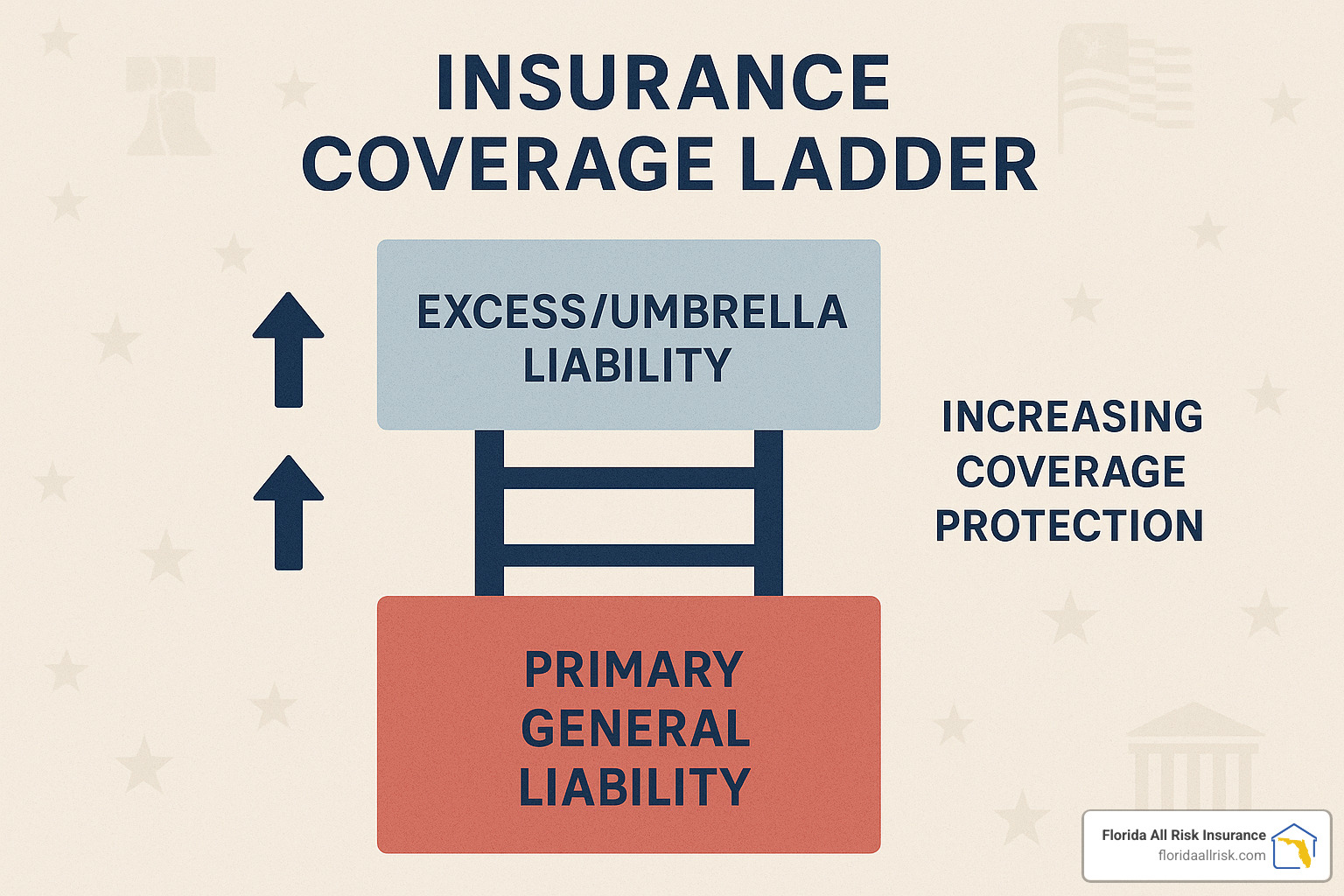
While general civil liability insurance forms the foundation of your business protection plan, it’s rarely enough on its own. Think of it as the first layer of your safety net—important, but potentially incomplete.
Most businesses benefit from additional coverage types that address specific risks not covered by general liability:
-
Umbrella/excess liability insurance provides extra protection beyond your primary policy limits—essential if you face a catastrophic claim that exceeds your base coverage.
-
If your business provides professional advice or services, you’ll need professional liability insurance (also called errors and omissions). This covers claims alleging mistakes, negligence, or inadequate work that caused financial harm to clients.
-
For businesses with employees, employment practices liability insurance (EPLI) protects against claims of wrongful termination, discrimination, harassment, and other workplace issues.
-
Do you use vehicles for business? Your personal auto policy likely won’t cover business use, making commercial auto liability insurance essential.
-
As cyber threats grow, cyber liability insurance has become critical for businesses of all sizes that handle sensitive data.
For more information about comprehensive business protection, check out our detailed guide to Commercial General Liability Insurance.
Frequently Asked Questions about General Civil Liability Insurance
What does the claims process look like from start to finish?
When the unexpected happens, knowing how your general civil liability insurance claim will unfold can provide much-needed peace of mind.
It all begins when you report the incident to your insurer—and I always recommend doing this promptly, even if no formal claim has been made yet. Those first 24-48 hours are crucial for preserving evidence and documenting what happened. Take photos, collect witness contact information, and write down your recollection of events while everything is fresh.
Your insurance company will then assign a claims adjuster who becomes your main point of contact. This professional will conduct a thorough investigation, which might include visiting your business, interviewing witnesses, and reviewing documentation.
Based on their findings, your insurer makes a coverage determination. If your policy covers the incident, they’ll proceed with handling the claim. Should a lawsuit be filed, your insurer will appoint an attorney to defend you—one of the most valuable benefits of your general civil liability insurance.
Many claims never see the inside of a courtroom because your insurer will often attempt to negotiate a settlement with the injured party. These negotiations can resolve matters more quickly and with less expense than litigation.
How can I lower my premiums without sacrificing coverage?
Consider adjusting your deductible—the amount you’ll pay out-of-pocket before insurance kicks in. Raising this figure typically lowers your premium, though you’ll need to ensure you have funds available should a claim occur.
Bundling policies often yields significant savings. When you purchase multiple coverages from the same insurer (like combining general liability with property insurance in a Business Owner’s Policy), you’ll usually qualify for multi-policy discounts.
Your safety practices matter too. Insurers love businesses that take risk management seriously—documented safety protocols, regular employee training, and incident prevention measures can translate directly into premium savings.
Payment structure is another opportunity for savings. Annual payments nearly always cost less than monthly installments—sometimes by as much as 10%.
Make sure you’re properly classified. Insurance rates vary dramatically by industry class codes, and being incorrectly categorized can lead to unnecessarily high premiums.
Will a policy protect my personal assets if I operate as an LLC?
Many business owners form LLCs believing their personal assets are completely shielded from business liabilities—but the protection isn’t as absolute as many think. Your general civil liability insurance provides crucial additional protection that works alongside your business structure.
While an LLC does create a legal separation between your business and personal finances, this “corporate veil” can be pierced under certain circumstances. If you commingle personal and business funds, fail to follow corporate formalities, or undercapitalize your business, courts may disregard the LLC structure and hold you personally responsible.
Personal guarantees represent another vulnerability. If you’ve signed loan documents or leases with personal guarantees (as many small business owners do), those obligations bypass your LLC protection entirely.
Direct negligence is particularly important to understand. If you personally commit a negligent act—even while conducting business—you may still be held individually liable. Your LLC structure doesn’t shield you from your own actions.
The strongest protection comes from combining a properly maintained business structure with appropriate insurance coverage. Your LLC provides the first line of defense, while your insurance ensures financial resources are available to address claims without endangering business or personal assets.
Conclusion
General civil liability insurance is not just another business expense—it’s an essential investment in your company’s future. Without it, a single accident or lawsuit could threaten everything you’ve worked to build.
The financial protection this coverage provides extends beyond just paying claims. It gives you peace of mind knowing you can focus on growing your business rather than worrying about potential liability disasters lurking around every corner.
At Florida All Risk Insurance, we understand the unique challenges Florida businesses face, from hurricane-related risks to the state’s complex legal environment. As an independent agency based in St. Petersburg, we offer access to a wide range of carriers, allowing us to find the right general civil liability insurance solution for your specific needs.
Whether you’re a contractor working across Tampa Bay, a retailer with multiple locations throughout Florida, or a professional service provider in St. Petersburg, we can help you steer the complexities of business liability protection.
Don’t wait until after an incident occurs to find you need better protection. Contact Florida All Risk Insurance today to review your general civil liability insurance needs and ensure your business has the comprehensive coverage it deserves.
For more information about our comprehensive general liability solutions, visit our General Liability coverage page.
In today’s litigious environment, it’s not a question of if your business will face a liability claim, but when. Make sure you’re prepared with the right general civil liability insurance in place.

