

Understanding General Aggregate Insurance Coverage: The Foundation of Your Protection
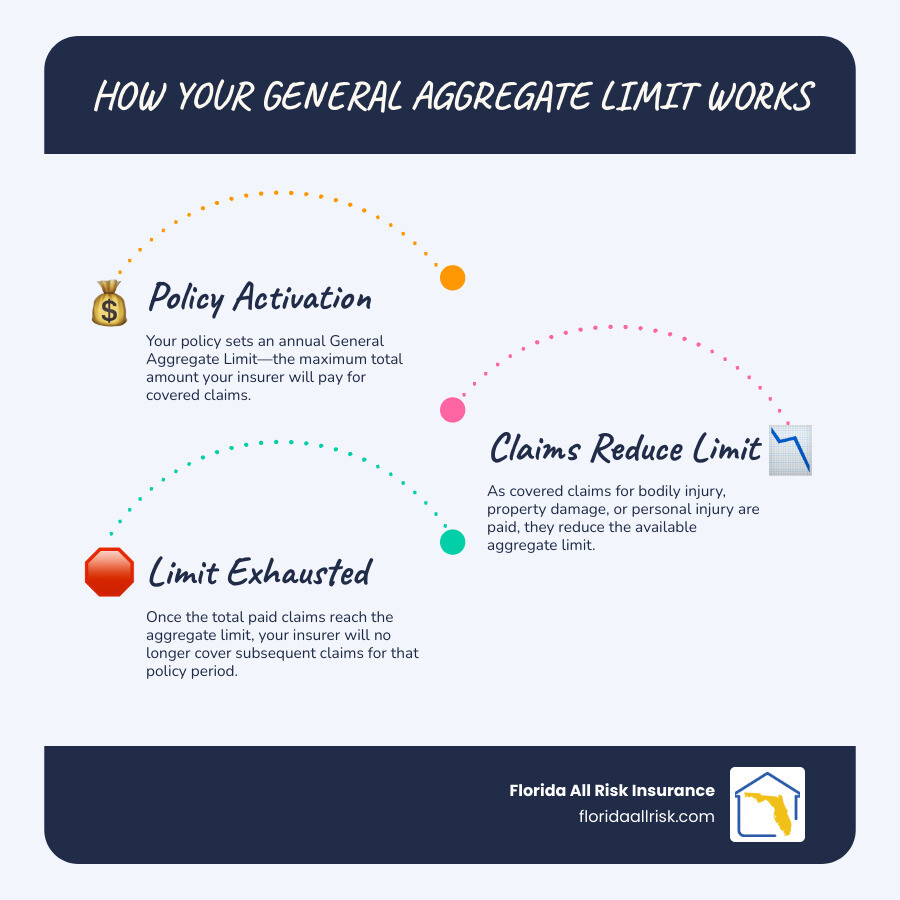
General aggregate insurance coverage is the maximum amount your insurer will pay for all covered claims during a single policy period, most commonly one year. Think of it as a bucket for the year: each covered claim involving bodily injury, property damage, or personal and advertising injury draws from the bucket. When the bucket is empty, coverage for those categories pauses until the policy renews. This is different from the per-occurrence limit, which caps how much your insurer will pay for any one incident. Both limits work in tandem to define the boundaries of your financial protection.
Understanding where your aggregate sits at any point in time matters for financial stability. For example, if your policy has a $2 million general aggregate limit and you have $1.5 million in paid claims midyear, there is only $500,000 left for additional covered claims. If a new claim costs $750,000, the policy typically pays up to the remaining $500,000 and your business is responsible for the rest ($250,000), subject to policy terms and deductibles.
This concept is particularly important for Florida businesses that face a mix of high foot traffic, seasonal surges, and severe weather. A St. Petersburg restaurant can experience several slip-and-fall claims in a busy season. A Tampa-area contractor may face multiple property damage allegations across jobs. Each payment reduces the remaining aggregate. Monitoring your aggregate helps you plan for risk, anticipate potential out-of-pocket costs, and make timely decisions about endorsements or excess coverage.
Two more nuances help round out the picture:
- The general aggregate typically applies to the sum of bodily injury, property damage, and personal and advertising injury during the policy period, subject to exclusions and sub-limits.
- Products-completed operations usually has its own separate aggregate limit, so losses arising after a job is finished do not reduce the general aggregate for your ongoing operations (subject to your specific policy form and endorsements).
Below is a quick guide to related topics that build on the aggregate concept:
What is a General Aggregate Limit in Insurance?
The general aggregate limit is the total amount your insurer will pay for all covered claims during one policy year for designated categories, typically bodily injury, property damage, and personal and advertising injury. Each paid claim reduces this total, acting like a drawdown on a bank account. Once the aggregate is exhausted, your policy will no longer fund additional covered claims within those categories until renewal, unless you have excess or umbrella coverage that applies.
Why Insurers Use an Aggregate Limit
- Financial stability: Aggregate caps help insurers plan for the maximum amount they might pay across many claims in a year, supporting solvency and predictable pricing.
- Premium fairness: By limiting exposure, carriers can price policies more competitively. Without aggregate limits, premiums would need to be much higher to account for unlimited frequency.
- Risk discipline: Knowing there is a ceiling encourages businesses to prevent incidents, implement safety protocols, and manage claims proactively.
How the Aggregate Works in Practice
Assume a $2 million general aggregate:
- March: A customer injury leads to a $75,000 settlement. Remaining aggregate: $1,925,000.
- July: You accidentally damage a client’s property; $200,000 is paid. Remaining aggregate: $1,725,000.
- October: A personal and advertising injury claim settles for $150,000. Remaining aggregate: $1,575,000.
If a later claim costs $900,000, the policy can only pay up to the remaining $1,575,000 (if the per-occurrence limit also permits). If that remaining amount were smaller than the claim value, you’d be responsible for the difference.
Products-Completed Operations vs. General Aggregate
In standard Commercial General Liability (CGL) forms, the products-completed operations hazard has its own aggregate limit, separate from the general aggregate for ongoing operations. This separation prevents claims from finished work (e.g., a defect found months after a project ends) from depleting the coverage available for day-to-day operations.
Defense Costs: Inside or Outside the Limit?
Under many ISO-based CGL policies, defense costs (supplementary payments) are paid in addition to the policy limits. Some nonstandard or manuscripted policies, however, use defense-within-limits, meaning legal expenses erode the aggregate. Always review your declarations, endorsements, and policy form to confirm how your defense costs are handled.

The Core Components: Occurrence Limits vs. Aggregate Limits
Understanding the interplay between the per-occurrence limit and the general aggregate limit is essential. They work together to shape your coverage but control it in different ways.
Occurrence Limit vs. General Aggregate Limit
- Per-occurrence limit: The maximum your insurer pays for a single covered incident.
- General aggregate limit: The maximum your insurer pays for all covered incidents combined during the policy year for specified coverage parts.
Example with a $1 million per-occurrence and a $2 million general aggregate:
- Incident 1: A customer injury results in a $1.5 million judgment. The insurer pays $1 million (capped by the per-occurrence limit). The remaining $500,000 is your responsibility unless other coverage applies. That $1 million payment reduces the general aggregate to $1 million for the rest of the policy year.
- Incident 2: A later incident costs $600,000. The insurer can pay this amount (it is within the per-occurrence limit), reducing the general aggregate to $400,000 for the remainder of the term.
The per-occurrence limit is a single-claim cap. The general aggregate limit is your cumulative cap. For a helpful primer on aggregate limits, see this overview of aggregate limits in insurance. For broader context on liability insurance fundamentals, the Insurance Information Institute’s resource on commercial liability is also useful: Commercial liability insurance explained.
How Aggregate Limits Interact with Sub-Limits
Many CGL policies include specific sub-limits that are part of the general aggregate:
- Personal and Advertising Injury: Applies to libel, slander, or certain IP claims. Payments reduce the general aggregate.
- Damage to Premises Rented to You: Often a smaller limit (e.g., $100,000) for damage such as fire to rented space; payments reduce the general aggregate.
- Medical Payments: Typically a modest per-person limit intended to handle minor injuries quickly; payments reduce the general aggregate.
Sub-limits help structure the coverage for diverse risks, but they still draw down your aggregate. Track these to avoid surprises late in the policy period.
Why Understanding Your General Aggregate Insurance Coverage is Crucial
Your general aggregate limit acts as a financial guardrail for your business. It is not uncommon for a series of modest incidents to erode the aggregate faster than expected, especially in high-traffic environments or in years with unusual events. In Florida’s uniquely litigious and weather-exposed context, this risk is magnified. The combination of a dense population, high tourism rates, and the annual threat of hurricanes creates a perfect storm for liability claims.
Consider these dynamics:
- Frequency risk: Multiple small injuries, minor property damage incidents, or advertising claims can steadily chip away at your aggregate.
- Clustered events: A severe storm or a single busy season could correlate with more incidents.
- Legal environment: Defense costs, settlements, and judgments vary widely; even relatively small cases can be expensive to resolve.
What Happens if the General Aggregate is Exhausted?
When the aggregate is exhausted for the covered categories:
- Your insurer stops paying additional covered claims for those categories until renewal, subject to the policy’s terms.
- You are responsible for subsequent defense and indemnity costs out-of-pocket unless other coverage applies (e.g., umbrella).
- If the policy provides defense outside the limit and the aggregate is fully used for indemnity, the duty to defend may still cease if no coverage remains to respond to the claim. Policy wording controls this interaction—review your form and endorsements carefully.
Which Policies Often Use Aggregate Limits?
- Commercial General Liability (CGL): The foundational liability policy for most businesses, with general and products-completed operations aggregate limits.
- Professional Liability (E&O): Typically includes an aggregate limit for negligence or error claims.
- Directors & Officers (D&O): Uses aggregate limits for management liability claims.
- Employment Practices Liability (EPLI): Uses aggregate limits for allegations such as discrimination, harassment, or wrongful termination.
Policies That Typically Do Not Have an Annual Aggregate Limit
- Workers’ Compensation: State-mandated benefits do not have an annual aggregate. Benefits are statutory and intended to be consistently available.
- Commercial Auto Liability: Usually no annual aggregate for liability; coverage is generally limited per accident.
This mix of structures underscores why it’s essential to know your policy’s aggregate mechanics and where it does—and does not—apply.
Advanced Concepts: Tailoring and Enhancing Your Coverage
Standard general aggregate limits may be fine for some businesses, but others face heightened exposures or contractual requirements that call for a more custom approach.
Per-Project Aggregate
Contractors frequently encounter the per-project aggregate endorsement. Instead of a single aggregate across all work, a separate general aggregate is applied to each project. This structure is valuable because:
- Contract compliance: Project owners often require it, ensuring one project’s losses do not impair another’s coverage.
- Risk isolation: A significant loss on Project A does not drain the aggregate available for Project B.
If you work on multiple sites simultaneously, a per-project aggregate helps preserve protection across your portfolio of work. Consider it alongside other construction-oriented endorsements when exploring General Liability Insurance for Contractors.
Per-Location Aggregate
Businesses with multiple premises (such as a franchise with several storefronts) may use a per-location aggregate endorsement. Like per-project, it allocates a separate aggregate to each location. If one location has an unusual claim frequency, other locations remain protected by their own aggregates.
Umbrella and Excess Liability Policies
If you need more headroom above your CGL (and other primary policies):
- Commercial Umbrella Policy: Sits above your underlying policies (e.g., CGL, commercial auto). It provides additional limits once underlying limits are exhausted and can sometimes broaden coverage subject to terms.
- Excess Liability Policy: Typically “follow form,” meaning it mirrors the terms of the underlying policy and simply adds more limit without broadening coverage.
A layered approach can be cost-effective: rather than increasing primary limits dramatically, you can maintain appropriate primary limits and add umbrella/excess capacity. The right structure depends on your industry, size, contracts, and risk tolerance.
When to Consider Higher or Custom Aggregates
- Contractual obligations: Owners, lenders, or clients might specify per-project or higher aggregate limits.
- Exposure growth: Expanding operations, larger crowds, or new product lines can increase frequency or severity potential.
- Claims history trends: A pattern of frequent small claims can signal the need for more capacity.
- Catastrophe sensitivity: Operations in severe-weather regions or with seasonal surges might benefit from additional buffer.
Determining and Managing Your Aggregate Limits
Selecting an appropriate general aggregate limit is a balancing act between meaningful protection and cost. A thoughtful, data-informed approach will help you avoid both underinsurance and unnecessary premium spend.
Factors to Consider When Choosing a General Aggregate
- Risk profile: Public-facing businesses (retail, hospitality) often need higher aggregates than low-traffic, professional settings.
- Industry specifics: Construction and manufacturing typically present more bodily injury or property damage exposure than consulting.
- Revenue and scale: Larger organizations face larger potential claims and are more visible targets.
- Contractual requirements: Many contracts require specific per-occurrence and aggregate thresholds, sometimes including per-project or per-location aggregates.
- Claims history: Past frequency and severity can inform how quickly your aggregate might be depleted in a typical year.
- Geography: Operating in Florida introduces hurricane seasons, heavy tourism periods, and other factors that can influence both frequency and severity.
- Organizational structure: Multiple named insureds or locations may call for endorsements to prevent one entity or location from using a disproportionate share of capacity.
Practical Steps to Right-Size Your Limits
- Benchmarking: Compare peers in your industry and region to get a baseline for limits and umbrella/excess strategies.
- Stress testing: Imagine a year with two moderate claims and one large claim; estimate how much aggregate you would consume.
- Contract review: Map each key contract’s insurance requirements, then identify the highest requested limit as your starting point.
- Claims prevention: Invest in safety training, maintenance logs, vendor/contractor vetting, and advertising review (to reduce personal and advertising injury) to lower claim frequency.
- Coordination with other coverages: Consider how professional liability, cyber, D&O, or EPLI aggregates interact with your overall risk posture; a holistic view helps you avoid blind spots.
How Aggregate Limits Affect Premiums
Higher aggregates mean the carrier is accepting more potential loss in a given year, which generally increases premium. That increase is influenced by your underwriting profile: a lower-risk business might secure more aggregate for modest additional premium, while a higher-risk operation could face steeper costs. If you need substantial additional capacity, explore adding an umbrella or excess layer rather than pushing primary limits far beyond standard market tiers.
Keep Tabs on Your Aggregate During the Policy Term
- Track erosion: If your broker or insurer provides claims updates, monitor the remaining aggregate after each paid claim.
- Midterm adjustments: If aggregate erosion is heavier than expected, ask about adding an umbrella or excess layer midterm, or increasing primary limits on renewal.
- Endorsement review: Confirm whether any endorsements (such as defense-within-limits or aggregates shared across entities) change how fast your aggregate might erode.
Frequently Asked Questions about General Aggregate Limits
What’s the difference between a general aggregate and a per-occurrence limit?
The per-occurrence limit caps what the insurer pays for a single covered incident. The general aggregate caps what the insurer pays for all covered incidents combined during the policy period for specified coverage parts. Both caps must be considered simultaneously when evaluating how much coverage remains.
What happens if I use up my general aggregate before renewal?
Coverage for those categories stops for the rest of the policy term, and you must pay subsequent covered losses out-of-pocket unless excess or umbrella coverage applies. Your options are typically to add umbrella/excess midterm (if available) or adjust limits at renewal. Policy wording governs any exceptions.
Are defense costs included in the general aggregate limit?
Under many ISO-based CGL forms, defense costs are paid in addition to limits (outside the aggregate). Some policies, however, are structured with defense costs within limits, which can erode your aggregate as legal expenses accrue. Always confirm with your specific policy language and endorsements.
Do products-completed operations claims count against the general aggregate?
In standard CGL forms, products-completed operations has a separate aggregate limit. Claims falling under that hazard reduce that separate aggregate rather than the general aggregate. Confirm the definitions and any endorsements that may modify how hazards are allocated.
How does an umbrella policy interact with my aggregate?
Umbrellas provide additional limits above underlying policies. After your underlying per-occurrence or aggregate is exhausted (depending on the claim), the umbrella can step in, subject to attachment points and conditions. Some umbrellas also offer broader terms, while excess policies typically follow form and simply add limit without broader coverage.
Do additional insureds (AIs) share my aggregate?
Yes. Generally, additional insureds access the same limits and aggregates as the named insured, meaning their claims can erode your aggregate. Contracts often require AI status; factor that into your aggregate selection.
If I operate from multiple locations, can one location drain the aggregate for all others?
It can—unless you use a per-location aggregate endorsement. With per-location aggregates, each location has its own aggregate so losses at one site don’t diminish capacity for another.
Does increasing my limits midterm reset the aggregate?
Increasing limits midterm typically raises the maximum available going forward but does not retroactively replenish amounts already used. If the general aggregate has been partially consumed, the increase applies prospectively, subject to the endorsement effective date.
Are there policies that don’t use aggregate limits?
Workers’ compensation does not have an annual aggregate. Commercial auto liability generally uses per-accident limits without an annual aggregate cap. For a broader primer on commercial liability structures, see the Insurance Information Institute’s overview: how commercial liability coverage works.
Where can I learn more about aggregate limits and policy mechanics?
For a general introduction, see this explanation of aggregate limits. For policy-specific interpretations or endorsements, consult your policy form, endorsements, and state regulations.
Conclusion: Put the Right Guardrails Around Your Liability Risk
A general aggregate limit is more than a number on your declarations page—it defines your annual capacity to absorb multiple covered claims. By understanding how the aggregate differs from the per-occurrence limit, how sub-limits draw from it, and how separate aggregates (like products-completed operations, per-project, or per-location) work, you can make informed choices that align with your operations and contracts. Monitoring aggregate erosion during the policy term, stress-testing your limit against realistic scenarios, and considering umbrella or excess policies where appropriate are practical steps to avoid unpleasant surprises.
If you’re ready to review your liability limits, compare options like per-project or per-location aggregates, or explore umbrella and excess layers, our team can walk you through the details and help you align coverage with your goals.
- Explore foundational protection: Commercial General Liability Insurance
- See options for contractors: General Liability Insurance for Contractors
- Learn about costs and budgeting: General Liability Insurance Cost
- Extend capacity where needed: Excess General Liability
Contact Us
Florida All Risk Insurance
Address: 2300 9th St N, St. Petersburg, FL 33704
Phone: (727) 521-4253
Email: [email protected]

