

Short Term Car Insurance Florida: Best Options 2026
Understanding Your Short-Term Coverage Options in the Sunshine State
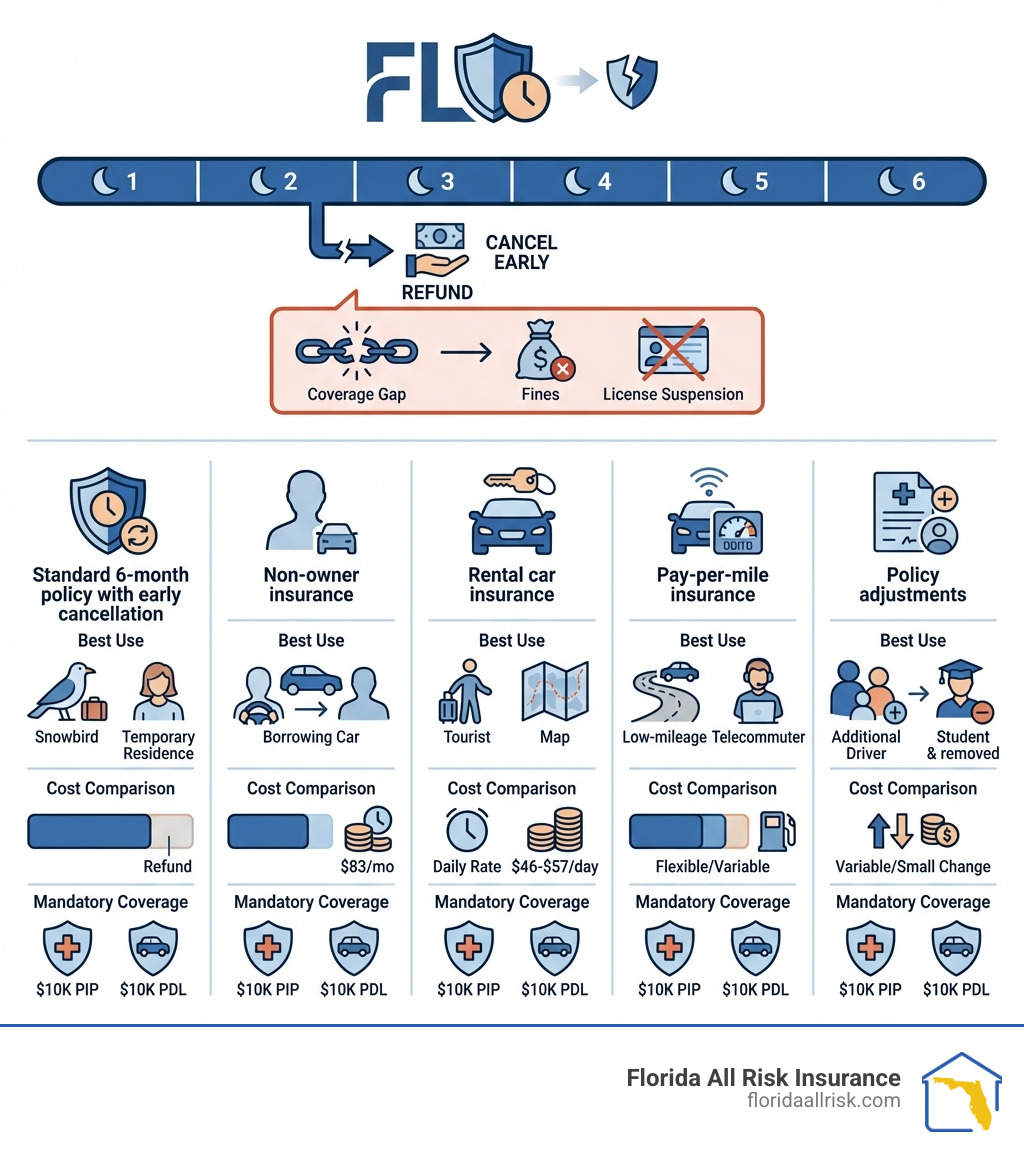
While short term car insurance Florida isn’t sold as a standalone product by major insurers, you have several legal alternatives to get covered for weeks or months without a full-year commitment.
Quick Answer: Your Florida Short-Term Coverage Options
- Buy a standard 6-month policy and cancel early: Most insurers refund the unused premium, but watch for cancellation fees.
- Non-owner car insurance: Helpful if you do not own a vehicle but still need liability coverage.
- Rental car insurance: Get coverage directly from the rental agency for the duration of your rental.
- Pay-per-mile insurance: A good fit for infrequent drivers who want flexible, usage-based coverage.
- Adjust your existing policy: Temporarily add or remove drivers or vehicles as your needs change.
Important: Florida law requires continuous insurance on all registered vehicles. A gap in coverage can lead to fines up to $500 and the suspension of your license and registration.
The reality is that major insurance companies do not typically sell “temporary” policies for just days or weeks. This is because underwriting short-term risk is costly, and Florida statutes mandate continuous coverage. The six-month policy is the industry standard, but that does not mean you are stuck overpaying. Whether you are a seasonal resident, a college student home for break, or between vehicles, careful planning can keep you legal and help you control costs.
With more than 20 years of experience, the independent agents at Florida All Risk Insurance have helped thousands of Florida drivers work within state laws to find compliant, cost-effective short term car insurance Florida alternatives. As a St. Petersburg-based independent agency, they can compare multiple carriers and tailor strategies to suit temporary needs across the state.
The Reality of Temporary Car Insurance in Florida
The idea of a true temporary car insurance policy in Florida—one lasting just a few days or weeks—is a common misconception. In Florida, state law and the insurance business model make such products from major carriers virtually non-existent. The standard policy term is six months, a practice rooted in the need for insurers to accurately assess risk and manage administrative costs. Underwriting policies for very brief periods is usually not economically viable for them.
Be cautious about any entity advertising “1-day” or “7-day” coverage, especially online or via social media. Some of these offers may be misleading, may not provide the coverage required under Florida law, or may not come from a licensed insurer. Before buying, always verify that the company is properly licensed through state resources and review the policy documents carefully. To better understand what Florida actually requires, see Florida All Risk Insurance’s Mandatory Car Insurance Florida Guide.
Why You Can’t Buy 1-Day Car Insurance from Major Insurers
Florida statutes set the framework for how auto insurance is written in the state. Most established insurers design their products around six-month (or sometimes annual) policy terms so they can gather enough data to price risk appropriately and keep administrative costs manageable. Writing large numbers of very short policies would increase overhead, which would likely drive premiums higher.
Because of this, you will not typically find legitimate 1-day or 7-day policies from well-known carriers. If you come across offers for ultra-short-term policies, treat them with skepticism. Some may:
- Not meet Florida’s minimum coverage requirements for Personal Injury Protection (PIP) and Property Damage Liability (PDL)
- Be sold by companies or agents who are not licensed in Florida
- Provide documents that appear official but do not actually file with the state or respond if you file a claim
You can verify insurer licensing and status through the Florida Office of Insurance Regulation or similar official channels. The Florida Legislature’s website also provides the full text of Florida’s financial responsibility law, which outlines key legal requirements.
Understanding Florida’s Continuous Coverage Requirement
Florida operates under a no-fault system and mandates continuous insurance coverage for any registered vehicle. This is not just a best practice; it is a statutory requirement. If your insurance lapses, even for a short period, the Florida Department of Highway Safety and Motor Vehicles (FLHSMV) can suspend your driver’s license and vehicle registration.
Reinstating them involves fines that can reach up to $500. Beyond the immediate legal penalties, a documented lapse in coverage can signal to insurers that you present higher risk, which may increase your future premiums for several years.
Maintaining continuous coverage—whether through a standard auto policy, a non-owner policy, or storage coverage—is almost always the most financially sound approach. For more detail on the consequences of a lapse, see Florida All Risk Insurance’s Driving Without Insurance Florida Guide and the FLHSMV’s official insurance requirements.
Smart Alternatives for Short-Term Coverage on Your Own Vehicle
Since true short term car insurance Florida is not available as a stand-alone product for vehicles you own, there are several smart, legal workarounds to get the coverage you need while staying compliant with state law.
The Standard Policy & Early Cancellation Strategy
The most common method for short-term coverage is to buy a standard six-month policy and cancel it when you no longer need it. This ensures you are fully insured and compliant with Florida law. When you cancel, many insurers provide a prorated refund for the unused premium. For example, if you pay for six months but only need three, you may be refunded for the remaining three months.
Before you buy, ask about the cancellation terms. Some insurers charge a small flat fee or apply a short-rate cancellation (keeping a slightly higher portion of the unused premium), while others may waive fees. Understanding these details up front helps you avoid surprises.
Equally important is avoiding a coverage gap. If you intend to park a vehicle for a while, talk with your agent about timing the cancellation with stopping registration, or shifting to a different coverage type, so you do not accidentally show a lapse. To find the best rates for a standard policy you can later adjust, start by comparing options through Florida All Risk Insurance’s Cheap Auto Insurance Quotes Florida.
Pay-Per-Mile and Usage-Based Insurance
If you drive infrequently, pay-per-mile or broader usage-based insurance programs can be a flexible alternative. With these options, your premium is based on a base monthly rate plus a few cents for each mile you drive, or on driving behavior measured by a telematics device or smartphone app.
This approach can significantly reduce costs for low-mileage drivers because your price more closely matches your actual use. However, it does require agreement to some level of data collection, such as mileage, time of day, or driving habits. If you have privacy concerns, discuss exactly what is tracked and how it is used with your agent before enrolling.
For more on how these programs work in Florida, review Florida All Risk Insurance’s Pay As You Drive Insurance Florida guide. You can also explore the Insurance Information Institute’s background on pay-as-you-drive auto insurance (telematics) for a national perspective.
Seasonal Coverage and Vehicle Storage
For Florida’s seasonal residents and anyone planning to store a vehicle long term, adjusting coverage is often a smart strategy. If a car will not be driven for an extended period, you may be able to reduce coverage to comprehensive-only—sometimes called “storage insurance.” This typically covers non-driving risks such as theft, fire, vandalism, or storm damage at a lower premium than a full policy.
Two key points to keep in mind:
- If the vehicle remains registered in Florida, you generally must maintain the required PIP and PDL coverage. Canceling these while leaving the registration active can lead to penalties.
- If you plan to cancel liability and PIP coverage entirely, talk with your agent about whether you should temporarily surrender the tag or registration to stay within Florida’s continuous coverage rules.
Florida All Risk Insurance can help you structure seasonal coverage so you stay compliant and protected while trimming costs. You can also explore potential savings in their Florida Car Insurance Discounts guide.
Options for Insuring a Car You Don’t Own
If your need for short term car insurance Florida involves a vehicle you are renting, borrowing, or otherwise driving but do not own, there are specific solutions available.
Non-Owner Car Insurance: The Best Bet for Frequent Borrowers
A non-owner car insurance policy is designed for individuals who regularly drive but do not own a vehicle. It is an excellent option if you frequently rent cars, borrow from friends or family, or need to file an SR-22 to reinstate your license. This type of policy typically provides liability coverage for damages you might cause to others while driving a vehicle you do not own.
In Florida, non-owner policies are often more affordable than standard owner policies, and they help you maintain a continuous coverage history, which can be important when you later buy a car and need a full policy. However, non-owner insurance does not cover damage to the car you are driving and does not usually include coverage for your own injuries beyond what is required by law.
For a complete overview of who should consider this option, see the Non-Owner Car Insurance Florida Guide.
Rental Car Insurance Explained
When you rent a car, the rental agency will offer coverage at the counter. This is a convenient way to get insured for a short period. Typical options include:
- A Collision Damage Waiver (CDW), which can protect you from paying for damage to the rental vehicle in many situations
- Supplemental liability protection, which increases the liability limits beyond the state minimums
- Personal accident insurance, which may help cover medical expenses for you and your passengers
While convenient, these add-ons can be expensive on a daily basis, especially for longer rentals. Before you buy coverage from the rental company, check whether your existing auto policy already extends to rental cars and whether your credit card offers any secondary rental car insurance benefits. Many cards and policies provide some level of protection, which can reduce what you need to buy at the counter.
The Insurance Information Institute provides additional rental car insurance information that can help you compare choices.
Permissive Use: Borrowing a Friend’s Car
If you occasionally borrow a friend’s or relative’s car with their permission, you are often covered under their auto policy’s “permissive use” provision. In many situations, their insurance acts as the primary coverage in case of an accident.
However, permissive use is generally intended for infrequent or occasional driving. If you use someone else’s vehicle regularly, or live in the same household, the insurer may require that you be listed as a driver on that policy. Failing to do so can cause complications if a claim occurs.
Before relying on permissive use, it is wise to:
- Confirm with the vehicle owner what coverage they have and whether their insurer restricts permissive drivers
- Make sure you understand any exclusions, such as business use or using the vehicle for delivery or rideshare services
If you find yourself driving non-owned vehicles often, a non-owner policy arranged through an independent agency like Florida All Risk Insurance can provide more predictable protection.
Legal and Financials: The Rules of Short Term Car Insurance Florida
Navigating short term car insurance Florida requires a clear understanding of the state’s legal minimums and how different coverage approaches affect your budget.
Florida’s Mandatory Insurance Laws
As a no-fault state, Florida law requires all drivers with a registered vehicle to carry at least:
- $10,000 in Personal Injury Protection (PIP): Helps cover your own medical expenses and lost wages, regardless of fault, up to policy limits.
- $10,000 in Property Damage Liability (PDL): Helps cover damage you cause to someone else’s property, such as another vehicle or a fence.
Any insurance solution you choose—whether a standard policy, non-owner policy, or storage arrangement—must respect these minimums when the vehicle is registered for use on Florida roads. Driving without required coverage can lead to license and registration suspension, reinstatement fees of up to $500, and personal responsibility for accident-related costs.
For official details, visit the Florida Department of Highway Safety and Motor Vehicles insurance requirements or Florida All Risk Insurance’s Basic Auto Insurance Florida guide.
The Average Cost of Temporary Coverage in Florida
There is no fixed “temporary policy” price in Florida, because most solutions are built around standard six-month terms or specialized arrangements. However, you can estimate short-term costs by looking at typical premiums:
- A standard six-month policy in Florida averages around $1,155, or about $192 per month, depending on coverage.
- Liability-only policies can be less, sometimes starting near $91 per month for qualifying drivers.
Your actual cost will depend on many factors, including:
- Driving record and claims history
- Age and years of licensed driving
- Location (for example, urban areas such as Miami often have higher rates than smaller cities like St. Petersburg)
- Vehicle type, safety features, and value
- Coverage limits and deductibles you choose
Florida All Risk Insurance’s Car Insurance Rates Florida Complete Guide explains how each of these elements influences your premium so you can better estimate what short-term arrangements might cost.
Comparing the Pros and Cons of Temporary Insurance Solutions
This table summarizes some of the most common short term car insurance Florida strategies and their tradeoffs.
| Solution | Pros | Cons |
|---|---|---|
| Standard Policy & Early Cancellation | – Offers full coverage options (liability, collision, comprehensive) – Prorated refund for unused premium in many cases – Helps maintain continuous coverage history |
– Most insurers have a 6-month minimum term – Possible cancellation or short-rate fees – Requires an upfront commitment to a standard policy |
| Non-Owner Policy | – Often cheaper than standard owner policies – Ideal for frequent use of borrowed or rented cars – Helps maintain continuous coverage history |
– Generally provides liability coverage only – Does not cover physical damage to the vehicle you are driving |
| Rental Car Insurance | – Convenient, purchased directly at the rental counter – No long-term commitment; tied to your rental period – Coverage applies specifically to the rental vehicle |
– Can be expensive on a per-day basis, especially for longer trips – May overlap with coverage from your existing auto policy or credit card – Choices at the counter can be confusing if you do not review them beforehand |
| Pay-Per-Mile or Usage-Based Policy | – Cost-effective for low-mileage drivers – Can reward safe driving habits in some programs – Maintains continuous coverage while adjusting cost to use |
– Requires using a telematics device or app, which may raise privacy concerns – Not ideal for high-mileage drivers, as per-mile charges can add up |
Common Scenarios for Temporary Car Insurance Needs
Knowing which short term car insurance Florida approach to use depends on your specific situation. Here are some common real-world scenarios.
Coverage for Students, Visitors, and Seasonal Residents
-
College students home for breaks: If a student returns home for the summer or holidays and will drive your car, most insurers allow you to add them as a driver for that period. Some offer “distant student” discounts when the student attends school far from home without regular access to a vehicle, which can help balance the cost.
-
Seasonal residents (“snowbirds”) wintering in Florida: If you split time between Florida and another state and keep a car here, you typically need Florida-compliant insurance if you stay longer than 90 days within a 365-day period. Many seasonal residents adjust their policies to comprehensive-only or storage coverage when they are away, and then restore full coverage before returning.
-
International drivers and tourists: For short visits, buying insurance from a rental car company is usually the simplest solution. For longer stays where you may borrow a car or buy a vehicle in Florida, you will generally need either a non-owner policy or a standard six-month policy that complies with state minimums.
Bridging Gaps and Special Situations
-
Driving a new car off the lot: Many existing auto policies provide a short grace period for newly purchased vehicles, but the length and coverage can vary. You generally need to inform your insurer as soon as possible and formally add the vehicle to the policy.
-
Between selling and buying a vehicle: If you sell your car and expect a gap before purchasing another, a non-owner policy can help you maintain continuous coverage and provide liability protection when renting or borrowing vehicles in the interim.
-
Test-driving cars: Dealerships typically carry insurance that covers customers during test drives. For private sales, the current owner’s policy often extends to you under permissive use, but it is wise to confirm this beforehand.
-
Rideshare drivers: If you drive for a rideshare platform, your personal policy may not cover you while the app is on and you are waiting for a trip request. Specialized rideshare endorsements or policies can fill that gap and help you avoid uncovered losses. If your situation also involves a serious violation like a DUI, Florida All Risk Insurance’s DUI Auto Insurance Florida guide offers additional context and options.
How to Find the Right Temporary Car Insurance Solution in Florida
Finding the right short term car insurance Florida strategy means choosing coverage that fits your specific needs and timeline while keeping you compliant with state law.
Key Questions to Ask Before Committing
Before choosing a policy or strategy, consider asking your agent these questions:
- What is your cancellation policy, and are there any fees for canceling early?
- How is the refund for any unused premium calculated if I cancel mid-term?
- Does my personal auto policy extend coverage to rental cars, and if so, under what conditions?
- What discounts (for example, low-mileage, multi-policy, or distant student) might apply in my situation?
- How do I temporarily add or remove a driver or vehicle from my policy, and how quickly can changes take effect?
- Does this coverage meet or exceed Florida’s minimum PIP and PDL requirements?
- Are there any important limitations or exclusions I should know about (such as for business use or rideshare)?
- Will this approach help me maintain continuous coverage, or is there a risk of a recorded lapse?
Documenting the answers in writing—such as in an email from your agent—can help avoid confusion later.
Why an Independent Insurance Agent is Your Best Ally
Florida’s insurance rules are complex, and short-term needs can make them feel even more confusing. Working with an independent insurance agency gives you access to multiple carriers instead of just one company’s products. That flexibility can be especially valuable when you are trying to:
- Balance short-term and long-term costs
- Combine non-owner, storage, and standard policies over different periods
- Address special circumstances such as seasonal residency, SR-22 filings, or rideshare driving
Florida All Risk Insurance, based in St. Petersburg, focuses on helping drivers throughout the state understand their options and choose coverage that fits both their timelines and budgets. As an independent agency, they can compare prices and features across many insurers to find solutions that align with Florida’s legal requirements.
To learn more about how an independent broker can help you structure coverage—whether for a few months or for the long term—see their Auto Insurance Broker St Petersburg FL page.
Secure Your Peace of Mind on Florida’s Roads
While true “temporary car insurance” isn’t a standard product in Florida, you have several excellent alternatives to stay legally covered without overpaying. From canceling a standard policy early to securing a non-owner policy, the right strategy depends on your unique situation. The most important step is to ensure you maintain continuous coverage to avoid legal penalties and higher future rates.
Navigating these options can be complex, but you don’t have to do it alone. As an independent agency based in St. Petersburg, our team at Florida All Risk Insurance specializes in finding creative, compliant, and cost-effective solutions for our clients across the state. We’re here to help you understand all your options for short term car insurance Florida and make the best choice for your unique circumstances.
Ready to find the perfect fit for your short-term needs? Explore our complete Temporary Car Insurance Florida guide for more details and resources.
For a personalized assessment and a no-obligation quote, Get a Quote online or call our expert team today!

