Why Florida Small Business Insurance Is Essential for the Sunshine State
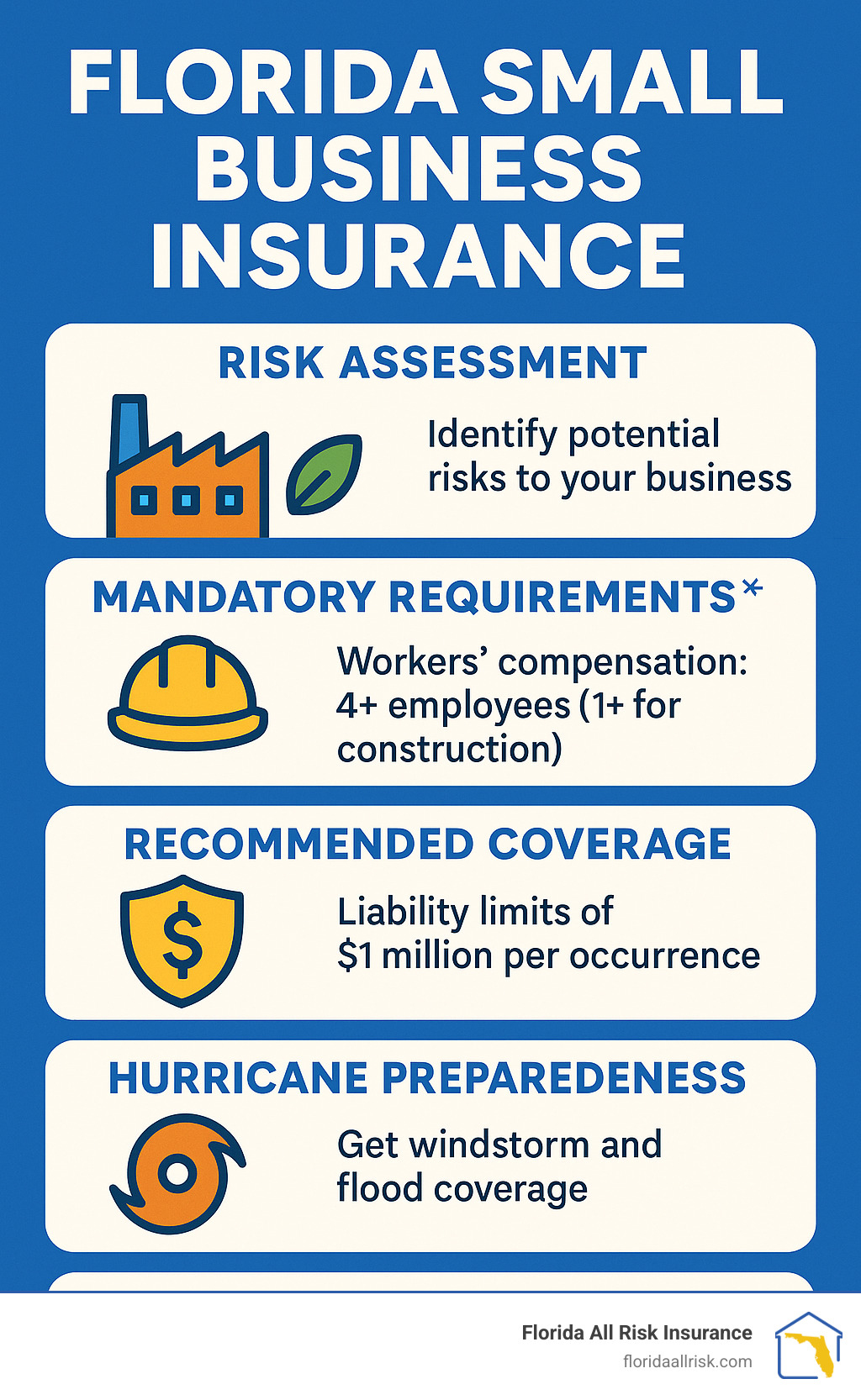
Florida small business insurance protects your business from lawsuits, property damage, and weather disasters that could otherwise destroy everything you’ve built. With 2.8 million small businesses employing 3.6 million people across the state, Florida’s economy depends on entrepreneurs who understand that proper coverage isn’t optional—it’s survival.
Here’s what Florida law requires and what experts recommend:
• Legally Required: Workers’ compensation (4+ employees for most businesses, 1+ for construction) and commercial auto liability if you own business vehicles
• Highly Recommended: General liability ($49/month average), professional liability ($71/month average), and commercial property insurance
• Florida-Specific Needs: Hurricane/windstorm coverage, flood insurance, and higher liability limits due to lawsuit-friendly courts
• Smart Money Move: Business Owner’s Policy (BOP) bundles liability and property coverage for better rates
The stakes are high in Florida. Between hurricane seasons that can level buildings and a legal environment where slip-and-fall claims regularly hit six figures, uninsured businesses face existential threats that proper coverage prevents.
Whether you’re running a Miami tech startup, a Tampa restaurant, or a Jacksonville construction company, your insurance needs go beyond basic coverage. Florida’s unique risks—from named storms to uninsured drivers (20% of the state)—demand specialized protection that generic policies don’t provide.
I’m Jason Miller, and I’ve been helping Florida business owners steer insurance challenges for over 20 years as a second-generation insurance professional. My expertise in Florida small business insurance comes from owning several insurance companies statewide and protecting thousands of businesses through our volatile marketplace.
Key Florida small business insurance vocabulary:
– Affordable employee health insurance
– what is a self funded group health insurance plan
– benefits of health benefits
Florida Business Insurance Requirements & Laws
Here’s something that surprises many new business owners: Florida small business insurance laws are actually pretty minimal. The state takes a hands-off approach, requiring only a few specific coverages while leaving most protection decisions up to you.
That freedom sounds great until you realize it puts all the responsibility on your shoulders. Choose wrong, and a single lawsuit or accident could wipe out everything you’ve worked to build.
What Coverage Is Legally Mandatory?
Workers’ compensation insurance is Florida’s big legal requirement, but the rules depend entirely on what kind of business you run and how many people you employ.
If you’re in construction, you need workers’ comp coverage the moment you hire your first employee. No exceptions, no waiting until you grow bigger. The state considers construction inherently dangerous, so they draw a hard line at one employee.
For non-construction businesses, you get more breathing room. You don’t need workers’ comp until you have four or more employees, whether they’re part-time or full-time. Corporate officers can sometimes elect to exempt themselves, but honestly? We rarely recommend it. The savings aren’t worth the risk if something goes wrong.
Commercial auto insurance kicks in automatically when you register any vehicle for business use. Florida’s no-fault system means you need Personal Injury Protection (PIP) that covers 80% of medical expenses up to $10,000, plus 60% of lost wages up to the same amount. You’ll also need Property Damage Liability (PDL) with at least $10,000 coverage for damage you cause to other people’s property.
The penalties for skipping required coverage hit hard and fast. Miss workers’ comp? You’re looking at stop-work orders and fines up to $1,000 per day. Drive without proper commercial auto coverage? License suspension and personal liability for any accidents you cause.
More info about Business Liability Insurance
City & County Extras You Might Need
While Florida keeps state requirements light, local governments love adding their own insurance demands. These requirements change dramatically depending on which of our 67 counties and hundreds of cities you’re operating in.
Occupational licenses often come with insurance strings attached. Many cities won’t issue your business license without proof of general liability coverage. Miami-Dade, for instance, typically requires $300,000 minimum coverage for service businesses working in residential areas.
Bonding requirements pop up frequently for contractors, security companies, and any business handling client money. These surety bonds aren’t technically insurance, but they protect your customers if you fail to complete work or mishandle their funds.
Flood zone considerations can force your hand on flood insurance, especially in coastal counties. If you’re in a FEMA flood zone and financing equipment or property, you might face mandatory flood coverage requirements. Even inland businesses near rivers or lakes sometimes hit local flood insurance mandates.
Before you open your doors, call your city and county occupational license offices to check local requirements. What’s completely optional in Jacksonville might be absolutely mandatory in Key West. It’s worth a quick phone call to avoid expensive surprises later.
Florida Small Business Insurance Basics: Must-Have & Nice-to-Have Coverage

Once you’ve covered the legal basics, smart Florida small business insurance planning means protecting against the real threats that actually shut down businesses. I’ve watched too many Florida entrepreneurs lose everything because they thought “optional” coverage was truly optional.
The truth is, while Florida law only requires workers’ comp and commercial auto in specific situations, the risks facing your business don’t care about legal minimums. A single lawsuit, hurricane, or cyber attack can wipe out years of hard work faster than you’d believe.
Let me walk you through the coverage that separates businesses that survive Florida’s challenges from those that don’t.
Why General Liability Is the Backbone of Florida Small Business Insurance
Think of general liability insurance as your business’s immune system. You hope you’ll never need it, but when trouble strikes, it’s the difference between a minor setback and total disaster.
This coverage handles the everyday accidents that happen in every business. Slip-and-fall claims are incredibly common in Florida’s humid climate where floors get slippery fast. I’ve seen customers slip on wet tiles in restaurants, trip over merchandise in retail stores, and fall on freshly mopped floors in office buildings.
Property damage protection kicks in when your business operations accidentally harm someone else’s property. Maybe your delivery driver backs into a client’s fence, or your employee spills coffee on a customer’s expensive laptop during a meeting.
Product liability coverage protects businesses that sell anything physical. Even if you’re just reselling products made by others, you can still face lawsuits when those products cause injuries or damage.
The numbers tell the story. With average premiums of just $49 per month in Florida, general liability typically provides $1 million per occurrence and $2 million aggregate coverage. That’s incredible protection value for what most businesses spend on coffee each month.
More info about General Liability Insurance for Small Business
Professional vs. General Liability—Know the Difference
Here’s where many Florida business owners get confused. They think general liability covers everything, but it doesn’t protect against the most expensive claims facing service-based businesses.
General liability covers physical problems—when someone gets hurt or property gets damaged. Professional liability (also called errors and omissions) covers financial problems—when your professional advice or services cost clients money.
| General Liability | Professional Liability (E&O) |
|---|---|
| Covers bodily injury and property damage | Covers errors, omissions, and negligence in professional services |
| Protects against physical accidents | Protects against advice, design, or service failures |
| Required by most contracts | Required by professional licensing boards |
| Average $49/month in Florida | Average $71/month in Florida |
If you’re an architect and your building design has a flaw that costs the client money to fix, that’s a professional liability claim. If someone trips and falls in your office, that’s general liability.
Professional liability becomes essential for consultants, IT professionals, healthcare providers, financial advisors, and anyone who sells expertise rather than products. Many professional licensing boards actually require this coverage.
The mistake I see constantly is service businesses thinking they only need one or the other. Most professional service companies need both types of coverage.
Business Owner’s Policy (BOP): Bundle & Save
A Business Owner’s Policy is like buying insurance in bulk—you get more protection for less money by bundling general liability and commercial property insurance together.
Most small businesses save 10-15% by choosing a BOP instead of buying separate policies. But the real advantage goes beyond cost savings. You get streamlined management with one policy, one renewal date, and one agent to call when problems arise.
Commercial property coverage protects your building (if you own it), equipment, inventory, furniture, and supplies. In Florida, this includes protection against our unique weather risks like windstorm damage and named storm events.
Business income coverage might be the most undervalued part of a BOP. When a covered event forces you to close temporarily, this pays for ongoing expenses and lost profits. After Hurricane Ian, businesses with good business income coverage stayed afloat while others struggled to reopen.
Florida BOPs include special features you won’t find in other states. Named storm deductibles typically run 2-5% of your insured value—much higher than regular deductibles but necessary for hurricane protection. Ordinance and law coverage helps pay for building code upgrades required after storm damage.
Annual BOP premiums range from $500 for low-risk office businesses to $10,000+ for higher-risk operations. The exact cost depends on your industry, location, and coverage limits, but the bundling savings make BOPs our most popular recommendation.
More info about Business Insurance for Small Businesses
Beyond the basic BOP, Florida businesses should consider cyber liability insurance for data breach protection, commercial umbrella coverage for extra liability limits, and inland marine insurance for equipment that travels to job sites. Flood insurance deserves special attention since standard commercial property policies exclude flood damage entirely.
The key is building your insurance program systematically. Start with the BOP foundation, then add specialized coverage based on your specific risks and industry requirements.
Specialized Coverage for Florida Risks & Industries
Running a business in Florida means dealing with risks that simply don’t exist anywhere else. From hurricane-force winds to cyber criminals who love targeting our tourism industry, Florida small business insurance needs go far beyond what works in other states.
After two decades of helping Florida businesses recover from everything imaginable, I’ve learned that one-size-fits-all insurance approaches leave dangerous gaps. Your Miami auto shop faces different threats than a Jacksonville tech company, and your coverage should reflect that reality.
Garage Keepers vs. Garage Liability: Auto Businesses Explained
If you work with cars, you’re probably confused about garage insurance—and you’re not alone. Even seasoned auto business owners mix up garage keepers and garage liability coverage, but getting this wrong can cost you everything.
Garage keepers insurance protects customer vehicles while they’re in your possession. Think of it as babysitter insurance for cars. Whether a customer’s BMW gets stolen from your lot overnight, catches fire while you’re working on it, or gets damaged during a test drive, garage keepers coverage handles the claim.
This coverage becomes essential when you consider the value of vehicles in your care. A single luxury car theft could easily exceed $100,000, and Florida’s car theft rates remain stubbornly high.
Garage liability insurance works more like traditional business insurance, protecting your operations and premises. It covers slip-and-fall accidents in your waiting area, property damage from your business activities, and liability for parts you sell or install.
Here’s the key difference: Garage keepers protects their stuff, while garage liability protects you from lawsuits.
Auto repair shops, dealerships, body shops, valet services, and mobile mechanics all need both types of coverage. The good news? Premiums typically start around $500 annually for small shops, making this specialized protection surprisingly affordable.
More info about Commercial Liability Insurance for Small Business
Florida’s Hurricane & Flood Reality Check

Let’s be honest about Florida weather: hurricanes aren’t a possibility, they’re an annual tradition. Your Florida small business insurance strategy must accept this reality and plan accordingly.
Named storm deductibles hit differently than regular deductibles. While your everyday property claim might have a $1,000 deductible, hurricane damage often carries deductibles of 2% to 5% of your property’s insured value. That $500,000 building suddenly comes with a potential $25,000 out-of-pocket cost when the next big storm hits.
The wind versus flood distinction trips up even experienced business owners. Your standard property insurance covers wind damage—like when hurricane winds rip off your roof or blow out windows. But when storm surge floods your first floor or rising water ruins your inventory, that’s flood territory requiring separate coverage.
Here’s where it gets tricky: rain entering through a wind-damaged roof usually counts as wind damage (covered), while water rising from overwhelmed storm drains counts as flooding (not covered without flood insurance).
Business interruption coverage becomes crucial during hurricane season. When mandatory evacuations or storm damage force you to close, this coverage pays for lost profits and continuing expenses like rent and payroll. Most policies include a 72-hour waiting period, so brief closures won’t trigger benefits.
For flood protection, you can choose between the National Flood Insurance Program with standardized coverage or private flood insurance that often provides higher limits and broader protection. Many businesses benefit from both.
Cyber Insurance: Digital Storms in the Sunshine State
Cyber attacks hit Florida businesses with frightening regularity, and small businesses make particularly attractive targets. Research shows that hackers are three times more likely to target small businesses than large corporations, making cyber insurance as essential as hurricane coverage.
The financial damage from cyber attacks often exceeds physical storm damage. A single data breach can trigger notification costs (Florida law requires notifying affected individuals), legal defense expenses, credit monitoring services for victims, and devastating business interruption when systems go down.
Florida’s economy makes us especially vulnerable. Tourism businesses handle massive amounts of credit card data, healthcare providers manage protected health information, real estate companies store sensitive financial documents, and professional services firms maintain client confidential information.
Ransomware attacks have become particularly common, with criminals demanding payments to open up encrypted business data. While we always recommend working with law enforcement rather than paying ransoms, cyber insurance can cover these costs when businesses feel they have no choice.
Cyber insurance premiums typically range from $500 to $2,000 annually for small businesses seeking $1 million in coverage. Given that the average cyber claim costs exceed $200,000, this protection offers exceptional value.
The digital age has created new storms that can devastate unprepared businesses. Just as you wouldn’t operate in Florida without hurricane insurance, cyber coverage has become equally essential for modern business survival.
Costs, Premium Factors & Money-Saving Tips
Let’s talk money. Understanding what drives Florida small business insurance costs helps you make smarter coverage decisions and find legitimate ways to reduce premiums without sacrificing the protection your business needs.
The truth is, insurance costs in Florida can feel overwhelming at first glance. Between hurricane risks, coastal surcharges, and our state’s lawsuit-friendly environment, premiums here often run higher than national averages. But here’s the good news: knowing what affects your rates puts you in control of managing those costs.
How Much Does Florida Small Business Insurance Cost?

The numbers might surprise you—Florida small business insurance is often more affordable than business owners expect. General liability insurance averages just $49 per month, making it one of the best protection values available. Workers’ compensation runs about $54 monthly for most small businesses, while professional liability coverage costs around $71 per month.
For comprehensive protection, a Business Owner’s Policy typically costs $141 monthly (about $1,687 annually). This bundles general liability and property coverage together, often saving you money compared to buying separate policies.
But here’s where Florida gets tricky. Coastal businesses often pay 20-40% more due to hurricane exposure. If your business sits within 10 miles of the beach, expect higher property insurance rates. It’s not personal—it’s just mathematics based on storm history.
Industry classification makes a huge difference in your costs. A clerical office worker might cost $0.50 per $100 of payroll for workers’ compensation, while a roofer could cost $15-20 per $100 of payroll. Construction, restaurants, and healthcare businesses typically face the highest rates due to injury frequency.
Your claims history follows you for 3-5 years. Even one significant claim can bump up premiums across multiple policy renewals. This is why many smart business owners choose slightly higher deductibles to avoid filing smaller claims.
Payroll size directly impacts workers’ compensation premiums. As your team grows, so do your workers’ comp costs. However, larger businesses often qualify for better rates due to improved risk spreading.
Proven Ways to Trim Your Premiums
Smart business owners can significantly reduce insurance costs without compromising protection. I’ve helped clients save 20-30% on premiums using strategies that actually work in Florida’s unique market.
Raising your deductibles is often the fastest way to cut costs. Increasing your property deductible from $1,000 to $5,000 can reduce premiums by 10-15%. Just make sure you can comfortably afford the higher out-of-pocket cost if you need to file a claim.
Bundling policies with one carrier almost always saves money. Combining your Business Owner’s Policy with workers’ compensation can yield up to 10% discounts. Adding commercial auto to the package often provides additional savings. Plus, you’ll have just one renewal date and one agent to call.
Safety programs aren’t just good business—they’re money-savers. Workers’ compensation carriers offer substantial discounts for businesses with formal safety training programs. Some insurers reduce premiums by 5-15% for documented safety initiatives. The time you invest in safety training pays for itself quickly.
Storm protection improvements can dramatically reduce property insurance costs in Florida. Installing storm shutters, upgrading to impact-resistant windows, or adding security systems all qualify for discounts. Wind mitigation improvements are especially valuable—sometimes saving enough to pay for the improvements within a few years.
Paying annually instead of monthly typically saves 5-8% compared to monthly installments. Most insurers charge processing fees for payment plans, so paying your annual premium upfront eliminates these costs.
Maintaining good business credit affects your insurance rates more than many business owners realize. Insurance companies use business credit scores in their underwriting process. Improving your credit can lead to better rates across all coverage types.
The key is working with an experienced agent who understands Florida’s unique insurance landscape. We know which carriers offer the best rates for specific industries and can help you implement cost-saving strategies that actually work.
More info about Insurance for Small Businesses
Step-by-Step Guide to Buying & Managing Policies
Buying Florida small business insurance feels like navigating a maze, but it doesn’t have to be. After helping thousands of Florida business owners through this process, I’ve learned that success comes from taking it one step at a time and not getting overwhelmed by all the options.
The key is understanding that insurance isn’t a one-time purchase—it’s an ongoing relationship that protects your business as it grows and changes. Let me walk you through exactly how to do this right.
Buying Florida Small Business Insurance in 7 Steps
Step 1: Take an honest look at your risks. Sit down with a cup of coffee and think about everything that could go wrong with your business. What happens if a customer slips and falls in your lobby? What if a hurricane damages your equipment? What if an employee gets hurt on the job? This isn’t about being pessimistic—it’s about being prepared.
Step 2: Figure out what coverage you legally need. Florida law requires certain types of insurance, and your local city or county might add more requirements. Check with your occupational license office, review any client contracts you’ve signed, and see what your landlord requires. Don’t assume—verify what’s actually mandatory for your specific situation.
Step 3: Get quotes from multiple insurers. Insurance rates can vary by 30% or more between companies for identical coverage. Request at least three quotes, but make sure you’re comparing apples to apples. A cheaper quote with higher deductibles or lower limits might not be the bargain it appears to be.
Step 4: Fill out applications completely and honestly. I know insurance applications are tedious, but accuracy matters enormously. If you misrepresent something on your application, the insurance company can deny claims later. Take your time with details about your business operations, revenue projections, and any previous claims.
Step 5: Review everything before you sign. Don’t just look at the price—read the policy declarations and understand your deductibles, especially for named storms. Make sure the coverage effective dates work for your business needs, and understand the renewal and cancellation terms.
Step 6: Get your certificates of insurance ready. Almost immediately after binding coverage, you’ll need to prove you have insurance to clients, vendors, or your landlord. Make sure your agent can provide certificates of insurance quickly and knows how to handle additional insured requirements.
Step 7: Schedule your annual review. Your business changes every year, and your insurance should change with it. Set a calendar reminder to review your coverage annually, adjusting limits as your revenue grows and adding coverage for new operations or locations.
Certificates of Insurance: Proving You’re Covered
Certificates of insurance are like your business insurance ID card—everyone wants to see them, and you’ll need them more often than you think. These simple one-page documents prove that you actually have the coverage you claim to have.
You’ll need certificates for almost everything. Before you can sign that big client contract, set up a booth at a trade show, or even move into some commercial spaces, someone will ask for a certificate. Smart business owners request these in advance rather than scrambling at the last minute.
The certificate shows the basics of your coverage—which insurance companies you use, what types of coverage you have, your policy limits, and when your coverage expires. Sometimes you’ll need to add the requesting party as an “additional insured,” which requires a separate endorsement to your policy.
Most certificates can be issued within 24 hours, but complex requests with additional insured requirements might take longer. Work with an agent who understands these requirements and can handle them efficiently—it’s a sign of how they’ll handle other service needs too.
Frequently Asked Questions about Florida Small Business Insurance
Is business insurance tax-deductible in Florida?
The good news for Florida business owners is that business insurance premiums are generally tax-deductible as ordinary business expenses. This applies to virtually all the coverage types we’ve discussed throughout this guide.
Your general liability insurance premiums qualify as deductible business expenses, along with professional liability coverage, commercial property insurance, and workers’ compensation insurance. If you own business vehicles, those commercial auto insurance premiums are deductible too.
The one major exception involves life insurance policies where your business serves as the beneficiary. Those premiums typically aren’t deductible, though the rules can get complex depending on your specific situation.
Since tax laws change and every business situation is unique, we always recommend consulting with a tax professional for guidance specific to your circumstances. They can help you maximize your deductions while staying compliant with current regulations.
What should home-based or one-person businesses know about coverage?
Home-based businesses represent a huge portion of Florida small business insurance clients, and they face some unique challenges that many entrepreneurs don’t realize until it’s too late.
Your homeowners policy probably won’t help your business. Most homeowners insurance policies specifically exclude business-related claims, which means you’re essentially operating without protection. If a client trips and falls during a meeting at your home office, your homeowners policy likely won’t cover the lawsuit. If someone steals your business computers, you might not have coverage for replacement.
Business personal property coverage protects your equipment, inventory, and supplies that your homeowners policy excludes. General liability insurance becomes essential if clients visit your home or if you make deliveries. Many home-based service providers also need professional liability coverage to protect against claims that their advice or services caused financial harm.
For one-person businesses, you’re not legally required to carry workers’ compensation for yourself since you don’t have employees. However, consider disability insurance to replace lost income if an injury prevents you from working. Some solo entrepreneurs also invest in key person life insurance to protect their families if the business depends entirely on their expertise.
Cyber liability coverage has become increasingly important for home-based businesses, especially those handling customer data or accepting online payments. The costs are reasonable, and the protection can be business-saving.
How does Florida’s climate affect policy limits and deductibles?
Living in Florida means your insurance policies look different from what businesses in other states carry, and understanding these differences can save you from nasty surprises during hurricane season.
Named storm deductibles are typically much higher than your standard deductibles for other types of damage. While you might have a $1,000 deductible for fire or theft, your hurricane deductible could be 2-5% of your property’s insured value. For a building insured at $500,000, that means you could face a $10,000 to $25,000 out-of-pocket cost before insurance kicks in.
Coverage limits need to account for Florida’s post-disaster reality. Construction costs skyrocket after major hurricanes when contractors are in high demand. Building codes often change between when your building was constructed and when you need to rebuild, requiring expensive upgrades that basic coverage might not include.
Business interruption periods tend to be longer in Florida after widespread disasters. When Hurricane Ian hit Southwest Florida, some businesses couldn’t reopen for months due to infrastructure damage, supply chain disruptions, and contractor shortages. Make sure your business income coverage reflects these extended timelines.
Seasonal restrictions can catch business owners off guard. Many insurers won’t allow policy changes during hurricane season, which typically runs from June 1 through November 30. If you’re planning to increase coverage limits or add new locations, handle those changes well before hurricane season begins.
The key is planning ahead and budgeting for higher out-of-pocket costs during major weather events. Florida small business insurance isn’t just about having coverage—it’s about having the right coverage structure for our unique climate challenges.
Conclusion
Running a business in the Sunshine State means dancing with hurricanes, navigating complex regulations, and protecting against risks that simply don’t exist anywhere else. Florida small business insurance isn’t just about meeting legal requirements—it’s about building a fortress around everything you’ve worked to create.
After two decades of helping Florida entrepreneurs protect their dreams, I’ve seen too many businesses crumble because they treated insurance as an afterthought. The smart ones understand that proper coverage isn’t an expense—it’s the foundation that lets you sleep peacefully during storm season and focus on growth instead of catastrophic what-ifs.
Your business faces uniquely Florida challenges that generic insurance approaches simply can’t handle. From named storm deductibles to uninsured motorist coverage, from cyber liability in our tourism-heavy economy to the specialized needs of coastal businesses—every coverage decision matters when the stakes are this high.
At Florida All Risk Insurance, we’ve built our reputation on understanding these complexities because we live them every day. Based right here in St. Petersburg, we’re not some distant corporate office trying to understand Florida from afar. We’re your neighbors, and we’ve weathered the same storms that threaten your business.
What sets us apart is simple: We’re an independent agency with access to multiple carriers, which means we work for you, not the insurance company. When hurricane season approaches or your business needs change, we’re here to adjust your coverage and find better rates. We don’t just sell policies and disappear—we build relationships that help your business thrive through whatever Florida throws at it.
The entrepreneurs who succeed in Florida are those who prepare for our state’s unique challenges while embracing its incredible opportunities. Proper Florida small business insurance provides that preparation, giving you the confidence to take calculated risks and grow your business without fear of losing everything to one bad day.
Ready to protect your business the right way? Our team is standing by to review your current coverage, identify gaps you might not know exist, and provide competitive quotes that make sense for your budget and risk profile.
More info about group health coverage for teams
The bottom line is this: In Florida, unexpected challenges aren’t a matter of if—they’re a matter of when. Don’t let inadequate insurance be the reason your business doesn’t survive its next test. Let’s make sure you’re properly protected before you need to be.