

Why Finding Temporary Auto Insurance Florida Solutions Matters More Than Ever
The topic of temporary auto insurance Florida is a common source of confusion for drivers across the Sunshine State. With its dynamic population of seasonal residents, college students, and international tourists, Florida has a unique and persistent demand for short-term vehicle coverage. However, the insurance landscape doesn’t always align with these flexible needs. Here’s what you need to know:
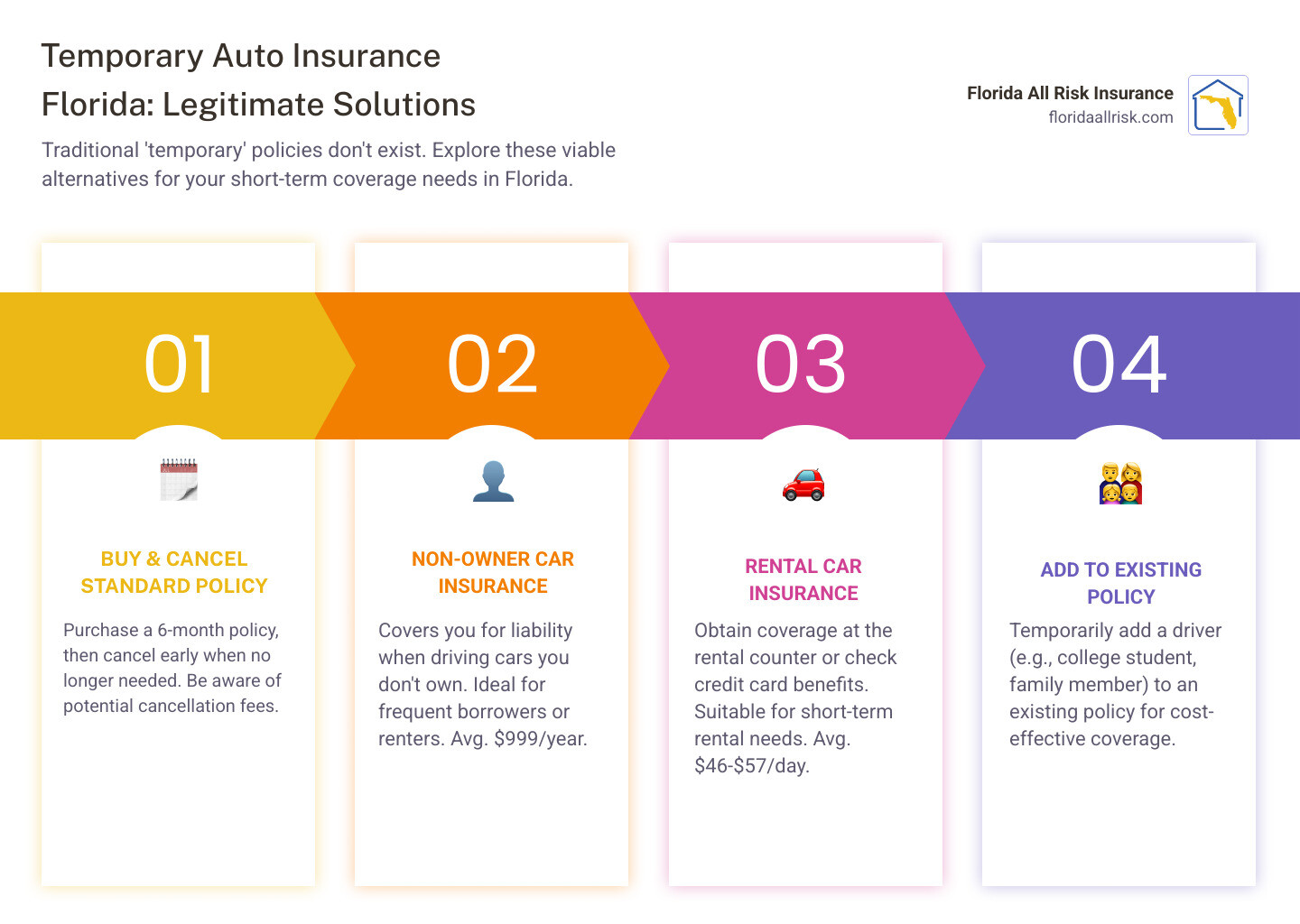
Quick Answer: Traditional temporary auto insurance from major insurers is not available in Florida. However, several legitimate alternatives can meet your short-term coverage needs:
- Standard Policy + Early Cancellation: Purchase a 6-month policy and cancel when you no longer need it (fees may apply).
- Non-Owner Car Insurance: Provides liability coverage when you drive cars you don’t own.
- Rental Car Insurance: Daily coverage purchased directly from a rental agency.
- Adding to an Existing Policy: Temporarily add a driver to a family member’s or friend’s policy.
The Florida insurance market presents unique challenges for those needing flexible coverage. Most major insurers only offer policies with six-month or one-year minimum terms, creating a significant gap between driver needs and available products. This discrepancy often leads to confusion, frustration, and potentially costly mistakes as people seek out solutions that seem too good to be true.
Fortunately, legitimate and effective solutions exist. They just don’t look like the “temporary” insurance you might expect. Understanding these alternatives is the key to saving money while staying legally compliant with Florida’s strict insurance laws. The right short-term solution depends entirely on your specific situation, whether you’re a snowbird nesting for the winter, a student home for the summer, or simply in between vehicles.
The Myth of “Temporary” Policies: What’s Really Available in Florida?
Many people searching for temporary auto insurance Florida expect to find and buy coverage for a specific, brief period—a day, a week, or a month. Unfortunately, the reality of Florida’s regulated insurance market is fundamentally different. Most major, reputable insurance companies do not offer what is traditionally considered “temporary” car insurance. Instead, their business models are built around standard six-month or one-year policy terms.
This isn’t an arbitrary decision; it’s rooted in the economics of the insurance industry. The administrative costs of underwriting a policy—which includes evaluating a driver’s risk profile, processing paperwork, running background checks, and setting up the account—are substantial. These fixed costs are roughly the same whether the policy is for seven days or seven months. The premium collected from a week-long policy would barely cover these essential expenses, making it an unprofitable product for the insurer. Furthermore, accurately assessing risk over very short periods is statistically challenging for actuaries who rely on long-term data to predict the likelihood of claims.
Because of this, you should be extremely wary of online advertisements promising “one-day,” “weekly,” or “30-day” insurance policies, especially at unusually low rates. These are often either outright scams designed to steal your money or they provide substandard coverage that fails to meet Florida’s legal minimum requirements. Falling for such an offer could leave you uninsured in an accident and facing severe legal penalties. Legitimate solutions will keep you legal and protected, even if they aren’t marketed under the “temporary” label.
Does traditional temporary car insurance exist in Florida?
The straight answer is no, standard temporary car insurance as most people imagine it doesn’t exist from major, reputable insurers in Florida. This is a nationwide reality, not a quirk unique to the Sunshine State. Major carriers like Progressive, Geico, and State Farm have established policy minimums, typically starting at six months, for sound economic and risk-management reasons. The cost to issue, service, and ultimately close a policy is a fixed expense, making extremely short-term policies financially unviable.
Any company aggressively marketing daily or weekly policies should be approached with extreme caution. These offers often come from unlicensed, offshore, or fraudulent entities. This doesn’t mean you’re out of options; it just means the real solutions require a different approach.
Common Scenarios Requiring Short-Term Coverage
Real-life situations frequently create a legitimate need for flexible, short-term auto coverage. Understanding these scenarios can help you identify the best alternative solution:
- College students returning home for breaks: A student may only need to drive the family car for a two-month summer break. Adding them to a parent’s policy for just those two months is far more economical than keeping them listed year-round. For example, temporary coverage for two months might cost around $734, whereas an annual addition could be about $3,669.
- Seasonal residents (“snowbirds”): Many part-time Florida residents store their cars in the state while they live elsewhere for half the year. They need to maintain continuous coverage to avoid penalties but don’t need full driving coverage when the car is parked. Adjusting coverage levels seasonally can lead to significant savings.
- Vehicle transitions: You might sell your primary vehicle a few weeks before your new one arrives. During this gap, you may need to borrow cars from friends or use a rental, creating a temporary need for liability protection without owning a car.
- Borrowing a vehicle for an extended period: While a friend’s policy might cover you for a quick errand under “permissive use,” if you’re borrowing their car for a whole weekend or a week, you need more reliable coverage. A non-owner policy or being added to their policy is a safer bet.
- International visitors and tourists: Visitors renting a car or borrowing one from family need to meet Florida’s mandatory insurance requirements without committing to a long-term, six-month policy they won’t use.
- Test-driving multiple vehicles: When shopping for a new car, you might test-drive several vehicles from private sellers. While the seller’s insurance may offer some protection, having your own liability coverage ensures you are protected from financial disaster.
Smart Alternatives for Short-Term Coverage in the Sunshine State
Since traditional temporary auto insurance Florida policies aren’t a viable option, creative and strategic thinking is required. The key is to match the right, legitimate alternative to your specific driving situation. Here are four proven strategies that provide effective short-term coverage.
Option 1: Purchase a Standard Policy and Cancel Early
This is often the most direct and straightforward solution for coverage needs lasting one to five months. The process is simple: you purchase a standard six-month auto insurance policy from a reputable carrier and then cancel it once you no longer need the coverage. By law, insurers must issue a prorated refund for the unused portion of your premium. For example, if you purchase a six-month policy for $1,104 (about $184/month) and cancel it after three months, you are entitled to a refund of the remaining three months’ premium, which would be approximately $552.
However, you must be aware of potential cancellation fees. These vary by insurer. Some companies charge a small flat fee (often under $100), while others may charge a percentage of the remaining premium (typically 10-15%). It’s crucial to ask about the specific cancellation policy before you purchase the policy. Many insurers waive these fees if the policy has been active for a certain period, such as 60 or 90 days. To find policies with the most favorable cancellation terms, you can compare Car Insurance Quotes Florida.
Option 2: Non-Owner Car Insurance
Non-owner insurance is a highly flexible and often misunderstood product. It is a liability policy that is tied to you as a driver, not to any specific vehicle. This makes it the perfect solution for individuals who do not own a car but drive occasionally. This includes frequent car borrowers, users of car-sharing services, or individuals who need to file an SR-22 to reinstate their license but don’t own a vehicle. If you cause an accident while driving someone else’s car, the car owner’s insurance acts as the primary coverage. Your non-owner policy then provides secondary liability coverage if the damages exceed the limits of the owner’s policy, protecting you from significant personal financial loss.
In Florida, a non-owner insurance policy costs around $999 per year, which breaks down to about $83 per month. While it is an annual policy, it provides continuous liability protection for various short-term driving needs that may arise throughout the year, often costing far less than maintaining a standard auto policy. Learn more about Non-Owner Car Insurance Florida to see if this versatile option fits your lifestyle.
Option 3: Adding a Driver to an Existing Policy
If your short-term driving needs involve regularly using a car owned by a family member or a close friend, being formally added to their policy is often the most secure and cost-effective solution. While most policies include a “permissive use” clause that covers very occasional, one-off drivers, this does not extend to regular or predictable use. If a college student is home for the summer and will be driving the family car several times a week, they must be listed as a named driver on the policy to be properly insured.
This strategy works perfectly for students, visiting relatives, or a partner who needs temporary access to a vehicle. The policyholder can contact their insurer to add a driver for a specific period (e.g., two months) and then remove them, ensuring they only pay for the coverage when it’s needed. The cost impact varies based on the added driver’s age, driving record, and location, but it is almost always cheaper than purchasing an entirely separate policy.
Option 4: Rental Car Insurance
For very short-term needs that are centered exclusively on a rental car—such as a vacation, business trip, or when your own car is in the shop—buying insurance directly from the rental car company is the most convenient option. This provides immediate, guaranteed protection for the duration of the rental. Typically, you’ll be offered several products at the counter:
- Collision/Loss Damage Waiver (CDW/LDW): This covers theft or damage to the rental car itself.
- Supplemental Liability Insurance (SLI): This provides liability coverage for bodily injury or property damage you cause to others.
- Personal Accident Insurance (PAI): This covers medical costs for you and your passengers.
Daily rates for a comprehensive package in Florida can range from $46 to $57. While this is expensive for longer periods, it makes perfect sense for trips of a few days. Before you buy, always check two things: your personal auto policy (if you have one) and your credit card benefits. Many auto policies and premium credit cards offer rental car coverage, which could save you a significant amount of money. For more details, the Insurance Information Institute offers a guide on rental car insurance.
Navigating the Legal and Financial Landscape of Temporary Auto Insurance Florida
Understanding Florida’s specific insurance regulations is absolutely crucial for protecting your finances when using any temporary auto insurance Florida solution. Attempting to cut corners to save a few dollars can lead to severe legal penalties and long-term financial consequences that far outweigh any initial savings.
Florida’s Legal Car Insurance Requirements

Florida is a no-fault state. In simple terms, this means that after an accident, your own insurance policy is the primary source of payment for your initial injuries, regardless of who was at fault. To legally register and operate a vehicle in Florida, you must carry a policy that includes:
- Personal Injury Protection (PIP): A minimum of $10,000 in coverage. This pays for 80% of your eligible medical bills and 60% of your lost wages, up to the limit.
- Property Damage Liability (PDL): A minimum of $10,000 in coverage. This pays for the damage you cause to someone else’s property, such as their car, fence, or building.
A critical rule in Florida is that any vehicle with a Florida license plate must have continuous coverage, even if it is stored and not being driven. If your insurance coverage lapses for any reason, the insurer is required to notify the state. This can trigger an automatic suspension of your driver’s license and vehicle registration. Reinstatement involves paying fines up to $500 and significant reinstatement fees. For official details, always consult the Florida Department of Highway Safety and Motor Vehicles. You can also review your Auto Insurance Coverage Options to ensure you are fully compliant.
The High Cost of a Coverage Gap
A lapse in insurance coverage, even for a single day, can have surprisingly long-lasting financial repercussions. Insurers use your continuous coverage history as a key factor in determining your risk level. A gap signals to them that you are a higher-risk driver, either due to financial instability or a lack of responsibility. As a result, when you go to purchase a new policy, your premiums can be significantly higher—often by 5-20%—and this penalty can follow you for three to five years. The type of policy you have doesn’t matter for your driving record, but a coverage gap is a major red flag for all insurers. The solution is simple: always ensure your new coverage begins on or before the day your old one ends. A brief overlap of a day or two is far cheaper than a gap of the same length.
Average Costs and Savings for temporary auto insurance Florida
Understanding the numbers involved helps in making smart, cost-effective decisions. The costs can vary based on your driving record, age, and location within Florida, but here are some typical figures:
- Non-Owner Car Insurance: Averages around $999 annually in Florida, which translates to a manageable $83 per month for continuous liability protection.
- Rental Car Insurance: Costs between $46 and $57 per day when purchased directly from the rental agency. This is ideal for very short-term use but becomes prohibitively expensive quickly.
- Adding a Young Driver: Temporarily adding an 18-year-old to a parent’s policy for a two-month summer break costs about $734. This provides a massive savings compared to the approximately $3,669 it would cost to keep them on the policy for the entire year.
- Early Cancellation Fees: These are designed to be manageable. Expect either a flat fee (e.g., $50) or a small percentage (10-15%) of the remaining premium. Canceling a $1,104 six-month policy after three months with a $50 fee would still net you a refund of about $502, making it a very viable strategy.
Exploring Florida Car Insurance Discounts can help reduce these costs even further.
Pay-Per-Mile and Usage-Based Insurance: A Modern Solution
For the growing number of Floridians who drive infrequently, traditional insurance can feel wasteful and unfair. Pay-per-mile and usage-based insurance (UBI) offer a modern alternative where your premium is directly linked to your actual driving habits and mileage. This approach is ideal for people who work from home, retirees, city dwellers who rely on public transit, or anyone with a second car that sees limited use. It effectively applies a temporary auto insurance Florida mindset to a full-time policy by ensuring you primarily pay for what you use, not for the time your car is parked.
How Pay-As-You-Go Car Insurance Works in Florida
Pay-as-you-go insurance, also known as telematics insurance, operates on a simple formula: a low monthly base rate plus a per-mile fee. The base rate covers your vehicle against risks while it’s parked (like theft, fire, or vandalism), ensuring you maintain the continuous coverage required by Florida law. The per-mile charge, typically just a few cents, is then added for every mile you drive.
Mileage and driving behavior are tracked using one of a few methods. The most common is a small telematics device that you plug into your car’s OBD-II port (standard on cars made after 1996). Alternatively, some insurers use a smartphone app that tracks your trips using GPS, or even allow you to self-report by submitting monthly photos of your odometer. Your monthly bill is then calculated based on your base rate plus the miles driven that month. This model provides a fair, transparent, and flexible pricing structure that can lead to substantial savings for low-mileage drivers. To see if this model fits your driving patterns, you can learn more about Pay As You Drive Insurance Florida.
Pros and Cons of Usage-Based Coverage
This innovative insurance model has a distinct set of benefits and drawbacks that are important to consider:
-
Pros:
- Significant Savings: Drivers who log fewer than 10,000 miles per year can save hundreds of dollars annually compared to a traditional policy.
- Direct Cost Control: Your monthly bill is directly tied to how much you drive, giving you the power to lower your insurance costs by driving less.
- Safe Driving Rewards: Many UBI programs offer additional discounts for safe driving habits, such as smooth braking, gentle acceleration, and avoiding late-night trips. This incentivizes and rewards safer road behavior.
-
Cons:
- Privacy Concerns: Some drivers are understandably uncomfortable with the idea of their insurance company tracking their location, mileage, and driving habits. It’s important to read the company’s data privacy policy carefully.
- Variable Bills: Monthly bills that fluctuate based on mileage can make budgeting more difficult compared to the predictability of a fixed six-month premium.
- Not for High-Mileage Drivers: If you have a long daily commute or frequently take long road trips, you will likely find that a traditional, unlimited-mileage policy is more affordable.
- Potential for Penalties: While most programs focus on discounts, some may penalize risky driving behaviors like consistent speeding or hard braking with higher rates.
For more background, the Insurance Information Institute provides details on pay-as-you-drive insurance.
Frequently Asked Questions about Temporary Car Insurance in Florida
Here are detailed answers to some of the most common questions drivers have when searching for temporary auto insurance Florida solutions.
Can I get car insurance for just one day in Florida?
While you cannot purchase a one-day policy from a major, reputable insurer, you have practical options for single-day coverage. The most direct solution is rental car insurance. If you are renting a car for the day, you can purchase liability and damage waivers directly at the rental counter for $46 to $57. If you are borrowing a car from a friend or family member for a day, their policy likely includes “permissive use,” which extends coverage to someone driving their car with permission. However, you must confirm the specifics of their policy with them first, as limits and restrictions can apply. For those who find themselves needing to borrow cars often, a non-owner policy is a more robust and economical solution in the long run, providing year-round liability coverage for a low daily equivalent cost.
How does using a temporary insurance solution affect my driving record?
Your official driving record, maintained by the state of Florida, is completely independent of the type of insurance policy you have. This record tracks moving violations (like speeding tickets), accidents, and license points. These are recorded regardless of whether you’re insured via a standard policy, a non-owner policy, or a usage-based plan. The real danger to your insurance history is a coverage gap. Your insurance record, which companies use to set your premiums, tracks your history of continuous coverage. Driving uninsured, even for a day, creates a lapse that marks you as a high-risk driver. This will lead to significantly higher premiums for several years. The key is to always maintain continuous coverage when switching between any insurance solutions.
What are the biggest red flags of a temporary car insurance scam?
The confusion surrounding the lack of true temporary insurance creates a fertile ground for scammers. You must be vigilant and watch for these critical warning signs:
- “Too good to be true” offers: Be extremely skeptical of any website or ad promising ultra-cheap policies for very short terms (e.g., 7, 14, or 30 days). Reputable insurers do not offer these products because they are not financially viable.
- Unusual or unsecured payment methods: Scammers often demand payment via wire transfer, gift cards, prepaid debit cards, or cryptocurrency. Legitimate insurance companies will always accept major credit cards and bank transfers through secure, professional payment portals.
- Lack of verifiable licensing: A legitimate insurer or agent must be licensed by the Florida Office of Insurance Regulation (FLOIR). Ask for their license number and verify it on the FLOIR website. If they refuse or cannot provide it, they are not legitimate.
- Vague or unprofessional contact information: A real insurer will have a physical office address, a professional website, and corporate phone numbers. Be wary of companies that only provide a P.O. box, a generic email address (like a Gmail or Yahoo account), or a mobile phone number.
- Insufficient coverage: Any policy sold in Florida must, at a minimum, meet the state’s $10,000 PIP and $10,000 PDL requirements. Any offer for “liability only” that doesn’t include PIP is illegal and will not protect you.
Conclusion: Finding Your Perfect Short-Term Fit
The search for temporary auto insurance Florida reveals that while traditional short-term policies are unavailable, smart and legitimate alternatives exist. By strategically canceling a standard policy, using non-owner insurance, being added to an existing policy, or opting for rental coverage, you can find a solution for nearly any scenario.
The key is to understand Florida’s legal requirements, avoid costly coverage gaps, and watch out for scams. By matching your specific situation to the right solution, you can drive legally and with peace of mind in the Sunshine State.
Get a personalized, no-obligation quote today!
Learn more about your options for temporary coverage
Contact Us
Finding the right temporary auto insurance Florida solution doesn’t have to be a challenge. At Florida All Risk Insurance, we understand that every driver’s situation is unique. Our experienced team is ready to help you steer the alternatives and find a solution that fits your needs and budget.
Reach out to our St. Petersburg team for personalized guidance. We’ll review your situation and help you secure the right protection.
Address: 7901 4th St N, Suite 300, Saint Petersburg, FL 33702
Phone: (727) 350-9123
Email: [email protected]

