

Why Florida Real Estate Insurance is More Critical Than Ever
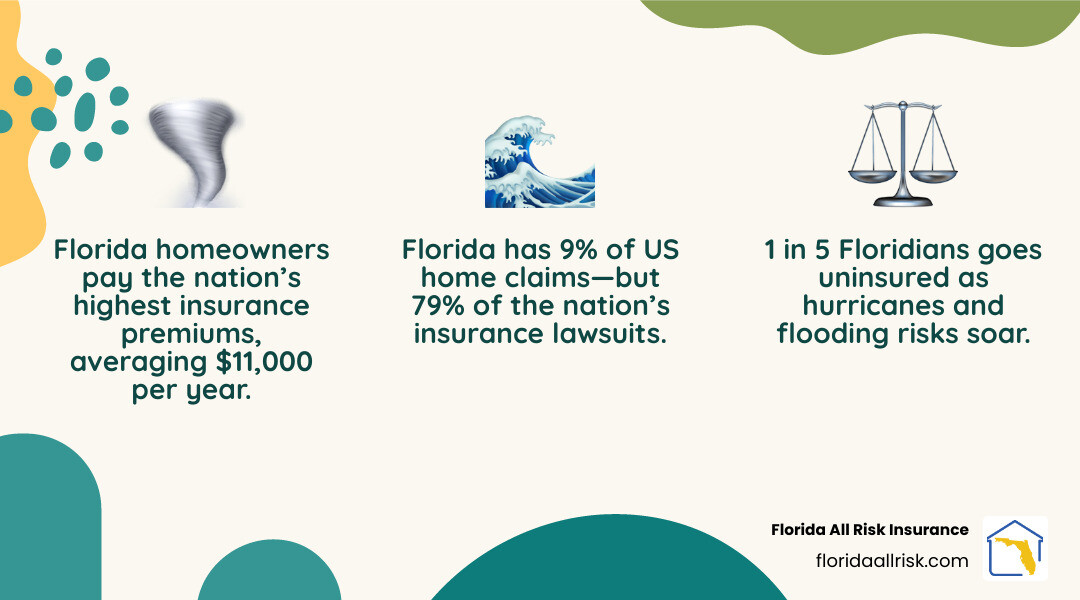
Florida real estate insurance has become one of the most challenging and expensive aspects of homeownership in the Sunshine State. With average annual premiums hitting $11,000 – the highest in the nation – and about 20% of homeowners now going without coverage entirely, understanding your options isn’t just smart financial planning, it’s essential for protecting your most valuable asset.
Key Florida Real Estate Insurance Facts:
- Average Cost: $11,000 annually (highest in U.S.)
- Uninsured Rate: 15-20% of Florida homeowners lack coverage
- Premium Increase: 72% over the past five years
- Claims vs. Lawsuits: Florida has 9% of U.S. claims but 79% of lawsuits
- Required by Law: No, but mortgage lenders typically mandate it
- Last Resort Option: Citizens Property Insurance Corporation serves 1.4 million policies
Florida’s unique geography creates a perfect storm of risks. Hurricanes batter the coastline, sinkholes swallow homes in central counties, and flooding threatens properties both coastal and inland. Add in a litigation crisis that’s driven dozens of insurers out of the state, and you have a market where finding affordable, comprehensive coverage feels nearly impossible.
The stakes couldn’t be higher. Without proper coverage, a single hurricane can wipe out decades of equity. Even minor incidents like water damage or liability claims can cost tens of thousands out of pocket.
I’m Jason Miller, a second-generation insurance professional with over 20 years of experience helping Florida families secure florida real estate insurance protection. Having owned several insurance companies in Florida and witnessed how the market has evolved, I’ll guide you through the essential information you need to make informed decisions about protecting your property and financial future.
Essential florida real estate insurance terms:
- another home insurance company leaving florida
- best homeowners insurance in florida 2025
- homeowners insurance in pinellas county florida
Florida Real Estate Insurance 101
Florida real estate insurance is your financial safety net in a state where Mother Nature loves to test your resolve. It’s actually a family of coverage options designed to protect different types of property ownership, from beachfront condos to rental properties.
Florida has 111 domestic property and casualty insurers writing about $59 billion in direct premiums annually, with nearly 19% going toward homeowners coverage. The Florida Office of Insurance Regulation oversees these insurers to ensure they meet standards needed to protect Florida families.
Most homeowners start with Homeowners Insurance Florida as their foundation. But Florida’s unique challenges often mean you’ll need additional layers like Flood Insurance Florida. For commercial properties, All Risk Commercial Property Insurance becomes essential.
What Is “florida real estate insurance”?
Homeowners policies (HO-3) are the workhorses of residential coverage, protecting single-family homes against all perils except those specifically excluded. Condominium policies (HO-6) focus on your unit’s interior and belongings since the condo association’s master policy handles the building structure. Dwelling policies (DP-3) often cover rental properties with more limited liability coverage. Landlord policies are specially designed for rental property owners facing unique challenges like loss of rental income.
Is Homeowners Coverage Legally Required in Florida?
Florida law doesn’t require homeowners insurance, but your mortgage lender almost certainly will. Nearly every mortgage contract includes an insurance clause requiring continuous coverage. If you let coverage lapse, your lender can purchase expensive “force-placed insurance” that protects their interests, not yours.
With nearly 30% of Florida homes owned outright, many people are choosing to drop coverage rather than pay high premiums. Legally, they can do this. Financially, it’s a massive gamble.
Meet Your Safety Net: Citizens Property Insurance Corporation
When private insurers decline your property, Citizens Property Insurance Corporation steps in as Florida’s insurer of last resort. At its peak in fall 2023, Citizens was covering 1.4 million policies across Florida.
Citizens operates differently than private insurers. As a state-backed entity, Citizens can assess all Florida policyholders if claims exceed reserves. To qualify, you need proof that you’ve been declined by at least one private insurer, or that private market rates exceed Citizens’ rates by more than 15%.
For current information about Citizens’ programs, visit Citizens Property Insurance Corporation’s official website directly.
Understanding Your Policy Parts
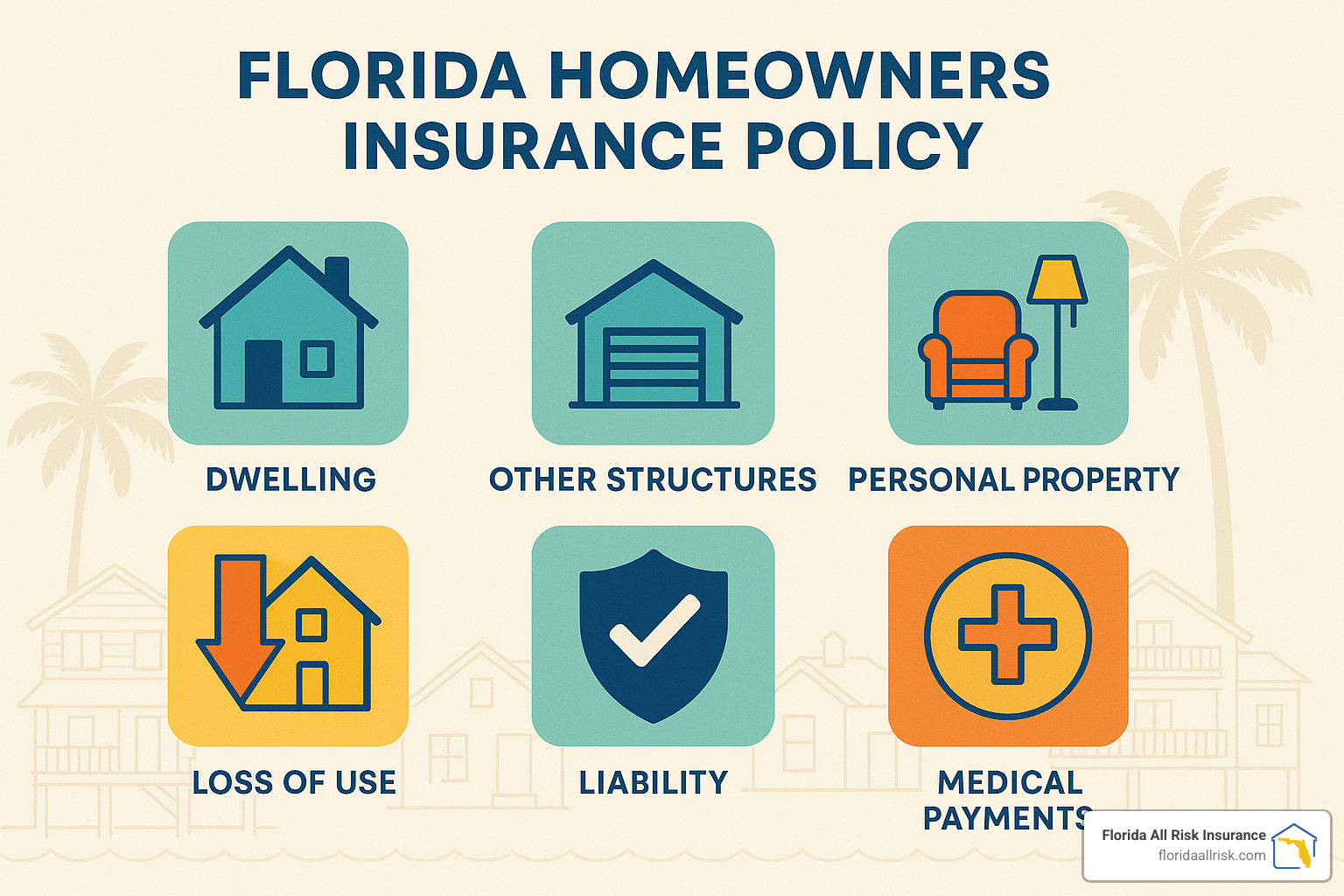
Your florida real estate insurance policy contains six main coverage sections, each serving a specific purpose:
Coverage A – Dwelling protects your home’s structure from foundation to roof, including everything permanently attached. This should reflect actual rebuild costs today, not market value or purchase price.
Coverage B – Other Structures covers detached garages, sheds, fences, and pools. Most policies automatically provide 10% of your dwelling coverage for other structures.
Coverage C – Personal Property protects your belongings, typically providing 50-75% of your dwelling coverage. Choose replacement cost over actual cash value for better protection.
Coverage D – Loss of Use pays extra living expenses when you can’t live in your home after a covered loss.
Coverage E – Personal Liability protects when someone gets hurt on your property. With Florida’s lawsuit environment, standard limits often aren’t enough.
Coverage F – Medical Payments covers medical expenses for injured guests regardless of fault.
Natural-Disaster Add-Ons Every Floridian Should Consider
Windstorm coverage is essential, though some coastal properties need separate windstorm policies. Hurricane deductibles are typically 2%, 5%, or 10% of your dwelling coverage, not flat dollar amounts.
Flood insurance is crucial since homeowners policies exclude flood damage. Get coverage through the National Flood Insurance Program or private insurers.
Sinkhole coverage addresses Florida’s unique geological risks. State law requires catastrophic ground cover collapse coverage, but full sinkhole coverage protects against gradual damage.
Hidden Gaps: What Standard Policies Exclude
Flood damage is the biggest exclusion, covering surface water from heavy rains, overflowing rivers, and storm surge. Mold damage coverage depends on the cause – sudden water events are usually covered, but long-term moisture problems aren’t. Sewer backup requires a separate endorsement. Ordinance and law coverage pays extra costs when building codes have changed since your home was built.
Commercial & Rental Property Coverage
Landlord DP-3 policies focus on protecting rental properties with limited liability coverage. Short-term rental coverage addresses Airbnb/VRBO activities that standard policies often exclude. Commercial property insurance handles business properties’ unique needs. Our Commercial Property Insurance specialists understand these complex requirements.
Risk Hotspots & How to Cover Them
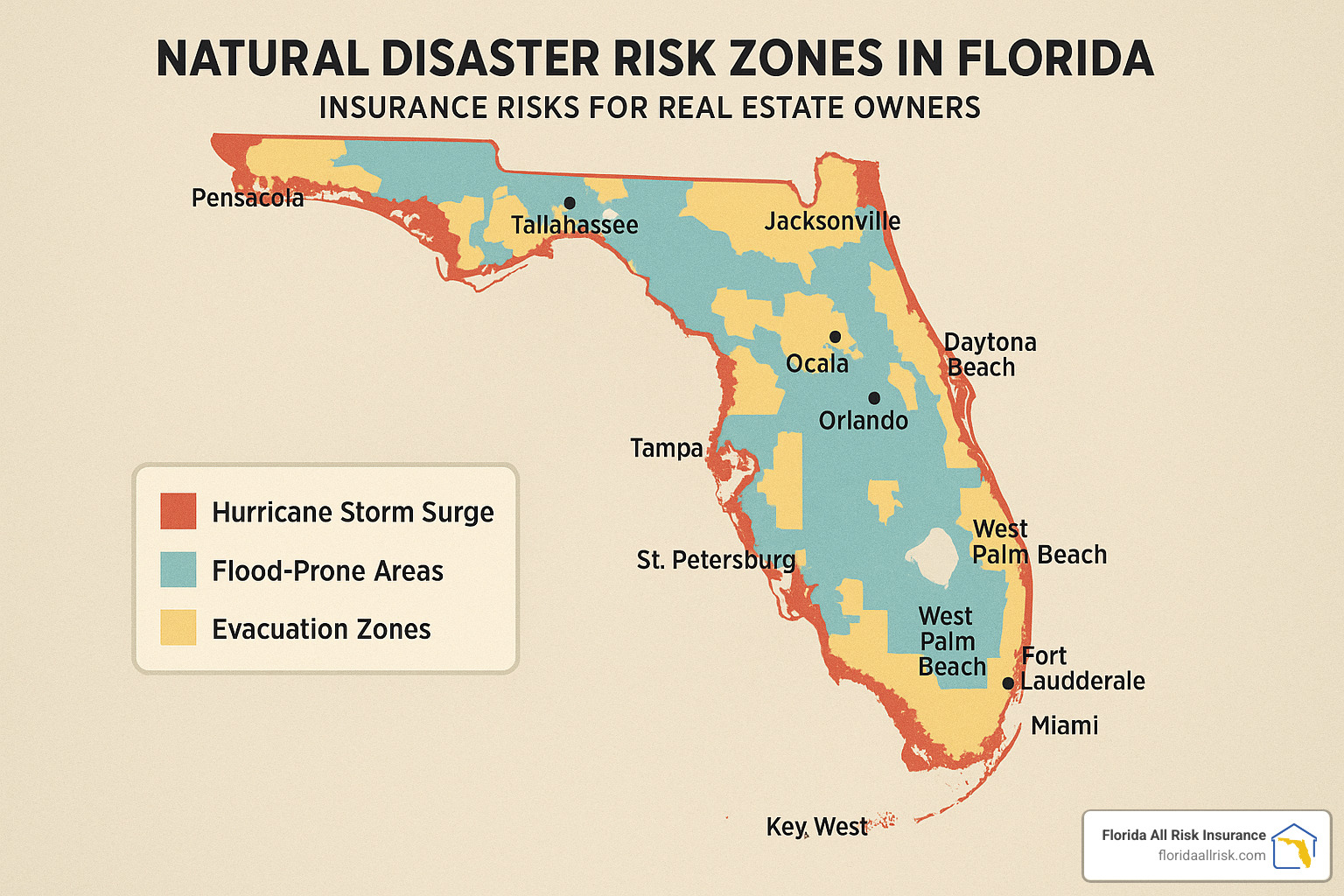
Florida faces unique natural disaster risks across every region. Coastal areas battle storm surge and hurricane winds, while inland properties face flooding from overwhelmed drainage systems. Central Florida’s “Sinkhole Alley” in Pasco, Hernando, and Hillsborough counties leads the nation in ground collapse incidents. Rural areas near state forests face growing wildfire risks, and Florida actually has more tornadoes per square mile than any other state.
Climate change is intensifying these risks with rising sea levels, stronger storms, and more extreme rainfall patterns. For detailed flood risk information, check FEMA flood maps for your specific property.
Hurricanes: The Costliest Threat
Hurricanes are Florida’s most expensive natural disaster. Hurricane deductibles work as percentages of your dwelling coverage – a 2% deductible on a $300,000 home means $6,000 out of pocket before insurance kicks in.
Wind mitigation credits can slash premiums by 10-45%. Hurricane straps, impact windows, and reinforced roof attachments all qualify for discounts. The My Safe Florida Home Program offers grants up to $10,000 for eligible homeowners to install hurricane mitigation features.
Roof age restrictions have become common, with many insurers requiring roofs under 15-20 years old.
Flooding: Coverage You Can’t Ignore
Your homeowners policy does NOT cover flood damage. The National Flood Insurance Program (NFIP) provides standardized coverage with $250,000 for buildings and $100,000 for contents. The private flood market often offers higher limits and broader coverage.
Elevation certificates document your home’s elevation relative to base flood elevation, potentially saving hundreds in annual premiums. For comprehensive information, visit FloodSmart.
Sinkholes & Ground Collapse
Florida’s limestone foundation makes it the most sinkhole-prone state. Pasco and Hernando counties report the highest activity. Florida law requires catastrophic ground cover collapse coverage, but full sinkhole coverage protects against gradual damage and can cost $1,500-$4,000 annually.
Dollars & Sense: Premiums, Discounts, and Savings
At $11,000 annually, Florida homeowners pay the nation’s highest insurance premiums. Geography matters significantly – Miami averages $3,700 while Tallahassee averages $1,436. Your credit score can impact premiums by 47%, and claims history follows you for years.
| City | Average Annual Premium | Primary Risk Factors |
|---|---|---|
| Miami | $3,700 | Hurricane, flood, high litigation |
| Orlando | $2,510 | Hurricane, sinkhole, inland flooding |
| Tampa | $2,800 | Hurricane, sinkhole, storm surge |
| Jacksonville | $2,200 | Hurricane, flood, wind |
| Tallahassee | $1,436 | Lower hurricane risk, inland location |
Why Florida Premiums Are Sky-High
Florida has 9% of the nation’s homeowners claims but 79% of lawsuits. Insurer failures have become common, reducing competition. Global reinsurance costs have skyrocketed after years of catastrophic losses. Assignment of benefits abuse turned routine claims into profit centers for contractors.
10 Proven Ways to Lower Your Bill
- Wind mitigation inspections ($75-$150) can save 10-45% on premiums
- Roof replacement with hurricane-resistant materials opens substantial discounts
- Policy bundling with auto insurance provides 5-25% discounts
- Higher deductibles can cut costs by 15-30%
- Security systems qualify for 2-15% discounts
- Water shut-off valves prevent claims and qualify for discounts
- Paperless billing offers small but helpful savings
- Loyalty discounts reward long-term customers
- Claims-free discounts provide the biggest long-term savings
- Surplus lines shopping opens alternatives for hard-to-place risks
Can You Go Without Insurance? Risks of Self-Insuring
Nearly 20% of Florida homeowners now go without coverage. Out-of-pocket rebuild costs for a $350,000 home, plus debris removal and temporary housing, can easily exceed $450,000. Foreclosure after disaster creates a nightmare scenario where you lose your home but still owe the full mortgage balance. At $11,000 annually, you’d need 32 years without a major loss to save enough for a $350,000 rebuild – unlikely odds in Florida.
Buying, Maintaining & Claiming
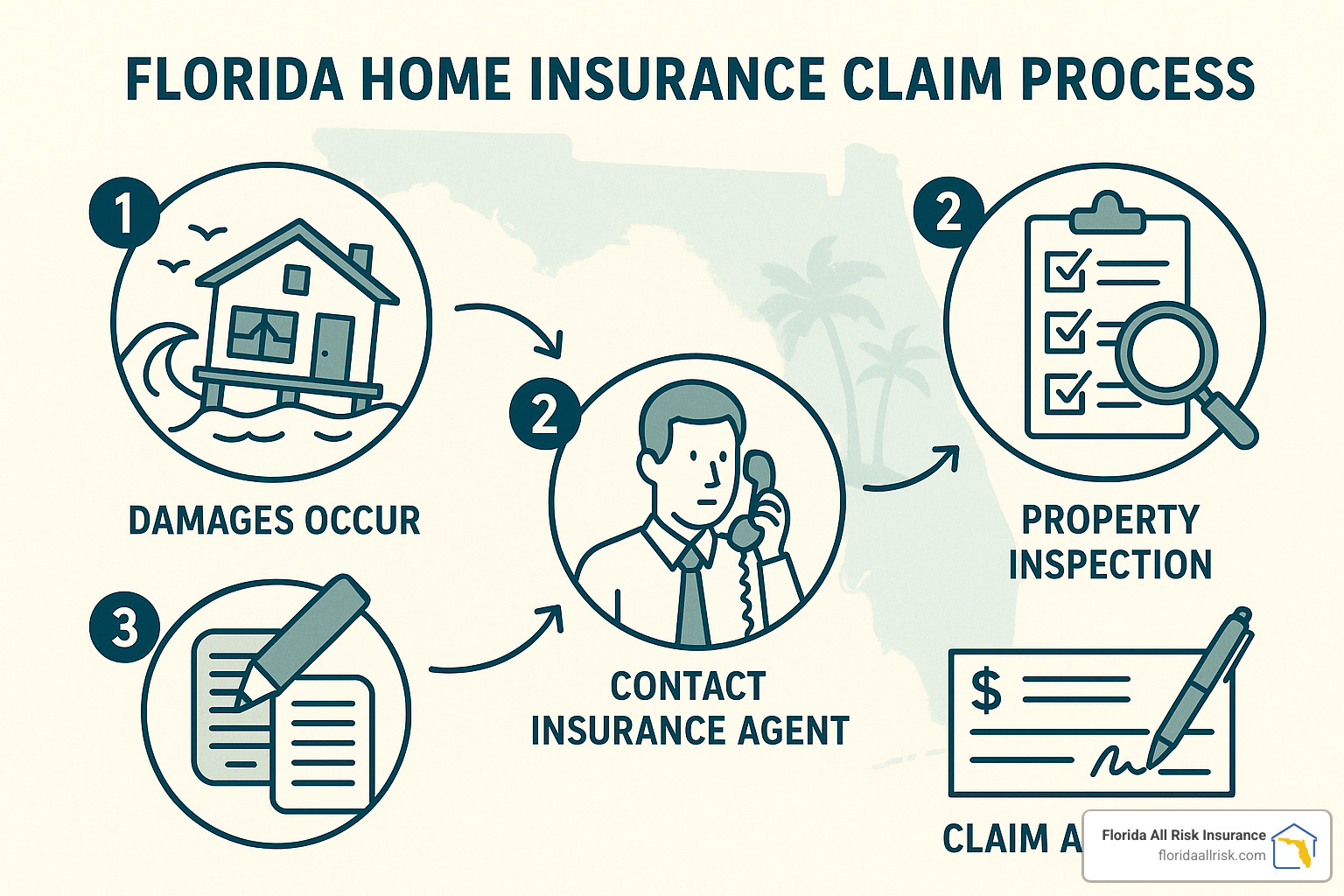
Getting florida real estate insurance requires honesty on your application about your property’s construction, claims history, and protective features. Property inspections have become standard – insurers check roof condition, electrical systems, and overall maintenance.
Binding restrictions during hurricane season mean some insurers won’t write new policies when storms are brewing. Policy renewals can bring 30%+ premium increases or non-renewals entirely.
Florida law requires insurers to acknowledge claims within 14 days and complete investigations within 90 days.
How to Shop Smart
Verify your agent’s license through the Florida Department of Financial Services. Compare identical coverage limits and deductibles – that cheaper quote might have a much higher hurricane deductible. Replacement cost coverage should reflect actual rebuild costs, not market value.
Set up annual reviews a few months before renewal. Our Commercial Property Insurance Agents Near Me understand Florida’s complex market.
Filing a Claim After Disaster
Document everything immediately with photos and videos before making any changes. Make temporary repairs to prevent further damage and keep all receipts. Hurricane deductibles can be shocking – a 2% deductible on a $300,000 home means $6,000 out of pocket.
Be present when the adjuster visits and point out all damage. If your claim gets denied, you have the right to appeal. Public adjusters charge 10-20% of settlements but often achieve better results.
Legislative & Market Trends
The 2022-2024 legislative reforms have limited attorney fees and tightened lawsuit rules, beginning to stabilize the market. Eight new insurers have entered Florida recently – the first good news in years. Citizens depopulation efforts continue moving policies back to private companies. New roof solicitation laws crack down on door-to-door contractors contributing to fraudulent claims.
Frequently Asked Questions about Florida Real Estate Insurance
Does my policy automatically cover hurricane damage?
Most florida real estate insurance policies include hurricane coverage, but with important limitations. The biggest surprise is the hurricane deductible – calculated as a percentage of your dwelling coverage rather than a flat amount. A 2% hurricane deductible on a $300,000 home means $6,000 out of pocket.
The hurricane deductible applies when the National Weather Service issues a hurricane warning. However, flood damage from hurricanes isn’t covered by standard homeowners policies – you need separate flood insurance regardless of the storm’s intensity.
How much can wind mitigation save me?
Wind mitigation inspections cost $75-$150 but can save 10-45% on premiums. The inspection documents hurricane-resistant features like hurricane straps (5-35% savings), impact windows (10-45% savings), and reinforced roof attachments (1-15% savings). Most homeowners see the inspection cost returned in first-year savings.
What happens if Citizens becomes insolvent?
Citizens has special assessment authority, meaning they can bill all Florida property insurance policyholders if claims exceed reserves. This makes Citizens virtually impossible to become insolvent traditionally, but means all Florida policyholders share the risk through potential assessments up to 15% of premiums annually.
Conclusion
After two decades in the Florida insurance industry, I’ve watched countless homeowners struggle with protecting their most valuable asset without breaking the bank. Florida real estate insurance isn’t just another monthly bill – it’s your financial lifeline when Mother Nature tests your resolve.
Yes, the market is challenging with premiums averaging $11,000 annually. But the alternative – facing hurricanes, floods, or sinkholes without protection – can wipe out a lifetime of work in a single day. I’ve seen families lose everything because they thought they could ride out storms without insurance, and I’ve helped countless others rebuild because they stayed protected.
Florida’s risks aren’t going anywhere – if anything, they’re intensifying. But solutions are emerging. New insurers are entering the market, legislative reforms are taking effect, and innovative coverage options are developing. The key is staying informed and adapting your strategy as conditions change.
Don’t let complexity overwhelm you. Start with the basics – understand your current coverage, identify your biggest risks, and explore your options. Whether you need wind mitigation inspections, flood insurance, or help after a non-renewal, solutions are available.
Your next steps matter more than ever. Hurricane season doesn’t wait for perfect timing. Review your coverage now while you have options. Document your property’s protective features. Build relationships with trusted professionals who understand Florida’s unique challenges.
At Florida All Risk Insurance, we’ve built our reputation helping Florida families steer exactly these challenges. We’re not just selling policies – we’re helping you build comprehensive protection strategies that evolve with your needs and the market.
The insurance landscape will continue changing, but your need for protection remains constant. Let us help you find the right balance of coverage and cost for your specific situation. Ready to take control of your insurance future? Visit our Homeowners Insurance Florida page for personalized coverage recommendations and competitive quotes.
Contact Us
Florida All Risk Insurance
Saint Petersburg, FL
Phone: (888) 880-9200
Email: [email protected]
For questions about homeowners, flood, auto, or commercial coverage anywhere in Florida, our independent agents are available to provide clear, unbiased guidance. Because we represent multiple carriers, we can compare policies and rates to find options that match your unique needs. Reach out by phone or email and a licensed professional from our St. Petersburg office will be happy to assist you.

