

Navigating the Florida Health Insurance Landscape
Florida medical insurance plans come in several types to meet different needs and budgets. Here’s a quick overview:
- ACA Marketplace Plans: Available through Healthcare.gov with potential subsidies
- Employer-Sponsored Plans: Offered by companies to their employees
- Medicare: For those 65+ or with qualifying disabilities
- Medicaid: For low-income individuals and families
- Short-Term Plans: Temporary coverage for gaps between plans
- Supplemental Plans: Additional coverage for specific needs
Finding the right health insurance in Florida doesn’t have to be overwhelming. Whether you’re shopping during Open Enrollment (November 1 – January 15) or qualifying for a Special Enrollment Period due to life changes, understanding your options is the first step toward comprehensive coverage.
Many Floridians now qualify for reduced or even $0 monthly premiums thanks to the American Rescue Plan Act and Inflation Reduction Act. Most plans offer essential benefits including preventive care, prescription drugs, emergency services, and mental health care.
I’m Jason Miller, a second-generation insurance professional with over 20 years of experience helping thousands of Floridians steer Florida medical insurance plans to find the coverage that best suits their unique needs and budget.

Quick Florida medical insurance plans definitions:
– Small business employee benefits
– buy business insurance
– what is a self funded group health insurance plan
Understanding Florida Medical Insurance Plans: Types & Eligibility
Navigating health insurance in the Sunshine State doesn’t have to feel like getting lost in the Everglades. Florida offers several paths to coverage, each designed for different life situations. Let’s walk through your options together.
ACA Marketplace Florida Medical Insurance Plans
The Health Insurance Marketplace (Healthcare.gov) serves as Florida’s central hub for individual and family coverage under the Affordable Care Act. These plans come in metal tiers that reflect how you and your insurance company share costs.
“I’ve seen families save hundreds each month thanks to recent legislation,” shares Maria Hernandez, one of our healthcare navigators at Florida All Risk Insurance. “Many Floridians are surprised to learn they qualify for substantial savings or even $0 premiums thanks to the American Rescue Plan Act and Inflation Reduction Act.”
Think of the metal tiers as your cost-sharing comfort level:

Your subsidy amount depends on your household size and income. Florida residents who are U.S. citizens or legal residents can apply, as long as you don’t have access to affordable employer coverage. You’ll need to enroll during Open Enrollment (November 1-January 15) unless you experience a qualifying life event.
Employer-Sponsored Florida Medical Insurance Plans
Many of us get our health coverage through work. These group plans typically offer good value because they spread risk across all employees, resulting in more stable premiums.
“Employer plans often come with hidden perks,” explains Carlos Rodriguez, our benefits specialist in St. Petersburg. “Wellness programs, preventive care incentives, and pre-tax premium payments can add up to significant savings that aren’t immediately obvious when comparing plans.”
Large-group plans (for companies with 50+ employees) differ from small-group plans in their requirements and pricing structures. Most employers have waiting periods—typically 30-90 days after hiring—before new employees become eligible.
If you leave your job, COBRA allows you to temporarily keep your employer coverage, though you’ll shoulder the full premium plus a small administrative fee. While expensive, this can provide crucial continuity during transitions.
Want to explore affordable options for your business? Visit our Affordable Employee Health Insurance page for custom solutions.
Government Florida Medical Insurance Plans (Medicare & Medicaid)
As Floridians age or face financial challenges, government programs offer vital safety nets.
Medicare serves those 65+ and certain younger people with disabilities through a four-part structure:
Part A covers hospital stays (usually premium-free if you’ve worked 10+ years)
Part B covers doctor visits and outpatient care (requires monthly premium)
Part C (Medicare Advantage) offers private insurance alternatives that typically combine Parts A & B with extra benefits
Part D covers prescription medications
Here in Florida, many seniors choose Medicare Advantage plans that provide access to thousands of doctors and hospitals statewide, plus coverage when traveling outside Florida.
Medicaid provides coverage for our most vulnerable neighbors. While Florida hasn’t expanded Medicaid under the ACA, the program still covers specific groups:
“Understanding eligibility can be tricky,” notes Jennifer Thompson from our Florida All Risk team. “Medicaid in Florida primarily serves parents with very low incomes, pregnant women, children, elderly, and people with disabilities. The income limits vary by category.”
Florida KidCare (our CHIP program) offers affordable coverage for children from families who earn too much for Medicaid but struggle to afford private insurance.
Many seniors qualify for both Medicare and Medicaid, creating significant savings opportunities. For comprehensive Medicare guidance, visit the CMS Medicare Coverage Center.
Finding the right Florida medical insurance plan starts with understanding which programs you’re eligible for. Our team at Florida All Risk Insurance is here to help you steer these waters with confidence and peace of mind.
Comparing Plan Designs: HMO vs. PPO vs. EPO vs. POS
Shopping for Florida medical insurance plans feels a bit like choosing between different models of cars – they’ll all get you where you need to go, but the ride experience can be quite different! Let’s break down these plan types so you can find your perfect match.
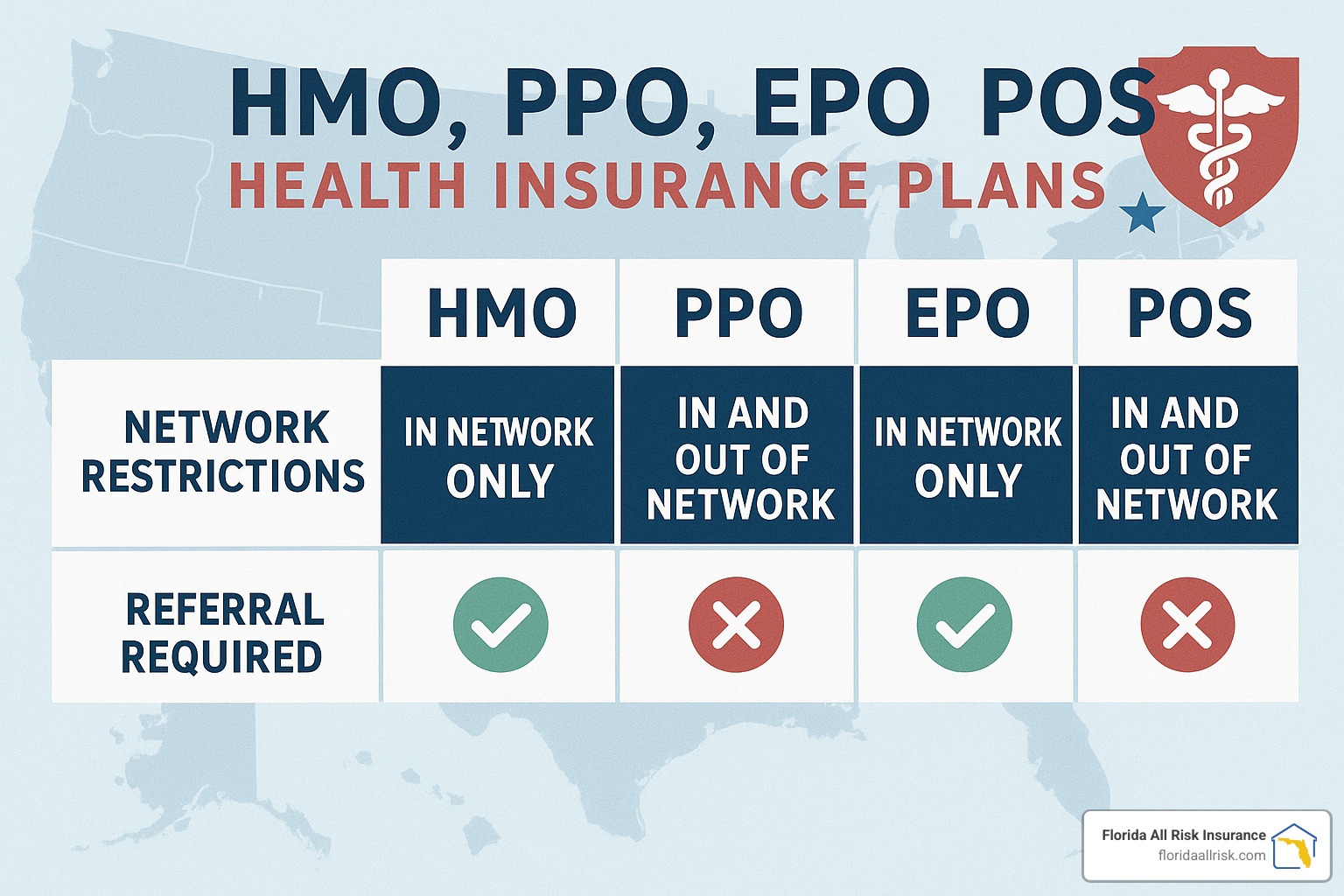
Health Maintenance Organization (HMO)
Think of an HMO as your neighborhood healthcare community. You’ll choose a primary care physician (PCP) who becomes your healthcare “home base” and coordinates all your care. Need to see a dermatologist or cardiologist? Your PCP will provide a referral.
HMOs typically have the lowest premiums and out-of-pocket costs, which is great news for your wallet. The trade-off? You’re limited to doctors within the network, except in genuine emergencies.
Many Florida health plans make HMOs particularly convenient with thousands of in-network providers and one-stop care centers where you can see your doctor, fill prescriptions, get lab work, and even receive urgent care – all under one roof!
Preferred Provider Organization (PPO)
If flexibility is your middle name, a PPO might be your plan of choice. With a PPO, you’re free to see any doctor you want – no referrals needed! Visit specialists directly, and even see out-of-network providers (though you’ll pay more for the privilege).
This freedom comes with slightly higher monthly premiums, but many Floridians find the flexibility worth every penny, especially those with existing doctor relationships or complex health needs. PPOs are perfect for the “I want it my way” healthcare consumer.
Exclusive Provider Organization (EPO)
EPOs are the clever middle ground between HMOs and PPOs. Like an HMO, you’ll need to stay in-network for coverage (except emergencies). But like a PPO, you typically don’t need referrals to see specialists.
The result? You get more direct access to specialists than an HMO offers, often with premiums that won’t break the bank. EPOs are great for folks who don’t mind limiting their provider choices but want to skip the referral process.
Point of Service (POS)
A POS plan is like the best of both worlds – it blends HMO and PPO features. You’ll have a primary care doctor coordinating your care with referrals (like an HMO), but you can also venture outside the network if you’re willing to pay more (like a PPO).
“Most of my clients choose their plan type based on their relationship with their doctors,” says David Martinez from Florida All Risk Insurance. “If you absolutely love your specialists and want to keep seeing them, check which networks they participate in before making your decision.”
Cost Factors in Florida Medical Insurance Plans
Understanding healthcare costs is a bit like learning a new language at first, but once you get the basics, it all makes sense!
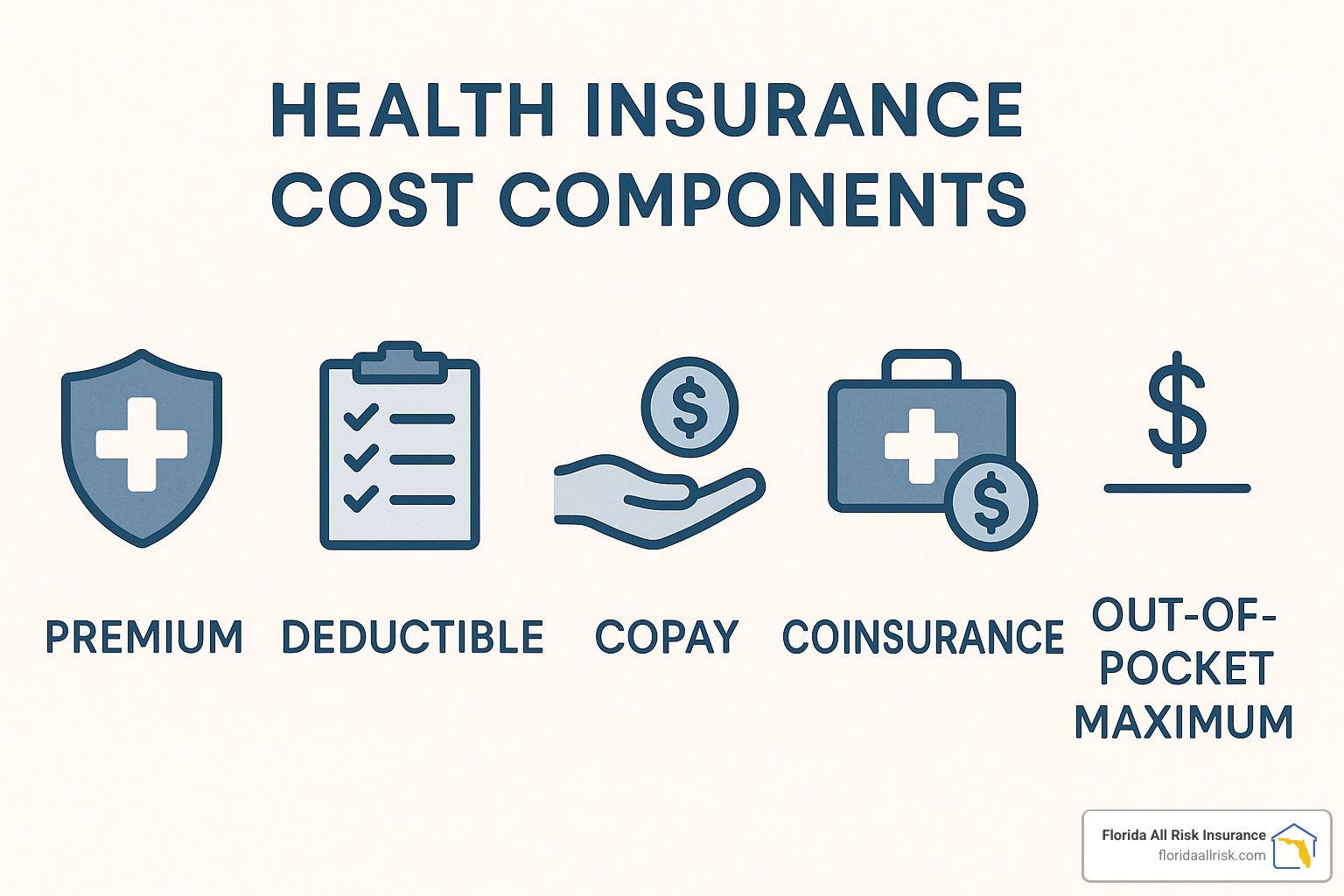
Your premium is simply your monthly “membership fee” for having insurance. But that’s just the beginning of the cost story. Your deductible is what you’ll pay out-of-pocket before insurance kicks in (think of it as your skin in the game).
After meeting your deductible, you’ll typically pay either a copay (a fixed amount, like $25 per doctor visit) or coinsurance (a percentage of the cost, like 20% of a hospital stay). The good news? Your out-of-pocket maximum caps your annual spending – once you hit that limit, insurance covers 100% for the rest of the year.
Many insurance providers offer budget-friendly options with $0 deductible plans and $0 copays when you choose certain providers – a real blessing for those watching their healthcare dollars.
Your age and zip code matter too! A 60-year-old in Miami-Dade County might pay quite different rates than a 30-year-old in Jacksonville for identical coverage, thanks to Florida’s geographic rating areas.
Small business owners looking for group coverage options can learn more about their options on our Small Company Health Insurance page.
Benefits You Can Expect
Here’s some good news – all ACA-compliant Florida medical insurance plans must cover essential health benefits including doctor visits, hospital stays, emergency services, maternity care, mental health services, prescription drugs, lab services, preventive care, and pediatric services.
Preventive care is particularly valuable – annual check-ups, vaccinations, cancer screenings, and many other preventive services are covered 100% when you use in-network providers. No copays, no deductibles – just care that keeps you healthy!
Mental health services now receive equal treatment with physical health services under federal law. This parity means your plan can’t impose stricter limits on therapy visits or psychiatric care than it does on physical health treatments.
Many insurance providers have acceptd the preventive care model with plans offering $0 virtual urgent care, $0 preventive visits, and prescription drugs for as little as $0–$3 for preferred generics on most plans.
“I always tell clients to take full advantage of preventive benefits,” shares Rachel Williams from Florida All Risk Insurance. “Not only are they already paid for through your premiums, but catching health issues early can save you significant money – and more importantly, keep you healthy – in the long run.”
How to Choose the Best Plan for Your Needs
Finding the right Florida medical insurance plan doesn’t have to feel like solving a puzzle. With a thoughtful approach, you can find coverage that fits your life like a glove. Let’s walk through this together.
First, take a moment to think about your healthcare habits. Do you visit the doctor frequently, or are you the type who rarely needs medical attention? Maybe you take prescription medications every day, or perhaps you’re managing a chronic condition that requires regular care. Your unique health situation forms the foundation of your insurance needs.
“I always tell my clients to be honest about their health patterns,” says Lisa Morales from Florida All Risk Insurance. “Someone with asthma or diabetes will have very different needs than someone who only sees a doctor for their annual physical.”
Your budget matters tremendously when choosing coverage. Consider how much you can comfortably afford in monthly premiums, but don’t stop there. Think about how you’d handle out-of-pocket costs if you needed care. Some people prefer the security of higher monthly premiums with lower costs when they actually use services, while others are comfortable with higher deductibles if it means paying less each month.
One crucial step many Floridians skip? Checking provider networks. Before falling in love with a plan, make sure your favorite doctors, specialists, and local hospitals are in-network. There’s nothing more frustrating than finding out your trusted family physician of 10 years doesn’t accept your new insurance.
If you take regular medications, the plan’s drug formulary deserves your attention. Not all plans cover all medications, and the tier placement of your prescriptions can dramatically affect what you’ll pay at the pharmacy counter. This simple check can save you hundreds of dollars throughout the year.

“The biggest mistake I see Floridians make is choosing a plan based solely on the premium,” explains Michael Johnson at Florida All Risk Insurance. “You need to consider your total potential healthcare costs, including what you’d pay if you actually need to use the insurance.”
Don’t overlook additional benefits that might be valuable to you. Many Florida medical insurance plans now offer convenient telehealth services, wellness programs with financial incentives, or specialized benefits for families planning to have children. These extras can add significant value beyond the basic coverage.
Using Enrollment Periods to Your Advantage
Timing your enrollment strategically can make all the difference in getting the coverage you need without gaps or penalties.
The Open Enrollment Period (OEP) is your annual opportunity to shop for health insurance without needing a special reason. For ACA Marketplace plans, Florida’s window runs from November 1 through January 15. Medicare beneficiaries have their own period from October 15 through December 7, while employer plans typically hold enrollment in the fall, though exact dates vary by company.
But life doesn’t always align neatly with these calendar dates. That’s where Special Enrollment Periods (SEPs) come in. These are triggered by significant life changes like getting married or divorced, having a baby, losing other health coverage, or moving to a new area. When these events happen, you generally have 60 days to select a new plan.
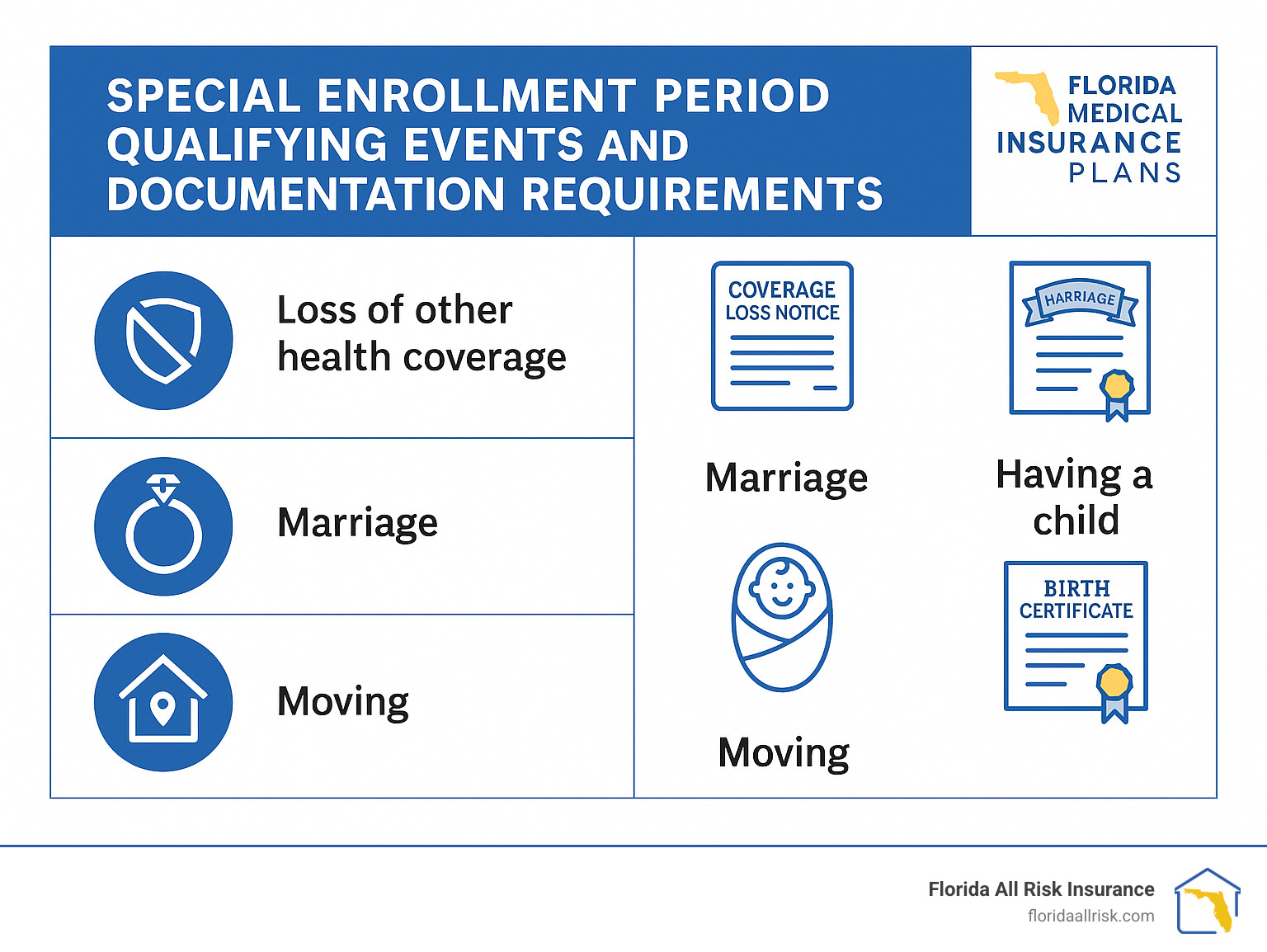
“Keep documentation of qualifying life events readily available,” advises Sarah Peterson of Florida All Risk Insurance in St. Petersburg. “You’ll typically have 60 days from the event to enroll, and proper documentation speeds up the verification process.”
Having proof of your qualifying event—like a marriage certificate, birth certificate, or letter showing loss of coverage—can make the enrollment process much smoother. Planning ahead prevents unnecessary stress during what might already be a challenging life transition.
Financial Assistance & Subsidies
Many Floridians are pleasantly surprised to find they qualify for financial help with their health insurance costs. These savings opportunities can transform what seems unaffordable into something that fits comfortably in your budget.
Premium Tax Credits (PTCs) work like an instant discount on your monthly premium. They’re available to individuals and families with incomes between 100% and 400% of the Federal Poverty Level. Thanks to the American Rescue Plan Act and Inflation Reduction Act, these subsidies are more generous than ever, with some Floridians qualifying for plans with $0 monthly premiums.
If you’re shopping in the Silver plan category and your income falls between 100% and 250% of the Federal Poverty Level, you might also qualify for Cost-Sharing Reductions. These valuable subsidies lower your out-of-pocket costs when you actually use healthcare services, reducing your deductible, copays, and coinsurance.
Families with children should explore Florida KidCare (Florida’s CHIP program), which offers low-cost health insurance for children from birth through age 18. Monthly premiums adjust based on your family’s income, making quality care accessible for Florida’s youngest residents.
“Many middle-income families don’t realize they might qualify for subsidies,” notes Robert Garcia from Florida All Risk Insurance. “A family of four earning up to $111,000 could receive premium assistance in 2023.”
Many Florida medical insurance plans also offer wellness rewards that can save you money while encouraging healthy habits. These might include premium discounts for completing health assessments, gift cards for preventive screenings, or reduced copays for participating in disease management programs.
For more information about how health benefits can support your overall financial wellness, visit our Benefits of Health Benefits page.
Keeping Coverage Continuous & Filling Gaps
Life happens—jobs change, situations shift, and sometimes you might find yourself between health insurance plans. But going without coverage, even briefly, can leave you vulnerable to unexpected medical costs. Let’s explore how to keep your protection intact during life’s transitions.
COBRA Continuation
Losing your job doesn’t have to mean losing your health insurance. COBRA allows you to maintain your employer’s plan for up to 18 months after leaving your position. While it keeps your familiar coverage and network, there’s a catch—you’ll pay the full premium plus a small administrative fee.
“COBRA gives you breathing room to explore options without sacrificing coverage,” explains Lisa Rodriguez from Florida All Risk Insurance. “Yes, it costs more than what you paid as an employee, but it’s identical coverage that keeps your healthcare consistent during transitions.”
Think of COBRA as your safety bridge—not necessarily a long-term solution, but a valuable way to maintain comprehensive coverage while you sort out your next steps.
Marketplace Special Enrollment
Lost your job? Moved to a new county? Had a baby? These life changes create a 60-day window for you to enroll in an ACA Marketplace plan outside the standard enrollment period. This Special Enrollment Period ensures you don’t have to wait until November to get covered.
Many insurance providers offer both ACA Marketplace plans and short-term options in Florida, giving you flexibility whether you need temporary coverage or a long-term solution.
The key is acting quickly—that 60-day clock starts ticking from the date of your qualifying event. Miss it, and you might be waiting until the next Open Enrollment unless another qualifying event occurs.
Medicaid Redetermination
If you’re currently covered by Medicaid, be aware that Florida periodically reviews eligibility. When the state determines you no longer qualify (perhaps because your income increased), you don’t have to scramble—you automatically qualify for a Special Enrollment Period to purchase a Marketplace plan with potential subsidies.
This seamless transition opportunity helps thousands of Floridians maintain continuous coverage even as their financial circumstances improve.

Short-Term Bridge Plans
When you need coverage quickly and temporarily, short-term health insurance can fill the gap. Available year-round with often immediate approval, these plans typically last 1-12 months and feature lower premiums than comprehensive coverage.
But James Wilson of Florida All Risk Insurance offers an important caution: “Short-term plans serve a specific purpose—temporary protection during transitions. They typically don’t cover pre-existing conditions and aren’t required to provide the essential health benefits of ACA plans. They’re like an umbrella during a storm, not a permanent roof.”
These plans work well for specific situations: waiting for employer coverage to begin, being between jobs, or missing Open Enrollment while healthy. Their flexibility makes them valuable tools in your coverage toolkit—just understand their limitations.
Supplemental Florida Medical Insurance Plans
Even with solid Florida medical insurance plans, certain expenses might fall through the cracks. Supplemental coverage helps patch those gaps, giving you extra financial protection against specific health events.
Dental Insurance keeps your smile bright with coverage for cleanings, fillings, and major work like crowns or root canals. Most plans fully cover preventive care but have waiting periods for major procedures—another reason to maintain continuous coverage.
Vision Insurance helps with eye exams, frames, and lenses with typically modest premiums. If you wear glasses or contacts, these plans often pay for themselves through regular use.
When the unexpected happens, Accident Insurance provides cash benefits directly to you after covered injuries. These payments help with deductibles, copays, or even non-medical expenses like childcare during recovery—regardless of what other insurance you have.
Critical Illness Insurance offers peace of mind through lump-sum payments upon diagnosis of serious conditions like cancer, heart attack, or stroke. “These payments are yours to use however you need,” notes Jennifer Martinez from Florida All Risk Insurance. “Whether that’s covering medical bills, making mortgage payments during treatment, or replacing lost income—the flexibility helps families focus on recovery rather than finances.”
For hospital stays, Hospital Indemnity Insurance pays fixed daily benefits, helping offset the rising costs of hospitalization. These payments stack on top of your regular medical insurance benefits, creating an additional layer of financial protection.
“Supplemental plans are particularly valuable for Floridians with high-deductible health plans,” Martinez adds. “They provide targeted protection against specific risks at relatively affordable monthly premiums.”
For more comprehensive information about our group health insurance offerings, visit our Insurance Products: Group Health page.
Special Considerations for Families, Seniors & People with Disabilities
Finding the right Florida medical insurance plans looks different depending on your stage of life and unique health needs. Whether you’re raising children, entering retirement, or managing a disability, understanding your specific options can make a world of difference in both coverage and costs.
Family Coverage Rules
When insuring your family in Florida, it’s good to know that children can remain on their parents’ health plans until age 26—even if they’re married, financially independent, or eligible for their own employer coverage. This provision has helped thousands of young Floridians maintain continuous coverage during those transitional years after college.
Family plans typically share a single deductible and out-of-pocket maximum, which can be more economical than individual policies for each family member. And there’s peace of mind knowing that pediatric dental and vision care are considered essential health benefits for children under ACA-compliant plans.
“I always remind my clients that family plans often hit their maximum out-of-pocket limit faster when multiple family members need care,” says Maria Gonzalez from Florida All Risk Insurance. “This can actually save money for families with ongoing healthcare needs.”
Pregnancy and Maternity Care
Expecting a baby? All ACA-compliant Florida medical insurance plans cover prenatal visits, labor and delivery, and postnatal care without waiting periods or exclusions for pregnancy. This coverage applies even if you become pregnant after enrolling in the plan.
Many Florida insurers have developed specialized maternity programs that go beyond basic coverage. Various prenatal programs provide expectant mothers with personalized support, educational resources, and even high-risk pregnancy management at no additional cost.
“The extra support programs can be invaluable,” explains Sarah Martinez from our St. Petersburg office. “From 24/7 nurse lines to breastfeeding guidance and postpartum depression screening, these programs help families steer the joys and challenges of welcoming a new baby.”
Seniors on Medicare
For Floridians approaching 65, Medicare enrollment is a significant milestone. Your Initial Enrollment Period begins three months before your 65th birthday and extends three months after. Missing this window can result in permanent premium penalties for Medicare Part B and Part D, so marking your calendar is essential.
The choice between Original Medicare and Medicare Advantage deserves careful consideration. Original Medicare (Parts A & B) provides nationwide coverage but leaves gaps in prescription drugs, dental, and vision care. Medicare Advantage plans, offered by private insurers, often include these additional benefits but typically restrict you to provider networks.
“Many of my senior clients are surprised to learn that Original Medicare has no out-of-pocket maximum,” notes Robert Thompson from Florida All Risk Insurance. “That’s why Medicare Supplement policies are worth considering—they help cover those potentially unlimited costs for just a predictable monthly premium.”
Medicare plans can be changed annually during Open Enrollment from October 15 through December 7, giving you the flexibility to adjust your coverage as your health needs evolve.
People with Disabilities
Navigating health insurance with a disability requires special attention to detail. If you’ve been receiving Social Security Disability benefits for 24 months, you’ll automatically qualify for Medicare regardless of age. Some conditions, including ALS and End-Stage Renal Disease, qualify for immediate Medicare enrollment.
For those with limited income and resources, Florida Medicaid offers several programs designed specifically for people with disabilities. Home and Community-Based Services (HCBS) waivers can provide support that helps you remain independent in your own home rather than requiring institutional care.
When selecting a Florida medical insurance plan with a disability, provider accessibility becomes crucial. Before enrolling, verify that:
- Specialists who understand your condition are in-network
- Medical facilities are physically accessible
- Your plan covers specialized equipment, therapies, and medications you need
“I always encourage my clients with disabilities to call potential providers directly,” advises Jennifer Wilson from our St. Petersburg office. “Ask specific questions about accessibility features like wheelchair ramps, exam tables that lower, and availability of ASL interpreters if needed. These details make a huge difference in your healthcare experience.”
For self-employed individuals looking for group coverage options, our Group Health Insurance Plans for Self-Employed page provides valuable guidance on available options.
Finding the right coverage for your family’s unique situation doesn’t have to be overwhelming. At Florida All Risk Insurance, we’re committed to helping you steer these important decisions with personalized guidance that considers your specific health needs, provider preferences, and budget.
Frequently Asked Questions about Florida Medical Insurance Plans
What qualifies me for a Special Enrollment Period in Florida?
Life happens, and sometimes you need health insurance outside the standard Open Enrollment Period. That’s where Special Enrollment Periods (SEPs) come in handy for Floridians.
“I see clients all the time who don’t realize they qualify for a Special Enrollment Period after major life changes,” says Maria Gonzalez from Florida All Risk Insurance. “These windows of opportunity are crucial when your circumstances change unexpectedly.”
Qualifying life events include losing your health coverage when you leave a job, aging off your parents’ plan at 26, or even losing Medicaid eligibility. Household changes like getting married, divorced, having a baby, or adopting a child also qualify you for an SEP.
Moving to a new county or ZIP code opens a Special Enrollment window too, as does experiencing significant income changes that affect your Marketplace subsidy eligibility. Becoming a U.S. citizen or lawfully present resident also qualifies you.
You typically have just 60 days from your qualifying event to select a new plan, so don’t delay. You’ll need documentation—birth certificates, marriage licenses, termination letters from employers or insurers—to verify your qualifying event.
How do I confirm my doctor or pharmacy is in-network?
There’s nothing more frustrating than finding your trusted doctor doesn’t accept your new insurance. Here’s how to avoid that headache with your Florida medical insurance plan.
The simplest approach is using your insurer’s online provider directory. Most insurance companies offer searchable tools where you can filter by specialty, location, and even languages spoken. This is particularly helpful when you’re comparing plans during enrollment.
“I always recommend calling both the insurance company and your doctor’s office to double-check network status,” advises Thomas Rodriguez from Florida All Risk Insurance in St. Petersburg. “Online directories aren’t always up-to-date, and that five-minute call can save you hundreds in unexpected out-of-network charges.”
When you call your provider’s office, be specific about your plan—saying you have “Blue Cross” isn’t enough, as they might accept some Blue Cross plans but not others. Also ask if they’re accepting new patients with your specific insurance.
For medications, check if your prescriptions appear on the plan’s formulary and note which tier they fall under, as this affects your out-of-pocket costs. The plan’s pharmacy directory will show which local and mail-order pharmacies are in-network.
Provider networks can change throughout the year, so it’s wise to verify before scheduling appointments, especially with specialists or for planned procedures.
Can my subsidy change if my income shifts during the year?
Absolutely! Your Marketplace premium subsidy (officially called Premium Tax Credits) is based on your estimated annual income. Life rarely follows our financial predictions perfectly, so it’s important to understand how income changes affect your subsidies.
If your income increases—perhaps you got a promotion or picked up extra work—you might be receiving more subsidy than you’re eligible for. This could mean an unwelcome surprise at tax time when you have to repay some of that assistance.
“I had a client who got a substantial raise mid-year but didn’t report it to the Marketplace. At tax time, she had to repay nearly $2,000 in excess subsidies,” shares Sarah Johnson from Florida All Risk Insurance. “Reporting income changes promptly can help avoid these painful situations.”
Conversely, if your income decreases due to reduced hours or job loss, you might qualify for a larger subsidy. Why wait until tax time to benefit? Reporting the change could lower your premium immediately, putting more money in your pocket when you need it most.
As a general rule, consider reporting to the Marketplace if your income changes by more than 10% or if you experience a significant life event. You can update your information by logging into your account at Healthcare.gov or by calling the Marketplace directly.
Florida medical insurance plans and subsidies can be complex, but staying proactive about reporting changes helps ensure you receive the appropriate financial assistance without surprises at tax time.
Conclusion
Finding the right Florida medical insurance plan is a journey, but it doesn’t have to feel like navigating a maze without a map. Throughout this guide, we’ve walked through the landscape of health coverage options available to Floridians, from the ACA Marketplace to employer plans, Medicare, Medicaid, and beyond.
The healthcare world can seem complicated, but when you break it down, it’s about finding the right fit for your life. Think of your health insurance like a good pair of shoes – it needs to support you properly, be comfortable for your budget, and carry you through both everyday activities and unexpected challenges.
Here’s what to remember as you make your decision:
First, take time to understand what type of plan structure works best for your healthcare habits. Are you someone who values the coordination of care through an HMO? Or do you prefer the flexibility of a PPO that lets you see specialists without referrals? The right structure depends on how you typically use healthcare services.
Always look at the complete financial picture. That monthly premium is just one piece of the puzzle – your deductible, copays, coinsurance, and out-of-pocket maximum tell the full story of what your healthcare will actually cost you. Sometimes a slightly higher premium can save you thousands if you need substantial care.
Your relationship with your doctors matters. Before signing on the dotted line, verify that your trusted physicians and preferred pharmacy are in-network. A quick call can save you from unexpected bills and the stress of finding new providers.
Don’t leave money on the table! Many Floridians qualify for financial assistance that can dramatically reduce their costs. Whether it’s premium tax credits, cost-sharing reductions, or eligibility for programs like Medicaid or CHIP, these resources can make quality coverage much more affordable than you might expect.
Life changes happen – new jobs, growing families, retirements. Understanding how to maintain continuous coverage during these transitions protects both your health and your wallet. Losing coverage usually qualifies you for a Special Enrollment Period, giving you 60 days to find a new plan outside the standard enrollment window.
At Florida All Risk Insurance, we’ve helped thousands of St. Petersburg residents and Floridians across the state find their way to better, more affordable health coverage. As an independent agency, we’re not tied to any single insurance carrier, which means we can truly focus on finding the right fit for your unique situation.
Health insurance isn’t just a financial product or a compliance checkbox – it’s peace of mind. It’s knowing that if you face a health challenge, you can focus on getting better rather than worrying about medical bills. It’s preventive care that keeps small issues from becoming big problems. It’s protection for everything you’ve worked for.
We’re here to help you find that peace of mind through the right Florida medical insurance plan for your life and budget. For more information about our group health coverage options, visit our group health coverage page or reach out to our St. Petersburg office for personalized guidance.
Your health deserves protection. Let’s find the coverage that works as hard for your wellbeing as you do.

