

The Rising Value of Employer-Sponsored Health Coverage in Florida
Florida group health insurance provides employer-sponsored health coverage for businesses with 2+ employees, allowing companies to offer valuable benefits while controlling costs through group purchasing power.
Quick Guide to Florida Group Health Insurance:
| Feature | Details |
|---|---|
| Eligibility | Businesses with 2+ employees (including owner on payroll) |
| Cost | Starting around $163 per employee monthly (varies by age, location) |
| Employer Requirements | 50% minimum contribution toward employee premiums recommended |
| Required by Law? | Only for businesses with 50+ full-time equivalent employees |
| Plan Types | PPO, HMO, POS, HDHP, ICHRA options available |
| Tax Benefits | Premium contributions are tax-deductible; Small Business Health Care Tax Credit available for eligible employers |
In today’s competitive job market, offering quality health benefits isn’t just nice to have—it’s essential for attracting and retaining top talent. As healthcare costs continue rising for individuals, Florida group health insurance creates a financial safety net that protects both employers and employees through the power of group purchasing and risk-pooling.
Small businesses face unique challenges finding affordable, comprehensive coverage. While companies with fewer than 50 full-time equivalent employees aren’t legally required to offer health insurance, doing so provides significant advantages:
- Talent attraction and retention in a competitive market
- Tax advantages through deductible premium contributions
- Healthier, more productive workforce with preventive care access
- Competitive positioning against larger employers
My name is Jason Miller, and as a second-generation insurance professional with over 20 years of experience providing Florida group health insurance solutions to thousands of businesses throughout the state, I understand the challenges employers face when navigating health benefit options. At Florida All Risk Insurance, our team specializes in finding the right balance of coverage and affordability for businesses of all sizes.
Key terms for Florida group health insurance:
– Affordable employee health insurance
– Small business employee benefits
– What is a self funded group health insurance plan
Florida Group Health Insurance Basics
Let’s explain Florida group health insurance together! When business owners first explore their options, they often feel overwhelmed by unfamiliar terms and complex regulations. Don’t worry – the fundamentals are actually quite straightforward.
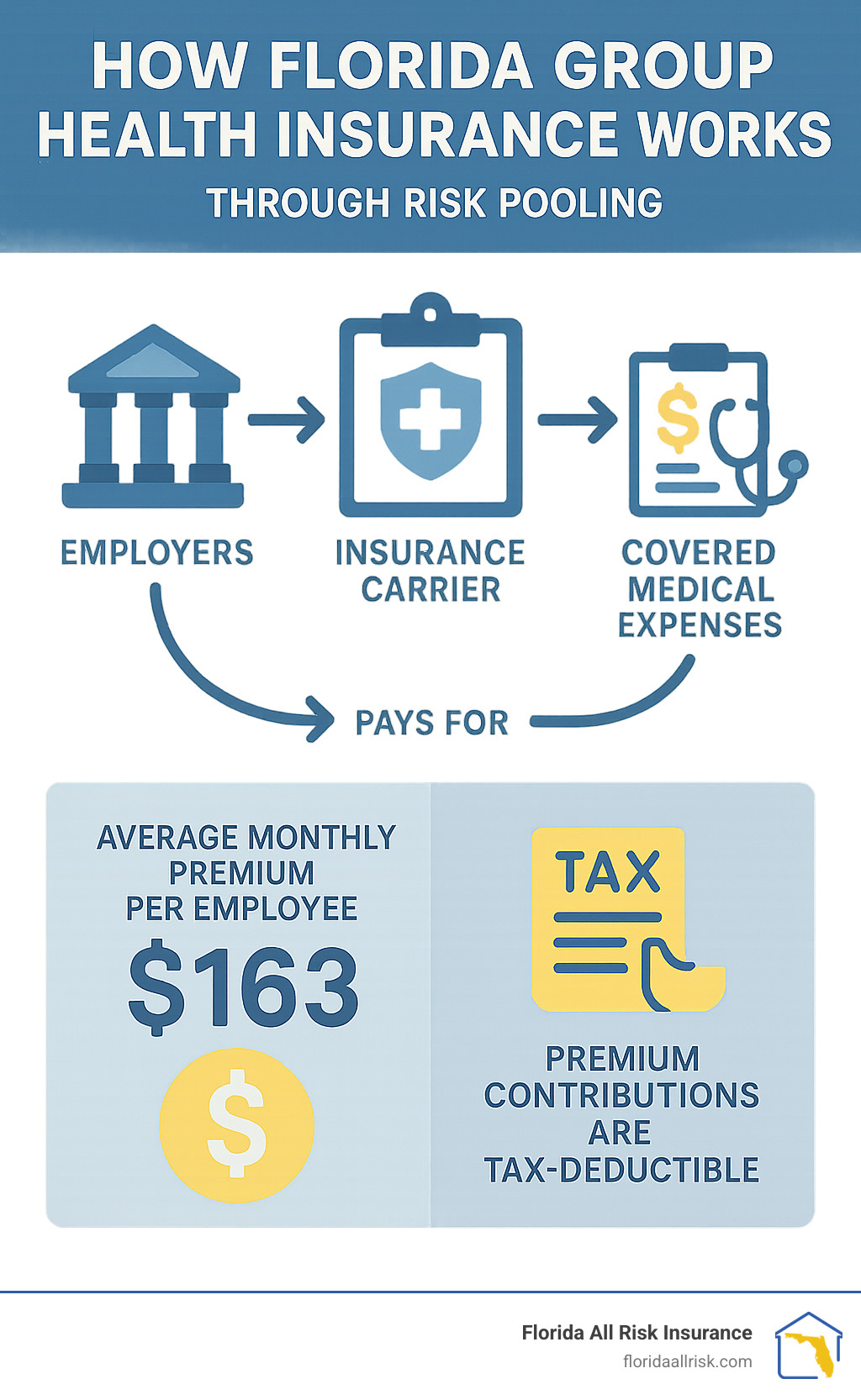
Group health insurance works through a beautiful concept called risk-pooling. By bringing multiple employees together under one plan, the financial risk gets spread across the entire group. This collective approach typically results in more stable rates and better benefits than what individuals could find on their own.
At Florida All Risk Insurance, we believe that quality healthcare should be accessible to everyone. Group plans make this possible by leveraging the power of numbers.
How does Florida group health insurance work?
Florida group health insurance creates a three-way partnership between your business (as the policyholder), the insurance carrier, and your employees (and their dependents). It’s a relationship built on shared responsibility.
For small Florida businesses with 1-50 employees, most plans are fully insured. This means your company pays a fixed monthly premium, and the insurance carrier takes on all the financial risk for claims. No surprises or unexpected costs – your budget stays predictable.
Most employers share premium costs with their team members. Typically, businesses cover between 50-83% of employee-only premiums, with employees handling the remainder through payroll deductions. Dependent coverage costs are often passed to employees, though some generous employers choose to subsidize these too.
One important Florida-specific detail: unlike some states, Florida doesn’t participate in the federal Small Business Health Options Program (SHOP). All small group plans here are offered “off-exchange” directly through insurance carriers or trusted brokers like us.
As Maria, our client who owns a Tampa accounting firm, recently told us: “I was terrified of setting up health insurance for my team. Florida All Risk made it painless – they explained everything in plain English and found us a plan that didn’t break the bank.”
Who is eligible for Florida group health insurance in Florida?
For Florida group health insurance, eligibility follows specific guidelines that protect both employers and insurance carriers.
Your business qualifies if you have at least two employees (including yourself if you’re on payroll). Unfortunately, self-employed individuals or family-only businesses must use the individual market instead. You’ll also need legitimate business operations with appropriate licensing.
For employee eligibility, W-2 employees working 30+ hours weekly are typically considered full-time and automatically qualify. Part-timers working fewer than 30 hours may be eligible depending on carrier rules. Seasonal workers can qualify if they work at least 120 days per year. Independent contractors (those receiving 1099 forms) generally don’t qualify unless they’re reclassified as employees.
Most carriers require at least two full-time equivalents (FTEs) to establish a group plan. FTEs are calculated by combining hours of part-time employees – for example, two 15-hour-per-week employees equal one full-time equivalent.

Understanding these basics gives you a solid foundation for making informed decisions about your company’s health benefits. Providing health coverage isn’t just about compliance – it’s about taking care of the people who make your business successful.
For more scientific research on employer health benefits, check out the Kaiser Family Foundation’s 2023 Employer Health Benefits Survey.
Plan Options & Coverage Features in Florida
Florida group health insurance offers a variety of options to fit different workforce needs and budgets. As a Florida employer, understanding these choices helps you provide the right coverage that balances cost with the benefits your team values most.
Core medical plan choices
When exploring health plans for your team, you’ll encounter four main types in the Florida market:
Preferred Provider Organizations (PPOs) give your employees more freedom and flexibility. They can see specialists without referrals and access a wider network of doctors. While premiums are typically higher, employees enjoy lower out-of-pocket costs when they need care. For example, an in-network doctor visit might only require a $10 copay, while out-of-network care might reimburse at 80% after paying upfront.
Health Maintenance Organizations (HMOs) offer more affordable premiums with predictable copays, though with more limited provider networks. Florida offers two HMO varieties: Open Access HMOs that don’t require specialist referrals, and Gatekeeper HMOs where your primary doctor coordinates your specialty care. HMOs generally don’t cover non-emergency care outside their networks, making them ideal for budget-conscious employees who don’t mind staying within a specific provider system.
Point-of-Service (POS) Plans blend the best of both worlds, offering the network coordination of HMOs with some out-of-network coverage like PPOs. These middle-ground options appeal to employers looking for balance between cost and flexibility.
High-Deductible Health Plans (HDHPs) feature lower monthly premiums but higher deductibles. The sweet spot? They can be paired with tax-advantaged Health Savings Accounts (HSAs) where both you and your employees can contribute pre-tax dollars. In 2024, HDHPs must have minimum deductibles of $1,600 for individuals or $3,200 for families. They’re particularly popular among younger, healthier workforces.
Beyond these traditional options, alternative funding approaches have gained traction with Florida businesses:
Balance-funded plans combine elements of fully-insured and self-funded arrangements, giving employers more financial control while maintaining predictability.
Level-funded plans allow smaller businesses to self-fund with protection against catastrophic claims, often with more stable monthly payments.
Self-funded plans let larger employers assume financial risk directly, potentially saving on premiums while maintaining third-party administration.
As one Florida Blue representative told us, “We’ve got you covered whether you seek high-value benefits or the lowest-priced alternative.”
ICHRA vs Traditional Florida group health insurance
A newer option that’s changing the landscape is the Individual Coverage Health Reimbursement Arrangement (ICHRA). Rather than purchasing a group policy, employers reimburse employees for individual health insurance premiums and qualified medical expenses.
| Feature | Traditional Group Health Insurance | ICHRA |
|---|---|---|
| Reimbursement Model | Employer purchases group policy | Employer reimburses individual plan premiums and qualified expenses |
| Minimum Participation | Typically 70% of eligible employees | No minimum participation requirements |
| Employer Contribution | Generally 50%+ of employee premium | Flexible; can vary by employee class |
| Employee Choice | Limited to employer-selected plans | Any ACA-compliant individual plan |
| Portability | Coverage ends with employment | Employees keep their individual plans |
| Tax Treatment | Tax-deductible for employer; tax-free for employees | Tax-deductible for employer; tax-free for employees |
| Compliance | Complex ACA regulations | Simpler administration |
Smaller companies might consider Qualified Small Employer HRAs (QSEHRAs), which offer similar benefits with specific limitations on company size and contribution amounts.
Tom Miller, our benefits specialist at Florida All Risk Insurance, often shares: “Many small organizations can’t meet the 70% participation requirement for group plans and instead opted for a QSEHRA. This allows them to provide a valuable health benefit without the constraints of traditional group coverage.”
For more information about self-funded options, visit our guide on What is a Self-Funded Group Health Insurance Plan?
Value-add benefits Floridians love
The best Florida group health insurance plans go beyond basic medical coverage to include features that Florida employees particularly value.
Wellness Programs have become increasingly popular, with platforms like Better You Strides offering online tools, fitness challenges, nutrition guidance, and health coaching. Many carriers provide premium discounts for participation in healthy behaviors, creating win-win scenarios for employers and employees alike.
Telemedicine access has become essential, not just convenient. With 24/7 virtual visits through platforms like Doctor on Demand, your team can connect with healthcare providers for low or no cost, reducing time away from work and addressing health concerns before they become serious problems.
Pharmacy Benefits matter tremendously to employees managing chronic conditions. Beyond tiered formularies that make common medications affordable, mail-order options often provide discounts on maintenance medications. Some plans even offer preventive medications at no cost.
Mental Health Support has gained proper recognition as an essential benefit. Today’s best plans include robust counseling coverage, employee assistance programs, and resources for stress management – all crucial for maintaining a healthy, productive workforce.
Supplemental Benefits round out comprehensive coverage packages. Dental insurance (including pediatric dental), vision coverage, life and disability insurance, and specialized protection against critical illness and accidents can provide peace of mind beyond medical coverage.
Florida Blue’s Total Care Program exemplifies how these elements work together, focusing on “early intervention and chronic condition management” to improve health outcomes while controlling costs.

At Florida All Risk Insurance, we help you steer these options to create a benefits package that attracts and retains top talent while keeping costs manageable. The right combination of plans and features can make your company stand out in today’s competitive job market while supporting your team’s health and wellbeing.
Employer Responsibilities, Costs & Enrollment
Diving into Florida group health insurance means understanding what you’re signing up for as a business owner. Let’s walk through what’s involved—from legal requirements to getting everyone enrolled—in a way that makes sense for your company.
Legal Requirements and Contributions
If your business has 50+ full-time equivalent employees, you’re playing in a different ballpark:
You must offer affordable, quality coverage to at least 95% of your full-time team and their dependents. Not doing so in 2024? Expect a potential penalty of $2,970 per employee (after the first 30) if you offer no coverage at all. And if your coverage isn’t affordable, you could face an additional $4,460 hit for each employee who gets marketplace subsidies instead.
For smaller businesses with fewer than 50 FTEs, you have more flexibility—there’s no legal mandate to offer health coverage. However, to qualify for most group plans, you’ll typically need to contribute at least 50% toward employee-only premiums and have around 70% of eligible employees participate (after accounting for those with valid waivers).
As our HR consultant often reminds clients: “In order to stay competitive in today’s working environment, employers need to offer a health benefit package to their employees.” Even without a legal requirement, health benefits have become an expected part of a competitive compensation package.
Cost Considerations
When budgeting for Florida group health insurance, several factors influence what you’ll pay:
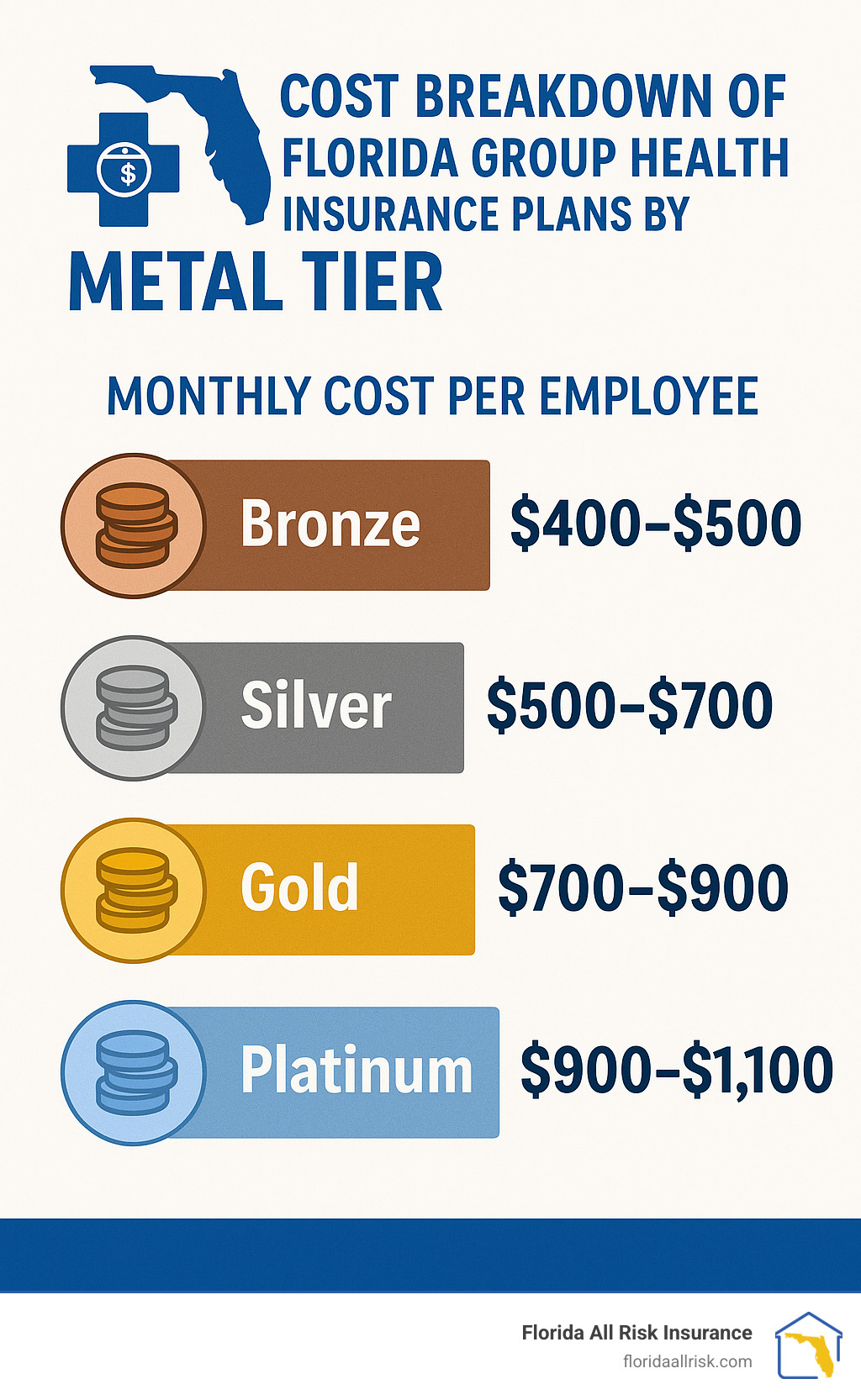
Your team’s age and size, the plans you select, where in Florida you’re located, which carrier you choose, and for larger groups, your claims history all affect pricing. Small group plans in Florida start around $163 per employee monthly, but realistically, most businesses pay between $400-$900 per employee each month depending on these variables.
Tax Advantages
One bright spot in offering Florida group health insurance is the tax benefits you’ll receive. As an employer, your premium contributions are 100% tax-deductible as a business expense. Plus, when you set up a Section 125 (cafeteria plan), you’ll save on FICA taxes for employee contributions.
Smaller employers should definitely look into the Small Business Health Care Tax Credit. If you have fewer than 25 FTEs with average annual wages under $50,000 and you contribute at least 50% toward premiums, you could receive a credit covering up to 50% of your premium contributions (35% for tax-exempt organizations).
Your employees win too—their premium contributions through payroll deduction are pre-tax, reducing their taxable income. If you offer HSA-compatible plans, they’ll enjoy additional tax advantages on their health savings.
Budgeting & saving strategies
Smart Florida business owners have found creative ways to manage health insurance costs while still providing quality coverage.
Consider level-funded plans, which offer the best of both worlds—predictable monthly payments with the potential for premium refunds if your group has lower-than-expected claims. These plans include stop-loss insurance to cap your liability and often cost 15-30% less than traditional fully-insured options.
HSA-compatible plans pair high-deductible health plans with Health Savings Accounts. Many employers contribute to their team’s HSAs to help offset the higher deductibles, while employees enjoy the triple tax advantage (tax-free contributions, growth, and qualified withdrawals).
Wellness initiatives can pay off too. Programs encouraging preventive care and healthy behaviors not only improve your team’s wellbeing but can lead to premium discounts from some carriers.
Be strategic with your contribution approach. A defined contribution (fixed dollar amount) rather than a percentage can help you budget more effectively. Some employers use tiered contributions based on salary or position, or implement spousal surcharges when other coverage is available.
One of our business clients recently shared: “It is a breath of fresh air to work with Florida All Risk Insurance. They saved us over $600 per month by finding a level-funded plan that provided even better coverage than our previous policy.”
Step-by-step enrollment roadmap
Getting your team enrolled in Florida group health insurance follows a clear timeline:
Starting 4-6 weeks before your desired effective date, prepare by completing your employee census with names, dates of birth, and dependent information. Determine your budget and contribution strategy, and identify must-have plan features and provider networks.
About 3-4 weeks out, review multiple carrier proposals with your broker, comparing benefits, networks, and costs before selecting your final plan offerings.
With 2-3 weeks remaining, focus on employee communication. Hold informational meetings, distribute Summary of Benefits and Coverage documents, and clearly explain costs, networks, and the enrollment process.
In the 1-2 weeks before your effective date, complete carrier applications, collect required documentation (like marriage certificates for dependents), and submit your final enrollment to the carrier.
On the effective date (typically the 1st of the month), distribute ID cards and plan documents, set up your premium payment process, and establish procedures for ongoing administration.
Unlike individual market plans that have fixed annual enrollment periods, Florida group health insurance can start any month of the year. For existing plans, annual renewals typically begin 30-60 days before your anniversary date, giving you time to explore alternatives if needed.
“When you’re offering benefits for the first time, the process can seem overwhelming,” explains our St. Petersburg-based benefits coordinator. “We guide employers through each step, ensuring they understand their options and responsibilities.”
At Florida All Risk Insurance, we make this journey smoother by handling the complex parts while keeping you informed and empowered throughout the process.
Frequently Asked Questions about Florida Group Health Insurance
How many employees are needed to start a group plan?
Starting a Florida group health insurance plan requires at least two full-time equivalent employees, and yes, owners can count if they’re on the payroll. This is one of the most common questions we hear at Florida All Risk Insurance.
“When I first called about getting coverage for my small business, I wasn’t sure if my three-person team would qualify,” shares Maria, a Tampa boutique owner. “I was relieved to learn we easily met the requirements.”
It’s worth noting that if you’re self-employed with no employees or running a family-only business, you’ll need to look at individual market options instead. Some carriers have additional requirements, like needing at least one employee who isn’t an owner or owner’s spouse. And remember, part-time employees can be combined to create full-time equivalents – two 15-hour-per-week employees equal one full-time equivalent in these calculations.
Are Florida employers legally required to offer health insurance?
The answer depends entirely on your company size:
If you have 50 or more full-time equivalent employees, the ACA’s employer mandate applies to you. This means you must offer affordable, minimum-value coverage to at least 95% of your full-time employees and their dependents – or face potentially significant penalties.
For smaller businesses with fewer than 50 FTEs, there’s no legal requirement to provide health insurance in Florida. That said, as one of our HR consultants often points out: “The law might not require you to offer health benefits, but the reality of today’s job market often does.” In a competitive hiring landscape, health benefits have become less of a perk and more of a necessity for attracting and keeping talented employees.
What deadlines and documents are required for enrollment?
Unlike individual health insurance with its limited annual enrollment window, Florida group health insurance offers more flexibility – you can establish coverage at any time during the year. However, there are still important timelines and documentation requirements to keep in mind.
For initial enrollment, most carriers will ask for:
– A completed employer application
– Employee enrollment forms (paper or online)
– Your first month’s premium payment
– Business documentation proving you’re a legitimate enterprise
– Wage and tax statements to verify employee status
“Documentation is everything,” explains Jason, our benefits specialist. “The most common hiccup we see is missing paperwork for qualifying life events. We always remind our clients to submit these changes promptly to avoid coverage gaps.”
For new employees, enrollment typically needs to happen within 30 days of their hire date or after they complete your waiting period (which can’t exceed 90 days). When employees experience qualifying life events like marriage or a new baby, they generally have 30-60 days to submit documentation and enroll.
For your annual renewal, decisions are typically due 15-30 days before your anniversary date, along with an updated employee census if you’re changing plan designs and new enrollment forms if switching carriers.
What is the difference between ACA-compliant and non-ACA plans?
When shopping for Florida group health insurance, you’ll encounter both ACA-compliant and non-ACA plans – and the differences are substantial.
ACA-compliant plans include all ten essential health benefits, have no annual or lifetime benefit maximums, cover pre-existing conditions, provide preventive services at no cost, and have regulated out-of-pocket maximums ($9,450 for individuals and $18,900 for families in 2024).
Non-ACA plans (like short-term or limited benefit plans) might seem attractive due to lower premiums, but they often exclude certain benefits, impose benefit caps, and deny coverage for pre-existing conditions. For larger employers with 50+ employees, offering these non-ACA plans can result in penalties if employees purchase subsidized marketplace coverage instead.
“Think of ACA plans as comprehensive protection, while non-ACA plans are more like partial coverage with significant gaps,” says Tom, our senior benefits advisor. “The premium difference often disappears when you factor in what you might pay out-of-pocket with less comprehensive coverage.”

How do group health insurance plans handle prescription drugs?
Prescription coverage is a crucial component of Florida group health insurance plans, though it’s often overlooked during the selection process. Most plans organize medications into tiered formularies:
Tier 1 features generic medications with the lowest copays, while Tier 2 covers preferred brand-name drugs with moderate copays. Tier 3 includes non-preferred brand-name drugs with higher copays, and Tier 4 encompasses specialty medications with the highest cost-sharing.
“When we’re helping clients choose the right plan, we always look closely at the prescription coverage,” explains our pharmacy benefits specialist. “For some companies, especially those with employees managing chronic conditions, the right formulary can make a huge difference in satisfaction and out-of-pocket costs.”
Many carriers now offer convenient mail-order pharmacy options with discounted pricing for maintenance medications. Some plans even provide free preventive medications before the deductible is met – a feature that can significantly improve medication adherence and overall health outcomes for your team.
When we help businesses evaluate their Florida group health insurance options, we make sure to consider not just the premium costs, but how well the prescription coverage aligns with their workforce’s specific needs.
Conclusion
Navigating Florida group health insurance doesn’t have to be overwhelming. With the right guidance, Florida employers can implement cost-effective health benefits that protect their employees while strengthening their business.
At Florida All Risk Insurance, we understand that each business has unique needs and challenges. Our St. Petersburg-based team specializes in creating customized Florida group health insurance solutions that balance comprehensive coverage with budget considerations.
Key takeaways for Florida employers:
– Group health insurance provides tax advantages and recruitment/retention benefits
– Multiple plan designs and funding options accommodate various budgets
– Small businesses (under 50 FTEs) have flexibility in contribution and participation
– Alternative approaches like ICHRAs offer new ways to provide health benefits
– Professional guidance simplifies compliance and administration
Whether you’re offering benefits for the first time or reviewing your existing coverage, we’re here to help. Our consultative approach ensures you understand all available options and can make informed decisions for your business and employees.
Ready to explore Florida group health insurance options? Contact Florida All Risk Insurance today for a personalized consultation and quote. Let us help you steer the complexities of employee benefits with confidence and clarity.
For more information about group health coverage options, visit our dedicated page or call our St. Petersburg office to speak with a benefits specialist.

