How to Find Current Florida Evacuation Orders
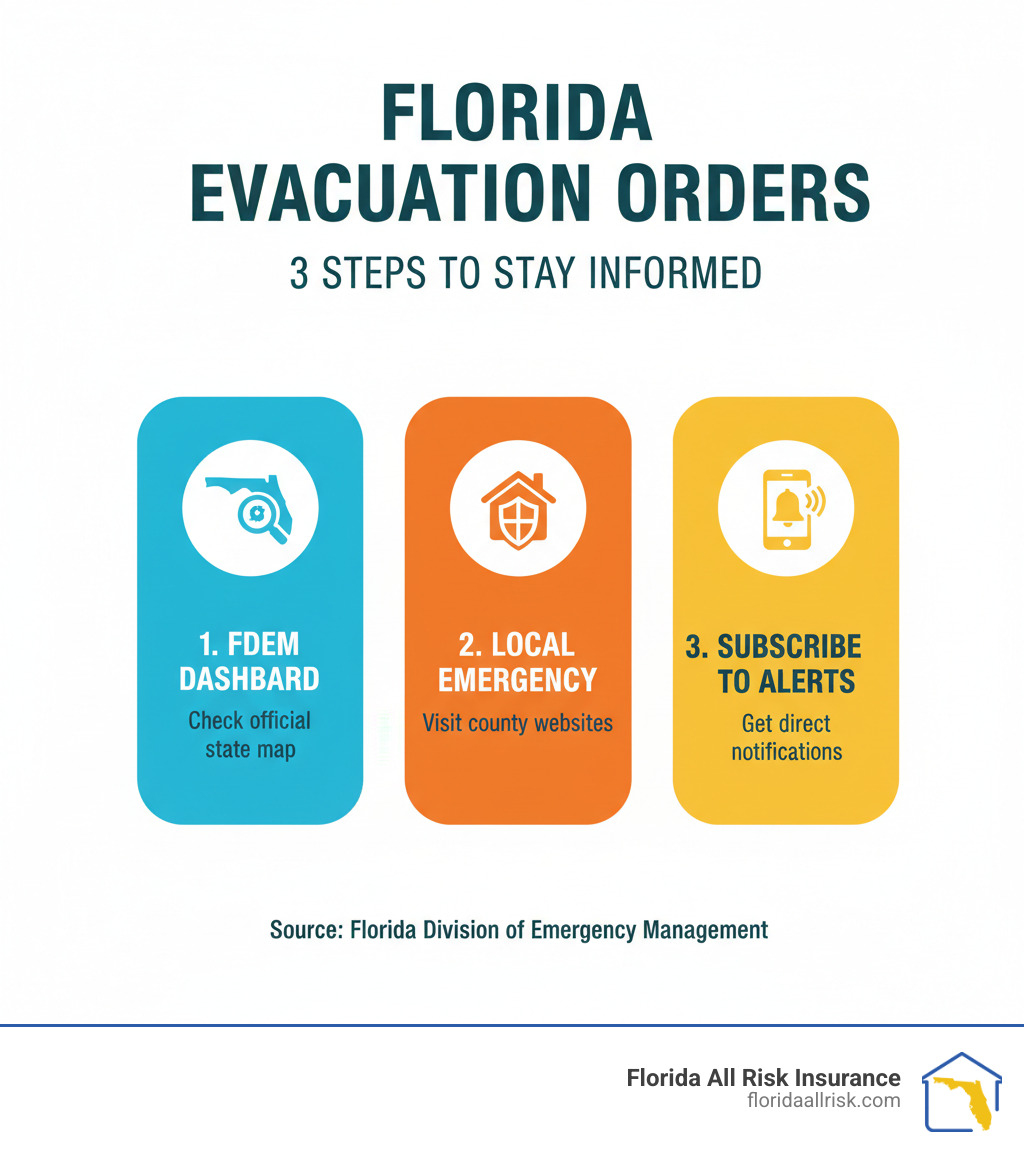
Understanding florida evacuation orders is a critical skill for every resident in the Sunshine State, especially when hurricanes threaten our coastlines. Knowing where to find the most up-to-date information can make all the difference in keeping your family safe. If you’re looking for current evacuation orders, here’s how to quickly find them:
- Official State Dashboard: Visit the Florida Division of Emergency Management (FDEM) website. They provide a map-based dashboard that shows active evacuation orders across all counties. This is often the quickest way to get a statewide view.
- Local Emergency Management: Check your specific county’s Emergency Management website. Local officials issue these orders, and their site will have the most detailed, localized information, including maps and specific instructions for your area.
- Emergency Alerts: Sign up for local emergency alerts (like AlertFlorida) and ensure your mobile phone’s Wireless Emergency Alerts (WEA) are enabled. These systems send direct notifications if your area is under an evacuation order.
Evacuation orders are serious directives designed to protect lives from dangerous storm impacts, primarily storm surge flooding. As an insurance professional with over 20 years in Florida’s market, I’ve seen the devastating impact of hurricanes and know that preparedness is the key to safety. These guidelines are here to help you steer these critical moments with confidence.
Understanding Evacuation Zones, Storm Surge, and Re-Entry
When you hear about evacuation zones, it can sound like alphabet soup—Zone A, Zone B, storm surge. This system is a thoughtfully designed safety net that ensures the most vulnerable people get to safety first. Here in St. Petersburg and throughout Florida’s coastal counties, this system is vital.
Florida’s Evacuation Zones: A-F
Florida’s coastal counties use evacuation zones labeled A through F. Crucially, these zones are not based on a storm’s wind speed or category; they are based on your location’s vulnerability to storm surge flooding.
- Zone A is where danger hits first. If you live on a barrier island, in a low-lying coastal area, or in a mobile home, you are likely in Zone A. When officials issue florida evacuation orders, Zone A residents are always called to leave first.
- As you move inland, the zones progress through B, C, D, E, and F, each representing progressively higher ground and less immediate risk. When officials order an evacuation of Zone C, they are also ordering Zones A and B to evacuate. This cumulative, phased approach prevents everyone from hitting the roads at once, which would create dangerous gridlock.
This tiered system exists in all of Florida’s coastal counties and those along the St. Johns River—anywhere storm surge can reach. The beauty of this standardized system is its clarity. When you hear “Zone A,” whether you’re in Miami-Dade or Pinellas County, you know it means the most vulnerable areas.
Storm Surge Zones vs. Evacuation Zones
This distinction confuses many people, but it’s simple: a storm surge map shows where water could go, while an evacuation zone map shows who needs to get out based on that threat and other logistical factors. A storm surge zone is a map prediction from the National Hurricane Center (NHC), which uses sophisticated models like SLOSH (Sea, Lake, and Overland Surges from Hurricanes) to show where water is expected to flow.
An evacuation zone is an action plan. Emergency managers take those surge predictions and add real-world factors like road clearance times and which neighborhoods could be cut off by flooding. This is why your home might be in an evacuation zone even if it sits on slightly higher ground. The issue isn’t just whether water reaches your door—it’s whether you’ll be trapped with no way for rescuers to reach you. The risk of Florida Flooding drives both types of zones, but evacuation zones are where the rubber meets the road for public safety.
Re-Entry and Special Cases
After the storm, you’ll encounter re-entry zones. These are different from evacuation zones. Counties restrict access to damaged areas so emergency crews can work safely. Monroe County (the Florida Keys) has a highly organized sticker-based re-entry system to phase residents back in.
The Keys also have a unique evacuation system. With only U.S. Route 1 as an artery, they use a phased plan based on Mile Markers (MM), evacuating zones sequentially to prevent gridlock on that single highway.
Finally, understanding your property’s location on the FEMA Flood Zone Map adds another layer of knowledge. Your evacuation zone tells you when to leave during a storm; your FEMA flood zone informs your long-term flood risk for insurance purposes.
The Decision-Making Process: Who Issues Orders and Why?
An evacuation order represents hours of careful analysis by local officials who understand what’s at stake. The decision is never made lightly and is handled at the local level by those most familiar with their community’s specific vulnerabilities.
Who Issues the Orders?
Evacuation orders are issued by county governments, typically by the county commission or mayor. This decision is based on the professional recommendation of the county’s Emergency Management Director. This local control is essential because it ensures that decisions are custom to the unique geography and population of each area. For example, the Emergency Management Director for Pinellas County, where our St. Petersburg office is located, works closely with county leaders, state agencies like the FDEM, and law enforcement to coordinate a safe and orderly process.
These officials are the conductors of a large orchestra. They analyze the threat by interpreting detailed forecasts, recommend action to elected officials, communicate clearly to the public through every available channel, and manage critical resources like public shelters and transportation for those with special needs.
Voluntary vs. Mandatory Orders
You’ll often hear the terms “voluntary” and “mandatory.” Officials may initially issue a “voluntary” or “recommended” evacuation, urging residents in certain zones to leave. This is a strong suggestion to get ahead of the storm. As the threat becomes more certain, this often escalates to a “mandatory” order.
While you may not be physically forced from your home during a mandatory evacuation, staying behind has serious consequences. Once tropical storm-force winds (around 39 mph) arrive, emergency services are suspended. First responders will not be sent into harm’s way. You could be stranded without assistance for days with no power, no water, and no way to call for help. Some counties have ordinances making it a misdemeanor to ignore an order, but the real consequence is survival. Always heed the advice and orders of local officials.
What Factors Influence the Decision?
The decision to issue florida evacuation orders is a complex risk analysis based on multiple data points. Emergency managers use sophisticated modeling and historical data to guide them. Key factors include:
- Storm Surge Forecast: This is the single most important factor. The predicted height and extent of coastal flooding—the potential for water inundation above ground level—is the primary driver.
- Storm Intensity and Track: The storm’s category (wind speed), size, forward speed, and projected path all determine which areas are at greatest risk. A larger, lower-category storm can create a more damaging surge than a smaller, more intense one.
- Tidal Cycles: A storm surge arriving at high tide will be significantly more destructive than one arriving at low tide. This timing is a crucial calculation.
- Inland Flooding: Heavy rainfall from a hurricane can cause severe freshwater flooding, which also influences evacuation decisions, especially near rivers like the St. Johns.
- Evacuation Clearance Times: Officials must consider how long it will take to safely move a large population out of harm’s way, sometimes issuing orders days in advance to prevent gridlock. Assessing these risks is also fundamental to understanding Flood Insurance Requirements Florida.
Preparing for an Evacuation: Your Essential Checklist
The “Know Your Zone, Know Your Home” initiative is a cornerstone of Florida’s preparedness strategy. It emphasizes two critical actions: know if you’re in an area that might require evacuation, and understand if your home is strong enough to withstand a storm if you’re not ordered to leave.
Homes built after 2002, when the Florida Building Code was significantly strengthened, are generally more resilient. If you’re unsure about your home’s construction, it’s worth checking your property records. Before any florida evacuation orders are issued, you should have a plan and a kit ready to reduce stress and ensure safety.
Your Evacuation “Go-Bag”
This is your survival kit for at least 3-7 days. It should be easy to grab and go.
- Important Documents: Gather insurance policies (home, flood, auto), deeds, birth certificates, and medical records. Store digital copies in the cloud and on a waterproof USB drive, and keep originals in a waterproof, fireproof container.
- Cash: ATMs and credit card machines won’t work without electricity. Have enough small bills for gas, food, and other necessities for at least a week.
- Medications: Pack a one-to-two-week supply of all prescription and over-the-counter medications, plus a first-aid kit.
- Electronics: Include chargers and fully charged battery packs for all your devices.
- Food and Water: Have at least a three-day supply of non-perishable food and one gallon of water per person, per day.
- Other Essentials: Pack clothing, personal hygiene items, a flashlight, a battery-powered radio, a whistle, and a wrench or pliers to turn off utilities.
Securing Your Home Before You Leave
Taking steps to mitigate damage can make a real difference in what you come home to.
- Install storm shutters or pre-cut plywood over all windows and glass doors.
- Bring everything inside: Secure outdoor furniture, decorations, and anything that could become a projectile in high winds.
- Turn off utilities (water, electricity, gas) if instructed by officials to prevent flooding and fire risk.
- Move valuables and important papers to the highest possible level of your home.
- Lock all doors and windows before you leave.
Don’t Forget Your Pets
Never leave your pets behind. Confirm pet-friendly hotels along your evacuation route or know the location of pet-friendly public shelters, as not all shelters accept pets. Your pet’s go-bag should include food, water, bowls, a leash, a carrier, medical records, and any medications.
The first step in all of this is to use the state’s Know Your Zone Interactive Map to find your zone now. It’s also a good time to review your Flood Insurance Coverage Florida to ensure you’re adequately protected.
Evacuation Logistics: Routes and Special Assistance
When emergency managers say, “evacuate tens of miles, not hundreds of miles,” they are sharing a critical life-saving strategy. The goal during a florida evacuation orders situation is not to flee the state, but to move from a vulnerable, low-lying area to a safer, more inland location. This approach reduces traffic congestion, conserves fuel, and helps ensure everyone who needs to evacuate can do so.
Understanding Your Evacuation Routes
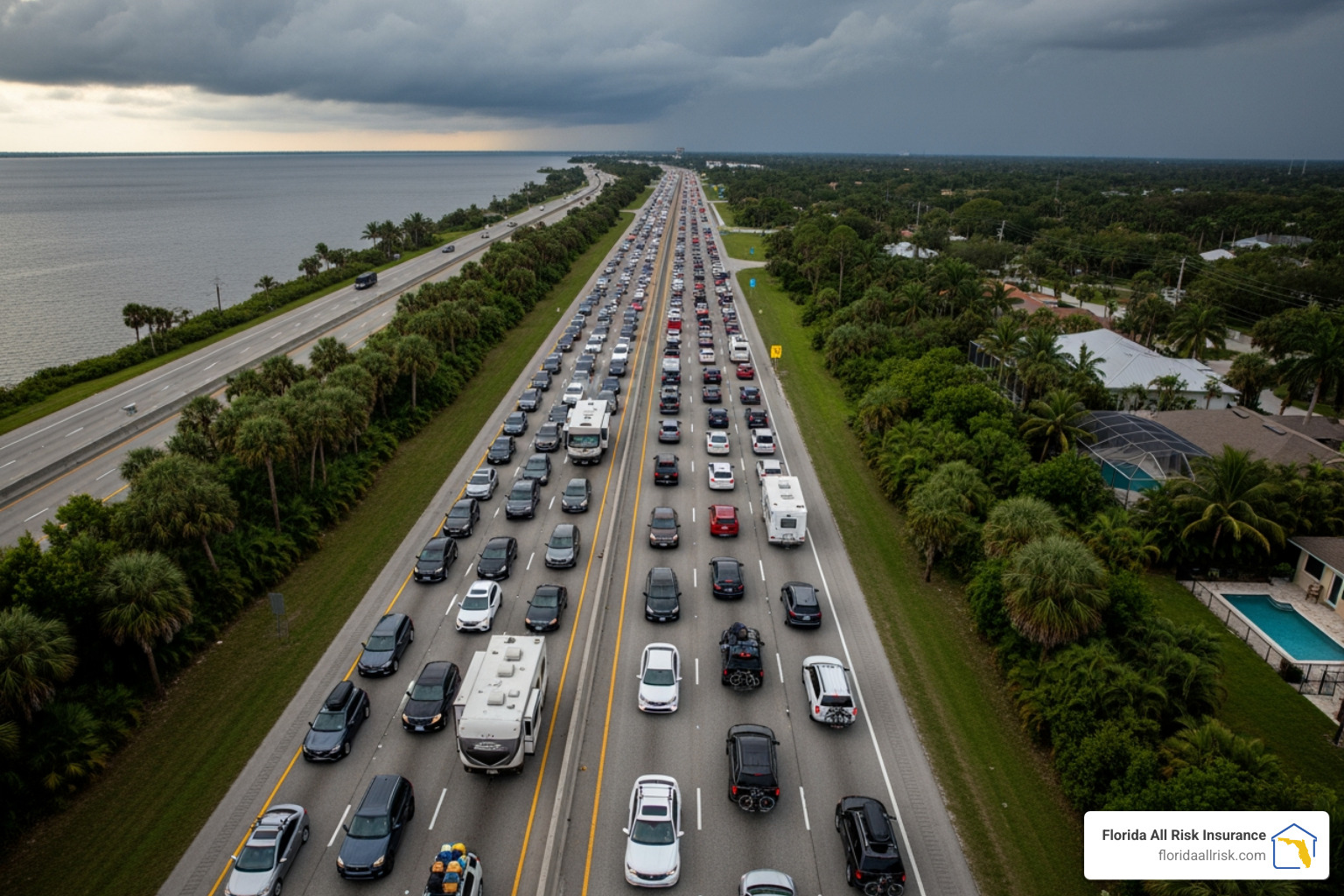
Before a storm appears on the horizon, you should be familiar with your designated evacuation routes. Florida’s major evacuation arteries include I-75, I-95, I-10, and the Florida Turnpike. The Florida Department of Transportation (FDOT) pre-determines these routes to ensure they can handle a surge of vehicles. You should know your primary route and have at least two alternates planned.
In extreme situations, officials may implement “contraflow,” where all lanes of a highway are directed away from the coast. This turns an interstate into a one-way evacuation corridor to maximize vehicle flow. If contraflow is activated, follow all instructions from law enforcement.
Regional routes vary by geography. In St. Johns County, residents on Anastasia Island and in Ponte Vedra Beach follow specific westward routes to reach I-95. In the Florida Keys, the entire island chain relies on U.S. Route 1. Monroe County’s carefully orchestrated, phased evacuation plan based on mile markers is designed to prevent gridlock on this single artery. If you live in the Keys, you must leave when your zone is called.
Special Needs Assistance Requires Advance Planning
If you or a family member has a medical condition, disability, or other circumstance that would make evacuating on your own difficult, Florida has a system to help—but you must register in advance. The Florida Special Needs Registry, managed by your county’s emergency management office, allows officials to plan for your specific requirements. This may include transportation to a Special Needs Shelter, which is equipped with medical staff and backup power.
You cannot wait until a storm is approaching to register for this assistance. The time to do this is now, during the calm before the storm season. Emergency managers need time to coordinate transportation and resources. Registering is straightforward—visit your county emergency management website or call their office. If your situation changes, be sure to update your registration.
The logistics of evacuation also extend to financial recovery. Understanding the Average Cost of Flood Insurance in Florida helps you budget for this essential protection, ensuring you have the resources to rebuild after a storm.
Sheltering in Place: When and How to Stay Put
Sometimes, the safest choice during a storm is to stay right where you are. If you are not in a designated evacuation zone and your home is sturdy, sheltering in place can be a sound decision. It helps keep roads clear for those in mandatory evacuation zones who truly need to leave.
Conditions for Sheltering in Place
Before deciding to stay, ensure you meet these key conditions:
- You are NOT in a mandatory evacuation zone. If officials have issued florida evacuation orders for your area, you must leave.
- You do NOT live in a mobile home or RV. These structures are highly vulnerable to hurricane-force winds and are almost always included in early evacuation orders.
- Your home is well-built and away from flood-prone areas. Homes constructed after the 2002 Florida Building Code update are more resilient, but no home is hurricane-proof. If you have any doubts about your home’s structural integrity, the safest choice is to relocate to a more secure building or public shelter.
Risks and Preparations
Choosing to stay put means being prepared for the risks. You could face extended power outages for days or even weeks. Communication systems may be disrupted, and emergency services will not be able to reach you during the storm. You must be completely self-sufficient.
To ensure your safety, your shelter-in-place kit should cover 7-14 days:
- A 7-14 day supply of non-perishable food and water (one gallon per person, per day).
- A manual can opener, battery-powered radio, flashlights, and extra batteries.
- A complete first-aid kit and all necessary prescription medications and medical supplies.
- Sanitation supplies like moist towelettes and garbage bags.
- Entertainment such as books, games, or puzzles to pass the time without power.
Designate a safe room within your home. This should be an interior room on the lowest level that is not susceptible to flooding, with no windows or skylights. This is where you will gather with your family and supplies when the storm is at its peak.
Even if your home isn’t in a high-risk flood zone, heavy rainfall can cause flooding anywhere. It’s a good time to ask, “Do All Homes in Florida Require Flood Insurance?“—the risk is widespread across our state.
Frequently Asked Questions About Florida Evacuation Orders
If I’m ordered to evacuate, do I legally have to leave?
This is one of the most common questions we hear at Florida All Risk Insurance, especially from first-time Florida residents. The short answer is: while there may be legal consequences in some counties for defying a mandatory florida evacuation orders, the real issue is far more serious than a fine.
When local officials issue a mandatory evacuation order, they’re making a difficult decision based on genuine concern for your life. They’re looking at storm surge models, wind forecasts, and the safety of their community. If you choose to stay in your home after a mandatory order is issued, you’re not just risking your own safety—you’re potentially putting first responders in danger too.
Here’s the reality: once tropical storm-force winds reach about 39 mph, emergency services stop responding to calls. Fire trucks, ambulances, and police cannot operate safely in those conditions. If you’re injured, if your roof collapses, or if water starts rising in your home, no one can come to help you. You will be on your own until the storm passes and roads are cleared, which could be many hours or even days.
Some Florida counties do have ordinances that make it a misdemeanor to ignore a mandatory evacuation, but honestly, the legal penalty is the least of your worries. The real consequence is survival. We’ve seen too many tragic stories over the years of people who thought they could ride it out, only to realize too late that they made a fatal error. Our advice, always and without exception: heed the florida evacuation orders issued by your local officials.
What assistance is available if I need help evacuating?
If you’re worried about how you’ll evacuate—whether it’s due to a medical condition, a disability, lack of transportation, or financial constraints—you’re not alone, and there is help available. But here’s the critical part: you must plan ahead.
Florida has a statewide Special Needs Registry that’s managed at the county level through your local emergency management office. This registry is for anyone who has medical needs that would make a typical evacuation difficult. This includes people who require oxygen, use wheelchairs or walkers, are on dialysis, or have other conditions that need special accommodations. When you register in advance, your county can plan for your specific needs, which might include arranging transportation to a Special Needs Shelter equipped with medical staff and generators.
Many counties also work with local nonprofits, churches, and community organizations to provide rides for residents who don’t have vehicles or can’t drive. However—and this is important—these resources are limited and often operate on a first-come, first-served basis. If you wait until a storm is 24 hours away to ask for help, there’s a good chance assistance won’t be available. Emergency management teams can only do so much when thousands of people suddenly need help at once.
The best time to figure out your evacuation assistance is right now, long before hurricane season starts. Call your county’s emergency management office today. Ask about the Special Needs Registry, transportation options, and what shelters will be available. Having this conversation in May is infinitely easier than having it in September when a Category 4 is bearing down on the coast. We’ve helped many of our clients at Florida All Risk Insurance understand these resources, and we’re always happy to point you in the right direction.
How do I know if my home is safe enough to shelter in place?
This is perhaps the most nuanced question we get about hurricane preparedness, and it deserves a thoughtful answer. The “Know Your Home” principle that Florida emergency managers promote is absolutely essential to making this decision safely.
First and foremost, if you’re in a designated evacuation zone—any zone from A through F—this question is already answered for you. You must leave. Period. Your home’s construction quality doesn’t matter if it’s going to be underwater or battered by sustained hurricane-force winds.
But if you’re inland and not in an evacuation zone, then your home’s construction becomes the deciding factor. Homes built after 2002 in Florida are significantly stronger than older homes. That year marked a major update to the Florida Building Code following Hurricane Andrew’s devastation. These newer homes have reinforced roofs, stronger connections between the roof and walls, and often impact-resistant windows. They’re built to withstand high winds in a way that older homes simply aren’t.
However—and this is a big however—no home is truly hurricane-proof. Even a well-built home can suffer catastrophic damage from a major hurricane. You need to honestly assess several factors about your specific property. Is your home in a low-lying area where water collects after heavy rain? Check your property’s location on the Florida Flood Insurance Rate Map to understand your flood risk, even if you’re not in an official storm surge zone. Flooding can happen anywhere in Florida, especially from the torrential rainfall that hurricanes bring.
What type of structure do you live in? If you’re in a mobile home or RV, the answer is clear: you must evacuate, regardless of your zone or the storm’s category. These structures cannot withstand hurricane winds and are typically included in the earliest evacuation orders.
Does your home have any existing issues? An old roof, damaged windows, cracks in the walls, or a compromised foundation all increase your risk. If you have any doubts—any at all—about your home’s ability to protect you, the safest choice is to relocate to a more secure building, stay with friends or family in a stronger home, or go to a public shelter. Your life is worth far more than the inconvenience of leaving for a few days.
We often tell our clients at Florida All Risk Insurance that understanding your home’s vulnerability isn’t just about evacuation decisions—it’s also about making sure you have the right insurance coverage. Many homeowners are surprised to learn that standard policies don’t cover flood damage. If you’re curious about whether your home requires it, you can read more about Do All Homes in Florida Require Flood Insurance? The answer might change how you think about your risk.
Conclusion: Your Final Step in Hurricane Preparedness
Navigating florida evacuation orders is a critical skill for every resident of our beautiful Sunshine State. By understanding your evacuation zone, having a solid plan, and knowing where to find reliable information, you can turn anxiety into confident action. The most important takeaways are simple: know your zone, have a plan, and always heed the orders of your local officials. Being proactive is your absolute best defense against a storm.
As your neighbors right here in St. Petersburg, we at Florida All Risk Insurance know that true preparedness goes beyond physical safety. It also means ensuring your largest asset—your home—is financially protected. With over two decades of experience helping Floridians, our local team specializes in cutting through the confusion of insurance. We’re here to help you understand your unique risks and secure the right coverage for your family’s future.
Before the next storm watch appears on the horizon, let’s chat. We can review your homeowners and flood insurance policies together to ensure you have the peace of mind that comes with being truly prepared, both physically and financially.
- Ready to take that crucial next step? Get a Flood Insurance Quote with us now. We’ll help you find options for the Cheapest Flood Insurance Florida that also offer the Best Flood Insurance Florida coverage for your needs.
- To understand your property’s specific risks, take a moment to view the Florida Flood Insurance Rate Map. It’s an invaluable tool for preparedness.
Contact Us
We hope this guide has offered you clarity and confidence in understanding florida evacuation orders. Our passion at Florida All Risk Insurance stems from a deep commitment to our community. We believe that being well-informed and well-protected is the best defense against the unexpected.
If you have any questions about your insurance coverage or need a review of your current policies, please don’t hesitate to reach out. Our local team is ready to provide personalized guidance.
Florida All Risk Insurance
450 1st Ave N
St. Petersburg, FL 33701
Email: [email protected]