

Flood insurance agent near me: Best 2025 Protection
Why Finding the Right Flood Insurance Agent Near You Is Critical
When searching for a flood insurance agent near me, Florida homeowners are not just looking for a policy; they are seeking a financial shield against one of nature’s most destructive forces. In a state defined by its proximity to water, having a qualified professional who deeply understands local risks and can steer both government and private insurance options is not a luxury—it’s a necessity. The urgency is real and growing. With changing weather patterns and evolving flood maps, the risk of flooding is a constant threat that extends far beyond the coastline.
The financial stakes are staggering. FEMA reports that just one inch of water inside a home can cause over $25,000 in damage. This isn’t just the cost of replacing soaked carpets; it’s the expense of tearing out and replacing drywall, remediating mold that can bloom in as little as 24 hours, replacing ruined furniture and electronics, and repairing compromised electrical and HVAC systems. For most families, absorbing such a cost out-of-pocket is financially devastating. This is compounded by the hard truth that standard homeowners insurance policies explicitly exclude flood damage. To protect your property, a separate, dedicated flood policy is essential. Since most policies have a mandatory 30-day waiting period, finding an agent and securing coverage before you need it is the only way to be prepared.
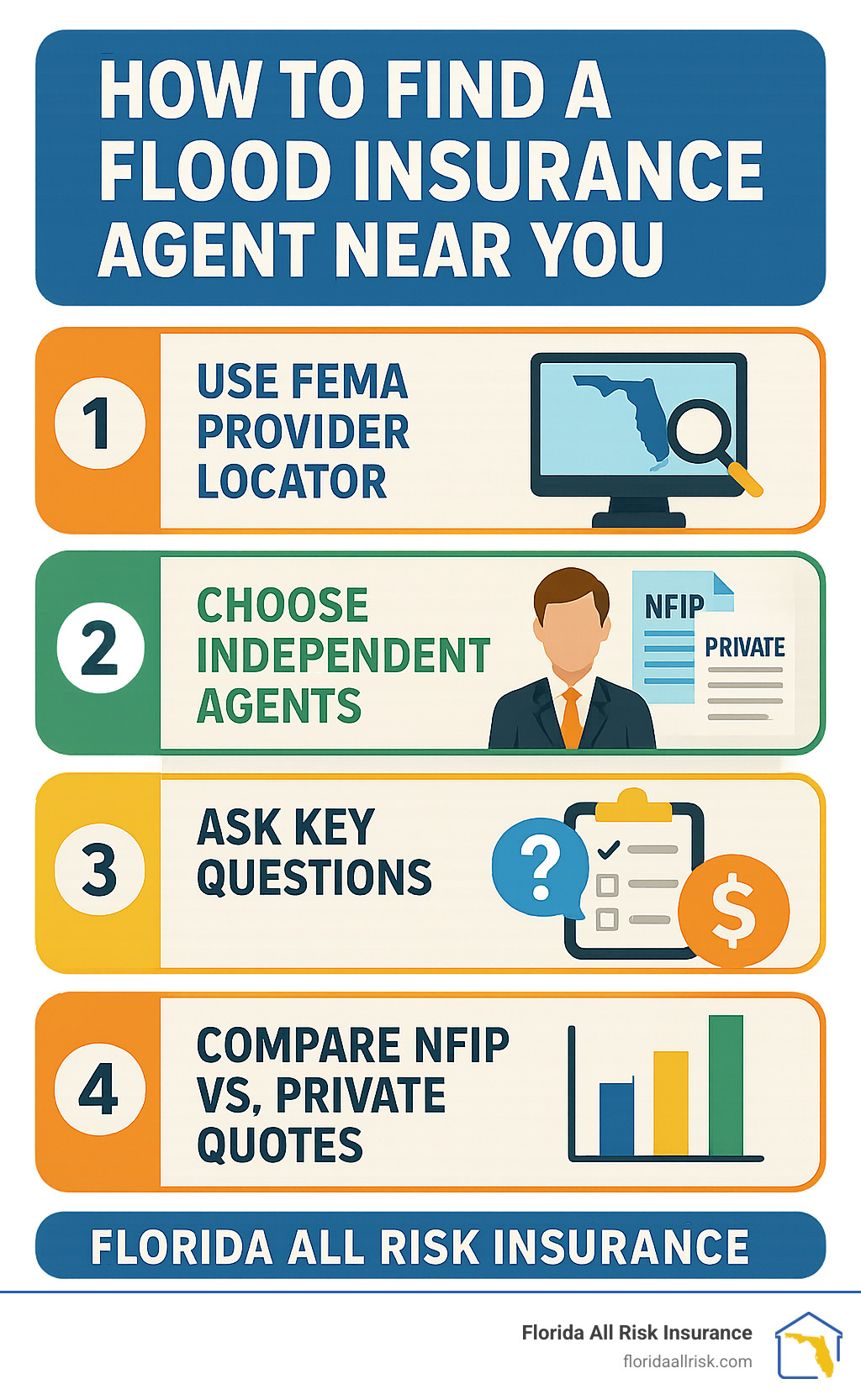
How to Find a Flood Insurance Agent Near You:
- Use FEMA’s Provider Locator: This is the official federal directory of licensed providers authorized to sell NFIP policies. It’s a reliable starting point to find legitimate agents in your area.
- Check State Insurance Websites: Before committing, visit your state’s Department of Insurance website to verify an agent’s license is active and to check for any complaints or disciplinary actions.
- Choose Independent Agents: Unlike captive agents who only represent one company, independent agents work with multiple carriers. This gives you access to both NFIP and a wide range of private flood insurance options, ensuring you get the best coverage at the most competitive price.
- Ask Key Questions: A prepared homeowner is an empowered one. Inquire about their Florida licensing, the specific coverage options they offer, and their experience with the unique flood risks in your specific neighborhood.
- Get Multiple Quotes: Don’t settle for the first offer. Comparing quotes from both the NFIP and several private insurers is the best way to understand the market and find the policy that best fits your needs and budget.
Florida’s unique geography demands local expertise. The right agent understands which providers are most competitive in your specific location, whether you’re in a coastal high-risk zone or an inland area prone to flash floods. They are your most valuable resource in securing adequate protection against devastating financial loss.
Flood insurance agent near me word guide:
Why Your Standard Homeowners Policy Isn’t Enough
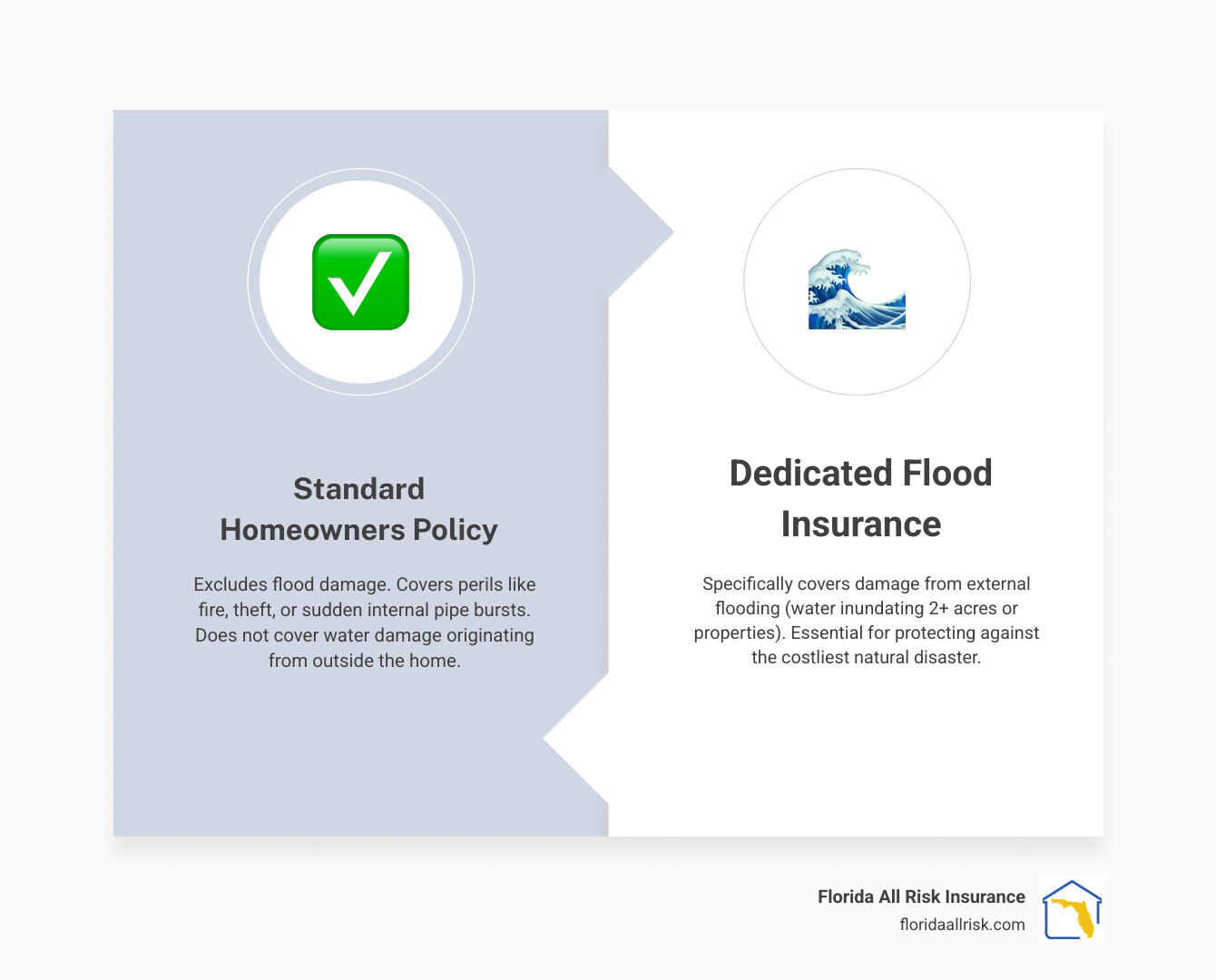
Many Florida homeowners are shocked to learn their standard policy doesn’t cover flood damage, a critical and often misunderstood blind spot in their financial protection. The National Flood Insurance Program (NFIP), which sets the standard, defines a flood as a general and temporary condition where two or more acres of normally dry land or two or more properties are inundated by water or mudflow. This water must come from an outside source, such as an overflowing river, a coastal storm surge, or runoff from heavy rains. A burst pipe inside your home that floods your kitchen is typically covered by your homeowners insurance; the water from a hurricane’s storm surge that inundates your entire first floor is not.
Why Flood Damage is Excluded
Insurers exclude flooding from standard policies because it is a catastrophic risk. Unlike isolated events like a house fire or theft, a major flood can affect an entire region simultaneously, leading to thousands or even millions of claims at once. If a single private insurer were responsible for all these losses, it could face bankruptcy. This systemic risk is why dedicated flood protection exists as a separate product, backed either by the federal government or specialized private carriers, designed specifically to handle this widespread peril. This separation ensures that funds are available to help communities recover from large-scale disasters without destabilizing the entire insurance market.
The cost of even minor flooding is sobering. Just one inch of water in an average 2,000-square-foot home can cause more than $25,000 in damage. This includes replacing flooring and drywall, repairing electrical systems, and discarding contaminated furniture. Within 24-48 hours, mold can begin to grow, adding thousands more in remediation costs that often require professional intervention. Without a dedicated flood insurance policy, these expenses come directly from your savings, retirement funds, or high-interest loans, putting your financial future in jeopardy. Flood protection is your financial lifeline, ensuring you have the resources to rebuild without facing bankruptcy.
Understanding Your Flood Risk
Every property in Florida has some level of flood risk, regardless of its distance from the coast. FEMA maps this risk in Flood Insurance Rate Maps (FIRMs), which categorize areas into different flood zones. High-risk areas, known as Special Flood Hazard Areas (SFHAs), have a 1% or greater annual chance of flooding (often called the “100-year flood”). These zones, typically labeled with letters like A or V, usually require mandatory flood insurance for homes with federally backed mortgages. Moderate-to-low risk areas (often Zone X) have a less than 1% chance of flooding. However, “low-risk” does not mean “no risk.”
The most surprising statistic is that more than 40% of all NFIP flood insurance claims occur outside of high-risk flood areas. This highlights a dangerous misconception among homeowners. Factors like rapid urban development, which replaces absorbent soil with non-porous concrete, and increasingly intense, localized rainstorms can overwhelm drainage systems and cause flash floods anywhere. You can check your flood zone here using FEMA’s official tool, but even if you are in a low-risk zone, you are not immune to flooding.
The High Cost of Waiting
Delaying the purchase of flood insurance is a high-stakes gamble. For families, a flood means not just financial strain but also displacement, emotional trauma, and the loss of irreplaceable belongings. For businesses, the stakes are even higher: FEMA reports that nearly 40% of small businesses never reopen their doors following a disaster. They simply cannot afford to repair the damage and cover ongoing expenses while being closed for an extended period.
Many people mistakenly believe that federal disaster assistance will bail them out. However, this aid is often misunderstood. First, it is only available if the President issues a formal disaster declaration, which does not happen for every flood event. Second, the most common form of assistance is a low-interest loan from the Small Business Administration (SBA), which must be repaid with interest, adding to your financial burden. A typical disaster loan can add hundreds of dollars to a family’s monthly expenses for years. In contrast, a flood insurance policy provides direct payments for covered losses—money that does not need to be repaid. It is proactive financial planning that provides the resources to rebuild your life immediately.
For more information about protecting your property, explore our flood insurance products and see how we can help safeguard your financial future.
Decoding Your Flood Insurance Options
When you search for a flood insurance agent near me, you will find two primary avenues for obtaining coverage: the long-standing, government-backed National Flood Insurance Program (NFIP) and the dynamic, rapidly growing private flood insurance market. For decades, the NFIP was virtually the only option available. However, legislative changes and advancements in risk modeling have fueled the growth of the private market, creating more choices for consumers—often with superior coverage and more competitive pricing. Understanding the nuances of each is crucial, especially since if you have a mortgage from a federally regulated lender and live in a high-risk flood zone (a Special Flood Hazard Area), you are legally required to have flood insurance.
The National Flood Insurance Program (NFIP)
Managed by the Federal Emergency Management Agency (FEMA), the NFIP was established by Congress in 1968 to provide standardized flood protection in communities that agree to adopt and enforce floodplain management ordinances. While you purchase an NFIP policy through a private insurer participating in the Write-Your-Own (WYO) program, the policy terms, coverage limits, and premium rates are all set by FEMA. The private company’s role is to service the policy and handle claims, but the financial backing comes from the federal government.
Key features of the NFIP include:
- Standardized Coverage: The program offers up to a maximum of $250,000 for the structure of your home (building coverage) and up to $100,000 for your personal belongings (contents coverage). These limits are fixed and may not be sufficient for homes with higher replacement costs.
- 30-Day Waiting Period: With very few exceptions (such as for a new mortgage closing), coverage does not take effect until 30 days after the policy is purchased. This rule is in place to prevent people from buying insurance only when a storm is approaching.
- Risk Rating 2.0: The NFIP recently overhauled its pricing methodology to a system called Risk Rating 2.0. Instead of relying primarily on flood zones, it now sets premiums based on a property’s specific characteristics, including its elevation, foundation type, construction materials, and proximity to a flooding source. This aims to make rates more equitable and reflective of true risk.
You can learn more about the National Flood Insurance Program directly on FEMA’s official website.
The Private Flood Insurance Market
As an alternative to the NFIP, the private flood insurance market has become a highly competitive option for many homeowners. Private insurers use their own advanced risk modeling technology to set premiums, which can often result in lower costs for properties that are deemed lower risk by their models than by FEMA’s.
Key advantages of private flood insurance often include:
- Higher Coverage Limits: Private policies can offer significantly higher limits, with building coverage often available up to $5,000,000 or more and contents coverage up to $500,000 or higher. This is a critical advantage for homeowners whose property value exceeds the NFIP’s caps.
- Potential for Lower Premiums: If a private insurer’s model assesses your property’s risk as low, you may receive a much more affordable premium compared to the NFIP.
- Shorter Waiting Periods: Most private policies have a much shorter waiting period, typically between 7 and 15 days, allowing you to get covered faster.
- Additional Coverages: Many private policies include valuable coverages that are not available or are limited in an NFIP policy. This often includes Additional Living Expenses (ALE) or Loss of Use, which covers the cost of temporary housing and other expenses if a flood makes your home uninhabitable. Some policies also offer coverage for basement contents and detached structures like sheds or garages.
Here’s a detailed comparison of your main options:
| Feature | NFIP (National Flood Insurance Program) | Private Flood Insurance |
|---|---|---|
| Maximum Building Coverage | $250,000 | Up to $5,000,000+ |
| Maximum Contents Coverage | $100,000 | Up to $500,000+ |
| Waiting Period | Typically 30 days | Often 7-15 days |
| Additional Living Expenses (ALE) | Not included | Often included or available as an add-on |
| Basement Coverage | Limited to structural elements and essential equipment (e.g., furnace, water heater) | Can include finished walls, floors, and personal belongings |
| Detached Structures Coverage | Not included in standard policy | Often included or available as an add-on |
| Pricing Method | Risk Rating 2.0 (standardized by FEMA) | Proprietary models from individual insurance companies |
What Does Flood Insurance Actually Cover?
Understanding the specifics of your policy is key to avoiding surprises during a claim. Generally, flood insurance is divided into two parts:
- Building Coverage: This protects the physical structure of your home and its essential systems. It includes the foundation, walls, electrical and plumbing systems, HVAC units, water heaters, permanently installed carpeting, built-in appliances (like dishwashers), and cabinets.
- Personal Contents Coverage: This covers your personal belongings. It includes items like furniture, clothing, electronics, curtains, portable appliances, and certain valuables up to a specified limit. It also covers food freezers and their contents.
Common exclusions for both NFIP and private policies are important to note. Coverage is typically not provided for damage to property outside the insured building, such as decks, patios, fences, landscaping, swimming pools, and septic systems. Additionally, damage from moisture, mildew, or mold that could have been avoided by the homeowner is usually excluded. Finally, financial losses caused by business interruption and valuable papers like currency or stock certificates are not covered. Always read your policy documents carefully to understand your specific coverages and limitations.
For more detailed information, you can learn more about Flood Insurance in Florida.
How to Find the Best Flood Insurance Agent Near Me

Finding the right flood insurance agent near me is the most critical decision you’ll make in protecting your home from water damage. The quality of advice and the range of options you receive depend heavily on the type of agent you choose. There are three main types:
- Captive Agents: These agents work for a single insurance company (e.g., State Farm, Allstate). They can only offer you the products sold by that one company, which severely limits your choices for flood insurance. While convenient if they already handle your other policies, they cannot shop the market for you.
- Online Providers: These direct-to-consumer websites can offer quick quotes, but they often lack the personalized service and expert guidance needed for a complex product like flood insurance. You are responsible for understanding all the terms and ensuring the coverage is adequate, without the benefit of a professional advocate.
- Independent Agents: An independent agent, like us at Florida All Risk Insurance, is not tied to any single insurer. We work with a multitude of carriers, including the NFIP and numerous private flood insurance companies. This allows us to act as your personal shopper, comparing dozens of policies to find the one that offers the best combination of coverage, price, and service for your specific needs.
Local expertise is a vital, non-negotiable trait in a flood insurance agent. An agent who understands the specific flood dynamics of St. Petersburg—from the risks of storm surge off Tampa Bay to the challenges of localized flooding in historic neighborhoods—can provide guidance that is precisely custom to your property. This local knowledge is invaluable.
Step 1: Use Official Directories and State Resources
Begin your search with trusted, official sources to ensure you are dealing with licensed and reputable professionals.
- FEMA’s Provider Locator Tool: This is the best place to start. You can Find a flood insurance provider via FEMA’s tool on the official FloodSmart.gov website. This directory lists all agents and companies authorized to sell and service NFIP policies in your state.
- State Department of Insurance: Once you have a few names, check your state’s Department of Insurance (or equivalent) website. You can verify that the agent’s license is current and check for any public complaints or disciplinary actions. This due diligence protects you from unqualified or unethical practitioners. If you’re in our area, you can Find our Florida agency locations to see if we have an office near you.
Step 2: Prioritize an Independent Agent
For a product as specialized as flood insurance, choosing an independent agent offers significant advantages:
- Access to the Entire Market: We can provide quotes from both the NFIP and a wide array of private insurers, giving you a complete picture of your options.
- Unbiased, Expert Advice: Our loyalty is to you, our client, not to an insurance company. Our goal is to find the best solution for your unique needs and budget, not to push a specific product.
- Complete Policy Customization: We can help you tailor coverage limits, deductibles, and endorsements to create a policy that perfectly fits your property’s value and your risk tolerance.
- A Single Point of Contact: An independent agent can often manage all your insurance needs (home, auto, flood, etc.), simplifying your life and ensuring there are no gaps in your overall protection.
An independent agent serves as your expert guide, steering you through the complexities of the market to find the right fit. Learn more about Why choose an Independent Insurance Agency in Florida.
Step 3: Ask the Right Questions
When you contact a potential agent, being prepared with a list of questions will help you vet their expertise and determine if they are the right fit for you. A good agent will welcome these questions and provide clear, confident answers.
- “Are you licensed to sell property and casualty insurance in Florida?” This is a basic, non-negotiable requirement.
- “Do you offer both NFIP and private flood insurance policies?” An agent who can only offer one or the other cannot provide a comprehensive comparison.
- “Can you explain the pros and cons of NFIP vs. private options for my specific property?” A great agent will be able to clearly articulate why one might be better for you.
- “How do you support your clients during the claims process?” You want an advocate who will be there to help you steer the process, not just a salesperson who disappears after the policy is sold.
- “What is your experience with the local flood risks in my specific neighborhood or zip code?” Test their local knowledge. They should be able to speak to local flood sources, recent map changes, and community mitigation efforts.
- “Can you show me my property on the flood map and explain what my designated zone means for my rates and requirements?” This demonstrates their ability to translate technical data into practical advice.
For specific information about our local expertise, you can See our St. Petersburg, FL agency details.
Securing Your Policy: From Quote to Coverage
Once you’ve found the perfect flood insurance agent near me and asked all the right questions, you’re ready to move forward with securing your policy. An experienced, independent agent will make this process seamless, guiding you from the initial application to the final issuance of your coverage documents. They will ensure all the details are correct so that you have the right protection in place when you need it most.
The Application and Quote Process
To begin an application for an accurate flood insurance quote, your agent will need several key pieces of information about your property. Be prepared to provide:
- Property Address: The full street address is used to pinpoint your location on flood maps.
- Home Construction Details: This includes the year your home was built, the number of stories, the total square footage, and the type of foundation (e.g., slab-on-grade, crawlspace, basement, pilings).
- Desired Coverage Amounts: You’ll need to decide on the amount of building coverage and contents coverage you want, up to the maximums allowed by the policy you choose.
For many properties, especially those in or near high-risk flood zones, an Elevation Certificate (EC) may be required or highly recommended. An EC is a formal document prepared by a licensed surveyor that details your property’s specific elevation, including the height of its lowest floor relative to the Base Flood Elevation (BFE). This certificate provides the precise data insurers need to accurately assess your risk and can often lead to significant premium discounts if your home is properly liftd.
While many websites offer instant online quote tools, working directly with an agent provides a much more accurate and reliable result. An agent can verify all the property data, identify potential discounts you may be eligible for (like those for flood vents or liftd machinery), and ensure you’re making a true apples-to-apples comparison between different policies. To get started, you can Get a Flood Insurance Quote online through our convenient tool, and one of our specialists will follow up to refine the details and find your best options.
Understanding the Waiting Period
It is critical to understand that flood insurance does not take effect immediately upon purchase. This mandatory waiting period is designed to prevent people from buying coverage only when a storm is already imminent, which would make flood insurance financially unsustainable.
- NFIP policies have a standard 30-day waiting period from the date of purchase before the coverage becomes effective.
- Private insurance policies typically have a shorter waiting period, often between 7 to 15 days, which is a significant advantage if you need coverage more quickly.
There is a major exception to this rule: the waiting period is usually waived when flood insurance is purchased as part of a new mortgage closing, a loan renewal, or when refinancing. In these cases, coverage can often begin on the day of the closing. Because of these waiting periods, you cannot afford to wait for a hurricane to enter the Gulf of Mexico to think about getting covered. The best time to secure a policy is during calm weather, well before the start of hurricane season, to ensure your protection is firmly in place.
Smart Strategies for Lowering Your Flood Insurance Premiums
While flood insurance is an essential expense for responsible homeowners in Florida, there are several proven strategies you can employ to reduce your annual premiums. Lowering your property’s physical and financial risk directly translates to lower insurance costs. An experienced agent can help you identify which of these strategies will provide the most significant return on investment for your specific property.
Property Mitigation (Flood-Proofing)
Making physical changes to your home to make it more resistant to flood damage is the most effective long-term strategy for saving money. These efforts, known as mitigation, can dramatically lower your premiums.
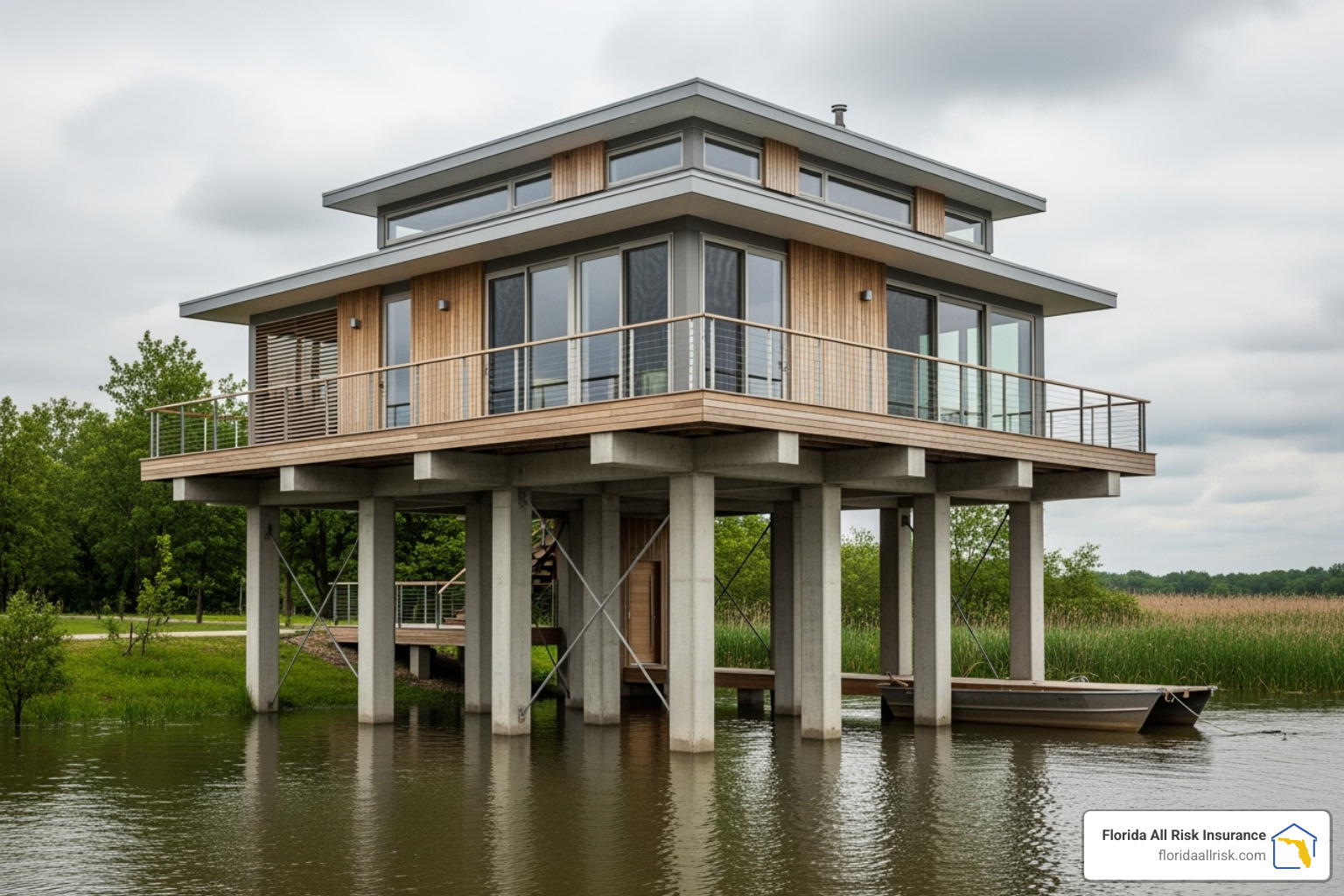
- Elevating Your Home: This is the gold standard of flood mitigation. Raising your home on stilts, piers, or an liftd foundation so that its lowest floor is above the predicted Base Flood Elevation (BFE) can lead to massive premium reductions. While costly upfront, the long-term savings and added safety can be substantial.
- Moving Utilities: Relocating expensive and essential equipment—such as electrical panels, water heaters, furnaces, and HVAC systems—from a basement or ground floor to a higher level or an attic can significantly lower your risk profile. This protects the systems from being destroyed in a flood and is a highly effective mitigation credit.
- Installing Flood Vents: For homes with enclosed foundation areas like crawlspaces, installing FEMA-compliant flood vents is crucial. These vents allow floodwaters to flow through the foundation area rather than building up hydrostatic pressure against the walls, which can cause a catastrophic collapse. Insurers offer significant discounts for properly installed vents.
- Using Flood-Resistant Materials: When building or renovating, using flood-resistant materials below the BFE can also lead to savings. This includes using materials like concrete, pressure-treated lumber, and waterproof insulation that can withstand water damage and be cleaned rather than needing full replacement.
To receive credit for these improvements, you will likely need an updated Elevation Certificate to provide official documentation to your insurer.
Community Rating System (CRS)
You may be eligible for discounts based not on your own actions, but on your community’s proactive floodplain management efforts. The Community Rating System (CRS) is a voluntary FEMA program that rewards municipalities that go above and beyond the minimum NFIP requirements. Communities earn points for activities like preserving open space, enforcing stricter building codes, maintaining drainage systems, and providing public flood risk information. These points translate into direct premium discounts of 5% to 45% for all NFIP policyholders in that community. Ask your agent about your community’s CRS rating or check the FEMA CRS Community List to see if you are already receiving a discount.
Policy Adjustments and Shopping Around
You can also manage your insurance costs through smart policy choices and diligent market comparison.
- Choose a Higher Deductible: A deductible is the amount you pay out-of-pocket before your insurance coverage kicks in. Opting for a higher deductible will lower your annual premium. However, you must ensure that you can comfortably afford the deductible amount if you need to file a claim. NFIP policies allow for separate deductibles for building and contents coverage, allowing you to customize your risk.
- Compare Quotes Annually: The flood insurance market is constantly changing. New private insurers enter the market, and risk models are always being updated. By having an independent flood insurance agent near me shop both NFIP and private market options for you each year, you can ensure you are always getting the best available rate. A private insurer’s risk model may view your property more favorably than the NFIP’s, resulting in significant savings.
- Conduct Annual Policy Reviews: Your needs change over time. You may have renovated your home, increasing its value, or flood maps may have been updated. A yearly review with your agent ensures your coverage limits are still adequate and that you have the best and most cost-effective policy for your current situation.
Your Next Step Towards Flood Protection
The most important takeaway from this guide is that finding the right agent is the key to securing proper flood protection. The world of flood insurance is complex, with evolving government programs, a dynamic private market, and location-specific risks that can be difficult to decipher on your own. An expert independent agent who understands your unique flood risk and can competently compare NFIP and private policy options is your most valuable asset. This is where our expertise makes a tangible difference—we shop the entire market to find the best possible fit for your home, your family, and your budget.
As a local Florida agency, Florida All Risk Insurance is deeply committed to helping our fellow Floridians steer their flood insurance options with the clarity and expertise that truly matters. We understand the unique challenges of coastal living, the patterns of summer storms, and the specific risks associated with our communities because we live and work here too. We are not just selling policies; we are helping our neighbors build a resilient financial future.
Ready to Secure Your Peace of Mind?
Don’t wait for a storm warning on the news to start thinking about flood insurance. With mandatory waiting periods of up to 30 days, proactive planning is not just recommended—it’s essential. Acting now is the only way to ensure your financial safety net is in place before the next flood event occurs.
Our team of dedicated experts is ready to help you find the right flood insurance policy for your specific needs. We provide honest, straightforward guidance to protect your most important investment. The peace of mind that comes with knowing you have proper flood insurance is immeasurable. It’s the confidence that you will have the resources to recover and rebuild, no matter what Mother Nature brings to our shores.
Contact Florida All Risk Insurance to explore your flood coverage options and take that vital step toward securing your property and your future.
Contact Us
Ready to take the next step toward comprehensive flood protection? When you’re searching for a reliable flood insurance agent near me, our team at Florida All Risk Insurance offers the local expertise, market access, and personalized service you deserve. We are committed to making the process of securing the right flood protection as simple and straightforward as possible. Contact us for a no-obligation consultation with a Florida-based flood insurance specialist.
Florida All Risk Insurance
Address: 360 Central Ave Suite 800, Saint Petersburg, FL 33701
Phone: (727) 306-0273
Email: [email protected]
Website: https://floridaallrisk.com/
Don’t wait until a storm is on the horizon. The time to prepare is now. Contact us today to get a free quote and expert guidance.
Authoritative Resources for Your Reference:
- FEMA Flood Map Service Center – Check your property’s official flood zone.
- National Flood Insurance Program (NFIP) Overview – Learn about the federal flood insurance program.
- FEMA Community Rating System (CRS) List – See if your community participates in the CRS for policy discounts.

