Why Florida Homeowners Can’t Afford to Go Without FEMA Flood Insurance
In the sun-drenched landscape of Florida, where waterfront living is a dream for many, an unseen threat looms: flooding. For homeowners, FEMA flood insurance isn’t just another policy; it’s a financial lifeline in a state uniquely vulnerable to water-related disasters. Whether it’s a hurricane storm surge, a king tide, or an unexpected summer downpour, the risk is ever-present and financially devastating.
Quick Facts About FEMA Flood Insurance:
- Program Name: National Flood Insurance Program (NFIP), managed by the Federal Emergency Management Agency (FEMA).
- Standard Coverage Limits: Up to $250,000 for a residential building and $100,000 for its contents.
- Affordability: Premiums can be surprisingly low, often less than $400 per year for properties in moderate-to-low risk areas.
- Mandatory Waiting Period: A crucial 30-day waiting period applies before most new policies become effective.
- Widespread Availability: Offered in over 22,600 communities that have adopted and enforce floodplain management regulations.
- Claims Payout: The average NFIP claim payout is approximately $68,000, and unlike a disaster loan, this money never needs to be repaid.
The numbers paint a stark and sobering picture of the nation’s flood risk. Since 1996, a staggering 99% of U.S. counties have been impacted by a flooding event. Despite this, a dangerous protection gap exists, with only about 4% of homeowners nationwide carrying dedicated flood insurance. This leaves millions of families exposed to financial ruin from a single weather event.
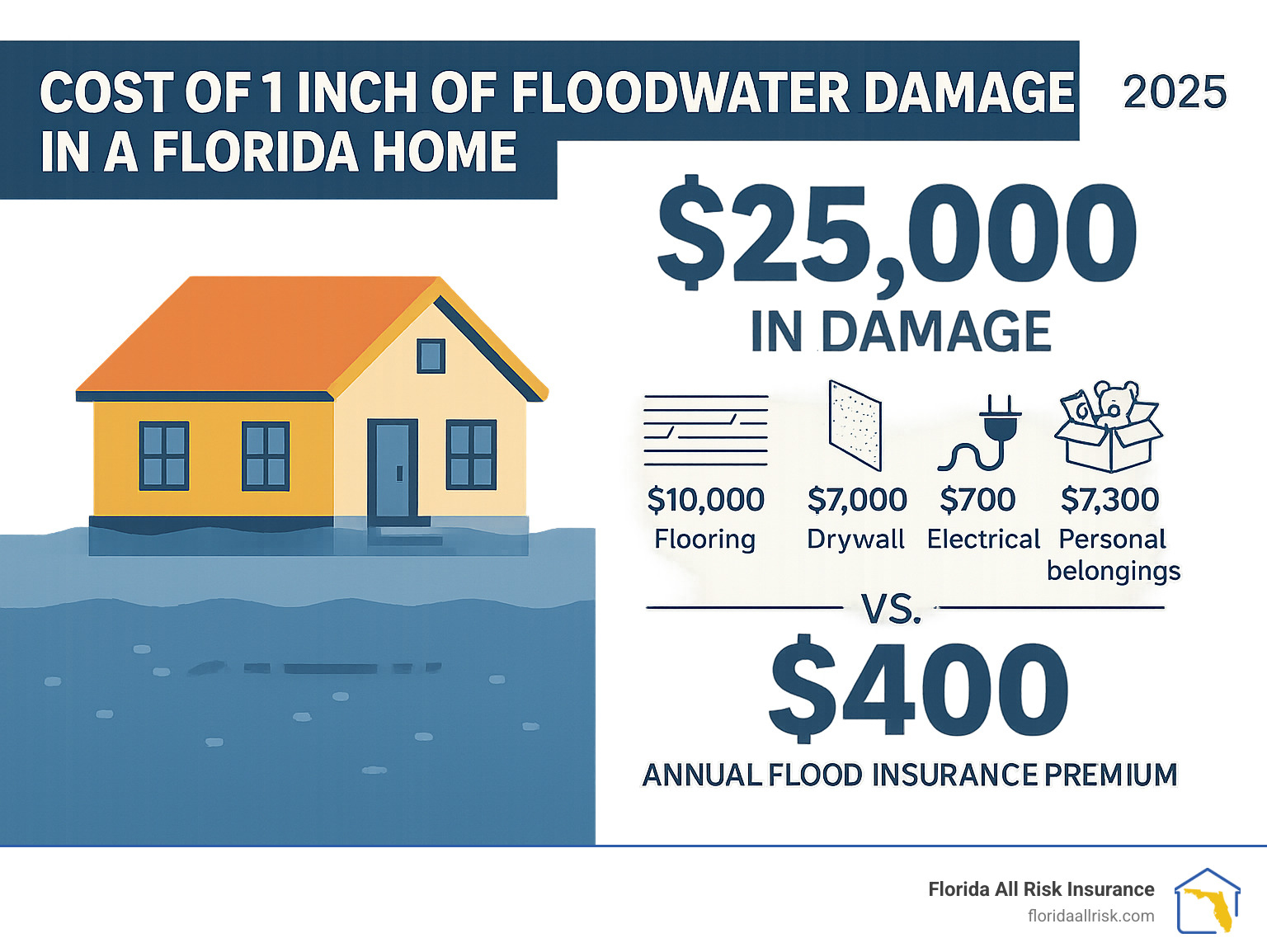
Floods are unequivocally the most common and most expensive natural disaster in the United States. The financial danger is compounded by a common misconception: most standard homeowners and renters insurance policies explicitly exclude damage from flooding. This means that without a separate FEMA flood insurance policy, you are on your own. Consider that just one inch of floodwater can cause over $25,000 in damages to a home, a cost that can quickly spiral into six figures, leaving you with crushing, long-term debt.
In Florida, the risks are amplified. The state’s extensive coastline, low-lying geography, and susceptibility to hurricanes and tropical storms create a year-round threat. Critically, you don’t have to live on the beach to be at risk. Over 40% of all NFIP flood insurance claims are filed by policyholders living outside of designated high-risk flood zones. This single statistic proves that flooding can, and does, happen anywhere.
I’m Jason Miller, and with over two decades of experience helping Florida families steer the complexities of insurance, I’ve witnessed the aftermath of countless floods. The story is always the same: the families who recover the fastest and with the least financial and emotional stress are the ones who planned ahead with proper FEMA flood insurance.
Glossary for fema flood insurance:
- Flood insurance requirements Florida
- Flood insurance coverage Florida
- Does flood zone AE require flood insurance in Florida
- FEMA Flood Zone Map
- Flood Insurance Cost
Understanding the National Flood Insurance Program (NFIP)
When people talk about FEMA flood insurance, they are referring to the National Flood Insurance Program (NFIP). This is a federal program created by Congress and managed by the Federal Emergency Management Agency (FEMA). Its purpose is to provide a viable way for property owners, renters, and businesses to protect themselves financially from the catastrophic impact of floods. Before the NFIP, flood insurance was largely unavailable or prohibitively expensive from private insurers, leaving victims of floods with little to no resources for recovery.
The NFIP operates as a unique partnership between the federal government, local communities, state governments, and the private insurance industry. For residents to gain access to NFIP policies, their community must agree to participate. This involves formally adopting and rigorously enforcing floodplain management ordinances designed to reduce future flood damage. These ordinances often include zoning laws, subdivision regulations, and building codes that align with FEMA’s standards for minimizing flood risk. In return for this commitment to community-wide resilience, the federal government makes affordable FEMA flood insurance available to everyone in that community.
A key operational component is the Write-Your-Own (WYO) program. Established in 1983, this program allows a pool of over 47 private insurance companies to sell and service NFIP policies under their own names. This makes it incredibly convenient for consumers, as they can often purchase flood insurance from the same trusted agent who handles their home and auto policies. While these private companies handle the day-to-day tasks of writing policies, processing claims, and providing customer service, the policies themselves are financially backed by the U.S. Treasury. This ensures that no matter which WYO company you choose, the coverage terms and claim payments are consistent and guaranteed by FEMA.
The NFIP was officially established on August 1, 1968, with the passage of the National Flood Insurance Act. It has undergone numerous reforms and updates since then to better serve communities, particularly in high-risk states like Florida. You can find more details about More info about Florida Flooding and the state’s unique challenges on our site.
What is the NFIP’s Mission?
The NFIP has a dual mission that goes beyond simply selling insurance policies. Its two primary goals are:
- To provide access to affordable flood insurance: By pooling risk on a national level and subsidizing some policies, the NFIP makes flood protection financially accessible to millions of Americans who would otherwise be unprotected.
- To promote community-based floodplain management: The program actively encourages communities to adopt and enforce smart, forward-thinking regulations. By promoting safer construction practices, restricting development in high-risk areas, and requiring flood-proofing measures, the NFIP helps mitigate the severity of flood damage before a storm ever hits. This proactive approach saves lives, protects property, and reduces the overall economic burden of floods on the nation.
The NFIP is a monumental undertaking, currently protecting approximately $1.3 trillion in assets across nearly 5 million active policies. This makes it the largest single-line property and casualty insurance program in the United States. Its ultimate goal is to create more resilient communities and ensure that families and businesses can recover from a flood without facing impossible financial ruin.
Who is Eligible for NFIP Coverage?
Eligibility for an NFIP policy is broad. Any property owner, renter, or business owner can purchase FEMA flood insurance as long as their property is located within one of the over 22,600 communities that participate in the program. If your city, town, or unincorporated county has adopted the required floodplain management ordinances, you are almost certainly eligible for coverage.
Crucially, eligibility is not restricted by flood zone. You can purchase a policy even if you are not in a high-risk flood area and are not federally required to have one. Given that more than 40% of NFIP claims originate from outside these high-risk zones, securing a policy is a wise and prudent decision for any property owner, regardless of their perceived risk. For specific requirements in Florida, see our page on More info about Flood Insurance Requirements Florida. It is always better to have protection and not need it than to need it and not have it.
What FEMA Flood Insurance Covers (and What It Doesn’t)
Understanding the specifics of your FEMA flood insurance policy is crucial because it is designed to cover something that standard homeowners and renters policies almost universally exclude: direct physical loss from a flood. To fully grasp your protection, you must first understand what the NFIP legally defines as a flood.

The official NFIP definition of a flood is a general and temporary condition of partial or complete inundation of two or more acres of normally dry land area or of two or more properties (at least one of which is your property) from:
- Overflow of inland or tidal waters: This includes riverbanks overflowing, storm surge from a hurricane, or lake water rising above its normal levels.
- Unusual and rapid accumulation or runoff of surface waters from any source: This covers flash floods from heavy rains, or situations where drainage systems are overwhelmed and water pools in low-lying areas.
- Mudflow: This is defined as a river of liquid and flowing mud on the surfaces of normally dry land areas, as when earth is carried by a current of water. It is distinct from a landslide, which is not covered.
It’s also important to note that damage from a sewer or drain backup is only covered if the backup is a direct result of a widespread flood event in the area. If the backup is caused by an issue isolated to your property’s plumbing, it is not covered by FEMA flood insurance. For a complete overview, you can review the Official Definition of a flood.
NFIP policies provide two distinct types of coverage: Building Coverage and Contents Coverage. You can purchase one or both, depending on your needs (e.g., a renter would only purchase Contents Coverage).
Building Coverage Explained
Building coverage protects the physical structure of your home and its essential, built-in systems. The maximum coverage limit for a single-family residential building is $250,000 ($500,000 for non-residential buildings). Key items protected under Building Coverage include:
- The foundation, walls, staircases, and roof structure.
- Electrical systems (wiring, outlets, fuse boxes) and plumbing systems (pipes, drains).
- Central air conditioning, furnaces, and water heaters.
- Built-in appliances such as refrigerators, stoves, and dishwashers.
- Permanently installed carpeting over an unfinished floor.
- Permanently installed cabinets, paneling, and bookcases.
- A detached garage, up to 10% of your Building Coverage limit (this amount counts toward the total limit, not in addition to it).
It is vital to know your home’s estimated reconstruction cost to ensure you purchase an adequate amount of protection. For more details, visit More info about Flood Insurance Coverage Florida.
Contents Coverage Explained
Contents coverage is purchased separately and safeguards your personal belongings. The maximum coverage limit is $100,000 for residential contents ($500,000 for non-residential). Unless you opt for an endorsement, this coverage is typically paid out on an Actual Cash Value (ACV) basis, which is the replacement cost of an item minus depreciation for age and wear. Covered items include:
- Clothing, furniture, and electronic equipment (TVs, computers).
- Curtains and other window treatments.
- Portable and window air conditioners.
- Washers and dryers.
- Food freezers and the food within them.
- Certain valuable items like artwork and furs, up to a specified limit (e.g., $2,500).
Maintaining a detailed home inventory with photos or videos is one of the best ways to streamline the claims process. Business owners can learn more about protecting their inventory and equipment at More info about Flood Insurance for Businesses.
Key Exclusions: What’s Not Covered?
Even a comprehensive FEMA flood insurance policy has important exclusions. Knowing what isn’t covered helps you plan accordingly and avoid unwelcome surprises after a disaster. Common exclusions include:
- Damage from moisture, mildew, or mold that could have been avoided by the property owner. The policy covers damage from a flood, but not secondary damage from neglect after the fact.
- Currency, precious metals, and valuable papers like stock certificates or deeds.
- Property and belongings outside of an insured building, such as landscaping, trees, decks, patios, fences, septic systems, and swimming pools.
- Financial losses caused by business interruption or loss of use of the insured property. This means the policy does not cover temporary housing costs if you are displaced by a flood. This type of coverage, often called “Additional Living Expenses,” is sometimes found in standard homeowners policies, but is not part of an NFIP policy.
- Cars and other self-propelled vehicles. These are typically covered under the optional comprehensive coverage portion of an auto insurance policy.
Your Guide to Getting FEMA Flood Insurance
Securing FEMA flood insurance is a straightforward process that provides invaluable peace of mind. Working with an independent insurance professional is the best way to steer your options, understand your true risk, and obtain a policy that is custom to your property and financial situation.
How Much Does FEMA Flood Insurance Cost?
The cost of FEMA flood insurance is no longer based on simple flood zones alone. Under FEMA’s new pricing methodology, Risk Rating 2.0, premiums are calculated based on a property’s unique and specific risk profile. This approach aims to make pricing more equitable and easier to understand. Key factors that influence your premium include:
- Flood Risk: This includes your property’s distance to a flooding source (like a river or coast), the type of flooding you’re exposed to (e.g., storm surge, river overflow), and ground elevation.
- Property Characteristics: The foundation type (slab, crawlspace, pilings), the height of the lowest floor relative to the Base Flood Elevation (BFE), and the construction materials used.
- Coverage and Deductible Choices: The amount of building and/or contents coverage you select and the deductible you choose. A higher deductible will lower your premium but increase your out-of-pocket cost during a claim.
- Cost to Rebuild: The replacement cost value of your home is now a primary rating factor, ensuring that the premium better reflects the potential claim amount.
While premiums vary widely based on these factors, a policy can still cost less than $400 per year for many properties in moderate-to-low risk areas. The only way to know your exact cost is to get a personalized quote from a licensed agent. For more information, see More info about Flood Insurance Cost.
How to Purchase FEMA Flood Insurance
Purchasing an NFIP policy is a simple, multi-step process. Here’s how to get started:
- Contact a Licensed Insurance Agent: The first step is to reach out to an insurance agent. You can work with an agent who represents one of the NFIP’s Write-Your-Own (WYO) partner companies or an agent who can sell NFIP Direct policies. An independent agent can often provide quotes from multiple sources.
- Provide Your Property Address: Your agent will only need your street address to start the quoting process. Using modern data sources, they can access most of the required rating information, such as flood risk data and property characteristics, automatically.
- Discuss Your Coverage Needs: Your agent will discuss your options for building and contents coverage. You’ll need to decide on the coverage limits that best protect your assets and select deductibles for both building and contents. Deductibles can range from $1,000 to $10,000.
- Review the Quote and Application: Your agent can often generate a quote in minutes. They will walk you through the coverage details, explain the premium, and help you complete the necessary application paperwork.
Understanding the Waiting Period
A critical detail about FEMA flood insurance that every property owner must know is the standard 30-day waiting period. From the date you purchase the policy, there is a 30-day window before the coverage actually takes effect. This rule is in place to prevent people from buying insurance only when a storm is already forecast. This underscores the importance of planning ahead and not waiting until the last minute.
There are a few important exceptions to this 30-day rule:
- Loan Closings: If flood insurance is required by a federally regulated lender to make, increase, extend, or renew a mortgage, coverage can begin at the time of the loan closing, with no waiting period.
- Map Revisions: If your property is newly mapped into a Special Flood Hazard Area (SFHA), and you purchase a policy within the 13-month period following the map revision, there is only a one-day waiting period.
- Post-Wildfire Flooding: If a property is on federal land that has been affected by flooding on burned-over ground after a wildfire, the waiting period may be waived.
Assessing Your Flood Risk and Why Everyone Needs Coverage
Since 1996, an astonishing 99% of U.S. counties have been impacted by a flooding event. This is not a coastal problem or a river problem; it is a national reality. Despite this overwhelming evidence, many homeowners cling to the mistaken belief that “it won’t happen to me.” The truth is that floods can happen anywhere, at any time. Intense thunderstorms, rapidly melting snow, overwhelmed drainage systems, or even a broken water main can cause catastrophic flooding in neighborhoods that have never seen it before.

Perhaps the most revealing statistic for any homeowner is this: over 40% of all NFIP flood insurance claims come from properties located outside of high-risk flood zones. This means that nearly half of all flood victims thought they were relatively safe. They learned the hard way that a line on a map is not a guarantee of safety and that unexpected events can lead to tens or even hundreds of thousands of dollars in uninsured damage.
Understanding your specific, property-level risk is a critical first step in protecting your family and finances. I strongly recommend that every property owner visit the FEMA Flood Map Service Center. This free online tool allows you to enter your address and view your home’s official flood zone designation and other important risk details. These maps are the official source for floodplain management and insurance requirements. For help interpreting the different zones and what they mean for you, visit More info about FEMA Flood Zone Map.
Debunking the “I’m Not in a Flood Zone” Myth
One of the most dangerous and pervasive misconceptions in real estate is the idea that if you’re not in a high-risk zone, you don’t need flood insurance. Officially, these high-risk areas are designated as Special Flood Hazard Areas (SFHAs) on FEMA maps. These are the zones where flood insurance is mandatory for properties with a federally backed mortgage. However, being outside an SFHA does not mean you are flood-proof; it simply means the statistical probability is lower, not zero.
In fact, properties in these so-called moderate-to-low risk areas (like Zone X) are five times more likely to experience a flood than a major fire over the life of a 30-year mortgage. Nearly every homeowner has fire insurance without a second thought, yet many forgo flood coverage, assuming they are safe. The simple truth is, where it can rain, it can flood. Outdated maps, new development altering drainage patterns, and increasingly intense rainfall events mean that even properties in Zone X can and do flood regularly. Learn more at More info about how much is flood insurance in Florida Zone X?.
Federal Disaster Assistance is Not a Substitute for Insurance
Many people mistakenly believe that if a major flood occurs, the federal government will step in to cover their losses. This is a catastrophic misunderstanding of how federal disaster assistance works. It is not a substitute for insurance.
The primary form of federal help available after a presidentially declared disaster is a low-interest disaster loan from the U.S. Small Business Administration (SBA). These are loans that must be repaid with interest, adding a significant new debt burden on top of the emotional and financial stress of rebuilding your life. These loans can have terms of up to 30 years.
In stark contrast, a FEMA flood insurance claim payment is a grant—funds that never have to be repaid. The average NFIP claim payout is around $68,000, providing the capital needed to repair your home and replace your belongings without taking on crippling new debt. While some limited federal grants (not loans) may be available through FEMA’s Individuals and Households Program, they are much smaller, averaging only about $5,000. These grants are designed only to cover essential, emergency needs to make a home habitable, not to restore it to its pre-disaster condition.
Furthermore, if you live in an SFHA, receive any form of federal disaster assistance for flood damage, and do not have flood insurance, you are required to purchase and maintain flood insurance for as long as you own the property to remain eligible for any future disaster aid. FEMA may provide a temporary Group Flood Insurance Policy (GFIP) for 36 months, but you must purchase your own policy before it expires. The bottom line is clear: insurance provides recovery, while disaster aid often means more debt.
Frequently Asked Questions about FEMA Flood Insurance
We understand that navigating insurance can be complex, and you likely have questions. We’re here to provide clear, straightforward answers to some of the most common inquiries we receive about FEMA flood insurance.
What is the difference between NFIP and private flood insurance?
FEMA flood insurance refers to policies sold through the National Flood Insurance Program (NFIP). These are federally backed policies with standardized coverage, limits, and rules across the country. This makes NFIP policies a reliable, widely accepted form of protection, especially for meeting mandatory mortgage requirements. Private flood insurance refers to policies underwritten and sold by private insurance companies, without federal backing. The private market is growing and can sometimes offer advantages like higher coverage limits (exceeding the NFIP’s $250k building/$100k contents caps), coverage for Additional Living Expenses (temporary housing costs), and potentially more competitive pricing for lower-risk properties. However, private policies can also have more restrictive terms and are not available in all areas. Our team can help you compare quotes and coverage from both the NFIP and private markets to find the best fit for you.
Do I need flood insurance for my condo?
Yes, it is highly recommended for nearly all condo owners. Your condominium association’s master insurance policy is vital for protecting the building’s exterior, foundation, and common areas (like the roof, elevators, and hallways). However, it typically does not cover the interior of your individual unit or your personal belongings. This means that in a flood, your flooring, cabinets, drywall, furniture, clothing, and electronics would not be protected by the master policy. To cover this significant gap, you need your own FEMA flood insurance policy. For a condo, this is typically a contents-only policy, though you may also need building coverage if your association’s policy doesn’t cover interior fixtures.
What is Risk Rating 2.0 and how does it affect my premium?
Risk Rating 2.0 is FEMA’s new pricing methodology for the NFIP, designed to make flood insurance rates more equitable and easier to understand. Instead of relying primarily on a property’s flood zone on a map, Risk Rating 2.0 uses a wide range of data points and catastrophe models to determine a property’s unique flood risk. Key factors now include the home’s elevation, its distance to a flooding source (river, coast, etc.), foundation type, and the home’s replacement cost value. The goal is to have rates that more accurately reflect a specific property’s true risk. For some, this has meant a decrease in premiums, while for others, particularly those with higher risks that were previously subsidized, it has meant an increase, though these increases are being phased in gradually by law.
Is flood damage from a hurricane covered?
This is a critical question for every Floridian. FEMA flood insurance covers damage from the storm surge and flooding associated with a hurricane. However, it does not cover wind and rain damage. Damage from wind, wind-driven rain (e.g., rain coming through a hole in the roof caused by wind), or hail is covered by your standard homeowners insurance policy (often subject to a separate hurricane deductible). This is why have both a robust homeowners policy and a separate flood insurance policy to be fully protected during a hurricane.
What happens if I receive federal disaster assistance after a flood?
If your property is located in a Special Flood Hazard Area (SFHA) and you receive any form of federal disaster assistance (like an SBA loan or a FEMA grant) for flood-related damage, you are legally required to purchase and maintain FEMA flood insurance for as long as you own that property. This requirement, known as a “condition of aid,” is attached to the property itself and passes to the new owner if you sell the home. It ensures that you, and future owners, are protected in subsequent floods, reducing the reliance on taxpayer-funded disaster aid. FEMA may issue a temporary Group Flood Insurance Policy (GFIP) for 36 months, but you must purchase your own individual policy before it expires to avoid a lapse in coverage and maintain your eligibility for any future federal assistance.
Conclusion: Secure Your Financial Future Today

Throughout this guide, we’ve explored the critical details of the National Flood Insurance Program and underscored why every Florida property owner should view FEMA flood insurance as an essential part of their financial planning. The core takeaway is simple but profound: floods are the most common, costly, and widespread natural disaster in the United States, and your standard homeowners policy offers no protection against them. Relying on hope or federal disaster aid is not a strategy; it’s a gamble with your most valuable asset.
The benefits of securing a FEMA flood insurance policy are clear, tangible, and life-altering in the face of a disaster:
- Protection from Catastrophic Debt: An insurance payout allows you to rebuild your home and replace your belongings without the crushing burden of a low-interest disaster loan that must be repaid over decades.
- Comprehensive Peace of Mind: Sleep better at night knowing that your largest financial asset and cherished personal belongings are protected from the nation’s most frequent natural disaster.
- Faster, More Dignified Recovery: Insurance provides the funds you need to begin repairs and restore normalcy to your life quickly, on your own terms, rather than waiting for and navigating complex government aid programs.
- Proactive Financial Strength: By planning ahead, you take control of your financial destiny. You choose to be resilient, not reliant.
Don’t wait until a storm is brewing in the Atlantic and the 30-day waiting period makes it too late. The time to act is now, when the skies are clear and you can make a calm, informed decision to safeguard your family’s future. If you’re ready to take the single most important step in protecting your home from flood damage, our team is here to help you get started.
Protect your property with comprehensive flood coverage
Contact Us
Florida All Risk Insurance
Address: Saint Petersburg, FL 33701
Phone: (727) 544-0064
Email: [email protected]