Electrical Contractor Insurance: Essential Guide 2025
Why Electrical Contractor Insurance is Essential for Your Business
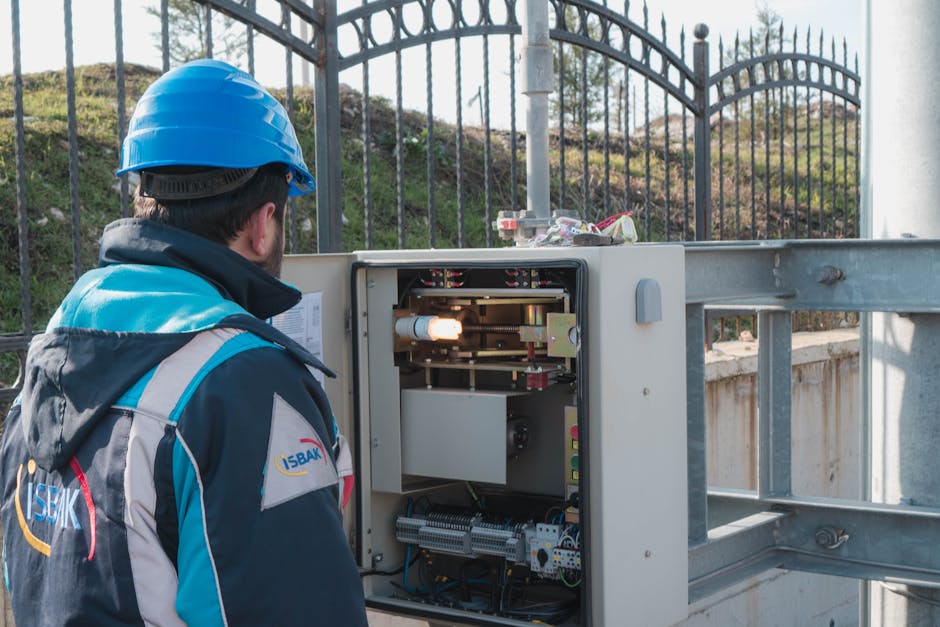
As an electrical contractor, you operate in a high-stakes environment where precision is paramount and the margin for error is virtually nonexistent. A single mistake can have catastrophic consequences, leading to devastating financial losses, legal battles, and irreparable damage to your reputation. This is where electrical contractor insurance becomes your most critical tool. It is not a single, one-size-fits-all policy but a specialized package of coverages meticulously crafted to shield your business from the unique and significant risks inherent in the electrical trade. Think of it as a custom-built financial safety net, designed to absorb the shocks of unexpected events, from job site accidents and equipment damage to third-party lawsuits and the ever-present threat of tool theft.
Without this foundational protection, your business, personal assets, and future earnings are left dangerously exposed. A comprehensive insurance portfolio is the bedrock of a resilient and successful electrical contracting business, enabling you to operate with confidence and pursue growth opportunities.
Quick Answer: Core Coverage Types You Need
Every electrical business requires a multi-layered defense. Here are the essential policies that form the core of a robust insurance program:
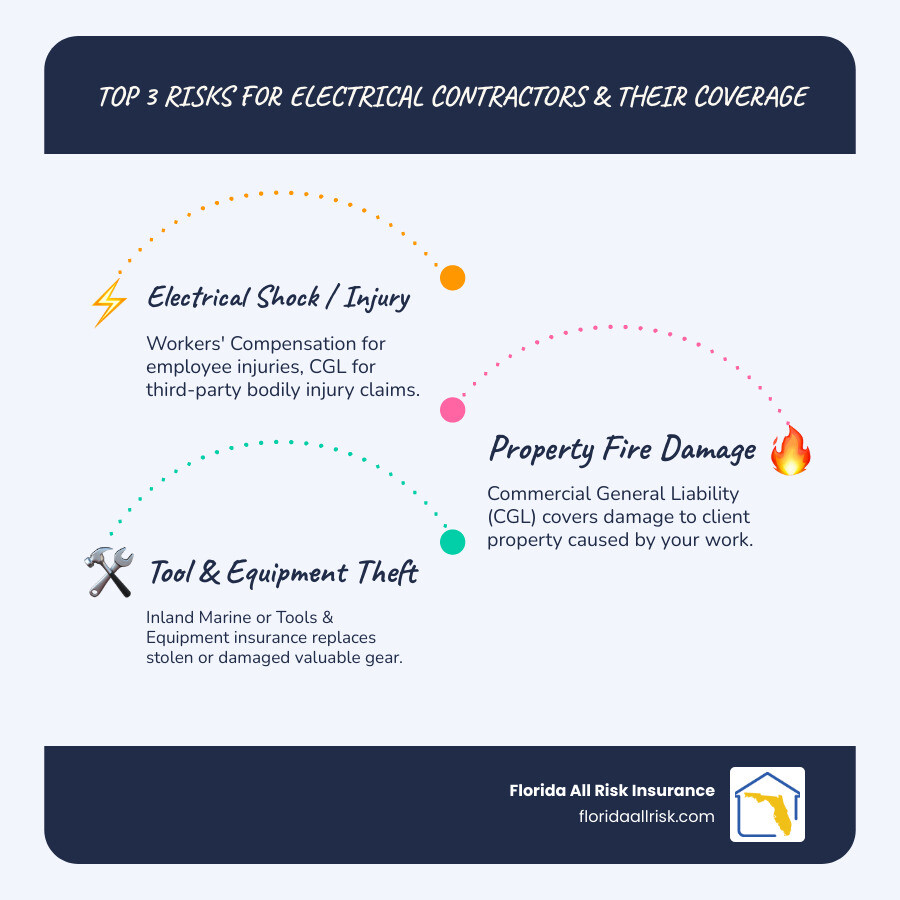
- Commercial General Liability (CGL): Your first line of defense. This protects your business against claims that your work caused bodily injury to a non-employee (like a client, vendor, or bystander) or damaged their property. It covers everything from a client tripping over your extension cord to a fire caused by faulty wiring.
- Workers’ Compensation: A legal and ethical necessity. If you have employees, this coverage is mandated by law in most states, including Florida. It pays for medical bills and lost wages for employees injured on the job, while protecting your business from direct lawsuits over those injuries.
- Commercial Auto Insurance: Essential for your work vehicles. Your personal auto policy will not cover accidents that occur while driving for business purposes. This policy protects your company trucks, vans, and other vehicles, covering liability and physical damage.
- Professional Liability (E&O): Protection for your expertise. Also known as Errors & Omissions insurance, this covers claims of financial loss due to your professional mistakes, such as faulty design, incorrect advice, or negligence that doesn’t result in bodily injury or property damage.
- Tools & Equipment Insurance (Inland Marine): Safeguards your most valuable assets. This policy protects your specialized tools and equipment from theft, damage, or loss, whether they are on a job site, in your vehicle, or in transit.
The High Stakes of Electrical Work
Working with electricity involves a level of risk far exceeding that of most other trades. The immediate danger of handling live circuits can lead to severe shocks, arc flash burns, or electrocution. The potential for property damage is immense; a single faulty installation, an overloaded circuit, or a poor connection can smolder for weeks before erupting into a devastating fire, potentially leading to a multi-million dollar lawsuit. The long-tail nature of these claims means you could be held liable for an incident that occurs months or even years after you’ve completed a job. The significant potential for injury and death is not just anecdotal; it’s a reality backed by data, as detailed in reports like A Study of Electrical Injuries and Fatalities on the Job, which underscores the hazardous nature of the profession.
Beyond these physical dangers, electrical contractors face significant operational risks. The theft of expensive tools and materials like copper wire from job sites and work vehicles is rampant and represents one of the most frequent claims filed in the construction industry. Furthermore, the regulatory landscape is strict. Most states and municipalities, including those across Florida, mandate specific insurance minimums as a prerequisite to obtaining and maintaining an electrical contractor’s license. Attempting to operate without the proper coverage is not only illegal but also a gamble you cannot afford to take. A single uninsured accident or lawsuit has the power to wipe out your business savings, seize your personal assets, and permanently shut down your operations. For this reason, a comprehensive Business Liability Insurance plan isn’t just an option; it’s the fundamental framework of a sustainable and professional electrical contracting business.
Key Types of Electrical Contractor Insurance Coverage
Assembling your electrical contractor insurance package is analogous to designing and wiring a complex electrical system. Each policy, or circuit, serves a distinct and critical purpose. A missing connection or an undersized breaker leaves the entire system vulnerable to a catastrophic failure. To build a truly resilient business, you must understand and implement each essential piece of protection.
Commercial General Liability (CGL) Insurance
This is the non-negotiable, foundational policy for any electrical contractor. CGL is designed to protect your business when your operations, products, or completed work cause bodily injury or property damage to a third party. The scope is broad, covering incidents that happen both on and off the job site. For instance, if a client trips over your tool bag and breaks their wrist, or if you accidentally drill into a hidden water pipe and cause extensive water damage, your CGL policy is designed to cover the ensuing medical bills, repair costs, and, crucially, your legal defense fees if you are sued. Even if a lawsuit is frivolous, the cost to defend your business can be financially crippling; CGL covers these defense costs, regardless of the outcome.
A vital component of CGL for contractors is products-completed operations coverage. This feature is indispensable, as it protects you from liability after you’ve packed up your tools and left the job site. If a circuit you installed six months ago malfunctions and causes a fire that destroys a home, your products-completed operations coverage would respond to the claim. In Florida, virtually all general contractors and commercial property owners will require you to provide a Certificate of Insurance (COI) proving you have active CGL coverage before allowing you to set foot on their property. You can explore the nuances of this coverage in this detailed overview of Commercial General Liability Insurance.
Professional Liability (Errors & Omissions) Insurance
While CGL addresses physical accidents and tangible damage, Professional Liability—commonly known as Errors & Omissions (E&O)—protects you from claims of professional negligence that result in a financial loss for your client, even when there is no physical injury or property damage. A simple way to distinguish them is: CGL covers the work of your hands, while E&O covers the work of your mind—your expertise and advice.
Consider this scenario: you design a lighting and power system for a new commercial office. After installation, the client discovers the system is inadequate for their high-demand computing equipment, forcing them to halt operations and pay for a costly redesign and rewiring. Your E&O policy would be triggered to cover their financial loss and your legal defense. This policy responds to a wide range of accusations, including negligence (failing to meet the professional standard of care), faulty workmanship related to design, providing incorrect advice, or misinterpreting blueprints. As more electricians engage in design-build projects or offer consulting services, E&O coverage is becoming an increasingly essential shield against costly professional mistakes. Learn more in our guide on Professional Liability Insurance for Independent Contractors.
Workers’ Compensation Insurance
Electrical work is inherently dangerous, with risks of shocks, burns, and falls. Workers’ Compensation insurance is the critical safety net that catches your employees—and your business—when a work-related injury or illness occurs. It provides state-mandated benefits to injured employees, primarily covering their medical expenses (from emergency care to rehabilitation), a portion of their lost wages while they are unable to work, and disability benefits for permanent injuries.
This coverage protects your business as much as it does your employees. In exchange for providing these no-fault benefits, employees are generally barred from suing their employer for workplace injuries. This principle, known as the “exclusive remedy,” shields your business from potentially bankrupting lawsuits. Without it, you would be personally liable for an injured worker’s damages. In Florida, the law is strict: you are legally required to carry Workers’ Compensation if you have one or more employees (with some exceptions). Given the high-risk classification of electrical work, this coverage is non-negotiable for any growing business, as detailed in our Workers Compensation Insurance Complete Guide.
Commercial Auto and Equipment Insurance
Your work truck or van is the mobile headquarters of your business, but a personal auto policy provides zero coverage for its commercial use. Commercial Auto insurance is specifically designed to protect vehicles used for work purposes. A robust policy includes liability coverage for accidents where you are at fault, as well as physical damage coverage (collision and comprehensive) to repair or replace your own vehicle after an accident, theft, or other event. Most experts recommend liability limits of at least $1 million to adequately protect your business assets from a major accident.
Furthermore, if you or your employees ever use personal vehicles for work errands—like picking up supplies—you need Hired and Non-Owned Auto (HNOA) insurance. This endorsement protects your business if an employee gets into an accident while driving their own car for a work-related task.
Your specialized tools and equipment—from multimeters and thermal imagers to conduit benders and wire pullers—represent a massive financial investment. Contractor’s Equipment insurance, a form of Inland Marine coverage, is designed to protect these valuable assets wherever they are: on the job site, in your truck, or in storage. Standard CGL and auto policies offer negligible coverage for tools, often capped at a mere $1,000 or $2,000. With tool theft being one of the most common and frustrating claims for electricians, a separate equipment policy is the only reliable way to protect your ability to work. Our page on Contractor Liability Insurance Coverage offers more insights.
Other Important Coverages to Consider
- Business Interruption Insurance: This vital coverage can be a business-saver. It replaces lost income and covers ongoing fixed expenses (like rent and payroll) if a covered disaster, such as a fire, hurricane, or major theft, forces you to temporarily shut down your operations. You can find more details in our guide on Commercial Property and Business Interruption Insurance.
- Commercial Property Insurance: If you own or lease a workshop, office, or storage space, this policy is essential. It protects the building itself and its contents—including office furniture, computers, and stored materials—from perils like fire, vandalism, theft, and storm damage. Read more in our Commercial Property Insurance resource.
- Surety Bonds: These are not insurance policies but are three-party financial guarantees required for many public and large commercial projects. A bond guarantees to your client that you will complete the work according to the contract and pay your suppliers and subcontractors. Common types include bid bonds (guaranteeing you’ll take the job if you win the bid), performance bonds (guaranteeing you’ll complete the job), and payment bonds (guaranteeing you’ll pay your bills).
- Cyber Liability Insurance: In the digital age, even electricians face cyber risks. If you store sensitive client information (names, addresses, payment details) or project blueprints on a computer or cloud service, you are a target for data breaches. Cyber Liability insurance covers costs associated with a breach, such as notification expenses, credit monitoring, and legal defense.
Understanding Costs, Quotes, and Policy Selection
The cost of electrical contractor insurance is a significant budget item, but viewing it as an investment rather than just an expense is key to building a resilient business. Premiums are not arbitrary; they are calculated based on a detailed assessment of your business’s unique risk profile. Understanding these factors empowers you to manage your risks effectively and secure the best possible value without compromising on essential protection.
What Factors Influence the Cost of Electrical Contractor Insurance?
Insurance carriers use a variety of data points to determine your premium. The more risk your business presents, the higher the cost will be. Key factors include:
- Annual Revenue and Payroll: These are primary rating factors. Higher revenue and payroll generally correlate with more work, larger and more complex projects, and a greater number of employees, all of which increase the overall potential for claims.
- Number of Employees: More employees directly increase the likelihood of workplace injuries, which is the main driver of workers’ compensation costs. Your safety record and training programs can significantly influence this.
- Years of Experience & Claims History: A long track record of professional work with few or no claims is a powerful indicator of low risk, often earning you preferential rates and a lower Experience Modification Rate (EMR) on your workers’ comp policy. Conversely, a history of frequent or severe claims signals higher risk and will lead to increased premiums.
- Location of Business: Geography matters. Rates can vary by state, city, and even zip code. Factors like local litigation trends, crime rates (theft), and exposure to natural disasters like hurricanes in Florida all play a role in pricing.
- Type of Work Performed: This is a critical factor. An insurer will want to know the breakdown of your work. Residential wiring is typically viewed as lower risk than complex commercial projects. Working on high-voltage industrial systems, airports, or hospitals carries significantly more risk—and a higher premium—than doing service calls for homeowners.
- Coverage Limits & Deductibles: The amount of coverage you buy directly impacts the price. Higher liability limits (e.g., $2 million vs. $1 million) will increase your premium. Conversely, choosing a higher deductible (the amount you pay out-of-pocket on a claim before insurance kicks in) can lower your premium, but requires you to have more cash on hand in the event of a claim.
While a small, one-person residential operation with a clean history might find a basic liability policy for around $650 annually, most established small businesses can expect to pay about $540 per year for a standard $1 million Commercial General Liability policy. However, this is just a starting point. A full package with workers’ comp, commercial auto, and other coverages will be more. For a comprehensive breakdown, see our Electrical Contractor Insurance Cost Complete Guide.
How to Get a Quote and Choose the Right Policy
Securing the right insurance shouldn’t be a confusing or frustrating process. Partnering with an independent insurance agency like Florida All Risk Insurance streamlines everything. Here’s a step-by-step guide to preparing for the quoting process:
- Gather Your Business Information: Be prepared to provide detailed information. This includes your legal business name, address, federal tax ID (FEIN), years in business, detailed descriptions of your operations, annual revenue projections, and full payroll details for all employees.
- Assess Your Risks Honestly: Take a hard look at your business’s biggest vulnerabilities. Do you work at heights? Do you perform hot work? Do you work on critical infrastructure like hospitals or data centers? Do you transport expensive tools and copper? A clear understanding of your risks is crucial for identifying the coverages you can’t afford to be without.
- Compare Apples-to-Apples Quotes: As an independent agency, we take your information and submit it to multiple top-rated insurance carriers that specialize in construction trades. We then present you with competing quotes, helping you compare not just the price but the specific terms, conditions, and exclusions of each policy.
- Review the Policy Details with an Expert: The cheapest quote is rarely the best. We’ll help you dive into the fine print. What are the exclusions? Does the policy include key endorsements like a waiver of subrogation or additional insured status? Understanding these details is critical to ensuring you have the coverage you think you do.
- Leverage an Independent Agent: Unlike a captive agent who works for a single insurance company, we work for you. Our primary goal is to act as your risk management partner, building a customized insurance package that perfectly aligns with the specific needs and budget of your Florida-based electrical contracting business.
Once your policy is bound, you’ll need a Certificate of Insurance (COI) to provide to clients and licensing boards. Our dedicated in-house team can often provide a policy and generate a COI within 24 hours, ensuring you can get on the job site and start work without costly delays.
How much electrical contractor insurance do I need?
There is no universal answer to this question; the right amount of coverage is unique to your business. However, you can determine your needs by evaluating three key areas:
- Legal & Licensing Minimums: Your first stop is compliance. The Florida state licensing board mandates specific minimum levels of CGL to obtain and maintain your license. If you have employees, Workers’ Compensation is also a legal requirement.
- Contractual Obligations: The contracts you sign will often dictate your insurance requirements. General contractors and commercial clients frequently require CGL limits of $1 million per occurrence and $2 million aggregate. They will also typically require you to name them as an “Additional Insured” on your policy, extending your coverage to protect them from liability arising out of your work.
- Comprehensive Risk Assessment: This is where you protect your business’s future. Consider a worst-case scenario. What is the total value of the property you are working on? A fire in a luxury home or commercial building could easily exceed a $1 million liability limit. How much would it cost to replace every tool and piece of equipment you own? A standard CGL policy with $1 million to $2 million in limits is a common starting point, but for businesses taking on larger projects or wanting to protect significant assets, a Commercial Umbrella (or Excess Liability) Policy is a cost-effective way to add an extra layer of protection, providing millions in additional coverage over your primary CGL and auto policies.
The ultimate goal is to strike the right balance between robust protection and affordable premiums. For more guidance, our resource on How Much General Liability Insurance Do I Need? can be a valuable tool.
Navigating Claims, Legal Mandates, and Special Cases
Having the right insurance policies is the first step; understanding how they function in the real world is the next. Electrical contractors must be prepared for the claims process, stay compliant with evolving state and local laws, and expertly manage the significant risks associated with using subcontractors.
Common Claims Scenarios and How Insurance Responds
Even the most diligent and safety-conscious contractors can face accidents. Understanding how your insurance package responds is key to your financial survival. Here’s a look at common scenarios:
- Scenario: Faulty Wiring Causes a Fire. Months after you rewired an older home, a faulty connection in the attic overheats and starts a fire, causing $500,000 in property damage. How Insurance Responds: Your Commercial General Liability (CGL) policy’s products-completed operations coverage would respond to cover the property damage. If the homeowner’s lawsuit also alleges your design was negligent, your Professional Liability (E&O) policy would cover your legal defense for that portion of the claim.
- Scenario: A Client Trips Over a Tool Bag. While you’re working in a client’s office, the property manager walks through the area, trips over your power cord, and suffers a serious concussion. How Insurance Responds: Your CGL policy would cover the third party’s medical expenses, lost wages from being unable to work, and any legal fees if they sue your business for bodily injury.
- Scenario: An Employee Suffers an Electric Shock. An apprentice makes contact with a live wire and sustains severe burns, requiring hospitalization and extensive rehabilitation. How Insurance Responds: Your Workers’ Compensation insurance immediately covers their medical bills and provides wage replacement benefits during their recovery. Importantly, it also shields your business from a direct lawsuit by the injured employee.
- Scenario: Tools Are Stolen from Your Trailer. You arrive at a job site to find the lock on your enclosed trailer has been cut and $25,000 worth of specialized tools, testers, and copper wire have been stolen. How Insurance Responds: Your Contractor’s Equipment Insurance (Inland Marine) policy would cover the cost to replace the stolen tools and equipment, minus your deductible, allowing you to get back to work quickly. Your commercial auto or property policy would provide little to no coverage for this loss.
- Scenario: A Work Van Rear-Ends Another Vehicle. Your employee, driving the company van, is involved in a multi-car accident, causing significant damage and injuring several people. How Insurance Responds: Your Commercial Auto Insurance would cover the damage to the other vehicles and the medical expenses of the injured parties up to your policy limit. It would also cover the legal defense for your company.
The financial exposure from any single incident can be catastrophic. The threat to Small Businesses is not theoretical; as highlighted in a New Study, Lawsuit System Costs Small Businesses $182 billion, the sheer cost of litigation can cripple even a healthy company.
Legal and Licensing Requirements in Florida
Operating as a licensed electrical contractor in Florida means adhering to a strict set of insurance regulations designed to protect the public and ensure professional accountability. Failure to comply can result in fines, license suspension, and work-stoppage orders.
The Florida Department of Business and Professional Regulation (DBPR) requires all electrical contractors to provide proof of insurance for licensure. The specific requirements depend on the license type:
- Certified Electrical Contractors (EC): Must carry Commercial General Liability insurance with minimum limits of $300,000 per occurrence for bodily injury and $500,000 for property damage.
- Registered Electrical Contractors (ER): Must carry CGL with minimum limits of $100,000 per occurrence for bodily injury and $300,000 for property damage.
Workers’ compensation laws in Florida are particularly stringent for the construction industry. Coverage is mandatory if you have even one employee. Due to the high-risk nature of the work, even some sole proprietors may be required by general contractors to carry a policy. It is crucial to verify your specific obligations with the state to avoid severe penalties.
Furthermore, insurance requirements often vary by municipality. Major cities and counties like Miami-Dade, St. Petersburg, and Tampa may have their own, often stricter, insurance or bonding requirements. Always confirm the local rules with the building department before commencing a project in a new jurisdiction. Our Florida Small Business Insurance guide provides a helpful overview of the state’s business landscape.
Covering Subcontractors: What You Need to Know
Using subcontractors can be an effective way to manage workflow and take on larger projects, but it introduces a critical insurance risk: your primary insurance policies do not automatically cover the actions of your subcontractors. Assuming your policy protects everyone on your job site is a dangerous and costly mistake.
To protect your business from liability stemming from a subcontractor’s work, you must implement these risk transfer best practices:
- Require Subcontractors to Carry Their Own Insurance: Mandate in your written subcontractor agreement that they must carry their own CGL and Workers’ Compensation policies with limits equal to or greater than your own.
- Collect a Certificate of Insurance (COI): Before any subcontractor begins work, you must obtain a current COI from them. This certificate is your proof that they have active insurance coverage. Keep these certificates meticulously organized on file.
- Demand “Additional Insured” Status: This is the most important step. Your contract must require the subcontractor to name your business as an “Additional Insured” on their CGL policy. This endorsement provides you with direct protection under their policy for claims arising from their negligence, making their insurance primary before yours.
- Obtain a Waiver of Subrogation: Requesting a waiver of subrogation on their workers’ compensation policy prevents their insurance carrier from suing your company to recover funds paid out for an injury to their employee, even if your job site conditions contributed to the injury.
These steps are essential for mitigating the risk of vicarious liability, where you can be held financially responsible for the mistakes of someone you hired. For a deeper look at this topic, see our 1099 Workers Comp Complete Guide.
Secure Your Business with the Right Coverage
Navigating the world of electrical contractor insurance can feel complex, but securing the right protection is unequivocally one of the most critical investments you will ever make in your business’s longevity and success. It’s about more than just satisfying a contractual requirement; it’s about strategically protecting everything you’ve worked so hard to build from the significant and varied liabilities you face every single day on the job.
A well-structured insurance portfolio acts as a comprehensive shield. It is a multi-faceted defense system where each policy plays a crucial role:
- Commercial General Liability stands as your frontline defense against the crippling costs of third-party property damage and injury lawsuits.
- Workers’ Compensation fulfills your legal and moral obligation to care for your employees while decisively shielding your business from injury-related legal action.
- Commercial Auto and Tools & Equipment coverage are the operational lifelines that keep your business moving forward after a vehicle accident or a costly theft, minimizing downtime and financial loss.
- Professional Liability protects your reputation and your bank account from claims related to your expert advice and design work.
The right insurance package provides more than just financial security; it provides peace of mind. It grants you the freedom to focus your energy on what you do best: delivering high-quality, safe, and reliable electrical work for your clients. It empowers you to confidently bid on larger, more lucrative projects, expand your team, and operate with the assurance that an unforeseen accident won’t derail your future.
This is precisely where the value of partnering with a dedicated, independent insurance agency like Florida All Risk Insurance becomes clear. We work for you, not for a single, captive insurance company. Our loyalty is to your business and its protection. We leverage our extensive network of top-rated, A-plus carriers—insurers who specialize in the construction trades—to find the optimal blend of comprehensive protection and competitive pricing. We take the time to understand your specific operations, from the type of work you do to the contracts you sign, and build a custom insurance package that addresses your actual risks.
We recognize that in the contracting world, time is money. Delays in getting insurance documents can mean losing a bid or being unable to start a job. That’s why our expert in-house team is structured to provide a policy and a Certificate of Insurance (COI) with remarkable speed, often within 24 hours, so you never miss an opportunity.
Don’t leave your business, your employees, and your personal assets exposed to the financial shock of an unexpected accident or lawsuit. The cost of being underinsured is a gamble with stakes that are far too high. With the right electrical contractor insurance package in place, you can weather any storm and keep your business energized and moving forward.
Ready to power up your protection and build a more resilient business? Get a Business Insurance Quote online today, or call our experts to see how we can help you secure comprehensive coverage at a competitive price. For a deeper dive into your liability options, we invite you to explore our complete Business Liability Insurance guide.
Contact Us
Florida All Risk Insurance
2600 59th St N, St. Petersburg, FL 33710
Phone: (727) 800-4740
Email: [email protected]