

Navigating the Challenges of DUI Auto Insurance in Florida
DUI auto insurance Florida requirements can be overwhelming after a conviction. Here’s what you need to know:
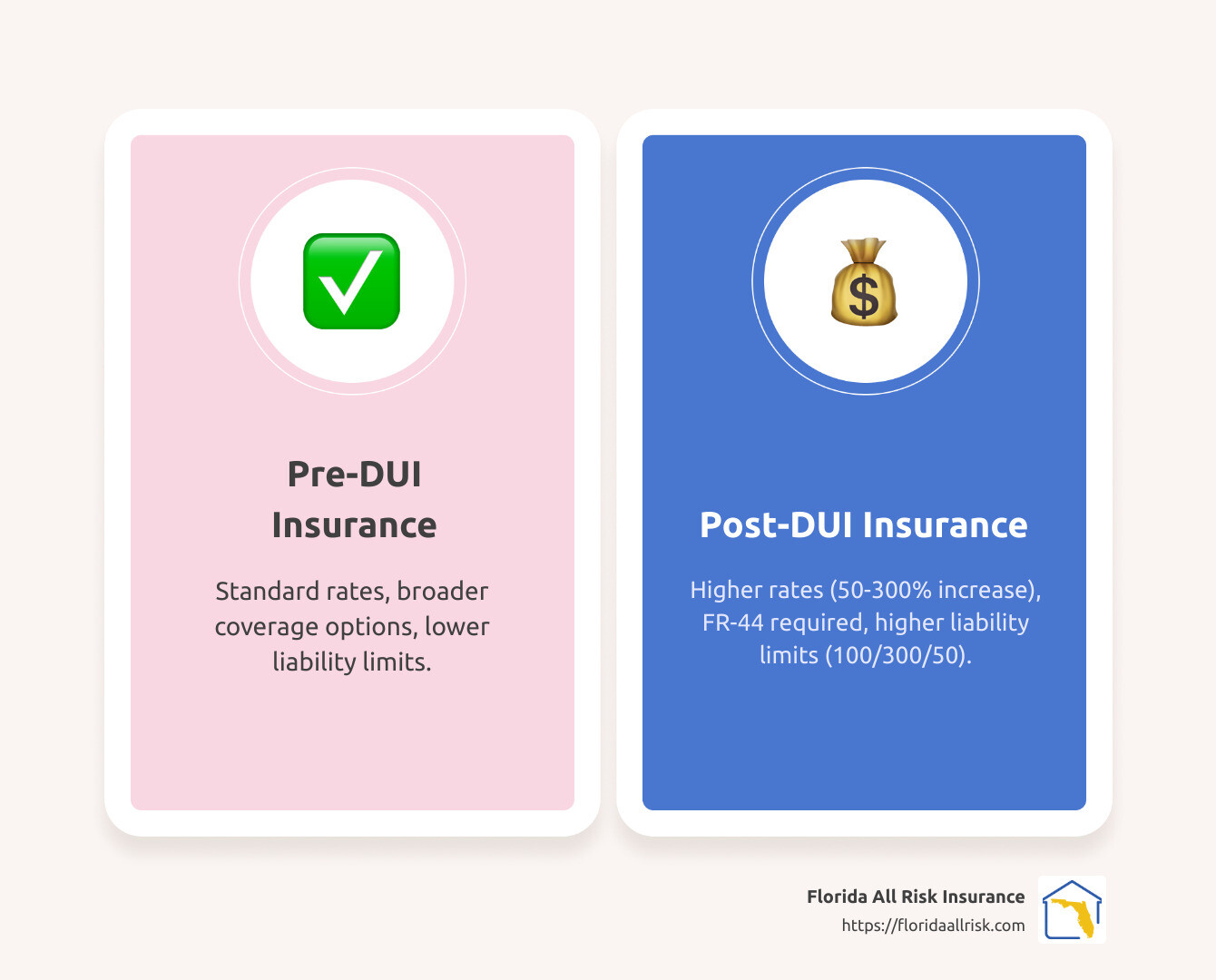
- Average premium increase: 50-300% after a DUI conviction
- Required insurance form: FR-44 (not SR-22)
- Minimum coverage required: 100/300/50 liability limits
- Duration requirement: Maintain for at least 3 years
- Best companies for DUI insurance: Some insurers specialize in high-risk drivers and may offer more competitive rates.
A DUI conviction in Florida creates immediate insurance challenges beyond the legal penalties. Your current insurer may cancel your policy with a 45-day notice, and finding new coverage becomes significantly more difficult and expensive. Florida law requires drivers with DUI convictions to file an FR-44 form, which mandates substantially higher liability coverage than standard policies.
While the sticker shock can be severe, you do have options. Insurance companies assess DUI risk differently, and shopping around becomes essential to finding the most affordable coverage. Some insurers specialize in high-risk drivers and may offer more competitive rates.
A DUI remains on your Florida driving record for 75 years, but its impact on your insurance rates typically diminishes over time if you maintain a clean driving record going forward.
I’m Jason Miller, and I’ve spent over 20 years helping Floridians steer the complex DUI auto insurance Florida requirements, drawing from my family’s combined 60+ years of insurance experience in the state to find affordable solutions for drivers facing DUI challenges.
Relevant articles related to DUI auto insurance Florida:
- Affordable car insurance Florida
- Liability car insurance Florida
- Uninsured motorist coverage Florida
Understanding the Impact of a DUI on Your Auto Insurance Rates
Once you have a DUI conviction on your record in Florida, your experience with auto insurance takes a sharp turn. Insurers now see you as a high-risk driver, which can lead to significant financial challenges.
Insurance companies rely heavily on driving history to predict future risk. A DUI conviction is like waving a big red flag, signaling that you might end up in more accidents or file more claims. This increased risk translates directly to higher premiums.
Beyond just a bump in costs, a DUI can lead to several other insurance problems:
Your current insurer might decide to cancel your policy, but they must give you at least a 45-day notice. Many standard insurance providers may shy away from covering drivers with a recent DUI. Even if you find coverage, expect higher deductibles and a loss of any safe driver discounts you once enjoyed.
As one insurance agent put it, “A DUI conviction in Florida is one of the most costly mistakes you can make with insurance. Its financial impact often lingers far beyond the legal penalties.”
How a DUI Affects Insurance Rates in Florida
The financial jolt of a DUI in Florida can be huge. While the exact premium increase varies, a typical Florida driver might see their rates swell by 50% to 300% after a DUI conviction.
To break it down, if you were paying $1,500 annually for insurance, post-DUI, those rates could shoot up to between $2,250 and $4,500—or even more. This jump is due to the higher risk category you now fall into.
Key factors influencing this rate hike include:
- Your driving history: A first-time offender with a clean record might see a smaller increase.
- Your age and gender: Young drivers and males often get hit harder.
- Your insurance company: Each has its own way of handling DUI cases.
- The severity of the DUI: High BAC levels or incidents involving accidents can result in bigger hikes.
- Your credit score: In Florida, a poor credit score can further compound premium increases.
Recent studies show the average full coverage premium in Florida rises from approximately $3,451 to $5,457 post-DUI—an average bump of 58%. While steep, this is actually less than the national average increase of 105%. A small win for Floridians!
Duration of a DUI’s Impact on Insurance Premiums
One of the tougher pills to swallow with a DUI in Florida is its lasting presence. Your record will hold onto a DUI for 75 years—essentially a lifetime. Yet, its grip on your insurance premiums eases over time with responsible driving.
Typically, insurers glance back three to five years when setting rates, though some peek back up to ten years. So while the DUI never truly fades away, its influence on your rates can lessen if you keep your record clean.
Here’s a look at the general timeline:
- Years 1-3: Expect the harshest premium hikes, aligning with your FR-44 requirement.
- Years 4-5: Some improvement if you maintain a spotless record.
- Years 6-10: Continued gradual relief in rates.
- After 10 years: Many insurers may no longer weigh the DUI heavily in rate calculations.
This timeline can sway based on your insurer’s policies and your overall driving history. Accumulating further violations or multiple DUIs will prolong the impact.
The key to easing the long-term burden is showcasing responsible driving habits. Each year of clean driving helps mend your insurance profile, slowly chipping away at the financial penalty of your DUI.
For more insights and assistance on navigating DUI auto insurance Florida, Florida All Risk Insurance is here to help you find the best path forward.
Navigating Florida’s SR-22 and FR-44 Insurance Requirements
Getting back on the road after a DUI conviction in Florida isn’t just about paying fines or completing community service. It involves navigating the sometimes confusing world of insurance requirements that go beyond the norm. To keep your driving privileges intact and avoid further penalties, understand these requirements thoroughly.
Florida stands out in its approach by requiring an FR-44 form instead of the more common SR-22 used in other states. This isn’t just a bureaucratic detail—it’s a big deal because the FR-44 has stricter rules, specifically for DUIs and other serious alcohol-related offenses.
Understanding FR-44 Insurance in Florida
Think of the FR-44 as your insurance report card—a certificate that proves you’re financially responsible enough to drive after a DUI. It’s not an insurance policy itself, but your insurance company files it with the Florida Department of Highway Safety and Motor Vehicles (DHSMV) to show you carry the required higher liability coverage.
Introduced on February 1, 2008, specifically for DUI offenders, the FR-44 demands significantly higher liability coverage than Florida’s standard. Here’s how the math breaks down:
- $100,000 per person for bodily injury
- $300,000 per accident for bodily injury
- $50,000 for property damage per accident
These increased limits—often referred to as “100/300/50″—are designed to ensure there’s enough coverage to handle any accidents or damages you might cause. The goal is to match the higher risk profile associated with DUI convictions.
You’ll need to keep up this FR-44 coverage continuously for at least three years from the date your license is reinstated. If there’s any lapse, your insurer will let the DHSMV know, and you’ll face automatic license suspension. So, staying on top of this is crucial!
Difference Between SR-22 and FR-44
While both SR-22 and FR-44 forms are certificates of financial responsibility, they aren’t identical twins—more like cousins. Here’s what sets them apart, especially in the Sunshine State:
SR-22 in Florida: This form is required for non-DUI driving violations, like driving without insurance or getting into at-fault accidents without coverage. The required minimum liability coverage is 10/20/10—that’s $10,000 per person for bodily injury, $20,000 per accident for bodily injury, and $10,000 for property damage. Notably, it’s generally less expensive than an FR-44 because of these lower requirements.
FR-44 in Florida: This one packs a punch with its requirements. Specifically mandated for DUI and other alcohol or drug-related offenses, it demands liability coverage of 100/300/50. This higher coverage, coupled with the DUI risk factor, makes it significantly more expensive than the SR-22.
Interestingly, Florida and Virginia are the only states that use the FR-44 for DUI offenses, reflecting the seriousness with which Florida treats these violations. If you’re scratching your head about which form you need, it’s a good idea to check your court documents or reach out to the DHSMV. Using the wrong form can lead to a heap of trouble, like continued license suspension.
Navigating these requirements might seem daunting, but understanding them is key to getting your license back and keeping it. If you’re feeling overwhelmed, remember the team at Florida All Risk Insurance is just a call away, ready to guide you through every twist and turn.
Steps to Minimize Insurance Premium Increases After a DUI
Facing a DUI conviction in Florida can undoubtedly feel daunting, especially when it comes to the financial impact on your insurance. But don’t fret—there are proactive steps you can take to soften the blow and find the most affordable DUI auto insurance Florida has to offer.
First and foremost, complete all court-ordered requirements promptly. This shows your commitment to turning over a new leaf and can positively influence how insurers view your risk level.
Next, consider enrolling in defensive driving or DUI education courses. Not only do these courses fulfill legal obligations, but they also arm you with safer driving skills. Insurance companies often provide discounts of 5-15% for completing these courses, which can help offset premium increases. Just make sure the course is approved by the Florida DHSMV—and don’t forget to check out their DUI Frequently Asked Questions page for a list of qualifying programs.
Shopping around for insurance is another key strategy. Different companies have varying approaches to DUI convictions, so it pays to compare quotes from multiple insurers. While some specialize in high-risk drivers and may offer better rates, others might have more lenient policies for first-time offenders with otherwise clean records. Including both standard insurers and those specializing in high-risk coverage in your comparison is wise. Remember to check out the Florida Automobile Joint Underwriting Association (FAJUA) if you’re struggling to find coverage; they provide solutions for drivers who can’t secure insurance through traditional means.
Maintaining continuous insurance coverage is crucial. Any lapse can lead to license suspension due to the FR-44 filing requirement. Plus, continuous coverage looks favorable to insurers and can help lower future rates. Set up automatic payments or calendar reminders to avoid missing payment deadlines, and ensure there’s no gap if you’re switching providers.
Improving your credit score, opting for higher deductibles, considering driving a less expensive vehicle, and exploring usage-based insurance programs are additional strategies that can help keep costs down. Moreover, bundling your auto insurance with other policies like homeowners or renters can open up further discounts.
By taking these steps, you can steer the challenging waters of securing affordable DUI auto insurance Florida and gradually steer your insurance costs back to smoother seas. Every little action helps pave the way toward more manageable premiums.
Finding Affordable DUI Auto Insurance in Florida

Finding affordable DUI auto insurance Florida can feel like searching for a needle in a haystack, but rest assured, it’s not impossible. With a bit of patience and a lot of persistence, you can find insurance options that won’t break the bank. At Florida All Risk Insurance, we’re here to help you steer this tricky terrain. With a little bit of research and exploration, you might be surprised at the options available.
Some insurers specialize in high-risk drivers and may offer more competitive rates for Florida drivers dealing with a DUI conviction. However, the right choice depends on personal factors, such as your age, where you live in Florida, your credit score, previous driving history, and what kind of car you own. At Florida All Risk Insurance, we collaborate with multiple carriers to pinpoint the best deals for our clients who need DUI auto insurance Florida.
Tips for Finding Cheap DUI Auto Insurance in Florida
To make your search a bit easier, consider these strategies:
Leverage multi-policy discounts by bundling your auto insurance with other policies like homeowners or renters insurance. This can often lead to savings of 10-25%, which certainly helps when faced with a DUI-related increase.
Explore usage-based insurance programs. These programs use telematics devices or smartphone apps to monitor your driving habits. If you drive safely, infrequently, or mainly during safer hours, these programs might offer you a break on your rates despite your DUI history.
Consider pay-per-mile insurance if you’re a low-mileage driver, clocking in under 7,000 miles per year. Since these policies charge based on how much you drive, they can be a cost-effective choice if your car spends more time parked than on the road.
Improve your credit score. In Florida, your credit score can significantly impact your insurance rates. By working to boost your credit, you may see your premiums decrease over time. This is crucial after a DUI since low credit combined with a DUI can sharply increase your rates.
Choose your vehicle wisely. If you’re car shopping, opt for a vehicle that’s cheaper to insure. Generally, newer models, luxury cars, or high-performance vehicles come with higher insurance costs. A modest, safe vehicle with excellent safety and anti-theft features can help keep your premiums in check.
Consider higher deductibles to help lower your monthly payments. Just make sure you can afford the deductible if an accident occurs.
Ask about specific discounts. Insurance companies often offer discounts for various reasons, including military service, professional affiliations, vehicle safety features, and more. Even opting for paperless billing or paying your premium upfront can sometimes open up savings.
Considering Non-Owner FR-44 Insurance
If you don’t own a car but need to meet your FR-44 requirements, non-owner FR-44 insurance could be a smart, cost-effective solution. It provides liability coverage when you’re driving cars that aren’t yours, like rentals or borrowed vehicles. Since it doesn’t involve insuring a specific vehicle, and typically skips comprehensive and collision coverage, it’s usually less expensive than standard FR-44 policies.
Non-owner FR-44 insurance satisfies the legal need for 100/300/50 liability coverage and can be 30-50% cheaper than regular FR-44 insurance. However, it’s important to note that it doesn’t cover damage to the vehicles you drive and isn’t available if you own a vehicle or have regular access to one in your household.
This type of policy is perfect for those who don’t own a vehicle but still need to reinstate their license, drive occasionally, or mainly rely on public transport and borrow a car now and then. At Florida All Risk Insurance, we’ve guided many clients to use non-owner FR-44 policies as a practical way to maintain their driving privileges while working toward better insurance rates down the road.
Legal Requirements for DUI Auto Insurance Coverage in Florida

Navigating the legal landscape of DUI auto insurance Florida can feel like threading a needle. But don’t worry, understanding these requirements will help you stay on the right side of the law and keep those driving privileges intact. Florida law sets specific rules for insurance coverage after a DUI conviction, aimed at ensuring both your protection and that of others on the road.
The framework for these requirements is laid out in several key statutes. Florida Statute 324.023 spells out the financial responsibility required after a DUI, while Florida Statute 316.193 digs into the nitty-gritty of what constitutes a DUI and the penalties involved. Also, Florida Statute 627.728 outlines how insurance cancellations related to DUI must be handled. Together, these laws create a robust system to ensure that DUI offenders have adequate insurance coverage.
Mandatory Minimum Coverage Limits Post-DUI Conviction
After a DUI, your insurance must cover more than the basic requirements. You’re now looking at higher liability limits, neatly bundled as “100/300/50” coverage. This translates to $100,000 for bodily injury per person, $300,000 per accident, and $50,000 for property damage. Plus, there’s the usual $10,000 for Personal Injury Protection (PIP). These numbers ensure that if you’re in an accident, there’s ample coverage to handle damages and injuries.
These improved limits are no joke and reflect the higher risk associated with a DUI conviction. They need to be in place continuously for at least three years from when your license is reinstated. Although these are the minimums, many folks find peace of mind in opting for even higher coverage. After all, medical bills and repair costs can balloon quickly.
Consequences of Not Meeting Insurance Requirements
Missing the mark on these insurance requirements can lead to some serious headaches. If you let your DUI auto insurance Florida lapse, you’re looking at automatic suspension of your license. Insurers are obligated to notify the DHSMV the moment your FR-44 policy falters, and that spells immediate trouble without any friendly heads-up.
To get your license back after such a suspension, you’ll need to fork out some cash: $150 for the first time, $250 for the second, and $500 for any further slip-ups. Plus, any gap in your FR-44 coverage could extend your requirement period, effectively dragging out the process. And let’s not forget, driving without a license due to suspension can add legal issues to your plate, including fines or even jail time.
One driver shared a cautionary tale: “I missed a payment and my insurance lapsed for just two weeks, leading to a suspended license. The whole ordeal of reinstating it and finding new coverage cost way more in the end. It was a real nightmare.”
The bottom line is that this coverage isn’t just a suggestion—it’s a legal mandate with hefty consequences for falling behind. If you’re struggling with costs, it’s better to explore options like non-owner policies or seek payment plans instead of allowing your coverage to lapse. At Florida All Risk Insurance, our team is here to help you steer these challenges and find solutions that keep you compliant and covered.
Defensive Driving Courses and Other Strategies to Reduce Insurance Costs
After a DUI conviction in Florida, it can feel like you’ve been hit with a financial one-two punch. But with some strategic steps, you can start to chip away at those towering insurance costs. At Florida All Risk Insurance, we believe in empowering our clients with knowledge and tools to steer their insurance journey wisely.
Benefits of Defensive Driving Courses
One of the first steps you might consider is enrolling in a state-approved defensive driving course. These courses can be a lifesaver—not only for your wallet but also for your peace of mind.
Insurance Premium Discounts: Many insurers offer a nice 5-15% discount on premiums for drivers who complete these courses. While it won’t erase the DUI-related increase entirely, it’s a solid start towards reducing your costs.
Point Reduction on Your Driving Record: In Florida, completing a defensive driving course can sometimes help shave points off your driving record. Fewer points can brighten your insurance outlook.
Demonstrating Responsibility to Insurers: Going the extra mile with voluntary courses shows insurers you’re committed to being a safer driver. This can positively shift how they view your risk.
Practical Safety Benefits: These courses aren’t just about discounts—they teach valuable techniques to help avoid future mishaps, which is crucial for slowly improving your insurance rates.
Florida offers various course options, like the Basic Driver Improvement (BDI) Course for point reduction, or the Advanced Driver Improvement (ADI) Course, which might be required for certain reinstatements. Remember to check that the course is approved by the Florida DHSMV and verify any discounts with your insurer.
Additional Ways to Lower Premiums
Beyond defensive driving courses, several strategies can help lighten your DUI auto insurance Florida load.
Consider increasing your deductibles. By bumping up your deductible from $500 to $1,000, you could slash 10-20% off those comprehensive and collision coverage costs. Just be sure you can handle the higher payout if it comes to claim time.
If you’re in the market for a new ride, choosing a less expensive vehicle can make a noticeable difference. High-performance or luxury cars are fun, but they can send your premiums sky-high. Researching insurance costs before buying can save you from sticker shock later.
Bundling insurance policies is another savvy move. Combining auto insurance with homeowners or renters insurance often open ups significant multi-policy discounts. At Florida All Risk, we can explore these options across our wide network of carriers.
Keeping an eye on your credit score is also key. In Florida, maintaining good credit can help keep your rates in check. Simple actions like timely bill payments and reducing debt can gradually improve your score.
Thinking about safety features? Installing safety and anti-theft devices in your vehicle could earn you discounts. Features like anti-lock brakes, airbags, and alarms not only make your car safer but might also trim down those premium costs.
Lastly, consider usage-based insurance if you drive safely and sparingly. These programs track real-time driving habits and could reward your caution with lower rates.
By weaving together these strategies, you can soften the financial blow of a DUI and show insurers your commitment to responsible driving. It’s all about taking small steps towards a more affordable and secure future.
Long-Term Implications of a DUI on Your Driving Record and Insurance
A DUI conviction in Florida doesn’t just affect you in the short term. It casts a long shadow over your driving record and insurance for years to come. In Florida, a DUI conviction stays on your driving record for a whopping 75 years. Yes, you read that right—almost a lifetime! This means that while the immediate sting of insurance rate hikes might lessen over time, the conviction itself stays accessible to anyone who looks up your record.
While the DUI is a permanent record fixture, its impact on your insurance premiums doesn’t last forever. Most insurers focus on the most recent 3 to 5 years of your driving history. This means that if you keep your record clean, the financial bite starts to soften. Here’s how the timeline generally plays out: Years 1-3 are the toughest with the highest premiums and the FR-44 requirement; Years 4-5 might bring some relief if you steer clear of any traffic troubles; Years 6-10 often see continued improvement; and beyond 10 years, many insurers might not even factor the DUI into their calculations.
DUI’s Impact on Other Types of Insurance
A DUI doesn’t just mess with your auto insurance; it can ripple through other types of insurance too. Life insurance often sees the biggest impact. Insurers view DUIs as risky behavior, which could mean higher premiums, possible coverage denial, or longer waiting periods before you’re eligible. Most life insurers look back 3 to 5 years for DUIs, but some might peek even further into the past.
For health insurance, the Affordable Care Act prevents denial based on pre-existing conditions, including DUIs. However, some plans might still consider DUIs when setting rates, especially if there are signs of substance abuse issues. Homeowners and renters insurance might also be affected, as some insurers see a DUI as a sign of risk tolerance, potentially nudging premiums slightly higher. And don’t forget about disability insurance; providers might hike premiums or add exclusions if you’ve had a recent DUI.
As one insurance pro said, “A DUI is like a pebble tossed into a pond—its ripples spread far and wide.”
Steps Toward Rebuilding Your Driving Record
Rebuilding your driving record after a DUI is a journey that requires patience and determination. First, make sure to complete all court-ordered requirements. This often includes DUI education programs, community service, and any fines or fees. Keeping a clean driving record is crucial. Even minor violations can have a big impact after a DUI, so it’s important to obey all traffic laws and drive defensively.
Consider participating in substance abuse programs, even if not required by the court. It demonstrates commitment to change. Regularly review your driving record to ensure accuracy and monitor improvements. As your record improves, reassess your insurance options annually. What was off-limits immediately after a DUI might become available as time passes. Advanced driver training can also show insurers you’re serious about safe driving.
Documenting positive changes can be useful. Keep certificates from driving courses, clean record documentation, and letters from counselors. These can help when negotiating with insurers or explaining your history to future employers.
Rebuilding your driving record is a marathon, not a sprint. Each year of accident-free driving gets you closer to overcoming the financial and practical impacts of your DUI conviction. At Florida All Risk Insurance, we’re here to help you steer this journey and find the right DUI auto insurance Florida solutions for your needs.
Frequently Asked Questions about DUI Auto Insurance in Florida
How Much Will My Insurance Increase After a DUI in Florida?
Brace yourself for a shock—after a DUI conviction in Florida, your auto insurance premiums might skyrocket by anywhere from 50% to 300%. This wide range is not just a random guess; it reflects how personalized insurance pricing can be. It’s like ordering a sandwich—you never know quite what you’ll get until you take a bite!
On average, the cost of full coverage insurance in Florida jumps from around $3,451 to $5,457 annually after a DUI. That’s about a 58% increase, which, believe it or not, is actually lower than the national average spike of 105%. Yay, Florida!
The exact increase depends on several factors:
- Your insurance company: Some are tougher on DUIs than others.
- Your previous driving record: A good history before that DUI might soften the blow.
- Your age and gender: Sorry, younger drivers and guys often face bigger hikes.
- Your location in Florida: City dwellers, brace yourselves for higher numbers.
- Your credit score: Poor credit plus a DUI? That’s a recipe for higher costs.
- Your coverage levels: Higher coverage (thanks to that FR-44 requirement) equals higher premiums.
The first year after your DUI is usually the worst for your wallet. Keep a clean driving record, and over time, things might just start to look up.
Can I Get Car Insurance After a DUI Conviction in Florida?
The short answer? Yes, you can still get car insurance after a DUI in Florida! But it might take a bit more legwork. It’s like shopping for the perfect pair of shoes—challenging but possible.
Here are your options:
- Standard insurers that accept DUI risks are out there. Names like State Farm, Travelers, and Direct General Insurance often come up when Florida drivers talk about finding coverage post-DUI.
- Non-standard or high-risk insurers are another route. These companies specialize in covering drivers with a history of DUIs and other complexities, though they do tend to charge higher premiums for the privilege.
- If all else fails, there’s the Florida Automobile Joint Underwriting Association (FAJUA). Think of it as the safety net for drivers who can’t find coverage elsewhere. It’s pricier, but it ensures you meet legal requirements.
At Florida All Risk Insurance, we’re here to help you steer this tricky terrain. We’ve got the experience and connections to find suitable coverage even with a DUI on your record. Just remember, be honest about your past when applying for insurance. It’ll show up anyway, and honesty is always the best policy.
How Long Do I Need to Maintain FR-44 Insurance?
In Florida, having an FR-44 insurance policy is like a three-year commitment—a bit like a gym membership you can’t quit, even on lazy days. This requirement starts ticking from the day your license is reinstated after a DUI, and there are no shortcuts or cheat codes to end it early.
Here’s what you need to know:
- Continuous coverage is a must. If your coverage lapses, the Florida Department of Highway Safety and Motor Vehicles (DHSMV) will know, and your license could be suspended faster than you can say “Oops!”
- The three-year countdown starts with reinstatement. Forget about the conviction date or arrest—it’s all about when you get back behind the wheel legally.
- Cancel your FR-44 before time’s up, and you’re looking at a suspended license until you grab another FR-44 policy and pay any fees.
- Moving out of state? Check the new state’s laws, as some might not accept your Florida FR-44.
- Changed cars? Ensure that your new ride is covered without any coverage gaps.
Once you’ve stuck with it for three years, you’re free to explore other insurance options—though keeping higher liability limits is always good advice. Your DUI might still cast a shadow on your rates for a while, but hey, at least the FR-44 obligations are behind you.
Conclusion

Navigating the complex world of DUI auto insurance Florida is challenging, but with the right information and approach, you can find affordable coverage that meets legal requirements while protecting your financial interests. While a DUI conviction creates significant insurance problems, they’re not impossible.
The key points to remember when dealing with DUI auto insurance in Florida are:
-
Expect significant premium increases of 50-300%, but know that rates can vary widely between insurers.
-
Understand and fulfill the FR-44 requirement with its higher liability limits (100/300/50) for at least three years.
-
Shop extensively for coverage by comparing quotes from multiple insurers that specialize in high-risk drivers.
-
Take proactive steps to minimize costs through defensive driving courses, policy bundling, and maintaining a spotless driving record going forward.
-
Consider alternatives like non-owner policies if they better fit your situation and budget.
-
Maintain continuous coverage without lapses to avoid license suspension and additional penalties.
-
Be patient and persistent as the impact of your DUI on insurance rates will gradually diminish over time with responsible driving.
At Florida All Risk Insurance, we understand that people make mistakes, and a DUI conviction shouldn’t define your future or make insurance unaffordable. Our team of experienced professionals specializes in helping Florida drivers with DUI convictions find the most competitive rates available across our network of carriers.
Based in St. Petersburg, we’ve helped countless Florida drivers steer the complexities of post-DUI insurance requirements. We take the time to understand your unique situation, explain your options clearly, and advocate on your behalf with insurance carriers.
While a DUI conviction remains on your Florida driving record for 75 years, its practical impact on your insurance rates typically diminishes significantly after 3-5 years of clean driving. The path forward requires patience and diligence, but affordable coverage is available, and your insurance situation will improve over time.
For more information about how we can help you find appropriate and affordable DUI auto insurance Florida coverage, please visit our Auto Insurance Coverage page or contact our office directly. We’re here to help you move forward after a DUI with confidence and appropriate protection.

