

Auto Insurance Companies in Florida: Ultimate 2026 Deals
Navigating the Florida Auto Insurance Landscape
Auto insurance companies in Florida operate in one of the nation’s most expensive and complex markets. If you’re shopping for car insurance in the Sunshine State, understanding the landscape is the first step.
What to Look for in Top-Rated Auto Insurance Companies
- Competitive Rates: While rates vary, top companies offer competitive pricing, especially for drivers with good records.
- Strong Discount Programs: Look for insurers with a wide range of discounts for things like safe driving, bundling policies, and vehicle safety features.
- Excellent Digital Tools: Modern insurers provide robust websites and mobile apps for managing your policy and filing claims.
- Specialty Coverage: Some companies cater to specific groups, such as military families, offering custom benefits.
- Independent Agency Access: Working with an independent agency gives you access to multiple carriers, allowing for comprehensive rate and coverage comparisons.
Florida’s Minimum Required Coverage
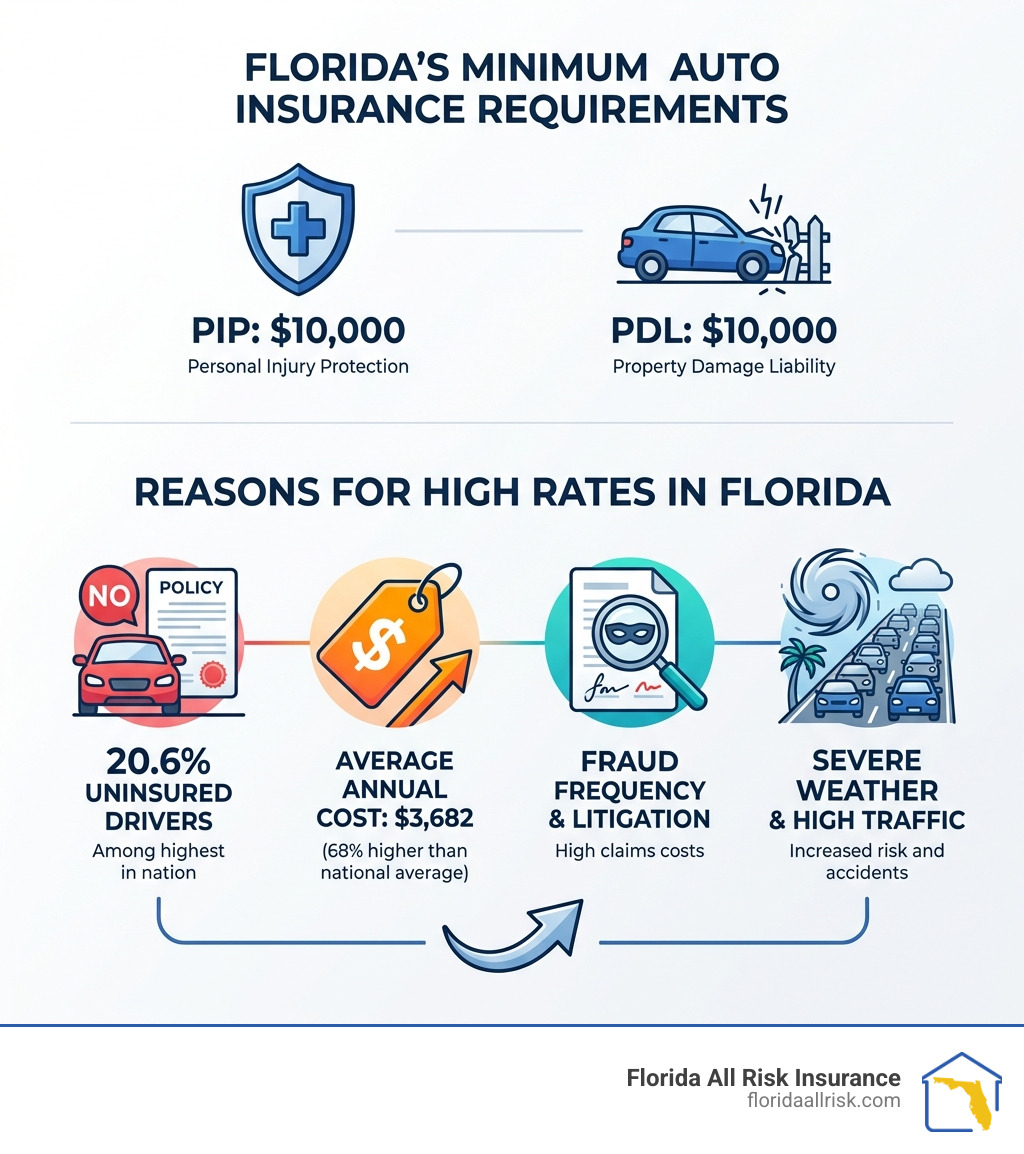
- Personal Injury Protection (PIP): $10,000
- Property Damage Liability (PDL): $10,000
- Note: Bodily injury liability is optional but highly recommended.
Why Florida Insurance Costs More
- Average annual premium: $3,682 (significantly higher than the U.S. average)
- A large percentage of drivers are uninsured
- High fraud rates and litigation costs
- Severe weather risks, including hurricanes
Florida’s unique no-fault system, high population density, and vulnerability to natural disasters create a volatile insurance marketplace. Finding the right coverage means looking beyond the state’s minimums. Many drivers find that the cheapest policy isn’t the best value—especially when a substantial portion of drivers on the road may have no insurance.
As Jason Miller, I’ve spent over 20 years helping Florida residents navigate auto insurance companies in Florida and find comprehensive protection. My family’s 60+ years of combined experience in the state led me to build Florida All Risk Insurance, where we provide personalized guidance through this complex market.
Why Is Car Insurance in Florida So Expensive?
Florida consistently ranks among the most expensive states for car insurance, with average costs significantly higher than the national average. The reasons are multifaceted:
- High Population Density and Tourism: Congested roadways lead to a higher likelihood of accidents and claims.
- Frequent Severe Weather: Hurricanes and tropical storms cause widespread vehicle damage, leading to a surge in comprehensive claims.
- High Number of Uninsured Drivers: A notable share of drivers lacks coverage. Insured drivers bear a greater financial burden, which auto insurance companies in Florida factor into premiums.
- Litigation Environment: The frequency and cost of lawsuits related to auto accidents are significant contributors to high insurance costs.
- Fraud Frequency: Insurance fraud is more common in Florida, and these costs are passed on to policyholders through higher premiums.
These factors create a challenging environment for auto insurance companies in Florida, making it crucial to find competitive rates without compromising coverage. For more background on how auto insurance works nationwide and in no-fault states, you can explore detailed resources from the Insurance Information Institute.
The Reality of Driving in the Sunshine State
Driving in Florida comes with unique risks. With a significant percentage of drivers operating without proper coverage, simply meeting the state’s minimum insurance requirements may not be enough to protect your assets.
Imagine being in an accident caused by an uninsured driver. Without adequate coverage on your own policy, you could be left with substantial medical bills and vehicle repair costs. This is why investing in sufficient coverage is a smart financial decision.
We believe in ensuring our clients are prepared for the unexpected, especially when driving alongside so many underinsured or uninsured motorists. A well-structured policy can help safeguard your savings, income, and long-term financial plans.

Understanding Florida’s Minimum Car Insurance Requirements
Before exploring the best auto insurance companies in Florida, it helps to understand the state’s legal requirements. Florida operates under a “no-fault” system, which shapes the insurance you must carry. This system centers on two coverages: Personal Injury Protection (PIP) and Property Damage Liability (PDL).
Is Florida a No-Fault State?
Yes, Florida is a no-fault state, a fact explained in detail by the Insurance Information Institute. Under no-fault, your own PIP insurance covers a portion of your medical expenses and lost wages after an accident, regardless of who was at fault. The goal is to streamline the claims process for minor injuries, ensuring accident victims receive prompt medical care without waiting for a fault determination.
This system also restricts your ability to sue another driver for pain and suffering unless your injuries meet a “serious injury” threshold defined by state law. This is a crucial distinction that highlights the importance of having adequate coverage on your own policy.
Mandatory Coverages: PIP and PDL
To legally drive in Florida, you must carry two key coverages:
- Personal Injury Protection (PIP): A minimum of $10,000 in PIP is required. It typically covers 80% of your medical bills and 60% of lost wages up to your policy limit, regardless of fault. This coverage can extend to you, relatives in your household, certain passengers, and even pedestrians or cyclists if struck by your vehicle.
- Property Damage Liability (PDL): You must also carry $10,000 in PDL. This pays for damage you cause to another person’s property in an at-fault accident, such as their car, a fence, or a building.
These are only the minimums. While Bodily Injury Liability (BI) and Uninsured Motorist (UM) coverage are not always mandatory, they are highly recommended for financial protection. Your policy must be from an insurer licensed in Florida, and you must carry proof of insurance when you drive. The Florida Department of Highway Safety and Motor Vehicles offers more details on its official insurance information page.
For drivers who need to address past violations or license suspensions, certain filings like an SR-22 may be required to show proof of financial responsibility. You can learn more about that process on our dedicated SR-22 information page: https://floridaallrisk.com/sr22-form/.
The Consequences of Driving Uninsured
Driving without the required insurance in Florida carries significant legal and financial penalties. The state takes this offense seriously to protect all drivers on the road.
If caught driving without valid Florida auto insurance, the consequences can include:
- Suspension of your driver’s license, vehicle tag, and registration.
- Reinstatement fees that may range from hundreds of dollars upwards, depending on the number of offenses.
- Financial Responsibility Law requirements. If you’re in an accident while uninsured, you may be required to carry more extensive liability coverage for three years.
As outlined by the Florida Department of Highway Safety and Motor Vehicles, all drivers must carry continuous coverage. Maintaining valid insurance is crucial to avoid these costly and inconvenient penalties.
For a more detailed breakdown of penalties and how lapses in coverage can affect you, you can also review our in-depth guide to driving without insurance in Florida: https://floridaallrisk.com/driving-without-insurance-florida-guide/.
How to Evaluate the Best Auto Insurance Companies in Florida
With so many auto insurance companies in Florida competing for your business, choosing the right one involves more than finding the lowest price. It’s about securing reliable coverage, responsive service, and long-term peace of mind. As an independent agency, we guide our clients through this process by focusing on several key evaluation criteria.
Key Criteria for Comparing Auto Insurance Companies in Florida
When evaluating insurers, it helps to look beyond the initial quote and consider long-term value:
- Financial Strength: An insurance company’s ability to pay claims is paramount. Independent rating agencies such as A.M. Best and others evaluate financial stability and claims-paying ability. A strong rating suggests the company can meet its obligations, even after widespread events like a hurricane.
- Claims Process Efficiency: After an accident, you need a smooth and fair claims experience. Look for companies known for efficient handling, clear communication, and consistent customer satisfaction.
- Customer Support: Is help available when you need it? Consider factors like 24/7 claims reporting, online resources, educational materials, and the availability of local agents who understand Florida-specific risks.
- Policy Options and Flexibility: The best companies offer a variety of coverage options and endorsements so your policy can reflect your specific needs, rather than a one-size-fits-all approach.
- Discount Availability: A broad range of discounts can significantly lower your premium. When we compare auto insurance companies in Florida, we consider how many drivers will realistically qualify for their discounts.
Captive Agents vs. Independent Agents
Understanding the difference between agent types is crucial in your search:
- Captive Agents: These agents work exclusively for one insurance company. While they are experts on that company’s products, they can only provide quotes and policies from that single insurer, which can limit your options.
- Independent Agents: This is where we, Florida All Risk Insurance, come in. As an independent agency, we are not tied to any single company. We partner with a wide network of auto insurance companies in Florida, which allows us to:
- Offer Choice: We shop the market on your behalf, comparing rates and coverages from multiple insurers.
- Provide Personalized Service: We get to know you, your vehicle, and your driving habits so we can recommend coverage levels and options that actually fit your life.
- Access a Broader Market: We can look for the best fit for your needs rather than trying to match you to a single carrier.
If you are ready to compare options, you can request a customized Florida auto quote directly from us here: https://floridaallrisk.com/insurance_products/auto-insurance/.
Key Factors That Influence Your Florida Car Insurance Rates
Have you ever wondered why your friend’s car insurance is so much lower than yours, even if you drive a similar car? Your car insurance rates are a highly personalized calculation, influenced by a range of factors. Auto insurance companies in Florida consider many variables to assess your risk profile and determine your premium.
Your Driving Record and History
One of the most significant factors influencing your car insurance premium is your driving record. Insurers view your past driving behavior as a strong indicator of your future risk.
- At-Fault Accidents: If you’ve been involved in an accident where you were deemed at fault, expect your rates to increase. The severity of the accident and the amount of damages paid out will also play a role.
- Traffic Violations: Speeding tickets, reckless driving citations, and other moving violations signal a higher risk to insurers, leading to higher premiums.
- DUI Convictions: A DUI (Driving Under the Influence) conviction will drastically increase your insurance costs and may even require you to obtain an SR-22 filing, a certificate of financial responsibility. You can learn more about this by visiting our page on the SR-22 form: https://floridaallrisk.com/sr22-form/.
- Clean Driving Record: Conversely, maintaining a clean driving record for several years can qualify you for safe driver discounts and more favorable rates.
Demographic and Geographic Factors
Beyond your driving history, personal details and where you live play a crucial role in shaping your insurance costs.
- Your ZIP Code and Location: This is a major factor in Florida. Rates can vary dramatically even between neighboring ZIP codes. Insurers analyze local data, including:
- Claim Frequency: Areas with a higher number of accidents, thefts, or vandalism claims will generally have higher premiums.
- Traffic Congestion: Urban areas with heavy traffic typically see more accidents.
- Weather Risks: Coastal areas or regions prone to severe weather events like hurricanes often have higher comprehensive coverage costs.
- Age and Driving Experience: Statistically, younger, less experienced drivers tend to be involved in more accidents, leading to higher rates. Florida has a graduated licensing system for teen drivers, with specific restrictions that affect their risk profile. Rates often decrease as drivers gain experience, then may increase again for some senior drivers.
- Vehicle Make and Model: The type of car you drive impacts your premium. Factors considered include:
- Vehicle Value: More expensive cars cost more to repair or replace.
- Repair Costs: Certain makes and models are more expensive to fix due to specialized parts or labor.
- Safety Features: Advanced safety features can sometimes lead to discounts.
- Theft Rates: Models commonly targeted by thieves may have higher comprehensive premiums.
- Engine Size and Performance: High-performance vehicles are often associated with higher risk.
- Credit-Based Insurance Score: In Florida, as in many other states, your credit history can influence your insurance rates. Insurers may use credit-based insurance scores as one factor in predicting how likely you are to file a claim.
- Annual Mileage: The more you drive, the higher your risk of being in an accident. If you have a long commute or use your vehicle extensively, your premiums may be higher than someone who drives fewer miles annually.
Understanding these factors can help you make decisions that gradually lower your risk profile—such as choosing a safer vehicle, improving your credit, and maintaining a clean driving record—leading to more favorable quotes from auto insurance companies in Florida over time.
Opening Up Savings: How to Lower Your Florida Auto Insurance Costs
Given Florida’s higher-than-average insurance costs, finding ways to save is a priority for many drivers. The good news is that there are numerous strategies you can use to reduce your premiums without sacrificing essential coverage. As an independent agency, we work diligently with our clients to explore every possible avenue for savings.
Common Car Insurance Discounts in Florida
Auto insurance companies in Florida offer a wide array of discounts. Many drivers miss out on savings simply because they don’t know what to ask for. Here are some of the most common discounts available:
- Multi-Policy (Bundling) Discount: Purchasing multiple insurance policies (for example, auto and home, or auto and renters insurance) from the same provider can reduce premiums on both policies.
- Multi-Car Discount: If you insure more than one vehicle on the same policy with the same company, you’ll likely qualify for a discount.
- Good Student Discount: Students with a B average or better often qualify for a discount, recognizing that academic responsibility can translate to responsible driving.
- Defensive Driving Course Discount: Completing an approved defensive driving course can not only make you a safer driver but also help you earn a discount, typically if completed within the last few years.
- Vehicle Safety Features Discount: Cars equipped with anti-lock brakes, airbags, anti-theft devices, and other safety features often qualify for discounts.
- Pay-in-Full Discount: Paying your annual or six-month premium upfront, rather than in monthly installments, can sometimes lead to a modest discount.
- Low Mileage Discount: If you don’t drive many miles annually, you might be eligible for a discount.
- Usage-Based Insurance (Telematics): Many insurers offer programs that monitor your driving habits (like speed, braking, and mileage) through a mobile app or device. Safe driving can lead to significant discounts.
- Online Account or Paperless Discount: Some insurers offer a small discount for managing your policy online or opting for electronic documents.
Actionable Steps to Reduce Your Premium
Beyond discounts, here are some proactive steps you can take to keep your Florida auto insurance costs in check:
- Shop Around and Compare Quotes Regularly: Insurance rates change frequently. Comparing quotes from multiple auto insurance companies in Florida at least once a year—or whenever you have a significant life event such as buying a new car or moving—is a smart habit. You can begin that comparison directly through our auto insurance page: https://floridaallrisk.com/insurance_products/auto-insurance/.
- Raise Your Deductible (Carefully): Opting for a higher deductible on your comprehensive and collision coverage means you’ll pay more out-of-pocket if you file a claim, but it can lower your premium. Just ensure you can comfortably afford the deductible amount in an emergency.
- Maintain Good Credit: Because credit-based insurance scores often factor into your premium, paying bills on time and managing your credit responsibly can positively impact your rates over the long term.
- Review Your Coverage Annually: Your insurance needs change over time. If your car is older and paid off, you might consider whether collision and comprehensive coverage still make sense for its value. If your financial situation has improved, increasing liability limits can give you better protection.
- Choose the Right Vehicle: Before buying a new (or new-to-you) car, research its insurance costs. Vehicles that are less expensive to repair, have strong safety ratings, and are less likely to be stolen often have lower insurance premiums.
- Use Telematics Programs: If you’re a consistently safe driver, enrolling in a usage-based program can be an effective way to demonstrate your low risk and earn discounts over time.
A thoughtful combination of these strategies can help you manage costs while maintaining the robust protection that Florida drivers often need.
Beyond the Basics: Additional Coverage to Consider
While meeting Florida’s minimum insurance requirements is legally necessary, these minimums offer very limited protection. In a state with high accident rates and many uninsured drivers, relying only on PIP and PDL could leave you financially vulnerable. We strongly encourage clients to consider coverages that go beyond the basics to protect their assets and income.
Bodily Injury Liability (BI)
Although not universally mandatory in Florida, Bodily Injury (BI) liability coverage is highly recommended. It may become mandatory for some drivers under the Financial Responsibility Law (for example, after an at-fault accident causing injury or a DUI).
- What BI Covers: If you cause an accident that injures or kills someone, BI pays for their medical expenses, lost wages, and pain and suffering, up to your policy limits.
- Why It’s Crucial: Without BI, you could be personally sued for these damages, putting your assets at risk. BI protects you if you’re responsible for severe injuries that exceed the other party’s PIP coverage or meet the legal threshold for a lawsuit.
Uninsured/Underinsured Motorist (UM/UIM)
Given that a notable percentage of Florida drivers are uninsured or underinsured, Uninsured/Underinsured Motorist (UM/UIM) coverage is one of the most important additions to your policy.
- How UM/UIM Protects You:
- Uninsured Motorist (UM): If an uninsured driver injures you, UM can help cover your medical bills, lost wages, and pain and suffering.
- Underinsured Motorist (UIM): If an at-fault driver has insurance but not enough to cover your damages, UIM can help cover the difference up to your policy limits.
- Why It’s Important: While PIP covers some initial medical costs, UM/UIM is crucial for covering larger expenses from severe injuries caused by an uninsured or underinsured driver.
Collision and Comprehensive Coverage
These two coverages protect your own vehicle. They are typically required if you have a car loan or lease.
- Collision Coverage: This pays to repair or replace your vehicle after a collision with another car or object, regardless of fault, minus your chosen deductible.
- Comprehensive Coverage: This protects your vehicle from non-collision events like theft, vandalism, fire, falling objects, and weather damage (including hurricane-related losses). In Florida’s climate, with its hurricane and storm exposure, this coverage is especially valuable.
Lenders and lessors almost always require both coverages to protect their investment. Even if your car is paid off, these coverages can offer important financial security if you would struggle to repair or replace your vehicle out-of-pocket.
Other Helpful Endorsements and Options
Depending on your situation, several optional coverages can add flexibility and convenience:
- Rental Reimbursement: Helps pay for a rental car while your vehicle is being repaired after a covered loss. This can be especially helpful if you rely on your car for work or family obligations. For more guidance on when rental coverage makes sense, see our detailed overview: https://floridaallrisk.com/rental-car-insurance-florida-guide/.
- Roadside Assistance: Provides services like towing, jump-starts, and help with flat tires or lockouts.
- Gap Coverage: If you have a loan or lease and your car is totaled, gap coverage can help pay the difference between your vehicle’s actual cash value and the remaining balance on your loan or lease.
Choosing the right combination of these options depends on your budget, vehicle, and comfort level with risk. An independent agent can help you balance cost and protection so you are neither over-insured nor under-protected.
Conclusion: Your Roadmap to the Right Coverage in the Sunshine State
Navigating auto insurance companies in Florida can feel complicated due to the state’s no-fault laws, higher average rates, and the prevalence of uninsured drivers. The key takeaway is that informed decisions and thoughtful coverage choices are your best protection.
Understanding the roles of PIP and PDL, and recognizing the importance of additional coverages like Bodily Injury Liability and Uninsured/Underinsured Motorist protection, can help you build a policy that works in real-world scenarios—not just on paper. Factoring in Florida-specific risks such as severe weather and dense traffic makes it easier to see why comprehensive protection matters.
Working with an independent agency like Florida All Risk Insurance gives you access to multiple auto insurance companies in Florida, plus guidance from professionals who focus on the needs of local drivers every day. Instead of trying to compare policies alone, you can rely on experienced agents who take the time to understand your situation and explain your options in clear, straightforward language.
If you are ready to review your current policy, explore better options, or start fresh with a new quote, our team is here to help you every step of the way.
Take the next step toward confident driving in Florida by requesting a personalized auto insurance quote today: https://floridaallrisk.com/insurance_products/auto-insurance/.
Have questions about coverage limits, discounts, or specific situations like driving without insurance, SR-22 requirements, or rental car protection? Reach out to our team for one-on-one guidance and clear answers tailored to your needs.
Contact Us
Florida All Risk Insurance
7220 Central Ave, Saint Petersburg, FL 33710
Phone: (727) 345-0242
Email: [email protected]
Website: https://floridaallrisk.com/
Whether you’re new to Florida, reassessing your current coverage, or simply want a second opinion, we welcome the opportunity to help you protect what matters most on the road.

