Florida car insurance calculator: Unlock Savings 2026
Why Estimating Your Car Insurance is a Smart Move
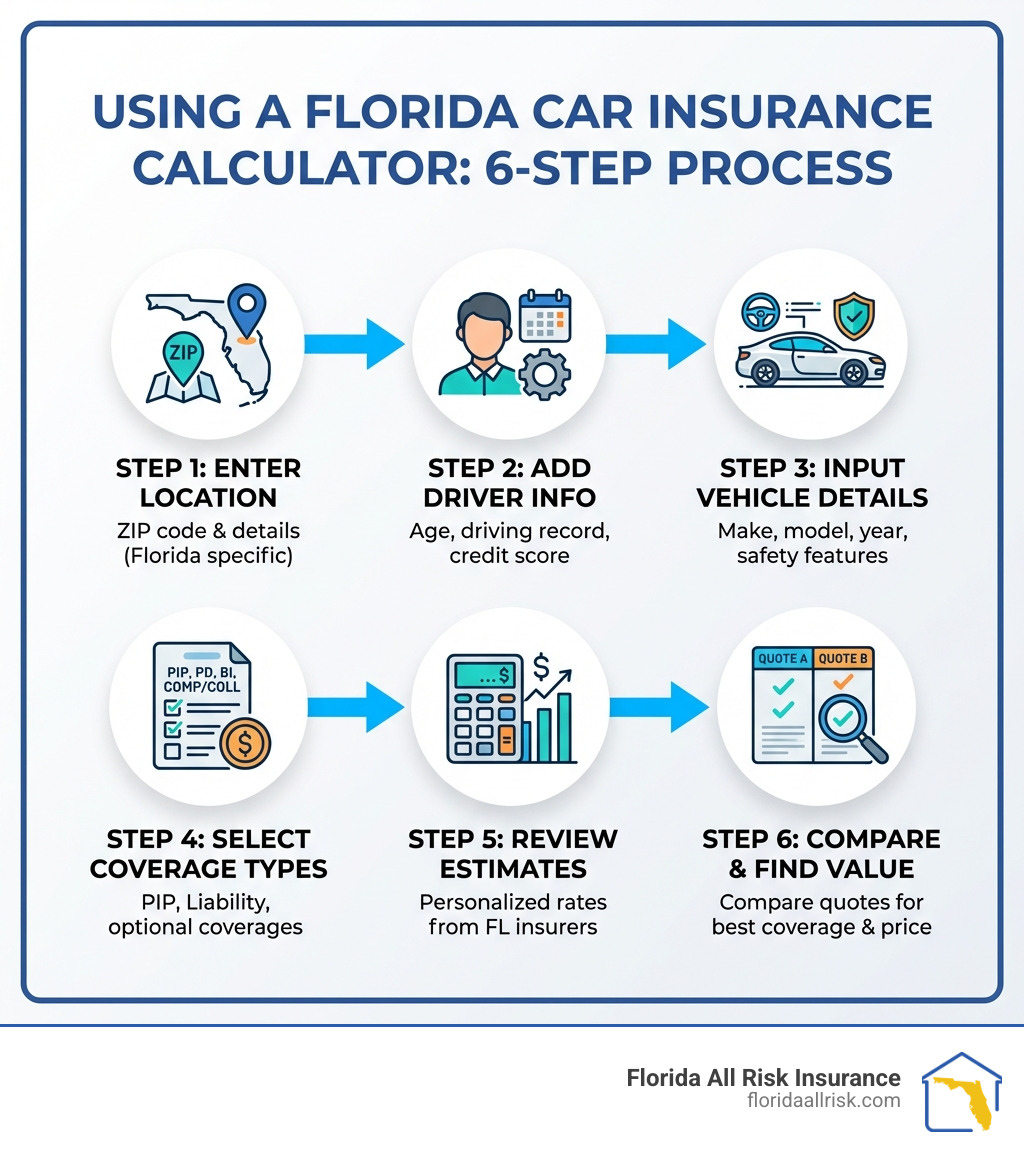
A Florida car insurance calculator is an online tool that helps you estimate your auto insurance costs before you commit to a policy. Here’s how it works:
Quick Answer: Using a Florida Car Insurance Calculator
- Enter your ZIP code – Rates vary significantly by location in Florida
- Provide driver details – Age, driving record, and credit score
- Input vehicle information – Make, model, year, and VIN
- Select coverage levels – State minimum, standard liability, or full coverage
- Receive instant estimates – Compare costs from multiple insurers
Average Florida Car Insurance Costs:
- Full Coverage: $2,694-$3,852 per year ($224-$321/month)
- Minimum Coverage: $993-$1,018 per year ($83-$85/month)
- Standard Liability (50/100/50): ~$1,629 per year ($136/month)
Many Florida homeowners juggle multiple insurance policies, and car insurance can feel like a guessing game. It’s easy to worry about overpaying while still getting the protection you need.
Florida consistently ranks among the most expensive states for car insurance. The average driver pays between $1,018 and $3,852 annually, depending on coverage and other factors. The good news is that you don’t have to accept the first quote you get or wonder if you’re paying too much.
A Florida car insurance calculator provides realistic cost estimates before you talk to an agent. You can test different coverage scenarios, see how your ZIP code affects rates, and understand what drives your premium. Whether you’re in Miami, Tampa, or a small coastal town, these calculators use real data from dozens of insurers to show you what you might pay.
Research shows that choosing the right insurance provider can cause your rates to drop 39% or increase by as much as 47% compared to the Florida average. Your age can swing rates by over 100%, and your credit score can create a spread of over $150 per month for the same coverage. These are the differences between affordable protection and a budget-breaking expense.
Florida’s unique insurance landscape makes estimation even more critical. As a no-fault state, you must carry Personal Injury Protection (PIP) and Property Damage Liability, but these minimums often leave you financially exposed after a serious accident. Factors like hurricane risk, dense populations in cities like Hialeah (where rates average $3,619/year), and a high number of uninsured drivers contribute to Florida’s high premiums. But expensive doesn’t have to mean unaffordable.
Related content about Florida car insurance calculator:
How to Use a Florida Car Insurance Calculator for an Accurate Estimate
Navigating car insurance can feel daunting, especially in Florida where rates fluctuate significantly. A Florida car insurance calculator simplifies this process, allowing you to get a clear picture of potential costs. It’s a powerful tool that empowers you to make informed decisions. Let’s walk through how to use it effectively.

Step 1: Gather Your Personal and Vehicle Information
To get the most precise estimate, gather some key details before you begin. The more accurate your information, the better your estimate will be.
- Driver Details:
- Age: A significant factor, with rates highest for teens and generally decreasing until around age 65.
- Address: Your Florida ZIP code plays a huge role in determining rates.
- Driving Record: Be prepared to list any accidents, tickets, or other violations from the past 3-5 years. A clean record leads to savings.
- Credit Score: In Florida, your credit score is a major rating factor.
- Marital Status, Occupation, and Education Level: These details can also influence your rates, sometimes leading to discounts.
- Vehicle Identification Number (VIN): While not always required for an estimate, a VIN provides the most accurate vehicle-specific data.
- Make, Model, and Year: These details inform insurers about the car’s value, safety features, repair costs, and theft risk. For example, the average annual premium for a 2023 Honda Accord LX in Florida was $4,574, compared to $2,847 for the 2024 model.
- Annual Mileage: How much you drive affects your rates. Low mileage may qualify you for discounts. Learn more here: Unlock Savings: How Low Mileage Can Slash Your Florida Car Insurance Bill.
- Safety Features: Features like anti-lock brakes, airbags, and anti-theft devices can sometimes lead to discounts.
Step 2: Input Your Data into the Florida Car Insurance Calculator
Once your information is ready, enter it into the calculator. Most online tools are user-friendly.
- ZIP Code Entry: This is usually the first piece of information requested, factoring in local risk data.
- Driver Profile: Enter your age, marital status, and driving history.
- Vehicle Type Selection: Provide the make, model, and year of your vehicle.
- Desired Coverage Levels: This is where you decide on your protection. You can start with Florida’s minimums or explore higher liability limits, comprehensive, and collision coverage. A good calculator will let you adjust these to see how they affect your estimated premium.
Step 3: Analyze and Compare Your Estimated Rates
After inputting your data, the calculator will generate estimated rates. This is a valuable starting point for comparison.
- Understanding the Estimate: The calculator provides an estimate, not a final quote. These are based on aggregated data and give you a realistic range of what you might pay.
- Comparing Multiple Providers: The power of these tools is their ability to show estimated rates from various insurers side-by-side. The provider you choose can cause rates to drop 39% or increase by as much as 47% compared to the average. This comparison is critical for finding the best deal.
- Identifying Potential Savings: Look for differences in rates for similar coverage to see which insurers might be more favorable for your profile.
- Full vs. Minimum Coverage Costs: You’ll see a significant cost difference between Florida’s minimum required coverage (around $993-$1,018 per year) and full coverage (around $2,694-$3,852 per year). This helps you weigh the financial impact of greater protection.
Comparing options is key to getting the best value. We can help you Compare Florida Car Insurance to find a policy that fits your needs and budget.
Key Factors That Drive Your Florida Car Insurance Rates
Car insurance rates in Florida are the result of a complex risk calculation. Insurers use various factors to determine how likely you are to file a claim. Understanding these elements is the first step in controlling your premiums. For a comprehensive overview, check out our Car Insurance Rates Florida Complete Guide.
Your Location Within the Sunshine State
Your Florida ZIP code profoundly impacts insurance costs due to factors like population density, accident rates, vehicle theft, and weather risks.
- ZIP Code Impact: Rates can vary dramatically based on location. For example, average monthly rates in Gainesville might be around $161, while in Hialeah, they could jump to $302.
- Urban vs. Rural Rates: Urban areas with more traffic and higher crime rates tend to have higher premiums than rural areas.
- City-Specific Costs: Major cities like Miami, Tampa, and Orlando often have higher rates due to congestion, tourism, and weather risks.
Average Annual Premiums in Florida Cities
| City | Average Annual Premium |
|---|---|
| Hialeah | $3,619 |
| Miami | $3,345 |
| Tampa | $3,131 |
| Clearwater | $3,007 |
| Orlando | $2,835 |
| Palm City | $2,706 |
| Deland | $2,701 |
| Avon Park | $2,639 |
| Gainesville | $1,934 |
Note: These are averages and individual rates will vary.
Vehicle Make, Model, and Year
The car you drive is a major rate determinant. Insurers consider:
- Cost to Repair: Luxury or sports cars cost more to insure because their parts and labor are pricier.
- Theft Rates: Models that are frequently stolen have higher insurance costs.
- Safety Ratings: Vehicles with high safety ratings and advanced features often qualify for lower premiums.
- Engine Size & Performance: High-performance vehicles tend to have higher rates due to a greater perceived risk of speeding and accidents.
- New vs. Used Cars: Newer cars often have higher comprehensive and collision premiums due to their value and technology. The average annual premium for a 2023 Honda Accord LX in Florida was $4,574, compared to $2,847 for the 2024 model. For unique vehicles, you might consider Classic Car Insurance Florida.
Your Driving Record and History
Your driving record is a direct reflection of your risk and one of the most influential factors for your rates.
- At-Fault Accidents: An at-fault accident can significantly increase your premiums, with rates changing up to 19%.
- Speeding Tickets: Even minor violations can lead to rate hikes.
- DUIs: A DUI is a severe infraction that will cause substantial rate increases and may require an SR-22 filing. Our DUI Auto Insurance Florida guide has more information.
- Clean Driving Record Benefits: Drivers with no accidents or violations enjoy the lowest rates and may qualify for “safe driver” discounts. Look into Safe Driver Insurance Discounts to see how you can save.
The Impact of Your Credit Score
In Florida, your credit score is a highly impactful factor. Insurers use credit-based insurance scores to predict the likelihood of future claims.
- Correlation with Claims: Studies show a correlation between credit scores and the likelihood of filing a claim.
- Rate Differences: The rate difference between excellent and poor credit can be substantial. For full coverage, average monthly rates can range from $152 for excellent credit to $309 for poor credit, an annual difference of nearly $1,900.
Age and Driving Experience
Your age and driving experience are critical risk assessment factors.
- Teen Driver Rates: Young drivers face the highest rates due to inexperience. A 16-year-old in Florida could pay an average of $746 per month, while a 65-year-old might pay $181 per month. Florida uses a graduated licensing system for teens to help them gain experience safely. We have more information on Auto Insurance for Young Drivers.
- Senior Driver Considerations: Rates generally decrease with age but may begin to rise again for very senior drivers.
- Rate Decreases with Age: Rates tend to decrease steadily through your 20s, 30s, 40s, and 50s as you gain experience.
Decoding Florida’s Car Insurance Requirements and Coverage Options
Understanding Florida’s car insurance laws is essential for legal compliance and financial protection. Our Mandatory Car Insurance Florida Guide offers a deeper dive into these requirements.
Florida’s Minimum Insurance Requirements
Florida law mandates all drivers carry two primary types of coverage:
- Property Damage Liability (PDL): Covers damages you cause to another person’s property. The minimum requirement is $10,000 per accident.
- Personal Injury Protection (PIP): As a no-fault state, Florida requires PIP to cover your own medical expenses and lost wages after an accident, regardless of fault. The minimum requirement is $10,000 per person.
Driving Without Insurance in Florida has severe consequences, including suspension of your driving privilege, vehicle tag, and registration, plus reinstatement fees from $150 to $500.
Understanding Florida’s “No-Fault” Law
Florida’s no-fault law impacts how claims are handled after an accident.
- How No-Fault Works: Your own PIP coverage pays for your initial medical expenses and a portion of lost wages, regardless of who caused the collision. This ensures quick medical care without waiting to determine fault.
- PIP Coverage Explained: Your $10,000 PIP coverage typically covers 80% of medical bills and 60% of lost wages, up to your policy limit.
- Suing for Severe Injuries: You can still sue an at-fault driver for non-economic damages (like pain and suffering) if your injuries meet Florida’s “serious injury” threshold. The Insurance Information Institute explains no-fault insurance in more detail. For a complete understanding, see our PIP Insurance Florida Complete Guide.
State Minimum vs. Full Coverage: What’s the Difference?
Florida’s minimum requirements often fall short in a serious accident.
- Liability-Only Limitations: State minimum coverage ($10,000 PDL and $10,000 PIP) offers very limited protection. You could be personally responsible for costs exceeding these limits.
- Full Coverage Components: “Full coverage” is a term for a policy that includes:
- Collision Coverage: Pays for damage to your vehicle from a collision.
- Comprehensive Coverage: Pays for damage to your vehicle from non-collision events like theft, vandalism, or natural disasters.
- Protecting Your Assets: Most drivers need more than state minimums. We often recommend higher liability limits, such as 100/300/100, to better protect your financial future.
- When Full Coverage is Required: Lenders almost always require collision and comprehensive coverage for financed or leased vehicles.
For a deeper dive, explore our Auto Insurance Coverage Options.
Additional Coverages to Consider
Several optional coverages provide crucial protection:
- Bodily Injury Liability (BI): Highly recommended. It covers injuries you cause to others. Without it, you could be mandated to carry it for three years after an at-fault accident.
- Uninsured/Underinsured Motorist (UM/UIM): Protects you if you’re hit by a driver with little or no insurance.
- Medical Payments (MedPay): Supplements PIP and covers medical expenses for you and your passengers, regardless of fault.
- Rental Reimbursement: Pays for a rental car while yours is being repaired after a covered claim.
- Roadside Assistance: Provides help with flat tires, towing, and other common issues.
- Gap Insurance: Covers the difference between your car’s value and what you owe on your loan if it’s totaled.
Even if you don’t own a car, you might need coverage. Learn more about Non-Owner Car Insurance Florida.
Strategies to Lower Your Florida Car Insurance Premiums
Given Florida’s high car insurance costs, finding ways to reduce your premiums is a smart move. At Florida All Risk Insurance, we’re dedicated to helping you find Affordable Car Insurance Florida. Here are some key strategies:
[LIST] of Common Car Insurance Discounts for Florida Drivers
Insurers offer many discounts that can lower your premium. Ask your agent which ones you qualify for.
- Multi-Policy (Bundling): Combine auto with home or renters insurance to save. Bundling can save customers over 25%.
- Good Student Discount: Young drivers on your policy with good grades may qualify.
- Safe Driver Programs (Telematics): Programs that monitor your driving habits via an app can earn you discounts up to 40% for safe driving.
- Defensive Driving Course: Completing an approved course can lead to a discount.
- Pay-in-Full Discount: Paying your entire premium upfront often results in savings.
- Low Mileage Discount: If you don’t drive much, you may qualify. Our guide on How Low Mileage Can Slash Your Florida Car Insurance Bill has more details.
- Multi-Car Discount: Insuring multiple vehicles with the same company usually earns a discount.
- Anti-Theft Device Discount: Factory-installed or aftermarket anti-theft devices can lower your comprehensive premium.
Explore more options with our Best Car Insurance Discounts.
Choosing the Right Deductible
Your deductible is what you pay out-of-pocket on a claim before your insurance pays.
- How Deductibles Work: With a $500 deductible on a $2,000 claim, you pay $500, and your insurer pays $1,500.
- Higher Deductible for Lower Premium: Choosing a higher deductible will lower your premium because you are taking on more financial risk.
- Financial Risk Assessment: Consider if you can comfortably afford a higher deductible ($1,000 or more) if you need to file a claim. If so, it’s a smart way to save. If not, a lower deductible may be better. Our Auto Insurance Deductible Options guide can help you decide.
Shopping Around and Reviewing Your Policy
The insurance market is competitive, and rates change. What was a great deal last year might not be today.
- Comparing Quotes Regularly: Use a Florida car insurance calculator or contact an independent agent to compare quotes annually. This ensures you’re getting a competitive rate.
- Using an Independent Agent: As an independent agency, Florida All Risk Insurance shops multiple carriers on your behalf to find the best coverage and rates.
- Reviewing Coverage After Life Events: Major life changes can impact your insurance needs. Review your policy after getting married, buying a home, adding a driver, or purchasing a new vehicle.
- Not Over-Insuring: Ensure you’re not paying for coverage you don’t need. For example, collision and comprehensive coverage may not be cost-effective for an old car with low market value.
Frequently Asked Questions about Florida Car Insurance Costs
We often hear similar questions from drivers trying to manage their car insurance costs in Florida. Here are some of the most common inquiries.
What is the average cost of car insurance in Florida?
Florida is known for its high car insurance costs. Averages can give you a baseline, but your actual cost will vary.
- Average Full Coverage Cost: A full coverage policy in Florida averages between $2,694 and $3,852 per year ($224 to $321 per month).
- Average Minimum Coverage Cost: State minimum coverage averages around $993 to $1,018 per year ($83 to $85 per month).
- Factors Causing Variation: Your actual cost depends on your location, vehicle, driving record, credit score, age, and chosen coverage.
- Florida’s Ranking: Florida consistently ranks among the most expensive states for car insurance, as noted by the Insurance Information Institute.
How can I get an official car insurance quote in Florida?
While a Florida car insurance calculator provides excellent estimates, an official quote requires a few more steps.
- Start with a Calculator: Use an online calculator to get a general idea of costs and compare coverage scenarios.
- Contact an Independent Agent: This is an efficient way to get multiple official quotes. An independent agency like Florida All Risk Insurance shops several carriers for you.
- Get Quotes Directly: You can also contact individual insurance companies directly for quotes.
- Information Needed: Be ready to provide your driver’s license number, vehicle VIN, address, and driving history for a firm quote.
Our Florida Auto Insurance Quotes Guide can help guide you through the process.
Why is car insurance so expensive in Florida?
Several interconnected factors contribute to Florida’s high car insurance rates:
- High Population Density and Tourism: More traffic leads to more accidents.
- Severe Weather: Hurricanes and tropical storms cause significant vehicle damage, driving up comprehensive claims.
- High Rate of Uninsured Drivers: Florida has a large percentage of uninsured drivers, increasing costs for insured drivers through UM/UIM coverage.
- Insurance Fraud: A history of Personal Injury Protection (PIP) fraud inflates medical costs and premiums for everyone.
- Litigious Environment: The state’s legal climate can contribute to higher costs as insurers factor in potential litigation expenses.
- Rising Cost of Repairs: Increasingly complex vehicle technology makes repairs more expensive.
Conclusion: Take Control of Your Car Insurance Costs
Using a Florida car insurance calculator empowers you to move beyond guesswork. By understanding the factors that shape your premium and exploring different coverage scenarios, you can make informed decisions that balance protection and affordability. An independent agency like Florida All Risk Insurance can help you steer the options and find the best policy for your unique needs. Don’t wait to find out if you’re overpaying.
Get a personalized auto insurance quote today!
Contact our expert agents to discuss your coverage options.
Contact Us
Florida All Risk Insurance
Address: 333 3rd Ave N Suite 210, Saint Petersburg, FL 33701
Phone: (727) 202-4114
Email: [email protected]