

E&O Policy: Your 4-Step Crucial Guide
What is an E&O Policy and Why Does It Matter?
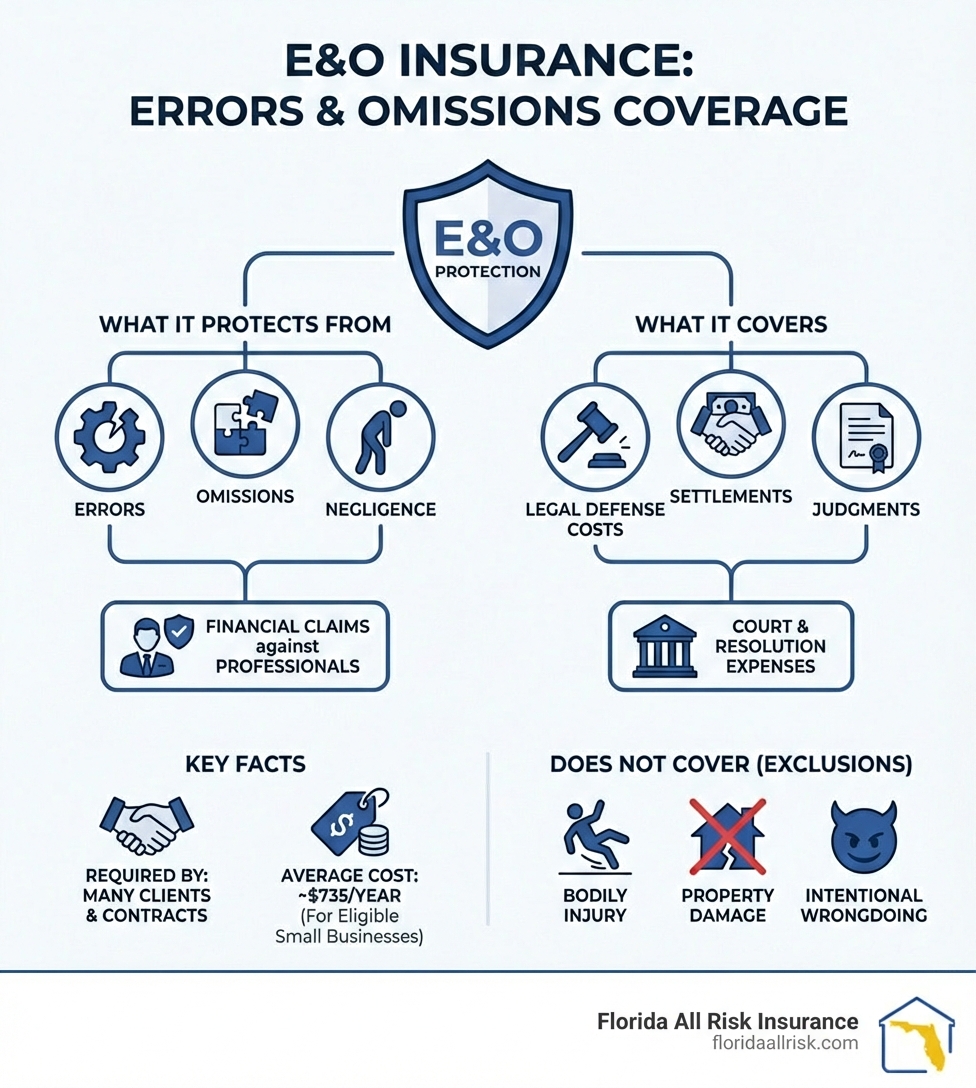
An e&o policy, more formally known as Errors and Omissions insurance, is a specialized form of professional liability insurance. It serves as a critical financial safeguard for your business when a client alleges that your professional services caused them financial harm. These claims can arise from a mistake you made (an error), something you failed to do (an omission), professional negligence, or giving advice that led to a negative outcome. In essence, it protects your expertise. An E&O policy is designed to cover the substantial costs of a legal defense and any resulting settlements or judgments against your company, which could otherwise be financially devastating.
Quick Answer: E&O Policy Essentials
- What it is: A type of professional liability insurance that shields your business from the financial consequences of claims related to your professional services. It covers financial losses, not physical damages.
- Who needs it: Any business or individual that provides professional services, advice, or designs for a fee. This includes traditional roles like accountants and architects, as well as modern professions like IT consultants, digital marketing agencies, and business coaches.
- What it covers: The core of an E&O policy is financial protection. It covers legal defense costs (which can be exorbitant even for frivolous lawsuits), settlements negotiated to avoid trial, and court-ordered judgments if a case is lost.
- What it costs: The average cost for a small business is around $735 per year, but this figure can vary significantly based on your profession, revenue, claims history, and desired coverage limits.
- Key difference from general liability: E&O insurance is for financial injury resulting from professional mistakes. General liability insurance is for physical injury (bodily injury) and property damage caused by your business operations.
In today’s hyper-competitive and increasingly litigious business environment, a single professional misstep can have catastrophic consequences. Imagine a software consultant in Miami miscalculating the server requirements for a system upgrade, causing a client’s e-commerce site to crash during a major sale. Or consider an architect in Orlando overlooking a critical building code, leading to costly rework and project delays. These are not abstract risks; they are real-world scenarios that professionals across Florida face daily. The global E&O insurance market is expanding precisely because clients are more willing to pursue legal action and contracts include more stringent liability clauses. Even if you are confident in your work and believe you are not at fault, the cost of defending against a lawsuit can cripple a small business, draining cash reserves and distracting you from your core operations. Without the right coverage, you are left to face these battles alone.
One of the most common and dangerous misconceptions among Florida business owners is that their general liability policy provides all the protection they need. This is a critical error. If a client sues your marketing firm for a campaign that failed to deliver promised results or your consulting firm for advice that led to a financial loss, your general liability policy will not respond. It is specifically designed to exclude claims arising from professional services. In these situations, an e&o policy is the only coverage that stands between your business and a potentially ruinous financial liability. For over 20 years, Florida All Risk Insurance has specialized in helping Florida businesses navigate this complex landscape. We guide professionals through the intricacies of selecting an e&o policy that aligns with their unique risk profile, ensuring they have a clear understanding of their protection long before they ever need to use it.
E&O vs. General Liability: A Crucial Distinction for Your Business
Understanding the difference between an e&o policy (Errors and Omissions) and general liability insurance is one of the most fundamental aspects of building a comprehensive risk management strategy for any business that offers professional services. While both are essential liability policies, they are designed to protect against entirely different types of risks, and having one without the other can leave your business dangerously exposed.
Commercial General Liability (CGL) insurance is the bedrock of business protection, covering claims of third-party bodily injury or property damage. It’s the policy that responds if a client slips and falls in your St. Petersburg office, or if an employee accidentally damages a client’s expensive server while on-site. CGL also typically includes coverage for personal and advertising injury, such as claims of libel, slander, or copyright infringement in your marketing materials. You can learn more about its scope in our detailed guide on What Does General Liability Insurance Cover.
In stark contrast, an e&o policy is exclusively concerned with the financial losses a client suffers because of your professional services. It is triggered by claims of negligence, faulty advice, a critical error in a design, or a failure to deliver a service as promised. It covers the client’s economic damages, not physical harm to people or property. For example, if an accountant’s tax error results in a client facing hefty IRS penalties, the E&O policy would cover those penalties and the associated legal fees. The general liability policy would offer no protection in this scenario.
Scenario Analysis: A Real-World Example
Imagine you run a web development firm in Tampa. You are hired to build a new e-commerce platform for a client. During the project:
- The General Liability Claim: One of your developers visits the client’s office and accidentally spills coffee on their main server, destroying it. The client sues you for the cost of the server and the business interruption it caused. Your Commercial General Liability policy would respond to this claim because it involves property damage.
- The E&O Claim: You launch the new website, but a coding error in the payment gateway prevents customers from completing purchases for 48 hours. The client sues you for the lost revenue and damage to their brand reputation. Your e&o policy would respond to this claim because it involves a financial loss caused by a professional error in your service.
In this example, both policies are crucial. Without CGL, you’d pay for the server out-of-pocket. Without E&O, you’d be responsible for the client’s massive lost revenue claim.
Here’s a simple table to help clarify this crucial distinction:
| Feature | Errors & Omissions (E&O) Insurance | Commercial General Liability (CGL) Insurance |
|---|---|---|
| Type of Risk | Financial loss due to professional mistakes, negligence, or failure to perform services. | Bodily injury, property damage, and personal/advertising injury. |
| Covered Damages | Client’s financial losses, such as lost revenue, legal penalties, or costs to fix an error. | Medical bills, repair/replacement costs for damaged property, legal defense. |
| Policy Trigger | A claim that your professional service caused a client financial harm. | A claim that your business operations caused physical injury or property damage. |
| Typical Claims | Miscalculation, faulty advice, missed deadlines, breach of professional duties, misrepresentation. | Slip and fall accidents, property damage caused by operations, product defects, slander. |
| Who Needs It | Professionals offering advice or services for a fee (e.g., consultants, accountants, contractors). | All businesses, especially those with a physical location or client interaction. |
Many professionals mistakenly assume their general liability policy is a catch-all, only to discover—often in the middle of a lawsuit—that it provides no coverage for claims related to their actual work product. This is why an e&o policy is also called professional liability insurance—it is tailored to the unique intellectual and service-based risks of your profession. For a deeper dive into how these coverages work together, check out our General Liability vs Errors and Omissions Guide.
Who Needs E&O Insurance and What Does It Cover?
If your business model involves providing advice, creating designs, managing projects, or offering any professional service in exchange for a fee, you almost certainly need an e&o policy. The need for this coverage has expanded far beyond traditional professions like law and medicine. In today’s service-driven economy, nearly any business can face allegations of professional negligence. Furthermore, it’s no longer just a matter of prudent risk management; it’s a business necessity. Many clients in Florida, particularly larger corporations, now mandate proof of E&O insurance as a prerequisite for signing a contract, making it essential for growth and competitiveness.

As the financial authority Investopedia notes, “Any business that offers a professional service or advice for a fee might need E&O insurance.” This is particularly true for the booming digital and tech sectors. A 2023 survey highlighted that 65% of Software-as-a-Service (SaaS) providers now carry E&O coverage, a testament to the recognized risks of software bugs and service outages. You can explore this topic further at Errors and Omissions Insurance: What It Is, How It Works, and Who Needs It.
Professions at High Risk for E&O Claims
While the need is broad, certain professions have a significantly higher exposure to E&O claims due to the nature of their work:
- Accountants & Financial Advisors: A simple calculation error, incorrect tax advice, or a poor investment recommendation can lead to substantial financial losses for a client, making this profession a primary candidate for E&O coverage.
- Architects & Engineers: Their work involves complex designs and calculations where a flaw can lead to structural failures, safety hazards, budget overruns, and costly project delays. An E&O policy is critical to cover liability for design defects.
- IT Consultants & Tech Firms: In the digital age, the risks are immense. Claims can arise from software implementation failures, data migration errors, cybersecurity vulnerabilities in developed code, or extended system downtime, all of which can cripple a client’s operations.
- Real Estate Agents: Agents can be sued for failing to disclose property defects, errors in contracts, or misrepresenting a property’s value or features, leading to financial harm for the buyer or seller.
- Attorneys: Legal malpractice is a well-known risk. Missing a statute of limitations, providing flawed legal advice, or a conflict of interest can all trigger a significant E&O claim.
- Marketing & Advertising Agencies: These firms face claims related to campaigns that fail to meet performance metrics, intellectual property infringement, or running afoul of advertising regulations, leading to client losses.
- Healthcare Providers: While typically covered by medical malpractice insurance (a highly specialized form of E&O), they face claims of misdiagnosis, treatment errors, and negligence.
- Contractors: A general contractor or subcontractor can be held liable for failing to meet project specifications, using incorrect materials, or project management errors that cause delays and financial loss. For specific guidance, see our page on Professional Liability Insurance for Independent Contractors.
What an E&O Policy Covers: From Legal Fees to Settlements
An e&o policy is designed to provide financial restitution when a professional mistake results in a client’s economic loss. It typically covers a wide range of allegations:
- Negligence: Claims that you failed to exercise the level of care considered standard for your profession, resulting in harm. For example, a business consultant failing to identify a major market risk.
- Errors & Omissions: Direct mistakes (errors) or overlooked details (omissions) in your work, such as a surveyor providing inaccurate property lines.
- Misrepresentation: Allegations that you provided false or misleading information about your services or their expected outcomes.
- Inaccurate Advice: Guidance that proves to be incorrect or unsuitable for the client’s situation, leading to a negative financial result.
- Breach of Contract: Claims that you failed to fulfill the specific terms and deliverables outlined in your service contract.
- Defense Costs: This is one of the most valuable components. The policy covers attorney fees, expert witness fees, and court costs, even for baseless claims that are ultimately dismissed. It’s crucial to have a policy where these costs are paid in addition to your policy limits, so they don’t erode the funds available for a settlement.
- Judgments and Settlements: The policy will pay for court-ordered damages or a settlement negotiated to resolve a claim, up to your policy’s coverage limit.
Common Exclusions: What Your E&O Policy Won’t Cover
An e&o policy is not a catch-all solution. Understanding its exclusions is just as important as knowing what it covers:
- Intentional Wrongdoing & Fraud: E&O covers honest mistakes, not deliberate fraud, criminal acts, or illegal activities.
- Bodily Injury or Property Damage: These claims are the domain of your general liability insurance policy.
- Employment-Related Disputes: Claims from employees, such as wrongful termination or discrimination, are covered by a separate policy called Employment Practices Liability Insurance (EPLI).
- Patent & Trade Secret Infringement: Most standard E&O policies exclude claims related to intellectual property like patents or trade secrets, which may require specialized IP or media liability coverage.
- Cyber Risks & Data Breaches: While a tech E&O policy might cover some cyber events, a dedicated cyber liability policy is typically needed for costs related to data breaches, hacking incidents, and ransomware attacks.
- Guarantees or Warranties: An E&O policy does not cover your failure to deliver on a promise of specific results (e.g., “we guarantee a 200% ROI”), unless that failure was caused by a demonstrable professional error.
It is absolutely vital to read your e&o policy documents carefully to understand its specific terms and limitations. At Florida All Risk Insurance, we can help you analyze your policy, identify potential gaps, and ensure your Florida business is comprehensively protected against its unique risks.
Choosing the Right E&O Policy: A Step-by-Step Guide
Selecting the right e&o policy is not a one-size-fits-all process. It requires a thoughtful, customized approach, as every Florida business possesses a unique set of professional risks. A policy that’s perfect for a real estate agent in Naples may be completely inadequate for a software developer in Jacksonville. At Florida All Risk Insurance, our expertise lies in helping you dissect your risks and tailor a policy that provides robust protection without unnecessary expense. For a high-level overview of how E&O fits into a larger insurance strategy, our Business Insurance Florida Complete Guide is an excellent starting point as we help you Unlock the Best Business Insurance for Your Enterprise.
Step 1: Assess Your Professional Risk Exposure
The foundational step is a deep and honest assessment of your specific vulnerabilities. We guide you through this process by evaluating several key factors:
- Services Provided: What is the exact nature of your work? Do you provide strategic advice, create tangible designs, manage complex projects, or handle sensitive data? The more impact your services have on a client’s revenue and operations, the higher your risk.
- Potential Financial Impact: Consider the worst-case scenario. What is the maximum financial loss a single client could suffer if you make a critical error? This figure should inform your coverage limits.
- Industry-Specific Risks: Are there unique regulatory, compliance, or data security risks in your field? For example, financial advisors must navigate FINRA regulations, while healthcare consultants must comply with HIPAA.
- Client Contracts: Carefully review your contracts. Do your clients stipulate minimum E&O coverage requirements? Many large corporations will not engage a vendor without proof of a specific limit (e.g., $1 million per occurrence).
For businesses operating in fields with greater inherent risks, such as construction or technology, our High Risk Small Business Insurance Guide offers more targeted insight.
Step 2: Compare Claims-Made vs. Occurrence Policies
This is one of the most critical technical distinctions in E&O insurance, and understanding it is vital:
- Claims-Made Policies: This is the most common structure for E&O insurance. A claims-made policy covers claims that are made and reported during the policy period, regardless of when the actual error occurred (as long as it was after the policy’s retroactive date). To maintain coverage for past work, you must keep the policy continuously active. If you cancel the policy or retire, you lose coverage for all your prior work unless you purchase an “Extended Reporting Period” (ERP), commonly known as “tail coverage.” The retroactive date is a key feature, typically set to the date you first purchased a claims-made policy. It ensures that work you did before the current policy period is still covered.
- Occurrence Policies: These policies are simpler but much less common and more expensive for E&O. They cover incidents that occur during the policy period, no matter when the claim is eventually filed. This provides long-term protection without the need for tail coverage, but the higher cost makes it prohibitive for many professional services.
We will help you understand the long-term implications of each structure, including the importance of maintaining your retroactive date and planning for tail coverage if you ever plan to sell your business or retire.
Step 3: Determine Your Coverage Limits and Deductible
Balancing comprehensive protection with affordability is the primary goal here. You’ll need to make informed decisions on several key figures:
- Per-Occurrence Limit: This is the maximum amount the insurer will pay for a single claim.
- Aggregate Limit: This is the total maximum amount the insurer will pay for all claims filed within a single policy year.
- Deductible (or Retention): This is the amount you must pay out-of-pocket on a claim before the insurance coverage kicks in. A higher deductible will typically lower your premium, but you must be sure you can comfortably afford to pay it if a claim arises.
- Defense Costs: A crucial detail is whether legal defense costs are covered inside or outside the policy limits. A policy with defense costs outside the limits is far superior. This means that legal fees do not deplete the funds available to pay a settlement or judgment, preserving your full limit for the actual damages.
Step 4: Understand the Cost of Your E&O Policy
The average premium for a small business e&o policy is often cited as around $735 a year, but this is merely a baseline. Your actual cost will be a unique calculation based on these factors:
- Industry & Risk Level: A wedding photographer has a lower risk profile and thus a lower premium than a structural engineer whose mistakes could cost millions.
- Business Size and Revenue: Higher revenue generally indicates larger projects and greater exposure, leading to higher premiums.
- Claims History: A history of past E&O claims is a primary indicator of future risk for underwriters and will significantly increase your premium.
- Location: Insurance costs and legal environments can vary by state and even by region within Florida.
- Coverage Limits & Deductible: The most direct levers on cost. Higher limits increase the premium, while a higher deductible lowers it.
Our team of experts can help you navigate these factors, run comparisons, and find an affordable e&o policy that doesn’t compromise on essential protection. For more context on how insurance pricing works, our General Liability Insurance Cost guide provides a useful parallel.
The E&O Insurance Market: Trends, Growth, and Future Outlook
The Errors and Omissions insurance market is a dynamic and constantly evolving landscape, shaped by technological innovation, new legal precedents, and emerging business risks. The broader Professional Liability Insurance market, which encompasses E&O, is on a significant growth trajectory. According to market research, it is projected to reach an estimated $435.30 billion globally by 2032, expanding at a Compound Annual Growth Rate (CAGR) of 6.2%. This robust growth is not arbitrary; it’s a direct reflection of the market’s adaptation to a world where professional accountability is more scrutinized than ever.
Key Growth Drivers and Industry Innovations
Several powerful forces are fueling the expansion and transformation of the E&O market:
- Increased Litigation and Social Inflation: We live in a more litigious society. Clients are more aware of their rights and are quicker to file lawsuits over perceived service failures. This trend is amplified by “social inflation,” where jury awards and settlement expectations are rising, increasing the potential cost of a claim and driving up demand for higher coverage limits.
- Stricter Client and Contractual Requirements: It is now standard practice for large corporations to mandate that their vendors, consultants, and contractors carry a minimum of $1 million in E&O insurance. This has shifted E&O from a discretionary purchase to a competitive necessity for any business wanting to work with larger clients.
- Expanding Regulatory Compliance: Growing government oversight in industries like finance, healthcare, and data privacy creates new standards of care. A failure to comply with these regulations can be interpreted as professional negligence, making E&O a critical tool for managing regulatory risk.
- Insurtech and Specialization: Technology is revolutionizing the insurance industry. Insurtech innovations are leading to more sophisticated underwriting models that can better price risk, as well as the creation of highly specialized E&O products. We are now seeing policies designed specifically for the risks associated with artificial intelligence, blockchain technology, and other cutting-edge fields. As noted by the industry authority The CLM, E&O is no longer just a policy but an essential, integrated part of a modern contractor’s risk management framework.
Emerging Risks to Watch For
As your independent insurance agency, our job is to stay ahead of the curve and monitor the emerging threats that could impact your business. We ensure your coverage remains relevant by keeping a close watch on these key areas:
- Cybersecurity and Data Privacy: The line between a professional error and a cyber liability event is becoming increasingly blurred. For a tech company, is a software vulnerability that leads to a data breach an E&O failure or a cyber failure? This requires careful policy coordination between E&O and Cyber Liability insurance to avoid dangerous gaps in coverage.
- Artificial Intelligence (AI) and Algorithmic Bias: Businesses that develop or use AI tools face a new frontier of liability. If an AI-driven diagnostic tool provides a faulty recommendation, or a hiring algorithm exhibits discriminatory bias, the company deploying it could face significant E&O claims. The “black box” nature of some AI makes assigning liability particularly complex.
- Remote Work and Distributed Team Liabilities: The shift to remote work introduces new challenges in supervision, quality control, and data security. A lapse in security on an employee’s home network that leads to a client data leak could potentially trigger an E&O claim, creating new questions about corporate responsibility for a distributed workforce.
- Gig Economy and Freelancer Challenges: The increasing reliance on independent contractors and freelancers creates a complex liability chain. Businesses must ensure that the freelancers they hire have adequate E&O coverage, or they may find themselves held vicariously liable for the freelancer’s mistakes.
Staying informed about the evolving risk landscape is paramount. For more general information on the topic, you can visit the non-profit Insurance Information Institute’s page on Errors and Omissions Liability Insurance.
How to Secure Your E&O Coverage in Florida
Obtaining a high-quality e&o policy in Florida is a straightforward and transparent process when you partner with an experienced independent agency like Florida All Risk Insurance. We act as your guide and advocate, simplifying the application and underwriting journey to ensure you secure the best possible coverage at the most competitive price.
The Application and Underwriting Process
The first step is completing a detailed application. This document is the primary tool insurers use to understand your business, assess your unique risk profile, and calculate your premium. As your broker, we help you prepare this information accurately and completely. You should be ready to provide:
- Detailed Description of Services: A clear and comprehensive explanation of all professional services you provide.
- Business Information: Details on your business structure, years in operation, and annual revenue.
- Risk Management Procedures: Information on your quality control processes, employee training, and use of client contracts.
- Client Contracts: Underwriters will often want to review a copy of your standard client service agreement to understand the liabilities you assume.
- Claims History: A five-year history of any prior E&O claims or incidents that could have led to a claim.
Once the application is submitted, the underwriter at the insurance carrier reviews it. They may come back with additional questions before issuing a formal quote. We manage this communication on your behalf, ensuring the process is smooth and efficient. We then present you with the best options from the market, explaining the nuances of each quote. Our guide on Finding the Right Insurance Agency offers more tips, and you can learn about our local commitment at Insurance Agencies in St. Petersburg, FL.
The Advantage of an Independent Insurance Agency
Choosing to partner with an independent agency rather than going directly to a carrier offers significant, tangible benefits for your business:
- Personalized Service and Risk Assessment: We don’t just sell policies; we build relationships. We take the time to learn the intricacies of your business operations so we can offer tailored advice, not a generic product.
- Access to a Broad Market of Carriers: As an independent agency, we are not captive to a single insurance company. We have access to a wide network of top-rated national and regional insurers, allowing us to shop the market and create competition for your business. This ensures you get the best terms and pricing available.
- Deep Market Expertise and Carrier Knowledge: We possess deep knowledge of the Florida insurance market and the specific nuances of E&O coverage. We know which carriers have an appetite for your specific industry and which ones offer the most favorable terms for professions like yours.
- Advocacy During Claims: This is where an independent agent provides the most value. If you ever need to file a claim, you are not alone. We guide you through the complex claims process, help you prepare the necessary documentation, and act as your advocate with the insurance carrier to ensure a fair and prompt resolution.
An independent agent is more than a vendor; we are a dedicated partner invested in your business’s long-term protection and success. Learn more about our philosophy in our articles, Why You Should Work With an Independent Insurance Agency, and Independent Business Insurance Agents.
Conclusion: Protecting Your Professional Future
In an economic landscape defined by complex professional services, heightened client expectations, and a litigious environment, an e&o policy is no longer an optional luxury—it is a fundamental pillar of a resilient and sustainable business strategy. For professionals and service-based businesses across Florida, from the tech startups in St. Petersburg to the consulting firms in Miami, this insurance provides an indispensable shield against the potentially catastrophic financial fallout of alleged errors, omissions, or professional negligence.
As we’ve explored, a well-structured e&o policy delivers a powerful combination of benefits that go far beyond simply paying claims:
- Financial Solvency: It provides the resources to cover crippling legal defense costs, negotiated settlements, and court-ordered judgments that could otherwise bankrupt your business and threaten your personal assets.
- Enhanced Client Trust: Carrying E&O insurance signals professionalism, stability, and accountability. It shows your clients that you take your responsibilities seriously and have the financial backing to stand behind your work.
- A Sharper Competitive Edge: In today’s market, E&O coverage is often a non-negotiable requirement for securing contracts with larger, more sophisticated clients. It opens doors to bigger and better projects that would otherwise be inaccessible.
- Invaluable Peace of Mind: Perhaps the most underrated benefit is the peace of mind that comes from knowing you are protected. This allows you to focus your energy on innovation, growth, and serving your clients to the best of your ability, without the constant fear that a single mistake or a baseless accusation could jeopardize everything you’ve built.
Don’t let one unforeseen event or disgruntled client derail your hard-earned success. The cost of a robust E&O policy is a minor, predictable business expense, while the cost of defending a lawsuit without one is unpredictable and potentially unlimited. At Florida All Risk Insurance, we are dedicated to helping Florida businesses like yours navigate the complexities of professional liability and secure robust, intelligent protection.
Ready to take the next step in safeguarding your professional future? Let our team of experienced agents help you find the perfect e&o policy tailored to your unique business needs.
Explore our specialized coverage options, including our integrated General Liability Errors and Omissions Insurance packages, to ensure your business is fully prepared for the challenges ahead.
Contact Us
Florida All Risk Insurance
4500 4th St N, Suite B
Saint Petersburg, FL 33703
(727) 555-0101
[email protected]
Learn more about us and our commitment to serving Florida businesses: About Us

