

Condominium insurance claims: 2 Policies, Smooth
Why Understanding Condominium Insurance Claims Matters in Florida
Condominium insurance claims in Florida present a unique and often confusing challenge, largely due to the mandatory two-policy system. When damage strikes, you are tasked with navigating both your personal HO-6 policy and your condominium association’s master policy to secure the full coverage you deserve. Mastering the boundaries between these two policies is more critical than ever in Florida’s volatile insurance market—a landscape defined by rising premiums, insurers exiting the state, and increasingly stringent regulations. Here, where water and hurricane damage are not just possibilities but seasonal certainties, a simple misunderstanding can have severe financial consequences. Many condo owners mistakenly assume the wrong policy covers their damage, leading to frustrating claim denials, lengthy disputes, and significant out-of-pocket expenses that can jeopardize their financial stability.
Quick Answer for Condominium Insurance Claims:
- Your HO-6 Policy: Covers your unit’s interior (“walls-in”), personal belongings, upgrades, liability, and can cover special assessments.
- Association’s Master Policy: Covers the building structure, exterior, and all common areas like lobbies, roofs, and elevators.
- File Promptly: Florida law has strict deadlines. You must provide prompt notice to your insurer, which is separate from the three-year statute of limitations for lawsuits.
- Document Everything: Use extensive photos, videos, detailed inventories, and keep a log of all communications.
- Know the Boundaries: Your association’s bylaws define responsibility. Review them before a loss occurs to avoid coverage gaps.
I’m Jason Miller, and with over 20 years of experience, my team at Florida All Risk Insurance has guided countless clients through complex condominium insurance claims. We’ve seen every scenario and can help you steer the process with confidence.
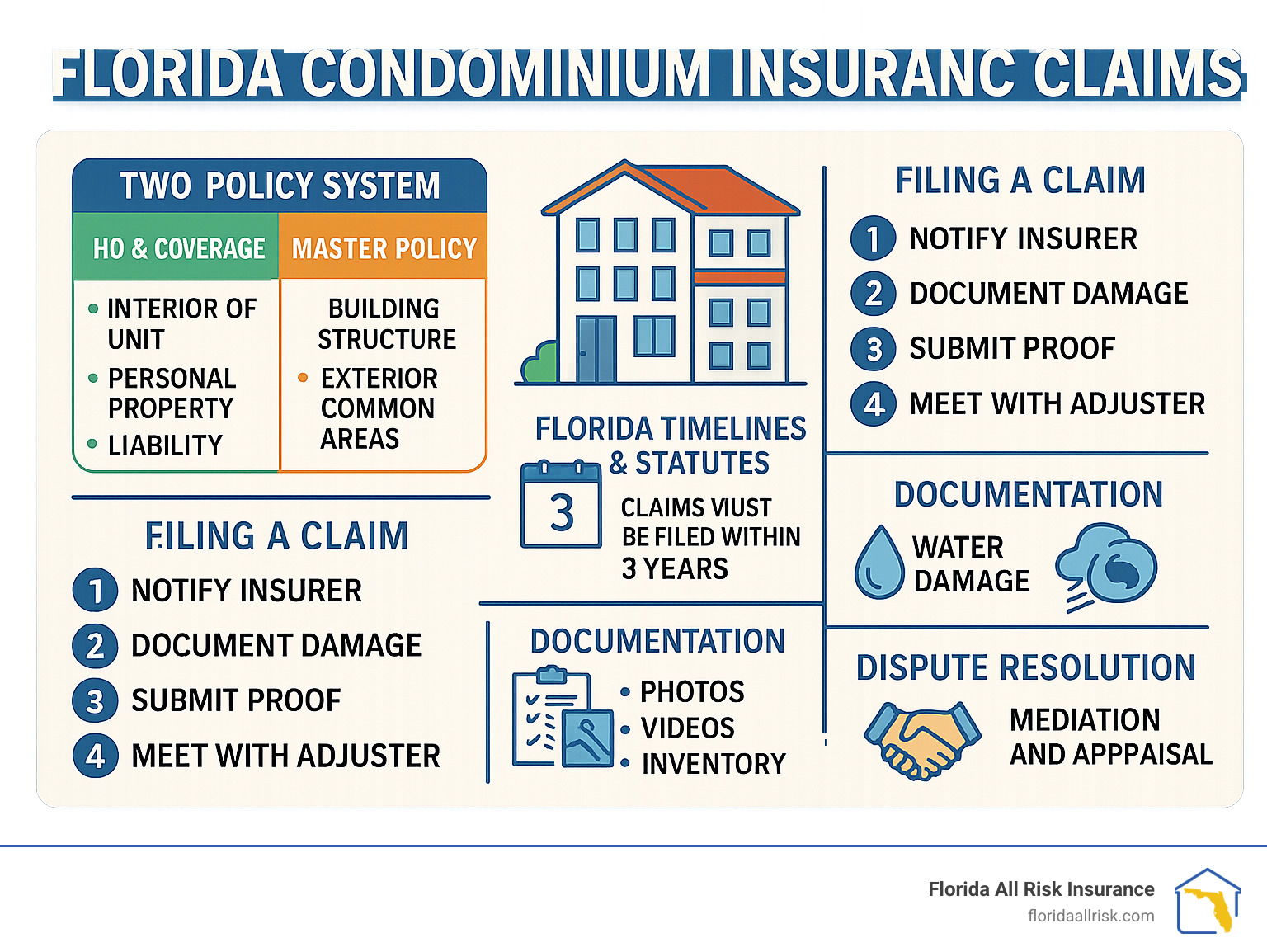
Understanding Your Coverage: The Two-Policy System
Every Florida condo owner is part of a dual-insurance system where your personal policy and the association’s master policy must work in tandem. These policies are not interchangeable; they are designed to cover different parts of the property, and understanding their distinct roles is the foundation of a successful claims process. A gap in understanding can easily lead to a gap in coverage.
Your Personal Condo Policy (HO-6)
Your HO-6 policy is designed specifically for condo owners and protects everything that is your personal responsibility inside your unit.
- “Walls-In” Coverage: This is the core of your policy. It generally covers the interior structure of your unit from the drywall inward. This includes elements like flooring, non-load-bearing interior walls, countertops, cabinets, plumbing fixtures, and lighting. It’s crucial to know if your association’s master policy is “bare walls” or “all-in,” as this dictates exactly where their coverage stops and your HO-6 must begin. A “bare walls” policy leaves you responsible for much more of the interior finishing.
- Personal Property: This covers your belongings, such as furniture, electronics, clothing, and artwork. To ensure your limit is sufficient, create a detailed home inventory by recording a video walkthrough of your unit, opening every closet and drawer, and supplementing it with a spreadsheet listing items, their value, and purchase dates.
- Betterments and Improvements: Any upgrades you’ve made—such as installing hardwood floors to replace standard carpet, upgrading to granite countertops, or installing high-end appliances—are considered “betterments.” These are covered by your HO-6 policy, not the master policy, which is only responsible for restoring the unit to its original builder-grade standard. Without proper coverage, your valuable improvements could be lost.
- Personal Liability: This protects you financially if someone is injured in your unit or if you accidentally cause damage to another person’s property. A prime example is a water leak from your washing machine that damages the ceiling of the unit below you.
- Loss of Use: Also known as Additional Living Expenses (ALE), this coverage is a lifeline if your condo becomes uninhabitable due to a covered loss. It pays for reasonable temporary living expenses like hotel bills, rent, and meals above your normal cost of living.
- Tenant’s Insurance: If you rent out your condo, your HO-6 policy does not cover your tenant’s possessions or their liability. Your tenant must secure their own renter’s insurance (HO-4) policy to protect their belongings.
For comprehensive protection, explore our Condo Insurance options.
The Condominium Association’s Master Policy
The master policy is the foundational insurance for the entire condominium complex, acting as an umbrella that protects the building’s structural integrity and all shared spaces. It is purchased by the Condominium Association on behalf of all owners.
- Common Elements: It covers all areas owned collectively by the unit owners. This includes the lobby, elevators, swimming pool, fitness center, hallways, and parking garage.
- Building Structure: The master policy’s primary responsibility is the building’s physical structure. This includes the foundation, exterior and load-bearing walls, roof, and essential infrastructure like central plumbing, electrical wiring within the walls, and HVAC systems that serve the building as a whole.
- Roofs, Hallways, and Amenities: Claims for damage to these areas, such as a leaking roof affecting multiple units or storm damage to the pool area, fall squarely under the master policy.
- Association Liability: This protects the association (and thus, all owners) if someone is injured in a common area or if the association is found negligent for property damage. The association should secure Commercial Property Insurance that provides full replacement cost coverage to avoid shortfalls.
Comparing HO-6 and Master Policy Coverage
Knowing which policy handles what is critical when damage occurs.
| Feature | HO-6 (Owner’s Policy) | Master Policy (Association’s Policy) |
|---|---|---|
| Covers | Interior of your unit (drywall, flooring, cabinets), personal belongings, liability for guests inside your unit, additional living expenses, betterments/upgrades. | Building structure, exterior, roof, foundation, common areas (lobbies, pools, elevators), shared infrastructure (plumbing/electrical mains), association’s liability. |
| Who Buys It? | Individual Condo Owner | Condominium Association/HOA |
| Purpose | Protects your personal assets and the finished interior of your unit, filling the gaps left by the master policy. | Protects the physical building and shared spaces for all owners, as required by Florida law and association bylaws. |
| Example Claim | A kitchen fire damages your custom cabinets, appliances, and personal belongings. | A hurricane damages the building’s roof and exterior siding, causing water intrusion in the hallways. |
Both policies are essential and non-negotiable. Your HO-6 policy is not optional; it’s the only thing that protects your personal investment within the building’s walls.
A Step-by-Step Guide to Filing Condominium Insurance Claims
When damage strikes your condo, a swift, organized response is crucial for a successful claim. You’re dealing with multiple parties and complex coverage boundaries, but following these steps will help you steer the process confidently.
Step 1: Assess the Damage and Ensure Safety
Your first priority is always the safety of yourself and your family. Once everyone is safe, you must take immediate steps to protect your property from further harm.
- Mitigate Further Loss: You have a contractual duty under your policy to prevent the damage from worsening. This is known as “mitigating your loss.” This could mean turning off the main water supply for a burst pipe, placing a tarp over a damaged section of the roof to prevent further water intrusion, or boarding up a broken window after a storm. Failure to take these reasonable steps could lead your insurer to deny coverage for the subsequent damage.
- Water Mitigation: In Florida’s humid climate, mold can begin to grow within 24-48 hours of water intrusion. It is imperative to start the drying process immediately. Call a professional water restoration company. If you can’t get one immediately, use fans, dehumidifiers, and wet-vacs to remove as much moisture as possible.
- Official Reports: For fire damage, obtain an incident report from the responding fire department. For theft or vandalism, file a police report immediately. Insurers will require these official reports to process your claim.
Step 2: Document Everything Thoroughly
Excellent documentation is the single most powerful tool you have for securing a fair and prompt settlement. Act like a detective gathering irrefutable evidence for your case.
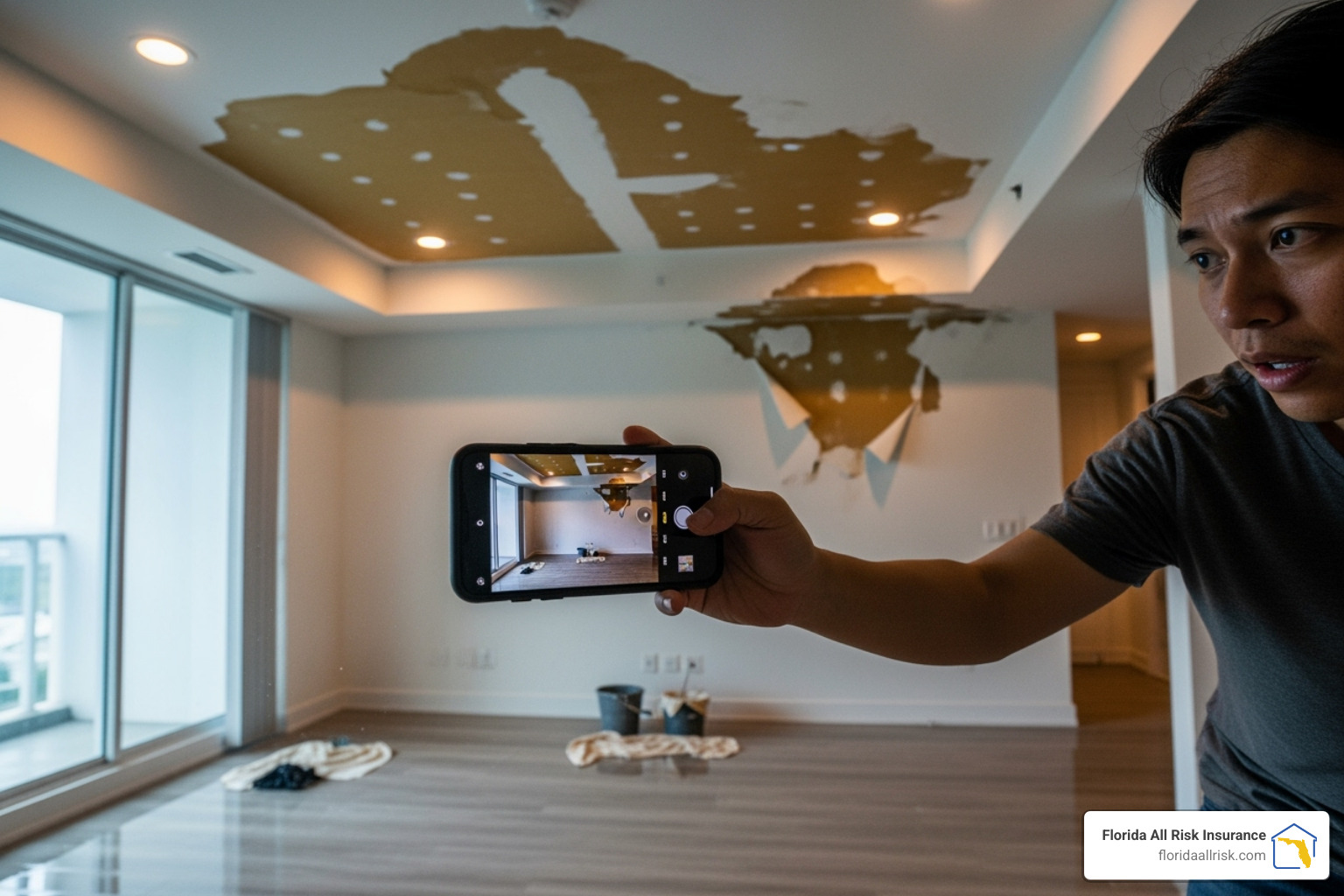
- Photos and Videos: Take more photos and videos than you think you need, all before any cleanup or repairs begin. Capture wide shots of each room, medium shots of damaged areas, and close-ups of specific items. A narrated video walkthrough where you describe the damage as you film is an extremely effective tool.
- Detailed Inventory: List every single damaged item. For each, include a detailed description, brand name, model or serial number (especially for electronics and appliances), approximate age and purchase date, and the estimated cost to replace it today. Use a spreadsheet or a home inventory app to keep this organized. This list is not just for you; it’s a critical piece of evidence for the adjuster.
- Receipts and Estimates: Gather receipts for major purchases to prove ownership and value. Obtain detailed, itemized repair estimates from at least two licensed and insured contractors to establish a credible baseline for the cost of repairs.
Step 3: Determine Which Policy Applies
Filing with the wrong policy is a common mistake that causes significant delays and frustration. The origin of the damage is your primary clue.
- Damage Origin: If the damage started in a common area (e.g., a leaky roof, a burst pipe in a common wall, a fire in the fitness center), it almost certainly falls under the master policy. If it started inside your unit (e.g., an appliance malfunction, an overflowing toilet, a kitchen fire), it is usually your HO-6 policy’s responsibility.
- Review Your Bylaws: Your association’s governing documents—the Declaration of Condominium and the bylaws—are legally binding contracts that define where the association’s responsibility ends and yours begins. These documents will specify whether the master policy is “all-in” (covering fixtures), “walls-in,” or “bare walls” (leaving you responsible for everything from the drywall in). Understanding this before you file is paramount.
- Consult Your Agent: When in doubt, call your insurance agent. We can help interpret your policy and the association’s documents to ensure you file with the correct party from the start. You can find our Claims Numbers to get started.
Step 4: File the Claim Promptly
Once you’ve documented the damage, file your claim(s) immediately. In many condo situations, you will need to coordinate with both your personal insurer and the association’s property manager.
- Contact Your Insurer and HOA: Notify your insurance company and the HOA board or property manager, ideally within 24-48 hours. Provide a clear, factual, and concise description of the date, time, and nature of the damage.
- Provide Documentation: Immediately submit all your photos, videos, inventories, and any official reports or repair estimates you have gathered.
- Get a Claim Number: This number is your unique identifier for the claim. Use it in all future communications.
- Work with the Adjuster: An adjuster will be assigned to inspect the damage on behalf of the insurance company. Be present for this inspection. Walk them through the damaged areas, explain what happened, and provide them with a copy of all your documentation. While you should be cooperative, remember the adjuster works for the insurer. Keep a log of all communications, including the date, time, and a summary of your conversation. Never sign any documents or agree to a final settlement on the spot without fully understanding what you are agreeing to.
Navigating Common Problems in Condominium Insurance Claims
Even with careful preparation, condominium insurance claims can present significant challenges. You might face an outright denial, a lowball settlement offer, or a frustrating dispute with your association. Knowing how to respond is key to overcoming these roadblocks and securing the funds you need to recover.
What to Do If Your Claim is Denied or Delayed
A denial letter is not necessarily the final word; it is the start of a new phase in the claims process. Your response begins with a careful analysis of the letter itself.
- Review the Denial Letter: Insurers are legally required to provide a written explanation for why a claim is denied, citing the specific policy language or exclusion they are using as the basis for their decision. Common reasons include the damage falling under an uncovered peril (like a flood, which requires a separate Flood Insurance), the loss being below your deductible, exclusions for “wear and tear” or “faulty workmanship,” or insufficient documentation.
- Provide More Evidence: If the denial is due to a lack of proof or a misunderstanding of the facts, you can often reopen the claim by submitting additional evidence, such as more detailed photos, new contractor estimates, or an independent expert’s report.
- Appeal the Decision: You have the right to formally appeal the insurer’s decision. This involves writing a letter that systematically refutes their reasons for denial, presenting your new evidence in an organized manner, and requesting a re-evaluation, often by a different, more senior adjuster. For more on this process, resources like What to Do in a Denied Condo Insurance Claim? offer valuable guidance.
- File a Complaint: If you believe your insurer is acting in bad faith (e.g., unreasonable delays, not conducting a proper investigation, misrepresenting policy terms), you can file a formal complaint with the Florida Office of Insurance Regulation.
Handling Low Settlement Offers
It’s common for an insurer’s initial offer to be lower than your actual losses, and you are under no obligation to accept it. The first offer is often just that—a starting point for negotiation.
- Understand Valuation: Offers may be based on Actual Cash Value (ACV), which pays for an item’s value minus depreciation. For example, if your 10-year-old sofa is destroyed, ACV might only give you $200, whereas a new, similar sofa costs $1,500. Replacement Cost Value (RCV) coverage is far superior, as it pays to replace the item with a new one of similar kind and quality. Review your policy to see which valuation method applies, and ensure the adjuster is using the correct one.
- Dispute the Estimate: The insurer’s estimate may be based on cheaper materials or lower labor rates. Counter this by providing your own detailed, itemized estimates from reputable, licensed contractors. A significant, well-documented difference between your estimates and the adjuster’s provides powerful leverage for negotiation.
- Negotiate Professionally: Present your counter-offer in writing. Clearly state the amount you believe is fair and provide the evidence to back it up—contractor quotes, your personal property inventory, receipts, and photos. Argue your case with facts, not emotion.
Resolving Disputes with the Condominium Association
Disagreements with your association are unfortunately common and often center on who is responsible for initiating the claim and covering the repairs. This is especially true in “gray area” claims, like damage originating from a common element that only affects your unit.
- Review Governing Documents: Your association’s declaration and bylaws legally define maintenance and repair responsibilities. These documents are the ultimate authority and the starting point for resolving any dispute. Keep a copy handy and be prepared to cite the relevant sections in your communications.
- Mediation: Before resorting to legal action, consider mediation. A neutral third-party mediator can facilitate a conversation between you and the association’s board to help you reach a mutually agreeable solution, saving both time and money.
- Legal Counsel: If mediation fails or the association refuses to fulfill its legal obligations, you may need to consult an attorney experienced in Florida condominium law. This is especially important if an association refuses to file a claim that clearly falls under its master policy. For more on this topic, Condominium Damage: Rights and Responsibilities for Owners and Associations is a helpful resource.
Florida-Specific Laws and Timelines for Condo Claims
In Florida, condominium insurance claims are governed by a complex web of state-specific laws and statutes. A failure to understand these regulations can jeopardize your claim from the outset. Protecting your investment requires knowing the rules of the game.
Florida’s Statute of Limitations
Florida has strict, non-negotiable deadlines for insurance claims that you cannot afford to miss.
- The Three-Year Rule: Under Florida Statute 95.11, you generally have three years from the date of loss to file a lawsuit against your insurance company if you cannot resolve your claim. It is critical to understand this is a legal deadline for litigation, not the deadline for reporting the claim. Your policy itself will require you to provide “prompt notice” to the insurer, which is typically interpreted as within days or weeks. Waiting months to report a claim can lead to a denial based on your failure to report in a timely manner, as it prejudices the insurer’s ability to investigate.
- Date of Loss: This is the date the damage occurred. For sudden events like a fire or storm, it’s straightforward. For slow, hidden damage like a gradual leak, the date of loss may be established as the date you first discovered, or reasonably should have discovered, the problem.
- Hurricane Exception: For hurricane claims, the timeline is different. You must report the claim to your insurer much sooner, often within one year of the date the hurricane made landfall. However, the three-year statute of limitations for filing a lawsuit still begins on the original date of loss (the date of landfall). This creates a complex set of overlapping deadlines that you must manage carefully.
- Act Quickly: The single best policy is to act immediately. Evidence disappears, damage worsens with time, and memories fade. Prompt action preserves your rights and strengthens your claim.
Condo Owner Rights and Responsibilities in Florida
The Florida Condominium Act (Chapter 718) outlines your legal rights and obligations as a unit owner.
- Right to Policy Information: You have the legal right to request and receive a copy of your association’s master insurance policy and a certificate of insurance. Reviewing these documents is essential to understanding your coverage boundaries and the master policy’s deductible amounts.
- Responsibility for Unit Interior: Under Florida law, you are responsible for insuring everything from the “walls-in.” This includes your personal property, interior finishes (flooring, paint), fixtures, and any improvements or betterments you’ve made. This is the specific purpose of your HO-6 policy. Our Florida Homeowners Insurance options can provide the custom coverage you need.
- Adherence to Bylaws: Your association’s governing documents are legally binding. They detail crucial rules about maintenance responsibilities, insurance deductibles, and how they can be paid, which directly impacts your financial liability in a claim.
Condo Association Rights and Responsibilities in Florida
Your association is a legal entity with specific duties under Florida law, particularly Chapter 718. Recent legislation following the tragic Surfside collapse has imposed even stricter requirements on associations, which indirectly impacts insurance and claims.
- Duty to Insure: The law requires associations to obtain and maintain adequate property insurance for all common elements and the building structure as defined in the declaration of condominium.
- Maintenance of Common Elements: The association has a fiduciary duty to maintain, repair, and replace all common elements. This now includes requirements for milestone structural inspections and maintaining adequate reserves for future repairs through Structural Integrity Reserve Studies (SIRS). If damage originates from a common element that was poorly maintained (e.g., a known leaky roof that was never fixed), the association can be held negligent and responsible for all resulting damages.
- Right to Levy Assessments: If a loss exceeds the association’s insurance coverage or falls within a large deductible, the association has the legal right to levy special assessments on all unit owners to cover the shortfall.
- Legal Framework: You can review the complete Chapter 718 of the Florida Statutes to understand your rights in detail. Associations should also carry Commercial General Liability Insurance to protect against injury claims in common areas.
Advanced Topics: Deductibles, Loss Assessments, and More
Beyond the basic claim process, several complex financial factors can dramatically impact your out-of-pocket costs. Understanding deductibles, loss assessments, and specialty coverages will give you a complete picture of your financial exposure after a loss.
Understanding Deductibles in Condominium Insurance Claims
A deductible is the amount you or your association must pay out-of-pocket on a claim before insurance coverage begins. In the condo world, you are dealing with two separate deductibles that can interact in complex ways.
- Master Policy Deductible: The association’s policy deductible can be extremely high, especially for hurricane damage in Florida, where deductibles of $100,000 or more are common. The association is responsible for paying this amount first for any claim on damage to common areas.
- HO-6 Deductible: This is your personal deductible for claims on your unit’s interior or your personal belongings. It is typically a much smaller, fixed amount, such as $1,000 or $2,500.
- Who Pays the Master Policy Deductible? This is one of the most contentious issues in condo claims. Your association’s bylaws dictate how the master policy deductible is handled. The association may be allowed to pay it from reserve funds, or it may be permitted to levy a special assessment to all unit owners to cover it. In some cases, if the loss originated within a single unit (e.g., your water heater burst and damaged the hallway), the bylaws might hold you responsible for the entire master policy deductible. Knowing these rules in advance is critical.
What is Loss Assessment Coverage?
This is one of the most important and frequently overlooked coverages for any condo owner. It is your financial safety net for costs passed down from the association.
- Special Assessments: If a major loss exceeds the master policy’s limits or if the association needs to cover its large deductible, it can legally levy a “loss assessment” on all unit owners to cover the shortfall. This could leave you with an unexpected bill for thousands of dollars.
- How It Protects You: Loss assessment coverage is an inexpensive but vital endorsement on your HO-6 policy that pays your share of these special assessments. For example, imagine a hurricane causes $1 million in damage, but the master policy has a limit of $800,000. The $200,000 shortfall would be divided among all unit owners. If there are 100 units, you would receive a bill for $2,000. Your loss assessment coverage would pay this bill for you, protecting you from a sudden, large out-of-pocket expense. It can also cover assessments levied to pay for a large master policy deductible.
What is Ordinance or Law Coverage?
Another critical HO-6 endorsement, especially for owners in older buildings, is Ordinance or Law coverage. If your unit is damaged, you are required to rebuild it according to current building codes, which are often much stricter than when the building was originally constructed. Your standard policy only pays to replace what you had, not to cover the extra costs of these legally required upgrades (e.g., new wiring, plumbing, or hurricane-impact windows). Ordinance or Law coverage fills this gap, paying for the increased cost of construction due to the enforcement of new codes. Without it, you could be responsible for thousands of dollars in mandatory upgrades.
Are My Storage Locker and Other Areas Covered?
Your HO-6 policy typically extends limited coverage beyond the four walls of your unit.
- Storage Unit Coverage: Personal belongings stored in a locker or caged storage area within your condominium building are generally covered under your personal property coverage, subject to your policy’s overall limits.
- Damage to the Structure: Damage to the storage area itself (the walls, door, etc.) is the responsibility of the association and would be covered under the master policy.
- Personal Property Off-Premises: Your policy usually provides limited coverage (often 10% of your total personal property limit) for belongings you have away from your home, such as items in a separate, off-site rental storage unit or with you while traveling. Always check your policy for specific limits and exclusions, as certain perils like floods require a separate Flood Insurance policy.
Conclusion: Your Partner in Navigating Condo Claims
Filing condominium insurance claims in Florida can feel overwhelming. The dual-policy system is inherently complex, the line between your responsibility and the association’s is often blurry, and disputes can easily arise.
However, preparation and knowledge are your greatest allies. By deeply understanding how your HO-6 policy (including crucial add-ons like Loss Assessment and Ordinance or Law coverage) and the master policy work together, documenting your loss meticulously, and knowing your rights under evolving Florida law, you put yourself in the strongest possible position. Challenges like denials, delays, or low offers are common hurdles, but they are not insurmountable with persistence and the right professional guidance.
At Florida All Risk Insurance, our role is to be your advocate and expert partner long before you ever need to file a claim. We have a deep, current understanding of Florida’s unique insurance landscape and complex condominium laws. We help our clients not only navigate the claims process—from water and hurricane damage to disputes over deductibles and loss assessments—but also proactively structure their policies to prevent coverage gaps in the first place.
Ready to ensure your condo insurance is working as hard as you are? Contact our experienced team today for a comprehensive review of your coverage and claim strategy.
Protect your investment with confidence. Explore our comprehensive Condo Insurance options designed specifically for Florida’s unique risks and condominium laws.
Contact Us:
Florida All Risk Insurance
Address: 111 2nd Ave NE Suite 900, St. Petersburg, FL 33701
Phone: (727) 471-4700
Email: [email protected]

