

Navigating the High Cost of Florida Auto Insurance
Metadata: This header image features a serene coastal highway in Florida, lined with vibrant palm trees and a clear blue sky, evoking the Sunshine State’s natural beauty. The road curves gently along the coastline, with the ocean visible in the background, symbolizing the journey and protection offered by Florida All Risk Insurance. The scene is calm and inviting, reflecting our commitment to providing peace of mind to our clients.
When you compare Florida car insurance, you’ll quickly find why the Sunshine State ranks among the most expensive in the nation. Whether you’re a longtime resident or new to Florida, understanding how to find the right policy at the best price is essential for protecting your finances and meeting state requirements.
Quick Answer: How to Compare Florida Car Insurance Effectively
- Get quotes from at least 3-5 insurers to see the wide variance in rates.
- Compare identical coverage levels, including limits and deductibles.
- Look beyond price to consider customer service, claims handling, and financial stability.
- Ask about all available discounts, such as safe driver, multi-policy, and good student.
- Review your coverage needs annually or after major life changes.
- Work with an independent agent who can shop multiple carriers on your behalf.
Florida drivers face some of the steepest car insurance costs in America, with average premiums reaching $2,553 per year. This is driven by factors like our no-fault insurance system, a high percentage of uninsured drivers, severe weather risks, dense urban populations, and high rates of insurance fraud. Despite these challenges, smart comparison shopping can lead to substantial savings. Research shows that Florida drivers who compare multiple quotes can save $867 per year or more.
Florida law requires all drivers to carry $10,000 in Personal Injury Protection (PIP) and $10,000 in Property Damage Liability (PDL). However, these minimums are often insufficient. Most experts recommend higher liability limits and additional coverages like bodily injury liability, comprehensive, and collision to truly safeguard your financial well-being.
Taking the time to compare Florida car insurance options thoroughly while working with a trusted advisor is the single best way to secure both comprehensive protection and competitive rates.
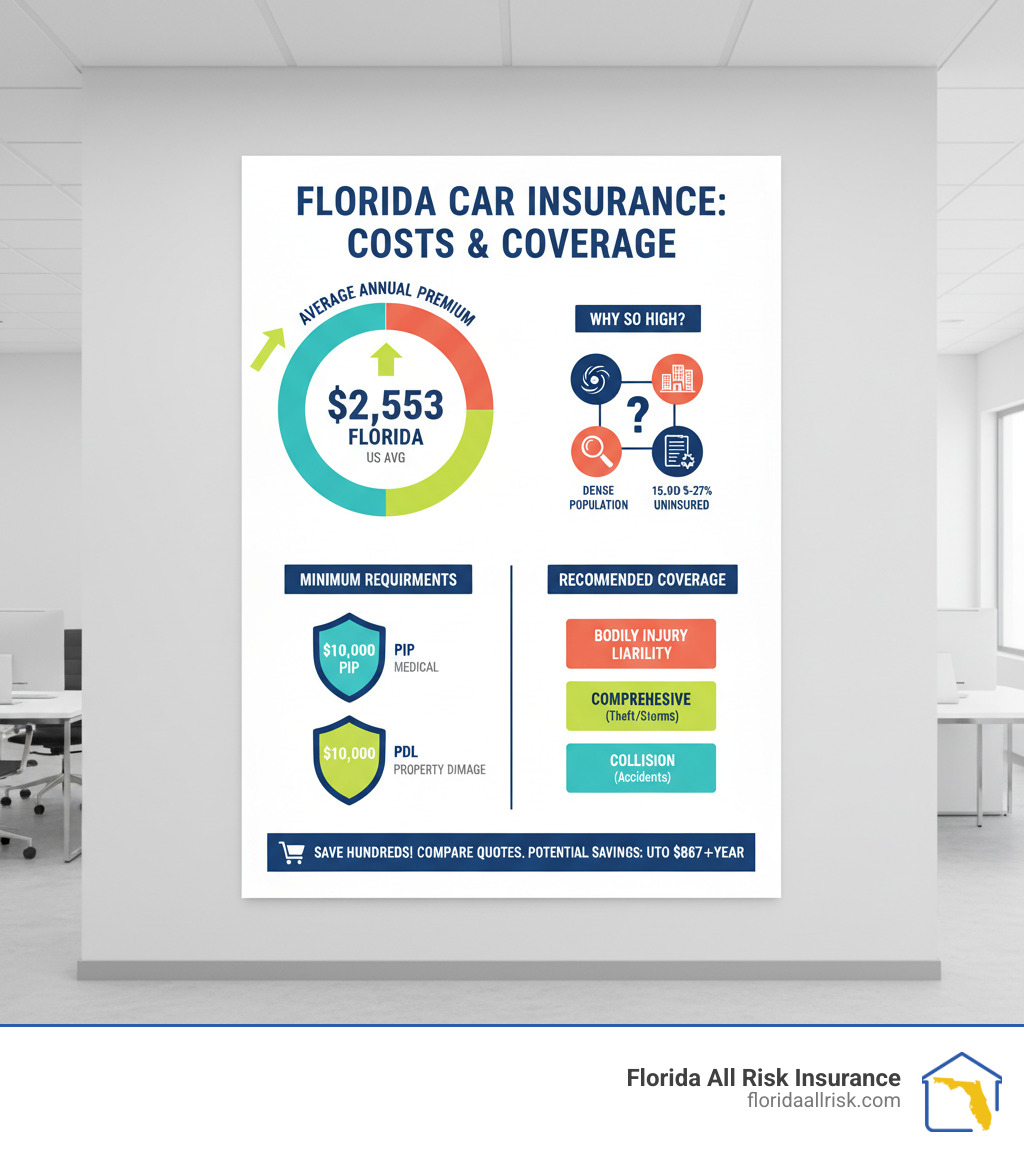
Metadata: This infographic visually breaks down the average car insurance costs in Florida compared to the national average, illustrating the financial impact of factors like severe weather, population density, high claims frequency, and the rate of uninsured motorists. It highlights key coverage types and provides a clear, concise overview of the Florida auto insurance landscape.
Why Are Florida Car Insurance Rates So High?
If you’ve noticed your premium creeping up, you’re not alone. When you compare Florida car insurance rates to other states, we consistently rank near the top for cost. Understanding the reasons can help you make smarter decisions when shopping for coverage.
The Impact of Weather and Population
Florida’s paradise setting comes with insurance challenges. Our 1,350 miles of coastline make us a prime target for hurricanes and tropical storms. Major events like Hurricane Ian cause billions in vehicle damage from catastrophic flooding, wind-blown debris, and fallen trees. This isn’t a rare occurrence; the constant threat of severe weather, including intense thunderstorms with hail and tornadoes, means insurers must price this significant and ongoing risk into everyone’s premiums.
Additionally, Florida’s population of over 22 million residents creates high population density in cities like Miami, Tampa, and Orlando. Congested roads, particularly along major arteries like the I-4 corridor and I-95, lead to a higher frequency of accidents. Add in over 130 million annual tourists, many unfamiliar with local roads and driving rental cars, and the risk of accidents on our highways increases even further. More claims activity naturally leads to higher premiums for everyone across the state.
For more detailed statistics on how uninsured motorists impact Florida’s insurance landscape, see the Insurance Information Institute’s facts on uninsured motorists{:target=”_blank”}.

Metadata: This image captures a busy urban intersection in a major Florida city, showcasing heavy traffic and the distinct architectural style of high-rise buildings framed by iconic palm trees. It visually represents the high population density and urban congestion that contribute to increased accident rates and higher car insurance premiums in the state.
A Litigious Environment and Insurance Fraud
Florida’s legal landscape adds another layer of cost. Our no-fault insurance system requires your own insurer to pay your initial medical bills through Personal Injury Protection (PIP), regardless of who caused the crash. While designed to speed up claims, this has contributed to the frequency of injury claims in Florida being about 40% higher than the national average, according to the Insurance Research Council (IRC). This system has historically been a target for abuse.
Florida is also one of the most litigious states for auto accidents, with lawsuits filed at a much higher rate than elsewhere. This culture of litigation, fueled by aggressive attorney advertising, drives up legal defense costs for insurers, which are then passed on to policyholders. Furthermore, insurance fraud is a major problem, with organized schemes involving staged accidents, fraudulent medical clinics, and inflated medical bills costing insurers billions annually. These fraudulent activities act as a hidden tax, driving up costs for all honest drivers. While recent legislative reforms aim to curb these issues, their full effect on rates will take time to materialize.
The Challenge of Uninsured Drivers
One of the most frustrating factors is the high number of uninsured drivers. Studies estimate that between 15.9% and 27% of Florida drivers are on the road illegally without insurance. When an uninsured driver hits you, your own insurance company often has to cover the damages, assuming you have the right coverage. This risk is priced into every policy, meaning responsible drivers end up subsidizing the costs created by those who break the law. We strongly encourage our clients to add Uninsured Motorist Coverage in Florida to protect themselves from this common scenario.
Florida’s Minimum Car Insurance Requirements
To legally drive in Florida, you must meet the state’s minimum insurance requirements. However, these minimums are just a starting point and often fail to provide adequate financial protection.
Understanding PIP and PDL
Florida’s no-fault system dictates our basic coverage. When you register a vehicle, you are required to carry:
- $10,000 in Personal Injury Protection (PIP): This covers your own medical expenses and lost wages after an accident, regardless of who is at fault. It helps ensure you can get immediate medical care without waiting for a fault determination.
- $10,000 in Property Damage Liability (PDL): This pays for damage you cause to another person’s property, such as their car or a fence, if you are at fault in an accident.
For full details, visit Florida’s official insurance requirements{:target=”_blank”} or see our guide on Basic Auto Insurance Florida.
The Risks of Minimum-Only Coverage
While meeting these minimums keeps you legal, it can leave you dangerously exposed. A modern vehicle can easily cost more than $10,000 to repair after a moderate accident. If you cause damage exceeding your $10,000 PDL limit, you are personally responsible for paying the difference out of pocket.
Similarly, a single trip to the emergency room can exhaust your $10,000 PIP limit, leaving you with significant medical bills. The most critical gap, however, is the lack of a Bodily Injury Liability requirement. If you cause an accident that injures someone else, you are personally liable for their medical bills, lost wages, and pain and suffering. This can lead to lawsuits, wage garnishment, and financial ruin.
At Florida All Risk Insurance, we’ve seen the devastating consequences of inadequate coverage. When you compare Florida car insurance with us, we’ll help you understand what protection you truly need. To protect your assets, we strongly advise considering more than just the minimum. Learn more about Liability Car Insurance in Florida and how it provides critical peace of mind.
Beyond the Basics: Essential Optional Auto Insurance Coverages
While state-minimum coverage keeps you legal, it often falls short of providing real financial security. In a high-risk state like Florida, considering additional coverages is essential. When you compare Florida car insurance policies, look for these options to build a policy that truly protects you.
Protecting Yourself and Others
These coverages address injury-related costs that can quickly exceed minimum limits.
- Bodily Injury Liability (BI): This is arguably the most important coverage you can buy. It pays for medical expenses, lost wages, and pain and suffering for others if you cause an accident. Without it, your personal assets—your home, savings, and future earnings—are at risk in a lawsuit. We recommend limits of at least $100,000 per person and $300,000 per accident, or higher if your net worth warrants it.
- Uninsured/Underinsured Motorist (UM/UIM): Given Florida’s high rate of uninsured drivers, this coverage is a lifesaver. It pays for your medical bills and other damages if you’re hit by a driver with little or no insurance. In Florida, you can choose between “stacked” and “non-stacked” UM. Stacked coverage allows you to combine the UM limits for multiple vehicles on your policy, providing a higher total amount of protection, which is invaluable in a serious accident. Non-stacked coverage applies the limit of only the specific vehicle involved in the crash.
- Medical Payments (MedPay): This supplements your PIP coverage, helping to pay for medical expenses for you and your passengers regardless of fault. It can cover health insurance deductibles and the 20% of medical costs that PIP doesn’t cover, providing an extra layer of financial protection.
Explore all your options in our guide to Auto Insurance Coverage Options.
Protecting Your Vehicle
These coverages are designed to repair or replace your car.
- Collision Coverage: Pays for damage to your car from a collision with another vehicle or object, regardless of fault. If you have a car loan or lease, your lender will require it. This coverage is subject to a deductible, which is the amount you pay out-of-pocket before insurance kicks in. Choosing a higher deductible can lower your premium.
- Comprehensive Coverage: This is your protection against non-collision events. It covers theft, vandalism, fire, falling objects, and, crucially in Florida, damage from hurricanes, floods, and hail. Like collision, it has a deductible. For many Floridians, this coverage is non-negotiable due to our weather risks.
- Gap Insurance: If your car is totaled, your insurance payout is for its current market value, which may be less than what you owe on your loan. Gap insurance covers this “gap,” preventing you from owing thousands on a car you no longer have. It’s highly recommended for new cars or vehicles with significant loans.
- Rental Reimbursement: This affordable add-on pays for a rental car (up to a daily limit) while your vehicle is being repaired after a covered claim, ensuring you aren’t left without transportation.
- Roadside Assistance: Provides peace of mind by covering services like towing, flat tire changes, battery jumps, and lockout assistance if you’re stranded.
How to Compare Florida Car Insurance to Find the Best Rates
Shopping around is the most powerful tool you have to lower your car insurance costs in Florida. By understanding what drives your premium and learning to shop strategically, you can take control and potentially save hundreds or even thousands of dollars a year.
Key Factors That Influence Your Florida Car Insurance Rates
Insurers assess your risk using a variety of factors to determine your premium. The most common include:
- Driving Record: A clean record with no at-fault accidents or moving violations results in the lowest rates. A DUI is especially costly, requiring an FR-44 filing and leading to massive premium increases. Learn more about DUI Auto Insurance in Florida.
- Age and Driving Experience: Younger, less experienced drivers face the highest rates. Premiums typically decrease with age and a consistent history of safe driving, with significant drops often seen after age 25.
- Credit-Based Insurance Score: In Florida, insurers can use a score derived from your credit history as a rating factor. Actuarial studies show a strong correlation between financial responsibility and lower claims frequency. Maintaining good credit can directly lead to lower insurance costs.
- Location (ZIP Code): Rates are higher in dense urban areas with more traffic congestion, crime, and claims frequency, like Miami and Fort Lauderdale, compared to quieter suburban or rural towns.
- Vehicle Type: The make, model, age, and safety features of your car affect your premium. Sports cars and luxury vehicles cost more to insure due to higher repair costs and theft rates, while a family sedan with advanced safety features will be cheaper.
- Annual Mileage: The more you drive, the higher the statistical risk of an accident. Low-mileage drivers, such as those who work from home, may qualify for significant discounts.
- Coverage History: A lapse in coverage, even for a short period, can lead to higher premiums. Insurers see continuous coverage as a sign of a responsible driver.
For households with new drivers, our guide on Auto Insurance for Young Drivers offers specific advice.
A Step-by-Step Guide to Compare Florida Car Insurance
Follow this systematic approach to ensure you’re making an informed decision.
- Gather Your Information: Have your driver’s license number, vehicle identification number (VIN), and current policy declaration page ready for all drivers and vehicles in your household.
- Determine Your Coverage Needs: Don’t just default to state minimums. Assess your financial situation to decide on appropriate liability limits and optional coverages. Ask yourself:
- What is my net worth (assets minus liabilities)? Your liability limits should be high enough to protect it.
- Do I own a home?
- Can I afford to pay for major repairs or a new car out of pocket?
- How much of a deductible can I comfortably afford?
- Get Multiple Quotes: This is essential. Rates for identical coverage can vary dramatically between companies. Aim for quotes from at least 3-5 different insurers, including both national and regional carriers.
- Compare Policies Apples-to-Apples: When quotes come in, ensure you are comparing the same coverage types, limits, and deductibles. A lower price may mean less protection. Look closely at the details.
- Ask About Discounts: Inquire about every possible discount. Don’t assume they are automatically applied. Common discounts include safe driver, multi-policy (bundling home/auto), good student, defensive driving course, and paid-in-full. See our guide to Florida Car Insurance Discounts.
- Review the Fine Print: Understand the policy’s terms, exclusions, and claims process before you buy. A cheap policy that doesn’t cover you when needed is no bargain. Check customer service ratings and financial stability reports for the insurers you’re considering.
To begin your comparison, you can get online auto insurance quotes in Florida through our site.
The Advantage of Using an Independent Agent to Compare Florida Car Insurance
Navigating Florida’s complex insurance market can be overwhelming. This is where working with an independent insurance agent from Florida All Risk Insurance makes all the difference.
- Expert Guidance: We live and breathe Florida insurance. We can explain complex coverages like stacked vs. non-stacked UM in plain English and help you choose what you truly need.
- Access to Multiple Carriers: Unlike captive agents who represent only one company (like State Farm or Allstate) or direct writers (like Geico or Progressive) who only sell their own product, we partner with a wide network of top-rated carriers. We shop the market for you to find the best combination of coverage and price.
- Personalized Service: We take the time to understand your unique situation—your family, your assets, your budget—and tailor our recommendations accordingly. You’re not just a policy number to us; you’re a neighbor.
- Time Savings: You provide your information once, and we do the heavy lifting of gathering and comparing quotes from multiple companies, saving you hours of repetitive work and phone calls.
Learn more about why you should work with an independent insurance agency. When you’re ready for personalized service, connect with a local auto insurance agent in St. Petersburg, FL.
Frequently Asked Questions about Florida Car Insurance
We’ve gathered some of the most common questions our clients ask when they compare Florida car insurance. Here are straightforward answers to help you steer the process.
How often should I compare my car insurance rates?
We recommend shopping for car insurance at least once a year, typically around your policy renewal time. Rates change frequently due to insurer profitability, market competition, and changes in your own risk profile. You could be overpaying without realizing it.
You should also get fresh quotes immediately following certain life events, as they can significantly impact your premium. These triggers include:
- Moving to a new ZIP code
- Buying a new car
- Getting married or divorced
- Adding or removing a driver (especially a teen)
- A significant birthday that moves you into a lower-risk age group
- An improvement in your credit score or driving record (e.g., an accident falling off your record after 3-5 years)
Staying proactive ensures your rate reflects your current situation.
What is the difference between an FR-44 and an SR-22 in Florida?
This is an important distinction. Both are certificates of financial responsibility that your insurer files with the state to prove you have coverage, but they are for different violations and have vastly different requirements.
- An SR-22 is typically required for non-DUI-related offenses, such as driving without insurance, being at fault in an accident without insurance, or accumulating too many points on your license. It certifies that you carry at least the state’s minimum liability coverage.
- An FR-44 is specifically for drivers convicted of a DUI or DUID (driving under the influence of alcohol or drugs) in Florida. It requires much higher liability limits: $100,000 bodily injury liability per person, $300,000 per accident, and $50,000 property damage liability (100/300/50). This certificate must be maintained for three consecutive years without any lapse.
Due to the higher risk and substantially higher coverage requirements, premiums for drivers needing an FR-44 are significantly higher. If you’re in this situation, an experienced agent can help you find the most competitive options. Learn more about DUI Auto Insurance in Florida.
What happens if I let my Florida car insurance lapse?
A lapse in car insurance in Florida has serious and immediate consequences. The moment your policy cancels, your insurance company is required by law to notify the Florida Department of Highway Safety and Motor Vehicles (FLHSMV). The FLHSMV will then send you a notice requiring you to provide proof of new insurance. If you fail to do so, your driver’s license, license plate, and vehicle registration will be suspended for up to three years or until you get new insurance. To reinstate them, you will have to pay a hefty reinstatement fee (ranging from $150 to $500) and provide proof of a new policy. Furthermore, having a lapse on your record will cause your future insurance premiums to be much higher, as insurers view you as a higher risk.
Are there alternatives to traditional car insurance in Florida?
Florida law does permit an alternative called self-insurance, but it is only a viable option for wealthy individuals or large businesses. To qualify, you must obtain a self-insurance certificate from the FLHSMV{:target=”_blank”} by proving a net worth of at least $40,000 and posting a significant bond or cash deposit with the state.
Crucially, self-insurance is not an insurance policy. It is a formal promise that you have the personal assets to pay for any damages or injuries you cause in an accident. You are personally responsible for all costs, including medical bills, property damage, and legal fees. A single serious accident could lead to hundreds of thousands of dollars in liability, putting your home, savings, and other assets at risk.
For the vast majority of drivers, traditional auto insurance is the only practical and safe way to protect themselves financially. Working with an agency like Florida All Risk Insurance ensures you have comprehensive protection without risking your personal wealth.
Find Your Perfect Florida Auto Policy Today
You’re serious about finding the right car insurance for your needs and budget, and that’s the best approach in Florida’s challenging market. While rates in the Sunshine State are high, a strategic plan to compare Florida car insurance policies can lead to significant savings.
The key is to understand what you need beyond the state minimums, know what factors drive your premium, and recognize when expert guidance can save you time and money. By putting these pieces together, you can find a policy that provides robust protection without breaking the bank.
This is where Florida All Risk Insurance comes in. As an independent agency in St. Petersburg, we work for you, not a single insurance company. Our agents are experts in the Florida market and understand the unique challenges our neighbors face. We do the comparison shopping for you, leveraging our network of top-rated carriers to find the ideal policy for your situation.
Think of us as your personal insurance shopper. You tell us your needs, and we handle the rest, presenting you with clear options and explaining what each policy covers in plain English. Our goal is to make the process simple, transparent, and affordable.
Whether you’re a new driver, adding a teen to your policy, or simply looking for better rates, we are here to help. We pride ourselves on building lasting relationships with our clients in the Tampa Bay community.
Ready to see how much you can save? Get your personalized Florida car insurance quotes online today! It takes just a few minutes, and there is no obligation.
Have questions or prefer to talk through your options? Contact our St. Petersburg office to speak with a knowledgeable agent who genuinely cares about helping you steer your options with confidence.
Contact Us
Florida All Risk Insurance
Address: 123 Main Street, Suite 100, Saint Petersburg, FL 33701
Phone: (727) 555-1234
Email: [email protected]

