

Understanding Business Liability Protection
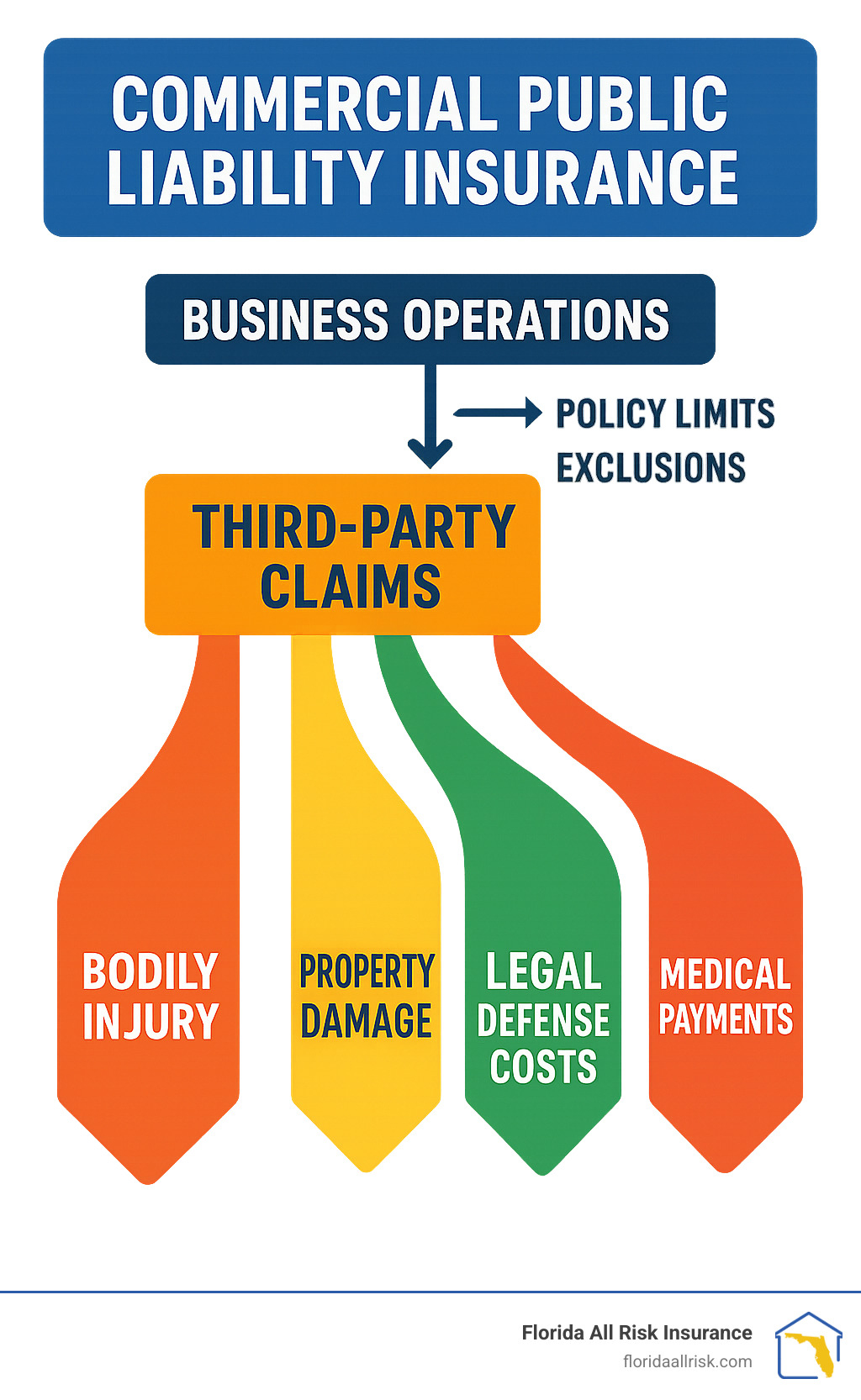
Commercial public liability insurance protects businesses against claims of bodily injury, property damage, or advertising injury caused to third parties due to your business operations. This coverage shields your business from potentially devastating financial losses.
Quick Facts About Commercial Public Liability Insurance:
| What It Is | What It Covers | Who Needs It | Average Cost |
|---|---|---|---|
| Insurance that protects against third-party claims | • Bodily injuries • Property damage • Legal defense costs |
• Businesses with physical locations • Those interacting with the public • Contractors and service providers |
$42-$80 per month depending on business size and industry |
Commercial public liability insurance is often bundled as part of general liability insurance or a Business Owner’s Policy (BOP). While not always legally required, many contracts, leases, and client agreements demand this coverage before you can do business.
When a customer slips and falls in your store, or your employee accidentally damages a client’s property during a service call, this insurance can be the difference between a minor setback and a business-ending financial disaster.
I’m Jason Miller, a second-generation insurance professional with over 20 years of experience helping Florida businesses secure appropriate commercial public liability insurance protection against everyday operational risks.
Simple commercial public liability insurance glossary:
– general risk insurance
– excess public liability
– high risk general liability insurance
What Is Commercial Public Liability Insurance?
When you run a business, unexpected accidents can happen anytime. Commercial public liability insurance is your financial safety net when things go wrong with customers or visitors.
This essential coverage protects against those “oh no!” moments – when someone gets hurt on your property, your operations damage someone’s belongings, or your business activities accidentally cause harm to others.
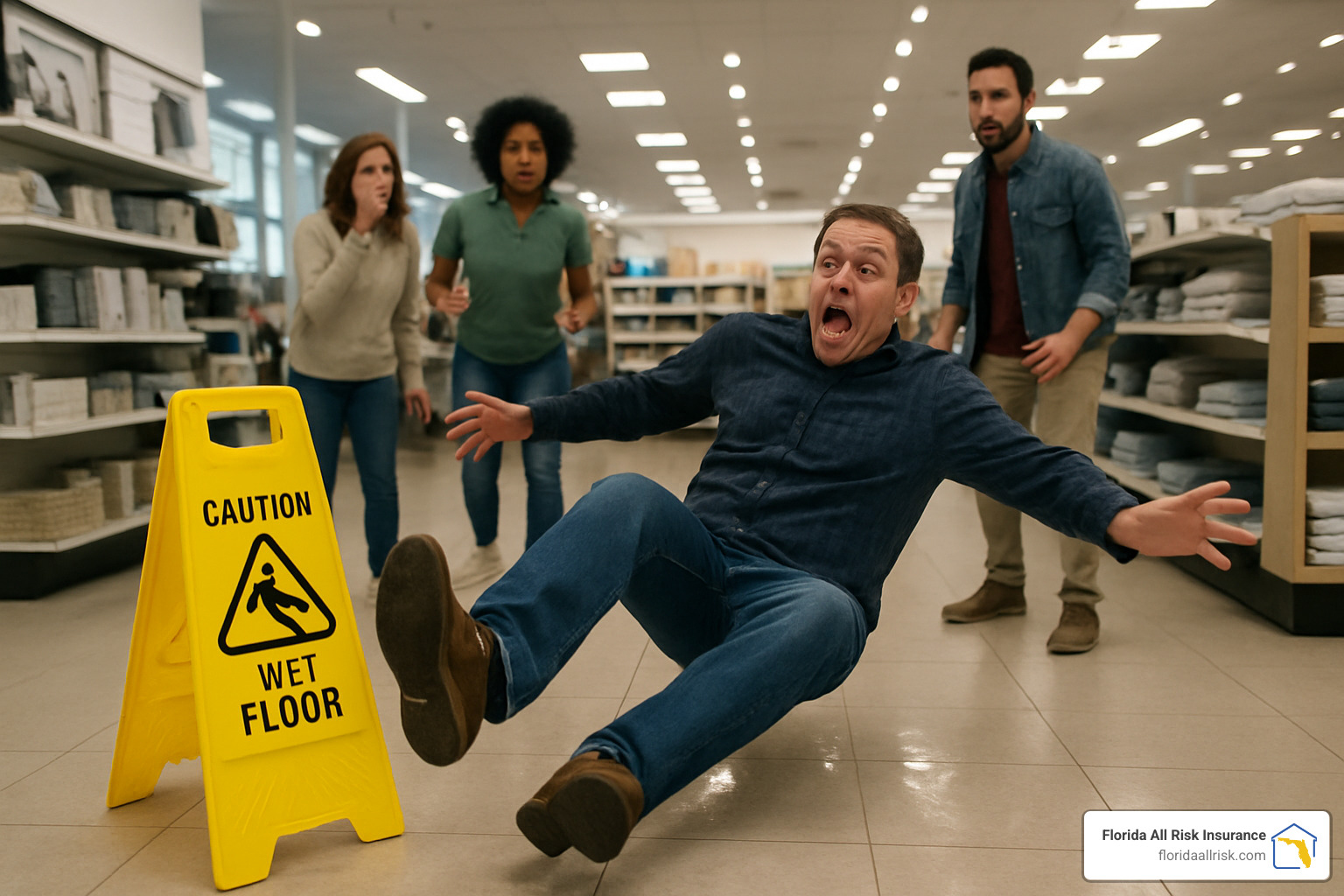
Imagine a rainy day at your Tampa gift shop. A customer walks in, slips on the wet floor, and breaks their wrist. Without proper coverage, you could be personally responsible for their medical bills, lost wages, and potential lawsuit. With commercial public liability insurance, those costs are covered, allowing you to focus on running your business.
This coverage isn’t just about paying claims – it also covers legal defense costs if you’re sued, even if the claim turns out to be groundless.
The Evolution from “Public” to “General” Liability
If you’ve been in business for a while, you might remember when everyone called this coverage “public liability insurance.” These days, you’ll more commonly hear it referred to as “general liability” or “commercial general liability (CGL)” insurance.
This name change reflects how the coverage has grown over time. What started as basic protection against public injuries has expanded to include more comprehensive safeguards for modern businesses.
Today, when Florida business owners ask about commercial public liability insurance, what they’re actually getting is a more robust commercial general liability policy that typically includes:
- Protection against bodily injuries to customers and visitors
- Coverage for damage to other people’s property
- Personal and advertising injury protection
- Products-completed operations coverage
- Medical payments coverage for minor injuries
For many small to medium-sized businesses in Florida, we often recommend bundling this coverage into a Business Owner’s Policy (BOP) – a cost-effective combination of general liability and property insurance.
How Commercial Public Liability Insurance Differs from Other Liability Policies
Business insurance comes in many flavors. Commercial public liability insurance is the policy that responds when your operations physically injure a third party or damage their property. Other liability policies pick up where this one leaves off.
• General liability is the modern, broader form of public liability. It adds protection for advertising mistakes and product issues.
• Professional liability (E&O) responds when your advice or services cause a client a financial loss.
• Workers’ compensation is for employee injuries ‑ something public liability specifically excludes.
• Product liability is for manufacturers or distributors whose products hurt someone after sale.
• Umbrella or excess liability provides higher limits once a big claim exhausts your primary policy.
Commercial Public Liability Insurance vs General Liability Insurance
Traditional public liability paid only for on-premises injuries or property damage. A modern general liability policy does that plus:
– Advertising injury (libel, slander, copyright infringement)
– Products-completed operations coverage once work is finished or goods are sold
– No-fault medical payments that can head off lawsuits
To avoid confusion, most insurers now issue a general liability (CGL) form, even when clients still ask for “public liability.” What matters is that the policy you buy matches your contractual obligations and risk profile.
Claims-Made vs Occurrence Policies
| Feature | Claims-Made Policy | Occurrence Policy |
|---|---|---|
| Coverage Trigger | Claim must be made during policy period | Incident must occur during policy period |
| Reporting Timeline | Must report claim while policy is active | Can report claim after policy ends |
| Retroactive Date | Covers incidents after this date if claim is made during policy period | No retroactive date; only covers incidents during policy period |
| Cost | Initially less expensive but increases over time | Initially more expensive but stable over time |
Most public (general) liability policies are written on an occurrence basis, giving you long-tail protection if a customer files a lawsuit years after an accident took place.
What Does Commercial Public Liability Insurance Cover?
Commercial public liability insurance pays for a wide range of third-party claims that could otherwise devastate your business finances:
• Bodily injury to customers or visitors
• Damage to someone else’s property
• Legal defense and court costs
• No-fault medical payments for minor injuries
• Personal and advertising injury (libel, slander, copyright issues)
• Products-completed operations claims after work is finished
Typical Incidents and Real-World Claims
• A diner in your cafe slips on spilled coffee and fractures an elbow medical costs plus legal fees: $25,000.
• Your employee drops a ladder and cracks a client’s granite countertop property damage: $8,500.
• A marketing post accidentally infringes a competitor’s slogan attorney fees: $12,000.
Coverage Extensions & Endorsements
Add-ons let you tailor protection:
– Additional insured for landlords or clients
– Hired & non-owned auto liability for employees using personal cars
– Damage to premises rented to you
– Cyber or data-breach endorsement for limited digital exposures
What’s Not Covered & Common Exclusions
While commercial public liability insurance provides crucial protection for your business, it doesn’t cover everything. Understanding these gaps is essential for building a complete insurance strategy.
Think of your insurance policy like a fence around your property – it’s important to know where the openings are so you can close them with additional coverage. Here are the key areas where your commercial public liability insurance typically won’t help you:
Intentional acts are never covered – if you or an employee deliberately causes damage or injury, you’re on your own. Insurance is designed for accidents, not deliberate harm.
Employee injuries fall outside the scope of public liability coverage. If your team member is injured, you’ll need workers’ compensation insurance instead – which is mandatory for most Florida businesses with employees.
Professional mistakes aren’t protected either. If you’re an accountant who makes a costly error on a client’s tax return or a consultant who gives advice that leads to financial loss, you’ll need professional liability insurance (also called E&O insurance).
Damage to your own property isn’t what public liability is designed for – that’s what commercial property insurance handles. Your storefront, inventory, equipment, and furnishings need their own separate protection.

Pollution and environmental damage claims are almost universally excluded from standard policies. Businesses with these exposures need specialized environmental liability coverage.
Asbestos and lead related claims are similarly excluded, which can be particularly important for businesses working with older buildings in historic areas of Florida.
Product recalls can be devastatingly expensive, but standard public liability won’t cover these costs. If you manufacture, distribute or sell products, consider dedicated product recall coverage.
Contractual liability you assume under certain agreements may not be covered unless you have specific endorsements. Always review your contracts with your insurance advisor.
Auto-related liabilities involving owned vehicles require commercial auto insurance – your public liability policy won’t help if your delivery van causes an accident.
Cyber incidents like data breaches, ransomware attacks, and other digital threats are generally excluded from standard policies but are increasingly common threats to Florida businesses.
Who Needs Coverage & Are You Legally Required?
Do you really need commercial public liability insurance for your business? If you interact with the public in any way, the answer is probably yes.
This coverage is particularly important if your business has a physical location where people visit, if you regularly interact with customers or clients, or if you provide products or services that could potentially cause harm.
Retailers with storefronts in St. Petersburg face daily risks as customers browse their shops. Contractors working in clients’ homes could accidentally damage property. Restaurant owners in Tampa need protection against slip-and-fall incidents. Even home-based consultants who have occasional client meetings need this coverage.
Commercial public liability insurance isn’t just for large corporations—businesses of all sizes benefit from this protection. In fact, smaller businesses often have the most to lose from an uncovered claim.
Commercial Public Liability Insurance for High-Risk Industries
Some businesses face greater liability challenges simply because of the nature of their work. If you’re in one of these high-risk industries, paying special attention to your coverage is especially important:
Construction companies face significant risks daily. Between hazardous work environments, heavy machinery, and the potential for property damage, contractors often need higher liability limits and specialized endorsements.
Food service businesses like restaurants and caterers deal with unique risks like foodborne illness and allergic reactions. Imagine a customer having a severe allergic reaction because a menu didn’t properly list ingredients—your commercial public liability insurance would be essential.
Live event businesses manage large crowds in dynamic environments where anything can happen. Whether you’re planning corporate events in Orlando or running a venue in Miami, the concentration of people creates heightened liability concerns.
Cleaning services work with chemicals and in clients’ homes or businesses, creating numerous opportunities for property damage claims. Similarly, transportation companies face risks beyond just auto accidents, particularly around loading docks and warehouses.
Certificate of Insurance: Proving You’re Covered
Once you have your commercial public liability insurance in place, you’ll often need to prove it to others. That’s where a Certificate of Insurance (COI) comes in.
This important document verifies your coverage and shows clients, landlords, and business partners that you’re properly insured. Think of it as your insurance “proof of purchase” that builds trust with those you do business with.
You’ll likely need to provide a COI when signing a client contract, leasing commercial space, applying for professional licenses, or bidding on projects. Many businesses in Florida won’t even consider working with you without seeing this proof of insurance first.
Requesting a certificate is simple. At Florida All Risk Insurance, we can typically provide certificates the same day you request them. Many insurers now offer digital access to COIs through convenient online portals.
More info about business insurance for small businesses
Cost Factors & How to Estimate Premiums
Most Florida businesses spend roughly $42–$80 a month for general liability (which includes public liability). Your exact premium depends on:
• Industry risk level – a roofer pays more than a bookkeeping firm.
• Revenue & payroll – higher numbers mean more foot traffic and exposure.
• Location – busy urban ZIP codes see more claims.
• Claims history – prior losses increase rates.
• Limits & deductibles – higher limits cost more; higher deductibles reduce premiums.

Premiums are generally tax-deductible as an ordinary business expense. IRS guidance on business expense deductions confirms the details.
Saving Money Without Sacrificing Protection
• Bundle liability and property into a BOP for a multi-policy discount.
• Raise deductibles only to levels your cash flow can handle.
• Document safety programs – insurers reward good risk management.
• Review coverage annually so you’re not paying for exposures you no longer have.
Choosing Limits, Policy Types & Endorsements
A common starting point is $1 million per occurrence / $2 million aggregate. You may need higher limits if you:
– Sign contracts requiring them
– Work in construction, hospitality, or other high-risk sectors
– Have significant business assets to protect
Going beyond primary limits is easy with excess or umbrella liability policies, which stack additional protection on top of your base coverage.
How Much Commercial Public Liability Insurance Do You Need?
- Assess your operations and worst-case loss scenario.
- Add up the value of assets you could lose in a lawsuit.
- Check client or landlord requirements.
- Plan for future growth so today’s limit still works tomorrow.
Buying, Filing a Claim & Keeping Coverage Current
Buying Coverage
Have these basics ready for a fast quote: business description, revenues, payroll, employee count, and prior claims. An independent agency like Florida All Risk shops multiple carriers to find the right fit.
Filing a Claim
- Document the incident (photos, witness info, date, time).
- Notify your insurer immediately – late reporting can jeopardize coverage.
- Cooperate with the adjuster assigned to your file.
Keeping Coverage Current
Your operations change; your policy should, too. Review annually for new locations, added services, or revenue jumps. Expect a year-end audit to confirm payroll and sales figures.
General Liability Insurance for Small Business
Reducing Your Risk of Liability Claims
Insurance helps after an accident; prevention keeps premiums low and customers safe.
• Provide industry-specific safety training to employees.
• Fix maintenance issues (loose tiles, poor lighting) promptly.
• Use clear signage and barriers for temporary hazards.
• Implement strict quality-control processes for any products you sell.
• Maintain basic cybersecurity to protect customer data.
• Require vendors to show proof of insurance before working on your premises.
• Have legal counsel review contracts, waivers, and disclaimers.

Frequently Asked Questions about Commercial Public Liability Insurance
Is this insurance required by law?
Many Florida business owners ask me whether commercial public liability insurance is legally mandatory. The short answer is: it depends on your specific situation.
Florida state law doesn’t universally require all businesses to carry this insurance, but don’t let that fool you into thinking you can skip it! In my 20+ years helping Florida businesses with their insurance needs, I’ve seen countless situations where this coverage is effectively required:
If you’re applying for certain professional licenses or permits in Florida, you’ll likely need to show proof of liability coverage before they’ll approve your application. This is especially common for contractors, food service businesses, and healthcare providers.
Planning to lease commercial space? Your landlord will almost certainly require commercial public liability insurance in your lease agreement. I’ve rarely seen a commercial lease in St. Petersburg or anywhere in Florida that doesn’t include this requirement.
When you’re bidding on contracts, particularly with larger organizations or government entities, they’ll typically specify minimum liability insurance requirements. Without the right coverage, you simply won’t be eligible for the work.
Are premiums tax-deductible?
Good news for your bottom line! The premiums you pay for commercial public liability insurance are generally tax-deductible as a legitimate business expense.
The IRS considers business insurance an “ordinary and necessary” cost of doing business. This means you can typically deduct 100% of your premium costs when filing your business taxes.
I always tell my clients in St. Petersburg that while this tax benefit is nice, it shouldn’t be the primary reason you purchase coverage. The real value is in the protection it provides your business.
Does an LLC still need coverage?
“I formed an LLC specifically for liability protection. Why would I still need insurance?”
I hear this question frequently from Florida business owners, and it’s a common misconception. While your LLC structure does provide valuable personal asset protection, it’s far from a complete solution.
Here’s the reality: your LLC structure primarily helps shield your personal assets (like your home or personal savings) from business liabilities. However, it does nothing to protect your business assets themselves. Without commercial public liability insurance, your business bank accounts, equipment, inventory, and future earnings remain completely exposed to liability claims.
There’s also the concerning possibility of “piercing the corporate veil” – a legal concept where courts may disregard your LLC protection and hold you personally liable, particularly if you haven’t maintained proper separation between personal and business finances or haven’t followed corporate formalities.
Even if a claim against your business is ultimately unsuccessful, the legal defense costs alone can be staggering. Your commercial public liability insurance covers these defense costs, which would otherwise drain your business resources.
Conclusion
When it comes to protecting your business, commercial public liability insurance isn’t just another expense—it’s your financial safety net when the unexpected happens. Throughout this guide, we’ve seen how this essential coverage shields Florida businesses from the potentially devastating costs of third-party claims.
Think about it: one customer slip on a wet floor, one accidental property damage incident during a service call, or one advertising misstep could lead to legal expenses and settlements that might otherwise drain your business resources. That’s where commercial public liability insurance steps in, giving you the freedom to focus on growing your business rather than worrying about what might go wrong.
While we’ve traditionally called it “public liability” insurance, today you’ll most often find this protection packaged as “general liability” coverage or as part of a comprehensive Business Owner’s Policy. The terminology has evolved, but the core purpose remains the same—protecting your business from third-party claims.
Your premium will depend on several factors unique to your business situation. Your industry type, business size, location in Florida, claims history, and chosen coverage limits all play a role in determining costs. Most small businesses can expect to pay between $42-$80 monthly for this essential protection—a small price for significant peace of mind.
Here at Florida All Risk Insurance, we understand that St. Petersburg businesses face unique challenges—from hurricane-related hazards to Florida’s distinctive legal environment. As your neighbors and local insurance experts, we’re committed to finding you coverage that perfectly fits your business needs without breaking your budget.
Don’t wait until after an incident to find gaps in your protection. Contact us today to discuss how commercial public liability insurance fits into your overall business protection plan. Let us help you build a solid foundation of coverage that gives you confidence to pursue new opportunities.
The greatest benefit of proper insurance isn’t just financial protection—it’s the freedom to run your business without constantly looking over your shoulder. With the right coverage in place, you can focus your energy where it belongs: serving your customers and building your Florida business.

