

Commercial property flood insurance: #1 Unseen Risk
The Unseen Risk: Why Your Business Needs Flood Protection
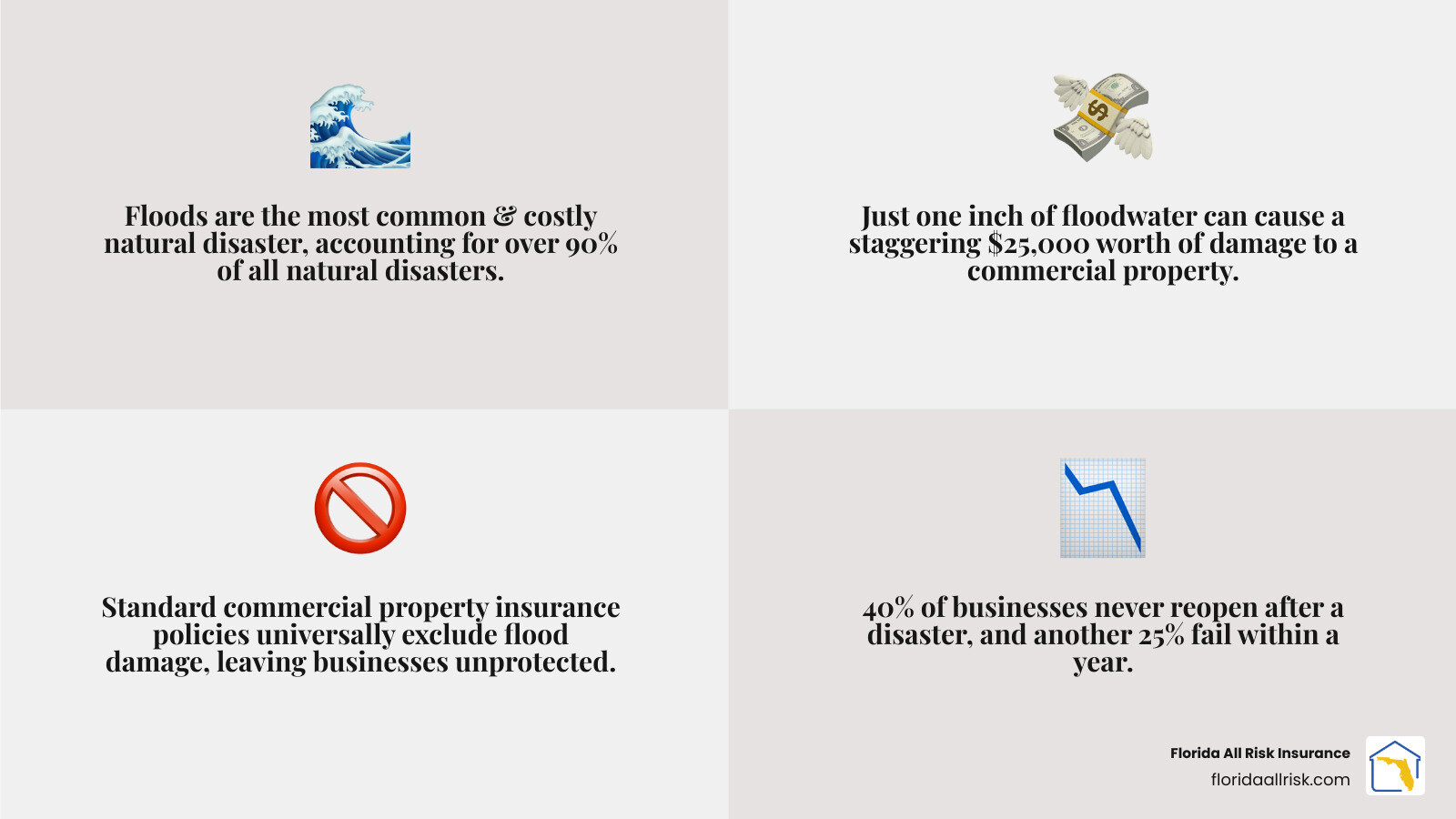
Flooding is the most common and costly natural disaster in the United States, yet many business owners find too late that their standard Commercial Property Insurance does not cover flood damage. This single exclusion can be financially devastating. Just one inch of water can cause upwards of $25,000 in damages to a commercial property. For a small business, this can be an insurmountable expense. The Federal Emergency Management Agency (FEMA) reports that about 40% of small businesses never reopen their doors following a disaster like a flood. This isn’t just a statistic; it’s a stark reality for entrepreneurs who lose their inventory, equipment, and customer base overnight.
Commercial property flood insurance is a separate, specialized policy designed to protect your business from these losses. It is not a luxury; it is a critical component of any sound business continuity plan.
My name is Jason Miller. With over two decades of experience in the Florida insurance market and a background in construction engineering, I’ve seen firsthand how water can dismantle a building—and a business. My unique perspective, blending structural knowledge with insurance expertise, has allowed me to dedicate my career to helping Florida businesses navigate the complex and often misunderstood world of flood risk.
The Critical Difference: Property vs. Flood Insurance
It’s essential to understand what separates your standard commercial policy from a flood policy.
- Standard Commercial Property Insurance: Covers perils like fire, wind, and theft. It almost universally excludes damage from flooding. If rain gets in through a wind-damaged roof, it may be covered as a form of water damage, but this is not flood damage.
- Commercial Property Flood Insurance: Covers direct physical loss from water that comes from the ground up. The National Flood Insurance Program (NFIP) defines a flood as a temporary, partial or complete inundation of two or more acres of normally dry land or of two or more properties. This includes storm surge, overflowing rivers, and heavy rain runoff.
Relying on federal disaster assistance is not a viable alternative. FEMA aid is primarily for individuals, and SBA disaster loans must be repaid with interest. A dedicated flood policy is the only reliable way to protect your commercial enterprise from rising waters. The statistics are a stark reminder of the risk: floods are the most common and costly natural disaster in the United States, and roughly 25% of all flood claims come from properties outside of high-risk zones.
Understanding NFIP Commercial Property Flood Insurance
Created by Congress in 1968, the National Flood Insurance Program (NFIP) is managed by FEMA to provide access to flood coverage and promote smart floodplain management. At Florida All Risk Insurance, we work with FEMA Flood Insurance guidelines to secure this vital protection for our clients.
The NFIP offers commercial property flood insurance through its General Property (GP) Form. This is designed for non-residential buildings and residential buildings with five or more units. For mixed-use properties, if business operations occupy 25% or more of the total floor area, the property is classified as non-residential and is eligible for this coverage. For example, a three-story building with a retail store on the ground floor and four residential apartments on the upper floors would be classified as non-residential because the business occupies more than 25% of the total area (in this case, 33%).
NFIP coverage is divided into two parts, which must be purchased separately:
- Building Coverage: Protects the physical structure of your property.
- Contents Coverage: Safeguards the movable assets inside your business, such as inventory and equipment.
Most businesses need both to ensure a complete recovery.
What’s Covered: NFIP Building & Contents Policies
An NFIP policy provides a broad range of protection for your physical assets.
Building Coverage typically includes:
- The building and its foundation. This includes not just the walls and roof, but also the foundational elements that are most vulnerable in a flood.
- Electrical, plumbing, and HVAC systems. Think of electrical switchgear, boilers, and central air-conditioning units—the very systems that keep your business operational.
- Permanently installed fixtures like carpets, cabinets, and paneling
- Awnings, canopies, and outdoor antennas
- Detached garages (up to 10% of building coverage)
- Pumps, machinery, and fuel tanks essential for the building’s operation
Contents Coverage (Business Personal Property) typically includes:
- Furniture, fixtures, machinery, and equipment. This is a broad category that includes everything from your office desks and computers to the specialized machinery you use for production.
- Stock and inventory waiting to be sold.
- Portable appliances (microwaves, window AC units)
- Non-permanently installed carpets
- Washers, dryers, and food freezers (including the food inside)
- Valuable items like artwork and furs (up to a $2,500 limit)
- Certain non-licensed vehicles used on the premises (e.g., forklifts)
- Tenant improvements and betterments (up to 10% of contents coverage), which covers items tenants install at their own expense.
Critical Exclusions: What NFIP Policies Won’t Cover
Understanding what is not covered is just as important. Key exclusions in NFIP commercial policies include:
- Business Interruption: Loss of income or profits while your business is closed for repairs. The NFIP is designed to cover direct physical losses, not indirect financial consequences. This is a critical gap that private insurance can fill.
- Property Outside the Building: Landscaping, fences, swimming pools, and septic systems are not covered. Damage to land itself, such as erosion or destabilization, is also excluded.
- Valuable Papers and Currency: Cash, precious metals, stock certificates, and deeds are excluded.
- Vehicles: Most cars, trucks, and other licensed vehicles are not covered (this is typically handled by the comprehensive portion of a commercial auto insurance policy).
- Avoidable Mold/Mildew: Damage from moisture or mold that could have been prevented by the property owner after a flood.
- Certain Sewer Backups: Coverage only applies if the backup is a direct result of a widespread flood event that inundates the property.
We review these exclusions with every client to ensure they understand any potential gaps in their coverage.
Deciphering Your NFIP Policy: Limits, Valuations, and Special Coverages
To be properly insured, you must understand your policy’s limits, how losses are valued, and what special coverages are available. The NFIP has specific rules that dictate how much it will pay after a flood.
NFIP Coverage Limits and Deductibles
The NFIP provides a solid foundation of coverage with clear maximums for commercial properties:
- Up to $500,000 for the insured commercial building.
- Up to $500,000 for the contents within the commercial building.
Building and contents coverage are purchased separately, and each has its own deductible. This means if both your building and its contents are damaged, you will be responsible for two separate deductibles. While choosing a higher deductible can lower your premium, it’s important to balance that savings with your ability to cover the out-of-pocket cost. We can help you analyze your Flood Insurance Cost to find the right balance for your budget and risk tolerance.
Valuing Your Loss: Actual Cash Value (ACV)
A critical aspect of NFIP commercial property flood insurance is how losses are calculated. For most commercial buildings and all contents, claims are paid on an Actual Cash Value (ACV) basis.
ACV is defined as the replacement cost of a damaged item minus depreciation. Depreciation accounts for age, wear, and tear. This means the payment you receive may be less than the full cost of buying a brand-new replacement. For example, imagine a piece of commercial equipment you bought five years ago for $10,000 has a useful life of ten years. After a flood, the insurance adjuster might determine its depreciation is 50% ($5,000). Under an ACV policy, your payout would be the replacement cost minus depreciation, which might be only $5,000 (less your deductible), not the full $10,000 needed to buy a new one. This is a crucial detail for business owners to grasp when planning for recovery. This differs from Replacement Cost Value (RCV), which pays the full cost to replace an item without deducting for depreciation. Understanding that your commercial policy uses ACV is vital for financial planning and assessing your potential out-of-pocket expenses after a flood.
Rebuilding Smarter: Increased Cost of Compliance (ICC) Coverage
After a severe flood, local ordinances may require you to rebuild to stronger, more flood-resistant standards. Increased Cost of Compliance (ICC) coverage is a valuable benefit included in NFIP policies that helps with these expenses.
ICC provides an additional $30,000 to help bring your building into compliance with current floodplain management regulations. This coverage is available if your property is declared “substantially damaged” or a “repetitive loss structure.” A property is deemed ‘substantially damaged’ when the cost to repair it to its pre-flood condition equals or exceeds 50% of its pre-flood market value. A ‘repetitive loss structure’ is one that has been flooded and received NFIP claim payments at least twice in the past 10 years. The funds can be used for specific mitigation activities, including:
- Elevation: Raising your building to or above the required flood level.
- Floodproofing: Making your building watertight through measures like installing flood shields for doors.
- Relocation: Moving your structure to a safer location.
- Demolition: Tearing down a heavily damaged building.
ICC coverage helps businesses rebuild not just to recover, but to become more resilient against future floods. This benefit is separate from your main building coverage and is essential for long-term risk reduction.
The Path to Protection: Purchasing and Maintaining Your Policy
Securing flood insurance is a proactive investment in your business’s future. However, the process involves specific rules and waiting periods, so you cannot wait until a storm is approaching to get covered.
How to Purchase Commercial Property Flood Insurance
You cannot buy an NFIP policy directly from FEMA. Instead, you work with a licensed insurance agent who participates in the Write-Your-Own (WYO) program. These private insurers sell and service policies on behalf of the NFIP. The WYO program was established in 1983 to increase the number of policies in force and improve service to policyholders. These private companies handle the day-to-day activities of flood insurance, including policy issuance, premium collection, and claim processing, but the NFIP retains the financial risk. This public-private partnership makes flood insurance more accessible to consumers.
As an independent agency, Florida All Risk Insurance is an expert in this process. We guide Florida businesses through their options, whether it’s an NFIP policy or a private market alternative. You can find a provider through FEMA’s portal at floodsmart.gov/get-insured/flood-insurance-provider or by contacting our agency directly.
The most critical detail is the 30-day waiting period. A new flood insurance policy does not become effective until 30 days after purchase. There are very few exceptions, such as when coverage is required for a loan closing. This makes advance planning absolutely essential.
Lender Requirements and Mandatory Purchase
For many businesses, commercial property flood insurance is not optional—it’s a legal requirement. The Flood Disaster Protection Act of 1973 mandates that businesses with a mortgage from a federally regulated lender must purchase and maintain flood insurance if the property is located in a Special Flood Hazard Area (SFHA), or high-risk zone.
Your lender will require coverage for the lesser of the outstanding loan balance, the property’s insurable value, or the NFIP maximum of $500,000. If you let this required coverage lapse, your lender can “force-place” a policy on your behalf. Force-placed insurance is typically more expensive and offers less coverage than a policy you select yourself. It is always better to proactively manage your own Flood Insurance Requirements Florida.
Understanding FEMA’s Risk Rating 2.0
FEMA has modernized its pricing methodology with a system called Risk Rating 2.0. This new approach moves away from broad flood zones and instead calculates premiums based on a property’s individual flood risk.
For commercial property flood insurance, your premium is now determined by a wider range of factors, including:
- Property elevation
- Distance to a water source
- Building construction type and foundation type
- Cost to rebuild
- History of past flood claims
- Frequency and severity of different types of flooding (river overflow, storm surge, heavy rainfall)
This equitable approach means rates more accurately reflect true risk. The goal of this hyper-granular approach is to create a more transparent system where policyholders can better understand their true risk and the cost associated with it. To prevent sudden, drastic price hikes, FEMA has capped annual premium increases for most commercial properties at 25%.
Beyond the Basics: Assessing Risk and Exploring Coverage Options
While the NFIP provides an essential safety net, its coverage limits may not be sufficient for all businesses. A complete risk management strategy involves understanding your specific flood exposure and exploring all available coverage options, including the private market.
How to Determine Your Flood Risk
The first step is to know your risk, and you shouldn’t assume you’re safe just because you’re not in a “high-risk” zone. Since 25% of flood claims occur in moderate- to low-risk areas, any business located where it can rain is vulnerable.
Start by checking the official FEMA Flood Zone Map through the online map service center. This will tell you if your property is in a high-risk zone (like Zone A or V) or a moderate-to-low-risk zone (Zone X). However, maps don’t tell the whole story. It’s important to remember that these maps are a snapshot in time. They can become outdated due to new construction, land development that alters drainage patterns, and the effects of climate change, such as rising sea levels. A property in Zone X today could be re-mapped into a high-risk zone tomorrow. Therefore, relying solely on a map can create a false sense of security. Consider your property’s specific characteristics:
- Local Topography: Is your business downhill from new development that could alter water runoff?
- Proximity to Water: Are you near a creek, river, or even a retention pond that could overflow?
- Building Elevation: What is the elevation of your lowest floor? Do you have a basement or below-grade space?
We help Florida business owners interpret these factors to get a true picture of their risk, as even properties in low-risk zones can and do flood.
Private and Excess Flood Insurance
The NFIP’s limits of $500,000 for buildings and $500,000 for contents are often insufficient for businesses with high-value properties, expensive equipment, or large inventories. This is where private and excess flood insurance policies provide a critical solution.
Private insurers can offer significantly higher limits and more flexible terms. They can also fill major coverage gaps left by the NFIP, such as providing business interruption coverage. The table below highlights key differences:
| Feature | NFIP Commercial Flood Insurance | Private/Excess Flood Insurance |
|---|---|---|
| Coverage Limits | Up to $500,000 (Building), Up to $500,000 (Contents) | Can offer significantly higher limits (e.g., up to $10,000,000 or more) |
| Waiting Period | Typically 30 days | Can be shorter (e.g., 7 or 14 days), or even waived |
| Business Interruption | Generally NOT covered | Often available as an add-on, providing crucial income protection |
| Valuation Method | Actual Cash Value (ACV) for most commercial properties | Can offer Replacement Cost Value (RCV) for commercial buildings and contents, providing a more complete recovery |
| Basement Coverage | Highly restricted; only covers certain items like foundation elements, essential utilities, and cleanup | Can offer broader coverage for finished basements and property stored within them |
| Policy Customization | Standardized policies | More flexibility to tailor coverage to specific business needs, including broader definitions of flood or additional perils |
| Lender Acceptance | Federally backed and widely accepted | Many private policies are “lender compliant,” meaning they meet federal requirements and are accepted by federally regulated lenders |
For many Florida businesses, the advantages of private flood insurance are clear. The ability to secure Replacement Cost Value (RCV) coverage ensures you can replace damaged property with new items, while business interruption coverage provides income while you’re closed for repairs. Many private policies are also accepted by lenders for mandatory purchase requirements.
Choosing the right path—NFIP, private, or a combination—depends on a thorough risk assessment. If your property value and contents exceed the NFIP’s $500,000/$500,000 limits, a private policy is almost certainly necessary. If you cannot afford any downtime, the business interruption coverage offered by private insurers is a must-have. For those who are required to have NFIP coverage but need higher limits, an excess policy that sits on top of the NFIP plan is an excellent solution. At Florida All Risk Insurance, our role is to help you weigh these factors and architect a coverage strategy that aligns with your financial exposure and risk tolerance. We work with the best flood insurance companies to find a solution that truly protects your business, whether it’s a standalone private policy or an excess policy that adds coverage on top of your NFIP plan.
Conclusion: Securing Your Business’s Future Against Floods
We’ve seen that flooding is a pervasive threat, and a standard Commercial Property Insurance policy leaves your business exposed. The reality is that in a state like Florida, surrounded by water and prone to hurricanes, flood risk is not a matter of ‘if’ but ‘when’. A standard business insurance policy creates a dangerous illusion of safety, leaving a gap that can swallow a company whole after a single storm. Commercial property flood insurance is the bridge over that gap. The financial consequences of being uninsured for a flood can be catastrophic, with many businesses failing to recover.
Fortunately, you can protect the business you’ve worked so hard to build. By understanding the protection offered by the National Flood Insurance Program, recognizing its limitations, and exploring the superior options available in the private market, you can make an informed decision. The key is to act before a disaster looms, as the typical 30-day waiting period for flood insurance means you cannot wait for a storm to appear on the forecast.
Navigating flood maps, policy limits, and lender requirements can be complex. That’s where working with a local expert who understands Florida’s unique environment makes all the difference. At Florida All Risk Insurance, we specialize in helping business owners in Saint Petersburg and across the state secure the right protection. We know the local risks and can guide you to the best solution, whether it’s an NFIP policy or a more comprehensive private market option.
Ready to determine your flood risk and find the right coverage for your business? Learn more about the average price of flood insurance in Florida to start budgeting for this essential protection.
Don’t leave your business vulnerable. Request a personalized flood insurance quote from our team today. We’ll conduct a thorough risk analysis for your specific location, explain the nuances between NFIP and private market policies in plain language, and deliver a no-obligation quote that empowers you to secure the comprehensive protection your business deserves.
Contact Us
Florida All Risk Insurance
777 Central Ave, Saint Petersburg, FL 33701
Phone: (727) 555-2222
Email: [email protected]

