

Why Your Business Needs Both Commercial Property and Business Interruption Insurance
Running a business in Florida means confronting a unique set of challenges. From year-round weather alerts for hurricanes and severe thunderstorms to the constant risks of theft and fire, the threats to your physical assets are numerous. Imagine your St. Pete restaurant, busy with customers, is suddenly silenced by a kitchen fire. A single storm or break-in can do more than just damage your building; it can shut down your revenue stream for weeks or even months. This reality is reflected in stark statistics: according to the Federal Emergency Management Agency, one in four companies never reopens after a disaster. Furthermore, Allianz’s annual Risk Barometer consistently places business interruption as a top global business risk, ranking as the second-highest concern worldwide for business leaders.
To prevent your business from becoming another statistic, a two-pronged insurance strategy is essential:
- Commercial property insurance is the policy that repairs or replaces the things you own – the building itself, your essential equipment, the office furniture, and your valuable inventory.
- Business interruption (BI) insurance is the policy that replaces the income you lose while those things are being repaired. It also covers the ongoing bills that don’t stop just because your doors are closed, such as key employee payroll, rent, and loan payments.
Think of property insurance as the seat belt and BI insurance as the air bag; you truly need both to walk away from an unexpected collision with disaster.
Understanding Commercial Property Insurance: The Foundation of Protection
What It Is
Commercial property insurance is the first line of defense for any company that owns, leases, or makes improvements to a physical space. Whether you operate from a sprawling stand-alone warehouse in Tampa or a small leased storefront in a St. Pete shopping center on a triple-net lease, the policy’s job is simple: provide the funds to repair or replace your physical assets after a covered event, known as a peril.
What’s Covered
This coverage is broader than many realize and typically includes four main categories:
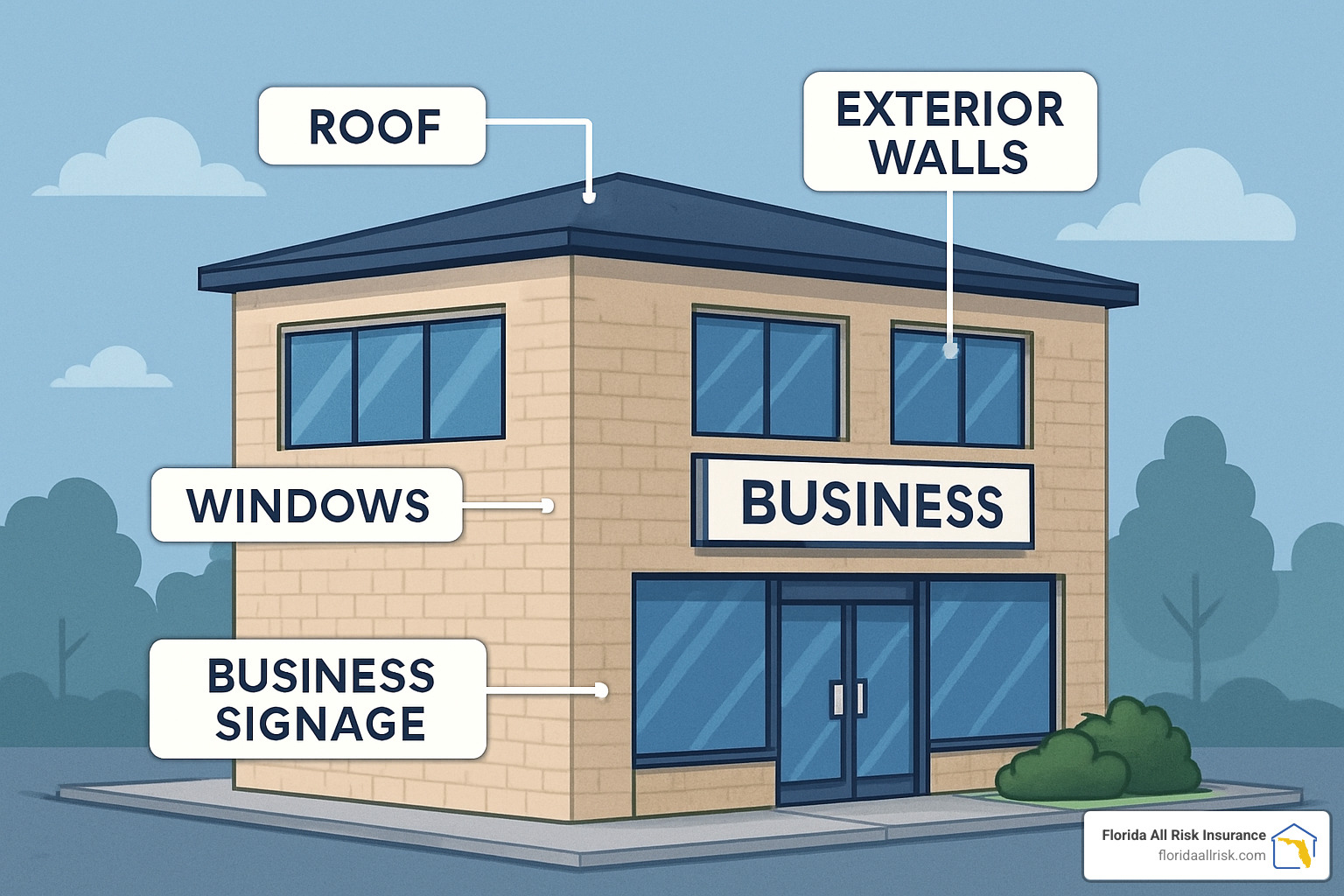
- Building – This covers the structure itself, including the walls, roof, foundation, plumbing, electrical systems, HVAC, and any permanently installed fixtures or machinery.
- Business personal property (BPP) – This is a wide-ranging category that includes all the movable items inside your building. Think of furniture, computers and servers, specialized tools and equipment, point-of-sale systems, finished goods waiting to be sold, and raw materials used in your production process.
- Property of others – If your business model involves holding customer property, this coverage is critical. It applies to items in your care, custody, or control, such as computers at a repair shop, garments at a dry cleaner, or client servers at a data center.
- Outdoor property – Coverage often extends to certain items outside the building, such as signage, fencing, and sometimes landscaping, typically within a specified distance like 100 feet of the premises.
In addition to these core categories, specialized endorsements can broaden protection—for example, covering valuable fine art on display in a lobby or refrigerated stock kept in walk-in coolers. Reviewing these optional add-ons with a knowledgeable adviser helps ensure no critical asset is overlooked.
Perils: Named vs. All-Risk
Policies are generally sold in three forms: Basic, Broad, or Special (all-risk). Basic and Broad forms only cover perils specifically listed in the policy. In contrast, a Special Form policy is highly recommended because it covers everything except for perils that are specifically excluded. This is a crucial distinction because it shifts the burden of proof in a claim from you (to prove it was a covered peril) to the insurer (to prove it was an excluded one). Common covered causes include fire, lightning, wind, hail, vandalism, and theft.
Key Exclusions to Know
Standard policies have common exclusions. In Florida, the most critical one to understand is flood damage, which is almost always excluded and requires a separate policy. Other typical exclusions include earth movement (like sinkholes, which may require an endorsement), gradual wear and tear, employee dishonesty, and government seizure. Many of these gaps can be filled with separate policies or endorsements, such as dedicated flood coverage for businesses.
For further context, the Federal Emergency Management Agency offers an excellent overview of commercial flood risks in its https://www.fema.gov/fact-sheet/commercial-flood-insurance (opens in a new tab) fact sheet.
Why Precise Valuation Matters
Commercial property claims are subject to coinsurance clauses that penalize you if you under-insure. Conducting a professional replacement-cost appraisal every few years—and updating your policy limits accordingly—protects you from costly shortfalls. The Insurance Information Institute notes that rebuilding costs have risen nearly 40 percent nationwide since 2019, a trend fueled by labor shortages and material inflation. Staying current on valuation keeps your coverage aligned with today’s economic realities and ensures your claim payout will match the true cost of reconstruction.
What Is Business Interruption Insurance and How Does It Work?

The Concept
Business interruption insurance, also known as business income insurance, is not a standalone policy. Instead, it’s a crucial endorsement that is added to your commercial property policy. Its coverage is triggered only when there is direct physical damage to your insured property from a covered peril (like fire or wind) that forces you to slow or completely stop your business operations.
What It Pays
BI insurance is designed to make your business whole, covering the income you would have earned had the disaster not occurred. It typically pays for:
- Lost net profit: This is calculated based on your company’s historical financial data, such as past profit-and-loss statements, with adjustments for reasonable growth projections.
- Continuing expenses: These are the fixed costs that you must pay even when your doors are closed and no revenue is coming in. This includes rent or mortgage payments, loan interest, insurance premiums, property taxes, and the payroll for essential salaried employees you can’t afford to lose.
- Extra expenses: This valuable component covers reasonable costs incurred to get your business back up and running faster, reducing the overall size of the BI claim. For example, it could pay for renting a temporary office space, leasing replacement equipment, or paying for overtime labor to speed up repairs.
What It Doesn’t Pay
It’s just as important to understand what BI insurance does not cover:
- Income that cannot be substantiated with financial records.
- Variable costs that disappear when you cease operations (e.g., the cost of raw materials you are no longer purchasing).
- Utility costs are often excluded unless you have a specific utility services endorsement.
- Losses from market downturns, loss of a key contract, or pandemic-related shutdowns. Most policies contain explicit virus exclusions, which were broadly added after the 2003 SARS outbreak and heavily litigated after COVID-19.
Because BI coverage is tied directly to the property policy, the core principle is simple: no covered property damage means no business interruption claim. The two coverages are therefore inseparable.
The Critical Link Between the Two Coverages

- Covered peril strikes – e.g., a kitchen fire damages equipment.
- Property insurance responds – pays to rebuild and replace.
- Waiting period (48–72 hours) – acts like a time deductible.
- Business interruption kicks in – covers lost income until the location is repaired with reasonable speed.
Specialized BI Options
- Extra Expense – covers costs incurred solely to speed reopening, even if you never fully shut down.
- Contingent BI – protects you if a supplier or major customer suffers damage and interrupts your revenue stream.
- Civil Authority – applies when a government order blocks access to your premises because of nearby damage (typically 14–30 days). Guidance from IRMI notes its value after wide-area disasters.
- Utility Services – responds when off-premises utility damage leaves you without power or water.
Period of Restoration
Coverage starts after the policy’s wait period and ends when the property should be repaired under normal conditions, plus a standard 30-day cushion. Extended period endorsements (up to 720 days) are available for operations that need more time to regain market share.
Navigating a Claim: From Payouts to Premiums
Claim Calculation Basics
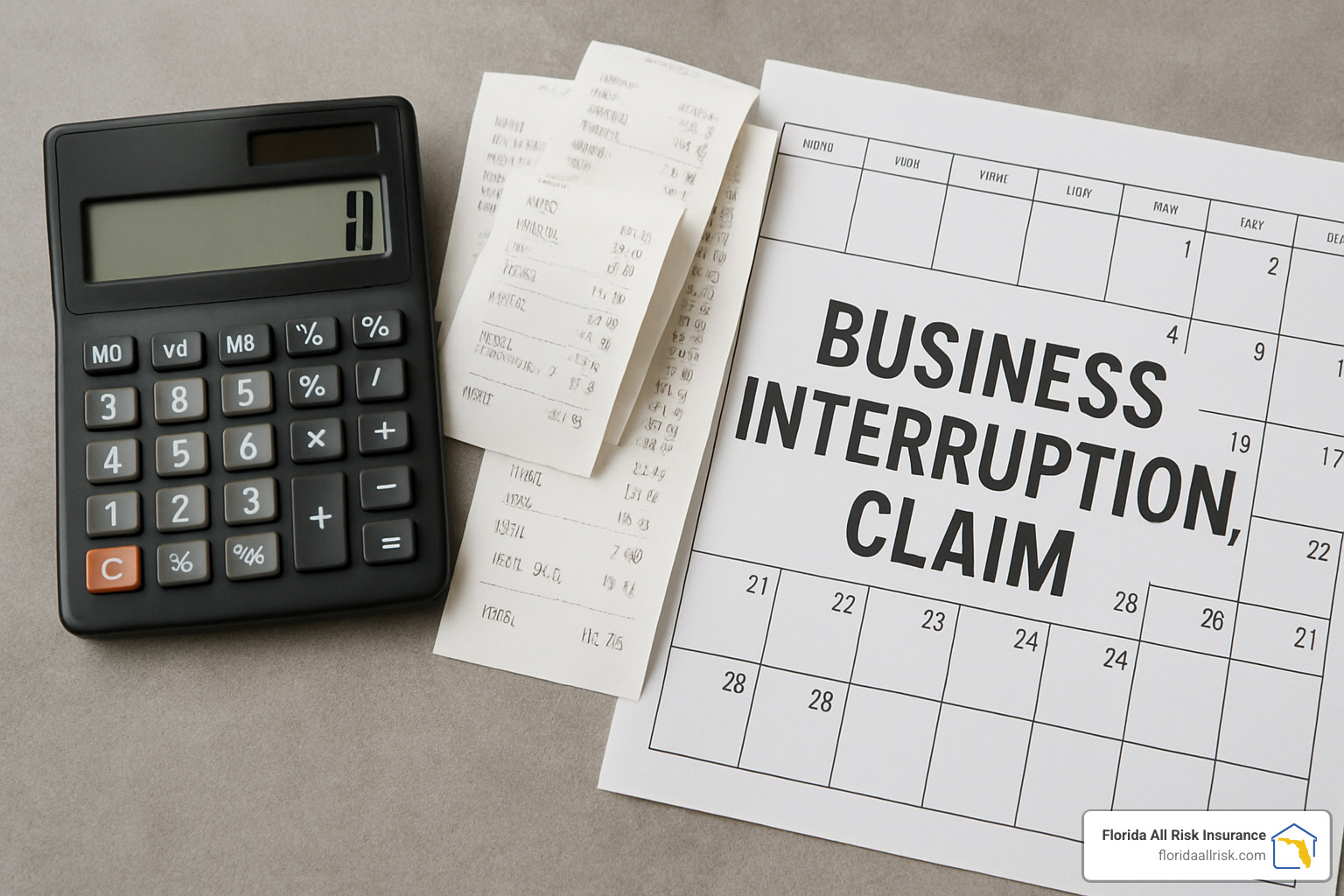
To calculate your claim, insurers determine your actual loss sustained – essentially, the difference between what your business would have earned and what it did earn during the period of restoration. This is not guesswork; it requires meticulous documentation.
Documents you’ll need to provide:
- Profit-and-loss statements (at least 2–3 prior years to establish a trend)
- Federal and state tax returns
- Monthly sales reports to accurately capture seasonality
- Payroll records for all employees
- Bank statements, supplier invoices, and utility bills
- Invoices and receipts for all extra expenses incurred
Given the complexity, many business owners hire a public adjuster or a forensic accountant. These professionals specialize in preparing and negotiating BI claims, ensuring the documentation is presented in the language adjusters understand, which can speed up payment and maximize the settlement.
What Influences Your Premium
- Industry class – A restaurant with open flames and high foot traffic will have a higher risk profile—and premium—than a small accounting office.
- Revenue & payroll – The higher your potential income loss and payroll obligations, the higher the coverage limit you’ll need, which directly impacts your premium.
- Building factors – The age of your building, its construction type (e.g., fire-resistant masonry vs. wood frame), the condition of the roof, and the presence of safety features like sprinkler systems and monitored alarms are all key factors.
- Location – Geography is paramount in Florida. A coastal business in a hurricane-exposed ZIP code will pay significantly more than a business in a lower-risk inland area.
- Coverage choices – Opting for a special-form (all-risk) property policy, choosing lower deductibles, or adding an extended period of restoration for your BI coverage will all increase the cost.
Why Rates Are Rising
The National Centers for Environmental Information documented 28 separate billion-dollar weather and climate disasters in the U.S. in 2023. This increasing frequency and severity of events, combined with supply-chain issues driving up construction costs and more expensive reinsurance for the insurance carriers themselves, means that carriers must charge more to remain financially stable. Understanding this market trend helps you budget realistically for your insurance costs.
Frequently Asked Questions
Who Really Needs These Policies?
If your business relies on a physical location, specialized equipment, or inventory to generate revenue, you need both commercial property and business interruption coverage. This includes a vast range of businesses such as retail stores, restaurants, medical clinics, auto repair shops, manufacturers, professional offices (lawyers, accountants), landlords, and contractors. For many small to medium-sized firms with under $5 million in revenue, a combined Business Owner’s Policy (BOP) can be a practical solution, as it bundles property, general liability, and business interruption insurance into a single package.
Does BI Insurance Cover Pandemic Shutdowns?
In almost all cases, no. The trigger for BI coverage is “direct physical loss or damage” to property. Courts have consistently ruled that the presence of a virus does not meet this requirement. Furthermore, standard Insurance Services Office (ISO) forms used by most carriers contain specific virus and bacteria exclusions, making coverage for pandemic-related shutdowns nearly impossible to obtain under a standard policy. Specialized pandemic products may exist, but they are rare, limited, and very expensive.
Can I Insure a Vacant Building?
Yes, but it requires a specific type of policy and comes with stricter conditions and higher rates. Standard commercial property policies often limit or exclude coverage after a building has been vacant for 60 days. To properly protect an empty property, you’ll need a dedicated vacant property policy. Insurers will typically require robust security measures, regular inspections, and proper maintenance before issuing coverage.
Secure Your Business’s Future Today
Disasters don’t send calendar invites. Putting the right insurance pieces in place before something goes wrong keeps a temporary setback from becoming a permanent closure.
Florida All Risk Insurance has spent two decades guiding local companies through coverage decisions and, when needed, through the claims process that follows. Our independent-agency model lets us compare multiple carriers and craft protection that fits your risk profile and budget.
Ready to review your commercial property and business interruption strategy? Reach out today and speak with a Florida-based advisor who understands the unique challenges of doing business in the Sunshine State.
Contact Us
Florida All Risk Insurance
Saint Petersburg, FL
Phone: (727) 393-7384
Email: [email protected]

