Commercial Premises Insurance: Top 3 Benefits
The Foundation of Business Security: An Introduction
Commercial premises insurance is the financial shield that protects your business property from unexpected events like fire, theft, storms, and vandalism. More than just a policy, it’s a strategic asset for business continuity. Whether you own or lease your space, this coverage is essential for protecting your building, equipment, inventory, and other physical assets from catastrophic loss. In today’s unpredictable economic climate, it’s the bedrock of resilience.
One unexpected event can wipe out years of hard work and shutter a business for good. A fire doesn’t just damage a building; it can destroy critical equipment, obliterate inventory, and force a business to shut down for months, leading to a total loss of income and market share. This is why commercial property insurance is the backbone of any sound business protection plan, enabling you to rebuild, recover, and reopen your doors.
In Florida’s unique risk environment, businesses face a constant barrage of challenges, from the annual threat of hurricanes and tropical storms to the ever-present risk of flooding and severe coastal weather. For Florida business owners, understanding your coverage options isn’t just smart—it’s essential for survival. A standard policy might not be enough. Proper, custom coverage can mean the difference between a business bouncing back from disaster with minimal disruption or closing its doors forever, unable to bear the financial weight of recovery.
This comprehensive guide will walk you through exactly what commercial premises insurance covers, how to customize your policy with critical endorsements, and what factors influence your costs. Our goal is to empower you with the knowledge to make informed, strategic decisions to protect your investment and secure your company’s future.
Know your commercial premises insurance terms:
- building insurance commercial landlords
- building insurance commercial lease
- vacant commercial property insurance
What is Commercial Property Insurance and What Does It Cover?
Think of commercial premises insurance as your business’s financial safety net. When disaster strikes—a kitchen fire that guts your restaurant, a retail break-in during a holiday weekend, or a hurricane that peels the roof off your warehouse—this coverage steps in to help you rebuild and recover. It protects the physical assets that keep your business running, from the building itself to the computers on every desk and the inventory on every shelf.
Whether you own your building or lease a space, this insurance is your shield against the unexpected. When a covered event occurs, your policy helps pay for repairs, replacements, and sometimes even the income you lose while getting back on your feet. It’s the key to changing a potentially business-ending catastrophe into a manageable challenge. For coverage details, see our Commercial Property Insurance services.
Core Coverage Components
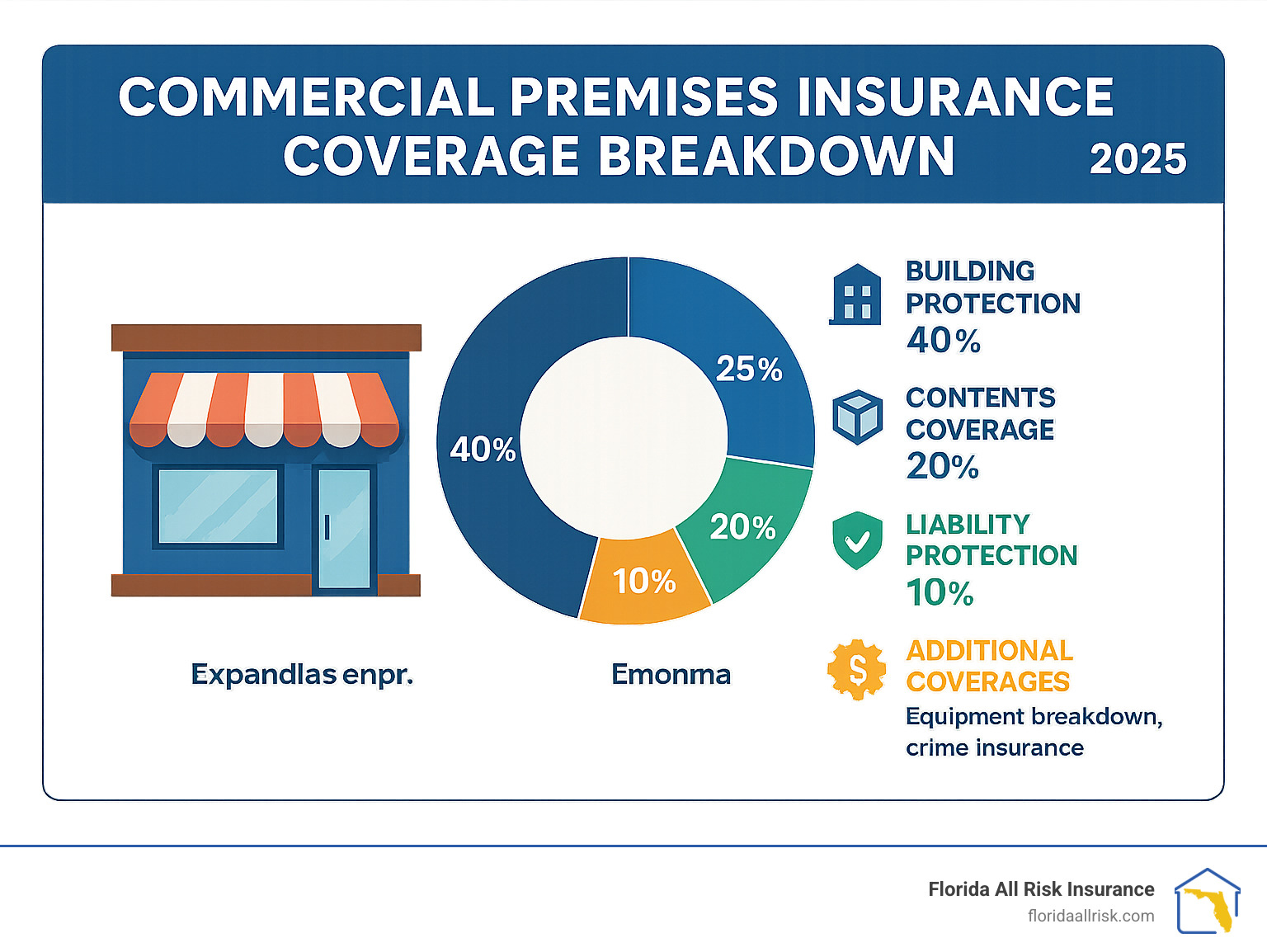
Your commercial premises insurance policy typically covers a wide range of physical assets essential to your operations. Let’s break down the key areas of protection:
- The Building Structure: This is the most fundamental component for property owners. It covers the building itself, including the foundation, walls, roof, floors, and permanently attached items like electrical wiring, plumbing, and built-in cabinets. If you own the building, this is critical. Tenants may also be responsible for certain structural elements depending on their lease.
- Fixtures and Machinery: This includes your HVAC system, lighting, security systems, boilers, and any large, permanently installed equipment that is essential for the building’s function.
- Business Personal Property (BPP) / Contents: This is a broad category covering items that are not part of the building structure. It includes your inventory, raw materials, office furniture (desks, chairs), computers, printers, and other electronics that are vital for daily operations. It can also cover the personal property of others that is in your care, custody, or control.
- Exterior Property: Don’t forget about assets outside the building. This coverage can extend to your company’s signs, fencing, landscaping, and even the parking lot lighting, all of which can be costly to repair or replace after a storm or act of vandalism.
- Tenant Improvements and Betterments: If you lease your commercial space, this coverage is crucial. It protects the financial investment you’ve made to customize the space for your business needs, such as installing new flooring, custom lighting, partitions, or built-in shelving. See Commercial Unit Insurance for how these improvements are protected.
Who Needs This Essential Protection?
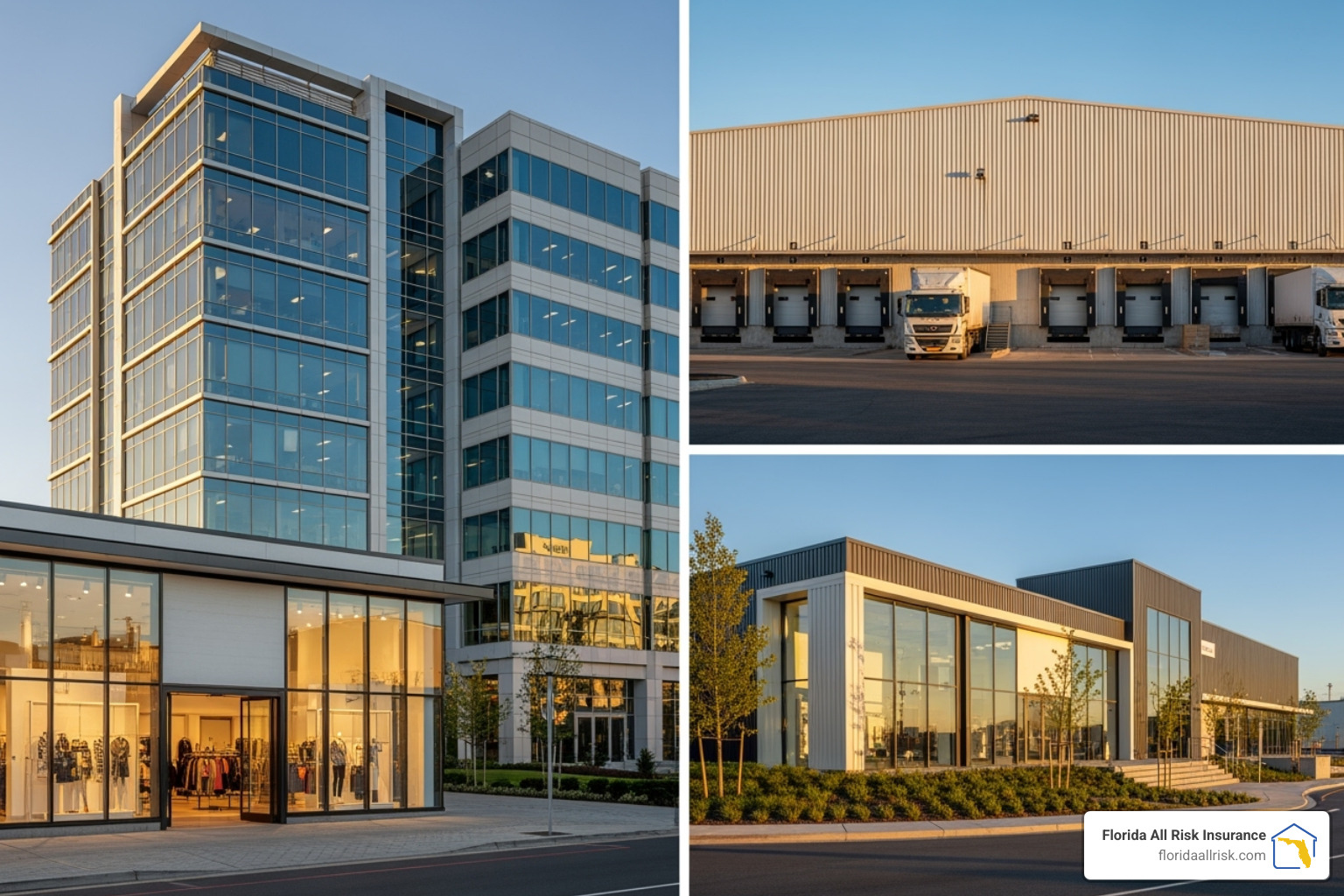
If your business has a physical location, owns or leases property, or holds physical inventory, you need commercial premises insurance. This protection is vital for a wide range of industries:
- Manufacturers and Retailers: Protect expensive machinery, raw materials, and finished inventory from fire, theft, or damage. A loss of stock could halt sales for weeks, making this coverage indispensable.
- Restaurants and Service-Based Businesses: Cover everything from specialized kitchen equipment and dining furniture to point-of-sale systems and the tools of your trade. A kitchen fire or equipment failure can shut down operations instantly.
- Office Professionals and Tech Companies: Safeguard the physical infrastructure that supports your work, including servers, computer networks, office space, and high-value electronics. A power surge or water leak could destroy critical digital assets.
- Landlords and Real Estate Investors: Protect your investment in the commercial building itself. Your needs differ from your tenants, focusing on the structure, loss of rental income, and your liability as a property owner. Our Commercial Landlord Building Insurance Guide explains these unique requirements.
- Healthcare Facilities and Non-Profits: Secure expensive medical equipment, patient records, and office facilities to ensure you can continue your mission-critical work after an unexpected loss.
Essentially, if losing your physical assets would financially impair your ability to operate, this insurance isn’t optional—it’s a fundamental component of a sound business strategy.
Customizing Your Coverage: From Perils to Policy Add-Ons
Basic commercial premises insurance provides a solid foundation, but customizing your policy with the right endorsements transforms it from adequate to exceptional. Every business faces unique risks—a restaurant worries about grease fires and food spoilage, while a tech company fears power surges and data loss. Your coverage must reflect your specific industry, location, and business model to be truly effective.
Customization involves choosing your policy structure and adding specialized coverages, known as endorsements or riders, that address your unique exposures. It’s about building a policy that closes coverage gaps and truly fits your needs.

All-Risk vs. Named Perils: What’s the Difference?
When buying commercial premises insurance, you’ll encounter two main policy types: All-Risk (or Open Perils) and Named Perils. The difference is critical and determines the breadth of your protection.
| Feature | All-Risk (Open Perils) | Named Perils |
|---|---|---|
| Coverage Scope | Covers all causes of loss unless specifically excluded. | Covers only the causes of loss (perils) explicitly listed. |
| Burden of Proof | The insurer must prove the cause of loss is excluded. | You must prove the cause of loss is a named peril. |
| Cost | Generally more expensive due to broader coverage. | Generally less expensive due to more limited coverage. |
All-Risk policies offer the most comprehensive protection by covering any event that is not specifically listed in the exclusions section. This is often the preferred choice for Florida businesses, which face unpredictable risks like sinkholes and hurricanes. The burden is on the insurer to prove a claim isn’t covered, giving you a significant advantage. See All-Risk Commercial Property Insurance for an overview.
Named Perils policies are more restrictive. They only cover disasters explicitly listed in the policy, such as fire, lightning, windstorm, hail, and vandalism. If your loss is caused by something not on the list, you have no coverage. While less expensive, they can leave significant and dangerous coverage gaps.
Common Exclusions: What Isn’t Typically Covered
Even the most comprehensive all-risk policy has exclusions. Understanding them helps you identify where you might need separate, specialized coverage:
- Flood Damage: This is the most critical exclusion for Florida businesses. Standard policies cover internal water damage (like a burst pipe) but exclude flooding from external sources like storm surge, overflowing rivers, or heavy rain. Separate flood insurance, either from the National Flood Insurance Program (NFIP) or a private carrier, is crucial. FEMA’s flood maps provide property-specific flood risk information.
- Earthquake and Earth Movement: This requires a separate policy endorsement.
- Wear and Tear: Insurance covers sudden and accidental events, not gradual deterioration from age, rust, or lack of maintenance. The principle of fortuity requires a loss to be unforeseen and unexpected.
- Employee Theft: Internal theft, fraud, or embezzlement is typically covered by a separate Crime Insurance policy, not a standard property policy.
- Vacant Properties: Coverage is often reduced or voided after a property has been vacant for an extended period (usually 30-60 days) due to increased risk of vandalism and undetected damage.
- Pollution: Costs to clean up pollutants are generally excluded unless the pollution was caused by a covered peril.
Popular Coverage Extensions to Strengthen Your Policy
Endorsements, or add-ons, address specific risks that can devastate a business:
- Business Interruption Insurance: One of the most valuable extensions. If a covered property loss forces you to close temporarily, this coverage replaces lost net income and covers ongoing expenses (like rent, utilities, and payroll) while you rebuild. It’s a financial bridge that keeps your business alive.
- Extra Expense Coverage: Often included with Business Interruption, this covers additional costs needed to avoid or minimize the shutdown and continue operations, such as renting a temporary location or outsourcing work.
- Ordinance or Law Coverage: A critical add-on, especially for older buildings. If your building is damaged, local codes may require you to demolish the undamaged portion and rebuild to newer, more expensive standards. This endorsement covers that cost, which is excluded from standard policies.
- Equipment Breakdown Insurance: Protects against the mechanical or electrical failure of critical equipment like HVAC systems, refrigeration units, or computer servers—failures that standard policies exclude.
- Spoilage Coverage: Essential for restaurants, grocers, and florists, this covers the loss of perishable stock due to equipment breakdown or power failure.
- Crime Insurance: Covers losses from external criminal acts like robbery and burglary, as well as internal risks like employee dishonesty, forgery, and social engineering fraud.
- Cyber Liability Insurance: An essential coverage that protects your digital assets and covers costs related to data breaches, cyberattacks, and network extortion.
These extensions create a comprehensive safety net. Our guide to Commercial Property and Business Interruption Insurance explains how they work together.
Decoding the Cost of Your Commercial Premises Insurance
Your commercial premises insurance premium isn’t a random number; it’s a calculated reflection of your business’s specific risks, a process known as underwriting. Understanding the factors that influence this cost empowers you to manage your expenses while securing the right protection. While everyone wants cheap commercial property insurance, the cheapest policy can be a costly mistake if it fails to cover a major loss.
Key Factors That Influence Your Premium (COPE)
Insurers use a framework called COPE to assess risk and determine your premium. COPE stands for Construction, Occupancy, Protection, and Exposure.
- Construction: The materials used to build your property are a primary factor. A fire-resistive steel and concrete building (like a modern high-rise) will cost less to insure than an older wood-frame structure. The building’s age and the condition of its roof, electrical, and plumbing systems are also critical.
- Occupancy: The type of business you operate determines the level of risk. A restaurant with deep fryers and open flames presents a much higher fire risk than a quiet accounting office. If you are a landlord, the activities of your tenants also affect your risk profile.
- Protection: You can earn significant discounts by investing in protective safeguards. Monitored burglar and fire alarms, automatic sprinkler systems, fire extinguishers, and surveillance cameras can lower your costs by reducing the likelihood or severity of a loss.
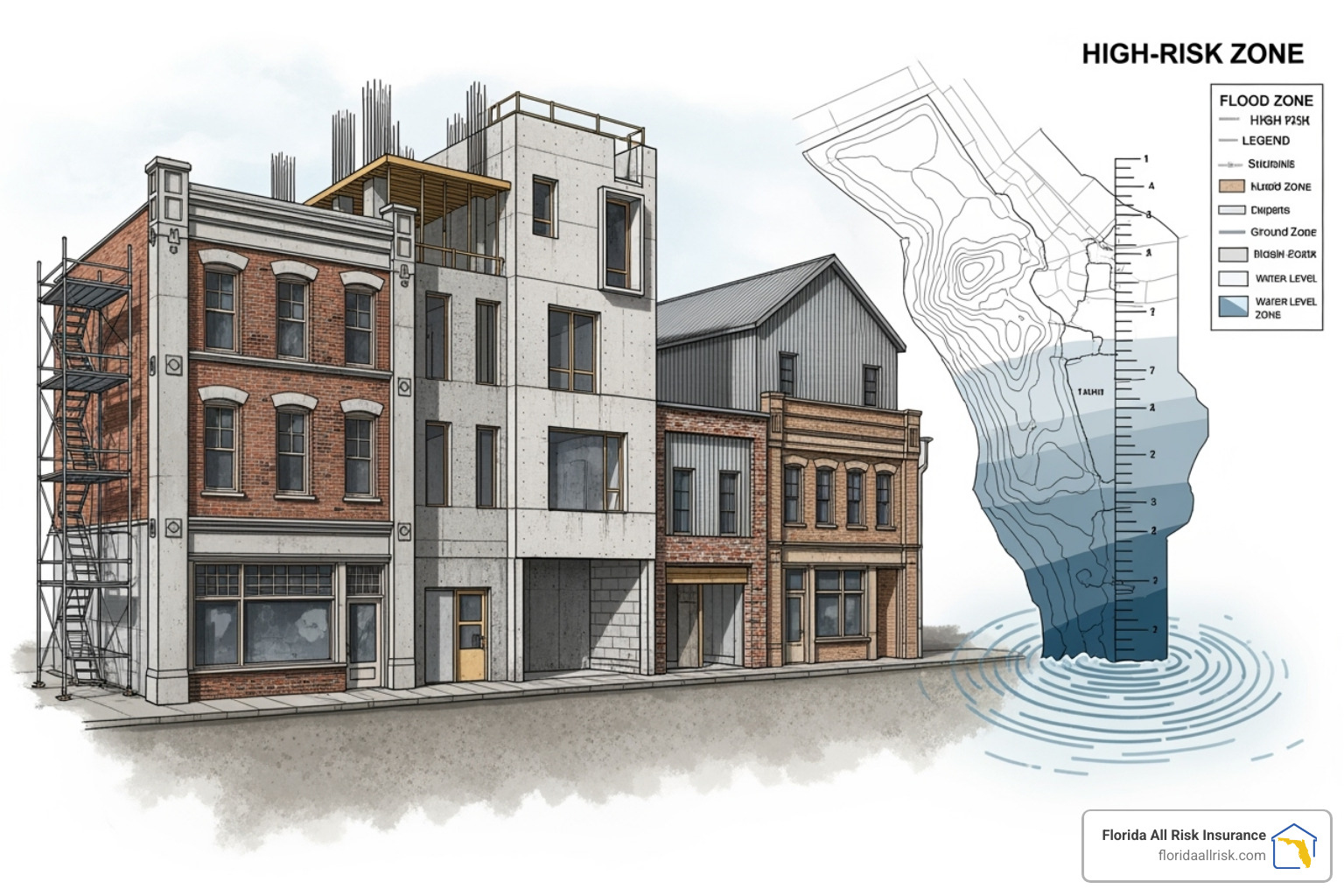
- Exposure: This refers to external risks, with location being paramount in Florida. Proximity to the coast, designation as a high-velocity hurricane zone or a flood zone, and local crime rates all significantly impact your premium.
- Claims History: A history of frequent or severe claims can lead to higher premiums, as insurers may view your property as a higher risk for future losses.
How to Ensure You Have Adequate Coverage
Getting the right price is only half the battle; ensuring you have enough coverage is just as important. Here’s how to avoid being dangerously underinsured:
- Replacement Cost vs. Actual Cash Value (ACV): Always opt for Replacement Cost coverage. It pays to rebuild or replace your property with new materials at current prices, without deducting for depreciation. ACV only pays the replacement cost minus depreciation, which could leave you with a massive shortfall, especially on an older building or equipment.
- Accurate Property Valuation: Insure your property for its rebuild cost, not its market value or tax-assessed value. The cost to rebuild from the ground up, including labor, materials, debris removal, and bringing the structure up to current building codes, is often much higher than what you paid for the property.
- The Coinsurance Clause Explained: This common policy condition requires you to insure your property for a minimum percentage (usually 80-90%) of its full replacement value. If you fail to meet this, you become a “co-insurer” and share the cost of a loss. Example: Your building’s replacement cost is $1,000,000, and you have an 80% coinsurance clause. You must insure it for at least $800,000. If you only insure it for $600,000 (75% of the required amount), the insurer will only pay 75% of any claim, minus your deductible. For a $100,000 loss, you would only receive $75,000, leaving you with a $25,000 penalty.
- Regular Policy Reviews: Your business is always changing. Review your policy annually with your agent, and especially after any significant purchase, renovation, or change in operations to ensure your coverage limits are still adequate.
- Understand Limits and Deductibles: Your policy limit is the maximum amount the insurer will pay for a single loss. Your deductible is your out-of-pocket share of the claim. A higher deductible can lower your premium, but make sure it’s an amount your business can comfortably afford to pay at a moment’s notice.
For more insights, our guide to the Best Commercial Real Estate Insurance offers additional detail.
Navigating Claims, Vacancies, and Special Scenarios
Knowing how your commercial premises insurance works when you need it most is critical. A policy is only as good as its ability to respond to a claim. Navigating the claims process, managing vacant properties, and understanding commercial lease requirements can be complex, but a clear understanding helps you manage these challenges successfully.
The Commercial Property Claim Process: A Step-by-Step Guide
When a disaster occurs, a clear head and a methodical approach are your best assets. Follow these steps:
- Prioritize Safety and Mitigate Further Damage: Your first priority is the safety of your employees and customers. Once everyone is safe, take reasonable steps to prevent further damage, such as placing tarps over a damaged roof or boarding up broken windows. Your policy requires you to do this, and these costs are often reimbursable.
- Notify Your Insurance Agent Immediately: Contact your agent as soon as possible. They will report the claim to the carrier and advise you on the next steps.
- Document Everything: Thoroughly document the damage. Take photos and videos from every angle before anything is moved or repaired. Create a detailed inventory of all damaged or destroyed property, including equipment, furniture, and stock. Gather receipts, invoices, and any other records that can prove the value of the lost items.
- Work with the Adjuster: The insurance company will assign a claims adjuster to inspect the damage and evaluate your claim. Be cooperative and provide all requested documentation. Keep a log of every conversation, including the date, time, and topics discussed.
- Keep Detailed Records of Expenses: Track all expenses related to the loss, including temporary repairs, additional operating costs (if you have Extra Expense coverage), and lost income data (for a Business Interruption claim).
Handling Vacant or Unoccupied Properties
An empty commercial property presents a different, higher risk profile, and insurers treat it accordingly. Be aware of the vacancy clause in your policy, which typically takes effect after a property has been unoccupied for 30 to 60 consecutive days.
Once a property is deemed vacant, insurers often reduce or eliminate coverage for certain perils like vandalism, sprinkler leakage, glass breakage, and theft. This is due to the increased risk of undetected problems (like leaks) and criminal activity. If you anticipate a vacancy, you must inform your agent to secure specialized Vacant Commercial Property Insurance to maintain adequate protection.
Understanding Your Responsibilities in a Commercial Lease
Commercial leases can create confusion over insurance responsibilities, leading to dangerous coverage gaps. It’s crucial to understand who is responsible for what.
- Landlord’s Responsibility: The landlord’s insurance typically covers the building’s primary structure—the “shell” or “bricks and mortar.” It does not cover your business contents or improvements.
- Tenant’s Responsibility: As a tenant, you are responsible for insuring your Business Personal Property (inventory, equipment, furniture) and any improvements or betterments you’ve made. You also need your own liability coverage.
- The Lease Agreement is Key: Your lease is the definitive guide. Review it carefully for clauses like “waiver of subrogation” (which prevents one party’s insurer from suing the other party after a claim) and requirements to name the landlord as an “additional insured” on your liability policy. These clauses significantly impact your risk and insurance needs.
Resources on Building Insurance for a Commercial Lease and Commercial Lease Liability Insurance provide detailed guidance.
Why Partnering with an Independent Agent is a Smart Business Move
Navigating the complexities of commercial premises insurance can be overwhelming. The policy language is dense, the coverage options are numerous, and the consequences of getting it wrong are severe. This is where partnering with an experienced independent insurance agent becomes a strategic advantage for your business. As the U.S. Small Business Administration advises, professional guidance is key to securing proper coverage.
An independent agent works for you, not for a single insurance company. We act as your translator and advocate, turning complex jargon into plain English and ensuring your interests are protected at every stage.

The Role of a Broker in Obtaining Commercial Premises Insurance
An independent agent is your trusted advisor and risk management partner. Our role includes:
- Needs Assessment: We conduct a thorough risk evaluation to understand the unique exposures your business faces, from your property’s construction to your operational risks.
- Market Access: We shop the market on your behalf, leveraging our relationships with dozens of carriers to find the best coverage at the most competitive price.
- Policy Customization and Negotiation: We don’t just find a policy; we build one. We negotiate terms and add the specific endorsements your business needs, ensuring there are no dangerous gaps in your protection.
- Claims Assistance: If you need to file a claim, we are your first call. We guide you through the process and advocate on your behalf with the insurance company to ensure a fair and prompt settlement.
- Ongoing Support: As your business grows and changes, we provide continuous support, conducting annual reviews and adjusting your coverage to meet your evolving needs. Why You Should Work With an Independent Insurance Agency provides additional context.
Questions to Ask Your Independent Agent
To find the right partner, ask potential agents these questions:
- Do you have experience insuring businesses in my specific industry and location in Florida?
- Which insurance carriers do you represent that are strong in commercial property?
- How will you help me determine the correct replacement cost for my building and contents?
- Can you explain the key exclusions in my policy and recommend endorsements to cover them?
- What is your process for handling claims?
Finding the Right Local Partner for Your Florida Business
Choosing a local, independent agent with deep Florida roots offers distinct advantages over a national call center.
- Local Expertise: We understand Florida’s unique challenges, from hurricane building codes and flood zones to the specific risks of coastal properties. This is practical knowledge gained from living and working here.
- Florida Market Knowledge: We know which insurance carriers have an appetite for Florida risks and which specialize in certain industries, saving you time and money.
- Accessibility and Community Presence: When you work with us, you’re partnering with a local business invested in our community’s success. We’re your neighbors, accessible and ready to help. Our Independent Business Insurance Agents combine local knowledge with national resources to serve you best.
Secure Your Business’s Foundation for a Stronger Future
As we’ve explored, commercial premises insurance is the bedrock of business security and resilience, especially in Florida. It’s not just a reactive expense; it’s a proactive investment in your company’s ability to withstand and recover from the unexpected. A well-structured policy is a critical component of your overall risk management strategy.
From choosing a broad all-risk policy over a limited named-perils one, to understanding critical concepts like coinsurance and replacement cost valuation, making informed decisions is key. In Florida’s challenging environment of hurricanes and floods, having a custom insurance strategy fortified with essential endorsements like Business Interruption and Ordinance or Law coverage is not a luxury—it’s a necessity for long-term survival.
Navigating claims, vacancies, and complex lease requirements can be daunting, but you don’t have to do it alone. With the right expert guidance and comprehensive coverage, these challenges become manageable parts of doing business. Your business deserves protection that matches your ambition and hard work. Don’t let an unforeseen disaster or an inadequate insurance policy put your life’s work at risk.
Ready to secure your business’s foundation? The peace of mind that comes with comprehensive commercial premises insurance is invaluable. Take the first step toward true business security and let us help you build an insurance strategy that protects what matters most. Get a quote for your commercial property coverage today.
Contact Florida All Risk Insurance
Below are the primary office details for Florida All Risk Insurance.
Contact Information:
- Address: 777 Central Ave, St. Petersburg, FL 33701
- Phone: (727) 555-5555
- Email: [email protected]