Protecting Your Business from the Unexpected
When you’ve poured your heart and soul into building your business, the last thing you want is to see it all threatened by an unexpected accident or lawsuit. That’s where commercial liability insurance for small business comes in – it’s like having a financial safety net when life throws curveballs your way.
Think of this coverage as your business’s shield. It protects you from financial losses when someone claims your business caused them harm or damaged their property. Without it, even a minor incident like a customer tripping in your store could potentially drain your business bank account and years of hard work.
Quick Guide to Commercial Liability Insurance:
| What It Covers | Average Cost | Who Needs It | Key Benefits |
|---|---|---|---|
| • Third-party bodily injuries • Property damage • Advertising injuries • Legal defense costs |
$42/month or $504/year (median) | • Any business with physical locations • Contractors • Retailers • Service providers |
• Protection from lawsuits • Client requirement fulfillment • Contract eligibility • Peace of mind |
I’ve seen it happen too many times – small business owners thinking, “It won’t happen to me.” Then a customer slips on a wet floor, or a contractor accidentally damages a client’s property, or an employee makes an honest mistake in a marketing campaign. Suddenly, they’re facing a lawsuit with potential costs that could reach tens of thousands of dollars.
Here’s the reality: no business is too small for liability protection. Even if you run your business from home, you still face risks when clients visit or when your products or services could potentially cause harm to others.
I’m Jason Miller, and helping Florida businesses find the right protection is personal to me. As a second-generation insurance professional with over 20 years in the industry, I’ve dedicated my career to helping small business owners steer the sometimes confusing world of commercial liability insurance for small business. My team at Florida All Risk Insurance understands that in today’s volatile insurance marketplace, small businesses face unique challenges – and we’re here to help you overcome them.
As you consider your business protection needs, you might come across related terms like excess public liability, which provides coverage beyond your standard policy limits, general risk insurance that addresses broader business risks, and public liability risk which focuses specifically on your obligations to the public. Understanding these concepts can help you build a more comprehensive protection plan for your business.
Understanding Commercial Liability Insurance for Small Business
Commercial liability insurance for small business is your financial safety net when the unexpected happens. Also known as general liability or business liability insurance, it’s the bedrock protection that shields your company when someone claims you’ve caused them harm or damaged their property.
When a customer trips over a display in your store, or your employee accidentally breaks an expensive vase while cleaning a client’s home, this insurance kicks in to cover medical bills, legal costs, and potential settlements. It’s not just about paying claims—it’s about preserving your business’s future.
As Paul H., a landscaper who recently purchased coverage, put it: “This gives me the ability to purchase insurance directly from my phone anytime and anywhere I need it. It’s fast, easy, and works great for me as a one-man operation.”
Most small businesses pay around $42 monthly or $504 annually for liability protection, though your actual cost will depend on factors like your industry, location, and business size.
Want to dive deeper? Check out our More info about Commercial General Liability Insurance page.
What Does It Cover?
Your commercial liability insurance for small business creates a protective bubble around your operations. It steps in when a customer slips on your freshly mopped floor and breaks their wrist, covering their medical expenses and your legal defense if they sue.
Beyond these slip-and-fall incidents, your policy handles property damage scenarios—like when your pressure washing business accidentally breaks a client’s window. It also provides product liability protection if something you sell causes harm, and covers completed operations claims that arise after you’ve finished a job.
Perhaps most surprising to many business owners is the reputational harm coverage. If your marketing accidentally includes someone else’s trademarked content or you’re accused of libel in your advertising, your policy helps with legal expenses and potential settlements.
Even if a claim seems ridiculous or unfounded, you’ll still need a lawyer—and those bills add up fast. Your policy covers attorney fees, court costs, and judgments up to your policy limits. It also typically includes immediate medical payments for minor injuries, regardless of who’s at fault.

What’s Not Covered?
While commercial liability insurance for small business offers robust protection, it’s not a catch-all solution. Understanding its boundaries helps you identify where you might need additional coverage.
Your general liability policy won’t cover employee injuries—that’s what workers’ compensation is for. It also steps aside for auto accidents, even if they happen while making deliveries or visiting clients. You’ll need commercial auto insurance for those situations.
When it comes to professional errors like giving bad advice or making mistakes in your professional services, you’ll need separate professional liability insurance. And if you deliberately cause harm or damage, don’t expect your insurance to bail you out—intentional acts are never covered.
Your own business property—from computers to inventory—requires commercial property insurance. Modern threats like cyber incidents need specialized cyber liability coverage, and employee discrimination claims fall under employment practices liability insurance.
Knowing these exclusions isn’t just about avoiding surprises—it’s about building a comprehensive protection plan for your business.
Who Needs It?
Almost every business benefits from commercial liability insurance for small business, but it’s absolutely essential for certain types of operations.
Contractors like electricians, plumbers, and carpenters face significant liability exposure every time they work on someone’s property. One wrong move could lead to property damage or even injury claims.
Retailers with physical storefronts welcome dozens or hundreds of people into their space daily, creating ample opportunity for slip-and-fall accidents or product-related injuries.
Consultants might think they’re low-risk, but even they need protection against bodily injury claims when clients visit their office or when they accidentally damage client property.
Even home-based businesses aren’t immune. Your homeowner’s policy typically excludes business-related claims, creating a dangerous coverage gap without commercial liability insurance.
As business owner Michael D. shared: “Once I had a policy, I needed Certificates of Insurance for different customers and waivers of subrogation. They made that process simple and easy.”
The reality is that in today’s litigious world, no business is too small for liability protection. One unexpected incident could lead to a claim that threatens everything you’ve worked to build. With the right coverage in place, you can focus on growing your business instead of worrying about what might go wrong.
Step-by-Step Guide to Buying Coverage
Purchasing commercial liability insurance for small business doesn’t have to feel overwhelming. Let me walk you through the process in plain English—the same way I’d explain it if we were sitting across from each other at your office.
First, take a good look at your business operations. What kind of client interactions do you have? Do you sell physical products? Do customers visit your location? This assessment helps identify where your liability risks might be hiding.
Once you understand your risks, you’ll have a clearer picture of the coverage limits that make sense for your situation. Some businesses need basic protection, while others require more substantial coverage due to their industry or client requirements.
Before you request quotes, gather some basic information about your business:
– Your official business name and address
– How many employees you have
– Your annual revenue figures
– A good description of what your company actually does
– Any previous insurance claims you’ve filed

At Florida All Risk Insurance, we’ll help you compare options from multiple carriers—a key advantage of working with an independent agency. We’re not tied to just one company, so we can truly shop around for the best fit for your business.
When reviewing your policy options, pay special attention to the coverage limits (how much the policy will pay), exclusions (what isn’t covered), deductibles (what you’ll pay out of pocket), and any endorsements (add-ons that customize your coverage).
After selecting your policy, the process is straightforward—complete the application, make your payment, and we’ll get your coverage in place. You’ll receive your policy documents and Certificate of Insurance (COI) promptly, giving you that official proof of coverage that clients and landlords often require.
One important decision you’ll need to make is choosing between occurrence and claims-made policies. Here’s how they compare:
| Feature | Occurrence Policy | Claims-Made Policy |
|---|---|---|
| Coverage Trigger | When incident occurs | When claim is reported |
| Long-Term Protection | Covers incidents during policy period, regardless of when reported | Only covers claims reported during policy period |
| Extended Reporting Period | Not needed | May require “tail coverage” |
| Cost | Generally more expensive initially | Often less expensive initially but may increase over time |
| Best For | Businesses with long-term liability exposure | Businesses looking for initial cost savings |
Determine the Right Amount of Coverage
Finding that sweet spot for your commercial liability insurance for small business coverage isn’t about guesswork. Too little coverage leaves you vulnerable, while too much means you’re paying premiums you don’t need to.
Start by looking at what’s standard in your industry. Contractors, for example, typically carry at least $1 million in general liability coverage. This isn’t arbitrary—it reflects the real-world risks these businesses face.
Client and contract requirements often dictate minimum coverage amounts. If you’re bidding on government contracts or working with larger companies, they’ll likely specify exactly how much coverage you need to have in place.
Landlord requirements matter too. Most commercial leases include insurance clauses that spell out the minimum liability coverage tenants must maintain. Check your lease—the information is typically right there in black and white.
The size of your business plays a role as well. Generally speaking, larger businesses with higher revenues need higher coverage limits because they have more exposure to potential claims.
Most standard policies offer per-occurrence limits of $1 million and aggregate limits of $2 million, but your specific situation might call for different amounts. For a deeper dive into this topic, visit our guide on How Much General Liability Insurance Do I Need?
Catherine, one of our business clients, recently told us: “The application and setup processes were straightforward and the chat support was helpful. Site navigation is user-friendly and the certificate feature is easy to use.” We love hearing feedback like this!
Getting Your Certificate of Insurance (COI)
Your Certificate of Insurance (COI) is essentially your proof of coverage—the document that shows clients, landlords, and others that you’re properly insured. Think of it as your insurance ID card, but for your business.
These certificates include all the essential details about your coverage: your policy number, effective dates, coverage limits, insurance carrier information, and who’s covered under the policy.
You’ll need your COI for all sorts of business situations:
– When signing contracts with new clients
– Before a landlord will hand over the keys to your new space
– To obtain permits from government agencies
– Before participating in events or trade shows
At Florida All Risk Insurance, we make accessing your COI quick and painless. Many of our clients can instantly download their certificates through our online portal—a huge time-saver when you’re in the middle of finalizing a deal or submitting a bid.
Genna, another small business owner we work with, appreciated this feature: “I needed to have proof of liability to present my proposal; got it on the spot. I didn’t win the bid but I didn’t get stuck with costly insurance, either!”
Many clients will ask to be added as an “additional insured” on your policy. This is especially common for contractors and service providers working with larger organizations. We can help you steer this process too, making sure you meet all your contractual requirements without unnecessary complications.
Cost of Commercial Liability Insurance & Key Pricing Factors
Wondering what commercial liability insurance for small business will cost you? While the median cost hovers around $42 per month (or $504 annually), your actual premium might look quite different. Think of insurance pricing like a fingerprint – it’s unique to your business.
When I sit down with clients to discuss their coverage options, they’re often surprised by how personalized their premium can be. Let me walk you through what influences your costs:
Your industry plays perhaps the biggest role in determining your premium. A construction company might pay around $88 monthly while a yoga instructor might only need to budget $15 per month. It makes sense when you think about it – hammers and nails create different risks than downward dog!

Your business location matters too. Here in Florida, our unique litigation environment and weather-related risks create different pricing considerations than you’d see in, say, Nebraska. Even your specific zip code can affect your rates.
Size does matter when it comes to insurance costs. Larger businesses with more employees and higher revenues generally face higher premiums – more activity simply means more exposure to potential claims.
Coverage limits directly impact what you’ll pay. While doubling your coverage from $1 million to $2 million will increase your premium, the good news is it won’t double it. You get more bang for your additional buck at higher coverage levels.
Your claims history tells insurers a story. A business with previous liability claims will likely pay more than one with a spotless record. Think of it like your driving record – a few fender benders will raise your rates.
Deductible choices put you in the driver’s seat. Opt for a higher deductible, and you’ll enjoy lower premiums, but you’ll need to cover more out-of-pocket if something happens. It’s a balancing act between monthly costs and potential future expenses.
Experience brings benefits too. Established businesses with longer operating histories often qualify for better rates than startups – insurers love to see a track record of stability.
Here’s some good news for your bottom line: commercial liability insurance for small business premiums are generally tax-deductible as a legitimate business expense. The IRS publication on deductible business expenses confirms that insurance premiums that are “ordinary and necessary” for business operations typically qualify. That said, I always recommend checking with your tax professional about your specific situation.
Ways to Save Without Sacrificing Protection
I’ve helped hundreds of Florida business owners find ways to reduce their insurance costs without cutting corners on coverage. Here are my favorite strategies:
Bundle up! Combining your general liability with property coverage in a Business Owner’s Policy (BOP) typically saves 10-15% compared to buying them separately. It’s like buying in bulk at the grocery store – more efficient and cost-effective.
Be proactive about safety. Businesses with solid risk management practices often qualify for lower premiums. Document your safety procedures, train your employees regularly, and keep records. Insurers love to see businesses that take risk seriously.
Consider a higher deductible if your cash flow allows it. Bumping your deductible from $500 to $1,000 can significantly reduce your premium. Just make sure you have that extra money set aside if you need to file a claim.
Pay annually instead of monthly if possible. Many of my clients save 5-10% just by paying their premium in full rather than spreading it out. It’s a simple way to save if you can manage the larger one-time payment.
Work with an independent agency like Florida All Risk Insurance. We compare options from multiple carriers to find you the best value – not just the lowest price, but the right coverage at a competitive rate.
Review your coverage regularly. As your business evolves, your insurance needs change too. I recommend annual reviews to ensure you’re not paying for unnecessary coverage or missing protection in critical areas.
Join industry associations. Many professional groups offer members access to special group insurance rates that aren’t available to non-members.
For more detailed information about what affects your costs, check out our comprehensive guide on General Liability Insurance Cost.
Using Your Policy: Filing Claims and Staying Protected
Having commercial liability insurance for small business is essential, but knowing how to use it effectively when trouble strikes can make all the difference. Think of your policy as a safety net – it’s there when you need it, but you need to know how to deploy it properly.
When and How to File a Claim
When something goes wrong – perhaps a customer slips on your freshly mopped floor or your employee accidentally damages a client’s property – taking the right steps immediately can significantly impact your claim’s outcome.
First, document everything. This means gathering witness statements, taking plenty of photos, saving any video footage, and writing down your own detailed account while the incident is fresh in your mind. These details might seem trivial in the moment, but they become crucial evidence during the claims process.
Next, report the incident promptly to your insurance provider. Many business owners make the mistake of waiting to see if a claim will actually be filed against them. Don’t fall into this trap! Delayed reporting can give your insurer grounds to deny coverage, leaving you financially exposed.
While working through the process, cooperate fully with your claims adjuster. They’re not the enemy – they’re there to help resolve the situation within the terms of your policy. Provide all requested information promptly and maintain open communication.
One important caution: be compassionate and helpful to affected parties, but don’t admit liability or make promises about compensation. A simple “I’m sorry this happened” is fine, but avoid saying “This was our fault” or “We’ll pay for everything.” Such statements can complicate your claim.
Throughout the process, keep track of all expenses related to the incident. From medical bills to repair estimates to correspondence – organize everything in one place for easy reference.

Timeline and Process
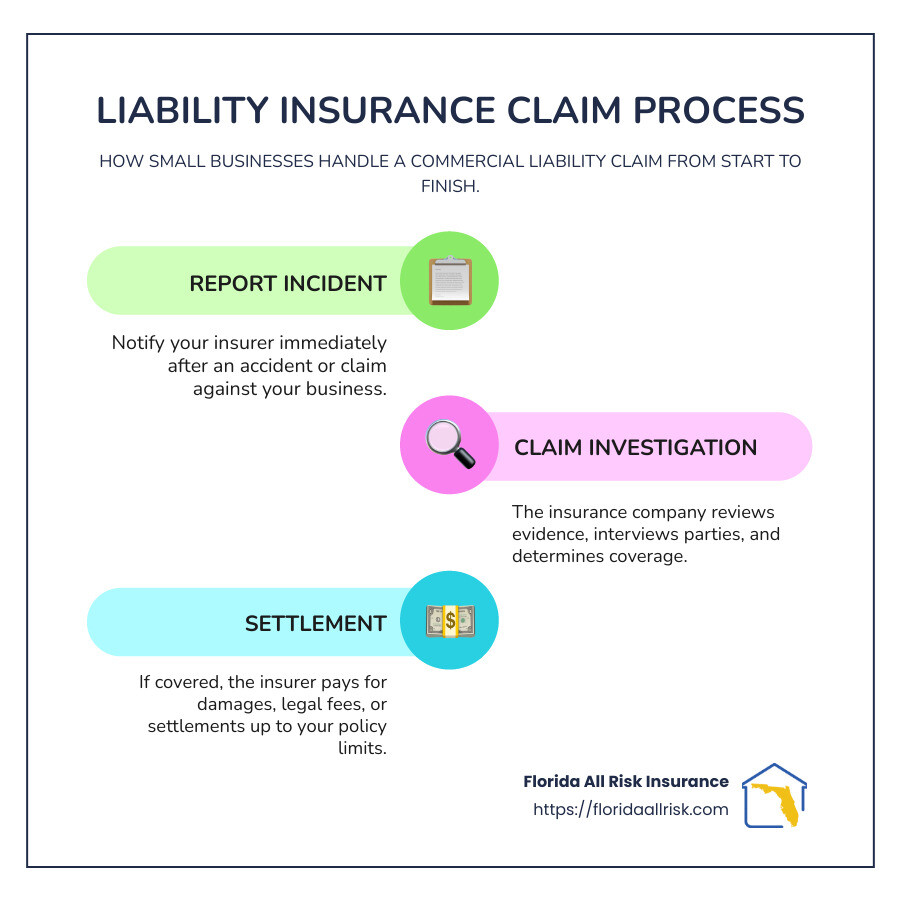
Understanding what happens after you file a claim helps set realistic expectations. The process typically follows a predictable path, starting with your initial report to the insurance company.
After reporting, an adjuster will be assigned to your case. Think of this person as the detective who investigates what happened and determines how your policy applies. They’ll be your main point of contact throughout the process.
During the investigation phase, the adjuster will review all evidence, interview witnesses, and assess damages. Be patient during this stage – thoroughness benefits everyone involved.
Once the investigation is complete, your insurer makes a coverage determination. They’ll decide if the incident falls within your policy’s terms and what portions are covered.
Finally comes resolution – either through a settlement with the injured party or, if necessary, defending you in court. If the claim isn’t covered, your insurer will explain why, giving you the opportunity to discuss or appeal if appropriate.
Most straightforward claims wrap up within 30-90 days. Complex cases involving serious injuries or multiple parties can take longer, sometimes even years if litigation is involved. Throughout this time, your insurance company handles the heavy lifting, allowing you to focus on running your business.
Maintaining Protection
Your commercial liability insurance for small business isn’t a “set it and forget it” purchase. Maintaining proper protection requires ongoing attention.
First and foremost, keep your policy active by paying premiums on time. Even a brief coverage lapse could leave you completely exposed during the very moment you need protection. Many insurers offer automatic payments to prevent accidental lapses.
Schedule an annual policy review with your agent at Florida All Risk Insurance. As your business evolves – perhaps adding new services, locations, or employees – your coverage needs change too. This yearly check-in ensures your protection grows alongside your business.
Remember to update your business information promptly when changes occur. Adding a new location, significantly changing your operations, or experiencing substantial revenue growth or decline can all affect your coverage needs and premium.
For contractors and service businesses, certificate renewal is crucial. Keep track of when your Certificates of Insurance expire and set calendar reminders to renew them before clients or projects require updated proof of coverage.
Smart business owners also document their risk management practices. Maintaining records of safety measures, employee training, and incident prevention strategies not only helps prevent claims but can sometimes lead to premium discounts.
Real-World Claim Examples
Sometimes, the best way to understand the value of commercial liability insurance for small business is through real situations where it made a difference.
Consider the retail store owner whose customer slipped on a wet floor with no warning sign posted. The customer suffered a broken hip requiring surgery and filed a lawsuit seeking $75,000 for medical expenses, lost wages, and pain and suffering. Without insurance, this claim could have bankrupted the small business. Instead, their general liability policy covered $15,000 in legal defense costs and settled the claim for $60,000, allowing the business to continue operating without financial catastrophe.
Or think about the plumbing contractor who accidentally caused $22,000 in water damage to a client’s home during what should have been a routine repair job. The damage affected flooring, drywall, and personal property – expenses far beyond what the small contractor could absorb. Their liability insurance covered the full repair costs, preserving both their finances and their reputation.
Even seemingly low-risk businesses face exposure. A small marketing firm unknowingly used copyrighted images in a client’s advertising campaign. When the copyright holder sued for infringement, the firm’s liability policy covered $30,000 in legal defense costs and a $45,000 settlement, protecting the business from a potentially devastating financial loss.
As Mark, a business owner with workers’ compensation coverage, noted: “You know you never think of insurance until you pay for it and when that accident happens.” The same principle applies to liability coverage – its true value becomes crystal clear precisely when you need it most.
Common Mistakes to Avoid
When managing your commercial liability insurance for small business, steering clear of these common pitfalls will help ensure you’re truly protected when it matters most.
Coverage gaps can leave your business completely exposed. Even a single day between policy periods could coincide with an incident that leads to financial disaster. Set up automatic renewals or calendar reminders well before expiration dates.
Many business owners select inadequate limits based solely on minimum requirements or cost considerations. Instead, assess your actual risk exposure when determining appropriate limits. Legal defense costs alone can quickly reach tens of thousands of dollars, even for frivolous claims.
Don’t ignore policy exclusions. Understanding what your policy doesn’t cover is just as important as knowing what it does. If your general liability policy excludes professional services, for example, you might need additional professional liability coverage to fill that gap.
When contracts require you to add clients as additional insureds, complete this process promptly. Failing to add required parties can put you in breach of contract and potentially lose you business opportunities.
Always be truthful about your business operations when applying for coverage. Misrepresenting your activities might reduce your premium initially, but it could lead to claim denials when you need coverage most. Be transparent about what your business actually does.
As your business grows or changes, neglecting to update coverage can leave you underinsured. What was adequate protection for your startup may be insufficient as you add employees, locations, or services.
Finally, avoid choosing based on price alone. The cheapest policy may have crucial coverage gaps or exclusions that could cost you dearly later. Focus on value and appropriate protection rather than just finding the lowest premium.
At Florida All Risk Insurance, we help Florida business owners steer these potential pitfalls and find the right balance of protection and affordability for their specific needs.
Leveraging Liability Insurance to Win Clients & Contracts
Having commercial liability insurance for small business does more than just protect you from financial disaster—it can actually help you grow your business. Let’s talk about how your insurance coverage can become one of your most effective business development tools.
Competitive Advantage
Picture this: You’re bidding on a project against several competitors with similar experience and pricing. What sets you apart? Your comprehensive liability coverage could be the deciding factor. When clients see you’ve invested in proper insurance protection, they view you as a professional who takes business seriously.
“Demonstrating that you’re insured gives you a competitive edge in securing larger contracts,” shared one of our long-time clients who expanded from local to regional projects after obtaining proper coverage. Your insurance becomes a silent salesperson, communicating responsibility and trustworthiness without you saying a word.
Contract Eligibility
Many doors remain firmly closed to businesses without proper insurance. Larger organizations, government agencies, and even many mid-sized companies won’t even consider working with uninsured contractors or vendors. Your commercial liability insurance for small business certificate essentially becomes your ticket to these opportunities.
I recently worked with a landscaping company that was losing out on lucrative HOA contracts because they lacked adequate coverage. Within a week of obtaining proper insurance, they secured two major contracts that had previously been out of reach. The insurance cost them about $600 annually but open uped over $40,000 in new business—that’s what I call a good return on investment!
Marketing Tool
Smart business owners know to mention their insurance coverage in proposals, on their websites, and in marketing materials. This isn’t about bragging—it’s about communicating value and security to potential clients.
Consider adding simple language like: “Fully insured with comprehensive general liability coverage to protect your project and property” to your business cards, email signatures, and proposal templates. This small addition can significantly impact how potential clients perceive your business.

Trust Building
At its core, business is about relationships and trust. Your insurance coverage sends a powerful message to clients: “I care enough about your project to protect it properly.” This builds confidence that you’ll handle other aspects of your work with the same level of care and professionalism.
Willie, a small business owner who recently purchased coverage through us, put it perfectly: “Customer service representative was detailed on different options that would cater to my small business needs.” That’s exactly the kind of thoughtful approach clients want to see from every aspect of your business.
Many of our clients report that mentioning their insurance coverage during initial consultations visibly relaxes prospective clients. That peace of mind can be the difference between winning and losing a contract.
In today’s competitive marketplace, anything that helps build trust gives you an advantage. Your commercial liability insurance for small business isn’t just protection—it’s a business growth strategy.
For more information about how liability insurance can benefit your business, visit our page on Business General Liability Insurance.
Frequently Asked Questions
Is commercial liability insurance required by law?
Unlike auto insurance or workers’ compensation, commercial liability insurance for small business isn’t typically mandated by state or federal law. But before you decide to skip this coverage, you should know it’s often required through other channels.
Many professional licenses and permits require proof of liability insurance before you can legally operate. I’ve seen countless clients find this requirement just days before opening their businesses, creating unnecessary stress and delays.
Client contracts frequently include insurance requirements too. In fact, when you’re bidding on projects with larger companies or government agencies, they’ll almost always require liability coverage before you can even submit a proposal.
If you’re leasing commercial space, check your lease agreement. Most landlords make liability insurance mandatory to protect their property interests. Similarly, business loans and financing agreements often include insurance requirements as part of their terms.
Even when it’s not legally required, liability insurance provides essential protection for any business that interacts with customers, vendors, or the general public. As one of our clients put it: “It’s the difference between sleeping soundly and worrying about what might happen tomorrow.”
Can premiums be deducted as a business expense?
Good news for your bottom line! Premiums for commercial liability insurance for small business are generally tax-deductible as ordinary and necessary business expenses.
According to IRS guidelines, insurance premiums directly related to your business operations qualify as legitimate business deductions. This tax benefit helps offset the cost of maintaining proper coverage, making insurance more affordable than it might initially appear.
One of our clients, a tax professional, explained it perfectly: “Insurance premiums are considered a cost of doing business and are tax-deductible. It’s one of those rare win-win situations where you get protection and a tax break.”
To maximize this benefit, keep detailed records of all premium payments throughout the year. I recommend setting up a specific category in your accounting software to track insurance expenses, making tax time much simpler. And of course, always consult with your tax professional to ensure you’re handling deductions correctly for your specific business structure.
What’s the difference between general liability and professional liability?
This is probably the question I hear most often when helping small business owners with their insurance needs. While both policies protect against liability claims, they cover very different types of risks.
General Liability Insurance protects your business from physical risks. Think of it as coverage for “things you can see” – like a customer slipping on your wet floor and breaking their wrist, or your employee accidentally damaging a client’s property while performing a service. It also covers advertising injuries like copyright infringement in your marketing materials.
Professional Liability Insurance (also called Errors & Omissions) covers financial losses resulting from mistakes, negligence, or failure to perform professional services properly. This is more about “things you can’t see” – like the advice you give, services you perform, or deadlines you miss that cause economic harm to your clients.
I often explain it this way: General liability covers you if someone gets hurt on your property, while professional liability covers you if your professional advice or service causes financial harm.
Many businesses need both types of coverage. For example, a financial advisor needs general liability to cover client injuries at their office and professional liability to cover investment advice. An architect needs general liability for job site injuries and professional liability for design errors.
At Florida All Risk Insurance, we can help you determine exactly which coverages make sense for your specific business, ensuring you’re properly protected without paying for coverage you don’t need.
Conclusion
When you run a small business, every decision matters – especially when it comes to protecting what you’ve worked so hard to build. Commercial liability insurance for small business isn’t just another expense; it’s the safety net that lets you sleep at night and focus on growth during the day.
I’ve seen how the right coverage has saved Florida businesses from financial disaster after unexpected incidents. A slip-and-fall claim that could have bankrupted a startup. A property damage situation that would have drained a contractor’s savings. These are real scenarios where proper insurance made all the difference.
At Florida All Risk Insurance, we’re small business owners too. We understand the balancing act between managing costs and ensuring adequate protection. That’s why our St. Petersburg team takes the time to understand your specific needs rather than pushing one-size-fits-all solutions.
The peace of mind that comes with proper coverage is truly invaluable. Imagine being able to sign new contracts without worrying if an accident could wipe out your business. Picture yourself confidently expanding operations knowing you’re properly protected. This is what the right liability policy delivers.
Remember these essential points about commercial liability coverage:
Your insurance is more than just protection – it’s a business asset that opens doors to new opportunities and contracts. At just $42 median monthly cost, it’s one of the most affordable ways to safeguard everything you’ve built. And as your business evolves, your coverage should too – regular reviews ensure you’re never underprotected or overpaying.
Don’t wait until after an incident to find gaps in your protection. Too many business owners have told me they wish they’d reviewed their coverage sooner. Take that important step today – contact our team for a personalized assessment of your liability needs and a competitive quote custom to your specific business.
For Florida small businesses, we offer something increasingly rare: personalized attention from experienced local agents who understand your market and can advocate for you with multiple carriers. We’re not just selling policies – we’re building partnerships that support your long-term success.
For more comprehensive information about general liability coverage options, visit our detailed page on More info about coverage.
Protect what you’ve built. Secure your future. Partner with Florida All Risk Insurance for commercial liability insurance for small business that truly fits your unique situation. Because your business deserves protection as dedicated as you are.