

Building insurance commercial landlords: Ultimate 2025 Guide
Why Your Commercial Property is Both a Valuable Asset and a Major Risk
Owning commercial real estate places you at a unique intersection of opportunity and peril. On one hand, it’s a powerful engine for wealth creation. On the other, it represents a concentration of financial risk that can be staggering. The right building insurance commercial landlords secure is not just a line item in a budget; it’s a financial lifeline designed to protect against catastrophic losses that could otherwise erase years of equity. As a commercial property owner, you steer a landscape of complex risks—from tenant-driven lawsuits and intricate liability exposures to the sheer financial weight of the asset itself—that residential landlords rarely encounter.
Quick Answer for Commercial Landlords:
- Property Coverage: This is the foundation, protecting the physical structure of your building, its essential fixtures (like HVAC systems and lighting), and any landlord-owned contents against perils like fire, wind, and vandalism.
- General Liability: This coverage acts as a shield, defending you against claims of third-party bodily injury or property damage that occur in common areas like lobbies, parking lots, or hallways.
- Business Income (Loss of Rents): A critical component, this replaces the rental income you lose if your property becomes uninhabitable due to a covered event, ensuring financial continuity during the repair and restoration period.
- Tenant Requirements: Your lease is a powerful risk management tool. It’s essential to mandate that tenants carry their own liability insurance and add you, the landlord, as an “Additional Insured” on their policies, creating a primary layer of protection for you.
- Cost Factors: Premiums are not arbitrary. They are a direct reflection of risk, influenced by the property’s location (e.g., coastal vs. inland), building age, construction materials, the type of business your tenants operate, and your claims history.
Investing in commercial real estate has proven to be a highly rewarding venture for many. Research indicates that commercial property values have appreciated significantly, with some indices showing a near 46.4% increase since 2007. This growth, however, is paralleled by a substantial increase in responsibilities and potential liabilities.
The modern risk environment is intensifying. The National Oceanic and Atmospheric Administration (NOAA) reported that 2020 was a record-breaking year for costly weather and climate disasters, a trend that continues to challenge property owners. Furthermore, volatile and rising material costs mean that rebuilding after a loss is more expensive than ever. Your property is simultaneously your biggest asset and your greatest liability. A single multi-million-dollar lawsuit, a devastating fire, or an extended period of lost rental income can rapidly transform a profitable investment into a financial nightmare.
A carefully crafted insurance strategy is your primary defense against these scenarios. However, relying on a standard, off-the-shelf property insurance policy often leaves dangerous and costly gaps in coverage. I’m Jason Miller, and with over 20 years of dedicated experience helping Florida’s commercial landlords steer this complex terrain, I’ve witnessed how a deep understanding of your coverage options can be the deciding factor between a manageable setback and complete financial ruin.

Quick building insurance commercial landlords terms:
- commercial property insurance
- all risk commercial property insurance
- hazard insurance for commercial property
Decoding Your Policy: A Complete Guide to Building Insurance for Commercial Landlords
Navigating the dense language of an insurance contract can feel like an impossible task. This section is designed to explain the process, breaking down the essential components of building insurance commercial landlords need into clear, understandable terms.
What Is Commercial Landlord Insurance?
Commercial landlord insurance is a specialized portfolio of coverages designed to create a financial safety net around your real estate investment. It specifically protects the physical assets—the building’s structure, from the foundation to the roof, and any property you own as the landlord within it. Given that commercial real estate values have climbed nearly 46.4 percent since 2007, safeguarding this substantial equity is not just prudent; it’s a critical business function. A well-structured policy does more than just pay for repairs; it ensures business continuity by covering lost rental income during downtime and satisfies the stringent insurance requirements imposed by lenders, who need assurance that their collateral is protected.
A cornerstone of many such policies is Lessor’s Risk Only (LRO) insurance. This is a specific type of general liability policy custom for landlords who lease their property to others. It addresses the unique liability you face arising from tenant activities and the premises itself. Even if you are not directly involved in an incident—for example, a visitor slipping on a wet floor just outside your tenant’s leased space—you can be drawn into a lawsuit simply by virtue of owning the building. LRO insurance is designed to respond to these exact scenarios.
For a comprehensive primer on the fundamentals of commercial property insurance, the Insurance Information Institute{:target=”_blank”} offers an excellent, unbiased overview.
Core Coverages You Shouldn’t Overlook
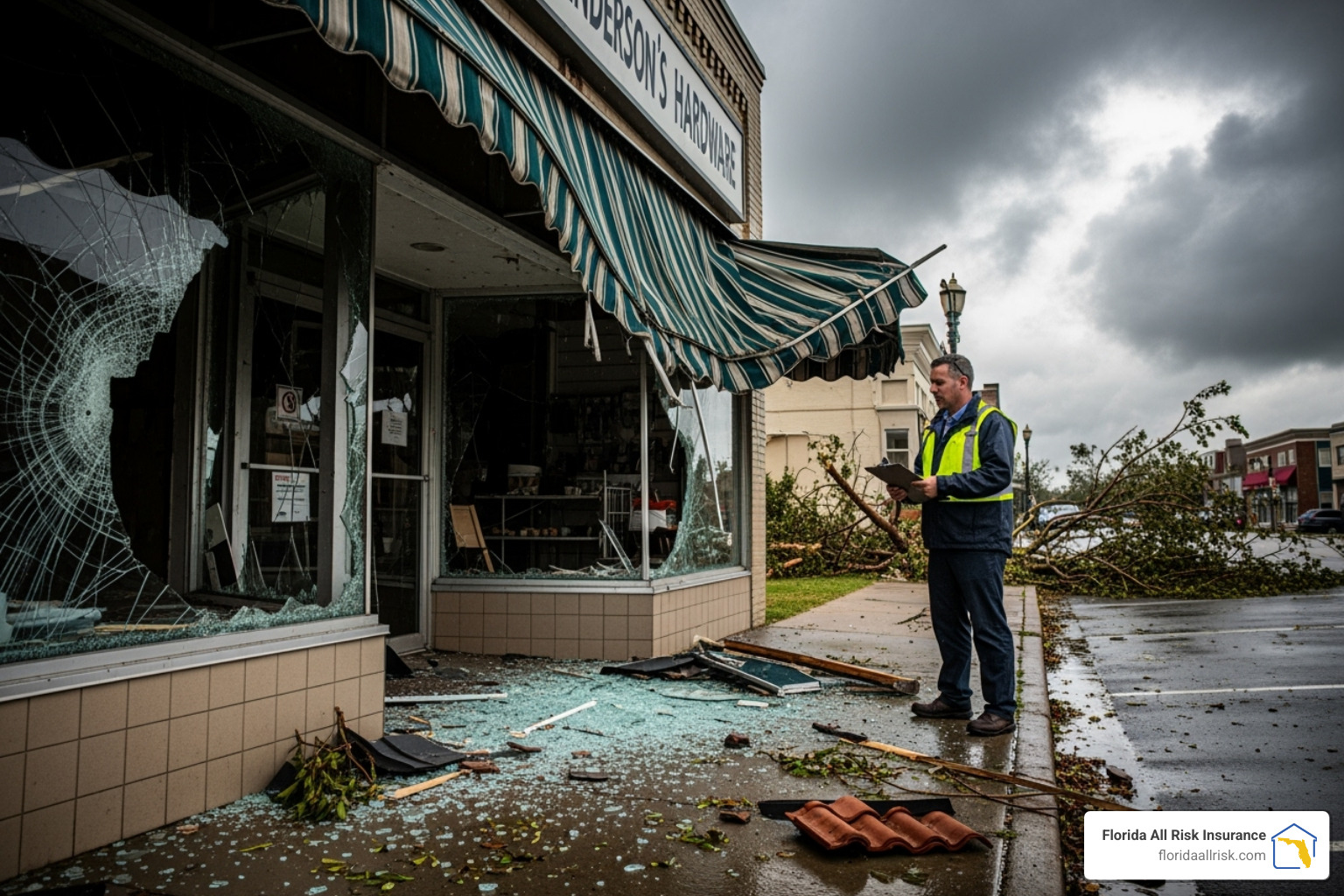
- Commercial Property Coverage: This is the bedrock of your policy. It protects the building structure, permanently installed fixtures, and machinery against a wide range of perils. Policies can be written on a “Named Peril” basis (covering only listed events like fire, lightning, and explosion) or, more commonly, an “All-Risk” or “Special Form” basis, which covers everything unless it is specifically excluded.
- General Liability Insurance: This provides a crucial shield against claims of bodily injury or property damage to third parties occurring in the areas you control, such as lobbies, elevators, parking lots, and sidewalks. For instance, if a visitor slips on an icy patch in your parking lot, this coverage would pay for their medical expenses and your legal defense.
- Loss of Income Coverage: Often called Business Interruption or Rent Loss insurance, this replaces your lost stream of rental income and covers ongoing operating expenses (like mortgage payments, property taxes, and insurance premiums) if the property becomes uninhabitable due to a covered loss. The “period of restoration” for this coverage is a key detail, defining how long benefits will be paid.
- Equipment Breakdown Coverage: This is vital for modern buildings. It pays to repair or replace critical building systems—such as HVAC units, boilers, electrical panels, and elevators—when they fail due to an internal mechanical or electrical breakdown, not an external cause like a fire. A standard property policy would not cover the sudden failure of a central air conditioning compressor, but this endorsement would.
Common Exclusions: What Your Policy Won’t Cover
Understanding what is not covered is as important as knowing what is. This knowledge prevents devastating surprises when a claim is filed.
- Flood Damage: Standard commercial property policies universally exclude damage from flooding (defined as rising surface water). Separate coverage must be purchased through the National Flood Insurance Program (NFIP) or specialized private flood insurers, especially in coastal regions or designated flood zones.
- Earthquake Damage: Like flood, damage from earth movement is a standard exclusion. This coverage must be added via an endorsement or a separate policy.
- Tenant’s Personal Property: Your policy protects the building and your property. It does not cover your tenant’s business personal property, such as their inventory, computers, furniture, or trade fixtures.
- Intentional Acts: Insurance is designed to respond to fortuitous accidents and events, not deliberate damage caused by the insured or illegal acts.
- General Wear and Tear: Policies do not cover the natural, age-related deterioration of property. Routine maintenance, such as replacing a worn-out roof or servicing an old HVAC unit, remains the owner’s financial responsibility.
Bundling Made Simple: The Business Owner’s Policy (BOP)
For many small to mid-sized commercial landlords with less complex risks, a Business Owner’s Policy (BOP) can be an excellent solution. A BOP conveniently bundles commercial property and general liability coverage into a single, often more cost-effective package. This simplifies administration with one policy and one renewal date. Optional endorsements can then be added to tailor the policy to your unique risks, such as ordinance or law coverage, data compromise protection, or equipment breakdown coverage.
The Landlord–Tenant Insurance Divide: Defining Responsibilities
One of the most frequent sources of conflict and financial loss in commercial real estate stems from poorly defined insurance responsibilities. Establishing crystal-clear boundaries between landlord and tenant obligations within the lease agreement is absolutely essential for the financial safety of all parties involved.
The Landlord’s Domain: Insuring the Structure and Common Areas
As the property owner, you have an “insurable interest” in the physical building itself. This means you stand to suffer a direct financial loss if it is damaged or destroyed. Your insurance policy should therefore be structured to cover all aspects of the property you own and maintain. This includes:
- The Building Structure: This encompasses the core elements of the property, including the foundation, walls, roof, floors, windows, and doors.
- Common Areas: You are responsible for insuring and maintaining liability for all areas used by multiple tenants and their guests. This includes lobbies, hallways, stairwells, elevators, public restrooms, and parking lots. A slip-and-fall in a common hallway is your liability exposure, not your tenant’s.
- Landlord-Owned Fixtures and Systems: This covers property you own that is integral to the building’s operation. Examples include the central HVAC system, fire suppression and alarm systems, exterior signage, security cameras, and common area lighting.
The Tenant’s Turf: Covering Business Assets and Liability
Tenants are responsible for insuring their own business operations and the property they own or install within their leased space. Their insurance portfolio should be separate from yours and address their unique exposures:
- Business Personal Property (BPP): This covers all of their movable assets, such as inventory, computers, desks, machinery, and other equipment used to run their business.
- Tenant Improvements and Betterments: This is a crucial category. When a tenant invests their own money to customize a space—such as installing high-end lighting, custom-built shelving, or a commercial-grade kitchen—they are responsible for insuring those improvements.
- Liability Inside Their Premises: The tenant’s general liability policy covers incidents that occur within their leased unit. If a customer is injured or property is damaged inside their store or office, their policy is the one that should respond.
- Business Interruption for Tenants: Just as you need to insure your rental income, tenants need to insure their own lost profits and ongoing expenses if they are forced to temporarily close due to a covered loss like a fire.
The U.S. Small Business Administration{:target=”_blank”} provides excellent guidance for tenants, offering a useful starting point for them to understand their own distinct insurance needs.
The Lease Agreement: Your Insurance Rulebook
A carefully drafted lease agreement is your most powerful risk management tool. It should function as a clear and unambiguous rulebook for insurance.
- Specify Coverage and Limits: The lease must explicitly state the types of insurance each tenant must carry (e.g., General Liability, Property, Workers’ Compensation) and the minimum required policy limits (e.g., $1,000,000 per occurrence for liability).
- Clarify Premium Responsibility: Be clear about who pays for what. In a Triple-Net (NNN) lease, tenants pay a pro-rata share of the building’s property insurance premiums, property taxes, and common area maintenance costs. Other lease types, like a Modified Gross lease, may have different structures.
- Require Additional Insured Status: The lease must mandate that tenants list the landlord (and potentially the property manager) as an Additional Insured on their general liability policies. This is non-negotiable. It allows you to be defended by their insurance policy for claims arising out of their operations, protecting your own policy and loss history.
- Include a Waiver of Subrogation: This clause prevents the insurance company of one party (e.g., your insurer) from suing the other party (e.g., your tenant) to recover damages, even if that party was at fault. It is a critical component that prevents costly litigation between parties after a loss.
- Collect and Track Certificates of Insurance (COIs): The lease should require tenants to provide a COI annually and upon renewal as proof of compliance. Simply collecting it once is not enough; you need a system to track expiration dates to ensure no tenant’s coverage ever lapses.
Decoding the Premium: What Influences Costs and How to Lower Them
Premiums for the building insurance commercial landlords purchase are not set in stone; they are the result of a detailed underwriting process that assesses the unique risk profile of your property. Understanding the primary factors that drive these costs empowers you to take proactive steps to manage both your risk exposure and your annual insurance expenses.
Key Factors That Shape Your Rate
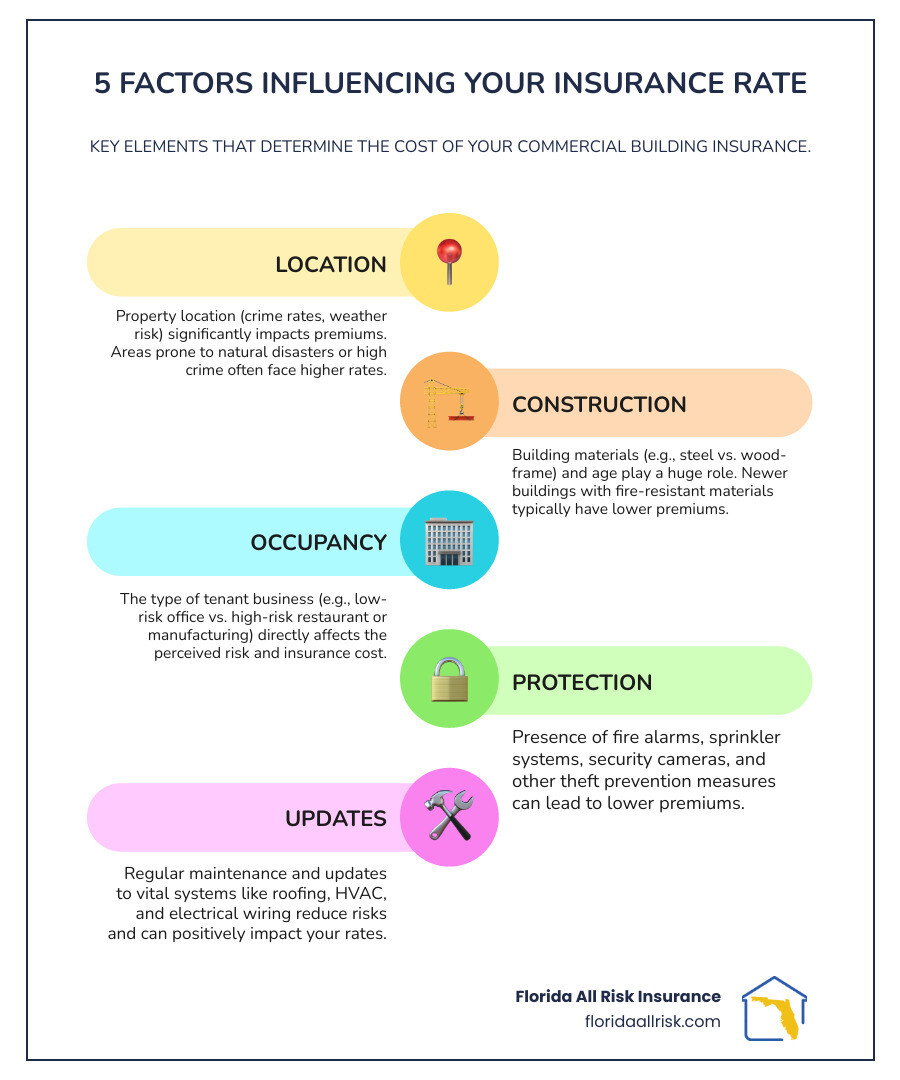
- Location (COPE Factor: L): This is paramount. Underwriters analyze geographic risks like exposure to hurricanes, tornadoes, hail, or wildfires. They also consider the property’s specific address, looking at local crime rates and its Public Protection Classification (PPC) code, which rates the responsiveness of the local fire department.
- Construction and Age (COPE Factor: C): The materials used to build your property have a direct impact on its fire risk. Buildings are rated by ISO construction classes, with fire-resistive (Class 6) structures earning much lower rates than wood-frame (Class 1) buildings. The age and condition of key systems are also critical; a building with modern electrical breakers, copper plumbing, and a new roof is a far better risk than one with outdated knob-and-tube wiring.
- Occupancy (COPE Factor: O): The type of business your tenants operate is a major rating factor. Risk varies dramatically by occupant. A quiet law office presents a very low hazard. A retail store has a higher risk due to public foot traffic. A restaurant with deep-fat fryers or a woodworking shop with flammable dust presents a significantly higher risk of fire and liability, leading to higher premiums.
- Protective Features (COPE Factor: P): What you do to protect your building matters. A building with a full fire sprinkler system can receive substantial premium discounts. Other protective features that can lower your costs include monitored central station fire and burglar alarms, security cameras, and secured access systems.
- Updates & Claims History: A well-maintained property with documented updates (e.g., a new roof in the last 5 years, updated HVAC systems) is viewed favorably by underwriters. Your claims history, documented in a “loss run” report, is also a key indicator. A property with few or no claims over the past five years will secure much better rates than one with a history of frequent or severe losses.
Practical Strategies for Cost Reduction
While you can’t change your property’s location, you have significant control over other factors. Implementing these strategies can lead to meaningful premium savings.
- Increase Your Deductible: A deductible is the amount you pay out-of-pocket on a claim before insurance kicks in. By agreeing to a higher deductible (e.g., $5,000 instead of $1,000), you assume more of the small-loss risk, which in turn lowers your annual premium. This is a good strategy if you have sufficient cash reserves.
- Implement Proactive Maintenance: Don’t wait for things to break. A documented program of regular maintenance for roofs, electrical systems, plumbing, and HVAC can prevent the very claims that drive up premiums. Share these maintenance logs with your underwriter.
- Document All Improvements: When you invest in capital improvements like a new roof, upgraded electrical panels, or a new fire alarm system, document everything. Keep receipts, permits, and photos, and provide this documentation to your insurance agent at renewal time to prove you are a responsible property owner.
- Invest in Safety and Security Systems: The return on investment for a sprinkler system or a monitored alarm system comes not only from loss prevention but also from direct premium discounts. Upgrading security lighting in a parking lot or adding cameras can also reduce liability risk.
- Craft and Enforce Strong Leases: A strong lease that transfers appropriate risk to tenants is a powerful cost-containment tool. Enforcing requirements like Additional Insured status and Waivers of Subrogation protects your own policy from claims, keeping your loss history clean.
- Verify Tenant Insurance Annually: Don’t let this slip. Diligently track and verify that every tenant’s insurance is current and meets the requirements of your lease. A lapse in a tenant’s coverage could expose you directly to a claim that should have been theirs.
Advanced Concepts: Valuation Methods and Specialized Coverage
For sophisticated investors and seasoned property managers, moving beyond the basics to understand advanced insurance concepts is crucial for creating a truly resilient financial fortress around your assets. Grasping property valuation methods and knowing which niche coverages to add can make the difference between a good policy and a great one.
Actual Cash Value (ACV) vs. Replacement Cost (RC)
This is one of the most critical distinctions in property insurance, directly impacting the size of your claim payout.
| Feature | Actual Cash Value (ACV) | Replacement Cost (RC) |
|---|---|---|
| Definition | The cost to replace damaged property with new property of like kind and quality, minus depreciation. | The cost to replace damaged property with new property of like kind and quality, without a deduction for depreciation. |
| Depreciation | Subtracted from the payout. Depreciation is the decrease in value due to age, wear, and tear. | Not considered in the payout. You receive the full amount needed to make the property whole again. |
| Payout Example | A 15-year-old roof with a 25-year lifespan is destroyed. It costs $50,000 to replace. ACV would pay roughly $20,000 ($50,000 minus 60% depreciation). | A 15-year-old roof is destroyed. It costs $50,000 to replace. RC coverage pays the full $50,000 (often in two payments: an initial ACV payment, with the remainder paid after repairs are complete). |
With construction and material costs continually rising, RC coverage is almost always the wiser—though more expensive—choice. An ACV policy can leave you with a significant financial gap when it comes time to rebuild. Furthermore, be aware of co-insurance clauses, which require you to insure your property to a certain percentage (usually 80% or 90%) of its full replacement value. Failing to do so can result in a penalty, reducing your claim payout even further.
What Is Lessor’s Risk Only (LRO) Insurance?
As mentioned earlier, LRO is a general liability policy specifically for landlords. It supplements your property coverage by responding when a landlord is sued for alleged negligence related to the premises. For example, if a tenant claims that inadequate maintenance of the building’s central HVAC system led to mold growth that damaged their inventory and made employees sick, the LRO policy would step in to provide a legal defense and pay for covered damages. It protects the landlord from liability arising from their duties as the owner of the premises, distinct from the tenant’s liability for their own operations.
Specialized Coverage for Unique Situations
Standard policies are not one-size-fits-all. You may need to add these endorsements to fill critical coverage gaps.
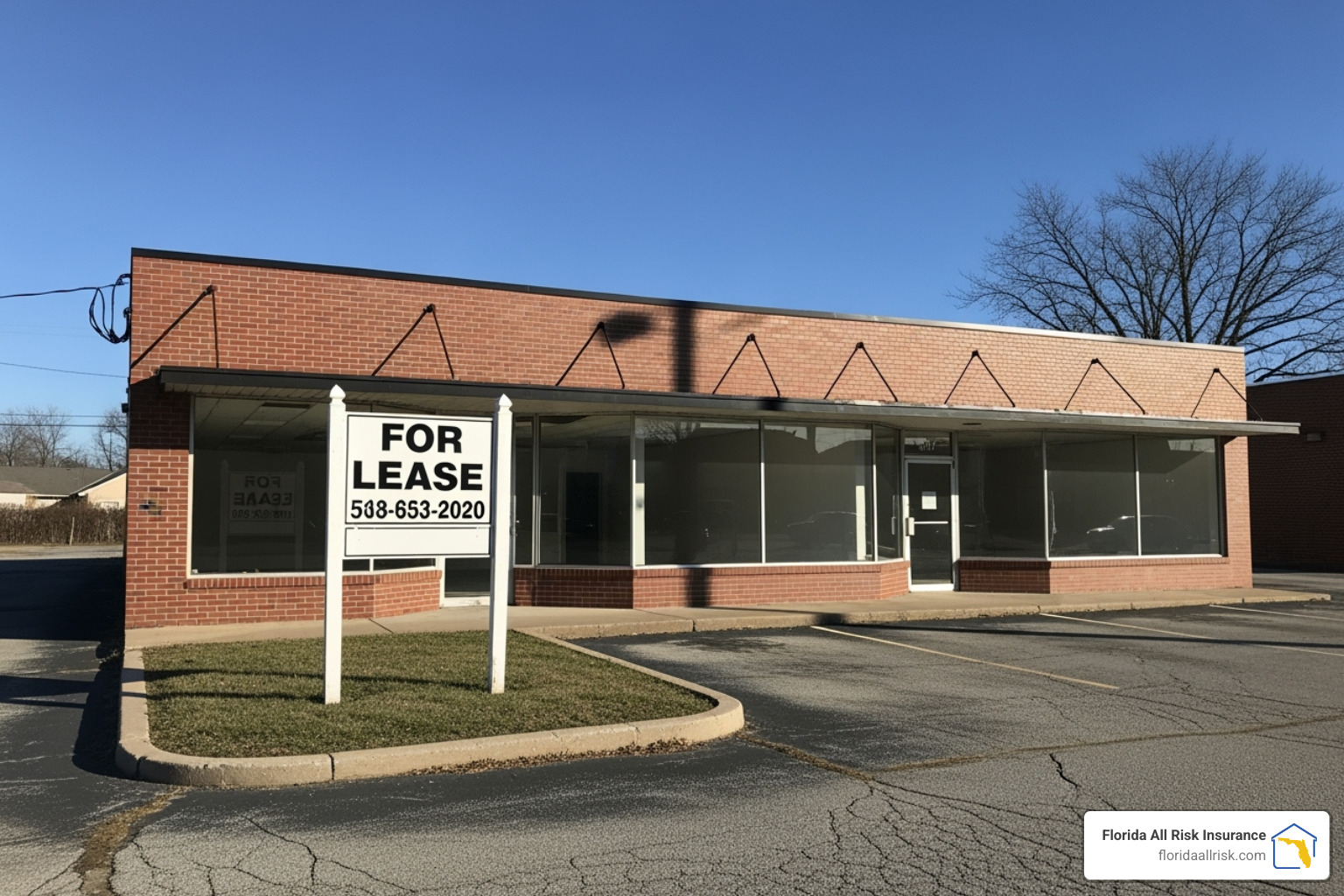
- Vacant Building Coverage: Standard policies contain a vacancy clause that can severely restrict or even void coverage if the property remains unoccupied for a set period (usually 30–60 days). Vacant properties face a higher risk of vandalism, theft, and undetected damage (like a slow water leak). A dedicated vacant property policy is necessary to maintain protection, though it may be more restrictive and costly.
- Ordinance or Law Coverage: This is one of the most important and overlooked coverages. If your building is significantly damaged and must be rebuilt, current building codes may require expensive upgrades that didn’t exist when it was first constructed. This endorsement provides three crucial coverages: (A) payment for the value of the undamaged portion of the building that must be demolished, (B) the cost to actually demolish that undamaged portion, and (C) the increased cost to rebuild to current code.
- Wind Deductible Buy-Downs: In coastal markets like Florida, hurricane or wind deductibles are often percentage-based (e.g., 2%, 3%, or 5% of the total insured value of the building). A 3% deductible on a $3 million building is a staggering $90,000 out-of-pocket cost. A buy-down policy is a separate policy that allows you to pay an additional premium to reduce this high percentage deductible to a more manageable flat dollar amount, like $10,000.
- Sewer and Drain Backup: Another common exclusion, this endorsement provides coverage if a sewer or drain backs up and causes water damage to your property. This is a frequent and unpleasant cause of loss that is vital to cover.
Frequently Asked Questions About Building Insurance for Commercial Landlords
Here are answers to some of the most common questions we receive from commercial property owners.
Who ultimately pays for commercial building insurance?
The landlord is the one who purchases the master property insurance policy because they own the structure and have the primary insurable interest. However, the financial responsibility for the premium is often passed on to the tenants as a condition of the lease. In a Triple-Net (NNN) lease, which is very common in commercial real estate, tenants pay a pro-rata share of all the property’s operating expenses, including property insurance, property taxes, and common area maintenance (CAM). The lease agreement must explicitly and clearly spell out this arrangement to ensure it is enforceable and to avoid misunderstandings.
Do I need special insurance if my property is empty?
Yes, absolutely. Standard commercial property policies include a vacancy clause that significantly reduces or eliminates coverage after a property has been vacant for a specified time, typically 30 to 60 consecutive days. Once the vacancy threshold is passed, perils like vandalism, glass breakage, water damage, and theft are often excluded entirely. To maintain proper protection, you must notify your insurer and secure a dedicated vacant property policy or a vacancy permit endorsement. This coverage is more expensive due to the increased risk, but failing to obtain it can result in a denied claim.
Should tenants list the landlord as an additional insured?
Yes, this is a non-negotiable requirement. Being listed as an Additional Insured on your tenant’s general liability policy is a critical layer of protection. It means that if a claim arises from your tenant’s operations or their specific premises, their liability policy must respond first to defend you and pay damages. This protects your own policy’s loss history and helps keep your future premiums down. For maximum protection, the lease should also require that this coverage be provided on a “primary and non-contributory” basis, meaning the tenant’s policy must pay first without seeking contribution from your policy.
How much liability insurance do I really need?
While a standard General Liability policy often provides limits of $1 million per occurrence and $2 million in aggregate, this may not be sufficient for a significant claim. The amount you need depends on factors like the type of tenants (a restaurant has higher risk than an office), the amount of public foot traffic, and the value of your assets. Most landlords should strongly consider purchasing a Commercial Umbrella Policy, which provides an extra layer of liability protection (from $1 million up to $10 million or more) on top of your primary general liability and auto liability policies.
Do I need Workers’ Compensation insurance as a landlord?
It depends. If you have direct employees, such as a property manager, maintenance staff, or janitorial crew, you are almost certainly required by state law to carry Workers’ Compensation insurance. This covers their medical bills and lost wages if they are injured on the job. Even if you don’t have direct employees, you should ensure that any contractors or vendors you hire (like plumbers, electricians, or roofers) carry their own Workers’ Compensation policies and provide you with a certificate of insurance as proof.
Your Next Step: Securing Your Investment
Your commercial property is a significant financial achievement, but its value is constantly exposed to risk. A single lawsuit, a devastating fire, or a powerful hurricane can turn years of hard work and successful investment into overwhelming financial distress. The key to long-term success is not just acquiring property but protecting it with intelligence and foresight. By mastering the fundamentals of coverage, understanding the critical importance of property valuation, and aligning your lease requirements with risk-management best practices, you can build a durable shield that protects both your cash flow and your asset’s value.
An insurance policy is more than a piece of paper; it’s a promise to restore your financial well-being after a disaster. However, not all policies are created equal, and the complexities of commercial insurance demand expert guidance. Don’t leave the fate of your most valuable asset to chance or an off-the-shelf solution.
Ready to safeguard your property with confidence and clarity? The next step is to speak with an experienced, independent agent who specializes in commercial real estate. An independent agent can analyze your specific needs, compare offerings from multiple top-rated carriers, and tailor a comprehensive policy that fits your building, your tenant mix, and your unique risk tolerance. Secure your legacy today.
Contact Us
Florida All Risk Insurance
Address: Saint Petersburg, FL 33701
Phone: (727) 555-7130
Email: [email protected]
Website: https://floridaallrisk.com/

