Your Business Passport in the Sunshine State
A Certificate of insurance commercial auto Florida is the indispensable document that proves your business has the correct and adequate insurance coverage for its vehicles. In Florida’s dynamic and highly competitive marketplace, this certificate is often the first item clients, general contractors, landlords, and municipal permitting offices demand to see before they will engage with your business. It is your non-negotiable ticket to operate professionally and legally.
Quick Answer: Certificate of Insurance for Commercial Auto in Florida
A Certificate of Insurance (COI) for commercial auto in Florida is a standardized, one-page document that serves as a snapshot of your policy. It:
- Proves you have valid commercial auto insurance, satisfying inquiries and contractual obligations instantly.
- Shows your specific coverage types (such as Liability, Personal Injury Protection (PIP), and Property Damage Liability (PDL)) and the corresponding policy limits, demonstrating your level of financial responsibility.
- Confirms your policy meets or exceeds Florida’s mandatory minimums, which are $10,000 for PIP and $10,000 for PDL for most vehicles.
- Lists the specific vehicles covered under the policy or, for broader protection, indicates “any auto” coverage, which is often required for larger contracts.
- Identifies the “certificate holder”—the third party, like your client or a property manager, who requested the proof of insurance.
- Costs nothing extra. A standard COI is a complimentary service provided by your insurer as part of your policy.
- Expires concurrently with your insurance policy, typically after one year, necessitating annual renewal and re-issuance.
How to get one: The process is simple. Contact your insurance agent and provide the full legal name and address of the party requesting the COI (the certificate holder). Most professional agents can generate and deliver a standard COI electronically within 24-48 hours, and often much faster.
Think of your COI as a business passport, essential for navigating the commercial landscape of the Sunshine State. You cannot bid on a government contract, sign a lease for a commercial garage, or even park your work van on a client’s property without presenting a valid and current Certificate of Insurance. From the bustling construction sites of Tampa to the complex logistics hubs of Miami and the thriving agricultural operations in Central Florida, this single document opens doors, builds immediate trust, and solidifies your professional credibility.
However, a COI is far more than a mere formality; it is a cornerstone of your company’s risk management strategy. Lacking a valid COI can lead to the immediate loss of lucrative contracts, exposure to severe legal penalties from state authorities, and the catastrophic risk of being held personally liable for accidents, injuries, and property damages that should have been covered by your insurance policy.
Obtaining a COI for your commercial auto policy in Florida is a straightforward and painless process when you are partnered with the right insurance advisor. As Florida All Risk Insurance, we have dedicated over 20 years to helping thousands of Florida businesses navigate these complex requirements. This comprehensive guide will cover everything from decoding the industry-standard ACORD 25 form to understanding Florida’s specific legal mandates, ensuring your business remains protected, compliant, and poised for growth.

Decoding the Florida Commercial Auto COI: What’s Inside?
A Certificate of Insurance (COI) is a one-page summary of your insurance coverage, designed for clarity and quick verification. The vast majority of COIs are issued on the standardized ACORD 25 form, a template that is universally recognized and accepted by businesses and government entities for insurance verification. Its purpose is to efficiently inform a third party that your business is adequately insured without requiring them to parse a lengthy and complex policy document.
Here’s a detailed breakdown of what you’ll find on your Florida commercial auto COI and what each section means:
- Producer: This is your insurance agent or broker—the entity that issued the certificate on your behalf. It’s crucial that this is a licensed and reputable agency.
- Insured: This is the full, legal name and address of your business. It must match your business registration and the name on any contract exactly to be valid.
- Certificate Holder: This is the third party requesting proof of your insurance. It could be a general contractor, a property management company, a client, or a government agency. Their full legal name and address must be listed here.
- Insurers: This section lists the specific insurance companies that underwrite your policies (e.g., Insurer A for Auto, Insurer B for General Liability). This is important for verifying the financial strength of the company backing your coverage.
- Policy Numbers: Each insurance policy (Auto, General Liability, etc.) has a unique number, which is listed here for reference and verification.
- Effective & Expiration Dates: This shows the exact period your policy is active. A COI is only valid between these dates.
- Coverage Types: This section details the specific insurance you carry. For a commercial auto policy, you will see entries for Automobile Liability, PIP, and PDL, among others.
- Policy Limits: This is one of the most critical sections. It specifies the maximum dollar amount the insurer will pay per covered claim or per policy period. The certificate holder will check this against their contractual requirements.
- Description of Operations/Locations/Vehicles: This is a blank space used for important notes and endorsements. It’s where special requirements, such as additional insured status, waiver of subrogation, or project-specific details, are officially noted.
- Cancellation Notice: This clause states that the insurer will “endeavor to mail” a notice to the certificate holder if the policy is canceled before the expiration date. It’s important to note this is not a legally binding guarantee of notification, making proactive verification essential.
The COI is a vital risk management tool that demonstrates your financial responsibility. For a general overview, you can review this authoritative resource: What Is a Certificate of Insurance (COI)?. A COI for commercial auto works in tandem with other policies like Commercial General Liability Insurance to provide a comprehensive shield for your business.
Key Parties on Your Certificate of Insurance
Understanding the roles of each party is simple but crucial:
- Insured: Your business—the policyholder.
- Producer: Your insurance agent (like us, Florida All Risk Insurance), who acts as the intermediary.
- Insurer: The insurance company that assumes the financial risk and pays claims.
- Certificate Holder: The person or company requiring proof of your insurance for a contract or access.
Understanding the Coverage Details
The “Coverages” section is the heart of your certificate of insurance commercial auto Florida, detailing the scope of your protection.
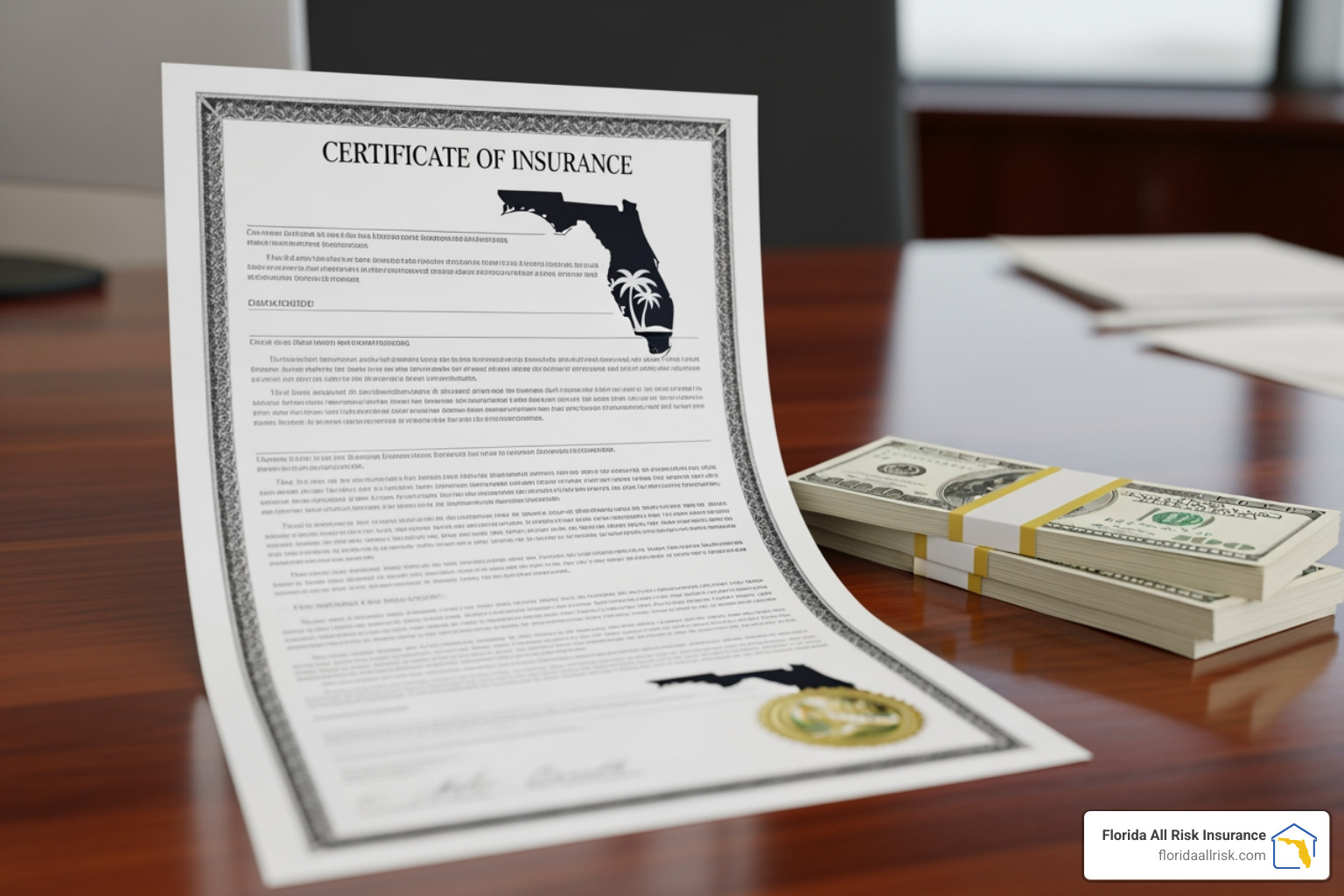
For commercial auto, you’ll see several key entries:
- Commercial Auto Liability: This is the core coverage, protecting your business if you are at fault in an accident that causes injury or property damage. The policy will specify which vehicles are covered:
- Any Auto: This is the broadest and most desirable coverage, protecting any vehicle used for your business, including owned, hired, and non-owned vehicles.
- Owned Autos Only: Covers only the vehicles your business owns and has listed on the policy.
- Hired Autos Only: Covers vehicles your business rents, leases, or borrows for business use.
- Non-Owned Autos Only: This is critical coverage for when employees use their personal vehicles for business errands. For example, if an employee causes an accident while driving their own car to the bank for a company deposit, this coverage protects the business from liability.
- Bodily Injury Liability (BIL): Covers medical expenses, pain and suffering, and lost wages for people injured by your vehicle in an at-fault accident.
- Property Damage Liability (PDL): Covers the cost to repair or replace someone else’s property (like their car, a fence, or a building) that your vehicle damages.
- Personal Injury Protection (PIP): Mandatory in Florida, this no-fault coverage pays for a portion of medical bills and lost wages for you and your passengers, regardless of who caused the accident.
- Uninsured/Underinsured Motorist (UM/UIM): A vital protection that covers your own injuries and damages if you are hit by a driver who has no insurance or insufficient insurance to cover your costs.
- Physical Damage Coverage: This is coverage for your own vehicles and includes Collision (covers damage from a crash) and Comprehensive (covers damage from non-collision events like theft, fire, vandalism, or hail).
The coverages and limits shown on your COI must be an accurate reflection of your actual policy. For more on tailoring these coverages, see our Auto Insurance Coverage Options.
COI vs. The Actual Policy: What’s the Difference?
It is absolutely critical to understand that a certificate of insurance commercial auto Florida is NOT an insurance policy. It is only a snapshot or proof of coverage. The policy itself is the full legal contract that governs coverage.
| Feature | Certificate of Insurance (COI) | Insurance Policy |
|---|---|---|
| Purpose | Proof of coverage; provides a summary to third parties. | Legal contract between you and the insurer; outlines full terms of coverage. |
| Length | Typically one page. | Many pages, often a thick document or PDF. |
| Level of Detail | Summarizes key information: types of coverage, limits, effective dates. | Contains all clauses, conditions, exclusions, definitions, and endorsements in detail. |
| Legal Standing | Informational document; does not amend, extend, or alter the policy. | The legally binding document; governs all aspects of your coverage. |
| Audience | External parties (clients, landlords). | The insured business and the insurer. |
| Amendability | Cannot be changed to grant coverage that doesn’t exist in the policy. | Can be amended via official endorsements issued by the insurer. |
The ACORD 25 form contains explicit language to this effect: “THIS CERTIFICATE IS ISSUED AS A MATTER OF INFORMATION ONLY AND CONFERS NO RIGHTS UPON THE CERTIFICATE HOLDER. THIS CERTIFICATE DOES NOT AFFIRMATIVELY OR NEGATIVELY AMEND, EXTEND OR ALTER THE COVERAGE AFFORDED BY THE POLICIES BELOW.” This means that while the COI is essential proof, the policy document is the ultimate authority on all terms, conditions, and exclusions.
Florida’s Legal Landscape: Commercial Auto Insurance and COI Mandates
Operating any commercial vehicle in Florida means adhering to a strict set of insurance regulations enforced by the Florida Department of Highway Safety and Motor Vehicles (FLHSMV). Your certificate of insurance commercial auto Florida serves as your primary proof of compliance with these non-negotiable rules. Florida law mandates that all registered vehicles must carry continuous insurance coverage to ensure financial responsibility in the event of an accident. For a complete overview of state mandates, you can visit the official Florida Insurance Requirements page or learn about Basic Auto Insurance Florida from our detailed resources.
Minimum Insurance Requirements for Florida Businesses
For the majority of commercial vehicles operating in Florida, the state-mandated minimum coverages are:
- $10,000 Personal Injury Protection (PIP): As a no-fault state, Florida requires this coverage to pay for your own and your passengers’ injuries, regardless of who caused the accident. It typically covers 80% of necessary and reasonable medical expenses and 60% of lost wages up to the $10,000 limit.
- $10,000 Property Damage Liability (PDL): This coverage pays for damages your vehicle causes to another person’s property, such as their car, a mailbox, or a building facade.
It is critical to understand Florida’s continuous coverage rule. This law requires that this insurance must remain active without any lapses for as long as the vehicle is registered in the state, even if it is temporarily out of service or parked for an extended period. The FLHSMV electronically monitors insurance status, and any lapse can trigger immediate penalties. While these are the minimums, they are often insufficient for true asset protection. Certain commercial operations have much higher requirements. For instance, taxis and other for-hire transportation services must carry Bodily Injury Liability (BIL) of $125,000 per person and $250,000 per occurrence, plus $50,000 in PDL. Meeting these legal minimums is the first step, but protecting your Business Insurance for Small Businesses assets usually requires significantly higher limits.
Special Requirements for Commercial Trucks and Heavy Vehicles
Heavier commercial trucks and vehicles used in commerce face substantially higher insurance requirements due to the greater potential for catastrophic damage and injury they represent. These mandates are often determined by the vehicle’s Gross Vehicle Weight (GVW) and its operational radius (intrastate vs. interstate).
- Florida Intrastate Requirements: For trucks operating solely within Florida, liability requirements can range from $50,000 to $300,000 Combined Single Limit (CSL) for vehicles with a GVW of 26,000 lbs or more.
- Federal Interstate Requirements: For trucks that cross state lines and are subject to U.S. Department of Transportation (DOT) and Federal Motor Carrier Safety Administration (FMCSA) regulations, the minimum liability coverage is significantly higher, typically starting at $750,000 CSL for general freight and going up to $1,000,000 or even $5,000,000 for those hauling hazardous materials.
Some very large corporations may apply to self-insure, but this is a complex process that requires proving immense financial stability to the state and is not a viable option for most businesses. Whether you operate a single delivery van or a large fleet of semi-trucks, ensuring you meet the specific GVW-based and operational requirements is absolutely critical for legal compliance. We specialize in helping businesses secure the right Commercial Truck Insurance to meet both state and federal laws.
How to Get Your Certificate of Insurance for Commercial Auto in Florida
Obtaining a certificate of insurance commercial auto Florida is a straightforward and routine process, provided you have the correct underlying insurance policy in place. The COI is a product of the policy, not the other way around.
Step 1: Secure the Right Commercial Auto Policy
Before you can request a COI, you must have a commercial auto policy that is specifically tailored to your business’s unique risks and contractual needs. This foundational step involves a thorough assessment with your insurance agent:
- Detailing Your Operations: You’ll need to provide information on your vehicles (make, model, year, VIN), their primary use (delivery, transport, sales calls), their typical radius of operation, and what, if anything, they transport (goods, equipment, people).
- Identifying Drivers: You must account for all employee drivers, including their driving records (MVRs). It’s also crucial to determine if employees will ever use their personal vehicles for work, as this creates a non-owned auto liability exposure that must be covered.
- Determining Adequate Limits: Your agent will help you determine coverage limits that go beyond the state minimums to adequately protect your business assets from a major lawsuit. This is based on your company’s revenue, assets, and contractual requirements.
As an independent agency, we provide comprehensive Commercial Auto Insurance Florida solutions by comparing offerings from multiple top-rated carriers to find the optimal balance of coverage and cost. You can Get a Quote to begin this essential process.
Step 2: Request the COI from Your Insurance Provider
Once your commercial auto policy is active, you can request a COI from your insurance agent at any time. To ensure the certificate is issued correctly and quickly, you will need to provide the following specific information:
- The Certificate Holder’s Details: This includes the full legal name and mailing address of the person or company requesting the COI. This information must be precise.
- Contractual Requirements: Inform your agent of any special insurance requirements stipulated in your contract. This includes specific liability limits, or the need for endorsements like “Additional Insured” status or a “Waiver of Subrogation.”
- Contact Information: Provide the email address or fax number where the COI should be sent.
- Project Details: If the COI is for a specific job or project, providing the project name or number can be helpful for inclusion in the description box.
We understand that business moves fast and that a COI can be the final piece needed to start a job. We are committed to generating and delivering accurate COIs within 24-48 hours, and often on the same business day. As an Independent Insurance Agency Florida, responsive service is our priority. Feel free to Contact Us with your request.
Step 3: Customizing Your Certificate of Insurance for Commercial Auto in Florida
A standard COI is often not enough; contracts frequently demand specific endorsements that alter your policy to provide protection to the certificate holder. These are noted in the “Description of Operations” box on the ACORD 25 form.
- Additional Insured: This is a common and critical endorsement. It extends your policy’s liability coverage to the certificate holder (e.g., your client or a general contractor), but only for claims arising from your specific work or operations for them. It protects them if they are sued because of your negligence.
- Waiver of Subrogation: Subrogation is the right of an insurer to pursue the at-fault party to recover funds paid out on a claim. A waiver of subrogation is an endorsement where your insurance company agrees to give up this right against the certificate holder. This is often required to prevent cross-lawsuits between parties working on the same project.
- Primary & Noncontributory: This clause specifies the order of payment if a claim occurs. It ensures that your policy will act as the primary coverage and pay out first, without seeking contribution from the certificate holder’s own insurance policy, even if they are partially at fault.
These customizations are not automatic. They are formal endorsements to your policy that may carry an additional premium, and they must be in place before they can be listed on the COI.
Verifying and Managing Your Florida Commercial Auto COI
Once you have a certificate of insurance commercial auto Florida in hand, the process is not complete. Whether you are the one providing the COI to a client or the one receiving a COI from a subcontractor, proper verification and ongoing management are essential components of a sound risk management program.
How to Ensure a COI You Receive is Valid
When a subcontractor, vendor, or partner provides you with a COI, it is a serious mistake to simply file it away. You must perform due diligence to protect your own business. Use this verification checklist:
- Check Policy Dates: Confirm the policy effective and expiration dates. Ensure the policy is active and will remain so for the entire duration of your project or contract.
- Match Names Exactly: The “Insured” name on the COI must precisely match the legal name of the business on your contract. Any discrepancy, even a small one, could invalidate the coverage in a claim situation.
- Verify Coverage and Limits: Scrutinize the policy limits listed in the coverage section. Do they meet or exceed the minimum requirements you stipulated in your contract? Are all the required coverage types (e.g., Auto Liability, Hired/Non-Owned) present?
- Confirm Endorsements: If your contract required “Additional Insured” status, a “Waiver of Subrogation,” or “Primary & Noncontributory” language, verify that this is explicitly stated in the “Description of Operations” box. For maximum assurance, always request a copy of the actual endorsement forms from the insurer, not just the note on the COI.
- Check the Insurer’s Rating: Note the insurance companies listed and do a quick search for their A.M. Best rating. This rating indicates the insurer’s financial stability and ability to pay claims. You want to see carriers with an ‘A-‘ rating or better.
- Contact the Producer Directly: The most foolproof verification step is to call the insurance agency (“Producer”) listed on the COI. Using the phone number on the certificate, ask them to confirm that the policy is active, that the coverages are as stated, and that the required endorsements are in place. This protects you from fraudulent or altered certificates.
Do not accept expired COIs, certificates with insufficient limits, or any document that appears to have been altered. This diligence is your first line of defense against inheriting another party’s liability. For more tips, see our Small Business Insurance Guide. Our team at Insurance Agencies in St. Petersburg, FL can also assist with verification questions.
How Long is a COI Valid and When Should It Be Updated?
A COI’s validity is tied directly to the underlying insurance policy, which typically has a term of one year. It is a live document only for the policy period shown.
You must obtain an updated COI in several situations:
- Annually Upon Renewal: When the policy renews, a new COI with the new effective and expiration dates is required. Many businesses use tracking software to automatically request renewal certificates from their vendors 30-60 days before expiration.
- After Any Mid-Term Policy Changes: If you increase your coverage limits, add a vehicle, or add a new endorsement, an updated COI should be issued to reflect these changes accurately.
- For Every New Project or Client: Always issue a fresh, current COI for each new client or project. Never reuse an old one, as the certificate holder’s name and requirements will be different.
The Risks of Non-Compliance: Penalties and Consequences
Failing to meet Florida’s commercial auto insurance requirements or being unable to provide a valid certificate of insurance commercial auto Florida when requested is not a minor administrative oversight. It carries severe and multifaceted consequences that can cripple your business operations and expose you to catastrophic financial loss.
Legal Penalties for Lacking a Certificate of Insurance for Commercial Auto in Florida
The Florida Department of Highway Safety and Motor Vehicles (FLHSMV) enforces the state’s insurance mandates with an automated, electronic system that leaves little room for error. If your commercial vehicle is found to be uninsured, even for a short period, you can expect swift and serious penalties:
- Immediate Suspension: The FLHSMV has the authority to suspend your driving privilege, the vehicle’s license plate, and the vehicle’s registration for up to three years for a violation.
- Hefty Reinstatement Fees: To get your license and registration reinstated after a suspension, you will be required to pay fees that can be as high as $500, per violation.
- Substantial Fines: In addition to reinstatement fees, you may be ticketed and levied additional fines for the infraction of operating an uninsured motor vehicle.
- SR-22 Requirements: You will likely be required to file an SR-22 form with the state. This is a certificate from your insurer that guarantees the state you are carrying continuous coverage. An SR-22 designates you as a high-risk driver and will almost certainly lead to significantly higher insurance premiums for several years.
Insurers are legally required to report all policy cancellations and lapses to the state, so the FLHSMV’s system quickly and automatically flags non-compliant vehicles. Maintaining continuous coverage is the only way to avoid these penalties. Our Business Insurance St. Petersburg solutions are designed to ensure you remain fully compliant with all state regulations.
Business and Financial Consequences
Beyond the direct legal penalties, the business and financial fallout from non-compliance can be even more devastating:
- Lost Contracts and Disqualification: The vast majority of commercial contracts and requests for proposals (RFPs) list a valid COI as a mandatory submission requirement. Without one, your bid will be immediately disqualified, shutting you out of countless revenue opportunities.
- Unlimited Personal Liability: This is the most severe risk. If an accident occurs while you are uninsured, the protection of the corporate veil can be pierced. Your business and even your personal assets—your home, savings, and investments—are at risk to cover medical bills, property damage, and massive legal defense fees.
- Denied Job Site Access: Picture this: your crew arrives at a major construction site, ready to work. The site manager asks for your COI. If you can’t produce a valid one, your vehicles and employees will be denied entry, causing costly delays, damaging your relationship with the general contractor, and potentially leading to breach of contract.
- Irreparable Reputational Damage: Failing to provide a basic document like a COI erodes trust and signals to clients, partners, and potential customers that your business is unprofessional, disorganized, or financially unstable.
- Crushing Out-of-Pocket Costs: Without insurance, your business is solely responsible for every dollar related to an accident. This includes vehicle repairs, rental car costs, medical bills for injured parties, and legal fees, which can easily run into the hundreds of thousands of dollars for a serious incident.
A COI is your proactive, first line of defense against these damaging and often business-ending risks.
Conclusion: Your Shield on Florida’s Roads
A certificate of insurance commercial auto Florida is far more than a piece of administrative paper; it is a dynamic and essential tool for legal compliance, financial protection, and sustainable business growth in the Sunshine State. It acts as your passport to professional opportunities, proving your credibility, opening doors to new and larger contracts, and, most importantly, safeguarding your hard-earned assets from devastating liability. By thoroughly understanding the components of a COI, Florida’s legal insurance mandates, and the critical importance of verification, you can ensure your business is always prepared, protected, and positioned for success.
Throughout this guide, we have detailed what a COI is, why it is non-negotiable for Florida businesses, how to decode the information it contains, and the strict legal framework that governs its use. We have also illuminated the severe legal and financial consequences of non-compliance, from license suspension and heavy fines to the catastrophic risk of personal liability.
Navigating the complexities of commercial auto insurance doesn’t have to be a challenge. The right insurance partner can transform this requirement from a burden into a strategic advantage. Our dedicated team at Florida All Risk Insurance provides comprehensive, customized solutions tailored to your specific business needs. As a leading independent agency, we pride ourselves on delivering personalized, responsive service and leveraging our access to a wide range of top-rated carriers to find you the right coverage at the most competitive rates.
Are you ready to secure the right protection and get the proof you need to drive your business forward with confidence? Request your free commercial auto insurance quote today and let us provide you with a valid, accurate COI quickly and efficiently.
For any questions about your specific operational risks or contractual requirements, please Contact our St. Petersburg-based team of experts for personalized, no-obligation guidance.
Contact Us
Florida All Risk Insurance
Address: 7901 4th St N, STE 4000, Saint Petersburg, FL 33702
Phone: (727) 471-4799
Email: [email protected]