

Car insurance rates Florida 2025: Big Drop!
Why Florida Car Insurance Rates Matter Now More Than Ever
Car insurance rates Florida drivers pay have been a source of frustration for years, but 2025 is bringing unexpected good news. If you’re wondering whether rates are truly dropping, here’s what you need to know right now:
Quick Answer: Are Florida Car Insurance Rates Dropping?
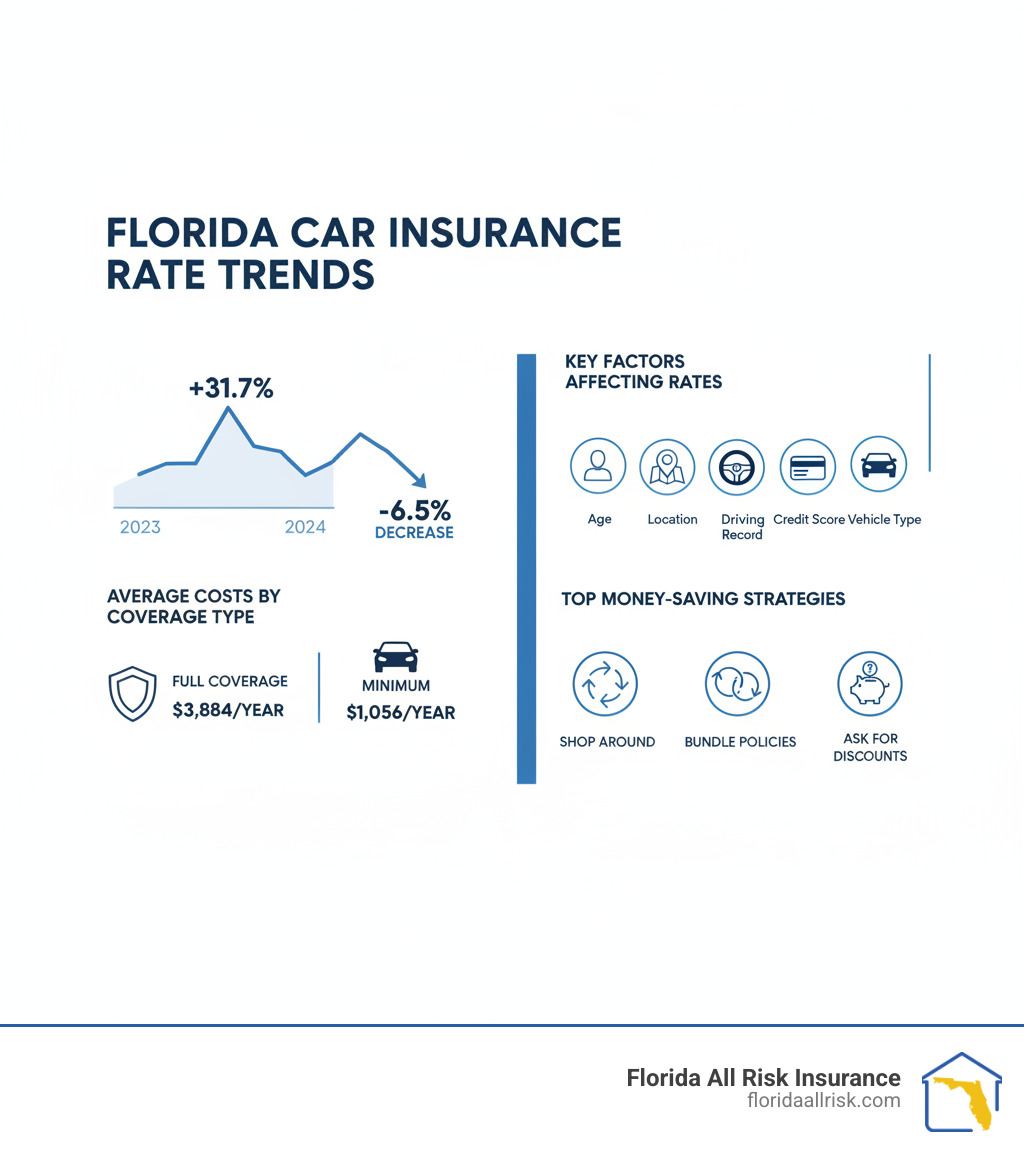
- Yes, rates are decreasing: Florida’s top auto insurance groups show an average -6.5% rate change for 2025.
- Average full coverage: $3,884/year ($324/month).
- Average minimum coverage: $1,056/year ($88/month).
- Key drivers of change: Legislative reforms, reduced litigation costs, and increased market competition.
After years of steep increases—including a staggering +31.7% average rate hike in 2023—Florida drivers are finally seeing relief. The state’s personal auto liability loss ratio dropped to 53.3% in 2024, the lowest in the nation, signaling a healthier market.
This shift is a direct result of historic insurance reforms enacted in late 2022 and early 2023. These changes curbed fraudulent claims and excessive lawsuits, allowing insurers to operate more efficiently and pass savings on to consumers. The market has also become more competitive, with 17 new insurance companies entering Florida, giving drivers more choices than ever.
However, Florida still ranks as the second most expensive state for car insurance, with full coverage costing 44% more than the national average. Your individual rate depends on dozens of factors—from your zip code and driving record to your credit score. Understanding these factors is key to finding excellent coverage at a fair price.
I’m Jason Miller, owner of Florida All Risk Insurance. With over 20 years of personal experience and 60 years of combined family expertise in Florida’s insurance market, I’ve helped countless families steer the complexities of Car insurance rates Florida drivers face. In this guide, I’ll break down what’s happening with rates, what drives your premium, and how you can take advantage of this changing market to protect yourself and save money.
The Shifting Tides: Why Florida’s Auto Insurance Market is Changing
For years, watching your insurance premium climb felt inevitable. But the tide is finally turning for Florida drivers. After a jaw-dropping +31.7% average rate hike in 2023, the market is showing real signs of stabilization. Florida’s top auto insurance groups are now indicating an average -6.5% rate change for 2025. Yes, rates are actually going down.
This turnaround is the result of a powerful combination of legislative action and market dynamics. Understanding these forces is your first step to navigating the current market and taking advantage of the improvements in car insurance rates Florida drivers are finally experiencing.
The Impact of Recent Insurance Reforms
For a long time, Florida had a reputation as a “litigation hellhole,” where fraudulent claims and excessive lawsuits drove costs through the roof. In 2023, that changed when Governor Ron DeSantis signed House Bill (HB) 837, a landmark piece of tort reform legislation. The goal was to tackle the rampant litigation that made Florida’s insurance market one of the most volatile in the country.
The key changes included eliminating one-way attorney fees, which had incentivized unwarranted lawsuits, and tightening the rules around bad faith lawsuits. The reforms also cracked down on auto glass fraud, causing related lawsuits to plummet by nearly 90% from Q2 2023 to Q2 2024.
The results are impressive. The personal auto liability loss ratio in Florida dropped to 53.3% in 2024, now the lowest in the nation. In plain English, this means insurers are paying out significantly less in claims and legal fees. This improved financial stability is a direct contributor to the rate decreases now being passed on to consumers.
Market Stabilization and Increased Competition
These reforms have done more than just lower costs; they’ve made Florida an attractive market for insurers. Previously, many companies were hesitant to operate in the state due to high risks. Since the legislative changes, 17 new insurance companies have begun operating in Florida. This influx of new players dramatically increases competition, which is always a win for consumers.
A more competitive environment pressures all carriers to offer better rates. This trend is amplified by consumer behavior. A recent LexisNexis report shows that auto insurance shopping grew 16% year-over-year in the first quarter of 2025. More savvy drivers are actively seeking lower prices instead of just accepting their renewal notice. This increased shopping activity further fuels competition, creating a positive cycle for consumers.
As an independent agency, we at Florida All Risk Insurance are thrilled to see more options for our clients. More competition means we can shop your coverage across a wider range of carriers to find customized coverage and competitive rates that fit your specific situation.
Decoding the Numbers: Average Car Insurance Rates Florida Drivers Pay
While the overall trend is positive, it’s crucial to understand the baseline costs. Even with recent improvements, Florida remains one of the more expensive states for car insurance, with full coverage costing approximately 44% more than the national average. The specific amount you pay, however, varies dramatically based on the level of coverage you choose.
Full Coverage vs. Minimum Coverage Costs
There’s a significant cost difference between a policy offering comprehensive protection and one meeting only the state’s bare-minimum requirements. Opting for minimum coverage might seem appealing, but it often leaves you exposed to substantial financial risks.
For a robust policy, Florida drivers pay an average of $3,884 per year or $324 per month for full coverage. This typically includes liability, collision, and comprehensive coverage, safeguarding you from a wide range of incidents. It’s the peace of mind option.
On the other hand, meeting just the legal requirements costs an average of $1,056 per year or $88 per month for minimum coverage. While significantly cheaper, this bare-bones coverage leaves you financially exposed in many common accident scenarios. We often advise clients to consider more than the minimum to truly protect their assets. You can learn more about finding the right balance with our auto insurance coverage options guide.
How Florida Compares to the National Average
Despite recent improvements, Florida’s history of high claim costs, dense population, tourist traffic, and severe weather risks mean our average Car insurance rates Florida residents pay are still well above the national benchmark.
The numbers tell the story: full coverage in Florida is 44% higher than the national average, making us the second most expensive state for car insurance. While the gap may be narrowing thanks to recent reforms, Floridians should still expect to pay more than their counterparts in many other states. This reality makes it even more important to actively seek out savings and ensure you’re not overpaying.
What’s Driving Your Premium? Key Factors That Influence Florida Rates
Have you ever wondered why your neighbor pays less for car insurance than you do? Your insurance premium is a highly personalized number. Insurers use dozens of data points to predict the likelihood of you filing a claim. Understanding these factors can help you identify opportunities to lower your costs. Let’s break down the major ingredients that go into calculating car insurance rates Florida drivers face.
Location, Location, Location: Rates by Florida City
Where you live and park your car significantly impacts what you’ll pay. Insurers analyze accident statistics, crime rates, and population density for your specific area. Densely populated urban areas see more traffic, accidents, and theft. Miami, for instance, averages $3,287 per year for full coverage—significantly higher than many other parts of the state. On the flip side, cities with less congestion, like Jacksonville, have lower average rates at $2,569 annually. The quieter streets and lower risk in these areas translate directly to savings. If you’re in the Tampa Bay area, location becomes even more nuanced, which is why we created a dedicated guide on Car Insurance St. Pete to help our neighbors steer these local variations.
Demographics: Age and Gender
Age is one of the most powerful predictors of risk for insurers. Young drivers face the steepest climb. An 18-year-old male on his own policy in Florida can expect to pay an eye-watering average of $10,706 per year for full coverage. This is due to a combination of inexperience and statistically higher accident rates. The good news is that rates drop steadily as drivers gain experience. We’ve put together helpful information on auto insurance for young drivers if you’re navigating this phase.
Drivers in the 35 to 65 age range are in the sweet spot, typically enjoying the lowest rates. After 65, you might see a modest uptick. Regarding gender, women in Florida pay an average of $2,754 annually for full coverage, while men pay slightly less at $2,595 annually, though this varies by age group.
Your Driving Record and Its Impact on Car Insurance Rates in Florida
Your driving record is the factor you control most directly. A single at-fault accident can increase your premium by 40% or more, and this increase typically stays on your record for three to five years. Florida drivers with a clean record pay an average of $2,357 annually, while those with just one accident see their costs jump to $3,614 per year.
Even minor violations add up. A speeding ticket can boost your premium by 15% or more. Drivers with one violation pay an average of $3,011 annually. The most severe infraction is a DUI. A DUI conviction is catastrophic for your rates, with Florida drivers paying an average of $494 per month for full coverage—a 53% increase over the state average. You’ll also be required to file an FR-44 form, which mandates higher liability limits. We’ve created a comprehensive guide on DUI auto insurance Florida to help those facing this situation.
Financial Responsibility: Your Credit Score
In Florida, your credit score plays a significant role in your insurance premium. Insurers have found a statistical correlation between credit history and the likelihood of filing claims. The impact is substantial. Drivers with excellent credit in Florida pay an average of $3,121 annually for full coverage—20% less than the state average. In contrast, drivers with poor credit face an average annual premium of $8,293. That’s 114% more than the Florida average and over $5,000 more per year than someone with excellent credit. Improving your credit score by paying bills on time and reducing debt is one of the most powerful long-term strategies for lowering your car insurance costs.
The Car You Drive: Vehicle Type
The make and model of your vehicle is another major piece of the puzzle. Insurers look at its market value, repair costs, safety ratings, and theft rates. Luxury and high-performance vehicles command premium prices. A BMW 330i, for example, averages around $373 per month to insure in Florida. Electric vehicles like the Tesla Model Y average $407 per month due to specialized parts and high repair costs.
On the more affordable end, practical vehicles with strong safety records and readily available parts offer significant savings. A Subaru Crosstrek averages around $277 per month, while a Toyota Tacoma comes in at about $289 per month. These vehicles are less expensive to repair and have lower theft rates, and insurers pass those savings on to you. Before you buy a new car, it’s wise to check the potential insurance costs.
Understanding Your Florida Auto Insurance Policy
Florida’s insurance system is unique. We have a “no-fault” system with some of the lowest minimum requirements in the country. While that might sound appealing, it can leave you exposed to serious financial risks if you’re not careful.
Florida’s Minimum Insurance Requirements
To legally drive in the Sunshine State, you need two types of coverage. First, $10,000 in Personal Injury Protection (PIP). This is the core of the no-fault system. It covers 80% of your medical expenses and 60% of your lost wages up to the $10,000 limit, regardless of who caused the crash.
Second, you need $10,000 in Property Damage Liability (PDL). This covers damage you cause to other people’s property. What surprises many is that Florida doesn’t require bodily injury liability insurance to register a personal vehicle. You can verify these requirements on the official Florida Highway Safety and Motor Vehicles website.
The Risks of Minimum Coverage and the “No-Fault” System
Just because something is legal doesn’t mean it’s smart. The term “no-fault” simply means your own PIP coverage pays for your initial medical bills. But these minimums are dangerously low. A $10,000 property damage limit won’t go far if you total a new SUV, and a $10,000 PIP limit can be exhausted by a single emergency room visit.
The scariest part is the lack of required Bodily Injury (BI) Liability coverage. If you cause an accident that injures another person and you don’t have BI, they can sue you personally. Your savings, your home, and your future earnings could all be at risk. I’ve seen people lose everything because they tried to save a few dollars on insurance.
Important Optional Coverages to Consider
Given these gaps, we strongly recommend carrying more than the bare minimum. These “optional” coverages are essential for true financial protection.
-
Bodily Injury (BI) Liability: This is the single most important coverage you can buy. It pays for injuries you cause to others, covering their medical expenses, lost income, and pain and suffering. We typically recommend limits of at least $100,000 per person and $300,000 per accident.
-
Uninsured/Underinsured Motorist (UM/UIM) coverage: This is critical in Florida, where nearly 16% of drivers are uninsured. It protects you if you’re hit by someone with no insurance or not enough to cover your damages. Learn more with our guide on Uninsured Motorist Coverage Florida.
-
Collision and Comprehensive coverage: These protect your own vehicle. Collision covers accident damage, while Comprehensive handles theft, vandalism, storms, and other non-collision events. If you have a car loan, your lender will require them.
-
Medical Payments (MedPay): This supplements your PIP, covering additional medical expenses for you and your passengers, regardless of fault. It can help fill the gaps when your PIP limit is exhausted.
At Florida All Risk Insurance, we walk you through these options to find what makes sense for you. Adding these coverages will increase your premium, but the protection is worth it. For more details, check out our guide on auto insurance coverage options. The goal isn’t just finding the cheapest policy—it’s finding the right balance of coverage and cost.
Your Roadmap to Savings: How to Lower Your Car Insurance Bill
Even with rates trending downward, car insurance is a significant expense. The good news is you have more control over your premium than you might think. Being a strategic shopper is the key to finding the best value.
Shop Around and Compare Quotes
This is the single most effective way to save money on your Car insurance rates Florida. Prices for the exact same coverage can vary dramatically between insurers. I’ve seen differences of $1,000 or more for identical policies. Aim to compare rates from at least three to five different companies. This is where using an independent agent like us at Florida All Risk Insurance is a game-changer. We do the shopping for you, accessing rates from numerous carriers to find the most competitive pricing for your needs.
It’s also a good habit to review your policy annually. The Florida market is changing rapidly. A quick check once a year, or after a major life event like moving or buying a new car, can reveal significant savings. Ready to see what’s out there? Get your personalized car insurance quotes in Florida today.
Ask for Discounts
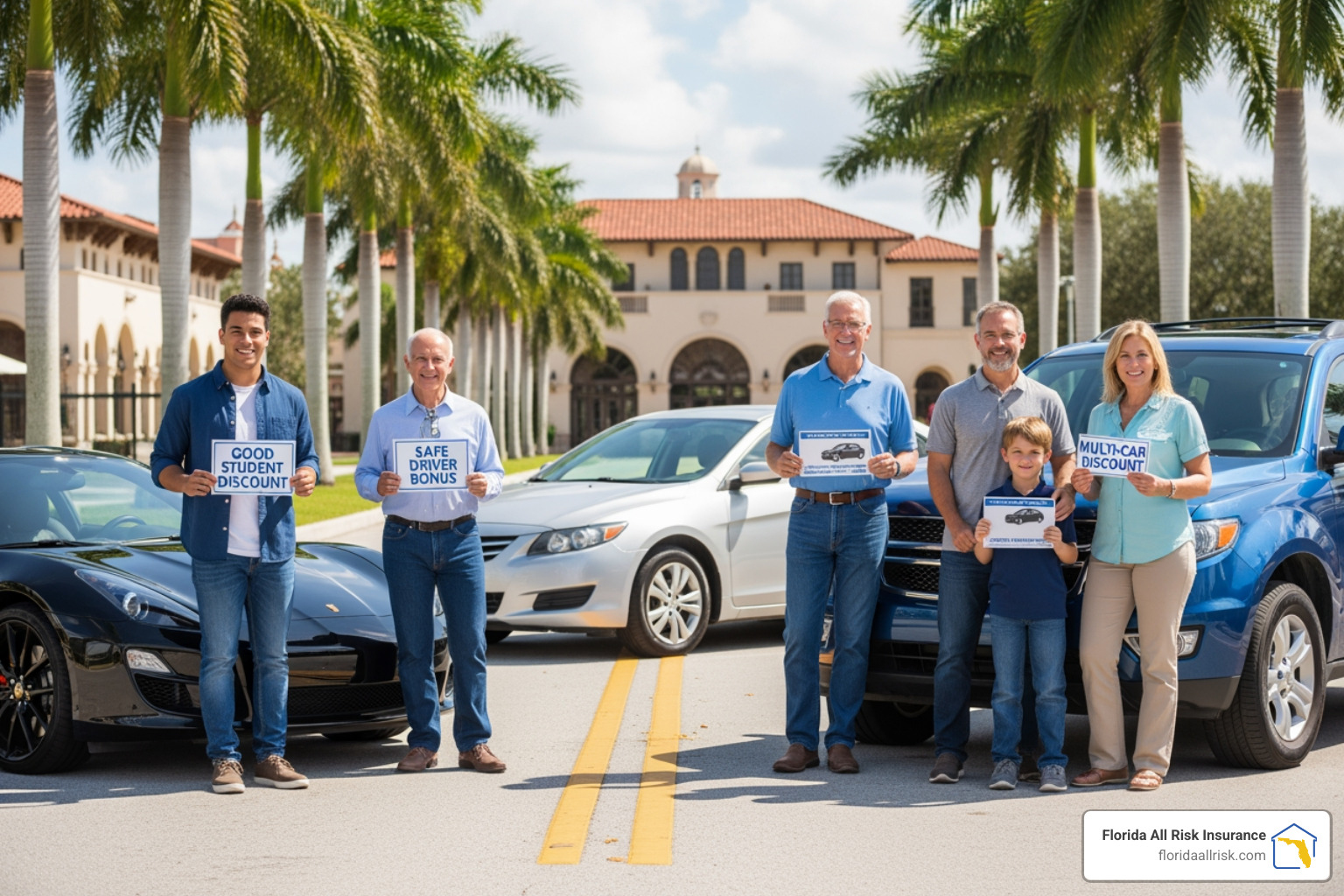
Insurers offer a wide variety of discounts, but they often aren’t applied automatically—you have to ask. Bundling your auto policy with home or renters insurance is one of the easiest ways to save, often cutting 15-25% off your premiums. Maintaining a clean driving record will qualify you for a good driver discount, a reward for being safe and responsible. Learn more in our guide to safe driver insurance discounts.
For families with young drivers, a good student discount is often available for maintaining a “B” average or better. Completing a defensive driving course can also net you a discount, especially for senior drivers. Your vehicle may also qualify you for savings if it has safety features like anti-lock brakes and anti-theft systems. If you don’t drive much, you might be eligible for a low-mileage discount. Find out how low mileage can slash your Florida car insurance bill. Finally, ask about discounts for paying your premium in full or insuring multiple vehicles. A few questions could save you hundreds.
Adjust Your Policy and Coverage
Strategically structuring your policy can also lead to savings, but it requires balancing cost and protection.
One effective strategy is raising your deductible. Your deductible is what you pay out-of-pocket on a collision or comprehensive claim. Increasing it from $500 to $1,000 can lower your premium by 15-30%. This works best if you have enough in savings to comfortably cover the higher amount. It’s a bet on yourself as a safe driver. Learn more about your auto insurance deductible options to make an informed decision.
Another option is dropping collision and comprehensive coverage on older vehicles. If your car has a low market value, it may not be cost-effective to continue paying for these coverages. A good rule of thumb is to consider dropping them if the annual cost of the coverage exceeds 10% of your car’s value. This is a personal decision that depends on your financial situation and risk tolerance, but it’s worth evaluating.
Conclusion: Taking Control of Your Florida Car Insurance Costs
We’ve covered a lot of ground, and the bottom line is this: the Florida auto insurance market is in a period of positive transition. Thanks to significant legislative reforms, the era of runaway rate hikes appears to be over, with top insurers showing an average -6.5% rate change for 2025. This is driven by improved loss ratios and a surge of new competition.
However, Florida remains a complex and expensive state for car insurance, costing about 44% more than the national average. Your final premium is determined by a host of personal factors, from your zip code and driving record to your credit score and car.
The key to getting the best deal in this evolving market is to be a proactive, informed consumer. Ensure you have adequate coverage beyond Florida’s low minimum requirements to protect your financial future. Shopping the market diligently is equally important. With 17 new carriers in Florida, there has never been a better time to compare quotes.
An independent agency like Florida All Risk Insurance is an invaluable partner in this process. We leverage our expertise and access to multiple carriers to find you the most competitive rates available in St. Petersburg and across the state. We’re here to help you steer the complexities and secure the best coverage for your needs and budget.
The market is moving in your favor, but you have to take action to benefit from it.
Ready to see if the new market trends can lower your bill? Get your personalized Florida auto insurance quote today! It takes just a few minutes, and you might be surprised at how much you can save.
Don’t overpay for coverage. Contact our team of experts to review your current policy and open up all the savings you deserve.
Contact Us
Florida All Risk Insurance
Address: 7210 1st Ave S, Saint Petersburg, FL 33707
Phone: (727) 345-5029
Email: [email protected]

