

Understanding Florida’s Flood Insurance Landscape
Yes, you can buy flood insurance in Florida through either the National Flood Insurance Program (NFIP) or private insurance carriers. Here’s what you need to know:
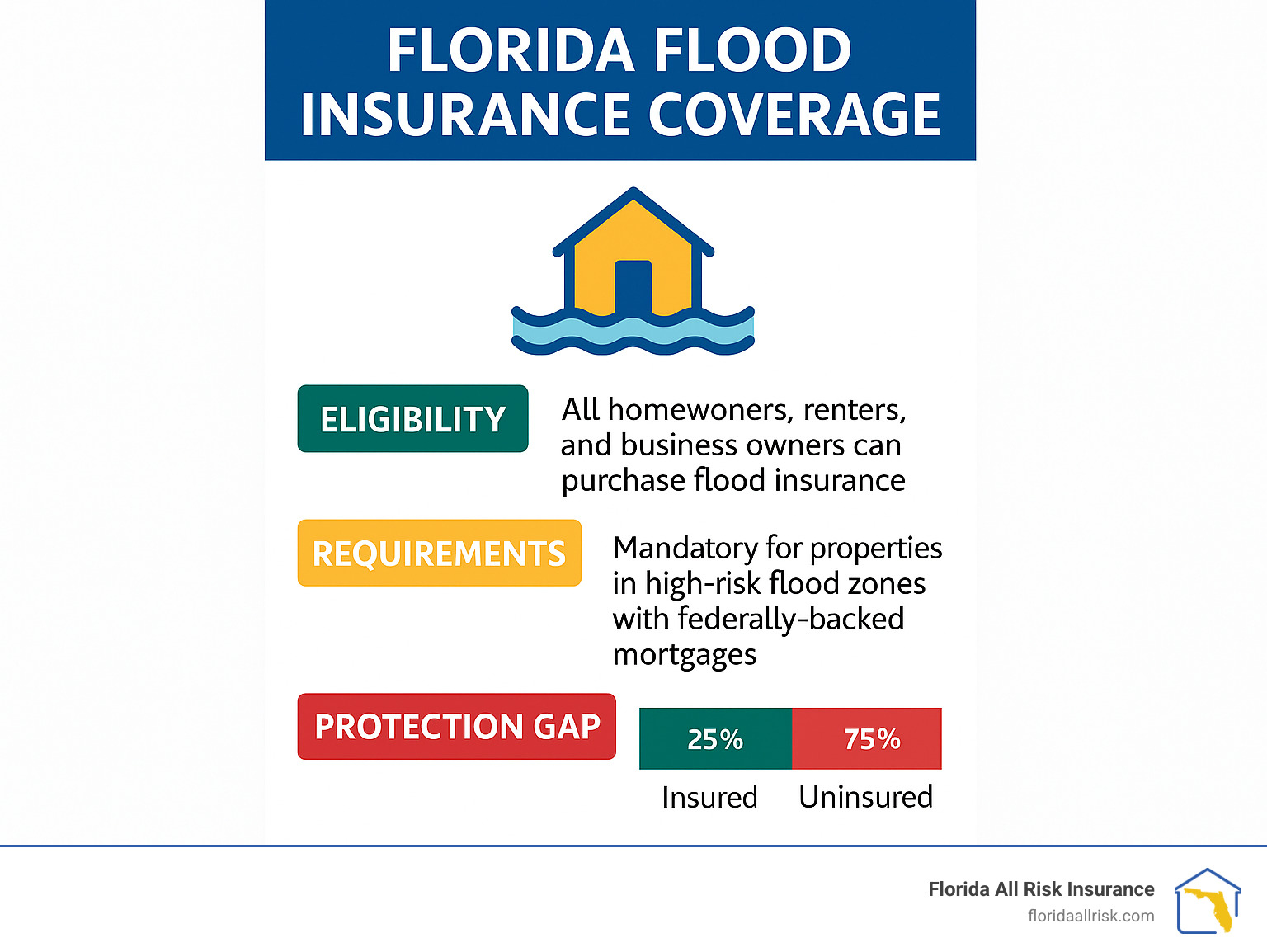
- Eligibility: All Florida homeowners, renters, and business owners can purchase flood insurance
- Providers: Available through NFIP (federal) or private insurance companies
- Requirements: Mandatory for properties in high-risk flood zones with federally-backed mortgages
- New mandate: Citizens Property Insurance policyholders must now purchase flood insurance by phased deadlines through 2027
- Average cost: Approximately $781 per year for NFIP policies in Florida
If it rains in Florida, it can flood. This simple truth is something many homeowners find too late – after water has already damaged their property. Just one inch of floodwater can cause more than $25,000 in damage, yet standard homeowners insurance policies don’t cover flooding. With Florida’s unique geography and climate, flood insurance isn’t just recommended – it’s essential.
Florida faces some of the highest flood risks in the nation, yet approximately 7 million Florida households remain without flood coverage. Even more concerning, over 25% of flood insurance claims come from properties outside designated high-risk zones, proving that flood damage can happen anywhere in the state.
I’m Jason Miller, and with over 20 years of experience helping Florida homeowners steer flood insurance options, I’ve seen how proper coverage can save families from financial disaster after a flood event. At Florida All Risk Insurance, we specialize in helping homeowners understand if they can buy flood insurance in Florida that meets their specific needs.
Learn more about can you buy flood insurance in florida:
– fema flood zone map
– flood insurance for condos
– do all homes in florida require flood insurance
Can You Buy Flood Insurance in Florida?
Yes, you can buy flood insurance in Florida – not just “can” but probably “should.” Florida actually leads the nation in NFIP policies, with about 19% of Florida households carrying flood insurance (second only to Louisiana).
Getting flood protection in Florida is straightforward through two main options:
The National Flood Insurance Program (NFIP) offers federally-backed coverage managed by FEMA. These standardized policies protect homeowners, renters, and businesses in participating communities throughout Florida.
Private flood insurance is also booming in Florida, with many carriers offering more flexible options, potentially lower premiums, and higher coverage limits than what you’ll find with NFIP policies.
What makes Florida unique is our recent groundbreaking legislation – we’ve become the first state to mandate flood insurance for many homeowners regardless of their flood zone. This change primarily affects Citizens Property Insurance policyholders and will roll out gradually over four years.
As one consumer advocate noted, “It’s probably a good idea to mandate people to have flood insurance. It might be a financial burden for some families, but how do you recover from flood-related storm damage if you have no coverage?”
The good news is that every Florida community participates in the NFIP, making every property in our state eligible for flood coverage. This universal availability is crucial considering our vulnerability to flooding from hurricanes, tropical storms, heavy rainfall, and even coastal king tides.
Learn more about NFIP benefits and eligibility
Who qualifies & when is it required?
While anyone can buy flood insurance in Florida, there are specific situations where it becomes mandatory:
If your home sits in a Special Flood Hazard Area (SFHA) – typically zones A, AE, or VE on FEMA flood maps – and you have a federally backed mortgage, your lender will require flood insurance.
Citizens Property Insurance policyholders now face a phased mandate requiring flood insurance according to this timeline:
– Starting April 1, 2023: Properties with $600,000+ dwelling coverage
– Starting January 1, 2024: Properties with $500,000+ dwelling coverage
– Starting January 1, 2025: Properties with $400,000+ dwelling coverage
– Starting January 1, 2026: Properties with $300,000+ dwelling coverage
– Starting January 1, 2027: All remaining properties
Additionally, if you’ve received federal disaster assistance after a flood and want to remain eligible for future aid, you’ll need to maintain flood insurance.
Even if you’re not in a high-risk zone, I strongly recommend considering flood coverage. More than 25% of flood claims come from properties in moderate to low-risk areas. Plus, the average FEMA disaster assistance payout in Florida is only about $5,100, compared to the average NFIP claim payment of around $29,000 – a significant difference when you’re trying to rebuild.

More information about flood insurance requirements in Florida homes
“can you buy flood insurance in florida” if you rent?
Yes, renters can absolutely buy flood insurance in Florida – and it’s a smart move considering our state’s flood risks. Your landlord’s policy might cover the building, but it won’t protect any of your personal belongings from flood damage.
As a renter, you have two main options:
The NFIP Contents-Only Policy is specifically designed for renters. These policies cover your personal belongings up to $100,000, with premiums starting as low as $99 per year for properties in moderate to low-risk areas.
Private Market Renter Policies are also available from several insurers offering flood insurance endorsements or standalone policies, often with more flexible coverage options and competitive rates.
For Florida renters, flood insurance makes particular sense because many rental properties sit in coastal or low-lying flood-prone areas. The average renter owns approximately $30,000 worth of personal property – replacing flood-damaged belongings without insurance can be financially devastating, especially when contents coverage is surprisingly affordable in moderate-risk zones.
When shopping for flood insurance as a renter, take time to inventory your belongings to determine appropriate coverage amounts. That certain high-value items like jewelry may have coverage limits and might require additional protection through riders or endorsements.
Comparing Policy Options: NFIP vs. Private Market
When looking into whether can you buy flood insurance in Florida, you’ll quickly find you have two main paths: the federal government’s National Flood Insurance Program (NFIP) or the growing private insurance market. Let’s break down how these options compare so you can make the best choice for your home and budget.
| Feature | NFIP Policies | Private Market Policies |
|---|---|---|
| Coverage Limits | $250,000 building/$100,000 contents | Often higher limits available |
| Waiting Period | Typically 30 days | As little as 10-14 days, sometimes less |
| Additional Living Expenses | Not covered | Often included |
| Basement Coverage | Limited | More comprehensive options |
| Pricing Model | Risk Rating 2.0 | Company-specific algorithms |
| Availability | All Florida communities | Varies by company and location |
| Claims Payment | Backed by federal government | Depends on company financial strength |
NFIP Policies
Think of NFIP policies as the classic, reliable option that’s been around since 1968. These government-backed policies offer standardized coverage that works like a safety net for millions of Florida homeowners.
With an NFIP policy, your home’s structure is protected up to $250,000. This covers everything from your foundation and electrical systems to your built-in appliances and permanently installed carpeting. For your personal belongings, you’ll get up to $100,000 in coverage for furniture, clothing, electronics, and other possessions.
One thing to note about NFIP policies is that they use separate deductibles for building and contents coverage, typically ranging from $1,000 to $10,000. The higher your deductible, the lower your premium – but the more you’ll pay out of pocket if you file a claim.
In 2021, FEMA rolled out its new Risk Rating 2.0 system, which was a game-changer for how flood insurance is priced. Instead of just looking at flood zone maps, this system considers your specific property characteristics like elevation, distance to water, and rebuilding costs. It’s a more personalized approach that can benefit some homeowners while potentially increasing costs for others.
Private Market Policies
Florida’s private flood insurance market has blossomed in recent years, offering more choices and often more flexibility than you might expect. These policies tend to shine when it comes to customization and sometimes pricing.
Private market options typically come in several flavors:
Standard Policies mirror NFIP coverage but might offer better pricing for certain properties. Preferred Policies provide improved protection for homes in moderate to low-risk areas. If you want something custom specifically to your situation, Customized Policies let you pick and choose coverage elements, while Flexible Policies can be adjusted based on your needs and budget constraints.
Many homeowners don’t realize that private insurers often include additional living expenses coverage – something NFIP policies don’t offer. This can be a lifesaver if a flood forces you out of your home and you need to pay for temporary housing.
Another advantage of private policies is the shorter waiting period – sometimes as little as 10-14 days compared to NFIP’s standard 30-day wait. When hurricane season is approaching, those extra two weeks can make all the difference.
For Citizens Property Insurance policyholders facing Florida’s new flood insurance mandate, there’s good news: both NFIP and private market options will satisfy the requirement. This gives you the freedom to shop around and find the best coverage for your specific situation.

More information about the best flood insurance options in Florida
Latest data from Florida Office of Insurance Regulation
How Much Does Flood Insurance Cost & How to Save
When Florida homeowners ask me “can you buy flood insurance in Florida?” their next question is almost always about cost. I get it – budget matters, especially in today’s economy.
The average NFIP flood policy in Florida runs about $781 per year (roughly $65 monthly), but I’ve seen premiums vary dramatically based on several factors that affect your specific situation.
Key Factors Affecting Your Florida Flood Insurance Premium:
Your flood zone makes a huge difference in what you’ll pay. Properties in Zone X (moderate to low risk areas) typically see premiums between $500-$700 annually. If you’re in Zones A or AE (high-risk areas), expect to pay $1,000-$2,000. And those coastal high-risk Zone VE properties? Those premiums often start at $2,000 and can go much higher.
Beyond your flood zone, your premium depends on your home’s unique characteristics. How high is your home above the Base Flood Elevation? What year was it built? Is it one story or two? Do you have a basement or crawlspace? Where are your utilities and mechanical systems located? All these details matter.
Of course, the coverage amounts you select will directly impact your costs. Higher building and contents coverage limits, along with lower deductibles, mean higher premiums.
Back in 2021, FEMA rolled out their Risk Rating 2.0 system, which was a game-changer in how flood insurance is priced. Instead of just looking at flood zone maps, they now consider each property’s specific flood risk factors – like your exact elevation, how close you are to water sources, and what it would cost to rebuild your home.
Strategies to Save on Florida Flood Insurance:
Here’s some good news – there are several ways to potentially lower your flood insurance costs. One of the most effective is getting an Elevation Certificate. This document officially verifies how high your property sits relative to the Base Flood Elevation. If your home is higher than the minimum requirement, you might see significant savings.
You can also implement flood mitigation measures that insurance companies love to see. Consider lifting water heaters and HVAC systems, installing flood vents in foundation walls, or using basements only for storage rather than living space. Some homeowners even lift their entire structure above the Base Flood Elevation – an investment that can pay off through dramatically lower premiums year after year.
Another simple approach is adjusting your deductible. Opting for a higher deductible typically lowers your annual premium, but make sure you have enough savings to cover that amount if you need to file a claim. I’ve seen too many homeowners caught short when flood damage occurs.
If you’re fortunate enough to be in a moderate to low-risk area, ask about NFIP’s Preferred Risk Policy. These policies often come with substantially lower premiums while still providing essential protection.
Don’t forget to compare NFIP and private market options. I’ve found that private insurers sometimes offer better rates for certain properties, especially those in lower-risk areas or with favorable characteristics. As an independent agency, we can help you shop multiple options.
Finally, whatever you do, maintain continuous coverage. Letting your policy lapse can affect your eligibility for certain programs and favorable rates down the road.
Under Risk Rating 2.0, premium increases are capped at 18% annually until you reach the full risk-based rate. This means some homeowners see gradual increases over time, while others might experience immediate savings.
More information about flood insurance costs in Florida
Scientific research on flood insurance rate setting
Step-by-Step Guide to Buying & Filing Claims
Wondering “can you buy flood insurance in Florida” and how to steer the process? I’ve helped hundreds of Florida homeowners through this journey, and I’m breaking it down into simple steps that anyone can follow.
Purchasing Flood Insurance in Florida:
Getting flood insurance in Florida isn’t complicated once you know the steps. Think of it as a journey with clear signposts along the way.
First, you’ll want to determine your flood risk. Check your property’s flood zone using FEMA’s Flood Map Service Center, but don’t stop there. Consider local flooding history beyond the official maps and assess your property’s elevation and proximity to water bodies. Even “low-risk” areas in Florida can flood during heavy storms.
Next, it’s time to choose your provider. You can contact your current homeowners insurance agent to discuss NFIP options, or explore private market alternatives through an independent agent like us. I always recommend comparing quotes from multiple sources to find the best coverage and rates for your specific situation.
When you’re ready to apply for coverage, you’ll complete an application with your selected provider. Be prepared to provide detailed property information, including construction details and elevation data. Most providers require annual payment upfront, though some carriers do offer payment plans to make it more budget-friendly.
Now comes the waiting period – and this is important. NFIP policies typically have a 30-day waiting period before coverage begins, while private policies may have shorter waiting periods of 10-14 days or sometimes less. There are exceptions to these waiting periods for properties newly mapped into high-risk zones or when flood insurance is required for a mortgage closing.
Once your policy is active, take time to review your policy documents carefully. Check your declarations page and policy terms, verify your coverage limits and deductibles, and make sure you understand what is and isn’t covered. This step might seem tedious, but it’s crucial for avoiding surprises when you need to file a claim.

Filing a Flood Insurance Claim:
When the unthinkable happens and your property floods, knowing how to file a claim properly can make all the difference in your recovery experience.
After a flood, take immediate action to document everything. Snap photos and videos of all damage before beginning cleanup. Create a detailed inventory of damaged items with estimated values, and save samples of damaged materials like carpet and drywall. Contact your insurance provider as soon as possible – don’t delay this critical step.
Your next move is to file a Notice of Loss with your insurer. For NFIP policies, this must be done as soon as reasonably possible. Think of this as officially raising your hand to say, “I’ve experienced a loss and will be filing a claim.”
Then, prepare for the adjuster visit by compiling documentation of damaged items and property. Gather any available receipts for high-value items, and be ready to show the adjuster all areas of damage. The more organized you are, the smoother this process will go.
One of the most important steps is to submit a Proof of Loss form. For NFIP policies, this must be submitted within 60 days and should include detailed damage estimates and supporting documentation. This is your official claim for damages and is required before any payment can be issued.
Finally, you’ll move to claim resolution and payment. Review the adjuster’s assessment and damage estimate carefully. Don’t hesitate to negotiate if you believe the estimate doesn’t fully cover your losses. Once approved, you’ll typically receive payment within 30-60 days.
If you disagree with the claim decision, both NFIP and private policies have appeals processes. For NFIP policies, you can appeal through FEMA’s National Flood Insurance Program. For private policies, the Florida Office of Insurance Regulation can guide you through dispute resolution.
Flood insurance claims are entirely separate from any federal disaster assistance you might receive. Document everything carefully and maintain open communication with your provider throughout the process.
Get a personalized flood insurance quote
Frequently Asked Questions about Flood Insurance in Florida
Can you buy flood insurance in Florida outside high-risk zones?
Yes, you can buy flood insurance in Florida regardless of your flood zone designation. This is actually one of the smartest moves you can make as a Florida property owner, even if your home isn’t in an area considered high-risk.
Here’s why it makes sense: about a quarter of all flood insurance claims through the NFIP come from properties outside high-risk zones. Mother Nature doesn’t always respect the boundaries on flood maps! The good news is that if you’re in a moderate to low-risk area, your premiums will typically be much more affordable—often between $500-$700 per year.
The NFIP offers special Preferred Risk Policies with great rates for properties in these lower-risk zones. Think of it as a reward for being proactive rather than reactive. And remember, Florida’s landscape is always changing—new development, shifting weather patterns, and even road construction can alter how water flows during heavy rains.
Even when your mortgage lender doesn’t require flood coverage, the peace of mind is worth every penny. After all, flooding doesn’t just come from hurricanes or overflowing rivers—it can happen from a heavy afternoon thunderstorm overwhelming storm drains or even new construction changing how water drains in your neighborhood.
How long before coverage starts after I buy flood insurance in Florida?
Most new flood policies come with a 30-day waiting period before coverage kicks in. This isn’t the insurance companies being difficult—it’s to prevent folks from waiting until the weather forecast looks ominous before getting coverage.
The good news is there are several exceptions to this waiting period:
If you’re buying a new home or refinancing, your flood policy can start on your closing date—no waiting required. Recently moved to a property that’s been newly mapped into a high-risk zone? You might qualify for just a one-day waiting period if you purchase coverage within 13 months of that map change.
For those of you who already have flood insurance, there’s no waiting period when you renew, as long as you pay before your current policy expires. And in rare cases involving flooding on federal lands affected by wildfires, the waiting period might drop to just one day.
Private flood insurance companies often offer shorter waiting periods than the NFIP—typically 10-14 days, and sometimes as little as a week or even immediate coverage. This can be a real advantage during hurricane season when you need protection quickly.
My best advice? Don’t wait for storm clouds to gather. Get your flood policy in place well before the start of hurricane season. As we say in Florida, “The best time to buy flood insurance was yesterday. The second-best time is today.”
Is flood insurance the same as hurricane or wind coverage?
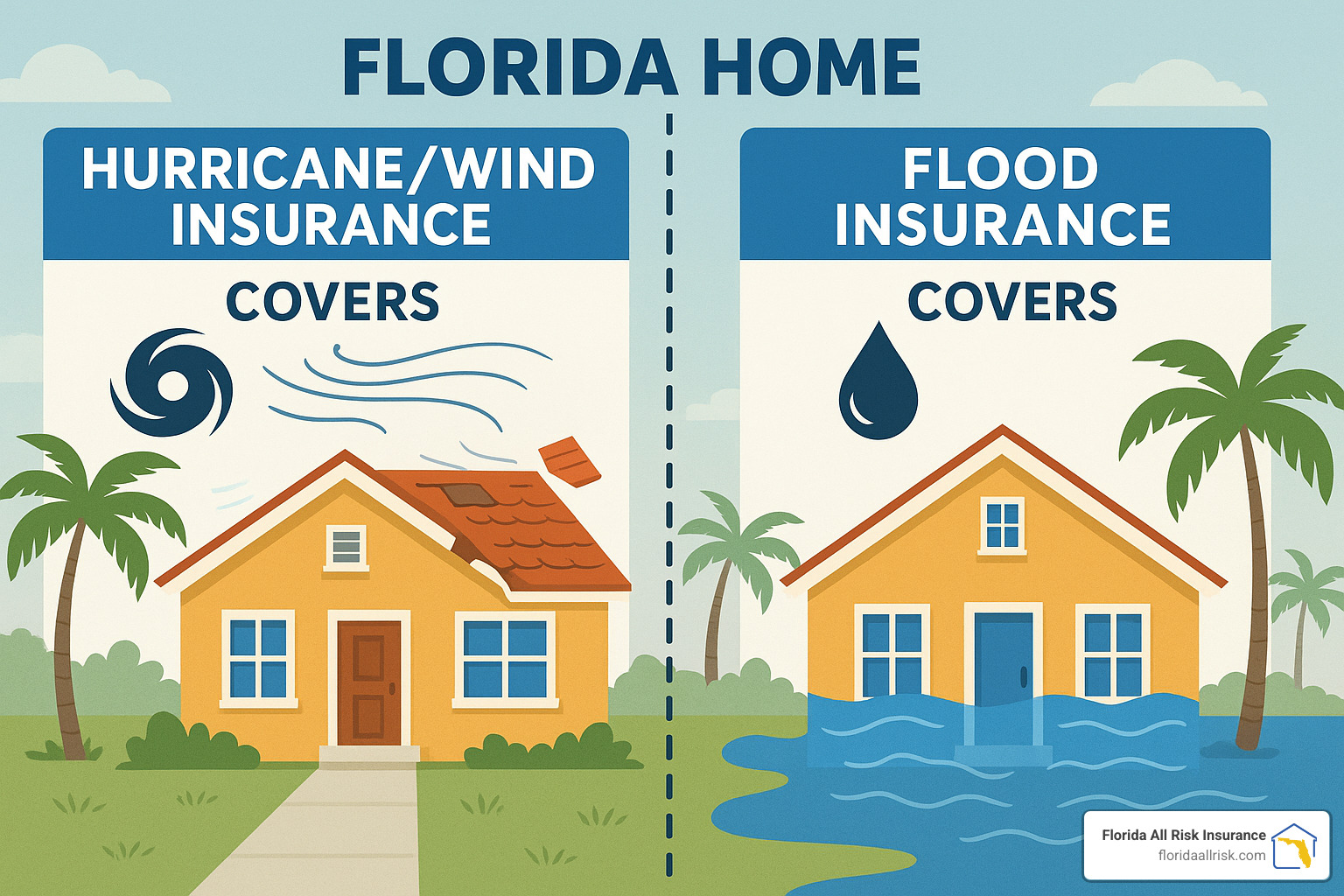
No, flood insurance and hurricane/wind coverage are completely separate types of insurance that protect against different perils. This misunderstanding has unfortunately left many Florida homeowners with devastating gaps in coverage.
Your hurricane or wind insurance (whether part of your homeowners policy or a separate wind policy) covers damage from wind—things like torn-off roofs, broken windows, and damage from flying debris. But here’s the critical part: it does NOT cover rising water or storm surge, even if that water entered your home because of a hurricane.
Flood insurance, on the other hand, specifically covers damage caused by rising water from any source. This includes storm surge, heavy rainfall, or overflowing water bodies. You’ll need to purchase this as a separate policy, either through the NFIP or a private insurer.
Hurricane Ian in 2022 provided a painful lesson for many Florida homeowners. Some found that while their hurricane policy covered wind damage to their roof, it didn’t cover the water damage that occurred when floodwaters rose into their homes.
To be fully protected in our beautiful but sometimes temperamental Florida climate, you really need both types of coverage. During hurricanes, determining whether damage was caused by wind or water can get complicated and contentious. Having both policies in place ensures you’re covered regardless of how the damage occurred.
Conclusion
When it comes to the question “can you buy flood insurance in Florida,” the answer is a resounding yes—and for most Florida property owners, it’s not just possible but essential. With our state’s unique geography, unpredictable weather patterns, and increasing flood risks, having proper flood coverage isn’t a luxury—it’s a necessity.
Think about it: Florida is practically surrounded by water, with countless lakes, rivers, and wetlands dotting our landscape. Add in our hurricane season and summer downpours, and you’ve got a recipe for potential flooding just about anywhere in the state.
Let’s recap what we’ve learned about flood insurance in Florida:
First, every Florida property owner can purchase flood insurance—whether you own a beachfront mansion, a suburban home miles from water, or rent an apartment. Your flood zone doesn’t limit your ability to buy coverage, though it may affect your premium.
You have options for coverage through both the National Flood Insurance Program (NFIP) and a growing private market. This competition gives you more choices and potentially better rates depending on your specific situation.
Be aware that requirements are changing. If you’re a Citizens Property Insurance policyholder, you’ll need to add flood insurance by the deadline that applies to your property value (phasing in through 2027). This groundbreaking legislation makes Florida the first state to mandate such coverage.
From a cost perspective, flood insurance is surprisingly affordable protection for most homeowners. With average premiums of $781 annually—and often much lower in moderate-risk zones—it’s a small price to pay compared to the devastating financial impact of flood damage. Just one inch of floodwater can cause more than $25,000 in damage to your home.
Perhaps most importantly, flood insurance is completely separate from hurricane coverage. This distinction catches many Florida homeowners by surprise when they find their standard homeowners policy doesn’t cover water damage from rising floodwaters—even during a hurricane.
I’ve seen how families without flood insurance have struggled to rebuild after a flood event. The harsh reality is that approximately 7 million Florida households remain unprotected, and with more than 25% of flood claims coming from outside high-risk zones, no area of our state is truly immune to flood risk.
At Florida All Risk Insurance, we understand the complexities of Florida’s flood insurance landscape. Our team provides personalized guidance and access to multiple carriers, helping you find the right flood policy for your specific needs and budget. We’ll walk you through both NFIP and private market options, explaining the pros and cons of each so you can make an informed decision.
Don’t wait until storm clouds are gathering or hurricane warnings are issued—by then, it’s too late to buy coverage due to waiting periods. Reach out today, and let us help you protect what matters most from Florida’s next flood event.

