

Buy workers compensation policy: Secure 2025
Why Every Florida Business Owner Needs Workers’ Compensation Protection
When you’re ready to buy workers compensation policy, you’re making a smart decision to protect your employees and your bottom line from the high cost of workplace injuries. This coverage is essential for nearly every business with a team.
Quick Guide to Buy Workers Compensation Policy:
- Assess your legal requirements – Most Florida businesses with employees must carry coverage.
- Gather business information – Have your FEIN, payroll estimates, and job descriptions ready.
- Contact a licensed agent – Get expert guidance and quotes from multiple carriers.
- Compare coverage options – Review policy limits, deductibles, and carrier ratings.
- Purchase and maintain coverage – Keep your policy active to avoid severe penalties.
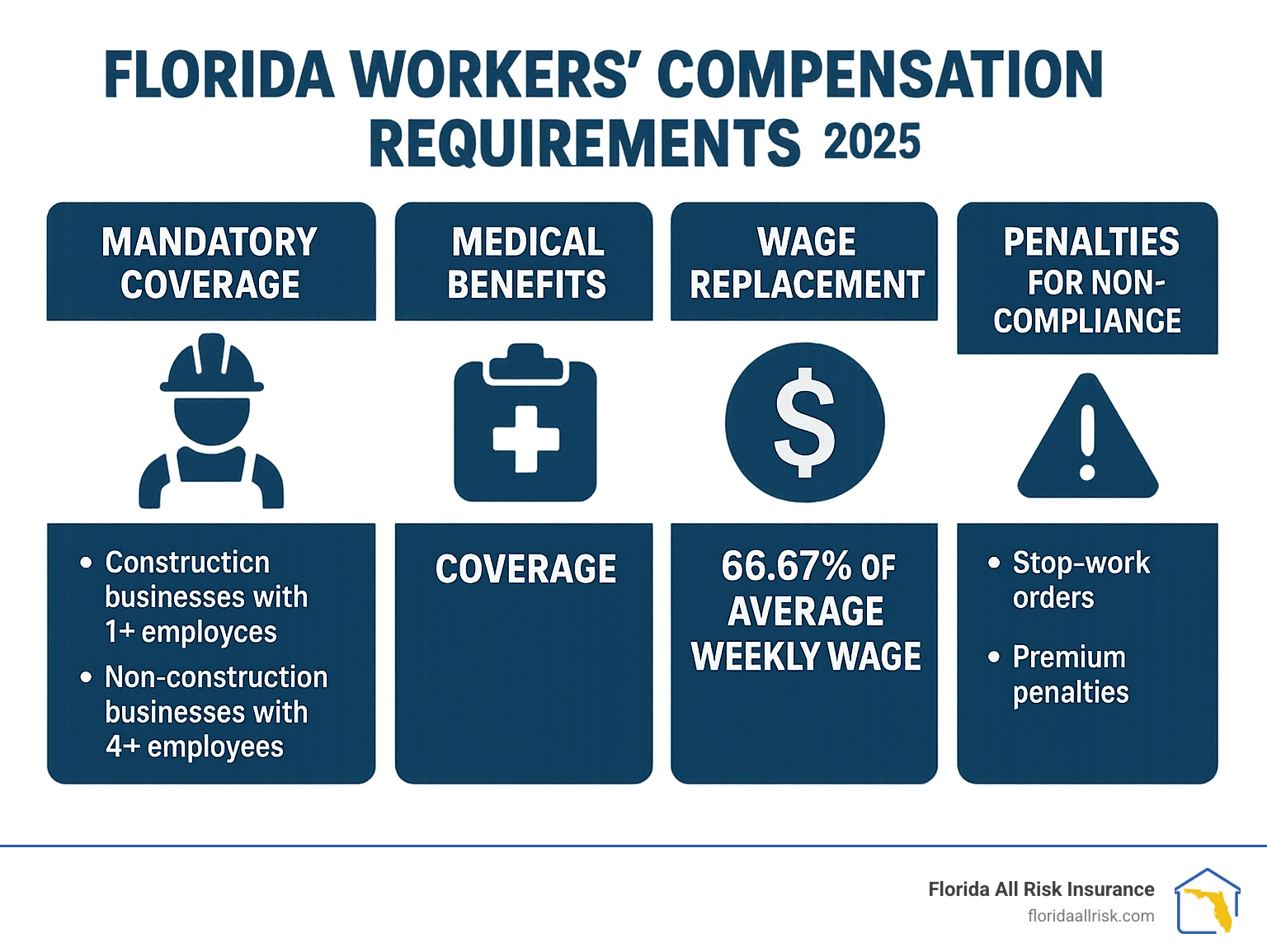
Workplace accidents are a constant risk, from slips in an office to injuries on a construction site. In Florida, the stakes are high, as the state mandates coverage for most employers and enforces steep penalties for non-compliance, including stop-work orders and crippling fines.
The good news is that securing coverage is affordable. The national median cost for workers’ compensation is just $80 per month, with some policies starting as low as $13 monthly. With the right guidance, you can find protection that keeps your business compliant and your employees safe.
I’m Jason Miller, and with over 20 years of experience, I’ve helped thousands of Florida business owners find a workers’ compensation policy that fits their needs and budget. My family has served Florida’s insurance needs for over 60 years combined, giving me deep insight into protecting businesses in our state.
What is Workers’ Compensation and Why Is It Non-Negotiable?
When you buy workers compensation policy, you’re investing in a no-fault system designed to protect everyone when an employee gets injured or ill on the job. It acts as a financial safety net, covering medical bills and lost wages without a lengthy legal battle over who was at fault.
This coverage works both ways: your employee receives necessary medical care and financial support, while your business is shielded from potentially devastating lawsuits. In exchange for guaranteed benefits, employees generally give up the right to sue their employer for negligence. This makes workers’ comp non-negotiable—it’s not just about following the law, but about business survival.
In Florida, carrying this insurance is a legal requirement for most businesses with employees. Ignoring this can lead to stop-work orders, hefty fines, and even felony charges. For more on how this fits into your overall protection, see our guide on Business Insurance for Small Businesses.
What Workers’ Compensation Typically Covers
A comprehensive workers’ comp policy provides a lifeline for your employees and a shield for your business. Key coverages include:
- Medical Expenses: Covers all necessary medical care, including doctor visits, hospital stays, surgery, and prescriptions, with no deductibles or co-pays for the employee.
- Lost Wages: Replaces a portion of the employee’s lost income while they are unable to work. In Florida, this is typically about two-thirds of their average weekly wage.
- Rehabilitation Costs: Pays for physical and occupational therapy to help employees regain their strength and skills.
- Disability Benefits: Provides financial support for both temporary and permanent disabilities that impact an employee’s ability to earn a living.
- Vocational Rehabilitation: Covers retraining costs if a severe injury prevents an employee from returning to their previous job.
- Death Benefits: Offers financial support to an employee’s dependents, including funeral expenses, in the event of a fatal work-related incident.
- Employer’s Liability: Protects your business by covering legal defense costs if an employee or their family sues outside the workers’ comp system.
What is Generally NOT Covered by Workers’ Comp
It’s also important to understand what workers’ compensation doesn’t cover. Exclusions typically apply to injuries that are not directly work-related or involve misconduct. Common exclusions include:
- Commuting Injuries: Accidents that occur during the daily commute to and from work.
- Self-Inflicted Injuries: Injuries that are intentionally caused by the employee.
- Injuries from Intoxication: Incidents where the employee was under the influence of drugs or alcohol.
- Violation of Company Policy: Injuries sustained while an employee was knowingly violating a clear safety rule.
- Horseplay: Injuries resulting from pranks or fighting unrelated to job duties.
- Criminal Acts: Injuries that occur while an employee is committing a crime.
Who Needs a Policy? Understanding State Mandates
Whether you need to buy workers compensation policy depends on your state’s laws and how many people you employ. Nearly every state requires it, but the employee threshold varies. Some states mandate coverage from the first hire, while others wait until you have three or five employees.
Ignoring these requirements can destroy a business. Penalties are severe and may include:
- Significant Fines: Daily penalties can accumulate into tens or hundreds of thousands of dollars.
- Stop-Work Orders: Your entire operation can be shut down until you obtain coverage.
- Lawsuits: Without coverage, you lose protection from employee lawsuits, exposing your business to unlimited liability for medical bills, lost wages, and pain and suffering.
- Personal Liability: Business owners can become personally responsible for an injured employee’s costs, putting personal assets at risk.
- Criminal Charges: Willful non-compliance can be treated as a felony in some states.

Florida’s Workers’ Compensation Requirements
As a St. Petersburg-based agency, we have deep expertise in Florida’s unique workers’ compensation laws, which are based on industry type.
- Construction Industry: You are required to have coverage if you have one or more employees, including corporate officers. The state recognizes the high-risk nature of construction and mandates immediate protection.
- Non-Construction Businesses: The requirement begins when you have four or more employees, including full-time, part-time, and corporate officers.
Florida allows for corporate officer exemptions, but these are not automatic and require specific filings with the Division of Workers’ Compensation. Failure to comply can lead to unexpected liabilities. The state actively enforces these rules, so it’s crucial to get it right. For official details, visit the Florida Division of Workers’ Compensation page on obtaining insurance coverage.
Exemptions for Specific Workers and Business Owners
Understanding who counts as an “employee” is key. While some workers may be exempt, it’s often wise to secure coverage anyway.
- Sole Proprietors and Partners: Generally exempt if they have no other employees, but they can elect to be covered. This is a smart choice, as personal health insurance may not cover work-related injuries and won’t replace lost income.
- Independent Contractors: Typically not covered, but misclassifying an employee as a contractor can lead to severe penalties. If a worker who receives a 1099 looks and acts like an employee, the state may reclassify them, making you liable for their injuries. It’s best practice to require contractors to provide proof of their own insurance.
- Volunteers and Family Members: Rules vary by state, but these individuals are often exempt under specific conditions.
Even if you are legally exempt, many clients, especially in construction, will require you to show proof of workers’ compensation insurance before hiring you.
How to Buy a Workers Compensation Policy: A Step-by-Step Guide
Shopping for workers’ compensation insurance is like any major business purchase—it pays to compare your options. While you can go directly to carriers, most small businesses find that working with an independent agent provides the best combination of choice, expertise, and competitive pricing. If you’re in a high-risk industry, states have assigned risk pools to ensure you can get the coverage you need.
Here’s a simple guide to get started.
Step 1: Assess Your Business Needs and Risks
Before seeking quotes, understand the risks specific to your business. An insurer needs to know exactly what they are covering.
- Analyze Job Roles: Document the daily tasks of your employees. The risks for an office worker are far different from those for a roofer, and this will be reflected in your rates.
- Identify Industry Risks: Acknowledge the inherent risks of your industry. Healthcare workers face different hazards than manufacturing employees or retail staff.
- Review Your Operations: Consider all aspects of your business, including employee count, seasonal workers, and remote employees, as these factors influence your coverage needs.
Step 2: Gather Necessary Business Information
Having your information organized upfront will ensure you receive accurate quotes. Be prepared to provide:
- Business Details: Your Federal Employer Identification Number (FEIN) and business structure (LLC, S-Corp, etc.).
- Estimated Annual Payroll: This is a primary factor in calculating your premium. Provide accurate estimates broken down by job classification.
- Employee Job Descriptions: Specific descriptions help ensure your employees are assigned the correct, most cost-effective classification codes.
- Claims History: If you’ve had coverage before, your loss run reports will show your claims history. A clean record can lead to better rates.
Step 3: Find an Agent and Get Quotes
Working with an independent insurance agent simplifies the process and often yields better results. As an independent agency, we shop the market on your behalf, giving you access to multiple quotes from top-rated carriers.
When comparing options, look beyond the price. Evaluate policy limits, deductibles, and insurer ratings for financial stability. A cheaper policy isn’t better if it has coverage gaps or is with an unstable company. We handle the legwork, explain the differences in plain English, and serve as your advocate to find the right protection at the right price. We can also assist with other policies, including Business Insurance Quotes in Tampa and across Florida.
Decoding the Cost: What Factors Influence Your Premium?
One of the first questions business owners ask is, “How much will this cost?” You might be surprised by the affordability. With some policies starting as low as $13 a month and a national median of just $80 per month in 2024, protection is within reach. Better yet, rates have been decreasing for seven consecutive years.
Your premium is calculated based on several key factors:
- Payroll Size: The larger your total annual payroll, the higher your premium will be, as benefits are tied to wage replacement.
- Class Codes: The National Council on Compensation Insurance (NCCI) assigns a risk code to every job type. An office worker has a low-risk code and rate, while a roofer has a high-risk code and rate. Correct classification is crucial for fair pricing.
- Experience Modification Rate (E-mod): This is a score that reflects your company’s safety record compared to others in your industry. A good safety record (E-mod below 1.0) earns you a discount, while a poor record (E-mod above 1.0) results in a surcharge.
- Industry Risk: High-risk industries like construction and manufacturing naturally have higher base rates than lower-risk sectors like professional services.
For help finding affordable coverage, explore our guidance on Cheap Business Insurance options that don’t sacrifice protection.
How to Potentially Lower Your Workers’ Comp Costs
Proactive business owners can take several steps to reduce their workers’ compensation premiums:
- Implement a Formal Safety Program: A written safety manual, regular training, and a commitment to a safe workplace are the most effective ways to reduce accidents and lower your E-mod over time.
- Maintain Accurate Records: Ensure your payroll is correct and employees are properly classified. Misclassifying an office worker in a higher-risk category can lead to years of overpayment.
- Develop a Return-to-Work Program: A structured plan to bring injured employees back to light-duty work can significantly reduce the cost of a claim.
- Create a Drug-Free Workplace: In Florida, having a certified drug-free workplace program can earn you a premium discount.
- Shop Your Policy Annually: The insurance market is always changing. As an independent agency, we can compare rates from multiple carriers each year to ensure you’re always getting a competitive price.
- Consider Pay-As-You-Go: This option bases your premium payments on your actual payroll each pay period, improving cash flow and preventing large audit bills at the end of the year.
Workers’ Comp vs. Other Key Business Insurance Policies
Building a solid insurance portfolio means understanding how different policies work together to protect you from various risks. Workers’ compensation is a critical piece, but it’s designed to work alongside other policies like general liability and commercial auto. Knowing which policy responds to which event is key to avoiding costly coverage gaps.
We can help you explore all types of Business Liability Insurance to ensure you’re fully protected.
How to buy a workers compensation policy vs. General Liability
Many business owners confuse workers’ compensation and general liability insurance. Both cover injuries, but the key difference is who is injured.
- Workers’ Compensation covers your employees for injuries or illnesses sustained on the job. It’s a no-fault system.
- General Liability covers third parties (customers, vendors, etc.) for bodily injury or property damage caused by your business operations. It’s based on negligence.
Here’s a simple comparison:
| Feature | Workers’ Compensation Insurance | General Liability Insurance |
|---|---|---|
| What it Covers | Employee injuries or illnesses sustained on the job | Third-party bodily injury or property damage caused by your business operations, products, or services |
| Who it Protects | Your employees (medical, wages) and your business (from employee lawsuits) | Your business (from third-party lawsuits) |
| Is it Mandated? | Yes, legally required in almost every state if you have employees | Not typically state-mandated, but often required by contracts or landlords |
| Example Scenario | An employee slips on a wet floor in your office and breaks their arm | A customer slips on a wet floor in your office and breaks their arm |
You need both policies, as they protect against entirely different risks.
Workers’ Comp vs. Disability and Health Insurance
These three policies all relate to health, but they apply in different circumstances:
- Workers’ Compensation: Covers medical bills and lost wages for work-related injuries and illnesses. It is paid for by the employer.
- Disability Insurance: Replaces income for injuries or illnesses that happen outside of work. It does not cover medical bills.
- Health Insurance: Pays medical bills for non-work-related health issues. It does not replace lost wages.
Understanding these distinctions ensures you and your employees have the right protection in place, no matter what happens. For more authoritative information, the U.S. Department of Labor’s workers’ compensation page is an excellent resource.
Frequently Asked Questions about Workers’ Compensation
After helping thousands of Florida businesses buy workers compensation policy, we’ve heard the same questions time and again. Here are the straight answers to the most common concerns.
How does the claims process work in practice?
The claims process is straightforward if you know the steps:
- Employee Reports Injury: The injured worker must report the incident to you as soon as possible.
- Employer Files Report: You must file a “First Report of Injury” with your insurance carrier and the state. This should be done within a few days.
- Insurer Investigates: The insurance company reviews the details to confirm the injury is work-related and covered by the policy.
- Benefits are Paid: Once approved, the policy covers medical treatment directly. If the employee is unable to work, lost wage benefits will also be paid.
- Return to Work: The goal is to help the employee recover and return to work safely, sometimes with modified or light-duty tasks during recovery.
Do I need workers’ comp for independent contractors or sole proprietors?
This is a tricky area where mistakes can be costly.
- Sole Proprietors: If you work alone, you are generally not required to have coverage for yourself. However, you can choose to buy a policy to cover your own work-related injuries and lost income, which your personal health insurance likely won’t cover.
- Independent Contractors: You are not required to cover true independent contractors. However, states have strict tests to determine a worker’s status. If you misclassify an employee as a contractor, you could be held liable for their injuries and face significant fines and back-premium penalties. The safest approach is to require all contractors to provide proof of their own workers’ compensation or general liability insurance.
What are the penalties for not carrying required workers’ comp in Florida?
Florida’s penalties for non-compliance are severe and designed to be a powerful deterrent. If caught without required coverage, you could face:
- A Stop-Work Order: The state can shut down your business operations immediately until you comply and pay all penalties.
- Harsh Financial Penalties: A penalty equal to two times the premium you would have paid for the uninsured period.
- Criminal Charges: Willful non-compliance can be prosecuted as a felony.
- Personal Liability: You could be held personally responsible for an injured employee’s medical bills and lost wages, with no limit on the cost.
The cost of compliance is always far less than the cost of getting caught.
Conclusion: Secure Your Business and Your Team Today
It should be clear that buying a workers compensation policy is not just another expense—it’s a fundamental investment in your company’s stability and future. It protects your employees, shields your business from crippling lawsuits, and ensures you comply with Florida law.
With policies starting at affordable rates, the cost of protection is minimal compared to the devastating impact of being uninsured. In Florida, the penalties for non-compliance are severe, including stop-work orders and fines that can shut a business down overnight. Beyond the legal mandate, providing this coverage shows your team that you value their well-being and are committed to running a responsible business.
At Florida All Risk Insurance, our family has served the state’s insurance needs for over 60 years combined. As an independent agency in St. Petersburg, we shop our network of top-rated carriers to find you the best coverage at a competitive price. We’re not just selling a policy; we’re your trusted advisors, here to build a protection strategy that grows with your business.
Don’t wait for an accident or a state inspector to force your hand. The peace of mind that comes from having the right coverage is invaluable.
Ready to protect your business and your team? Let’s get you set up with a workers’ compensation policy that fits your needs and budget. Visit our dedicated page to learn more and get started: Workers’ Compensation Insurance
Want to discuss your specific situation? Contact us today for a personalized consultation and competitive quotes from an experienced agent.
Contact Us
Florida All Risk Insurance
Address: 3301 1st Ave N, St. Petersburg, FL 33713
Phone: (727) 800-4740
Email: [email protected]

