

Business Premises Contents Insurance
What’s Protecting Your Business from the Unexpected?
Business premises contents insurance protects your company’s physical assets—from computers and furniture to inventory and equipment—against damage, theft, and destruction. This essential coverage ensures your business can recover quickly from unexpected disasters without facing financial ruin. It typically covers assets like:
- Office equipment (computers, furniture)
- Inventory and stock
- Tools and machinery
- Fixtures, fittings, and tenant improvements
This protection applies to common perils such as fire, theft, storms, vandalism, and water damage from burst pipes. While many business owners know their inventory value, the cost of replacing everything from laptops to staplers after a disaster can be a staggering, unbudgeted expense.
The statistics are sobering: up to 80% of businesses are underinsured, and 40% are unable to re-open following a disaster because they lack adequate coverage. In Florida’s unpredictable climate, proper business premises contents insurance isn’t just smart—it’s essential for survival.
At Florida All Risk Insurance, our team has guided thousands of business owners through the complexities of commercial coverage. We’ve seen how the right policy can mean the difference between bouncing back quickly and closing permanently, ensuring assets are protected against Florida’s unique risks.
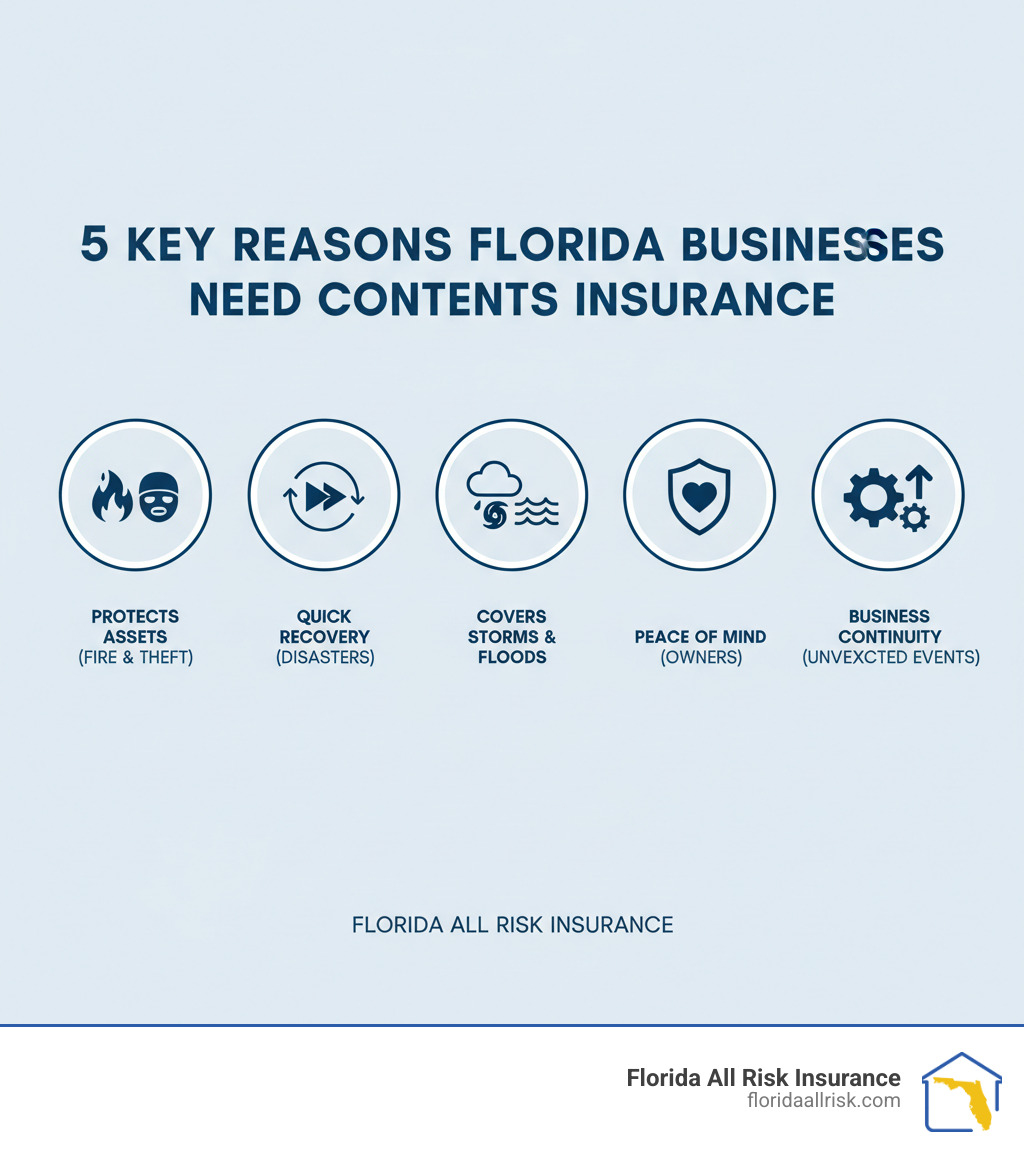
What is Business Contents Insurance and Why Is It Crucial?
Think of business premises contents insurance as a safety net for everything inside your business that keeps it running. This commercial contents insurance protects the physical items you rely on daily, from computers and inventory to tools and furniture. Business owners often overlook the thousands of dollars tied up in the “stuff” that makes their business function. Your laptop, cash register, shelving units, and all your inventory add up to more than you might realize.
For small and medium-sized businesses, this coverage can mean the difference between recovery and permanent closure. The harsh reality is that up to 80% of businesses are underinsured, leaving them vulnerable. In Florida, where hurricanes and floods are a part of life, this protection is even more critical. Your business might survive a storm, but if your contents are destroyed without proper coverage, you could face months of downtime.
This insurance is vital for a wide range of businesses:
- Retail stores need it for merchandise and point-of-sale systems.
- Offices rely on computers and furniture that are costly to replace.
- Restaurants have expensive kitchen equipment and dining furniture.
- Warehouses store valuable goods and use costly machinery.
- Medical practices have specialized, high-value equipment.
- Home-based businesses need it because a standard homeowner’s policy won’t cover business assets.
Who Needs This Essential Coverage?
If your business owns physical items to operate, you need business premises contents insurance. Many business owners mistakenly assume their landlord’s insurance covers their assets. However, a landlord’s policy only covers the building’s structure—the walls, roof, and floors. Everything inside is your responsibility to insure, whether you rent or own the space. This is especially true for Florida businesses facing risks from hurricane season and sudden storms that can destroy electronics and inventory in minutes. Startups with limited cash reserves and established companies with more to lose are equally at risk.
The High Cost of Being Unprepared
Imagine walking into your business after a break-in to find empty shelves or returning after a storm to find a roof leak has ruined your equipment. Without business premises contents insurance, you face a financial nightmare. The immediate cost of replacing everything can reach tens or hundreds of thousands of dollars.
But the damage doesn’t stop there. While you’re replacing your contents, your business isn’t generating revenue, and fixed expenses like rent and loan payments continue. This combination of lost revenue, ongoing expenses, and high replacement costs is why 40% of businesses fail to reopen after a disaster. The businesses that survive are almost always the ones that had proper coverage in place beforehand, a key part of any disaster preparedness plan.
For step-by-step guidance on continuity planning and disaster readiness, review the U.S. government’s comprehensive resource at Ready.gov: Business Continuity Planning, an authoritative primer on preparing to keep your operations running through disruptions.
Decoding Your Coverage: What’s Included and What’s Not?
Your business premises contents insurance policy is a detailed contract, and not all policies are created equal. Understanding the specifics is crucial to ensure you have the protection you expect.
A key distinction is between Named Perils and All-Risk policies. A Named Perils policy only covers losses from dangers explicitly listed in the policy (e.g., fire, theft). If a peril isn’t on the list, you’re not covered. In contrast, an All-Risk policy covers everything except for what is specifically excluded. This generally provides broader, more comprehensive protection, which is why many business owners prefer it. Always read the fine print to know exactly what your policy entails.
What Items Are Covered by Business Premises Contents Insurance?
This insurance is designed to protect the physical assets that keep your business running. While specifics vary, coverage typically includes the following:
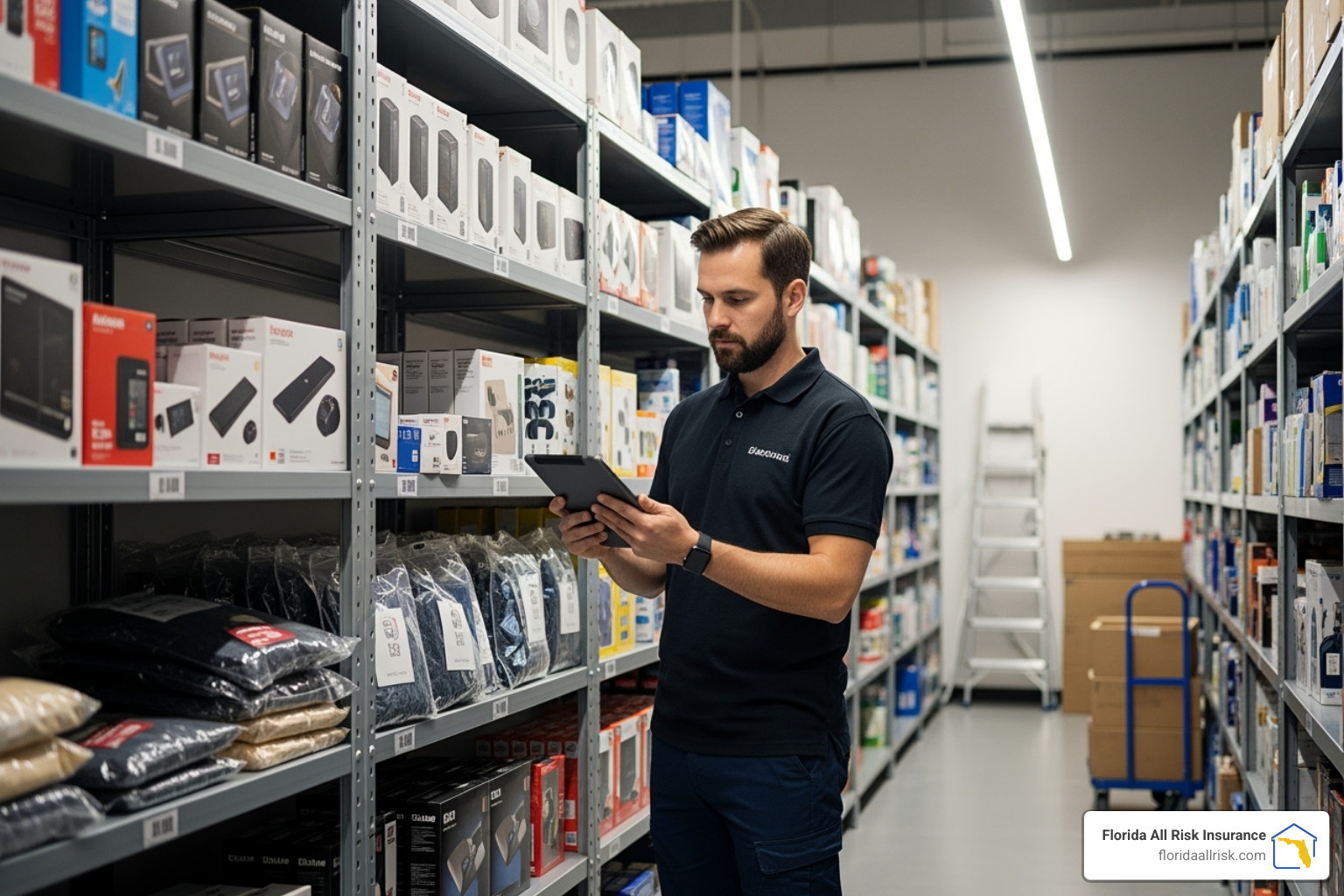
- Office Furniture and Electronics: Desks, chairs, filing cabinets, computers, servers, printers, and point-of-sale systems.
- Machinery and Tools: Production machinery, specialized equipment, hand tools, and kitchen appliances.
- Stock and Inventory: Raw materials, work-in-progress items, and finished goods ready for sale.
- Fixtures and Fittings: Items attached to the building that you could take with you, such as custom shelving, light fixtures, or non-structural partitions.
- Tenant Improvements: Upgrades you’ve made to a leased space, like new flooring or custom cabinetry.
- Documents and Data: The cost to recreate important business records and data (though cyber-related loss often requires a separate policy).
Perils and Events Typically Covered
Your policy acts as a shield against a wide range of unexpected events. Most standard policies cover:
- Fire, Smoke, and Explosions
- Theft and Burglary
- Vandalism and Malicious Damage
- Storm Damage, including wind, hail, and lightning
- Water Damage from burst pipes or plumbing failures
- Flood Damage from rising water (often requires a separate policy or endorsement in Florida)
- Riots and Civil Commotion
Common Exclusions and Limitations to Be Aware Of
It’s just as important to know what your policy doesn’t cover. Common exclusions help you identify where you might need additional, specialized insurance. These often include:
- General Wear and Tear: Insurance doesn’t cover items that wear out from normal use.
- Employee Dishonesty: Theft or fraud by your own employees requires separate crime insurance.
- Cyber Attacks: Data breaches and ransomware attacks are covered by a cyber liability policy.
- Mechanical Breakdown: Equipment failure due to internal faults requires equipment breakdown insurance.
- Unsecured Premises: Insurers expect you to take reasonable precautions, like locking doors.
- Vermin or Insect Damage: Damage from pests is typically not covered.
- High-Value Cash: Policies have strict limits on cash kept on-site.
- Acts of War or Terrorism: These are almost universally excluded from standard policies.
Valuing Your Assets: How to Get the Right Amount of Coverage
Getting the right amount of business premises contents insurance is critical. Underinsuring your assets is one of the biggest mistakes a business owner can make. It’s easy to forget the “little things”—office supplies, decor, cleaning equipment—that add up to a significant cost when you have to replace everything at once.
A staggering up to 80% of businesses are underinsured. This can trigger a co-insurance penalty, where your insurer reduces your claim payout because you didn’t insure your property for its full value. For example, if you only insured your contents for 60% of their actual worth, your insurer might only pay 60% of your claim, leaving you with a massive financial shortfall. Also, remember to account for seasonal stock fluctuations; your coverage limit should reflect your highest inventory value during the year, not the average.
Replacement Cost vs. Actual Cash Value (Indemnity)
How your claim is paid depends on the type of valuation you choose. This is a critical decision that impacts your ability to recover.
- Replacement Cost (RC): This coverage pays the full cost to replace your damaged items with new, comparable ones at today’s prices, without deducting for depreciation.
- Actual Cash Value (ACV): This coverage pays the current market value of your items, which is the replacement cost minus depreciation for age and wear.
| Coverage Type | What You Get | Premium Cost | Best For |
|---|---|---|---|
| Replacement Cost | Full cost to buy new, comparable items without depreciation deduction | Higher | Businesses wanting complete recovery and minimal out-of-pocket expenses |
| Actual Cash Value | Current market value minus depreciation for age and wear | Lower | Businesses with tight budgets or older assets where depreciated value is acceptable |
For example, if a fire destroys a coffee machine you bought for $3,000 three years ago, RC coverage might give you $3,200 to buy a new one. ACV coverage, after factoring in depreciation, might only give you $1,800. For most businesses, we strongly recommend Replacement Cost coverage. The higher premium is a small price to pay for the ability to get back on your feet quickly without draining cash reserves.
How to Determine the Value of Your Business Contents
Properly valuing your contents is a crucial investment in your business’s survival. Follow these steps:
- Conduct a Walkthrough: Systematically go through every room, including storage closets and back rooms.
- Create Detailed Records: For each item, log a description, serial number, purchase date, and original cost. Take photos or videos of everything.
- Store Records Safely: Keep digital and/or physical copies of your inventory off-site or in the cloud. They are useless if they are destroyed along with your assets.
- Use the Right Valuation: Value inventory at its cost price, not retail. For equipment, include any installation and setup costs.
- Include Tenant Improvements: If you lease, add the value of any improvements you’ve made, like custom shelving or new flooring.
- Update Regularly: Review and update your inventory list at least twice a year or after any significant purchases to ensure your coverage keeps pace with your business.
The Practical Guide to Your Business Premises Contents Insurance
Managing your business premises contents insurance effectively is just as important as having it. A little organization and forward-thinking can help you maximize your coverage and avoid costly surprises.
Creating and Maintaining an Accurate Contents Inventory
A detailed inventory is your best tool for a smooth claims process. In the chaos following a disaster, you won’t be able to recall every item you owned. An inventory list serves as proof of ownership and value.
- Categorize Your Assets: Group items into logical categories like office equipment, furniture, electronics, and inventory.
- Document Key Details: For each item, record its description, model/serial number, purchase date, and estimated replacement cost. Keep digital copies of receipts.
- Use Visuals: Take photos and videos of your premises, including close-ups of valuable equipment and wide shots of each room.
- Organize Your Data: Use a spreadsheet or a dedicated inventory app to keep all the information in one searchable place.
- Store It Off-Site: Never keep the only copy of your inventory at your business location. Use cloud storage like Google Drive or Dropbox.
- Update Regularly: Review your inventory at least twice a year and after any major purchases or disposals. An outdated list can lead to underinsurance.
Does Coverage Extend to Home Offices or Off-Site Locations?
As business operations become more flexible, it’s crucial to know where your coverage applies. Standard policies often have surprising limitations.
- Home Offices: Your personal homeowner’s insurance provides very little, if any, coverage for business equipment and inventory. You will likely need a commercial policy or a special endorsement to protect business assets at home.
- Portable Equipment: Standard contents policies are tied to your premises. If a laptop is stolen from your car or damaged at a client’s office, it may not be covered. Portable equipment insurance (sometimes called an “all-risks endorsement” or a “tools and equipment floater”) is needed for items that travel.
- Goods in Transit: Once inventory or equipment leaves your premises, it’s typically no longer covered by a standard contents policy. A separate goods in transit policy protects items from theft or damage during transportation.
Be upfront with your insurance agent about how and where your business operates so they can identify potential gaps and recommend the right protection.
Calculating Premiums for Business Premises Contents Insurance
Insurance premiums are not arbitrary; they are based on a calculated assessment of risk. Understanding these factors can help you manage your costs.
- Business Type: A high-end jewelry store faces different risks than an accounting firm, and premiums reflect this.
- Location: Factors like local crime rates and exposure to natural disasters (like hurricanes in Florida) heavily influence cost.
- Value of Contents: The higher the total value of your assets, the higher the premium.
- Security Measures: Insurers often provide discounts for monitored alarm systems, surveillance cameras, and fire suppression systems.
- Claims History: A history of frequent or large claims suggests higher risk and can lead to higher premiums.
- Deductible: Choosing a higher deductible will lower your premium, but you will pay more out-of-pocket during a claim.
- Policy Type: Broader All-Risk policies cost more than more restrictive Named Perils policies.
Related Insurance Policies for Complete Protection
Think of business premises contents insurance as the foundation of your protection strategy, but not the entire structure. To create a comprehensive safety net with no gaps, you need to understand how different policies work together.
Business Contents vs. Commercial Property Insurance
Business owners often confuse these two, but the distinction is simple:
- Business Contents Insurance protects the movable “stuff” inside your building: computers, desks, inventory, and equipment.
- Commercial Property Insurance covers the physical building structure itself: the walls, roof, foundation, and permanent fixtures.
If you own your building, you need both. If you are a tenant, your landlord is typically responsible for insuring the building, while you are responsible for insuring your contents and any improvements you’ve made to the space. Always check your lease to clarify your responsibilities.
Business Contents vs. Business Interruption Insurance
These two policies are essential partners in your recovery plan.
- Contents Insurance replaces your physical assets, giving you the tangible items needed to operate.
- Business Interruption Insurance protects your income stream while you are recovering. It covers the lost profits you would have earned and your ongoing fixed expenses (like rent and salaries) that continue even when you’re closed. It can also cover the extra costs of operating from a temporary location.
Without business interruption coverage, you could have new equipment but no cash flow to pay your bills, making a full recovery much more difficult.
Other Key Coverages to Consider
Several specialized policies can fill critical gaps left by standard coverage:
- Equipment Breakdown Insurance: A standard contents policy doesn’t cover equipment that fails due to an internal mechanical or electrical fault. This policy covers the cost to repair or replace essential machinery like HVAC systems, refrigeration units, or servers when they break down on their own.
- Crime Insurance: This protects your business from losses due to employee dishonesty, theft, or fraud—risks that are typically excluded from a standard contents policy.
- Cyber Liability Insurance: In our digital age, this is essential. It covers costs associated with data breaches and cyber-attacks, such as legal fees, customer notification, and regulatory fines, which are not covered by a contents policy.
For Florida businesses, layering these coverages provides a robust defense against a wide range of risks. You can find more information about how these policies integrate by exploring commercial property coverage options.
Conclusion: Secure Your Business’s Future Today
Your business is more than just a source of income; it’s a testament to your hard work, vision, and dedication. Protecting the physical assets that enable your operations is not merely a precautionary measure—it’s a fundamental pillar of sustainable growth and resilience. Business premises contents insurance stands as a crucial safeguard, ensuring that when the unexpected happens, your livelihood doesn’t vanish with it.
We’ve explored why this coverage is vital, what it protects, how to value your assets accurately, and how it integrates with other essential policies. The statistics on underinsurance and business recovery after a disaster serve as a powerful reminder: proactive protection isn’t an option; it’s a necessity. By understanding your policy, creating a detailed inventory, and considering the nuances of your operations, you can secure true peace of mind.
At Florida All Risk Insurance, we understand the unique challenges and opportunities that come with doing business in St. Petersburg and across Florida. Our expertise lies in crafting personalized insurance solutions that protect what matters most to you. Don’t wait for a disaster to strike—evaluate your needs now. A comprehensive business contents policy is a small investment to protect your entire livelihood.
Protect the assets you’ve worked so hard to build. Get a free, no-obligation quote for your business contents insurance today!
Have questions about your specific needs? Contact our experienced agents at Florida All Risk Insurance to design a policy that’s right for your St. Petersburg business.
Contact Us
Ready to protect your business with the right business premises contents insurance? Our team at Florida All Risk Insurance is here to help you steer the complexities of commercial coverage and find the perfect solution for your unique needs.
As an independent agency based right here in St. Petersburg, we understand the specific challenges Florida businesses face. From hurricane season to everyday risks, we’ve been helping local business owners secure comprehensive protection for years. Our personalized approach means you’re not just getting a policy—you’re getting peace of mind customized to your business.
Whether you need a quick quote, want to review your current coverage, or have questions about protecting your specific business assets, we’re just a phone call or email away.
Florida All Risk Insurance
1234 4th Street North, Saint Petersburg, FL 33704
Phone: (727) 328-8019
Email: [email protected]
Don’t leave your business vulnerable to the unexpected. Contact us today and let’s build a protection plan that keeps your assets safe and your business thriving, no matter what comes your way.

