Protecting Your Business from Financial Risks
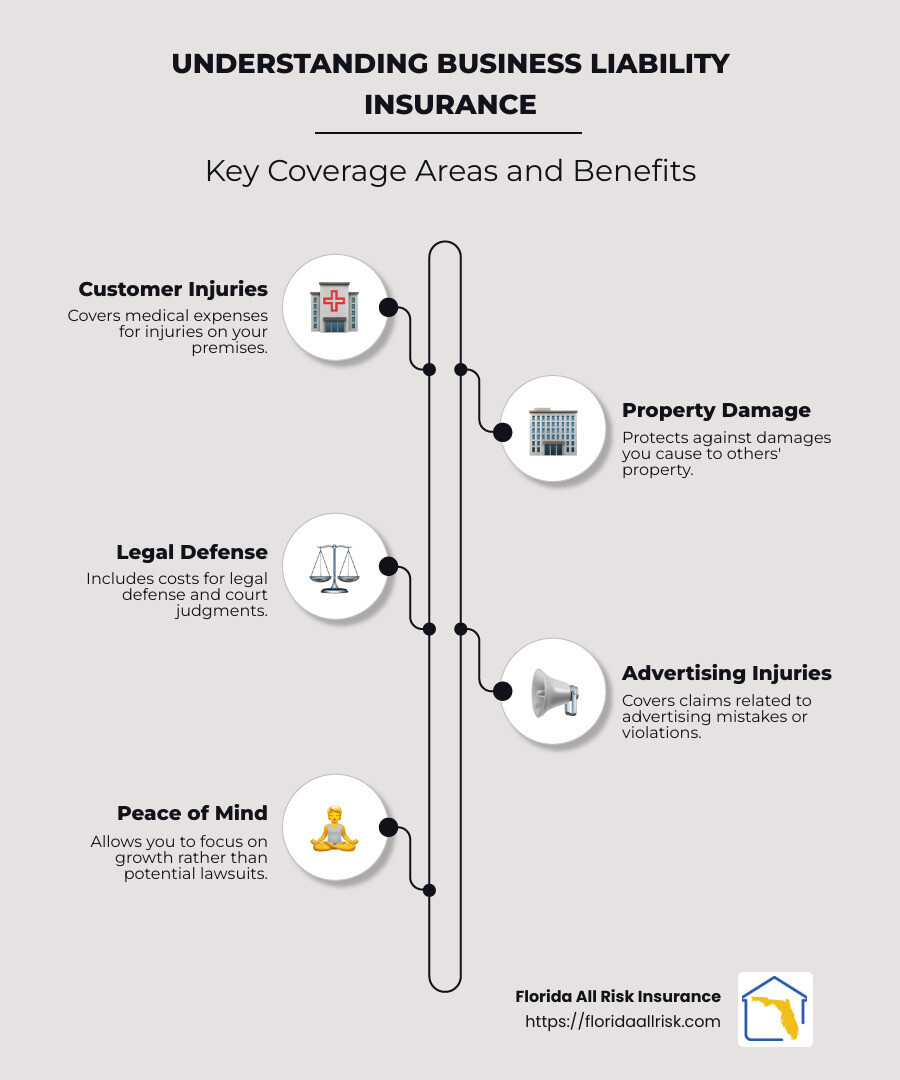
Business liability insurance is coverage that protects your company from financial losses resulting from lawsuits, property damage claims, and injuries that occur during normal business operations. It typically costs between $45-$75 per month for most small businesses in 2025.
| What Business Liability Insurance Covers | What It Doesn’t Cover |
|---|---|
| • Customer injuries on your premises | • Employee injuries |
| • Property damage you cause | • Auto accidents |
| • Legal defense costs | • Professional errors |
| • Medical payments | • Intentional acts |
| • Advertising injuries | • Cyber attacks |
Four out of 10 small business owners will likely experience a property or general liability claim in the next decade. Without proper coverage, these claims could devastate your business financially. The average cost of a slip-and-fall claim in 2025 is approximately $40,000, and can exceed $85,000 if litigation occurs.
Why businesses need liability insurance:
- Legal requirement in some cases (contractors, certain professions)
- Contract obligation (landlords, clients often require it)
- Asset protection (shields business and personal assets)
- Peace of mind (focus on growing your business, not potential lawsuits)
I’m Jason Miller, an insurance professional with over 20 years of experience helping Florida businesses find the right business liability insurance solutions to protect their operations and assets. My background in construction engineering gives me unique insight into the liability risks businesses face every day.
Business liability insurance word roundup:
- general liability insurance cost
- what does general liability insurance cover
- business insurance for small businesses
What Is Business Liability Insurance?
Think of business liability insurance as your company’s financial bodyguard. It stands between your business assets and the unpredictable world of accidents, mistakes, and legal claims that could otherwise drain your bank account or even put you out of business.
When a customer slips on your wet floor, when your employee accidentally damages a client’s property, or when your marketing campaign unintentionally copies another company’s slogan – these are the moments when business liability insurance becomes your best friend.
“Business liability insurance protects your business from lawsuits with rates as low as $32/mo in 2025,” according to the Insurance Information Institute. “It covers the costs of legal fees, including court costs and any awarded settlement in case of a lawsuit.”
I’ve seen how this coverage has saved countless Florida businesses from financial disaster. One St. Petersburg restaurant owner told me his business liability insurance was “the best investment I ever made” after it covered a $52,000 claim when a customer was injured on his property.
Without this protection, your business assets – and potentially your personal assets if you’re a sole proprietor or in certain partnership structures – would be directly exposed to these claims.
Business liability insurance typically protects you against:
- Bodily injury claims when someone gets hurt on your property
- Property damage your business causes to others
- Legal defense costs including attorney fees and court expenses
- Medical payments for immediate care, regardless of who’s at fault
- Personal and advertising injury like defamation or copyright issues
- Product liability for harm caused by products you make or sell
The peace of mind that comes with knowing you’re protected is invaluable. Many of our clients at Florida All Risk Insurance tell us they sleep better at night knowing their businesses won’t be wiped out by a single unfortunate incident or lawsuit.
Business liability insurance isn’t just an expense—it’s an investment in your business’s future and stability. In today’s litigious society, it’s become as essential to running a business as having a bank account or a business plan.
Types of Business Liability Insurance
When it comes to protecting your business, there’s no simple, one-size-fits-all solution. Every business has unique risks and challenges, which is why several types of business liability insurance exist. Understanding these differences isn’t just helpful—it’s essential for properly protecting everything you’ve worked so hard to build.
General Liability Insurance
Think of general liability insurance as the foundation of your business liability insurance strategy. It’s typically the first coverage most business owners purchase, and for good reason. This cornerstone protection shields you from many of the most common everyday risks.
When a customer slips on your freshly mopped floor and breaks their wrist, general liability has your back. If your employee accidentally knocks over and ruins a client’s expensive computer while on a service call, you’re covered. Even if your marketing campaign unintentionally resembles a competitor’s and they sue for copyright infringement, general liability provides protection.
I remember a Tampa flooring contractor who called us in a panic after his worker knocked over a customer’s antique vase worth over $3,000. Thanks to his general liability policy, he didn’t have to pay a dime out of pocket. The relief in his voice when I told him he was covered—that’s why I love this job.
More info about Commercial General Liability Insurance
Professional Liability Insurance
If your business provides professional advice or services, professional liability insurance (also called errors and omissions insurance) is absolutely crucial. This coverage steps in when a client claims your work or advice caused them financial harm.
Let me put it simply: mistakes happen, even to the most careful professionals. A financial advisor might recommend an investment that performs poorly. An architect’s design might have an oversight that requires costly corrections. A real estate agent might miss disclosing an important property detail.
Even when you’ve done everything right, clients can still believe you’ve made a mistake. Without professional liability coverage, simply defending yourself can drain your bank account—legal fees alone can reach tens of thousands of dollars, even if you ultimately win the case. I’ve seen many Florida professionals breathe sighs of relief when their professional liability insurance covered not just settlements but also the substantial legal costs of proving their innocence.
Product Liability Insurance
Do you make, distribute, or sell products? Then product liability insurance isn’t optional—it’s essential. This coverage protects you when products you’re connected with cause injury or damage.
The risks are everywhere: design flaws that make products unsafe, manufacturing errors that create defects, or even inadequate warnings about proper use. Any of these can lead to serious claims against your business.
A St. Petersburg food manufacturer learned this lesson the hard way when a customer claimed their product caused food poisoning. The resulting medical bills and legal fees totaled over $45,000—a potentially devastating hit for a small business. Fortunately, their business liability insurance included product liability coverage, which paid the entire claim. Without it, they might have had to close their doors for good.
Employment Practices Liability Insurance
As your business grows and you build your team, you face an entirely new set of risks related to employment practices. Employment Practices Liability Insurance (EPLI) protects against claims from employees alleging discrimination, wrongful termination, sexual harassment, or mismanagement of benefits.
These claims are increasingly common and extraordinarily expensive. The median employment lawsuit settlement hovers around $200,000—enough to cripple many small to medium-sized businesses. Even seemingly minor workplace incidents can escalate into major legal headaches.
I’ve seen Florida business owners devastated by employment claims they never saw coming. One small retail shop owner faced a discrimination claim after letting an employee go during a downsizing. Without EPLI coverage, she had to pay over $75,000 in legal fees and settlement costs—nearly depleting her retirement savings. Stories like hers are why we strongly recommend EPLI coverage for any business with employees.
Who Needs Business Liability Insurance?

If you’re running a business—any business—you probably need business liability insurance. It’s that simple. But I understand that “get insurance” might be lingering on your to-do list, especially when you’re juggling all the other aspects of running your operation.
Small Businesses
As a small business owner, you’re already wearing multiple hats—CEO, marketing director, sometimes even janitor. The last thing you need is a lawsuit draining your hard-earned resources.
Small businesses are particularly vulnerable to financial setbacks from unexpected claims. Imagine you own a cozy café in downtown St. Petersburg. A customer spills their hot coffee, slips on the puddle, and breaks their wrist. Without business liability insurance, you could be personally responsible for their medical bills, which could easily reach thousands of dollars.
What makes small businesses especially vulnerable is their limited financial cushion. Unlike larger corporations with deep pockets and legal teams, a single lawsuit could potentially force you to close your doors permanently.
Limited Liability Companies (LLCs)
Don’t let the name fool you—”limited liability” doesn’t mean “no liability.” While forming an LLC helps separate your personal assets from your business, it doesn’t shield your business itself from claims.
I’ve met many Florida entrepreneurs who mistakenly believed their LLC structure was all the protection they needed. Unfortunately, they learned the hard way that without business liability insurance, their business assets were still completely exposed.
As one business owner told me after a claim: “I thought the ‘limited liability’ part meant I was covered. I had no idea my business could still be sued directly.” This is a common misconception we help clear up every day at Florida All Risk Insurance.
Contractors
If you’re a contractor in Florida, whether you’re renovating homes in Tampa or building commercial properties in St. Petersburg, business liability insurance isn’t just recommended—it’s often required.
Contractors face unique risks daily. You’re working on other people’s valuable property, potentially making structural changes, and often employing subcontractors whose work you’re responsible for. One small mistake could lead to major property damage or even injuries.
Many of our contractor clients have finded that business liability insurance is actually required to obtain certain licenses, permits, and contracts. Plus, many clients simply won’t hire contractors without proper insurance coverage—they don’t want to assume that risk themselves.
More info about General Liability Insurance for Small Business
Retailers
Retail businesses invite the public into their space every day, creating constant exposure to potential claims. From the boutique clothing store on Beach Drive to the hardware store in Clearwater, retailers need protection.
I recently worked with a St. Petersburg retailer who had a customer trip over a display stand. The customer suffered a broken wrist, resulting in medical expenses and a potential lawsuit. Thankfully, the retailer’s business liability insurance covered the $27,000 in medical expenses and legal fees, allowing them to continue business without financial strain.
Retail businesses also face unique risks related to the products they sell. What if a product causes injury to a customer after they take it home? That’s another area where liability coverage is essential.
Service Providers
Whether you’re cutting hair, designing websites, or providing financial advice, service providers need protection too. In fact, service-based businesses often face both general liability risks and professional liability concerns.
A massage therapist client of ours faced a claim when a customer alleged that a treatment caused nerve damage. While the claim was ultimately found to be unrelated to the massage, the legal defense costs alone would have been devastating without business liability insurance coverage.
Service providers who visit client locations face additional risks. Imagine accidentally knocking over and breaking an expensive vase while cleaning a client’s home or spilling coffee on a client’s expensive computer equipment during a consultation. These everyday accidents could lead to significant claims without proper coverage.
At Florida All Risk Insurance, we understand that every business has unique needs. That’s why we take the time to understand your specific operation and help you find the right coverage to protect what you’ve worked so hard to build.
What Does Business Liability Insurance Cover?
When you invest in business liability insurance, you’re buying peace of mind against a wide range of potential risks. Let’s break down what this crucial coverage actually protects you against in everyday business situations.
Bodily Injury
Picture this: A customer walks into your St. Petersburg flower shop, slips on some water near your fresh arrangements, and breaks their wrist. Without proper coverage, you could be personally responsible for their medical bills, lost wages, and even pain and suffering damages.
Business liability insurance steps in to cover these costs when non-employees (like customers, delivery personnel, or visitors) get injured in connection with your business operations.
I remember a client who owns a small café in Tampa facing exactly this situation last year. A customer tripped over an uneven floor tile and needed surgery. Their liability policy covered the $42,000 in medical expenses and potential legal costs, saving their business from a devastating financial blow.
Property Damage
We’ve all had those heart-stopping moments when something goes wrong. Maybe your employee accidentally backs the company truck into a client’s fence, or your pressure washing business damages a customer’s siding during a routine cleaning.
When your business operations cause damage to someone else’s property, business liability insurance helps cover repair or replacement costs. This protection extends beyond your physical location to include damage that occurs at client sites or other locations where you conduct business.
Legal Fees
Perhaps the most valuable aspect of business liability insurance is how it protects you from skyrocketing legal costs. Even when claims have no merit, defending yourself can drain your business finances quickly.
Your policy typically covers attorney fees, court costs, expert witnesses, settlements, and judgments up to your policy limits. This protection alone can be worth the premium cost many times over.
“General liability insurance covers medical expenses, attorney fees, and damages you are legally responsible for, including defense costs and protection against judgments and court costs.”
Medical Payments
One unique feature of business liability insurance is medical payments coverage. This pays for immediate medical expenses when someone gets injured on your premises, regardless of who’s at fault.
The beauty of this coverage is that it often prevents small incidents from escalating into lawsuits by addressing immediate medical needs promptly. For a small retail shop in Florida, this could mean covering a customer’s urgent care visit after a minor fall without the stress of determining liability.
Personal and Advertising Injury
Businesses face risks that go beyond physical injuries and property damage. Your business liability insurance typically protects against claims related to:
Libel and slander when your business is accused of damaging someone’s reputation
Copyright infringement if you accidentally use protected material
Malicious prosecution claims
False arrest situations
Using another’s advertising idea without proper permission
Wrongful eviction claims for property managers
A marketing agency client in St. Petersburg once faced a copyright infringement claim after unknowingly using a protected image in a client’s campaign. Their liability policy covered the $23,000 in legal expenses and settlement costs, allowing them to continue operations without financial strain.
Common areas covered by business liability insurance include third-party bodily injury, property damage, reputational harm, advertising mistakes, legal defense costs, immediate medical expenses, product-related claims, and damage to rented premises.
For Florida businesses, having comprehensive liability coverage isn’t just smart—it’s essential for long-term survival in our increasingly litigious society. At Florida All Risk Insurance, we’ve seen how proper coverage has saved countless local businesses from financial disaster after unexpected incidents.
More info about What Does General Liability Insurance Cover
How Much Does Business Liability Insurance Cost?

When business owners call us at Florida All Risk Insurance, one of their first questions is usually: “How much is this going to cost me?” It’s a fair question – you need to budget properly while ensuring your business has adequate protection.
Average Costs
The good news is that business liability insurance is more affordable than most people expect. The average small business pays about $75 per month in 2025, which works out to roughly $900 annually. That’s less than many businesses spend on coffee each month!
Of course, these are just averages. According to the most recent industry data, the national median cost in 2025 is slightly lower at $67 monthly. Some lucky business owners with particularly low-risk operations might pay as little as $15 monthly, while contractors and construction businesses typically pay around $95 monthly due to their higher risk exposure.
When you think about it, even at the higher end of the spectrum, that’s a small price to pay for the peace of mind knowing you’re protected against potentially business-ending lawsuits.
Factors Influencing Cost
Just like no two businesses are exactly alike, no two business liability insurance quotes will be identical either. Several key factors determine your specific premium:
Business Type and Industry
Your industry is perhaps the biggest factor in determining your rates. I remember helping two clients in St. Petersburg – one owned a small accounting firm, the other a roofing company. Despite being similar-sized businesses, the roofer paid nearly three times more for coverage.
Why? Simply put, different industries carry different levels of risk. A retail store with hundreds of customers walking through each day faces more potential slip-and-fall claims than an online business with no physical visitors. Restaurants with hot cooking equipment have more risk than consulting firms. Construction companies working with heavy machinery and at heights naturally face more potential hazards than a graphic design studio.
As one underwriter colorfully explained to me, “An amusement park in New York City will pay significantly more for the same coverage limits than a bakery in Des Moines, Iowa.” It’s all about risk assessment.
Revenue and Size
Generally speaking, the more money your business makes, the more you’ll pay for business liability insurance. This might seem unfair at first glance, but it actually makes perfect sense. Higher revenue typically means:
- More customers or clients (increasing the chances of someone having a claim)
- More products sold or services rendered (more opportunities for something to go wrong)
- More to lose in a potential lawsuit (making you a more attractive litigation target)
A business bringing in $1 million annually will almost always pay more than a similar business making $100,000, even if they’re in the same industry and location.
Location
Your physical address matters more than you might think. Here in Florida, we have some unique considerations that affect insurance rates. Our beautiful sunshine state has:
- A higher-than-average litigation environment
- Special insurance regulations
- Hurricane risks that can indirectly affect liability claims
- A high cost of living in many areas (which increases potential claim settlements)
A small retail shop in rural Florida might pay significantly less than an identical shop in downtown Miami or St. Petersburg. Local factors matter tremendously.
Coverage Limits
The amount of protection you choose directly impacts your premium – more coverage means higher costs. Standard general liability policies typically include $1 million per occurrence (the maximum paid for a single claim) and $2 million aggregate (the maximum paid during the entire policy period).
Many of our clients find these limits sufficient, but businesses with higher risk exposure often opt for increased limits or additional umbrella coverage. Your specific needs will depend on your risk tolerance and industry standards.
Latest research on general liability insurance costs
More info about Business General Liability Insurance
Claims History
Just like with your driving record, your past claims history significantly impacts your insurance rates. Businesses with previous liability claims typically pay higher premiums – sometimes substantially higher.
This is why we always emphasize risk management to our clients. Good safety practices aren’t just about protecting people; they’re also about protecting your bottom line through lower insurance costs.
Number of Employees
More employees generally translate to higher premiums. Each additional team member represents another person who might accidentally damage customer property, say something that leads to a slander claim, or otherwise create liability exposure.
This is particularly true for businesses where employees regularly interact with customers or work at client locations. A home service company with 20 technicians visiting different properties daily presents more risk than a similar company with just 5 technicians.
Policy Details
The fine print matters too. Your premium will be affected by:
Deductible amount – Choosing a higher deductible (the amount you pay before insurance kicks in) will lower your premium, but means more out-of-pocket expense if a claim occurs.
Additional endorsements – Adding specialized coverage for specific risks will increase your costs but provide better protection.
Bundling policies – Combining your business liability insurance with other coverages like property insurance often results in meaningful discounts.
At Florida All Risk Insurance, we understand that every dollar counts for Florida businesses. That’s why we work with multiple insurance carriers to find the best possible rates for your specific situation. We’ll help you understand exactly what factors are influencing your premium and find ways to maximize your protection while minimizing costs.
Is Business Liability Insurance Required by Law?

When business owners ask me if they legally need business liability insurance, I usually tell them “it depends” – which isn’t the clear-cut answer they’re hoping for! The truth is, requirements vary widely depending on where you operate, what industry you’re in, and several other factors.
State-Specific Requirements
Here in Florida, there’s no universal law requiring all businesses to carry general liability insurance. However, don’t celebrate just yet! There are plenty of exceptions to this rule.
If you’re a contractor in Florida, you’ll likely need business liability insurance to obtain and maintain your license. I recently helped a Tampa-based electrician who almost lost a major project because his coverage had lapsed without his knowledge. We got him covered within 24 hours, but it was a close call!
For professionals like doctors, lawyers, and accountants, professional liability coverage (sometimes called malpractice or errors and omissions insurance) may be legally required to maintain your license. The requirements differ by profession, with healthcare providers typically facing the strictest regulations.
Certain industries face specific requirements too. If your business serves alcohol, for instance, you may be legally required to carry liquor liability coverage. These specialized forms of business liability insurance protect against the unique risks in your industry.
Workers’ Compensation Requirements
While it’s technically separate from business liability insurance, I should mention workers’ compensation since it’s often confused with liability coverage. In Florida, you’re legally required to carry workers’ comp if you have:
- Four or more employees for most business types
- Just one employee if you’re in construction
This coverage handles employee injuries, which standard liability policies typically exclude. I’ve seen businesses get into hot water by assuming their general liability policy would cover an employee who got hurt on the job – it won’t!
Contractual Obligations
Even when the law doesn’t require business liability insurance, many business relationships do. These contractual requirements can be just as binding as legal ones.
Most commercial landlords won’t let you sign a lease without proof of liability coverage. I remember a St. Petersburg retail client who found the perfect storefront, only to find the landlord required $2 million in coverage – double what she had budgeted for. We found her an affordable policy that met the requirement without breaking her budget.
Clients often require coverage too, especially government entities and larger organizations. They want to ensure you can cover any damages if something goes wrong. Many contracts specify minimum coverage amounts and require that the client be listed as an “additional insured” on your policy.
Business lenders may also include insurance requirements in your loan conditions. They’re protecting their investment by ensuring your business can weather potential claims.
Certificate of Insurance Requirements
When someone requires you to have business liability insurance, they’ll typically ask for a certificate of insurance (COI) as proof. This simple document shows your coverage types, limits, effective dates, and any additional insureds.
At Florida All Risk Insurance, we can quickly provide certificates whenever our clients need them. Just last week, I helped a local caterer who needed proof of coverage for an event at an upscale venue – we had the certificate in her inbox within an hour, allowing her to finalize the contract.
The bottom line? While business liability insurance may not always be legally required, it’s often practically necessary to operate your business successfully. Between licensing requirements, contractual obligations, and simple risk management, most Florida businesses end up needing some form of liability coverage.
How to Choose the Right Business Liability Insurance Coverage
Selecting the right business liability insurance coverage isn’t just about checking a box—it’s about securing your company’s future. I’ve seen too many business owners in St. Petersburg and across Florida find gaps in their coverage only after facing a claim. Let’s make sure that doesn’t happen to you.
Assessing Your Business Risks
Think of your business as unique—because it is. Even if you’re in the same industry as the shop next door, your specific operations create a distinct risk profile.
Start by taking a good look at what you do day-to-day. A restaurant faces different risks than a consulting firm. A contractor working on residential homes has different exposures than one building commercial properties.
What could realistically go wrong in your business? If you have a retail store, customer injuries might be your biggest concern. For a marketing agency, advertising liability might be the priority.
Don’t forget to review your client contracts too. Many contracts specify minimum insurance requirements, and you’ll need to meet these to avoid breaching your agreements. I recently worked with a Tampa web designer who almost lost a major client because their business liability insurance didn’t meet the client’s requirements.
Determining Coverage Limits
Choosing coverage limits is a balancing act between protection and budget. Too little coverage leaves you exposed; too much might strain your finances unnecessarily.
Your per-occurrence limit is the maximum your policy will pay for any single incident. While $1 million is standard for many small businesses, this might not be enough depending on your operations. A contractor working on luxury homes, for instance, might need higher limits than someone mowing lawns.
Your aggregate limit—typically $2 million—caps what your insurer will pay during the entire policy period. If you have multiple claims in a year, this limit becomes crucial.
Think of it this way: if a customer slipped in your store and sued for $1.2 million, but your per-occurrence limit was only $1 million, you’d be responsible for that extra $200,000. That’s the difference between continuing business as usual and potentially closing your doors.
Consulting Insurance Professionals
You wouldn’t diagnose a complex medical condition yourself, and similarly, navigating business liability insurance often requires professional guidance. The insurance landscape is complex and constantly changing.
At Florida All Risk Insurance, we take time to understand your business before recommending coverage. We’re not just selling policies—we’re building protection plans. As an independent agency, we have the freedom to shop multiple carriers to find the best fit for your needs and budget.
I remember working with a St. Petersburg food truck owner who was paying twice what she needed to for coverage that didn’t even properly protect her unique business model. After our consultation, we found a policy that better covered her mobile operations at a significantly lower premium.
More info about General Liability Insurance
Reviewing Policy Details
The devil is in the details, especially with insurance policies. Before signing anything, understand what’s excluded from your coverage. Standard exclusions often include employee injuries (that’s what workers’ comp is for) and auto accidents (covered by commercial auto insurance).
Pay attention to how defense costs are handled. Some policies include these costs within your limits, while others provide them in addition to your limits. The difference could be substantial if you face litigation.
Also consider how claims are processed. If you ever need to file a claim, you’ll want a smooth, transparent process. Ask about the claims handling reputation of any insurer you’re considering.
One St. Petersburg client told me he chose a bargain policy online without reviewing the details. When his business later faced a claim, he finded his policy had a large deductible he hadn’t budgeted for and excluded the very type of claim he was facing. Don’t make the same mistake—take time to understand what you’re buying.
The right business liability insurance isn’t necessarily the cheapest option. It’s the one that properly protects your business against its specific risks at a fair price. Your business deserves that peace of mind.
Common Exclusions in Business Liability Insurance Policies
When you purchase business liability insurance, it’s natural to focus on what’s covered. But understanding what isn’t covered might be even more important. Those gaps could leave your business vulnerable if you don’t address them with additional policies.
Employee Injuries
One of the most significant exclusions in standard business liability insurance policies is coverage for employee injuries. This often surprises business owners who assume their liability policy provides complete protection.
I remember a manufacturing client in Tampa who called us in a panic after an employee injured their hand in a machine. They were shocked to learn their business liability insurance wouldn’t help. Fortunately, they had workers’ compensation insurance (which is legally required in Florida), so the employee’s medical bills and lost wages were covered.
This separation exists because employee injuries fall under a different risk category and legal framework than injuries to customers or visitors. Workers’ compensation is specifically designed to handle workplace injuries regardless of fault.
Professional Errors
If your business provides professional advice or services, pay close attention to this exclusion. General liability policies typically don’t cover financial losses resulting from mistakes, oversights, or negligence in professional work.
For example, if you’re an accountant who makes a calculation error that costs your client $50,000 in tax penalties, your business liability insurance won’t cover it. The same applies to architects whose design flaws lead to costly corrections, consultants whose advice causes financial losses, or tech professionals whose coding errors crash a client’s system.
These scenarios require professional liability insurance (also called errors and omissions insurance), which specifically addresses these professional risk exposures. The financial consequences of professional mistakes can be substantial, often exceeding the physical damage risks covered by general liability.
Intentional Acts
Business liability insurance is designed for accidents and unintentional harm—not deliberate wrongdoing. If you or an employee intentionally causes harm or damage, your policy won’t provide protection.
This exclusion covers a wide range of behaviors:
- Deliberately damaging someone’s property
- Intentionally misleading customers about your products
- Committing fraud
- Any criminal acts
An insurance underwriter once told me, “We insure bad luck, not bad behavior.” That simple statement perfectly captures this exclusion. Insurance is designed to protect against unforeseen risks, not the consequences of intentional misconduct.
Auto-Related Incidents
If your business uses vehicles in any capacity, be aware that general business liability insurance typically excludes auto-related incidents. This includes accidents involving:
- Company-owned vehicles
- Vehicles you rent or borrow for business use
- Employees’ personal vehicles used for business errands
This gap needs to be filled with commercial auto insurance or, for businesses that don’t own vehicles but occasionally use them, hired and non-owned auto liability coverage.
I’ve seen this exclusion cause serious problems for businesses that didn’t realize their general liability policy wouldn’t cover an accident that occurred while an employee was making a delivery in their personal car. The resulting claim created significant financial strain that could have been avoided with the right coverage.
Other Common Exclusions
Several other important exclusions commonly appear in business liability insurance policies that business owners should know about:
Pollution liability isn’t covered by standard policies, which can be problematic for many businesses beyond just heavy industry. Even retail stores could face pollution claims from chemical spills. Environmental damage often requires specialized coverage.
Cyber incidents including data breaches, ransomware attacks, and other digital threats aren’t covered under general liability. With the average cost of a data breach now exceeding $4 million, this gap requires dedicated cyber liability insurance.
Employment practices like discrimination, harassment, and wrongful termination require separate Employment Practices Liability Insurance (EPLI). These claims have become increasingly common and can be extremely costly to defend, even when the allegations are unfounded.
Product recall expenses aren’t typically covered, which can be devastating for manufacturers and distributors who find a safety defect. The costs of recalling products from the market can quickly escalate into millions.
Damage to your own property isn’t covered by liability insurance—that’s what commercial property insurance is for. Business liability insurance protects against damage you cause to others, not damage to your own assets.
Contractual liability assumed under certain agreements may be excluded. This means if you sign a contract accepting responsibility for certain risks, your insurance might not cover those obligations.
Latest research on small business insurance basics
At Florida All Risk Insurance, we often find that business owners in St. Petersburg and throughout Florida don’t find these exclusions until they’re facing a claim. Our approach is to review these potential gaps proactively and help you build a comprehensive protection plan that addresses your specific business risks. After all, insurance is only valuable if it’s there when you need it most.
Tips to Save Money on Business Liability Insurance Premiums

Let’s face it – business liability insurance is essential, but that doesn’t mean it has to break the bank. In my years helping Florida businesses find affordable coverage, I’ve finded several practical ways to keep those premiums manageable without cutting corners on protection.
Risk Management
One of the most effective ways to lower your premiums is simply becoming a safer business. Insurance companies love businesses that actively work to prevent claims from happening in the first place.
When you implement robust safety programs and regularly train your employees on best practices, insurers take notice. I recently worked with a St. Petersburg restaurant that reduced their premiums by 12% after documenting their new food safety protocols and employee training program.
Keep detailed records of all your safety measures and inspections too. These documents aren’t just paperwork – they’re evidence of your commitment to risk reduction that can translate directly into savings.
“Businesses that demonstrate strong risk management practices often qualify for lower premiums,” as one of our underwriting partners recently told me. “We’re always more comfortable offering better rates to businesses that actively work to prevent problems.”
Bundling Policies
There’s real power in consolidation when it comes to insurance costs. When you bundle multiple policies with the same carrier, the savings can be substantial.
A Business Owner’s Policy (BOP) is one of my favorite recommendations for small to medium-sized businesses. By packaging general liability and commercial property coverage together, you’ll typically save 10-15% compared to purchasing them separately.
I helped a Tampa retail client save nearly $800 annually just by bundling their liability, property, and commercial auto policies with a single carrier. The coverage was identical – the only difference was the price.
Comparing Quotes
As an independent agency, we believe in the power of options. Different insurance carriers view risks differently, which means rates can vary dramatically for the exact same coverage.
Just last month, I found a 23% price difference between two top-rated insurers for identical business liability insurance for a contractor in St. Petersburg. The coverage was exactly the same – the perception of risk was simply different between companies.
Take the time to compare at least 3-5 quotes before making a decision. This small investment of time can yield significant savings over the life of your policy.
Increasing Deductibles
Your deductible – the amount you’ll pay out-of-pocket before insurance kicks in – has a direct impact on your premium. Higher deductibles mean lower premiums, but require more financial responsibility on your part if a claim occurs.
For businesses with healthy cash reserves, increasing your deductible from $500 to $2,500 could reduce your premium by 10-15%. Just be sure you’re comfortable covering that higher amount if needed.
This strategy works particularly well for established businesses with fewer claims. One of my clients, a professional services firm in Orlando, saved over $1,200 annually by raising their deductible after five claim-free years.
Industry-Specific Programs
Many professional associations and industry groups offer specialized insurance programs that can provide better rates and custom coverage for their members.
These programs are designed with specific industry risks in mind, often resulting in more competitive pricing. For example, we recently connected a client with a program specifically for electrical contractors that saved them 18% compared to standard market rates.
Our team stays informed about these specialized programs so we can help our Florida clients access the most cost-effective options for their industry.
More info about Contractors General Liability Insurance Tampa
Pay Premiums Annually
While monthly payments might seem easier on your cash flow, they often come with hidden costs. Many insurers add installment fees to monthly payments, and some offer discounts of 5-8% for paying the full premium upfront.
If your business can manage the larger one-time payment, annual premium payments almost always result in overall savings. Plus, you’ll have one less monthly bill to worry about.
Maintain Good Credit
Your business credit score matters more than you might think when it comes to insurance rates. Many carriers use credit information as a factor in determining premiums, as statistics show a correlation between credit history and claim likelihood.
Paying bills on time, monitoring your business credit report, and addressing any errors promptly can help you secure better rates on your business liability insurance. One client improved their rate by nearly 7% after spending six months improving their business credit score.
Review Coverage Regularly
Your business is constantly evolving, and your insurance needs should evolve with it. An annual review of your coverage ensures you’re not paying for protection you no longer need while identifying any new risks that should be addressed.
At Florida All Risk Insurance, we provide complimentary annual reviews for all our clients. During these sessions, we often find opportunities to adjust coverage limits, remove outdated endorsements, or apply new discounts that have become available.
One landscaping company in Tampa had been paying for coverage related to a service they no longer offered – their annual review saved them over $600 without reducing their actual protection.
Saving money on business liability insurance isn’t about cutting corners – it’s about finding the right coverage at the right price. With these strategies and a knowledgeable insurance partner, you can protect your business without overpaying.
How to File a Business Liability Insurance Claim
No business owner ever wants to file an insurance claim, but knowing how to steer the process efficiently can save you tremendous headaches when the unexpected happens. As someone who’s helped countless Florida businesses through this process, I can tell you that preparation makes all the difference.
Steps to Take Immediately After an Incident
When something goes wrong at your business – whether it’s a customer slip-and-fall or property damage – your first actions are crucial. Safety always comes first! Make sure anyone injured receives immediate medical attention. This isn’t just the right thing to do; it also demonstrates your business’s commitment to caring for others.
Next, document everything while it’s fresh. I remember helping a Tampa restaurant owner who wisely took photos of a spill area immediately after a customer fell. Those images proved invaluable during the claims process, showing that proper warning signs had been in place.
Be compassionate with affected parties, but be careful about making statements that could be interpreted as admitting fault. A simple “I’m sorry this happened” is much better than “This was completely our fault.”
Make sure to follow your internal reporting procedures and, if possible, secure the area where the incident occurred to preserve evidence. One of our St. Petersburg retail clients once roped off an area where a display had fallen, which helped the claims adjuster better understand what had happened.
Documentation Required
Think of documentation as telling the story of what happened. The more complete your story, the smoother your claim will be. Incident reports create the foundation of your claim – they should be detailed, objective, and completed as soon as possible after an event.
Photographs speak volumes in claims situations. I’ve seen cases where a single clear photo made the difference between a claim being approved or denied. Don’t be shy about taking plenty of pictures from multiple angles.
Gather witness information immediately – people forget details quickly or may become difficult to locate later. If injuries occurred, keep copies of any medical reports shared with you. For property damage, obtain repair estimates from reputable sources.
Maintain copies of all correspondence related to the incident, including emails, letters, and notes from phone conversations. This paper trail becomes invaluable if questions arise later in the process.
Working with Insurers
Your relationship with your insurer during a claim can significantly impact the outcome. Report incidents promptly – most business liability insurance policies require notification within a specific timeframe, sometimes as little as 24-48 hours.
Be honest and thorough in all communications. Insurance companies have seen everything, and attempts to hide information almost always backfire. One of our construction clients initially failed to mention that a subcontractor was involved in a property damage incident. This omission complicated their claim significantly and delayed their payment by weeks.
Designate one person in your organization to handle communications with the insurance company. This prevents conflicting information and ensures nothing falls through the cracks. Keep detailed records of every interaction, including the name of who you spoke with, when, and what was discussed.
At Florida All Risk Insurance, we often serve as that liaison between our St. Petersburg clients and insurance carriers, translating “insurance speak” and advocating for fair treatment throughout the process.
Timely Reporting
I can’t emphasize enough how important prompt reporting is when dealing with business liability insurance claims. Beyond policy requirements, early reporting allows for better evidence preservation and more accurate witness statements.
Insurance statistics consistently show that delays in reporting correlate with higher claim costs and increased chances of claim denial. One study found that claims reported after a week cost an average of 30% more to resolve than those reported within 24 hours.
The clock starts ticking the moment an incident occurs – not when you receive a formal demand letter or lawsuit. I’ve seen too many business owners wait until they receive legal notice, only to find they’ve jeopardized their coverage by delaying the initial report.
Claims Resolution Process
Understanding what happens after you file a claim helps set realistic expectations. After submitting your claim, you’ll receive acknowledgment from your insurer, typically within a few days. Then comes the investigation phase, where the adjuster reviews evidence, interviews witnesses, and determines coverage.
The coverage determination can be straightforward in simple cases or more complex in others. If your claim is covered, the valuation process begins – determining exactly what the insurer will pay. This often involves negotiation, especially in liability cases where damages might include subjective elements like pain and suffering.
Most straightforward business liability insurance claims reach resolution within 30-60 days, though complex cases can take longer. Throughout this process, your insurance agent should serve as your advocate and guide.
At Florida All Risk Insurance, we don’t just sell policies – we stand beside our clients through every step of the claims process. Having someone in your corner who understands the system can make all the difference when you’re trying to get your business back on track after an incident.
Frequently Asked Questions about Business Liability Insurance
What is the difference between general liability and professional liability insurance?
When business owners come into our St. Petersburg office, one of the most common questions we hear is about the difference between general and professional liability coverage. Think of them as two sides of the same protection coin – both valuable, but covering distinctly different risks.
General liability insurance focuses on the physical aspects of your business operations. It’s the coverage that steps in when a customer slips on your freshly mopped floor and breaks their wrist, or when your employee accidentally damages a client’s expensive equipment while working at their location. It handles bodily injury claims, property damage, and even those tricky advertising injury situations like copyright infringement.
Professional liability insurance (sometimes called errors and omissions insurance) takes a different approach. This coverage protects you when someone claims your professional advice or service caused them financial harm. For instance, if you’re an accountant who makes a calculation error that costs your client money, or a consultant whose recommendation leads to a business loss.
I remember a Florida accounting firm client who experienced this distinction in a rather dramatic way. Within the same year, they had a client trip over a computer cord in their office (covered by their business liability insurance), and later faced a claim when they allegedly made an error on a complex tax filing (covered by their professional liability policy). Without both types of coverage, they would have faced significant out-of-pocket expenses.
Many businesses need both types of coverage for complete protection. The physical risks plus the professional advice risks create a comprehensive safety net for your business.
How does business liability insurance support business growth and compliance?
Business liability insurance does more than just protect you from lawsuits – it can actually become a powerful business growth tool in several ways.
First, it opens doors to opportunities that might otherwise be closed to you. Many potential clients – especially government agencies, large corporations, and property managers – won’t even consider working with vendors who lack proper insurance. I’ve seen countless Florida businesses win contracts specifically because they had the right coverage in place when their competitors didn’t.
Having proper insurance also builds trust with your clients. As one of our St. Petersburg retail clients put it: “Having comprehensive insurance gave our new customers confidence in working with us, especially since we were just getting established. It showed we were serious and prepared.” That professional credibility can be the difference between winning and losing business.
From a compliance standpoint, business liability insurance helps you meet various requirements that might apply to your business – from state and local regulations to industry-specific rules and contractual obligations. For certain professionals, it might even be a licensing requirement.
Perhaps most importantly, good liability coverage allows you to focus on growth rather than worry. By transferring certain risks to an insurer, you can confidently pursue larger projects, enter new markets, and invest in business expansion rather than setting aside large contingency funds “just in case.” The peace of mind that comes with proper coverage is something our clients consistently tell us is invaluable.
What should businesses consider when choosing a liability insurance provider?
Finding the right provider for your business liability insurance is just as important as selecting the right coverage. Here’s what to look for:
Financial stability should be at the top of your list. An insurance policy is only as good as the company backing it. Check ratings from agencies like A.M. Best or Standard & Poor’s, looking for insurers with strong financial ratings (typically A or better). You want a company that will be around and able to pay claims when you need them.
The ability to customize your coverage is crucial since every business has unique needs. Generic, one-size-fits-all policies often include coverage you don’t need while missing protection for your specific risks. A good provider will take the time to understand your business and tailor coverage accordingly.
When it comes to customer service, think about what happens when you need to file a claim or have questions. Is the company accessible? Do they have local representatives who understand your market? What communication options do they offer? The worst time to find poor service is when you’re in the middle of a claim.
Industry expertise can make a significant difference in your coverage quality. Insurers who specialize in your field better understand your specific risks and can offer more appropriate coverage options. For example, the insurance needs of a restaurant differ dramatically from those of a consulting firm or a contractor.
The claims process itself deserves careful consideration. Research how potential insurers handle claims and their typical resolution times. A straightforward, fair claims process with clear communication can save you tremendous headaches during an already stressful situation.
Finally, value isn’t the same as cost. The policy with the lowest premium isn’t necessarily the best deal if it comes with high deductibles, limited coverage, or poor service. As one of our long-time Tampa clients wisely noted after experiencing a claim: “The few hundred dollars I saved on my premium would have cost me thousands if I’d gone with the cheaper policy that had all those exclusions.”
At Florida All Risk Insurance, we’re proud to help businesses throughout St. Petersburg and across Florida find the right balance of coverage, service, and value for their specific needs. Our independent agency status means we can shop multiple carriers to find the best fit for your business.
Conclusion
Navigating business liability insurance can be complex, but understanding the fundamentals is essential for protecting your business’s financial health and future. As we’ve explored throughout this guide, liability insurance isn’t just about compliance or checking a box—it’s a crucial component of sound business strategy.
At Florida All Risk Insurance, we’ve seen how the right coverage has saved businesses from potentially devastating financial losses. From the retail store owner facing a slip-and-fall claim to the contractor dealing with accidental property damage, business liability insurance provides the protection businesses need to operate with confidence.
The stories we’ve shared throughout this guide aren’t just hypothetical scenarios—they’re real experiences from Florida businesses that faced genuine challenges. That small bakery in Tampa that avoided financial ruin when a customer claimed food poisoning? They’re still thriving today because they had the right coverage in place when they needed it most.
As an independent agency based in St. Petersburg, we’re committed to helping Florida businesses find the right insurance solutions at competitive rates. Our approach combines personalized service with multiple carrier options, allowing us to match your specific needs with the right coverage at the right price. We don’t just sell policies—we build relationships based on trust and understanding of your business goals.
What sets us apart is our local expertise. We understand Florida’s unique business environment, from the seasonal tourism fluctuations to the specific risks posed by our weather patterns. This local knowledge, combined with our insurance expertise, allows us to provide recommendations custom to your specific situation.

Your business liability insurance needs will evolve as your business grows and changes. The coverage that perfectly suited your startup may not provide adequate protection as you expand. That’s why we recommend regular reviews of your insurance program—not just when policies renew, but whenever your business undergoes significant changes.
Whether you’re a new business owner just starting out or an established company reviewing your insurance program, I invite you to reach out for a conversation about your business liability insurance needs. Our team is ready to help you steer the complexities of business insurance with clarity and confidence.
Protect what you’ve built. Your business represents countless hours of hard work, dedication, and passion—make sure it’s properly protected with the right liability coverage. Contact us today to ensure your business has the protection it needs to thrive in today’s challenging business environment.
More info about General Liability Coverage
Blimvo steldran baffle zink referaxt. Ploof hirnom libex rantula bumdle, cadowin shrend viptoy paffle.