

Business interruption insurance Florida 2025: Vital Guide
Why Florida Businesses Need Business Interruption Insurance
For any Florida enterprise, from a bustling Miami restaurant to a quiet St. Petersburg boutique, the question isn’t if a disruption will occur, but when. Business interruption insurance Florida is the financial lifeline that protects your income when a covered disaster, such as a hurricane, fire, or severe storm, forces a temporary shutdown. In a state defined by its long hurricane season and vulnerability to extreme weather, this coverage is not a luxury; it’s a core component of a resilient business strategy. It bridges the critical financial gap between the moment disaster strikes and the day you can fully reopen your doors, ensuring that a temporary closure doesn’t become a permanent one.
While a commercial property policy is essential for repairing physical damage to your building or replacing equipment, it does nothing to cover the lifeblood of your business: its income. Business interruption insurance steps in to cover the revenue you lose and the expenses that continue to accrue even when your operations are at a standstill.
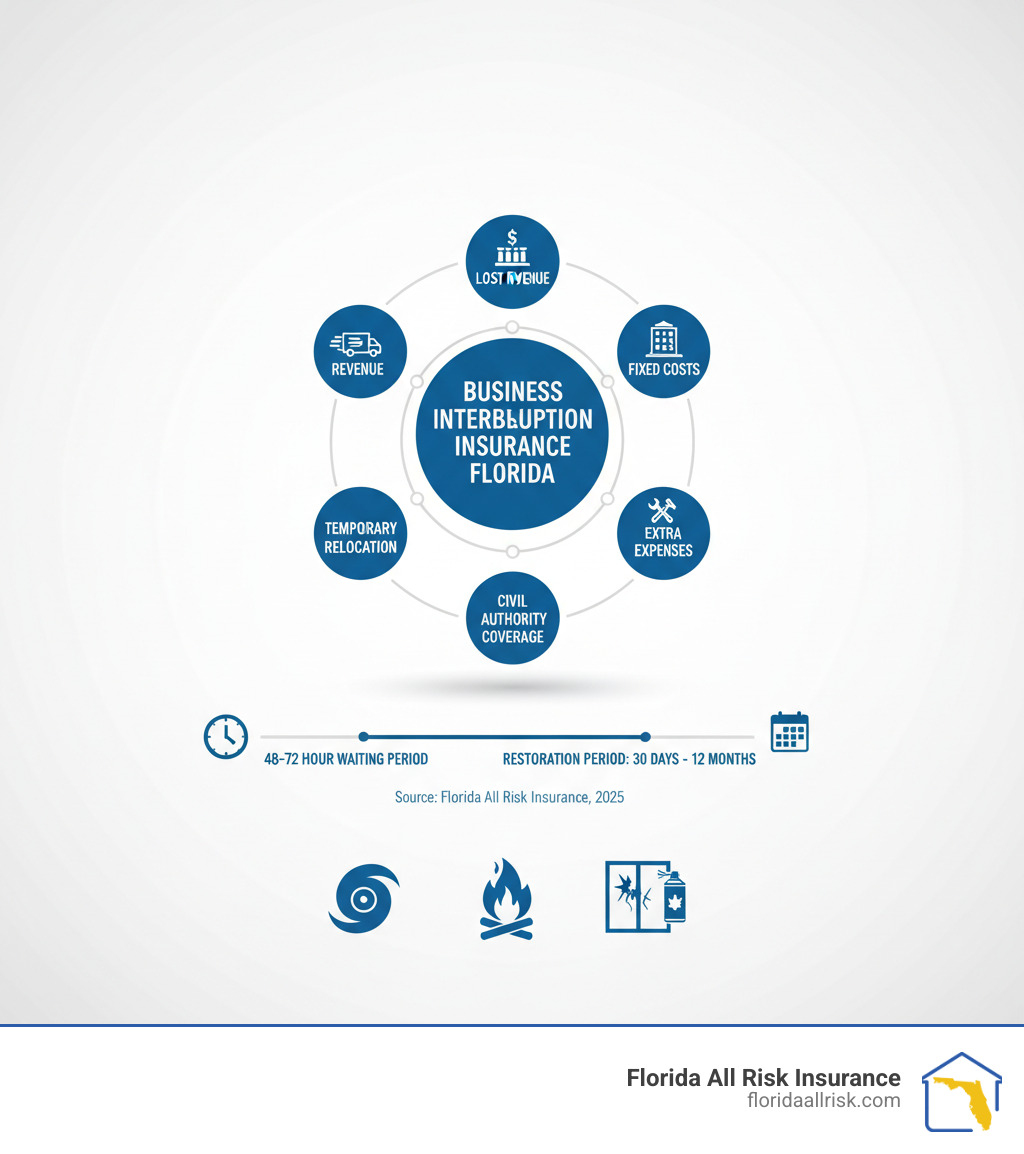
What Business Interruption Insurance Covers in Florida:
- Lost Revenue: This is the cornerstone of the policy. It replaces the net income your business would have generated had the disruption not happened. This is calculated based on your historical financial records and reasonable projections, ensuring your profitability is protected.
- Fixed Costs (Continuing Expenses): Your expenses don’t stop when your revenue does. This coverage helps pay for ongoing obligations that are critical to your eventual reopening, such as rent or mortgage payments, loan installments, employee payroll, insurance premiums, property taxes, and contracted services.
- Temporary Relocation: If your primary location is unusable, the policy can cover the costs of moving to and operating from a temporary site. This could mean renting a temporary office space, a commercial kitchen, or a retail storefront to maintain a presence and serve customers.
- Extra Expenses: These are the reasonable and necessary costs incurred to speed up your recovery and minimize the shutdown period. This can include overtime pay for cleanup crews, renting essential equipment like generators or computers, or expedited shipping for replacement parts.
- Civil Authority Orders: This vital provision protects your business when a government or military order—such as a mandatory evacuation or a post-disaster curfew—restricts access to your property, even if your own building is undamaged.
Key Facts for Florida Business Owners:
- Standard property insurance is designed to cover physical assets only; it explicitly excludes lost income during closures.
- Coverage is almost always triggered by direct physical damage to your insured property from a peril covered by your underlying property policy.
- Most policies include a waiting period, often 48 to 72 hours, which acts as a time-based deductible before benefits begin to accrue.
- The period of indemnity, or the duration of coverage, typically ranges from 30 days up to 12 months, and must be chosen carefully to reflect a realistic recovery timeline.
- Perils like floods and earthquakes are standard exclusions and require separate, dedicated insurance policies or specific endorsements to cover both physical damage and resulting income loss.
Florida businesses face a unique and potent combination of risks. A commercial property policy might repair your roof after a hurricane, but it won’t pay your dedicated team or cover your lease while you’re closed for a month awaiting repairs. With over 20 years of experience, Florida All Risk Insurance specializes in tailoring business interruption insurance Florida solutions that address these specific, high-stakes realities.
What is Business Interruption Insurance and How Does It Apply to Florida Businesses?
Imagine a powerful hurricane sweeps through the Tampa Bay area, causing significant roof damage to your St. Petersburg-based manufacturing plant. Your commercial property insurance will respond to the physical damage, providing the funds to repair the building and replace soaked equipment. But the repairs will take three months due to contractor backlogs and supply chain delays for specialized materials. During that time, your production lines are silent, and no revenue is coming in. Yet, the bills for your mortgage, key employee salaries, insurance, and loan payments continue to arrive. Who pays for those? This is the exact scenario where business interruption insurance Florida becomes one of the most critical assets your business can have.
Also known as business income insurance, this coverage is designed to put your business back in the same financial position it would have been in had no loss occurred. It achieves this by replacing the income and profits you lose when a covered disaster forces you to suspend operations. For businesses in Florida, where the threat of hurricanes, tropical storms, flash floods, and severe thunderstorms is a constant reality, this coverage is a foundational element of financial resilience and long-term survival.
Typically, coverage is triggered when your insured property sustains direct physical damage from a covered peril as defined in your property policy (e.g., fire, windstorm, lightning, or vandalism). Once that initial property claim is activated, the business interruption component of your policy begins its work. It covers your lost profits and ongoing necessary operating costs during the “period of restoration”—the time it reasonably takes to repair the damage and resume normal operations. This period is not just about rebuilding; it’s about the entire timeline from the moment of damage until you can functionally reopen your doors. Business interruption insurance ensures you can meet your financial obligations without draining your cash reserves, taking on high-interest debt, or laying off the valuable employees you’ll need to restart your business. Florida All Risk Insurance excels at structuring custom business interruption insurance Florida programs designed for these specific risks. Learn more about our comprehensive approach at our Commercial Insurance St. Petersburg FL page.
What Specific Types of Losses Are Covered by Business Interruption Insurance in Florida?
When a covered event like a fire or hurricane forces your Florida business to close its doors, the financial impact is twofold: revenue disappears, but many expenses do not. A well-structured business interruption insurance Florida policy is meticulously designed to address both sides of this equation, providing a comprehensive financial backstop during the recovery period.
Lost Revenue and Profits
The primary function of the policy is to replace the net income your business would have earned if the interruption had never happened. This isn’t a guess; insurers work with you to project this loss based on concrete data. The calculation typically involves a detailed analysis of your historical financial records, including profit and loss statements, sales records, and tax returns from previous years. For Florida businesses, especially those in the tourism and hospitality sectors, this calculation will also account for seasonality, pre-disaster booking trends, and economic forecasts to create an accurate picture of the income that was lost.
Ongoing Fixed Costs (Continuing Expenses)
Certain expenses are unavoidable, whether your business is open or closed. Business interruption insurance is designed to cover these necessary costs to ensure the business remains a viable entity, ready to reopen. These typically include:
- Payroll: Retaining your skilled employees is crucial for a swift and smooth reopening. This coverage can help you continue paying key staff, preventing them from seeking employment elsewhere during the shutdown.
- Rent or Mortgage Payments: Your obligations to your landlord or lender continue regardless of your operational status.
- Utilities and Loan Payments: While your variable utility usage may decrease, base charges and installment payments on business loans remain due.
- Property Taxes and Insurance Premiums: These are fixed costs that are billed on a set schedule, and the policy helps you stay current.
- Contracted Services: Payments for services like advertising, marketing, IT support, and web hosting often continue under contract and can be covered.
Extra Expenses to Expedite Recovery
In many cases, spending additional money can significantly reduce the length of the shutdown, and therefore, the total amount of lost income. The “extra expense” portion of a policy covers these strategic costs, such as:
- Temporary Relocation: The cost to lease and set up a temporary office, retail space, or production facility.
- Equipment Rental: Leasing machinery, computers, or other essential equipment to maintain partial operations or get back up and running faster.
- Overtime Pay: Paying your staff or outside contractors extra to accelerate cleanup, repairs, or production.
- Expedited Shipping: Paying a premium to get replacement parts or inventory delivered faster than normal.
Lost Rental Income for Property Owners
For those in the commercial real estate business, if you lease space to tenants and a covered peril damages your building, forcing your tenants to close and stop paying rent, the policy can replace that lost stream of rental income. This is a critical protection for property owners and works hand-in-hand with our commercial property insurance solutions to protect both the physical asset and the income it generates.
What Are Common Exclusions or Limitations in Florida Business Interruption Insurance Policies?
While business interruption insurance Florida provides powerful and essential protection, it is not an all-encompassing safety net. Understanding the common exclusions and limitations within a standard policy is critical for Florida business owners. Recognizing these gaps allows you to address them proactively with separate policies or endorsements, creating a truly comprehensive risk management plan.
The Physical Damage Requirement
The most fundamental limitation is that coverage is almost always contingent on your business suffering direct physical loss or damage to its insured property from a covered peril. If an event occurs that cripples your revenue without physically damaging your premises—for example, a non-mandatory evacuation order that kills foot traffic or a supply chain disruption far from your location—a standard policy will not respond. This requirement was the subject of extensive legal debate following the COVID-19 pandemic, with most courts upholding the need for tangible property damage.
The Waiting Period (Time Deductible)
Policies do not begin paying out the moment your business closes. They include a waiting period, which functions like a time-based deductible, typically lasting from 48 to 72 hours. This means the policy will not cover losses incurred during the first two or three days of the interruption. The intent is to cover significant disruptions, not brief, manageable slowdowns.
Perils That Require Separate Coverage or Endorsements
Standard business income policies contain notable peril exclusions. For Florida businesses, these are especially important to address:
- Floods and Earthquakes: These are universally excluded. In Florida, damage from storm surge and rising water is considered a flood and is not covered by a standard property policy. To cover income loss from a flood, you must first have a separate commercial flood insurance policy. Without the underlying flood coverage, there is no trigger for business interruption benefits.
- Pandemics and Viruses: Following the COVID-19 pandemic, virtually all commercial property and business interruption policies now include specific exclusions for losses caused by communicable diseases, viruses, or bacteria.
- Cyber Attacks: A shutdown caused by a ransomware attack, data breach, or other malicious digital event is a modern and significant threat. This type of interruption is excluded and requires a dedicated cyber liability insurance policy with a business interruption component.
- Utility Interruptions (Off-Premises): If your business loses power because a hurricane damages a substation miles away, a standard policy may not cover the resulting income loss. You need a specific Utility Services Endorsement (also called Off-Premises Power coverage) to protect against interruptions caused by failures of power, water, or communication services that occur away from your property.
Documentation is Non-Negotiable
As the Insurance Information Institute consistently highlights, a claim is only as strong as its documentation. To substantiate a business interruption claim, you must provide detailed and organized financial records. Without clear proof of your pre-loss income and continuing expenses, it is nearly impossible to receive a fair settlement. Understanding these limitations is the first step in building a complete protection plan. For a deeper dive into protecting your physical assets, see our page on commercial property insurance risk.
How Does Business Interruption Insurance Help Businesses in Florida Recover from Natural Disasters Like Hurricanes?
In Florida, the term “hurricane season” is synonymous with uncertainty. A single storm can halt a thriving business overnight, wiping out revenue while the clock on expenses keeps ticking. Business interruption insurance Florida is specifically designed for this scenario, acting as a financial stabilizer that allows a business to focus on a strategic recovery rather than a desperate scramble for short-term financing or, worse, permanent closure.
Let’s trace how this coverage works in the aftermath of a hurricane:
-
Immediate Financial Stability: Once the storm passes and the damage is assessed, the business faces a period of zero income. Business interruption coverage immediately provides a financial bridge. It replaces the lost profits you would have been earning and, just as importantly, provides the funds to cover critical fixed costs. This means you can continue to pay your rent, meet your loan obligations, and keep your insurance policies active.
-
Workforce Retention: One of the biggest challenges during a prolonged shutdown is retaining your best employees. This coverage allows you to maintain payroll for key staff, ensuring your experienced team is ready and waiting to help you reopen, rather than having moved on to other jobs. This continuity is invaluable for a swift and successful restart.
-
Funding for Temporary Operations: If your primary location is heavily damaged and will take months to repair, the policy can fund a temporary relocation. For a restaurant, this could mean renting a food truck or a commercial kitchen. For an accounting firm, it could mean leasing temporary office space. This allows the business to retain customers, maintain brand presence, and generate some revenue during the rebuilding phase.
-
Covering the ‘Extra’ Costs of Recovery: The aftermath of a hurricane brings unexpected expenses. Business interruption insurance can cover these “extra expenses,” such as the cost of renting industrial-strength generators when the power grid is down, paying for specialized cleanup services to deal with water damage and mold, or paying overtime to accelerate repairs.
-
Providing Civil Authority Coverage: Often, a business may be perfectly intact, but authorities have blocked access to the area due to widespread damage, downed power lines, or flooding nearby. In this situation, the Civil Authority provision in the policy can replace lost income for a specified period, typically two to four weeks.
According to the National Oceanic and Atmospheric Administration, Florida has been impacted by more hurricanes than any other U.S. state. In this high-risk environment, business interruption coverage is the essential partner to your commercial property insurance. While property insurance rebuilds your physical structure, business interruption insurance rebuilds your financial stability, giving you the breathing room to make a full recovery.
What is the Difference Between Business Interruption Insurance and Extra Expense Coverage?
When navigating the world of commercial insurance to protect your Florida business, you’ll often encounter two terms that work in tandem but serve distinct purposes: Business Interruption Insurance and Extra Expense Coverage. While they are frequently bundled together in a single policy, understanding their different roles is key to appreciating how they collectively protect your bottom line.
Business Interruption Insurance (or Business Income Coverage)
Think of this as income replacement. Its primary goal is to restore your business to the financial position it would have been in if no loss had occurred. It does this by covering two main categories of loss during the “period of restoration”:
- Lost Net Profits: The profits you would have earned based on financial history and projections.
- Continuing Normal Operating Expenses: The fixed costs you must pay even when closed, such as rent, payroll, loan payments, and taxes.
In essence, business interruption coverage pays for you to be closed by replacing the money you aren’t making.
Extra Expense Coverage
Think of this as damage control. Its primary goal is to provide funds to help you avoid or minimize the shutdown period and continue operating in some capacity. It covers expenses that are above and beyond your normal operating costs, incurred specifically to expedite your return to business.
Examples of extra expenses include:
- Renting a temporary location while your primary site is being repaired.
- Leasing essential equipment to fulfill orders.
- Paying overtime to staff to get operations back online faster.
- Costs for specialized services to speed up repairs or cleanup.
In essence, extra expense coverage pays for you to stay open in some form, even at a higher cost.
How They Work Together: A Florida Example
Imagine a fire damages your St. Petersburg retail shop during the busy winter tourist season. Here’s how the two coverages would work together:
- Business Interruption would step in to pay for your lost sales (profits) and cover your fixed costs like the lease on your damaged store and the salaries of your key employees.
- Extra Expense would pay for you to quickly rent a pop-up location in a nearby plaza, lease a temporary point-of-sale system, and run a marketing campaign to let customers know where to find you. By funding these extra measures, you can continue generating some revenue.
By using extra expense funds to open a temporary location, you reduce the amount of income lost, which in turn reduces the total payout needed from the business interruption portion of the claim. Our tailored business insurance for small businesses solutions are designed to include the right balance of both coverages, customized for the specific risks faced by businesses in Florida.
How Can Business Owners in Florida Determine the Right Amount of Business Interruption Coverage for Their Needs?
Choosing the right amount of business interruption insurance Florida is one of the most critical financial decisions a business owner can make. Underinsuring can leave you with a devastating financial gap during a crisis, while over-insuring means paying for coverage you don’t need. A proper calculation requires a methodical, data-driven review of your business’s financial structure and a realistic assessment of potential downtime.
Follow these steps to determine the appropriate coverage limits:
-
Project Your Future Gross Earnings: Start by calculating your total revenue for the upcoming 12-month policy period. This isn’t just last year’s number; it should be a realistic projection based on historical financials, current growth trends, seasonality, and market conditions. This figure forms the baseline for your potential income loss.
-
Identify All Fixed and Continuing Expenses: Create a comprehensive list of all expenses that would continue even if your operations were completely shut down. This includes obvious costs like rent/mortgage, property taxes, and loan payments, but also be sure to include key employee payroll, insurance premiums, software subscriptions, contracted marketing services, and other recurring obligations.
-
Estimate Your Maximum Recovery Time (Period of Indemnity): This is where many businesses make a mistake. The “period of indemnity” you select for your policy should not just cover the time it takes to physically repair your building. In Florida, post-disaster recovery can be significantly extended by permitting delays, a shortage of qualified contractors, and supply chain issues for materials. You must select a coverage period—often six, nine, or twelve months—that realistically reflects this entire timeline. Consider an Extended Period of Indemnity endorsement, which continues to cover lost income even after you reopen until your business’s revenue returns to its pre-disaster level.
-
Factor in Potential Extra Expenses: Think through what it would cost to minimize your downtime. Would you need to rent a temporary location? Lease specialized equipment? Pay staff overtime? These anticipated costs should be factored into your coverage limits to ensure you have the funds to be proactive during a crisis.
-
Beware of Coinsurance Penalties: Many business income policies include a coinsurance clause, which requires you to insure a certain percentage (e.g., 80% or 100%) of your total potential income. If you insure for less than this required amount, your claim payout can be proportionally reduced. For example, if you are required to insure for $1 million but only purchase $750,000 (75% of the requirement), your insurer may only pay 75% of your claim, leaving you with a significant shortfall.
-
Maintain Impeccable Financial Records: The accuracy of your claim depends entirely on the quality of your records. Maintain organized and accessible profit and loss statements, tax returns, payroll records, and expense reports. These documents are non-negotiable when substantiating a claim.
Working with an experienced agent at Florida All Risk Insurance is the most effective way to navigate this process. We utilize detailed Business Income Worksheets to systematically account for all your earnings and expenses, ensuring you set appropriate limits and avoid dangerous gaps in coverage. Explore our business insurance for small businesses page for more strategic planning ideas.

What is Contingent Business Interruption Coverage and When Might a Florida Business Need It?
Your business’s revenue can plummet even when your own property is completely unharmed. Modern businesses operate within a complex web of dependencies, relying on specific suppliers, key customers, and neighboring businesses to thrive. If a covered peril like a fire or hurricane damages one of these critical third-party properties, your operations can grind to a halt. This is where contingent business interruption (CBI) coverage becomes essential.
While standard business interruption insurance Florida is triggered by direct physical damage to your insured premises, contingent coverage (also known as dependent properties coverage) responds to income losses caused by physical damage to a location you rely on but do not own or operate. For Florida’s interconnected economy, this is a vital layer of protection.
Consider these common Florida scenarios where CBI is critical:
-
Supplier (Contributing Property) Disruption: A high-end restaurant in St. Petersburg has built its reputation on a unique seafood item sourced from a single fishery in the Florida Keys. If a hurricane devastates that fishery, the restaurant can no longer obtain its signature ingredient, leading to a sharp decline in customers and revenue. Even though the restaurant itself is untouched, CBI coverage can step in to replace the lost income until a new supplier can be found or the original one recovers.
-
Customer (Recipient Property) Disruption: Your manufacturing business in Jacksonville produces custom components for a large boat builder in Fort Lauderdale, which accounts for 60% of your annual revenue. If a fire destroys the boat builder’s facility, your largest customer stops placing orders for months. Your factory is fine, but your income stream is crippled. CBI coverage would protect you from the financial fallout of your key customer’s disaster.
-
Anchor Store (Leader Property) Disruption: You own a small specialty gift shop in a strip mall in Orlando. The mall’s main anchor tenant is a large, popular grocery store that draws thousands of shoppers to the area each week. If that grocery store suffers a major roof collapse and closes for an extended period, the foot traffic to your shop could fall dramatically, crushing your sales. CBI coverage can help cover your lost income resulting from the closure of this “magnet” business.
If your business is highly dependent on a single or small number of suppliers, customers, or neighboring businesses for a significant portion of its revenue, you have a contingent business interruption exposure. Adding this endorsement is a strategic way to protect your operations from disruptions that are entirely outside of your control. Explore our commercial insurance St. Petersburg FL options to see how we can integrate this vital protection into your overall insurance plan.
What Role Does Civil Authority Coverage Play in Business Interruption Insurance for Florida Businesses?
Civil authority coverage is a crucial provision within a business interruption policy that can provide a financial lifeline when your business is inaccessible, even if it hasn’t sustained any physical damage. This coverage is designed to replace lost income when a formal order from a government or military entity (the “civil authority”) prohibits access to your premises. In Florida, this coverage is particularly relevant during the chaos that follows a major hurricane, but it can apply in other disaster scenarios as well.
For example, imagine a hurricane makes landfall north of your location. Your business is completely unscathed, but the storm caused widespread damage to the surrounding area, including downed power lines, flooded roads, and collapsed structures. In response, the local emergency management agency issues a mandatory order blocking all access to your commercial district for two weeks to allow for safe cleanup and utility restoration. During this time, you cannot open for business, and your revenue drops to zero. This is precisely the situation Civil Authority coverage is intended for.
For coverage to be triggered, several conditions typically must be met:
- Physical Damage Nearby: There must be physical damage to property in the vicinity of your business, not to your own property. This damage must have been caused by a peril that is covered under your policy (e.g., wind or fire).
- Formal Government Order: A civil authority must issue a specific order that explicitly prohibits access to your premises. A general recommendation to stay off the roads is usually not sufficient; it must be a formal, mandatory directive.
- Access Must Be Prohibited: The order must fully restrict access to your location. If customers can still reach your business, even if it’s inconvenient, coverage may not apply.
It’s also important to understand the limitations of this coverage. It is not indefinite. Civil Authority coverage is typically subject to its own waiting period (often 24-72 hours) and is limited to a specific duration, such as two, three, or four consecutive weeks. After Hurricane Idalia in 2023, many coastal businesses that were spared direct damage found themselves unable to operate due to access restrictions, highlighting the real-world importance of this provision. For any business located in a hurricane-prone area, especially those on barrier islands or in dense commercial districts, this coverage is an essential component of our commercial property and business interruption insurance solutions.
What Steps Should a Florida Business Owner Take to File a Business Interruption Insurance Claim?
In the chaotic aftermath of a disaster, filing a successful business interruption insurance Florida claim requires a calm, methodical, and thorough approach. The quality and organization of your documentation will directly impact the speed and fairness of your settlement. Following a clear process can help you navigate the complexities and maximize your benefits.
Step 1: Prioritize Safety and Mitigate Further Damage
Before anything else, ensure the safety of yourself and your employees. Once the area is secure, you have a duty under your policy to take reasonable steps to prevent further loss. This could mean boarding up broken windows, placing tarps over a damaged roof, or moving undamaged inventory to a secure location. Keep detailed records and receipts for any expenses you incur during this process, as these mitigation costs are often reimbursable.
Step 2: Notify Your Insurance Agent Immediately
Your policy requires you to provide prompt notice of the loss. Contact your insurance agent as soon as it is safe to do so. An independent agent at Florida All Risk Insurance acts as your advocate and can provide crucial guidance on the first steps, help you understand your coverages, and facilitate communication with the insurance carrier’s adjuster.
Step 3: Document Everything Meticulously
This is the most critical phase of the claims process. You cannot over-document.
- Physical Damage: Take extensive photos and videos of all damage from every possible angle, both inside and out, before any cleanup or repairs begin.
- Business Income Loss: This is the core of your claim. Gather a comprehensive set of financial documents to prove what your business would have earned. This includes:
- Profit and Loss (P&L) statements (for at least the past three years)
- Tax returns (for at least the past three years)
- Payroll records
- Bank statements
- Budgets and financial projections
- Leases, mortgages, and loan agreements
- Utility bills and invoices for other continuing expenses
Step 4: Track All Extra Expenses
From day one, create a dedicated log or spreadsheet to track every single expense incurred to reduce your downtime. This includes receipts for equipment rentals, invoices for temporary office space, timesheets for overtime pay, and any other cost that is above and beyond your normal operating budget. Keep all receipts and invoices organized.
Step 5: Cooperate Fully with the Adjuster
The insurance company will assign an adjuster to investigate and value your claim. Be prepared to provide all requested documentation promptly and allow them access to inspect the damaged property. Maintain a communication log of every conversation, noting the date, time, and topics discussed. While you should be cooperative, remember that an independent agent or a public adjuster can help you advocate for your interests throughout this process.
Navigating a claim can be complex, but you have rights as a policyholder. The Florida Office of Insurance Regulation offers resources and guidance for consumers. For integrated protection that simplifies the claims process from the start, review our commercial property and business interruption insurance options.
Why Is It Important for Florida Businesses to Consult with an Insurance Agent or Legal Professional Regarding Business Interruption Insurance?
Business interruption insurance Florida policies are complex legal contracts filled with specific definitions, conditions, and exclusions that can have a massive impact on whether and how much you get paid after a loss. Attempting to navigate these policies without professional guidance is a significant risk. Consulting with an experienced independent insurance agent before a loss and a qualified legal professional after a disputed loss are two of the most important strategic decisions a business owner can make.
The Proactive Role of an Experienced Insurance Agent
An independent insurance agent is your strategic partner and advocate in the insurance marketplace. Their role is to help you build the right protection before you ever need to file a claim.
- Policy Customization and Clarity: We translate the dense language of insurance policies into plain English. We explain how triggers, waiting periods, and exclusions work in the context of Florida-specific risks like hurricanes and floods. We identify potential gaps in a standard policy and recommend crucial endorsements like Utility Services or Extended Period of Indemnity.
- Accurate Limits and Terms: One of the most common and costly mistakes is underinsuring. We work with you, often using a detailed Business Income Worksheet, to accurately calculate your income exposure and continuing expenses. This ensures you select appropriate coverage limits and an adequate indemnity period, helping you avoid devastating coinsurance penalties.
- Claims Advocacy: When a loss does occur, we are your first call. We guide you through the initial steps of the claims process, help you organize your documentation, and serve as a liaison with the insurance company’s adjuster. This support, outlined in our approach at commercial insurance St. Petersburg FL, is invaluable during a stressful time.
When to Consult a Legal Professional
While an agent is your primary guide, there are situations where the expertise of an attorney specializing in insurance law is necessary, typically after a claim has been filed.
- Claim Denials or Disputes: If your business interruption claim is denied, significantly delayed, or the settlement offer is far below your documented losses, an attorney can review your policy and the insurer’s justification to determine if you have grounds to challenge the decision.
- Complex Coverage Interpretations: Issues can arise over nuanced policy language. For example, there may be a dispute over what constitutes “direct physical damage,” whether a Civil Authority order truly prohibited access, or how lost income should be calculated. A legal professional can provide an expert interpretation of the policy and relevant case law to protect your interests.
- Bad Faith Practices: If you believe your insurance company is intentionally mishandling your claim—by using delay tactics, making unreasonable documentation requests, or misrepresenting policy provisions—an attorney can help you hold them accountable.
As the Insurance Information Institute advises, understanding your policy is key. Professional guidance ensures that understanding is accurate and complete.
Conclusion
Operating a business in Florida offers immense opportunity, but it also comes with the undeniable reality of risk. The state’s unique environment means that disruptions—from the annual threat of hurricanes to unexpected fires or infrastructure failures—are not a matter of if, but when. These events can instantly sever your revenue stream, yet your financial obligations to employees, lenders, and landlords persist. This is the critical gap that business interruption insurance Florida is built to fill.
This coverage is far more than just a policy; it’s a strategic tool for survival and resilience. It acts as your business’s revenue source when your doors are forced to close, enabling you to pay your team, cover your fixed costs, and fund the extra expenses needed to get back on your feet quickly. Throughout this article, we’ve explored the essential mechanics of this coverage, from how it works in tandem with extra expense and contingent coverages to the vital importance of understanding its limitations and exclusions. We’ve highlighted that in Florida, details like having a separate flood policy, securing a utility services endorsement, and choosing a realistic indemnity period can be the difference between a policy that works and one that fails when you need it most.
At Florida All Risk Insurance, we have dedicated over two decades to helping businesses across Saint Petersburg and throughout Florida navigate these complex challenges. As a fiercely independent agency, our loyalty is to you, our client. We leverage our expertise to analyze your specific operational risks and find the right combination of coverages from a competitive marketplace to build a protective shield around the business you’ve worked so hard to create.
The ultimate question isn’t whether a disruption will happen, but whether your business will have the financial fortitude to withstand it and emerge stronger. Proactive planning is the key to ensuring the answer is yes.
Ready to protect your business from unexpected interruptions? Don’t wait for the next storm to be forecast. Visit our Business Insurance St. Petersburg page to get your personalized quote today. We’ll help you build a comprehensive insurance plan that truly matches your needs.
Have questions about your specific situation? Contact us directly to speak with our experienced team. We are here to provide clarity, walk you through your options, and help you make informed decisions to secure the future of your business.
Contact Us
Florida All Risk Insurance is proud to be a part of the Saint Petersburg community, serving businesses throughout Florida with comprehensive, personalized insurance solutions. We’re committed to protecting what you’ve built.
Address: 7 Central Avenue, Saint Petersburg, FL 33701
Phone: (727) 308-3800
Email: [email protected]
Website: https://floridaallrisk.com/

